
Crypto World
Bitcoin Slips Below $95K as Analysts Flag Make-Or-Break Zone

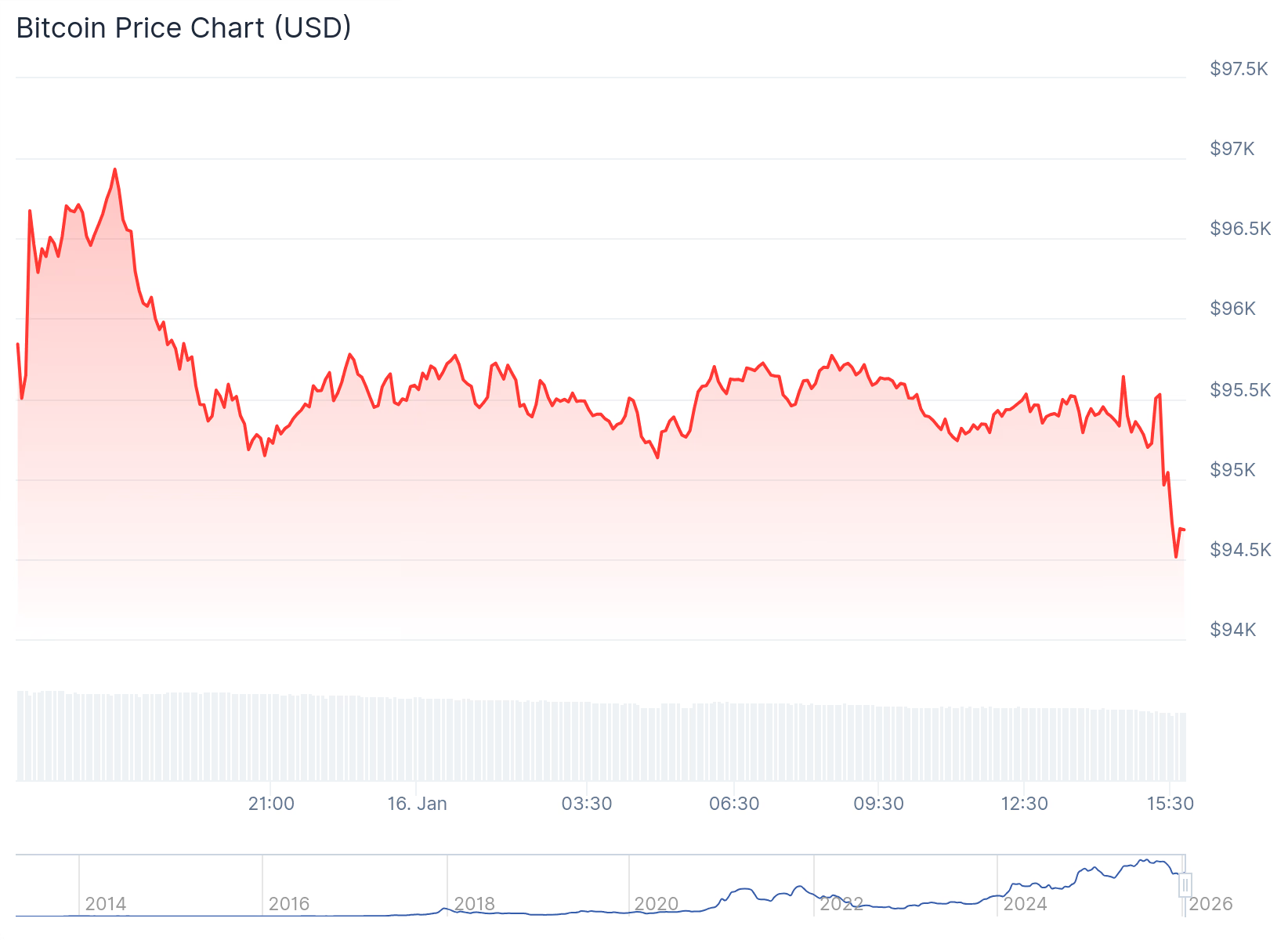
Crypto markets are mostly lower today as momentum fades and analysts flag a key range for Bitcoin.
Crypto markets pulled back slightly on Friday morning, Jan. 16, giving up some recent gains after a short-lived rally earlier this week.
As of press time, Bitcoin (BTC) was trading around $94,700, down about 1.2% on the day, after reaching over $96,900 in the past 24 hours. Despite the downturn, BTC is still up over 4% on the week, rising out of the holiday doldrums.
Total crypto market capitalization fell to roughly $3.3 trillion, slipping 1.7% on the day.

All of the top-10 cryptocurrencies by market capitalization were slightly lower on the day, with Dogecoin (DOGE) losing the most in 24 hours, down 4%.
Ethereum (ETH) is down 1.8% today, but still posting weekly gains of 5.5%, trading above $3,365 at press time.
BTC at Key Inflection Point
In a post on X today, glassnode analyst Chris Beamish said Bitcoin is nearing a “key inflexion point,” adding that the BTC price reclaiming the short-term holder cost basis “would signal that recent buyers are back in profit, typically a prerequisite for momentum to re-accelerate. “

At the same time, in another X post glassnode analysts pointed to growing activity on Ethereum, saying a sharp rise in month-over-month retention among new users is signaling a “wave of first-time wallets interacting with the network rather than activity driven only by existing participants.”
Mike Marshall, head of research at blockchain analytics firm Amberdata, said several signals still look constructive beneath the surface.
“Bitcoin’s price movement appears driven by a convergence of on-chain and market-structure signals,” Marshall said in commentary shared with The Defiant.
Marshall also pointed to recent stablecoin minting, signs that ETF outflows are slowing, and derivatives markets showing accumulation, while warning that “portfolio rotations and broader macro uncertainty could introduce volatility” later in Q1.
Big Movers and Liquidations
Looking at the top-100 assets by market cap, privacy-focused cryptocurrency DASH led gains again, rising about 15% today, following its recent 50% rally. The next biggest gainer today is SKY, which is up roughly 4.8% on the day, according to CoinGecko.
On the downside, POL (ex-MATIC) dropped around 8% after its recent rally, making today’s biggest loser among the top-100 crypto assets.
Liquidations remained relatively muted over the past 24 hours with total crypto liquidations reaching roughly $239 million, per Coinglass data. Long positions made up $181 million, compared with $58 million in short ones.
Bitcoin liquidations totaled about $62.5 million, followed by Ethereum at roughly $38 million, with another $31 million across altcoins.
ETFs and Macro Conditions
On Thursday, Jan. 15, spot Bitcoin ETFs recorded net inflows of $100.2 million, bringing cumulative inflows to $58.2 billion, per data from SoSoValue.
Meanwhile, spot Ethereum ETFs continued to see stronger demand, posting $164.4 million in net inflows on the day, while total net assets across spot Ethereum ETFs climbed to about $20.4 billion.
On the macro side, U.S. Treasury yields were mixed, with the 10-year around 4.18% and the 30-year near 4.8%, as markets stayed on edge over geopolitical concerns, including U.S. President Donald Trump’s renewed push to take control of Greenland, per CNBC.
According to the U.S. Labor Department’s Bureau of Labor Statistics, import prices rose 0.4% between September and November, even as imported fuel prices fell 2.5% over the same period.
In terms of geopolitical moves, traders were also eyeing Canada’s deepening ties with China. Prime Minister Mark Carney said today that Canada is moving toward a “new strategic partnership” with Beijing, signaling a break from the U.S. on tariffs amid what he described as a shifting global order, Bloomberg reports.
“I’m extremely pleased that we are moving ahead with our new strategic partnership,” Carney said during meetings with China President Xi Jinping, framing the move as preparation for what he called a “new world order.”


TLDR:
- Russia’s monthly oil revenue doubled to $24 billion as Brent crude surpassed $100 per barrel.
- Ukraine’s drone strikes have taken roughly 40 percent of Russian export refining capacity offline.
- Iran’s attack on Ras Laffan removed 17 percent of global LNG and 33 percent of helium supply.
- Western sanctions capped Russian oil at $60 per barrel, but the dual-war supply shock made it void.
Russia’s oil revenue has surged sharply as two concurrent conflicts disrupt global energy supply chains. Ukrainian drone strikes have degraded roughly 40 percent of Russian export refining capacity in recent weeks.
At the same time, Iran’s strikes on Gulf infrastructure pushed Brent crude above $100 per barrel. Russia’s Foreign Minister Lavrov and President Putin have both publicly forecast oil reaching $150 per barrel. Russia appears financially positioned to benefit from both conflicts running simultaneously.
Russia Benefits as Iran’s Gulf Strikes Push Oil Above $100
Russia supplied Shahed drone technology and design upgrades to Iran’s Islamic Revolutionary Guard Corps over recent years. Those drones, combined with Chinese BeiDou-guided ballistic missiles, struck the Ras Laffan complex in Qatar.
The attack removed 17 percent of global LNG export capacity and 33 percent of global helium supply. The energy shock from those strikes quickly pushed Brent crude above $100 per barrel.
Russia’s monthly oil revenue consequently doubled to $24 billion as crude prices climbed. The Western sanctions price cap of $60 per barrel has since become functionally irrelevant at current market levels.
Sanctions were designed to target Russian oil pricing, but both conflicts have instead targeted global supply directly. Supply disruptions have overpowered the sanctions framework that was originally built to limit Russian earnings.
On March 27, Lavrov publicly warned of what he called “the most severe energy crisis in human history.” Putin followed by openly forecasting oil at $150 per barrel shortly after.
Both leaders are stating a price target that enriches Russia with every dollar crude rises above current levels. Social media analyst Shanaka Anslem Perera described it as a self-amplifying feedback loop that continuously benefits Russia.
Perera wrote: “Russia arms Iran. Iran closes Hormuz. Hormuz closure spikes oil. Oil spike enriches Russia.” He further noted that Russia needs neither Hormuz reopened nor its own refineries fully operational.
Russia needs both disruptions to persist so their combined effect drives oil toward $150. The compound supply shock, as a result, overwhelms a sanctions architecture never designed for this dual-war scenario.
Ukraine Retaliates Against Russian Refineries and Builds New Alliances
Ukraine struck the Tuapse refinery complex, one of Russia’s largest, setting it ablaze with precision drones. Combined with weather damage and maintenance backlogs, approximately 40 percent of Russian export refining capacity is now offline.
Each barrel of Russian refined product removed from markets tightens global supply further. Every tightening, in turn, pushes oil closer to the $150 target Russia has publicly forecast.
That same week, Ukrainian President Zelensky traveled to Saudi Arabia for high-level diplomatic engagements. Ukraine offered its battle-tested anti-drone expertise to protect Gulf LNG and helium infrastructure directly.
Ukrainian technology has already proven effective against the same Shahed variants Iran deploys in the broader region. This opened an unexpected military technology export market for Ukraine among the world’s wealthiest nations.
The OECD revised US inflation projections upward to 4.2 percent, directly linking the change to the Iran-driven energy shock. BlackRock CEO Larry Fink stated publicly that $150 oil would likely trigger a global recession.
Ukraine’s strikes on Russian refineries and Iran’s pressure on Gulf supplies are tightening markets from opposite directions.
Russia, however, continues collecting elevated revenue from price premiums generated by both disruptions running at once.
Perera closed his widely shared analysis with a sharp observation: “Two wars. One price. One beneficiary. The arsonist is selling fire insurance.”
The feedback loop connecting both conflicts shows no sign of breaking under current conditions. Russia’s oil earnings continue to grow beyond what any sanctions cap was structured to contain.
As long as both wars persist, Russia’s financial position remains stronger than at any prior point since invading Ukraine.

TLDR:
- Dogecoin is printing a consistent accumulation-markup-pullback cycle near $0.09, signaling structured price behavior.
- Analysts note shallow pullbacks and tight consolidation zones that point to underlying demand supporting DOGE price.
- A long-term MACD crossover is forming on macro timeframes, a signal that has historically preceded DOGE rallies.
- The $0.05 support level remains critical, as a hold with MACD confirmation could trigger a broader bullish reversal.
Dogecoin is once again following a recurring cycle pattern that analysts say could fuel fresh rally expectations. The token has been trading near $0.09, where chart structures show a consistent sequence of accumulation, markup, and pullback phases.
Adding to the outlook, a long-term MACD signal is now forming on macro timeframes. These two developments are drawing close attention from traders watching for the next directional move in DOGE.
Recurring Accumulation Cycle Points to Potential Markup Phase
Dogecoin has been printing a recognizable cycle structure that technical analysts describe as methodical. Crypto analyst Bitcoinsensus recently outlined the pattern, noting three repeating phases: accumulation, markup, and pullback. The consistency of this structure across multiple cycles is what separates it from typical sideways price action.
Each accumulation phase begins with a contraction in volatility. Price trades within a tight range as buyers absorb available supply at lower levels. This compression phase tends to persist until a liquidity event triggers the next move upward.
The markup phase that follows is typically sharp and measured. Bitcoinsensus noted that these moves often begin with stop hunts, clearing out weak hands before price advances. Rather than forming a sustained trend, these bursts reflect structured participation, likely algorithmic in nature.
After each markup, Dogecoin enters a shallow pullback that respects prior breakout zones. These retracements hold above key support areas, reinforcing the presence of underlying demand. If the current consolidation near $0.09 maintains this structure, the next markup phase could be forming.
MACD Signal on Macro Chart Strengthens Rally Expectations
Beyond the micro-cycle structure, a broader technical signal is now building on Dogecoin’s macro chart. Crypto Logic Lab flagged a developing MACD crossover forming on longer-term timeframes, not the daily, but higher macro charts. This type of signal has historically preceded sustained rallies in DOGE.
Bears are currently targeting the $0.05 level as a key zone to test before the crossover confirms. The strategy involves pushing price lower to shake out long positions and trigger stop losses. Both sides of the market are watching this level, making it the central battleground for this cycle.
Crypto Logic Lab noted that the MACD signal is forming ahead of any price breakout, which represents the optimal positioning window.
A hold at $0.05 combined with MACD confirmation would strengthen the case for a reversal and a broader rally. A breakdown below that level, however, would cancel the bullish setup entirely.
The convergence of the recurring cycle pattern and the developing macro MACD signal gives rally expectations a stronger technical foundation.
Traders are watching for a breakout above the recent local high as confirmation. Until then, the $0.05 support zone remains the critical level to monitor for directional clarity.

The crypto market is buzzing again, are you watching closely or missing out? With Bitcoin showing renewed strength and Solana gaining momentum from recent ecosystem growth, investors are actively hunting for the best altcoins to invest before the next breakout wave hits.
While Bitcoin holds dominance and Solana continues scaling with faster transactions, a new contender is quietly building explosive potential. Enter APEMARS ($APRZ), currently in presale and already generating serious buzz. As major coins make headlines, smart investors are positioning early in projects like APEMARS that could deliver life-changing returns before hitting exchanges.
APEMARS: The Best Altcoins To Invest Before The Next Surge
If you’re searching for the best altcoins to invest, timing is everything, and APEMARS is right at that sweet spot. Still in presale, it offers a rare early-entry opportunity that most investors only wish they had with projects like Solana or even Bitcoin in their early days.
APEMARS is currently in Stage 14 (Drift King) of its presale, priced at $0.00017238, with a projected listing price of $0.0055. That’s a massive 3,090% ROI potential from this stage alone. With over 1,505 holders, $345K+ raised, and 22.84 billion tokens sold, the momentum is undeniable. The numbers aren’t just stats, they signal growing demand and shrinking opportunity.
Staking System Powering Long-Term Growth
One of the strongest features of APEMARS is its staking system, known as the APE Yield Station. Offering an impressive 63% APY, it allows investors to grow their holdings passively. Inspired by Mars’ extreme conditions, this mechanism isn’t just creative, it’s strategic. With a mandatory 2-month lock post-launch, it helps stabilize early trading and reduces sell pressure, giving the project a stronger foundation right out of the gate.
Orbital Boost Referral System Driving Viral Expansion
APEMARS also introduces a powerful referral system called the Orbital Boost System. Once you contribute at least $22, you unlock the ability to earn 9.34% rewards for both you and your referrals. This creates a community-driven growth engine where users are incentivized to spread the word, fueling organic expansion and increasing demand as the presale progresses.
How To Buy APEMARS
Getting started with APEMARS is simple:
- Visit the official presale platform
- Connect your crypto wallet (like MetaMask)
- Choose your investment amount
- Confirm the transaction
- Secure your tokens before the next stage price increase
Turn $2,000 Into A Massive Win: APEMARS ROI Breakdown
Let’s talk real numbers, because this is where things get exciting.
If you invest $2,000 today at Stage 14 price ($0.00017238), you’ll receive approximately 11.6 million tokens.
- At launch price ($0.0055): Your $2,000 becomes approximately $63,800
- If APEMARS reaches $1: Your investment skyrockets to $11.6 million
- At $5: You’re looking at a jaw-dropping $58 million+
This is why early investors hunt presales. While others chase trends, you position yourself before the wave hits. If you’ve ever regretted missing early Bitcoin or Solana, this is your second chance.
Solana Surges With Ecosystem Growth And Institutional Attention
Solana has recently been gaining traction again, fueled by increased developer activity and institutional interest. Faster transaction speeds and lower fees continue to make it a strong competitor in the smart contract space.
With growing adoption in DeFi and NFTs, Solana is proving its resilience after past challenges. Many analysts are optimistic about its future, and it often appears in discussions around Bitcoin price prediction and broader altcoin market movements. However, while Solana offers stability, its explosive growth phase may already be partially priced in.
Bitcoin Holds Strong As Market Confidence Returns
Bitcoin remains the backbone of the crypto market. Recent bullish sentiment, ETF developments, and macroeconomic factors have helped it maintain strong price support.
As always, Bitcoin is seen as a safer long-term hold, especially during uncertain times. But for investors seeking exponential returns rather than steady growth, Bitcoin’s size limits its upside compared to emerging projects. It sets the tone for the market, but smaller caps like APEMARS create the real wealth opportunities.
Conclusion
The search for the best altcoins to invest often leads investors to established names like Bitcoin and Solana, but the biggest gains usually come from getting in early. APEMARS is still in its presale phase, offering a rare opportunity to enter before exchange listings drive prices higher. With strong tokenomics, staking rewards, and viral growth mechanisms, it’s designed for momentum.
If you’re serious about finding the best crypto to buy now, APEMARS stands out as a high-potential contender. Opportunities like this don’t stay open forever. As stages progress and prices rise, early access disappears. Don’t wait until it trends, position yourself now and be part of the journey before the masses arrive.
Using the information curated by best crypto to buy now, this analysis presents an overview of crypto rankings and growth opportunities.
For More Information:
Website: Visit the Official APEMARS Website
Telegram: Join the APEMARS Telegram Channel
Twitter: Follow APEMARS ON X (Formerly Twitter)
Frequently Asked Questions About Best Altcoins To Invest
What Are The Best Altcoins To Invest In 2026?
The best altcoins to invest include emerging presale projects like APEMARS, alongside established coins. Early-stage investments often provide higher ROI potential compared to already matured cryptocurrencies.
Is APEMARS ($APRZ) A Good Investment?
APEMARS ($APRZ) offers strong presale metrics, staking rewards, and referral incentives. Its early entry price and structured growth model make it appealing for high-risk, high-reward investors.
How Does Bitcoin Price Prediction Affect Altcoins?
Bitcoin price prediction often reflects broader market sentiment. When XRP and major altcoins rise, it signals bullish momentum that can positively impact smaller projects like APEMARS.
Can APEMARS Compete With Solana And Bitcoin?
While Solana and Bitcoin are established, APEMARS has higher growth potential due to its early stage. It targets exponential returns rather than stability.
When Is The Best Time To Buy APEMARS?
The best time is during presale stages like Stage 14, where prices are still low. Early participation increases potential ROI before exchange listings.
Disclaimer: This is a Press Release provided by a third party who is responsible for the content. Please conduct your own research before taking any action based on the content.

Crypto gambling has grown steadily over the past few years, and 2026 has brought more competition to the space than ever. Stake.com remains one of the biggest names in the industry, but it is no longer the only platform drawing serious attention. ZunaBet entered the market this year and has quickly become a talking point among crypto gamblers. This comparison looks at both platforms across bonuses, game selection, loyalty rewards, and overall value.
What Stake.com Brings to the Table
Stake.com has been around since 2017. It operates under a Curaçao license and has grown into one of the most visited crypto gambling sites in the world. The platform covers both casino games and sports betting, with support for Bitcoin, Ethereum, Litecoin, Dogecoin, and several other cryptocurrencies.
A big part of Stake’s identity is its library of original games. Titles like Plinko, Crash, Mines, and Dice are provably fair and have developed a loyal following. Outside of originals, Stake carries slots and live dealer tables from well-known providers including Pragmatic Play, Hacksaw Gaming, and Evolution.

The sportsbook side covers major leagues and sports globally, including football, basketball, tennis, MMA, and a solid esports section. Stake has earned a reputation for sharp odds and a straightforward betting experience.
Where Stake stands apart from most competitors is its approach to bonuses. There is no welcome bonus. No deposit match, no free spins for signing up. Instead, Stake operates an invite-only VIP program where rewards are unlocked based on wagering volume over time. Benefits at higher tiers include rakeback, weekly and monthly bonuses, and tailored offers. This setup favors players who are already planning to bet frequently and in larger amounts.
What ZunaBet Offers as a Newcomer
ZunaBet went live in 2026 under the ownership of Strathvale Group Ltd. It holds an Anjouan gaming license and was built by a team with more than 20 years of combined experience in online gambling. The platform was designed from the ground up as crypto-first, meaning crypto is the primary way to deposit and withdraw rather than a secondary option bolted onto a fiat system.

The game library is hard to ignore. ZunaBet lists over 11,000 games from 63 different providers. That roster includes Pragmatic Play, Hacksaw Gaming, Yggdrasil, BGaming, and Evolution, covering slots, table games, and live dealer options. With 60+ providers feeding into one platform, the variety is among the widest available in the crypto casino market right now.
Sports betting is fully integrated. The sportsbook covers football, basketball, tennis, NHL, and combat sports, along with esports markets for CS2, Dota 2, League of Legends, and Valorant. Virtual sports are included too. Everything sits under one account, so switching between casino and sports is seamless.
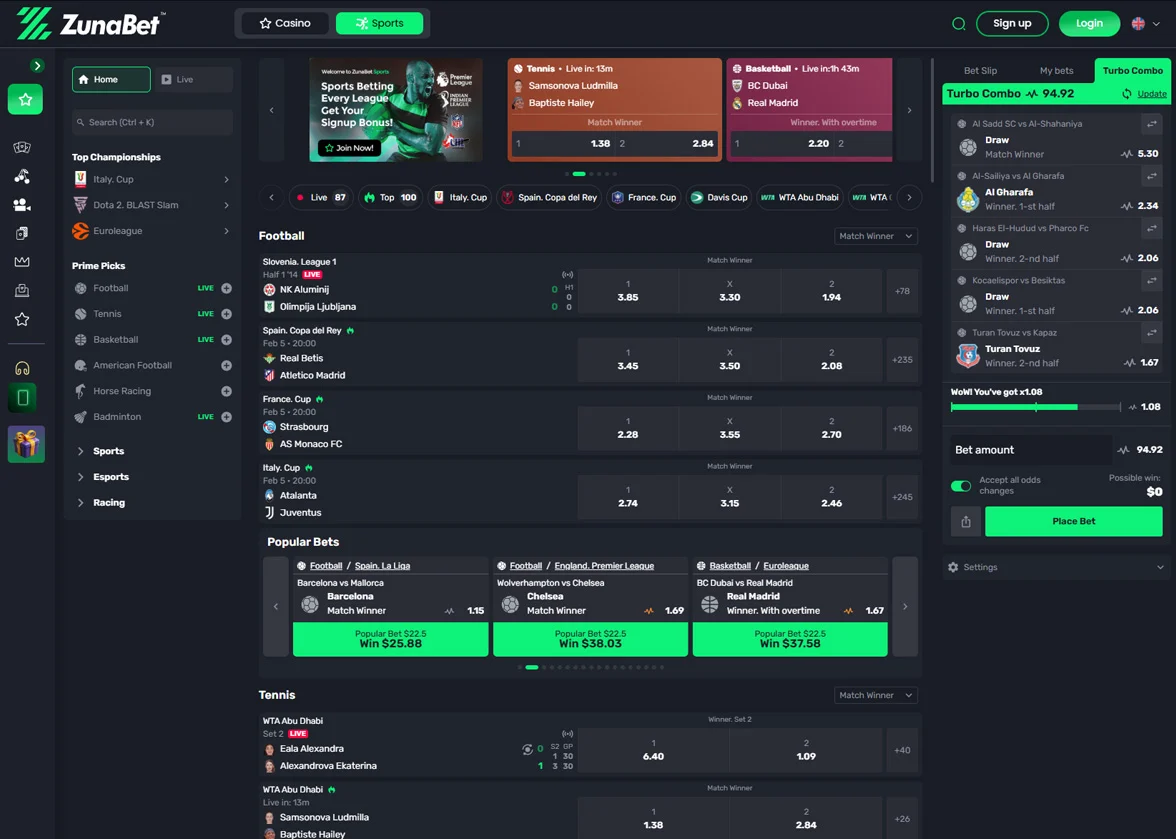
ZunaBet supports more than 20 cryptocurrencies. The list includes BTC, ETH, USDT on multiple chains, SOL, DOGE, ADA, XRP, and others. The platform charges no processing fees on its end, and withdrawals are built to process quickly. Apps are available for iOS, Android, Windows, and MacOS, and live chat support runs around the clock.
Welcome Bonus: A Clear Split
The most obvious difference between these two platforms is what happens when you first sign up.
Stake gives you nothing upfront. There is no deposit match and no free spins. You start playing, and if you wager enough over time, you may eventually get invited into the VIP program. That works for a certain type of player, but it asks for commitment before giving anything back.
ZunaBet goes in the other direction with a welcome package worth up to $5,000 plus 75 free spins. It breaks down like this: the first deposit is matched at 100% up to $2,000 with 25 free spins, the second deposit is matched at 50% up to $1,500 with 25 spins, and the third deposit is matched at 100% up to $1,500 with another 25 spins. Spreading the bonus across three deposits keeps players coming back rather than dumping everything into one session.
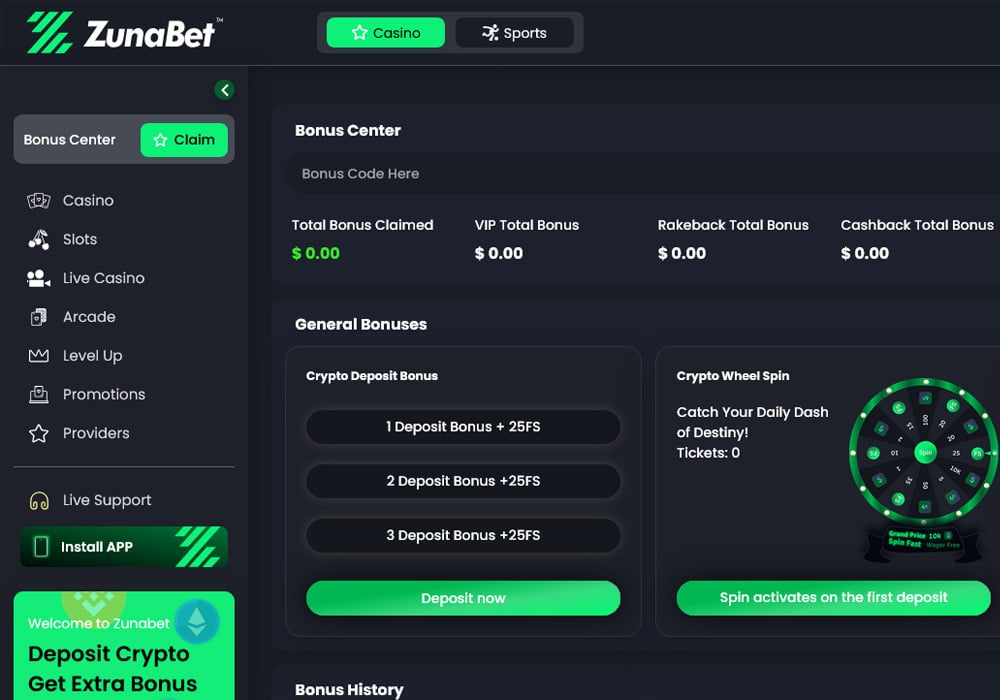
For anyone who wants value from day one, ZunaBet has the clear edge here. A $5,000 bonus ceiling gives players real room to explore the library and sportsbook with extra funds backing them up.
Loyalty Rewards: Open vs Invite-Only
Stake runs a closed VIP system. Players are invited based on their activity, and the exact thresholds are not publicly listed. Once you are in, the rewards — rakeback, reload bonuses, and personalized offers — can be significant. But if you are a casual or mid-level player, you may never see the inside of that program.
ZunaBet handles loyalty differently. Its system is themed around dragon evolution and has six named tiers: Squire, Warden, Champion, Divine, Knight, and Ultimate. Rakeback starts at 1% at the lowest level and climbs to 20% at the top. Other perks include up to 1,000 free spins depending on tier, VIP club access, double wheel spins, and a gamified experience built around a dragon mascot called Zuno.
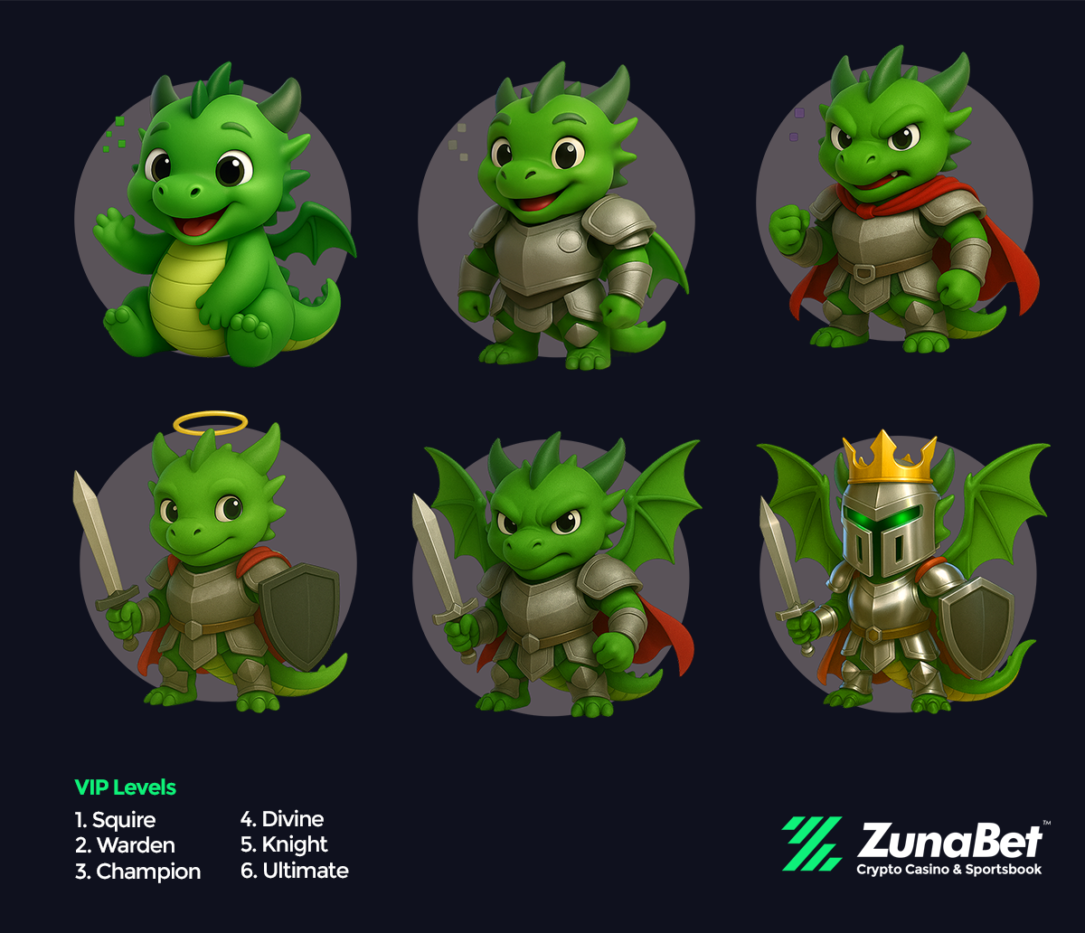
The important distinction is that ZunaBet’s system is transparent and open to everyone from the start. You can see the tiers, see the rewards, and track your own progress. There is no guessing about whether you qualify or waiting for an invitation that may not come. For most players, that openness is more motivating than a mystery system operating behind the scenes.
The Crypto Advantage Over Traditional Operators
Both Stake and ZunaBet sit firmly in the crypto camp, which already separates them from traditional operators like DraftKings, BetMGM, FanDuel, and Caesars. Those platforms were built around bank transfers, credit cards, and regulated fiat currencies. Withdrawals can take days. Fees add up. Payment options are limited by region.
Crypto platforms skip most of that. Transactions are faster, fees are lower, and players have more control over their funds. ZunaBet pushes this further with support for 20+ coins and zero platform processing fees. For players who already live in the crypto world, this is how they expect a gambling platform to work.
Traditional platforms still hold advantages in terms of regulatory trust and brand recognition in markets like the US and UK. But for players outside those tightly regulated markets, or for anyone who simply prefers crypto, platforms like Stake and ZunaBet are the more practical choice.
Where Things Stand
Stake.com has years of trust built up. It has a massive user base, a recognizable brand, and a VIP system that delivers real value to its most active players. If you already know you are going to wager heavily and consistently, Stake rewards that over time.
ZunaBet is making a pitch to everyone else — and doing it well. A generous welcome bonus, a game library with over 11,000 titles, broad crypto support, and a loyalty program that does not hide behind an invite wall add up to a compelling package. It feels built for the current moment, designed for players who grew up with crypto and expect their gambling platform to reflect that.
Stake set the standard for crypto casinos. ZunaBet is showing what the next version of that standard could look like — more games, better upfront value, and a rewards system that treats every player like they matter from the first deposit. For anyone shopping for a new platform in 2026, ZunaBet is the one generating the most buzz right now.
Disclaimer: This is a Press Release provided by a third party who is responsible for the content. Please conduct your own research before taking any action based on the content.
TLDR:
- Ethereum secures 61.4% of tokenized assets, reaching $206.2 billion in total market value globally.
- Tokenized asset market cap on Ethereum has grown over 40% year over year.
- Institutional voices point to blockchain adoption across equities, bonds, and real estate markets.
- Market data shows Ethereum leading infrastructure for tokenization and stablecoin settlement.
Ethereum accounts for 61.4% of all tokenized assets, totaling $206.2 billion in value. Data from Token Terminal shows steady expansion, with the network’s tokenized asset market cap rising more than 40% year over year.
Ethereum’s Expanding Role in Tokenized Markets
Recent data shared by Coin Bureau on X places Ethereum at the center of tokenized asset activity. The post notes that over $206.2 billion worth of assets currently settle on the network. This figure represents more than half of the global tokenized asset market.
The growth rate also stands out. Token Terminal data shows a year-over-year increase exceeding 40%. This trend reflects rising adoption across financial applications using blockchain infrastructure. As a result, Ethereum continues to lead in both scale and activity within this segment.
The data arrives during a period of steady development within the Ethereum ecosystem. Market participants have observed increased focus on practical use cases rather than long-term theoretical upgrades. This shift appears to align with the broader expansion in tokenized asset value recorded over the past year.
At the same time, tokenization continues to gain attention across financial sectors. Market data suggests that institutions are exploring blockchain systems to represent traditional assets digitally. Ethereum remains a primary platform for these activities due to its established infrastructure.
Market Voices Point to Growing Tokenization Demand
Comments shared by Etherealize on X feature insights from Bitwise CIO Matt Hougan. He describes Ethereum as a leading network for both stablecoins and tokenized assets. According to Hougan, recent developments show a stronger focus on market-driven outcomes.
He also points to broader financial trends supporting tokenization. Statements referenced include views from regulators and asset managers who expect blockchain-based systems to expand. These perspectives reflect growing institutional attention toward tokenized markets.
Hougan compares the current stage of tokenization to early skepticism around exchange-traded funds. He notes similarities in adoption patterns, where gradual acceptance leads to wider use over time. The comparison suggests a familiar path of market development within financial innovation.
The discussion also touches on the scale of traditional markets. Equities, bonds, and real estate collectively represent large asset classes.
Tokenization offers a method to represent these assets on blockchain networks. Ethereum’s current share positions it as a key infrastructure layer for this transition.
Meanwhile, the network’s 61.4% share indicates continued concentration of activity. As tokenized markets expand, Ethereum remains closely tied to this growth.
Data from Token Terminal provides a snapshot of current positioning, while market commentary reflects ongoing developments across the sector.
Iran’s Parliament Speaker Mohammad Bagher Ghalibaf posted what amounted to trading advice on X (Twitter), calling Trump’s pre-market announcements a “reverse indicator” and urging followers to take the opposite side of every energy move.
The post added a surreal layer to a week that saw Wall Street’s most popular dip-buying strategy collapse under the weight of real geopolitical risk.
The TACO Trade Hits a Wall
The Trump Always Chickens Out (TACO) trade defined market behavior for much of 2025. Traders bought every Trump-induced dip, expecting a reversal within days. That playbook worked reliably during tariff standoffs with China, Canada, and the EU.
However, it broke down last week. Trump extended his deadline to strike Iranian energy infrastructure from March 27 to April 6. The expected relief rally never came.
Barclays strategist Emmanuel Cau noted that repeated flip-flopping was undermining market confidence. Investors stopped treating delays as a path to peace. They began seeing them as tactical pauses before further escalation.
The Atlanta Fed’s GDPNow tracker slashed Q1 growth estimates to 2%, down from 3.1% just a month earlier.
Meanwhile, CME FedWatch data shows markets pricing in rates holding steady through late 2026, with only a modest probability of any move.
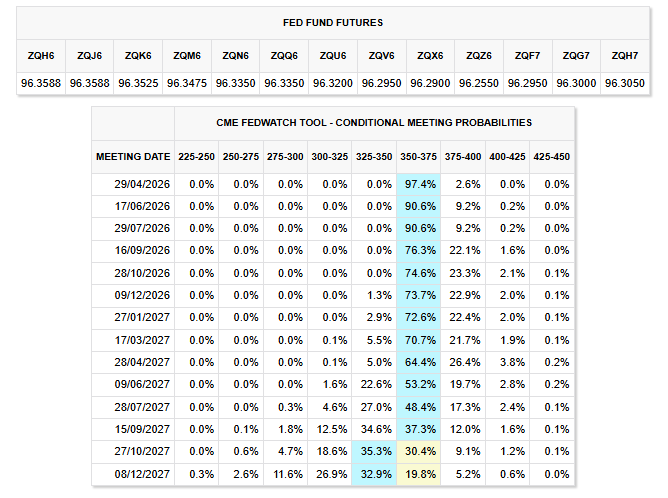
This represents a far cry from the multiple rate cuts investors expected at the start of the year.
Ghalibaf and the Bond Market Warning
Ghalibaf, a former Islamic Revolutionary Guard Corps (IRGC) commander who has emerged as Iran’s most visible wartime political figure, went beyond denying U.S. talks.
He told followers that Trump’s pre-market posts serve as profit-taking setups.
“Pre-market so-called ‘news’ or ‘Truth’ is often just a setup for profit-taking. Basically, it’s a reverse indicator. Do the opposite,” wrote Ghalibaf.
Separately, Johns Hopkins economist Steve Hanke said bond vigilantes had turned against Trump due to the combined pressure of the tariff war and the Iran conflict.
The U.S. 10-year Treasury yield has climbed to 4.46%, approaching the 4.5% threshold that forced Trump to pause reciprocal tariffs in April 2025.
Ghalibaf had also warned earlier in the week that financial institutions buying U.S. Treasury bonds were legitimate military targets.
That statement added direct geopolitical risk to the bond market’s existing fiscal concerns.
Why the Old Playbook No Longer Applies
The TACO strategy worked because Trump’s trade counterparties were rational economic actors. China, the EU, and Canada all wanted stability and accepted face-saving compromises.
Iran presents no such dynamic. Its supreme leader was killed in the opening strikes.
Its military infrastructure has been hit repeatedly. Yet Tehran has not moved toward negotiations. Ghalibaf himself accused Washington on Sunday of planning a ground invasion while publicly signaling that talks were underway.
With Brent crude above $110 per barrel and the Strait of Hormuz still effectively closed, the economic damage from the war is already embedded in prices.
Dip-buyers who relied on TACO logic now face a market in which the geopolitical premium is no longer a temporary spike but a structural feature.
The question heading into next week is whether the 10-year yield crossing 4.5% will force the White House to act, as it did during last year’s tariff crisis, or whether a real war proves harder to walk back than a trade dispute.
The post Iran’s Top Power Broker Shares Trading Advice As Trump’s TACO Trade Falters appeared first on BeInCrypto.
TLDR:
- S&P 500 posts fifth weekly loss as RSI drops below 30, signaling oversold market conditions.
- Traders cite past crash patterns showing brief rallies before deeper declines in similar setups.
- Iran conflict raises oil disruption fears, adding pressure to already weakening market sentiment.
- Futures suggest a steady open near 6,400 despite growing bearish calls across trading circles.
The S&P 500 ended Friday at 6,368.85 after falling 1.7%, marking its fifth weekly loss in a row. Market signals show growing stress as geopolitical tension and technical indicators combine, leaving traders split on whether a deeper drop or short-term rebound comes next.
Technical Signals Stir Bearish Expectations
Recent market data shows the S&P 500 nearing correction territory after a steady decline over several weeks. The index has now dropped close to 9% from recent highs, raising caution among traders tracking historical patterns.
Relative Strength Index readings have fallen below 30, placing the market in oversold territory. Such levels previously appeared during major downturns, including the 2008 financial crisis and the 2020 pandemic-driven selloff. These comparisons have increased concern among market participants watching for similar price behavior.
Traders have intensified the bearish narrative. A widely shared message from Rekt Fencer warned of an imminent crash, urging traders to exit positions quickly. Another account, Midas, echoed a similar sentiment, reinforcing fears of a sharp decline.
Meanwhile, Ted Pillows outlined historical cycles where initial declines were followed by short rallies before deeper drops.
According to his analysis, past crashes in 2008 and 2020 followed this pattern, with brief recoveries preceding larger sell-offs.
He noted that the current market has already declined about 9%, with potential for a temporary bounce before another leg down.
These views have gained traction as traders compare current price action to earlier downturn structures. However, not all participants agree with the bearish outlook, creating a divided market environment.
Geopolitical Tension and Market Uncertainty
The ongoing two-month conflict involving the United States and Iran has added pressure to financial markets. Concerns about potential oil supply disruptions continue to influence sentiment, especially as energy prices remain sensitive to geopolitical developments.
Rising oil prices could contribute to inflation concerns, which may affect monetary policy expectations. Investors are closely monitoring how these external factors interact with existing market weakness. As a result, volatility has increased across major indices.
Despite the negative sentiment, some analysts point to the oversold condition as a possible setup for a short-term rebound.
Historically, markets often experience relief rallies after extended declines, especially when technical indicators reach extreme levels.
S&P 500 futures suggest a relatively stable open near 6,400, indicating that immediate panic selling may not materialize. This has led some traders to expect a temporary recovery before any further downside movement.
At the same time, uncertainty remains elevated as market participants weigh technical signals against geopolitical risks. With both bearish and neutral expectations in play, trading activity continues to reflect caution rather than consensus.
TLDR:
- Ripple rebranded GTreasury as Ripple Treasury, connecting 13,000 banks and 1,000+ corporate clients globally.
- The platform processes $12.5 trillion annually, with zero percent currently settled through crypto rails.
- A 1% migration of payment volume to XRPL would generate $125 billion in new on-chain annual volume.
- With 769M XRP locked in ETFs and rising utility demand, supply tightening may reshape XRP market dynamics.
Ripple’s acquisition of GTreasury, rebranded as Ripple Treasury, positions XRP at the center of a massive corporate payment shift.
The platform connects 13,000 banks and serves over 1,000 corporate clients, including Volvo, Subway, and Stihl. Together, these clients process $12.5 trillion in annual payments.
Currently, none of that volume moves through crypto. Ripple CEO Brad Garlinghouse has identified this gap as the company’s core opportunity going forward.
Ripple Treasury Targets Corporate Finance With Full-Stack Blockchain Integration
The Ripple Treasury platform covers the full scope of corporate treasury operations. It handles payments, cash forecasting, netting, reconciliation, risk management, liquidity, and regulatory reporting.
Corporations using it do not need to learn blockchain technology at all. The system works exactly like traditional treasury software on the surface.
ClearConnect bridges the platform to banks and ERP systems on one side. Ripple’s blockchain stack sits on the other, covering wallet, custody, payments, prime, and compliance functions.
The settlement layer shifts from correspondent banking to the XRP Ledger quietly. Users experience no change in workflow, while speed and cost change significantly.
X Finance Bull noted on X that the gap between price and infrastructure has never been wider. The post pointed out that $12.5 trillion in annual volume currently sits at 0% crypto penetration.
That volume is now directly connected to Ripple’s payment rails. The migration pathway is already in place through the platform’s architecture.
The transition does not require corporate clients to adopt new interfaces or change existing workflows. Instead, the settlement layer underneath gradually shifts to XRPL.
This approach lowers adoption friction for large enterprises considerably. It also makes XRP’s role in the process nearly invisible to end users.
Supply Tightening and Volume Growth Could Reshape XRP Market Dynamics
On the investment side, 769 million XRP is currently locked in exchange-traded funds. Seven funds hold a combined $1.1 billion in assets under management.
This reduces the circulating supply available on open markets. Tighter supply alongside growing utility tends to affect price over time.
Even a 1% migration of the $12.5 trillion pipeline to XRPL would add $125 billion in annual volume. That level of on-chain activity would be unprecedented for the XRP network.
Liquidity depth, transaction demand, and market interest would all respond to that scale. The network effects from such a shift would be substantial.
XRP is currently trading at $1.31, while the infrastructure supporting it continues to expand. The contrast between that price and the scale of Ripple’s enterprise buildout is drawing attention from analysts.
More institutional volume flowing through XRPL could alter how the market values the asset. The platform is now positioned to test that thesis directly.
BlackRock raised CEO Larry Fink’s total compensation to $37.7 million for 2025, a roughly 23% jump from the prior year, as its Bitcoin ETF quietly became one of the firm’s top revenue generators.
A proxy filing showed the pay package included a $1.5 million base salary, a $10.6 million cash bonus, and roughly $24.6 million in stock awards. The stock component accounted for most of the increase, rising by about $6.5 million from 2024.
Bitcoin ETF Revenue Surged in 2025
The iShares Bitcoin Trust ETF (IBIT) became a significant earnings driver during the year. BlackRock’s filings show the fund collected approximately $174.6 million in net sponsor fees for 2025, up from $47.5 million during its 2024 launch year. The iShares Ethereum Trust ETF (ETHA) added another $18.4 million.
Combined, both crypto products generated roughly $193 million in fees. While that remains a fraction of BlackRock’s total 2025 revenue of $24.2 billion, it marked one of the fastest-growing product lines in the firm’s history.
IBIT surpassed $100 billion in assets during the year, making it one of the fastest ETFs ever to reach that level.
Fink has publicly stated that digital assets could become a $500 million annual revenue source for the firm within five years.
“Private markets for insurance, private markets for wealth, digital assets, and active ETFs. We believe all of these could become $500 million revenue sources over the next five years,” he wrote in a recent note.
Record AUM Drove the Bigger Picture
Bitcoin (BTC) alone did not account for the full pay increase. BlackRock ended 2025 with a record $14 trillion in assets under management, fueled by $698 billion in full-year net inflows.
The firm beat Wall Street profit estimates in Q4, posting $2.18 billion in net income excluding one-time charges.
The compensation committee weighed overall financial performance, strategic execution, and business growth when setting the award.
Private markets expansion, active ETFs, and technology platforms also factored heavily alongside the crypto business.
However, not all shareholders were convinced. Proxy adviser Institutional Shareholder Services had recommended voting against the executive pay packages.
BlackRock said it received 67% of votes cast in support of its compensation program.
History Shows Pay Can Swing Sharply
Fink’s compensation has moved in both directions before. BlackRock cut his total pay 30% to $25.2 million for 2022, when rising interest rates and market turmoil pushed the firm’s AUM down 14%. His pay fell again, roughly 18% in 2023.
That precedent suggests a sustained downturn in crypto prices or broader markets could pressure future awards.
Still, with digital assets now woven into BlackRock’s long-term strategy, Bitcoin’s role in the CEO’s compensation story is likely here to stay.
The post How Bitcoin Fueled Larry Fink’s Biggest Payday as BlackRock CEO appeared first on BeInCrypto.
TLDR:
- Coinbase risks losing $1.35B in annual revenue if the CLARITY Act’s passive yield ban passes as written.
- White House Crypto Adviser Patrick Witt warned Coinbase to stop blocking the bill or face losing the deal entirely.
- JPMorgan’s Dimon publicly clashed with Coinbase’s Armstrong at Davos 2026 over the CLARITY Act’s stablecoin terms.
- Coinbase charges a 35% commission on staking rewards, making yield protections central to its entire business model.
The CLARITY Act is at the center of a heated debate between Coinbase and U.S. lawmakers. As the Senate Banking Committee prepares to release the full draft of the Digital Asset Market Clarity Act of 2025, Coinbase has raised “significant concerns” about stablecoin yield provisions.
Critics argue the exchange is stalling the largest crypto legislation in U.S. history. Supporters say Coinbase is protecting both its business and the broader crypto ecosystem.
Coinbase’s Revenue at Risk as Yield Ban Looms
The latest Senate draft includes a provision that bans “passive yield” on stablecoin balances. This means platforms cannot pay users simply for holding stablecoins. Only narrow, activity-based rewards may survive under the current language.
The financial stakes for Coinbase are substantial. The exchange and its partner Circle earned roughly $2.75 billion gross in 2025 from interest on U.S. Treasuries backing USDC. Circle retains the gross earnings but forwards over 60% to Coinbase.
Coinbase pockets all on-platform rewards and around 50% from other sources. This adds up to an estimated $1.35 billion, representing nearly 19% of its total 2025 revenue. A ban on passive yield could eliminate that income almost entirely.
Coinbase Chief Legal Officer Paul Grewal made the company’s position clear. “My memory is a little better than to trust future rogue regulators to faithfully apply the law,” Grewal said. His concern centers on vague bill language that future regulators could later use against the industry.
The exchange is now drafting a counterproposal. It aims to preserve sustainable rewards programs while still supporting most of the CLARITY Act’s other provisions, including DeFi rules and SEC/CFTC jurisdiction clarity.
White House Issues Warning as Political Window Narrows
White House Crypto Adviser Patrick Witt issued a direct warning to Coinbase over its position on the bill. Witt did not mince words, stating plainly: “BLOCK IT… AND SEE WHAT HAPPENS.”
He used a football analogy, comparing Coinbase to a quarterback holding the ball too long while the pocket collapses.
His message was straightforward: pass the best deal available now or risk losing everything. The administration has made clear it wants crypto legislation finalized during this favorable window. Delay, in their view, could result in a far less friendly regulatory environment later.
The tension between Coinbase and Washington became public earlier at Davos in January 2026. JPMorgan CEO Jamie Dimon confronted Coinbase CEO Brian Armstrong at a private coffee meeting.
Dimon reportedly told Armstrong directly, “You are full of s—,” accusing the exchange of lying about banks quietly gutting the CLARITY Act.
The irony in that confrontation is hard to miss. In July 2025, JPMorgan and Coinbase announced a major partnership.
Chase customers can now link bank accounts to Coinbase wallets, use credit cards for trades, and transfer reward points into crypto.
The public conflict between both firms, therefore, raises broader questions about how much of the drama is strategic.
Private deals and public disputes often serve different purposes in high-stakes legislative battles. The next draft of the CLARITY Act, expected next week, will reveal how much ground either side has gained.
Russia’s Dual-War Windfall: How Two Conflicts Are Driving Oil Toward $150 Per Barrel

Gary Woodland: US golfer wins Houston Open for first title since brain surgery

Today’s NYT Strands Hints, Answer and Help for March 30 #757


-
 NewsBeat5 days ago
Manchester United reach agreement with Casemiro over contract clause amid transfer speculation
-

 News Videos4 days ago
Parliament publishes latest register of MPs’ financial interests
-

 Sports6 days ago
Gary Kirsten Accuses Pakistan Cricket Board Of ‘Interference’, Mohsin Naqvi Responds
-

 Sports7 days ago
Remo Stars and Kano Pillars Strengthen Survival Hopes in NPFL
-

 NewsBeat2 days ago
The Story hosts event on Durham’s historic registers
-

 News Videos6 days ago
Ch 9 Financial Management Part 1 | Detailed One Shot | Class 12 Business Studies Boards 2026
-

 Business3 days ago
Instagram, YouTube Found Responsible for Teen’s Mental Health Struggle in Historic Ruling
-
 NewsBeat4 days ago
Tesco is selling new Cadbury Dairy Milk bar and people can’t wait to try it
-

 Tech6 days ago
Samsung will soon let you control smart home devices from your car’s dashboard
-
 Entertainment6 days ago
Cynthia Bailey Dishes on ‘RHOA’ Season 17, Discusses Kandi
-

 Sports7 days ago
2026 Kentucky Derby horses, odds, futures, preview, date: Expert who hit 12 Derby-Oaks Doubles enters picks
-
 Entertainment1 day ago
Lana Del Rey Celebrates Her Husband’s 51st Birthday In New Post
-
 NewsBeat6 days ago
Colombian military plane with 110 soldiers onboard crashes following takeoff
-

 Business5 days ago
More women enter wealth management, but few in advisory roles: study
-

 Fashion5 days ago
Does It Matter What You Wear When You’re Laid Off and Looking?
-

 Fashion6 days ago
Fringe Bags for the Season
-

 Business6 days ago
Late-paying firms face multimillion-pound fines under new crackdown
-

 NewsBeat5 days ago
Entrepreneurs Forum survey reveals optimism in North East
-

 Sports5 days ago
Fantasy Baseball Week 1 Preview: Top sleeper hitters for both five- and 12-day period led by Munetaka Murakami
-

 Politics6 days ago
How Media Platforms Balance Performance and Accessibility in Image Delivery
You must be logged in to post a comment Login