
Crypto World
Bitdeer Liquidates All BTC Reserves, Holdings Drop to Zero


Bitdeer Technologies, a prominent Bitcoin mining operator backed by industry figure Jihan Wu, has sharply recalibrated its Bitcoin treasury, reporting a zero balance in its corporate holdings. In the latest weekly operations update, the company disclosed that its “pure holdings,” which exclude client deposits, have fallen to 0 BTC. The period saw the production of 189.8 BTC, all of which were sold, alongside an additional 943.1 BTC liquidated from existing treasury reserves. This marks a notable shift from earlier disclosures, when the treasury still held a substantial balance.
Key takeaways
- Bitdeer reports zero corporate Bitcoin in its treasury, after selling 189.8 BTC produced in the latest period plus 943.1 BTC drawn from reserves.
- A February update showed the treasury at 943.1 BTC, with 179.9 BTC sold from 183.4 BTC mined that week, leaving treasury holdings unchanged at that time.
- The company is pursuing a significant financing move, announcing plans to raise $300 million through a convertible senior note offering, with a possible expansion to $345 million.
- The notes, due in 2032, can be converted into stock, cash, or a mix, and are intended to fund data center expansion, AI cloud growth, mining hardware development, and general corporate needs.
- Meanwhile, Bitdeer is expanding its self-mining capabilities as demand for external mining hardware wanes, reflecting a broader industry shift toward hybrid AI/HPC revenue streams.
Tickers mentioned: $BTC, $MARA
Price impact: Negative. Bitdeer’s plan to raise convertible debt coincided with a sharp share decline, underscoring investor concern over liquidity and funding strategy.
Market context: The sector has been navigating tighter margins post-halving and a growing interest in hybrid models that blend Bitcoin production with AI and high-performance computing revenue streams. The move toward self-mining and AI services mirrors a broader trend as miners reassess balance sheets and diversify revenue sources.
Why it matters
The decision to liquidate the corporate Bitcoin treasury signals a potential pivot in Bitdeer’s capital strategy. By converting a portion of mined proceeds into cash, the company may be prioritizing liquidity to support ongoing operations and debt servicing, even as it seeks to scale data center infrastructure and AI-focused offerings. This shift underscores the tension between treasury exposure to Bitcoin’s price volatility and the need for predictable funding for growth initiatives in a capital-intensive industry.
Concurrently, the $300 million convertible debt offering marks a high-profile move to raise capital that could be immediately deployed to expand Bitdeer’s data center footprint and advance AI cloud capabilities. The convertible feature adds a layer of complexity for investors, as future equity dilution is possible if the notes are converted. The company has framed the financing as a tool to accelerate its expansion plans and hardware development while maintaining flexibility to adapt to market conditions.
Beyond Bitdeer, the mining landscape is undergoing a broader reorientation toward AI and computing services. MARA Holdings recently acquired a majority stake in Exaion, a French computing infrastructure firm, signaling a deeper foray into AI and cloud services. The deal positions the miner as a broader technology infrastructure provider, expanding its footprint beyond traditional hash power. This follows a wider industry pattern where several miners, faced with tighter margins, are pursuing hybrid models that leverage their energy and data-center assets to offer AI-enabled computing capacity.
Observers note that the industry is reconfiguring around demand for AI capacity and energy-efficient compute, rather than venerating hash price alone. Several peers are repurposing facilities for data-center use or pivoting toward AI infrastructure as a way to diversify revenue streams and hedge against mining cycles. The trend is underscored by moves within the ecosystem that include CoreWeave’s established shift toward AI infrastructure and other players repositioning assets to capture AI compute demand. For readers tracking this space, the evolving balance between traditional hashing revenue and AI-enabled services will likely define miners’ strategizing in 2024 and beyond.
The current environment remains nuanced: while Bitcoin mining remains a niche but essential component of the larger crypto economy, the capital-intensive demands of data centers and the strategic importance of AI capabilities push miners to blend their hardware with software services. This dual approach can help stabilize cash flows amid volatility in digital asset prices, energy costs, and regulatory considerations, while offering new avenues for growth in an increasingly digital and compute-driven landscape.
What to watch next
- Bitdeer’s next weekly update to confirm whether the treasury remains at zero and to track any changes in production or sales pace.
- Progress and timing of the $300 million convertible debt offering, including potential expansion and terms of conversion.
- Updates on Bitdeer’s data center expansion plans and the development of AI cloud initiatives tied to mining operations.
- Industry moves by peers, particularly MARA Holdings’ integration of Exaion and how AI/hpc ventures influence miner profitability across the sector.
- Regulatory or energy-cost developments that could impact mining economics and the viability of hybrid business models combining Bitcoin production with AI infrastructure.
Sources & verification
- Bitdeer weekly operational update showing 0 BTC in pure holdings and the 189.8 BTC produced and sold, plus 943.1 BTC liquidated from treasury — https://x.com/BitdeerOfficial/status/2025136775266550191
- Bitdeer Feb. 13 update indicating 943.1 BTC treasury the week prior and 179.9 BTC sold out of 183.4 BTC mined — https://x.com/BitdeerOfficial/status/2022530485876896182
- Cointelegraph report on Bitdeer’s convertible debt offering of $300 million with potential expansion to $345 million — https://cointelegraph.com/news/bitdeer-stock-drops-17-after-convertible-senior-note-offering
- MARA Holdings’ majority stake in Exaion article detailing the AI/data-center expansion angle — https://cointelegraph.com/news/mara-majority-stake-exaion-ai-data-centers-bitcoin-miner
- Related industry shifts toward AI infrastructure in crypto mining, including CoreWeave’s pivot — https://cointelegraph.com/news/crypto-mining-ai-data-centers-coreweave-infrastructure-shift
Bitdeer pivots from treasury to expansion amid AI pivot
Bitcoin (CRYPTO: BTC) has become the focal point of Bitdeer’s latest strategic recalibration, as the company logs a full liquidation of its corporate Bitcoin treasury even as it grows commitments to data centers and AI-enabled compute. In its most recent weekly update, Bitdeer disclosed that its pure holdings, excluding client deposits, dropped to zero BTC. The report shows 189.8 BTC mined during the period, all of which were sold, in addition to 943.1 BTC drained from the treasury reserves. This marks a clear departure from prior reporting where the treasury still contained BTC, albeit with ongoing sales tied to operating costs.
The prior update, issued on Feb. 13, had the treasury at 943.1 BTC, with 179.9 BTC sold from 183.4 BTC mined that week, leaving treasury holdings unchanged after the sale. The shift from treasury exposure to a cash-focused approach is a notable pivot for a company that, like many in the sector, has balanced the need for liquidity with the opportunistic exposure to Bitcoin’s price action. In context, mining firms frequently sell a portion of production to cover electricity and equipment costs, yet fully liquidating a treasury position is less typical and can indicate a more aggressive capital deployment strategy.
Meanwhile, Bitdeer disclosed plans to raise $300 million through a convertible senior note offering, with an option to expand the sale by an additional $45 million. The notes, due in 2032, can be converted into stock, cash or a combination of both. The financing is earmarked to accelerate data center expansion, fuel AI cloud growth, support mining-hardware development, and fulfill general corporate needs. The market reacted to the financing news with a notable drop in Bitdeer’s shares, underscoring investor concerns about debt dilution and the company’s ability to deploy proceeds effectively in a competitive landscape.
Beyond Bitdeer, the broader mining industry is undergoing a reorientation toward AI and high-performance computing. MARA Holdings—another prominent name in the space—announced a majority stake in Exaion, a French computing infrastructure firm, signaling a deeper plunge into AI and cloud services. The deal highlights a strategic shift from pure hash-rate generation to hybrid business lines that leverage existing energy and data-center assets for AI compute capacity. It reflects a broader trend in which miners, faced with the realities of halved block rewards and tighter margins, pursue diversified revenue streams to sustain growth.
Industry coverage also notes that other miners are repurposing facilities and energy infrastructure for data-center use, while some players have fully pivoted to AI infrastructure providers. The exchange between crypto mining and AI data services is increasingly viewed as a way to reconcile revenue volatility with an expanding demand for AI compute capacity. The long‑term outlook for miners may hinge on whether these hybrid models can deliver consistent cash flows, especially as regulatory pressures and energy costs continue to shape the economics of the sector.


TLDR:
- Cambodia’s parliament passed its first cybercrime law on April 3, 2026, targeting online scam centres directly.
- Convictions carry prison terms of up to 10 years and fines reaching $250,000 for gang-related scam operations.
- Cambodia extradited two high-profile figures to China amid a broader crackdown on senior scam network leaders.
- Britain sanctioned Cambodia’s largest fraud complex and a crypto marketplace used to trade stolen personal data.
Cambodia’s cybercrime law marks a turning point in the country’s fight against online fraud operations. The parliament passed the legislation on Friday, April 3, 2026, making it the first law specifically targeting scam centres.
These centres have cost international victims billions of dollars. The move follows growing global pressure on Southeast Asian governments to act against the illicit operations embedded across the region.
Parliament Approves Strict Penalties for Online Scam Operators
The new law sets out prison terms of two to five years for those convicted of online scams. Fines can reach up to $125,000 for individual offenders.
Gang-related scams or cases involving multiple victims carry heavier sentences of up to 10 years. Fines in such cases can go as high as $250,000.
Justice Minister Keut Rith described the law as a tool to strengthen ongoing enforcement efforts. He stated the law aimed to enhance the “cleaning operation” taking place across the country.
He also stressed that it would ensure the centres do not return after the crackdown. The law will proceed to Cambodia’s king for final signature before taking full effect.
Rith further explained the reach of the problem during his remarks to reporters. He said the issue had also affected the economy, tourism, and investment in Cambodia.
He described the law as being “strict like the fishing net, strict to ensure we don’t have the online scams anymore in Cambodia.” Those words captured the government’s stated intent to pursue a thorough and lasting enforcement effort.
The law also covers penalties for money laundering, data collection on victims, and scammer recruitment. Previously, Cambodia had no dedicated legislation for targeting scam operations.
Authorities had relied on charges such as aggravated fraud and recruitment for exploitation. This new legislation addresses that legal gap directly.
Recent Arrests and Extraditions Signal Broader Crackdown
Cambodia’s enforcement actions have extended beyond legislation in recent months. On Wednesday, the government extradited Li Xiong to China.
Li Xiong was a former leader at a Cambodian financial conglomerate accused of laundering money for criminal organisations. The extradition reflects a shift toward holding senior figures accountable.
In January, Chinese-Cambodian businessman Chen Zhi was arrested in Cambodia and also extradited to China. Chen Zhi faced accusations of running a brutal online scam and money laundering operation.
His arrest marked a dramatic reversal for a once-prominent business figure. The case drew international attention to Cambodia’s ties with transnational crime networks.
On Thursday, Britain sanctioned operators of what it described as Cambodia’s largest fraud complex. The UK also targeted a crypto marketplace used to trade stolen personal data.
Britain called it part of a fast-growing network of scam centres across Southeast Asia. Workers in these compounds are reportedly confined and forced to commit fraud.
Cambodian officials say the current campaign is broader than previous efforts. Hundreds of sites are being closed, and senior figures are being detained.
The government had long played down the existence of these compounds. That position has now clearly changed.

TLDR
- An imposter X account masqueraded as Jonathan the tortoise’s veterinarian to announce a fabricated death
- Major publications including BBC, Daily Mail, and USA Today fell for the deception, which garnered 2 million views
- Cryptocurrency donations were being requested through the fraudulent account
- The governor of Saint Helena personally verified Jonathan was alive during a nighttime check
- Cryptocurrency scam losses reached an unprecedented $17 billion in 2025
An elaborate social media hoax declaring the death of the planet’s oldest living terrestrial animal transformed into a cryptocurrency fraud scheme that managed to deceive numerous prominent international news organizations.
Jonathan the Tortoise is alive and well 🐢
• He’s ~193 years old — the longest-living land animal on Earth
• A suspected crypto scammer went viral on April Fools Day pretending to be his vet
(via @BritishOverseas) pic.twitter.com/YiV4ZNK7i0
— Culture Crave 🍿 (@CultureCrave) April 1, 2026
Jonathan, a Seychelles giant tortoise aged 194 years who resides on Saint Helena island, became the subject of false death reports earlier this week following a deceptive X account that disseminated the fabricated news to millions of users.
The fraudulent profile adopted the name and credentials of Joe Hollins, Jonathan’s actual veterinary doctor. The account expressed being “heartbroken” while announcing that Jonathan had “passed away peacefully.”
Within a short timeframe, the message accumulated two million impressions. Multiple prestigious news organizations, including the BBC, Daily Mail, and USA Today, ran articles declaring Jonathan’s demise based solely on this account’s claims.
The reality: the authentic Joe Hollins maintains no presence on X whatsoever. He verified that the announcement was entirely fraudulent.
“Jonathan the tortoise is very much alive,” Hollins told USA Today. “I believe on X the person purporting to be me is asking for crypto donations… it’s a con.”
Investigation revealed the counterfeit account originated from Brazil rather than Saint Helena.
How the Truth Came Out
Nigel Phillips, Saint Helena’s governor, was preparing to retire for the evening when international messages began pouring in. He personally ventured outside during nighttime hours to inspect the tortoise’s condition firsthand.
Jonathan the Giant Tortoise’s death has been revealed to be a hoax, and the big guy is alive and well at the age of 193.
A crypto scammer created an account impersonating his caretaker and spread misinformation to several media outlets. pic.twitter.com/ybEonk8fDJ
— Pubity (@pubity) April 1, 2026
Phillips discovered Jonathan precisely where expected — resting beneath a tree within his enclosure.
“Jonathan is asleep under a tree in the paddock,” Phillips told The Guardian. He verified the animal was “very much alive.”
The following Thursday morning, Phillips addressed the situation with humor on social platforms. He referenced Mark Twain, stating the “report of my death was an exaggeration.”
The Friends of the British Overseas Territories published an official statement highlighting that the fraudulent account had recently modified its username while actively requesting cryptocurrency contributions.
Guinness World Records acknowledged the news with a relieved “phew.”
Jonathan’s Condition
Notwithstanding the digital commotion, Jonathan maintains excellent health considering his advanced age. While he has experienced vision loss due to cataracts and no longer possesses his olfactory sense, his appetite remains robust and he continues to be physically active.
His residence at Plantation House, which serves as the governor’s official home, is shared with three companion tortoises: Emma, David, and Fredrik.
Throughout his remarkable lifespan, Jonathan has witnessed eight British monarchs, survived two global conflicts, and experienced the complete evolution of the digital era.
News organizations that initially published the death reports have subsequently issued retractions.
This deception represents a broader pattern of cryptocurrency fraud employing impersonation strategies. Blockchain analytics company Chainalysis documented that crypto scam losses achieved a record-breaking $17 billion throughout 2025.
Individual scam payments surged by 253% to an average of $2,764, fueled by artificial intelligence-enhanced impersonation techniques and progressively sophisticated criminal operations.
TLDR:
- Block confirms its Bitcoin faucet launches April 6, allowing users to collect free satoshis online.
- The original Bitcoin faucet, created in 2010, distributed roughly 19,700 BTC before closing in 2012.
- Block cut 40% of its workforce to refocus on Bitcoin, using AI-driven workflows to sustain operations.
- Block’s product line now includes Cash App, Bitkey hardware wallet, and Proto Bitcoin mining systems.
Bitcoin faucet is making a notable comeback, and Jack Dorsey’s Block is driving the effort. The company has confirmed Monday, April 6, as the official launch date.
Users will collect satoshis for free, closely mirroring the original model from 2010. Block currently holds 8,883 BTC, valued at around $594 million, on its balance sheet.
The revival reflects the firm’s continued focus on Bitcoin education and broader adoption.
The Origins and Evolution of Bitcoin Faucets
The original Bitcoin faucet launched in 2010, created by developer Gavin Andresen. His goal was straightforward: educate newcomers and promote adoption of the emerging digital currency.
Each Bitcoin address could claim 5 BTC at the time by solving a basic CAPTCHA. Those coins would be worth more than $330,000 in today’s market, had early recipients held them.
The site ran for about two years before shutting down in 2012. Over that period, it distributed roughly 19,700 BTC to participants around the world.
Block’s Bitcoin-focused account recently confirmed the return of this concept with a brief post: “The bitcoin faucet is back. 04.06.26 From btc.day.” The date in the post corresponds directly to the Monday launch schedule.
Since the original faucet closed, others have continued the model across various platforms. Modern faucets now often support multiple cryptocurrencies beyond Bitcoin alone.
Many rely on advertising revenue and microwallets to deliver small rewards consistently to users. Reputable platforms offer a beginner-friendly path into crypto, though caution around scam faucets remains necessary.
Block’s version stands apart due to its institutional resources and Bitcoin-only focus. The firm’s substantial BTC balance sheet provides a solid foundation for sustaining the program.
Free satoshis lower the entry barrier for newcomers exploring the space for the first time. The launch directly continues the educational mission that Andresen put in motion over 15 years ago.
Block’s Internal Shift and Expanding Bitcoin Products
Block recently restructured by cutting more than 4,000 jobs, approximately 40% of its total workforce. Dorsey described the move as a necessary step to refocus on core Bitcoin initiatives.
The company now relies on AI-driven development workflows to maintain output with leaner teams. Automated agents actively support reduced engineering staff across multiple product lines.
Dorsey and board director Roelof Botha back what they describe as a mini-AGI vision for Block. Their position is that AI can effectively replace several layers of traditional corporate coordination.
Smaller, focused teams can then operate more efficiently than larger conventional organizations. Block sees this internal model as a competitive advantage moving forward.
Block’s product line now extends well beyond Cash App’s peer-to-peer payment features. Bitkey is a self-custody hardware wallet for users who prefer direct control over their own Bitcoin.
Proto offers a range of Bitcoin mining systems for individuals looking to join the network. Together, these products reinforce Block’s position as a full-service Bitcoin company.
The Bitcoin faucet launch ties directly into this expanding product ecosystem. New users who receive free satoshis may later turn to Bitkey for secure storage solutions.
Others could explore Proto as a natural pathway into Bitcoin mining. The April 6 launch connects these offerings through a shared and accessible onboarding strategy.

Bitcoin has traded in a tight, directional lull, stubbornly holding below the $70,000 mark as traders await a decisive catalyst. With price action confined for weeks, analysts argue that the duration of this consolidation could magnify the eventual breakout, whichever direction it takes. Michael van de Poppe, founder of MN Trading Capital, framed the current phase as setting the stage for a potentially powerful move, noting that the longer the range persists, the more pronounced the ensuing breakout could be. He highlighted the key upside threshold of $71,000, a level Bitcoin hasn’t cleared since March 26, as a potential trigger for renewed momentum.
At the time of writing, Bitcoin was hovering around the mid-$60,000s, roughly $66,900, according to CoinMarketCap. That price sits within a broader range established since a February low near $60,000, with resistance near $74,000 forming the upper bound. Over the past 30 days, the largest cryptocurrency has slipped about 8% in value, underscoring a risk-off mood that has dominated the sector even as selective traders look for catalysts to spark a fresh leg higher. The market’s measured pace contrasts with the volatility that preceded the recent cycle, underscoring the need for a clear trigger to ignite a sustainable move.
Key takeaways
- Bitcoin remains trapped in a narrow trading range beneath $70,000, with the upper boundary around $74,000 and a near-term pivot at $71,000.
- Analyst Michael van de Poppe argues that a prolonged, quiet phase increases the potential magnitude of the next breakout, provided BTC can clear $71,000.
- Market sentiment remains deeply negative, with the Crypto Fear & Greed Index clustering in “Extreme Fear” at a score of 11, signaling subdued risk appetite.
- Contrasting views warn of the possibility of a deeper bear scenario driven by macro conditions, while others doubt fresh cycle highs will appear soon, potentially delaying new all-time highs beyond 2026.
Bitcoin’s rangebound reality and the near-term map
Since carving a yearly trough near $60,000 on Feb. 6, Bitcoin has traded within a relatively tight corridor—from roughly $60,000 up to the mid-$70,000s. The current stance around $66,900 illustrates a market that has not committed to a directional breakout, even as macro winds remain uncertain. The lack of a clear break above the late-M-March milestone of $71,000 adds to the sense that participants are waiting for a definitive signal rather than chasing incremental moves. Price action in such environments often punctuates with a single, decisive swing, but the timing and texture of that swing remain highly contingent on evolving macro data and liquidity conditions.
For traders, a close above $71,000 could reframe the near-term setup, potentially inviting renewed buying pressure. Yet the lack of sustained conviction in the broader market has kept traders cautious about extrapolating a rapid ascent. Observers note that while the long-run trend remains uncertain, the risk-reward dynamics during a breakout could be outsized if momentum shifts decisively in BTC’s favor.
Diverse voices: a spectrum of outcomes for Bitcoin
The debate among prominent market observers underpins the current mood. On the optimistic side, Michael van de Poppe argues that a drawn-out consolidation tends to precede a stronger breakout. In a post on X, he emphasized that “the longer it lasts, the heavier the breakout will be,” underscoring the idea that patience in the market could yield a more powerful move once a clear directional bias emerges. He pointed to a potential breakout through $71,000 as a critical inflection point that has lingered out of reach since late March. For traders aiming to capitalize on a shift in momentum, the path of least resistance appears to hinge on clearing that threshold with conviction and a commensurate rise in volume.
Not all voices share the same optimism. Willy Woo, a veteran on-chain analyst, has warned of the possibility of a deeper bear scenario, citing macro conditions that could undermine the secular bull narrative. In a post on X, Woo suggested that a breakdown in the broader macro environment could open the door to further downside pressure, even if a temporary bounce occurs in the short term. The caution reflects a broader concern that macro cycles and liquidity dynamics can override intra-market signals during times of global financial stress.
Another seasoned price commentator, Peter Brandt, recently offered a longer-horizon view that challenges the likelihood of new Bitcoin highs within 2026. Brandt indicated that, based on his assessment of historical cycles and macro considerations, a fresh cycle peak might be more plausible in 2027 rather than this year. His perspective helps contextualize the divergence between near-term price action and longer-term expectations, illustrating how different time horizons can yield contrasting conclusions about Bitcoin’s trajectory.
The juxtaposition of these viewpoints—range-based patience from some, macro-driven caution from others, and longer-horizon skepticism from veteran traders—illustrates that the market awaits a decisive catalyst before committing to a new directional wave. In such environments, liquidity, macro indicators, and regulatory developments often serve as the catalysts that tip the balance.
Sentiment, risk appetite, and what to watch next
The current mood in crypto markets is reflected in sentiment gauges, with the Crypto Fear & Greed Index lingering in the deepest levels of fear. A reading of 11 out of 100 signals a risk-off stance among participants and elevated caution around new allocations to risk assets. This backdrop suggests that even a constructive technical setup could be tempered by a cautious macro stance, as traders seek higher confidence before committing capital to a run of gains.
As the narrative unfolds, traders will likely monitor a handful of near-term triggers. A clean close above $71,000 on strong volume could rekindle upside momentum and draw in short-term momentum players. Conversely, a break decisively below the February low near $60,000 could sharpen downside pressure and renew talk of deeper retracements. Beyond price levels, macro developments—such as shifts in liquidity conditions, inflation data, and policy signals—will shape Bitcoin’s path more than any single technical pattern in the days ahead.
In the broader context, the debate around Bitcoin’s next major move remains unresolved. While some analysts anticipate an imminent uplift, others highlight the weight of macro forces that could extend the bear phase. The coming weeks will be telling as market participants weigh technical cues against macro realities and continue to parse signals from on-chain activity, derivatives positioning, and cross-asset liquidity flows.
For readers and participants, the key takeaway is that the near-term outlook hinges on a catalyst capable of turning a range into a directional move. Whether that catalyst arrives in the form of a sustained break above $71,000, a decisive break below $60,000, or a macro development that reorders risk sentiment, the market’s next leg will likely be driven by a combination of price action, volume, and external factors rather than a single indicator.
As markets monitor these dynamics, investors should stay alert to potential shifts in liquidity and risk appetite that could accelerate Bitcoin’s next chapter. The coming sessions will reveal whether the current consolidation is merely a pause before a new leg higher, or a precursor to a deeper restructuring of the market’s macro regime.


Naoris Protocol has gone live with its quantum-resistant blockchain mainnet, becoming the first Layer 1 network built entirely on post-quantum cryptography approved by the U.S. National Institute of Standards and Technology — a milestone arriving as researchers shorten timelines for a threat that could compromise Bitcoin and Ethereum.
Summary
- Naoris Protocol launched its quantum-resistant mainnet on April 1, 2026, using NIST-approved post-quantum cryptography standards finalized in August 2024
- The testnet phase processed over 106 million post-quantum transactions and mitigated more than 603 million security threats, with over one million security nodes activated globally
- The NAORIS token carries a market cap of approximately $36 million at launch; the network is in an invite-only phase for validator operators
“Mainnet represents the transition from proof-of-concept to production infrastructure. The network has already validated over 100 million transactions using post-quantum cryptography. That is not a roadmap promise; it is measured, operational capacity,” said Nathaniel Szerezla, Chief Growth Officer of Naoris Protocol.
The mainnet runs on NIST’s ML-DSA algorithm — the standardized version of CRYSTALS-Dilithium, published as FIPS 204 — for all transaction signatures. The system enforces an “irreversible security transition”: once a user adopts post-quantum keys, the protocol automatically blocks any subsequent transaction attempts using classical cryptographic methods.
The Quantum Insider confirmed that the launch is directly timed to accelerating regulatory pressure: Google published research in late March 2026 estimating that breaking Bitcoin’s elliptic curve cryptography would require fewer than 500,000 qubits — far below previous estimates — while Ethereum co-founder Vitalik Buterin outlined a quantum migration plan in February 2026.
Why Timing Matters
NIST finalized its post-quantum cryptographic standards in August 2024. The European Commission has mandated member states begin national post-quantum strategies by 2026, with full migration required by 2035. The White House’s National Cybersecurity Strategy in March 2026 accelerated federal adoption of post-quantum cryptography.
Industry analysts have warned that approximately 4.5 million Bitcoin sit in addresses with exposed public keys, potentially vulnerable once quantum capability reaches the necessary threshold. Naoris Protocol’s CEO first outlined this threat model in detail, warning that “harvest now, decrypt later” attacks are already underway — meaning encrypted data is being collected today in anticipation of future decryption capability.
What the Network Offers
Naoris operates as a Sub-Zero Layer — infrastructure positioned beneath traditional L1 and L2 networks, designed to secure validators, wallets, exchanges, DeFi protocols, and cross-chain bridges. Users who move assets to Naoris receive quantum-resistant protection; assets remaining on classical chains stay exposed.
“Assets moved to Naoris become quantum-secure, while assets left on classical chains remain vulnerable. The earlier users migrate, the smaller their exposure window,” Szerezla told Decrypt. In September 2025, Naoris was cited in an SEC research submission as the reference model for the Post-Quantum Financial Infrastructure Framework (PQFIF).

Coinbase has secured conditional approval from the Office of the Comptroller of the Currency for a national trust charter. The decision signals progress toward federal oversight of its custody business and strengthens its position in institutional crypto infrastructure.
Coinbase Moves Toward Federal Custody Framework
Bitcoin traded near $68,000 as markets absorbed regulatory developments in the United States. Meanwhile, Coinbase advanced its institutional strategy with a key approval milestone. The company aims to expand federally supervised custody services.
The OCC granted conditional approval for Coinbase National Trust Company after reviewing its application. The regulator outlined requirements that Coinbase must meet before receiving full authorization. These conditions include compliance systems, governance frameworks, and risk controls.
The approval does not permit deposit-taking or lending activities under the trust structure. Instead, Coinbase will focus on custody, staking, and fiduciary services for institutions. This model aligns with existing trust company frameworks used in financial markets.
Conditions Highlight Compliance and Risk Controls
Coinbase must satisfy several operational and regulatory conditions before launching the trust entity. These include anti-money laundering programs and know-your-customer procedures. The company must also meet capital and liquidity standards set by regulators.
Additionally, Coinbase needs to demonstrate strong governance and internal risk management systems. The OCC requires an operating agreement that defines oversight and reporting obligations. Only after meeting these conditions will the regulator grant full approval.
The timeline for completion remains uncertain, although similar approvals took several months. Coinbase filed its application in October 2025, and the review extended beyond earlier cases. The scale of assets under custody likely influenced the extended review process.
Institutional Demand Drives Charter Strategy
Ethereum traded near $3,400 as institutional participation continued to expand across digital asset markets. Meanwhile, Coinbase reported hundreds of billions in assets under custody. This scale highlights its importance in institutional crypto infrastructure.
The company already serves as custodian for several U.S. spot Bitcoin exchange-traded funds. A federal charter would enhance its credibility among pension funds and asset managers. These clients often require federally regulated counterparties for custody services.
Moreover, the charter enables Coinbase to operate under a unified national regulatory framework. This reduces reliance on state-level licensing systems such as those in New York. It also simplifies compliance across multiple jurisdictions.
Regulatory Context and Industry Competition
Ripple Labs, Circle, and Paxos have also received similar conditional approvals. The OCC has expanded its oversight of crypto-native firms through these charters. Each company must independently meet pre-opening conditions before operating.
At the same time, Binance continues to lead in global trading volumes. However, Coinbase holds a significant share of institutional custody assets. This distinction reinforces its focus on regulated financial infrastructure.
The broader regulatory environment remains complex, with ongoing debates in Congress over digital asset legislation. Coinbase has also engaged in legal actions to defend certain product offerings. These developments reflect evolving oversight across the crypto sector.
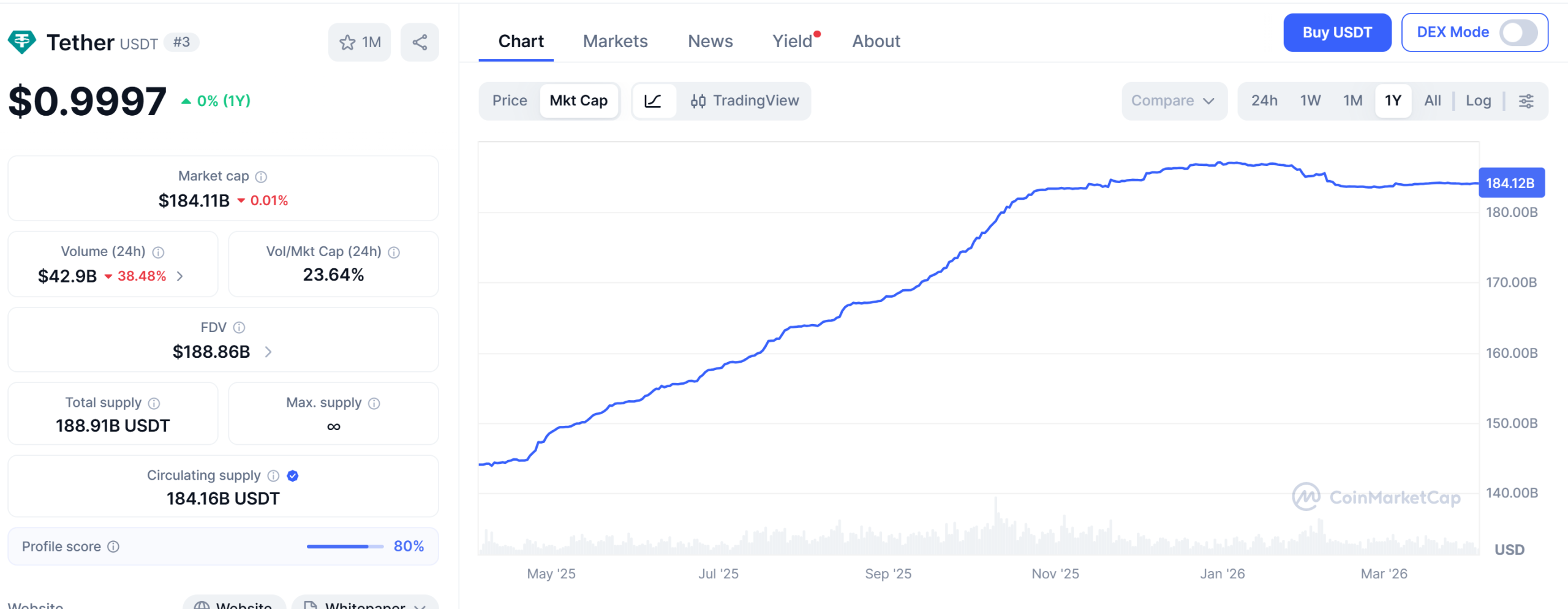
Tether is pressuring investors to commit to a fundraising round at a $500 billion valuation within the next two weeks, saying that it may delay the raise if demand falls short.
The El Salvador-based firm has been seeking fresh capital since late last year but has faced resistance from investors wary of the valuation, The Information reported Friday, citing unnamed sources. If commitments fall short of expectations, the company is likely to delay the raise.
The $500 billion target would place Tether among the world’s largest financial firms, exceeding every US bank except JPMorgan Chase. JPMorgan, the largest bank in the world, has a market capitalization of about $794.55 billion, while the second-largest bank in the country, Bank of America, has a market cap of $352.86 billion.
Tether’s USDt (USDT) stablecoin, the world’s largest stablecoin, currently has a market cap of $184 billion. The company’s other top products include Tether Gold (XAUt) and Tether EURt (EURt), pegged to the euro.

Related: Stablecoin supply reaches $315B in Q1 as USDC rises, USDT declines
Tether explores fundraising
In September last year, Bloomberg reported that Tether was exploring a fundraising round of up to $20 billion that could value the company at around $500 billion. The firm was considering raising $15 billion to $20 billion through a private placement for roughly a 3% stake, with Cantor Fitzgerald acting as lead adviser.
Following the report, CEO Paolo Ardoino said on X that the company was exploring a raise from a select group of investors to expand across “existing and new business lines (stablecoins, distribution ubiquity, AI, commodity trading, energy, communications, media) by several orders of magnitude.”
However, in a comment to Cointelegraph in February, Ardoino denied reports that it planned to raise up to $20 billion, saying earlier figures were hypothetical scenarios rather than an active fundraising plan. Still, he defended the $500 billion valuation, comparing the company’s profits to AI platforms such as OpenAI.
Cointelegraph reached out to Tether for comment, but did not get a response by publication.
Related: Tether says ‘Big Four‘ firm to handle first full audit of USDT reserves
Tether taps KPMG for first full audit od USDt
Meanwhile, Tether has reportedly hired KPMG to conduct its first full audit of USDt’s financial statements, with PwC assisting in preparing internal systems, according to the Financial Times. The move follows years of relying on reserve attestations from BDO Italia rather than a comprehensive audit.
A full audit would go beyond reserve snapshots to examine assets, liabilities and internal controls across Tether’s balance sheet.
Magazine: Bitcoin may take 7 years to upgrade to post-quantum — BIP-360 co-author
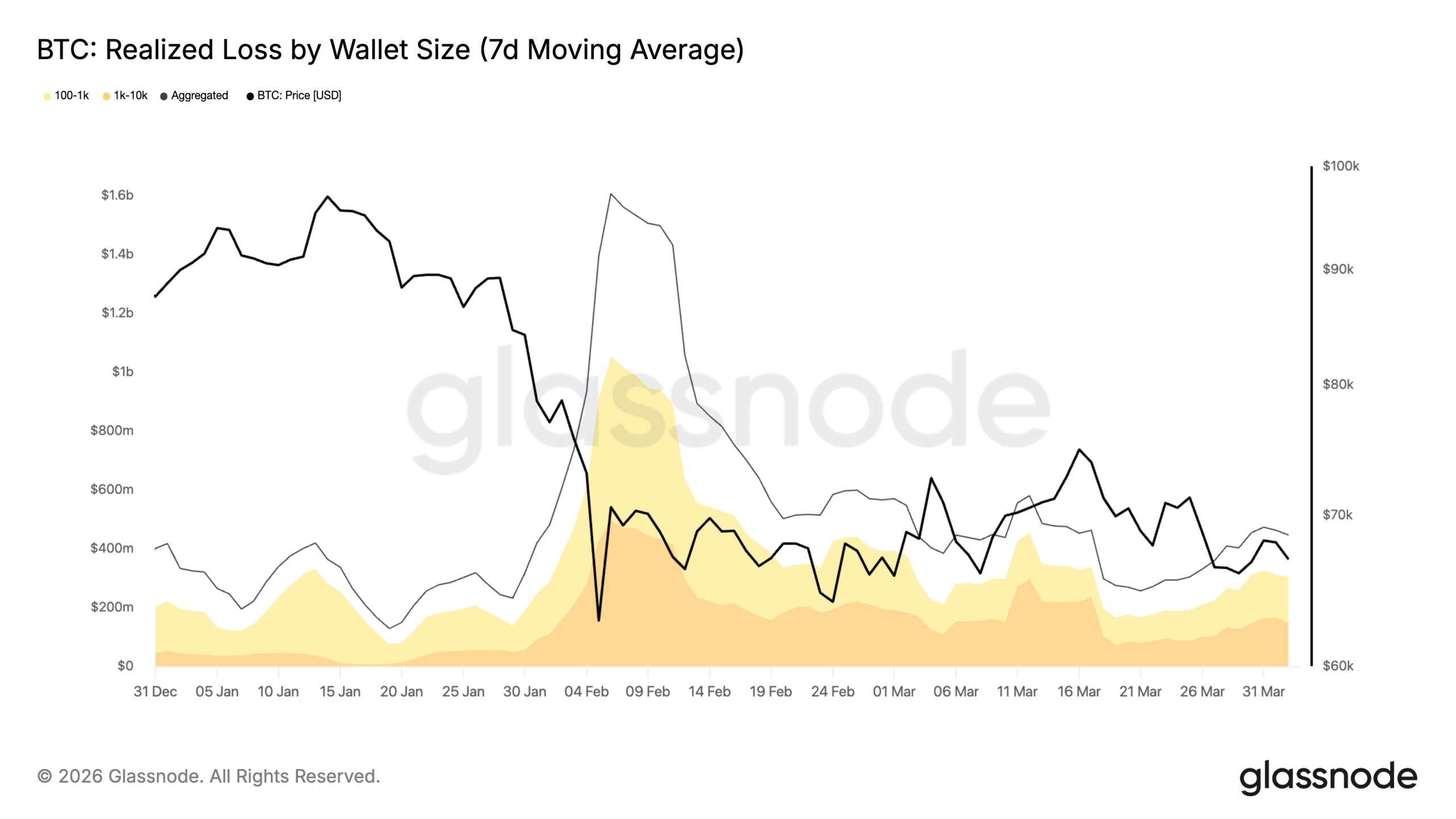
Bitcoin (BTC) traders holding 100–10,000 BTC realized losses at an average of $337 million per day in Q1 2026, the worst quarter since 2022, according to data from Glassnode.
Key takeaways:
-
Bitcoin dropped more than 20% after whales last realized losses at a comparable pace in 2022.
-
Long-term holders are also selling at a loss, indicating capitulation and potentially more downside in price.
BTC whales, sharks realized $30.91 billion loss in 2026
Realized Loss tracks the total dollar value of losses locked in when BTC is sold on-chain below its purchase price. In 2026, two significant wallet cohorts show signs of capitulation.
They are addresses holding 100–1,000 BTC, or “sharks” that often represent mid-sized funds or wealthy investors, and those holding 1,000–10,000 BTC, which are considered whale-sized entities.
In Q1, Bitcoin’s sharks (yellow) realized losses at an average of $188.5 million per day, while whales (orange) comprised another $147.5 million daily.

Combined, these large entities have locked in roughly $30.91 billion in realized losses so far in 2026.
Bitcoin’s realized losses in Q1 2026 for these high-net-worth entities rank among the most severe on record, trailing only Q2 2022’s roughly $396 million daily average.

In Q2 2022, BTC’s price dropped by over 50% and another 20% by the year’s end. It kept falling as the Terra collapse, Celsius freeze, and Three Arrows failure triggered panic across crypto, draining liquidity and confidence.

In 2026, pressure on Bitcoin has come from different sources, including Iran war-driven inflation fears, quantum-security risk, and broader stress in the AI-led risk trade.
Related: Bitcoin supply in profit heads to ‘true bear market’ levels
Therefore, whales and sharks are cutting their losses now because they expect the Bitcoin price to drop further as macro risks mount. This sentiment raises the odds of a 2022-like bear market, with a bottom in Q4 2026.
Bitcoin’s long-term holders add to downside risks
Another sign that Bitcoin’s sell-off may not be over comes from Glassnode’s Long-Term Holder Realized Loss chart, which tracks losses locked in by investors who held coins for more than six months before selling.
That figure remains elevated at around $200 million per day on a 30-day average basis since November 2025.

“A meaningful cooldown toward levels below $25M per day would represent a more compelling signal of exhaustion in selling pressure,” Glassnode analysts said in their weekly report published on Wednesday, adding:
“A prerequisite for the base formation that historically precedes a sustainable bull market transition.”
Together, these headwinds have already fueled calls for a deeper BTC correction, with some analysts pointing to the $40,000–$50,000 range as a possible bottom.
This article is produced in accordance with Cointelegraph’s Editorial Policy and is intended for informational purposes only. It does not constitute investment advice or recommendations. All investments and trades carry risk; readers are encouraged to conduct independent research before making any decisions. Cointelegraph makes no guarantees regarding the accuracy or completeness of the information presented, including forward-looking statements, and will not be liable for any loss or damage arising from reliance on this content.
Crypto World
Coinbase CEO Brian Armstrong Pledges Direct Involvement in Bitcoin’s Quantum Defense Strategy
Quick Overview
- A recent Google Quantum AI study indicates next-generation quantum machines could extract Bitcoin private keys from public keys in approximately 9 minutes
- Approximately 6.9 million BTC (nearly one-third of total circulation) remain in addresses with publicly visible keys, creating significant exposure
- With Bitcoin’s typical block validation taking ~10 minutes, attackers could have roughly a 41% success rate intercepting transactions
- Brian Armstrong, Coinbase’s CEO, has committed to direct involvement in developing quantum-resistant Bitcoin protocols with urgency
- Cryptocurrencies built with quantum resistance saw substantial gains: QRL climbed 51%, while Algorand rose 42% within a week
A groundbreaking study released by Google this week suggests that advanced quantum computing technology could potentially compromise the cryptographic foundations securing Bitcoin wallets. The research, issued by Google’s Quantum AI team on March 31, triggered significant concern across cryptocurrency communities.
[[EMBED_0]]
Bitcoin’s price hovered around $66,900 when the study became public knowledge. Market sentiment deteriorated sharply, with the Crypto Fear and Greed Index plummeting to 11—firmly within “extreme fear” range.
The vulnerability stems from Bitcoin’s transaction architecture. During a transaction, your wallet generates a cryptographic signature using your private key. This process necessarily reveals your public key to the network, where it remains visible in the mempool—a waiting area for unconfirmed transactions.
Currently, reversing a private key from its public counterpart remains computationally impossible within practical timeframes. However, Google’s findings suggest that sufficiently powerful quantum computers employing established algorithms could accomplish this feat in roughly nine minutes.
Bitcoin transaction confirmations average approximately 10 minutes per block. This narrow window creates a theoretical vulnerability where quantum-equipped attackers would possess about a 41% probability of intercepting funds during transaction processing.
According to Google’s calculations, executing such an attack would require under 500,000 physical qubits. Currently, the most sophisticated quantum processors contain approximately 1,000 qubits.
The More Pressing Danger: Permanently Visible Keys
While the nine-minute attack scenario captures attention, cybersecurity experts emphasize that a more immediate risk already exists on the blockchain itself.
Research suggests that roughly 6.9 million Bitcoin—representing about one-third of total supply—reside in addresses where public keys remain permanently exposed. This category encompasses legacy-era addresses and any wallet that has recycled addresses.
These holdings face heightened vulnerability because attackers wouldn’t face time constraints. Instead, they could systematically target exposed keys without deadline pressure.
Bitcoin’s Taproot implementation in 2021 inadvertently expanded this risk by defaulting to on-chain public key visibility, thereby increasing the pool of susceptible wallets.
Among these exposed assets are approximately 1.1 million BTC believed to belong to Satoshi Nakamoto, Bitcoin’s enigmatic founder.
How the Crypto Sector Is Responding
Brian Armstrong, CEO of Coinbase, issued a response within hours of the paper’s publication. He announced his personal commitment to addressing the challenge and emphasized the need for action “sooner rather than later.” Coinbase is currently organizing a coalition of Bitcoin core developers to facilitate transitioning toward quantum-secure cryptographic standards.
Blockstream Research highlighted ongoing post-quantum initiatives already in development on the Liquid sidechain network.
Not all industry figures view the situation as critical. Grayscale characterized the quantum concerns as a “red herring,” arguing that quantum computers capable of breaking Bitcoin’s security would equally compromise global banking systems and internet infrastructure. Changpeng Zhao, former Binance CEO, expressed confidence that cryptocurrency would “adapt and survive.”
The National Institute of Standards and Technology has already released post-quantum cryptographic standards that Bitcoin developers could implement. Bitcoin Improvement Proposal BIP-360 provides a potential migration framework, though implementing consensus changes across Bitcoin’s decentralized architecture presents considerable challenges.
Bitcoin’s proof-of-work mining relies on SHA-256, an algorithm that remains resistant to quantum computing attacks using known methodologies. Block production would continue unaffected.
Cryptocurrencies designed with quantum resistance experienced notable price appreciation following the announcement. QRL surged 51% over the past seven days. Algorand, referenced 32 times in Google’s paper for its post-quantum research contributions, gained 42% during the same period.


Blockchain investigator ZachXBT has publicly accused Circle of failing to freeze stolen USDC as it moved through the company’s own cross-chain infrastructure during the $285 million Drift Protocol exploit on April 1, 2026 — raising pointed questions about when and why the stablecoin issuer chooses to exercise its freeze authority.
Summary
- The Drift Protocol hack on April 1 is the largest DeFi exploit of 2026, draining over $285 million from the Solana-based perpetual futures exchange
- The attacker bridged approximately $232 million in USDC from Solana to Ethereum via Circle’s CCTP across more than 100 transactions over six consecutive hours with no action from Circle
- ZachXBT’s broader filing lists 15 cases totaling over $420 million in alleged Circle compliance failures since 2022
The April 1 attack on Drift, a Solana-based decentralized perpetuals exchange, was flagged by security firm PeckShield. Using a manipulated oracle and compromised admin key, the attacker drained Drift’s main vault in approximately 12 minutes, according to blockchain analytics firm Arkham. Drift’s total value locked fell from roughly $550 million to under $300 million within an hour. The DRIFT token dropped more than 40%. Over ten additional Solana protocols reported disruption.
After converting most of the stolen assets to USDC, the attacker used Circle’s Cross-Chain Transfer Protocol (CCTP) to bridge approximately $232 million from Solana to Ethereum across more than 100 transactions — over six consecutive hours during U.S. business hours.
“Circle was asleep while many millions of USDC were swapped via CCTP from Solana to Ethereum for hours from the 9-figure Drift hack during US hours,” ZachXBT wrote on X.
The criticism cuts sharper given the timing. Just nine days earlier, on March 23, Circle froze USDC across 16 unrelated business hot wallets — including one belonging to the DFINITY Foundation — as part of a sealed U.S. civil case. ZachXBT called that freeze “potentially the single most incompetent” action he had witnessed in five years of on-chain investigations.
The contrast — aggressive action against legitimate businesses, inaction during a confirmed nine-figure exploit transiting Circle’s own bridge — has reignited debate over how centralized stablecoin governance actually works in practice. Security researcher Specter noted the attacker deliberately avoided converting funds to Tether’s USDT, appearing confident Circle would not intervene.
Circle’s Defense
Circle responded: “Circle is a regulated company that complies with sanctions, law enforcement orders, and court-mandated requirements. We freeze assets when legally required, consistent with the rule of law and with strong protections for user rights and privacy.”
Salman Banei, general counsel at Plume, warned that freezing assets without authorization could expose Circle to legal liability. Ben Levit, CEO of stablecoin ratings agency Bluechip, described the situation as “a gray area,” noting this was an oracle exploit rather than a clean hack. Blockchain analytics firm Elliptic identified multiple indicators suggesting North Korean hackers were responsible for the Drift exploit.
As crypto hack losses had moderated significantly in the months preceding this incident, the $285 million Drift hack marks a stark reversal — and the Circle debate it has sparked may have lasting implications for how the broader stablecoin regulatory framework is written, particularly around freeze authority and issuer accountability.

Bitcoin holds near $67K as crypto markets stay muted; volatility seen rising ahead
Cambodia Passes First Cybercrime Law to Shut Down Scam Centers for Good

Elder Paul Bassey, Godswill Akpabio International Stadium Headline Sportsville Awards


-

 NewsBeat2 days ago
Steven Gerrard disagrees with Gary Neville over ‘shock’ Chelsea and Arsenal claim | Football
-

 Business1 day ago
No Jackpot Winner and $194 Million Prize Rolls Over
-
Entertainment5 days ago
Fans slam 'heartbreaking' Barbie Dream Fest convention debacle with 'cardboard cutout' experience
-

 Fashion15 hours ago
Weekend Open Thread: Spanx – Corporette.com
-

 Crypto World3 days ago
Gold Price Prediction: Worst Month in 17 Years fo Save Haven Rock
-

 Tech5 days ago
The Pixel 10a doesn’t have a camera bump, and it’s great
-
 Entertainment6 days ago
Lana Del Rey Celebrates Her Husband’s 51st Birthday In New Post
-
Crypto World4 days ago
Dems press CFTC, ethics board on prediction-market insider trades
-

 Tech5 days ago
Avatar Legends: The Fighting Game comes out in July and it looks pretty slick
-

 Sports4 days ago
Tallest college basketball player ever, standing at 7-foot-9, entering transfer portal
-

 Fashion6 days ago
Amazon Sundays: Soft Spring Layers
-

 Tech4 days ago
EE TV is using AI to help you find something to watch
-

 Business2 days ago
Login and Checkout Issues Spark Merchant Frustration
-

 Tech6 days ago
Elon Musk’s last co-founder reportedly leaves xAI
-

 Tech4 days ago
How to back up your iPhone & iPad to your Mac before something goes wrong
-

 Politics5 days ago
Should Trump Be Scared Strait?
-

 Crypto World4 days ago
U.S. rule change may open trillions in 401(k) funds to crypto
-

 Tech5 days ago
Apple will hide your email address from apps and websites, but not cops
-

 Fashion5 days ago
The Best Spring Trends of 2026
-

 Tech4 days ago
Flipsnack and the shift toward motion-first business content with living visuals
You must be logged in to post a comment Login