
Crypto World
BitRiver CEO Reportedly Under House Arrest Amid Tax Evasion Charges


The Zamoskvoretsky Court in Moscow has reportedly ordered BitRiver CEO Igor Runets to remain under house arrest amid tax evasion charges. Local outlets RBK and Kommersant reported that Runets was detained on January 30 and faces three counts for allegedly concealing assets to evade taxes. The court documents, cited by the outlets, indicate that Runets was charged on January 31 and placed under house arrest the same day. A narrow window remains for a potential appeal before the measure becomes fully enforceable on February 4. Cointelegraph reached out to Runets for comment as the case unfolds, underscoring the brisk pace of developments in a sector already shaped by sanctions and regulatory scrutiny. The developing story adds another layer to BitRiver’s fraught trajectory in a landscape where crypto mining in Russia intersects with geopolitical risk and energy considerations.
Key takeaways
- Detention and charges: Runets was detained on January 30 and charged on January 31 with three counts related to concealing assets to evade taxes; a house-arrest order was issued on the same day, with enforcement set to begin on February 4 unless an appeal changes the outcome.
- Regulatory backdrop and sanctions: BitRiver has weathered sanctions from the US Treasury in mid-2022, reflecting ongoing geopolitical risk surrounding crypto mining in Russia and the wider energy-intensive sector.
- Client exodus and cost-cutting: By late 2024, BitRiver reportedly initiated cost reductions and scaled back operations, with salary delays affecting staff as the firm faced mounting financial pressures.
- Litigation in the new year: In early 2025, Infrastructure of Siberia filed two lawsuits against BitRiver, alleging non-delivery of equipment after payment under a contract, signaling continued creditor friction as the case progresses.
- Wealth and profile: Bloomberg’s 2024 reporting placed Runets’ net worth at roughly $230 million, illustrating the personal scale of potential risk and the stakes for the founder amid legal scrutiny.
Tickers mentioned: $BTC
Market context: The case sits within a broader framework of regulatory scrutiny of crypto mining in Russia, ongoing sanctions regimes, and the volatility of multinational energy- and infrastructure-intensive mining operations. The outcome could influence financing, partnerships, and operational strategy for Russian miners in the near term.
Why it matters
The Runets case crystallizes the legal and regulatory crosswinds facing Russia’s prominent crypto-mining operators. BitRiver’s prominence—built on large-scale data centers in Siberia that provide crypto mining services to other entities—made it a high-profile target for authorities seeking to enforce asset disclosures and tax compliance. If the court’s decision stands, it could further constrain management decisions in the near term and complicate negotiations with suppliers, lenders, and energy providers who remain sensitive to compliance risk in the sector.
Beyond the consequences for BitRiver itself, the proceedings illuminate how Russia’s crypto ecosystem is navigating a shifting regulatory climate. The mid-2022 sanctions regime linked to BitRiver’s activities and the subsequent 2023 client departure by SBI—reported as halting usage of BitRiver’s infrastructure—underline how sanctions and geopolitical tensions reverberate through day-to-day operations. End-2024 reports of cost cuts and delayed salaries suggest liquidity challenges that could affect payroll, maintenance of mining capacity, and the ability to meet commercial commitments. The early-2025 lawsuits add a creditor-facing dimension to the case, illustrating how disputes over payments and delivered equipment can compound legal risk for a private operator already under scrutiny.
Looking at the broader perspective, the case underscores the persistent tension between rapid growth in private mining capacity and the robust enforcement of financial and asset reporting standards. It also highlights how individual executive-level cases can become proxies for the sector’s governance challenges, including how privately held mining ventures manage assets, liabilities, and cross-border relationships in a climate of sanctions and regulatory ambiguity. The narrative around Runets—once cited as a central figure in Russia’s crypto-mining expansion with a reported net worth around $230 million—emphasizes the high personal stakes involved when market dynamics meet legal accountability.
What to watch next
- February 4 enforcement: Whether Runets’ appeal short-circuits or delays the house-arrest order, and what the court says in any ruling or scheduling update.
- Defense statements: Any formal response or filings from Runets’ legal team that could shape the trajectory of the case or inspire a settlement framework.
- BitRiver operational updates: Any announcements about changes to mining capacity, staffing, or supplier agreements in light of the financial pressures and ongoing investigations.
- Regulatory developments: New or evolving guidance from Russian authorities on tax reporting, asset disclosure, or sanctions-related compliance for mining firms.
- Creditor actions: Developments related to the Infrastructure of Siberia lawsuits and any related settlements or judgments that could affect BitRiver’s balance sheet.
Sources & verification
- Zamoskvoretsky Court documents cited by RBK and Kommersant reporting on Runets’ detention and charges.
- RBK, coverage on Runets’ detention and three-count charge and the timing of the house-arrest order.
- Kommersant, reporting on court filings and the January 31 charge date.
- Bloomberg, 2024 profile referencing Runets’ net worth around $230 million and the broader crypto-mining context.
- US Treasury sanctions on BitRiver in mid-2022, referenced in coverage of the firm’s regulatory exposure.
- Kommersant, late-2024 reporting on BitRiver cost cuts and delayed salaries under pressure.
- Infrastructure of Siberia, early-2025 lawsuits against BitRiver alleging non-delivery of equipment after payment.
Legal pressure mounts on BitRiver founder amid tax-evasion charges
BitRiver, founded in 2017, emerged as one of Russia’s largest Bitcoin (CRYPTO: BTC) mining operators, running expansive data-centers across Siberia that provided mining services to third parties as the sector expanded. The latest legal developments, centered on its chief executive Igor Runets, place a spotlight on asset reporting and tax compliance in a business model built on high-capacity power use and complex vendor relationships. According to court documents cited by local outlets, Runets was detained on January 30 and formally charged on January 31 with three counts of concealing assets to evade taxes. The Zamoskvoretsky Court subsequently ordered him under house arrest on the same day, with the measure slated to take full effect on February 4 unless an appeal is filed or granted. The case thus enters a critical phase, and Runets’ legal team has a narrow window to respond before the period of restriction consolidates.
In the wake of the charges, Runets’ representatives have not issued a public statement, and Cointelegraph confirmed it sought comment from the parties involved. The broader context includes BitRiver’s history of external pressures, notably the US Treasury’s sanctions in mid-2022 in response to the Russia-Ukraine conflict. The March 2023 timeline also saw SBI, a prominent Japanese banking group, pull back from using BitRiver’s infrastructure, a development that underscored the fragility of cross-border partnerships amid geopolitical frictions. By late 2024, industry reporting suggested BitRiver was implementing cost reductions and delaying salaries, signaling liquidity strains that can accompany a company facing legal scrutiny and sanctions exposure.
The financial strain was compounded by a sequence of disputes that surfaced in early 2025 when Infrastructure of Siberia filed two lawsuits alleging that the company paid for equipment that was never delivered. This creditor pressure mirrors the wider challenge for mining operators trying to maintain operation while navigating regulatory risk and the volatility of energy markets, which are essential to the unit economics of crypto mining. The Bloomberg profile in 2024, which pegged Runets’ net worth at around $230 million, adds another layer to the stakes involved—where personal holdings intersect with the fortunes of a fast-growing but increasingly regulated sector. Taken together, the case paints a portrait of a high-stakes industry confronting legal accountability while attempting to preserve capacity and reliability in an environment shaped by sanctions and geopolitical headwinds.


There was a time when “earning” meant showing up.
Clock in. Do the work. Get paid.
That model is quietly being rewritten.
Not by corporations. Not by governments.
But by code.
The Shift No One Is Talking About
In traditional economics, labor and capital are separate forces:
- Labor = effort, time, skill
- Capital = money, assets, tools
You worked for capital. Capital didn’t work for you.
DeFi flips that.
Now your capital:
- Provides liquidity
- Secures networks
- Arbitrages inefficiencies
- Rebalances positions
- Optimizes yield across protocols
That’s not passive.
That’s functionally labor.
Yield Farming = Outsourced Work
Let’s call it what it is.
Yield farming isn’t just “earning interest.”
It’s:
- Acting as a market maker
- Acting as a lender
- Acting as a validator (indirectly)
- Acting as a trader via automated strategies
Instead of hiring humans, protocols use your capital as the worker.
Is your USDC in a liquidity pool?
That’s filling trades 24/7.
Your ETH in staking?
That’s helping secure consensus.
Your funds in an arbitrage vault?
That’s scanning price inefficiencies faster than any human ever could.
No breaks. No emotions. No sleep.
Capital as a Full-Time Employee
Here’s the uncomfortable realization:
Your money might already be working harder than you are.
In DeFi, capital doesn’t sit idle:
- It compounds
- It reallocates
- It executes strategies automatically
And unlike human labor:
- It scales instantly
- It operates globally
- It doesn’t burn out
We’re watching the birth of something new:
Synthetic labor.
From “Work → Earn” to “Deploy → Earn”
The old formula:
Work → Earn money → Save → Invest
The new formula:
Deploy capital → Earn like labor → Reinvest → Compound
This changes everything.
Because now:
- Income is no longer tied to time
- Productivity is no longer tied to effort
- Output is no longer tied to human limits
If your capital is positioned correctly, it behaves like:
- A trader
- A banker
- A liquidity provider
All at once.
The Uneven Playing Field
Here’s where things get real.
If capital becomes labor, then:
- People with more capital = more “workers”
- People without capital = left selling time
This amplifies inequality.
Because:
- One person can deploy $1M across strategies
- Another can only deploy $100
Both access the same protocols.
But only one owns a fleet of synthetic workers
The Rise of Capital Efficiency Wars
Protocols are already competing for your capital:
- Higher APYs
- Token incentives
- Better risk-adjusted returns
Why?
Because capital is labor supply in DeFi.
More capital = deeper liquidity = better markets = stronger protocol
We’re entering a phase where protocols don’t just attract users.
They recruit workers made of capital.
The Psychological Flip
This is where most people lag.
They still think:
“I need to work harder to earn more.”
But the real question is:
“Is my capital working at all?”
Because idle money in a bank account is:
- Not securing anything
- Not providing liquidity
- Not capturing inefficiencies
In DeFi terms, it’s unemployed.
Risks: Not All “Workers” Are Safe
Let’s not romanticize it.
Synthetic labor comes with real risks:
- Smart contract exploits
- Impermanent loss
- Protocol collapse
- Incentive rug pulls
Your “worker” can:
- Underperform
- Lose capital
- Get wiped out entirely
Unlike human labor, there are no labor laws here.
Where This Is Heading
Zoom out.
If capital becomes programmable labor:
- DAOs become employers
- Protocols become economic machines
- Users become capital allocators instead of workers
The long-term implication?
We’re heading toward a system where:
- Work is optional (for some)
- Capital allocation is the primary skill
- Financial literacy becomes survival
Final Thought
DeFi didn’t just create new ways to earn.
It quietly redefined what “earning” even means.
You’re no longer just a worker.
You’re a manager of workers.
The twist?
Your workers are made of capital.
And they never sleep.
REQUEST AN ARTICLE


Michael Saylor’s Strategy (MSTR) added 4,871 bitcoin to its treasury over the past week at an average price of roughly $67,718 per coin, spending approximately $329.9 million, according to a Monday filing.
The purchase brings total holdings to 766,970 BTC acquired for $58.02 billion at an all-in average cost basis of $75,644. At bitcoin’s current price near $69,120, the entire position is underwater by roughly 8%, or about $5 billion in unrealized losses on paper.
Last week’s purchases were mostly funded through $227.3 million in sales of the company’s STRC preferred stock. The remainder was funded with $72 million of sales of common stock.
A CryptoQuant report last week flagged Strategy’s 30-day accumulation at roughly 44,000 BTC through late March, making it one of only two institutional channels absorbing supply at scale alongside spot ETFs, which purchased approximately 50,000 BTC over the same period.
At 766,970 BTC, Strategy holds roughly 3.8% of bitcoin’s total circulating supply of 20.01 million coins and remains by far the largest corporate holder of the asset.


Disclosure: This article does not represent investment advice. The content and materials featured on this page are for educational purposes only.
Investors shift from spot trading to automated income strategies as platforms like NOW DeFi gain attention.
Summary
- Retail crypto investors shift from spot trading to passive income models like cloud mining amid market volatility
- NOW DeFi promotes automated quantum cloud mining, offering hands-free strategies and daily yield generation
- AI-driven mining platforms gain traction as users seek stable returns over speculative “buy and hold” strategies
Still obsessively checking charts, praying for XRP or BTC to pump? While ordinary retail investors are paralyzed by market volatility and holding idle bags, a massive wealth shift is happening right under their noses.
The smartest crypto holders have completely stopped trading spot. Instead, they are plugging their idle digital assets into NOW DeFi, a game-changing Quantum Cloud Mining platform, and unlocking staggering passive income of up to $12,777 every single day. The era of “buy and hope” is dead; the era of automated, high-yield cash flow is here.
Why are holders flocking to quantum cloud mining?
For years, generating real wealth in crypto required expensive mining rigs, cheap electricity, or high-risk day trading. NOW DeFi’s Quantum Cloud Mining has democratized the industry. It utilizes AI-driven quantum algorithms to instantly allocate computing power across global, green-energy data centers.
There is no need to buy any hardware. Simply lease institutional-grade ASIC hashrate, and the algorithm automatically targets the most profitable blockchain networks. Whether the spot market is pumping or crashing, the hashrate is actively minting new assets, securing guaranteed, predictable profits 24/7.
The NOW DeFi edge: Why smart money trusts the protocol
The mass migration to NOW DeFi isn’t a coincidence. The platform has architected an elite, automated wealth-building ecosystem designed to eliminate retail pain points while maximizing institutional-grade returns:
- $22 Instant Welcome Bonus: To accelerate onboarding, NOW DeFi offers an immediate $22 cash reward upon registration, allowing users to kickstart their yield generation instantly.
- 100% Hands-Free Automation: Users no longer need to monitor crashing charts. By purchasing a strategy package, yields are automatically calculated and credited every 24 hours.
- Ultimate Liquidity & Flexible Withdrawals: Capital efficiency is paramount. Once the account balance reaches a minimum of $100, users can withdraw directly to their personal crypto wallets or reinvest for compound growth.
- Fort Knox-Level Security: In an era of rampant exploits, user capital is fortified by industry-leading McAfee® and Cloudflare® dual-layer protection, alongside third-party custody solutions.
- The Global Safe-Haven Consensus: The protocol is already trusted by over 10 million smart investors across 198+ countries and regions who have chosen guaranteed yields over market anxiety.
- Seamless Multi-Asset Integration: The platform directly supports and settles in top-tier assets, including XRP, BTC, ETH, SOL, DOGE, USDC, USDT, BNB, and BCH.
- Zero Hidden Fees: The yield models operate with absolute transparency. There are no hidden maintenance fees or surprise charges.
Following the smart money: How to execute the strategy
For retail holders looking to replicate this institutional strategy and stop the bleeding in their spot portfolios, the execution process has been streamlined into three steps:
- Create an Account: Visit the official NOW DeFi platform or download the app to register and claim the $22 bonus.
- Deploy Capital: Choose a Quantum Contract that aligns with capital size and preferred digital asset.
- Automate & Earn: Once activated, the quantum matrix operates 24/7, depositing net profits directly into a wallet for daily withdrawal.
The yield matrix: Inside the data
Below is the transparent breakdown of the Quantum Cloud Mining contracts currently absorbing the massive influx of retail and institutional capital:
Strategy Model
Target Asset
Capital Required
Term
Daily ROI
Total Net Profit
Micro Hashrate
USDC / USDT
$100
2 Days
$4.00
$8.00
XRP Momentum
XRP
$1,200
10 Days
$14.16
$141.60
Digital Gold Miner
BTC
$5,000
20 Days
$67.50
$1,350.00
High-Frequency Alt
SOL / ETH
$15,000
35 Days
$240.00
$8,400.00
Institutional Matrix
Multi-Asset
$50,000
40 Days
$870.00
$34,800.00
Quantum Apex
Hyd Max
$890,000
45 Days
$12,777.00
$574,965.00
About NOW DeFi
NOW DeFi is a globally compliant web3 wealth management and decentralized hashrate platform. By bridging rigorous traditional finance logic with cutting-edge blockchain technology, NOW DeFi provides institutional-grade Quantum Cloud Mining solutions to millions of users worldwide. Committed to transparency, security, and consistent yield generation, NOW DeFi is redefining how digital assets are preserved and grown in the modern era.
Conclusion
The on-chain data speaks for itself. While retail traders continue to gamble in the highly volatile spot market, the industry’s smartest capital has already taken shelter in decentralized hashrate protocols to lock in absolute returns. Do not let digital assets sit idle and depreciate in a highly uncertain market. Reallocate XRP, BTC, and USDC to NOW DeFi today, leverage top-tier quantum algorithmic strategies, and secure a financial future.
For more information and to start generating daily automated yields instantly, please click here to visit the NOW DeFi official website or download the official application.
Email: [email protected]
Disclosure: This content is provided by a third party. Neither crypto.news nor the author of this article endorses any product mentioned on this page. Users should conduct their own research before taking any action related to the company.
Crypto World
IRGC Issues Destruction Warning Against UAE’s $30B Stargate AI Facility Backed by Tech Giants

Key Highlights
- Iranian Revolutionary Guard published threatening video on April 3 targeting Abu Dhabi’s $30B Stargate artificial intelligence facility
- Warning specifically conditions destruction on potential U.S. military action against Iran’s electrical infrastructure
- Major technology partners include OpenAI, Microsoft, Nvidia, Oracle, SoftBank, and additional firms
- Oracle’s Dubai data center sustained damage from Iranian missile fragments on April 2
- Financial markets show varied responses; Nvidia (NVDA) maintains top-tier 10 analyst Smart Score
The Islamic Revolutionary Guard Corps of Iran has issued a destruction warning against the $30 billion Stargate artificial intelligence data center currently under development in Abu Dhabi. This threat emerged through a video published on April 3, 2026, subsequently circulated by the Tehran Times via X.com.
Brigadier General Ebrahim Zolfaghari, serving as spokesperson, declared that “complete and utter annihilation” would be executed should the United States conduct military strikes against Iranian electrical generation facilities. The Revolutionary Guard specified that every U.S.-affiliated information and communications technology enterprise operating throughout the region would constitute “legitimate targets.”
The released footage demonstrated a Google Maps-style geographic progression, zooming into the Stargate complex’s waterfront position within the United Arab Emirates. The presentation transitioned to simulated night-vision imagery, exposing the comprehensive site configuration. Revolutionary Guard officials incorporated photographs of OpenAI’s Chief Executive Sam Altman alongside Nvidia’s CEO Jensen Huang throughout the video content.
Stargate’s official launch occurred in May 2025 through an agreement involving President Donald Trump. The initiative represents what’s planned as the most expansive AI data center development located beyond United States borders.
The undertaking enjoys financial and technical backing from prominent global technology corporations. OpenAI and Microsoft are developing the artificial intelligence platforms. Nvidia and SoftBank are contributing semiconductor technology and capital investment. Oracle and Cisco are managing cloud computing and networking systems. Abu Dhabi’s MGX serves as an additional primary backer.
Regional Technology Assets Experience Actual Damage
This threatening message follows confirmed physical damage reported across the area. On April 2, 2026, fragments from a neutralized Iranian missile impacted an Oracle data facility in Dubai, causing structural damage to the building’s exterior.
Amazon Web Services documented electrical supply interruptions at one of its regional installations following comparable attack incidents. The UAE Ministry of Defence reports successfully intercepting over 500 missiles and 2,100 unmanned aerial vehicles launched from Iranian territory since February 2026.
While the Stargate facility remains in its construction phase, these nearby incidents demonstrate that technological infrastructure throughout the UAE is experiencing direct impact from the ongoing conflict.
The Revolutionary Guard’s video content explicitly challenged Google’s privacy measures, asserting “nothing stays hidden from our sight, though hidden by Google.” This statement referenced the facility’s location being obscured on publicly accessible mapping platforms.
Financial Market Response
Notwithstanding the explicit threat directed at the development, Nvidia maintains its optimal Smart Score of 10 based on comprehensive analyst agreement. Among the consortium companies, only Cisco demonstrated positive stock movement during the previous month, registering a 0.48% increase.
Microsoft and Nvidia both continue displaying robust upward price targets according to analyst projections. Investment professionals appear to be interpreting the circumstances as a geographically confined geopolitical development at this stage.
OpenAI declined to provide commentary in response to Seeking Alpha’s inquiry at publication time.
The most recently verified incident remains the April 2 missile debris impact on Oracle’s Dubai data center facility.


Views Don’t Matter Anymore. Ownership Does.
For the last 15 years, the internet has run on a simple trade:
You give attention.
Platforms make money.
Every scroll, like, and click feeds an algorithm designed to extract one thing—your time. And while creators and users generate the value, platforms capture almost all of it.
That model is breaking.
Quietly, but decisively.
We’re moving from an attention economy to an ownership economy—and tokenization is the catalyst.
The Problem: Attention Is Extractive by Design
Traditional platforms don’t reward value—they reward engagement loops.
- Viral content beats meaningful content
- Clickbait beats substance
- Algorithms decide visibility, not creators
You don’t own your audience.
You don’t own your data.
You don’t even control distribution.
Even worse?
Creators are stuck in a system where:
- Monetization is gated (ads, sponsorships)
- Income is unpredictable
- Platforms can change rules overnight
You’re building on rented land.
The Shift: From Clicks → Ownership
Web3 flips the model.
Instead of extracting value from attention, it distributes value through ownership.
Tokens change everything because they turn users into participants, not products.
Now:
- Users can earn from the networks they contribute to
- Creators can own their communities directly
- Value flows back to the people generating it
This isn’t just monetization—it’s alignment.
Why Tokenized Value Is So Powerful
Tokens don’t just pay you—they represent your stake in a system.
That means:
1. Participation = Ownership
Providing liquidity, curating content, or even just being early can earn you a share of the network.
Your activity becomes capital.
2. Communities Become Economies
Instead of followers, you get stakeholders.
People aren’t just watching—they’re invested in growth.
That changes behavior:
- Less passive scrolling
- More meaningful contribution
- Stronger network effects
3. Value Is Transparent and Programmable
Smart contracts automate reward distribution.
No middlemen. No hidden rules.
If you add value, you get paid. Simple.
The Death of “Going Viral”
In the attention economy, success looks like this:
Millions of views. Minimal ownership.
In the tokenized economy, success looks like:
Smaller audience. Higher alignment. Real upside.
Virality becomes less important than economic participation.
Because:
- 1,000 aligned holders > 1,000,000 passive viewers
- A community that earns together stays together
The Next TikTok Won’t Sell Your Attention—It’ll Pay You
Imagine a platform where:
- You earn tokens for engagement
- Creators share upside with their audience
- Early users benefit from growth
- Algorithms are transparent—or even community-governed
This isn’t theoretical. It’s already happening in early forms across DeFi, social tokens, and on-chain platforms.
The difference?
These platforms don’t treat users as inventory.
They treat them as owners.
The Bigger Picture: Capital Becomes Labor
Here’s where it gets interesting.
In this new model:
- Your capital works like labor
- Your activity earns equity
- Your participation compounds over time
We’re moving from:
Work → Earn money
to:
Participate → Accumulate ownership
That’s a fundamental shift in how value is created and distributed online.
Final Thought
The attention economy isn’t dying because people stopped scrolling.
It’s dying because people are starting to realize:
They were never being paid what they’re worth.
The next phase of the internet isn’t about capturing attention.
It’s about rewarding contributions.
And in that world?
Views don’t matter.
Ownership does.
REQUEST AN ARTICLE
The crypto market will welcome tokens worth more than $899.3 million in the second week of April 2025. Major projects, including Aptos (APT), Babylon (BABY), and Linea (LINEA), will release significant new token supplies.
These unlocks could introduce market volatility and influence short-term price movements. So, here’s a breakdown of what to watch.
1. Aptos (APT)
- Unlock Date: April 12
- Number of Tokens to be Unlocked: 11.31 million APT
- Released Supply: 1.66 billion APT
- Total supply: 2.59 billion APT (Y2035)
Aptos is a Layer-1 blockchain platform designed for scalability, security, and efficiency in decentralized applications (dApps) and Web3 ecosystems. It utilizes the Move programming language to enable high-throughput transactions and smart contract execution.
Aptos will release 11.31 million tokens on April 12. The tokens are worth $9.65 million. It represents 0.68% of the released supply.
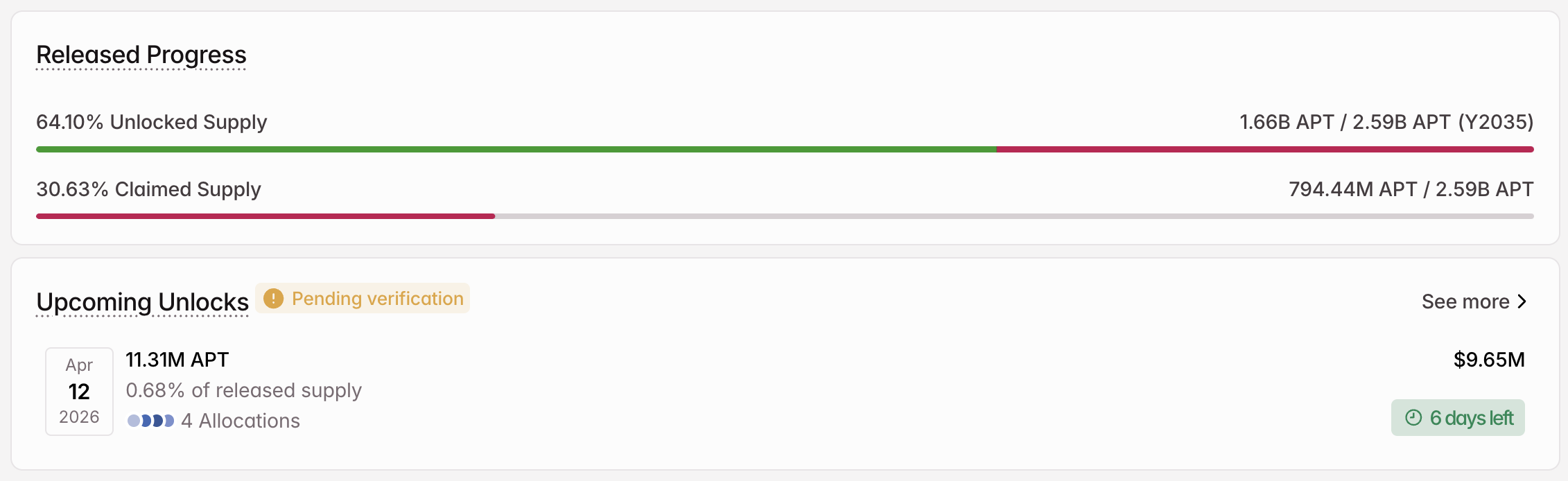
The team will award 3.96 million APT to core contributors. The community and investors will get 3.21 million and 2.81 million tokens, respectively. Additionally, Aptos will allocate 1.33 million tokens to the foundation.
2. Babylon (BABY)
- Unlock Date: April 10
- Number of Tokens to be Unlocked: 612.5 million BABY
- Released Supply: 1.62 billion BABY
- Total supply: 10 billion BABY (Y2035)
Babylon is a decentralized protocol that enables native Bitcoin (BTC) staking to secure Proof-of-Stake blockchains. It turns idle BTC into a productive asset without custodians or bridges. BABY is the native token of the network.
The altcoin serves three core functions: paying transaction fees, participating in on-chain governance, and dual-staking alongside BTC to secure the network.
On April 10, the network will unlock 612.5 million coins. The altcoins are worth $7.56 million. In addition, the unlocked tokens account for 37.77% of the released supply.
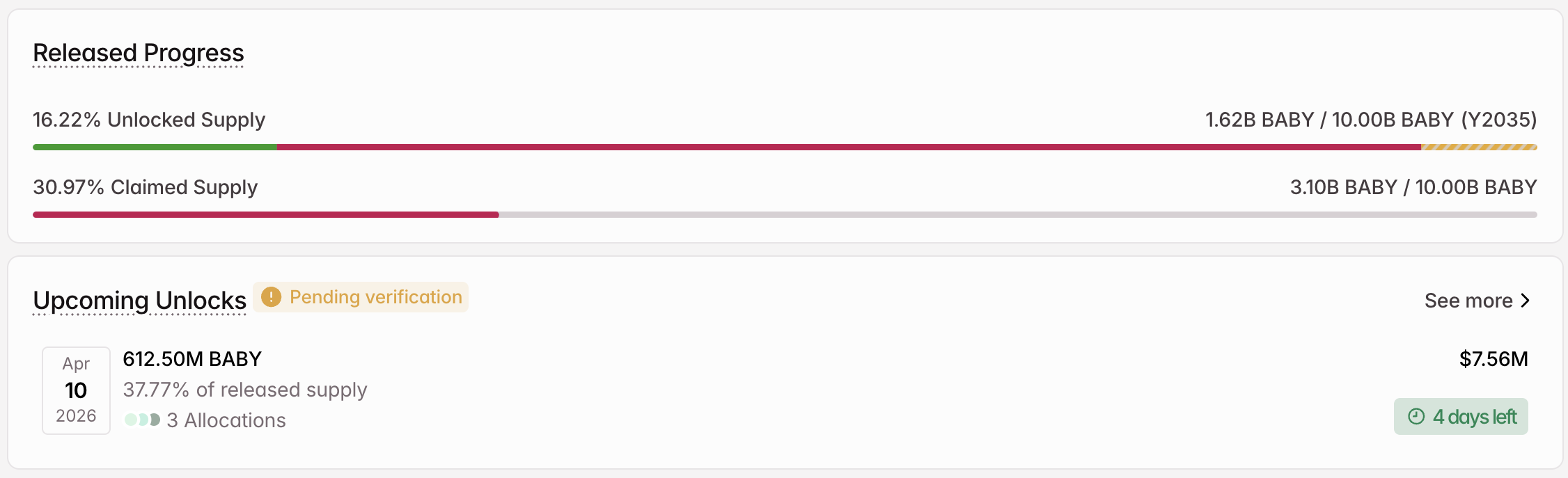
Babylon will split the supply three ways. Early private-round investors will receive 381.25 million tokens. The team will get 187.5 million BABY. Lastly, Babylon will direct 43.75 million tokens to advisors.
3. Linea (LINEA)
- Unlock Date: April 10
- Number of Tokens to be Unlocked: 1.38 billion LINEA
- Released Supply: 25.92 billion LINEA
- Total supply: 72.01 billion LINEA
Linea is a zkEVM Layer-2 scaling solution for Ethereum (ETH). The network provides fast, low-cost transactions while maintaining compatibility with Ethereum tools and security.
The network will unlock 1.38 billion tokens, valued at approximately $4.68 million, on April 10. The upcoming unlock represents 5.32% of the released supply
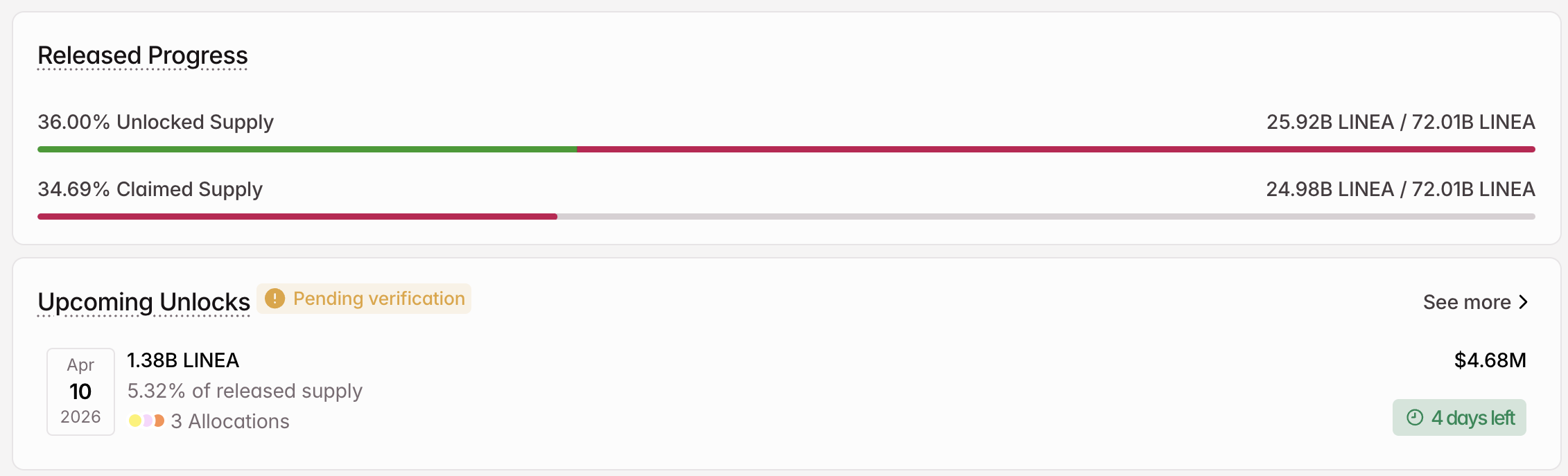
Linea will keep 600.08 million tokens for long-term alignment, and 480.07 million LINEA for Ignition. The team will allocate the remaining 300.04 million tokens for future airdrops.
In addition to these, other prominent unlocks that investors can look out for in the second week of April include RedStone (RED), BounceBit (BB), Movement (MOVE), and more.
The post 3 Token Unlocks to Watch in the Second Week of April 2026 appeared first on BeInCrypto.


Three veteran gemologists have launched a new gemstone testing facility, Swiss International Gemlab, introducing a proprietary artificial intelligence system to support grading accuracy and consistency.
Summary
- Swiss International Gemlab launches with an AI-supported grading system to improve accuracy and consistency in gemstone reports.
- The lab will operate from Lucerne and Hong Kong, offering full-service testing with a five-day standard turnaround and real-time tracking.
- SIG joins a growing shift as gemology labs adopt data-driven tools to enhance verification standards and reporting uniformity.
Willy Bieri, Lawrence Hahn, and Matthias Alessandri founded the lab, which will operate from Lucerne, Switzerland, and Hong Kong, the company said last week. The three have worked together for more than a decade and said the facility is designed to deliver faster reports, improved transparency, and strong scientific rigor, while remaining free from external influence.
Swiss International Gemlab (SIG) said it will provide the “full spectrum” of services for colored gemstones. These include identification, origin determination, treatment analysis, and detailed color grading.
At the core of its operations is “SIG-AI Assistance,” a proprietary system that cross-references analytical results with structured databases. The platform is designed to flag inconsistencies, support uniform reporting standards and shorten interpretation time, according to the lab.
The lab has set a standard turnaround time of five business days, with expedited options available for urgent submissions. Clients will also have access to real-time tracking to monitor the progress of their reports.
SIG is scheduled to make its first public appearance at this year’s GemGenève in May, where it will provide on-the-spot gemological services for exhibitors, offering a preview of its workflow and capabilities.
AI gains ground in gemstone grading
SIG’s launch comes as artificial intelligence continues to gain traction across the gemology sector, where labs are increasingly integrating data-driven tools into traditional workflows.
Several established laboratories have started using advanced digital systems in their workflows. Switzerland-based Gübelin Gem Lab, for example, introduced its “Gemtelligence” platform, which applies deep learning models trained on decades of gemstone data to assist with origin determination and treatment analysis while improving consistency.
Recent commentary from trade bodies indicates that these technologies are beginning to change how gemstones are identified and graded. The shift is also influencing day-to-day laboratory processes and shaping buyer confidence in certification standards.
At the same time, machine learning tools are being used to analyse spectroscopic data and high-resolution imagery. These systems can detect treatments, classify stones, and support grading decisions with a level of uniformity that remains difficult to achieve through manual assessment alone.
Against this backdrop, SIG’s use of its “SIG-AI Assistance” platform positions it within a growing segment of labs seeking to combine human expertise with algorithmic analysis to improve reliability and turnaround times in gemstone reporting.
Disclosure: This article does not represent investment advice. The content and materials featured on this page are for educational purposes only.
James Wynn, one of crypto’s most closely tracked traders, has been liquidated after shorting Bitcoin (BTC) on decentralized exchange Hyperliquid. On-chain intelligence firm Arkham Intelligence confirmed the wipeout.
Follow us on X to get the latest news as it happens
The liquidation left Wynn’s account at just over $900, with a loss of $20 million according to HypurrScan data.
“In just the past 2 weeks, he has been liquidated 6 times!,” blockchain analytics firm Lookonchain added.
Wynn had warned traders over the weekend that conditions across markets would worsen before improving. He outlined his multi-asset defensive strategy, which included shorting both the S&P 500 and the Nasdaq, going long on WTI crude oil, and selectively buying BTC dips with spot capital.
The trader’s bearish positioning coincided with heightened geopolitical tensions around the Strait of Hormuz and oil prices hovering above $100 per barrel. However, Bitcoin moved sharply against his short.
BTC climbed 3% over the past 24 hours. Earlier today, the cryptocurrency surged to an intra-day high of over $70,000, its highest level in more than a week. BeInCrypto Markets data showed that at press time, it traded at $69,133.
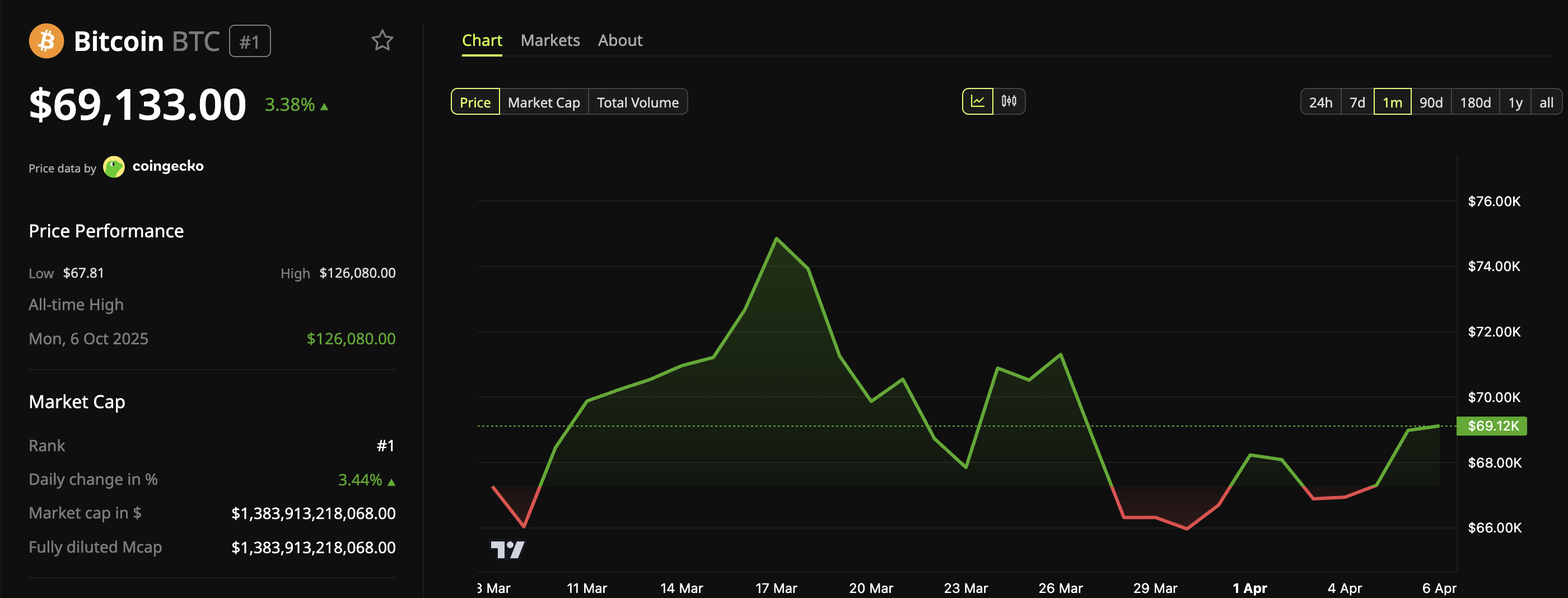
BeInCrypto reported that the rally was driven by a derivatives-led short squeeze that liquidated roughly $196 million in short positions across the market. The total crypto market capitalization recovered to $2.35 trillion on April 6, adding approximately $89 billion from the $2.27 trillion low hit on April 5.
Subscribe to our YouTube channel to watch leaders and journalists provide expert insights
The post James Wynn’s Account Drops to $900 After Latest Bitcoin Liquidation on Hyperliquid appeared first on BeInCrypto.
TLDR
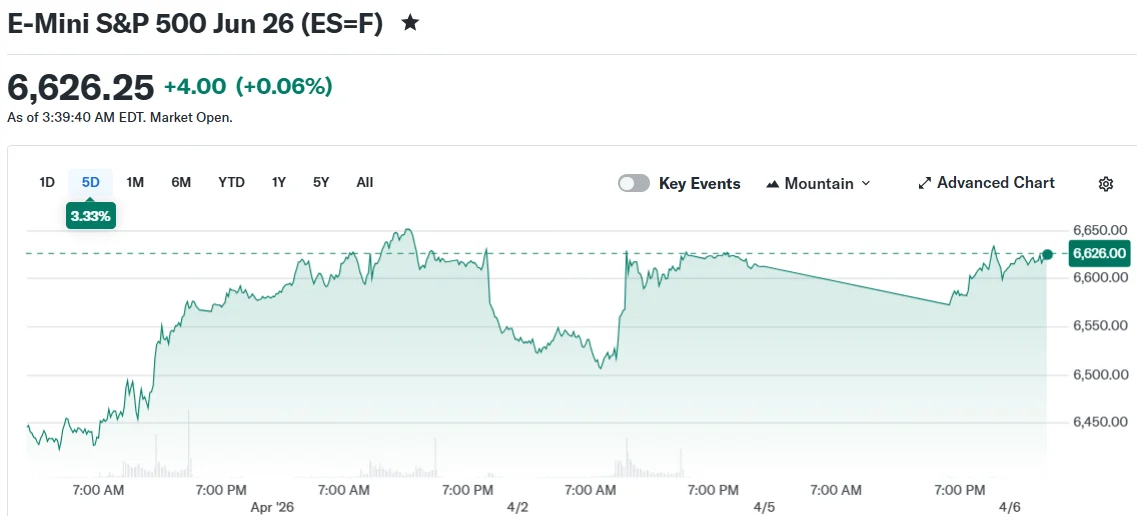
- Futures for the S&P 500 climbed 0.4% while Nasdaq 100 futures advanced 0.6% during Monday trading
- Diplomatic negotiations between Washington and Tehran, with Pakistan serving as mediator, boosted investor confidence
- President Trump extended his Iran ultimatum to Tuesday at 8:00 PM Eastern, warning of strikes on electrical infrastructure
- The critical Strait of Hormuz shipping channel continues to operate at minimal capacity, impacting approximately 20% of worldwide petroleum transport
- Crude prices retreated following ceasefire news, with Brent declining roughly 1.6% to settle near $107 per barrel
Wall Street futures posted solid gains Monday following emerging reports of potential diplomatic progress between Washington and Tehran. The positive movement arrived after a weekend marked by military escalation and aggressive rhetoric from the White House.
The S&P 500 futures contract advanced approximately 0.4%. Nasdaq 100 futures climbed 0.6%. The Dow Jones Industrial Average futures showed more modest growth at 0.1%.
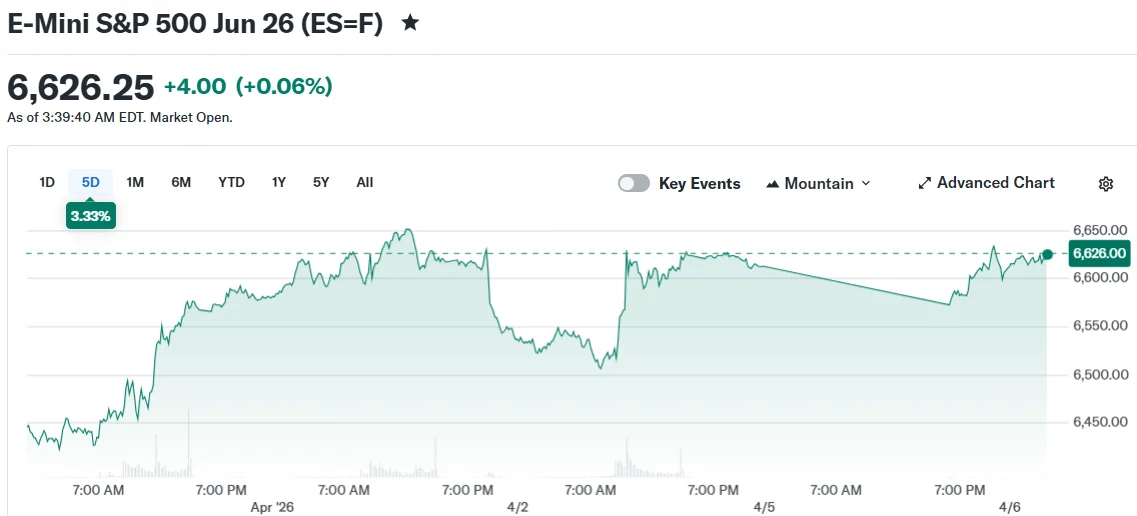
Equity markets experienced brief volatility overnight following fresh warnings from President Trump directed at Iran. However, sentiment improved as news of diplomatic channels emerged.
According to Reuters, both Washington and Tehran have been presented with a preliminary ceasefire framework brokered by Pakistani officials. The framework reportedly calls for an immediate cessation of hostile actions. To date, neither government has publicly acknowledged or endorsed the terms.
In parallel negotiations, American officials alongside regional intermediaries are advocating for an extended 45-day truce that could potentially conclude hostilities permanently. Sources close to the discussions caution that prospects for success remain uncertain.
President Trump’s initial 10-day ultimatum to Iran reached its expiration Monday. However, Trump announced a postponement via social media, declaring the revised deadline as “Tuesday, 8:00 P.M. Eastern Time.” In comments to the Wall Street Journal, he warned that American forces would target Iran’s entire electrical grid if the Strait of Hormuz shipping lane remains blocked beyond that timeframe.
Crude Markets Retreat on Diplomatic Progress
The strategically vital Strait of Hormuz, a waterway that typically facilitates approximately 20% of global petroleum shipments, remains severely restricted to commercial tanker traffic. This ongoing blockade has sustained upward pressure on oil prices throughout recent trading sessions.
Crude futures had surged nearly 3% at Sunday evening’s market opening. However, prices reversed course following the ceasefire developments. Brent crude retreated approximately 1.6% to trade around $107 per barrel. West Texas Intermediate declined roughly 2% to approximately $109.
A noteworthy market anomaly emerged: WTI pricing exceeded Brent levels, an uncommon occurrence. Market analysts attribute this inversion to contract timing discrepancies, with WTI still trading May delivery contracts while Brent has transitioned to June settlements.
Researchers at Gavekal Research suggest Iran may be leveraging its control over the strait to extract substantial passage fees from vessels. They characterize this as an emerging revenue strategy for Tehran.
Other Markets
Gold appreciated 0.9% to approximately $4,720 per ounce during Monday’s session. The benchmark 10-year US Treasury yield edged higher to 4.362%.
American military forces successfully extracted a US aviator who had been detained inside Iranian territory over the weekend. Iranian forces continued launching missiles and unmanned aerial vehicles toward Gulf nations and Israel through Monday morning.
The geopolitical landscape remains uncertain, with Tuesday evening’s deadline representing the next critical juncture for both financial markets and international diplomacy.
Bitcoin (BTC) faces a fresh showdown this week as macro tensions contrast with a bullish BTC price trend reversal.
-
A classic BTC price metric is above to flip bullish for the first time in nearly a year — last time, price gained $25,000 in two months.
-
Short time frames see liquidations as “aggressive” traders pile in at $70,000.
-
Iran war tensions are at breaking point as US President Donald Trump’s “Bridge Day” deadline nears.
-
US inflation data will come thick and fast as the war begins to reflect in the numbers.
-
The Bitcoin bear flag stays in play, with analysis warning that new lows are “likely just a matter of time.”
MACD indicator teases key bullish cross
On longer time frames, the weekly chart has become a source of hope for Bitcoin bulls this week.
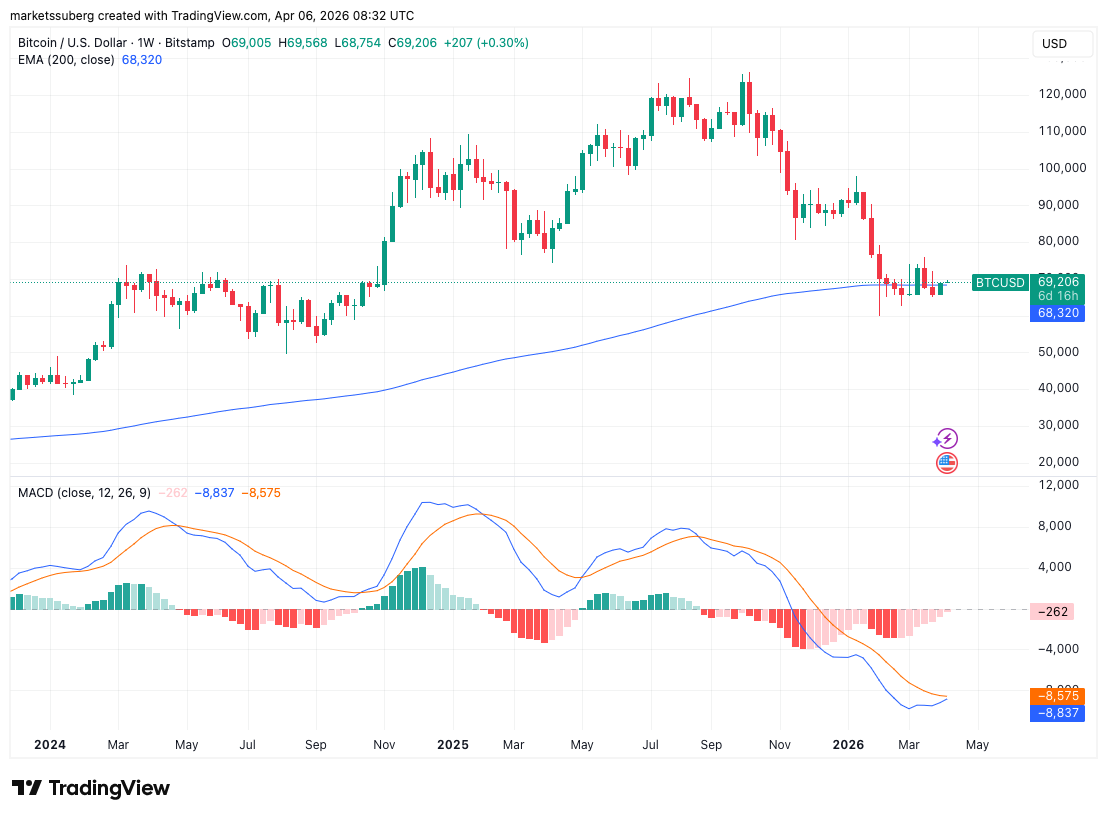
The weekly close reclaimed the 200-week exponential moving average (EMA) trend line, but more than that, a classic BTC price metric is about to produce a key bull signal.
On a weekly basis, the moving average convergence/divergence (MACD) hinted that Bitcoin’s latest downtrend is in the process of reversing.
“Holding this level is crucial for the entire Crypto industry,” X commentator Crypto Seth argued on Monday, noting that Ether (ETH) was also due an MACD cross.

Bitcoin’s last bullish weekly MACD flip occurred in May 2025, around one month after BTC/USD put in its 2025 low near $74,500. Over the following two months, price went from $94,000 to $119,000, setting new all-time highs.
Continuing on the phenomenon, X trading resource GalaxyTrading flagged key MACD comparisons across Bitcoin’s past two bear markets.
“In the 2018 bear market, it took around 245 days for the weekly MACD to turn positive,” it noted.
“In 2022, it also took 245 days to turn bullish. In 2026, we will reach 245 days by the end of April.”

Liquidations spike as Bitcoin tags $70,000
Bitcoin managed a trip beyond $70,000 after the weekly close, data from TradingView confirms, reaching new April highs.

While some traders remained skeptical over pre-market price action, the close itself was notable, bringing back both the 200-week EMA and old 2021 all-time high as potential support.
As Cointelegraph reported, both levels have courted suspicion over their reliability.
$BTC pumping on a Sunday and everyone celebrating…
You guys will never learn.
— Roman (@Roman_Trading) April 6, 2026
The move to the local highs caught short positions off guard, with total crypto liquidations passing $250 million over the 24 hours to the time of writing, per data from CoinGlass.
In his latest analysis, trader CrypNuevo continued to eye longs closer to $64,000 for a potential liquidity hunt to the downside.
“There are some HTF liquidations between $64k-$64.5k. This adds fuel a move lower. I don’t see conclusive data on LTF liquidations,” he commented in an X thread on Sunday.

In one of its “QuickTake” blog posts, onchain analytics platform CryptoQuant flagged the return of “aggressive short-term positioning” — spikes in both cumulative net taker volume and open interest on Binance.
This matters because Bitcoin’s move is being driven not only by price strength, “but also by renewed speculative participation in derivatives,” contributor Amr Taha commented.
“In simple terms, traders are becoming more willing to add fresh exposure as BTC pushes higher. If this trend continues, it could reinforce short-term momentum.”

Trump’s Iran “Bridge Day” puts markets on edge
A combination of geopolitics and key US inflation data makes for a week of “extreme volatility,” analysis predicts.
The US-Israel and Iran war continues to guide market sentiment, and oil prices reflect the uncertainty over the fate of key issues such as the partial closure of the Strait of Hormuz. WTI crude oil started the week with a trip above $115 per barrel.
Traders are now eyeing one deadline in particular when it comes to how the conflict might play out: Tuesday, 8pm Eastern time. This is when US President Donald Trump promises major infrastructure strikes if no deal with Iran is reached.
In a post on Truth Social at the weekend, Trump appeared particularly impatient, calling the day of the deadline “Power Plant Day” and “Bridge Day” while demanding that Hormuz reopen.

Headlines remain mixed, however, with talk of a 45-day ceasefire now a focus.
“This is being described as a ‘last-ditch effort’ to prevent ‘massive strikes on Iranian civilian infrastructure,’” trading resource The Kobeissi Letter reported on X.
Kobeissi noted that S&P 500 futures “erased all losses” on the news, underscoring risk-asset vulnerability to war-related triggers. As Cointelegraph reported, Bitcoin remains no exception.

Last week, macro investor and former hedge fund manager James Lavish nonetheless said that markets were pricing in odds of the war ending sooner rather than later.
A potential drawdown for BTC price action should markets experience a “black swan” event, he told Cointelegraph, could be up to 20%.
Risk assets face two major US inflation prints
Markets will thus be juggling war shocks and inflation data concurrently this week, with multiple US prints due.
Among them is the Personal Consumption Expenditures (PCE) Index, known as the Federal Reserve’s “preferred” inflation gauge.
February’s PCE release matched market expectations, but did not reflect inflation trends after the war had started.
“Following the jump in oil prices and potential spillover impact from fertilizer shortages on food prices, challenges around the inflation outlook still poses a major risk,” trading resource Mosaic Asset Company summarized in the latest edition of its regular newsletter, “The Market Mosaic.”

That risk also applies to the week’s last and arguably most important inflation number: the Consumer Price Index (CPI).
Here, the oil-price jump is especially pertinent, thanks to its direct impact on CPI inflation trends.
“Oil prices are now crossing above $115/barrel in the US. As a result, our models indicate that if current levels are sustained another ~7 weeks, US CPI inflation will rise to ~3.7%,” Kobeissi commented.
Kobeissi said that its “base case” for CPI inflation was now 3% — considerably higher than the Fed’s target.

Like PCE, the most recent CPI print was flat, helping temper the impact of previous overshoots.
The latest data from CME Group’s FedWatch Tool meanwhile shows practically no chance of the Fed either raising or lowering interest-rates at its next meeting at the end of April.

New lows “just a matter of time?”
As macro events play out, Bitcoin still has a specific cloud hanging over it that traders fear will only lead price downward.
Related: Bitcoin ‘done’ with 85% crashes, says Cathie Wood amid new $34K target
BTC/USD continues to battle for support at the bottom of its second bear flag of 2026. The first, which appeared in January, resulted in a drop of roughly $25,000.
“Structurally, $BTC price action is still nearly identical to the prior bear flag structure,” Keith Alan, cofounder of trading resource Material Indicators, warned last week.
“Nothing says that it has to continue to mimic that price behavior, but I’m following it like roadmap until price deviates from that path.”

When it comes to new lows, Cointelegraph reported on broad consensus that February’s downside wick below $60,000 will be revisited.
“When that breakdown eventually happens, watch the behavior closely. If price starts repeatedly sweeping the lows, making it psychologically difficult to enter longs, that’s when a true bottom is more likely forming,” pseudonymous trader LP told X followers this weekend.
LP said that new lows were “likely just a matter of time.”

Alan, meanwhile, eyed a trip to the mid-$40,000 range as part of a “measured move” below bear-flag support.
“Expecting to test resistance in the $67k – $69k range before the next leg down,” he wrote while discussing the topic on X.
“End to the war or a really strong Q2 Open could invalidate the bear flag and challenge resistance at the MACRO structure.”
This article is produced in accordance with Cointelegraph’s Editorial Policy and is intended for informational purposes only. It does not constitute investment advice or recommendations. All investments and trades carry risk; readers are encouraged to conduct independent research before making any decisions. Cointelegraph makes no guarantees regarding the accuracy or completeness of the information presented, including forward-looking statements, and will not be liable for any loss or damage arising from reliance on this content.

Dodgers series brings back ‘heartbreaking’ memories for Blue Jays

Prime Video: 24 Sci-Fi TV Shows You Absolutely Need to Stream Right Now

Coronation Street’s Carl finally exposed as Debbie declares the end | Soaps


-

 NewsBeat4 days ago
Steven Gerrard disagrees with Gary Neville over ‘shock’ Chelsea and Arsenal claim | Football
-

 Business4 days ago
No Jackpot Winner and $194 Million Prize Rolls Over
-

 Fashion3 days ago
Weekend Open Thread: Spanx – Corporette.com
-
Entertainment7 days ago
Fans slam 'heartbreaking' Barbie Dream Fest convention debacle with 'cardboard cutout' experience
-

 Crypto World5 days ago
Gold Price Prediction: Worst Month in 17 Years fo Save Haven Rock
-

 Business13 hours ago
Three Gulf funds agree to back Paramount’s $81 billion takeover of Warner, WSJ reports
-
Crypto World6 days ago
Dems press CFTC, ethics board on prediction-market insider trades
-

 Sports2 days ago
India men’s 4x400m and mixed 4x100m relay teams register big progress | Other Sports News
-

 Business4 days ago
Login and Checkout Issues Spark Merchant Frustration
-

 Tech7 days ago
Apple will hide your email address from apps and websites, but not cops
-

 Tech6 days ago
EE TV is using AI to help you find something to watch
-

 Sports6 days ago
Tallest college basketball player ever, standing at 7-foot-9, entering transfer portal
-

 Politics7 days ago
Should Trump Be Scared Strait?
-
Tech6 days ago
Daily Deal: StackSkills Premium Annual Pass
-

 Tech6 days ago
Flipsnack and the shift toward motion-first business content with living visuals
-

 Sports7 days ago
Women’s hockey camp eyes fitness boost, tactics ahead of WC 2026 campaign | Other Sports News
-

 Crypto World7 days ago
U.S. rule change may open trillions in 401(k) funds to crypto
-

 Tech6 days ago
How to back up your iPhone & iPad to your Mac before something goes wrong
-

 Politics7 days ago
BBC slammed for ignoring author of The Fraud
-

 Tech7 days ago
This is a 3D-Printed Macintosh That Apple Never Built
You must be logged in to post a comment Login