
Crypto World
Brazil Enacts Law Allowing Seized Crypto to Support Public Security


Brazil’s lawmakers have equipped public security agencies with a new instrument in the fight against organized crime: the ability to repurpose confiscated cryptocurrency to fund policing efforts. Law No. 15.358, approved by the National Congress and published this week, creates a legal framework that treats digital assets as instruments of crime that can be seized, restricted from exchanges, and redirected to support police operations.
The measure extends a police toolkit beyond traditional cash and property, allowing authorities to forfeit crypto assets tied to criminal activity and, with judicial authorization, deploy those assets for police reequipment, training, and special operations. The law signals a coordinated approach to asset recovery that could involve cross-border cooperation with international authorities, reflecting Brazil’s aim to address crypto-enabled crime on a global scale.
Key takeaways
- Crypto assets tied to criminal activity can be treated as crime instruments, enabling forfeiture and prohibiting related transactions on exchanges.
- Confiscated assets can be used provisionally for police equipment, training, and special operations, subject to judicial oversight.
- The law enables Brazil to cooperate with international authorities on investigations and asset recovery, including cases involving digital assets.
- Observers note the potential implications for public finances, given Brazil’s large population and widespread use of crypto among its citizens.
- Parallel policy debates in Brazil include discussions about a national Bitcoin reserve, with proposals that have reemerged in recent years.
What the law changes for enforcement and asset recovery
According to a translation of Law No. 15.358, the forfeiture framework treats any asset used to commit a crime as an instrument of the crime, even if it was not designed exclusively for illicit purposes. The law clarifies that forfeited assets and valuables may be used provisionally by public security agencies to bolster police capabilities, subject to authorization from the judge supervising the sentence’s execution. This creates a clearer path for authorities to liquidate or reallocate crypto assets recovered in criminal cases to fund policing priorities.
The forfeited assets and valuables may be used provisionally by public security agencies for police re-equipment, training, and special operations, subject to authorization from the judge overseeing the execution of the sentence.
Beyond domestic enforcement, the legislation contemplates closer coordination with international partners for investigation and asset recovery. Brazil’s authorities argue that cross-border cooperation will be essential to dismantle crypto-enabled crime networks that span multiple jurisdictions. With a population exceeding 213 million and a growing footprint of crypto activity, observers say the law could have material implications for how the state finances its security apparatus and how offenders face consequences that extend to digital assets.
The move also arrives amid ongoing public-policy debates about crypto and taxation. Reports have indicated that Brazil’s Finance Minister, Dario Durigan, signaled a plan to delay talks on crypto tax reform to avoid deep political divides and would push discussions beyond the presidential election set for October. That stance adds a layer of political uncertainty to Brazil’s broader approach to crypto regulation, even as enforcement authorities pursue aggressive asset-recovery tools.
In parallel, Brazil has faced notable enforcement activity in the crypto space. TRM Labs’ 2026 crypto crime report highlights a sprawling laundering and foreign-exchange evasion network in 2025 that allegedly moved tens of billions of reais via shell companies, OTC brokers, and non-custodial wallets. The case underscores why authorities view robust asset-recovery mechanisms as a potentially meaningful lever in countering sophisticated crypto-enabled crime networks.
Brazil’s evolving regulatory landscape and competing priorities
Brazil’s legal approach to seized crypto sits alongside broader debates about the country’s financial sovereignty and digital assets. A separate line of discussion has concerned whether Brazil should establish a national Bitcoin reserve. A proposal that first surfaced in 2024 reappeared in 2025, with lawmakers revisiting the framework to potentially allocate a portion of the treasury toward purchasing Bitcoin. Earlier reporting suggested options ranging from as little as a few percentage points of treasury reserves to up to one million BTC, though it remained unclear whether the measure would secure sufficient support to advance.
The tension between empowered enforcement tools and broader fiscal policy remains a defining theme. While the confiscation and redeployment of crypto assets to bolster public security represent a practical application of confiscated assets, the BTC-reserve concept embodies a strategic, macro-level bet on crypto as a state asset. Analysts note that even if a reserve remains aspirational, the mere progression of such discussions can influence how Brazil’s financial markets and crypto businesses price risk around policy clarity, taxation, and asset custody frameworks. For now, the law’s immediate impact centers on seizures, forfeiture, and the use of crypto proceeds to support law-enforcement capabilities rather than building a centralized digital-asset stockpile.
As with any regulatory shift, the practical effects will depend on implementation details, judicial oversight, and the tempo of cross-border cooperation. The law provides a framework, but courts, prosecutors, and international partners will shape how aggressively crypto assets are seized, liquidated, or repurposed. Investors and users should watch how authorities operationalize the mechanism in real cases, including which asset classes are most frequently targeted and how proceeds are tracked and accounted for in public security budgets.
For those tracking Brazil’s crypto policy arc, the connected policy threads—tax reform timing, enforcement clarity, and the possibility of a national BTC reserve—will be key to understanding the country’s longer-term stance on digital assets. The mix of aggressive asset-recovery powers and cautious tax policy signals a pragmatic, enforcement-driven approach in the near term, coupled with strategic questions about crypto’s role in national finance.
Readers should keep an eye on forthcoming judicial decisions that interpret and operationalize Law No. 15.358, as well as any administration-level statements clarifying the government’s stance on crypto taxation and asset reserves. The cross-border dimension will also hinge on cooperation agreements with other jurisdictions, which could set precedents for how Latin American countries coordinate on crypto-for-crime investigations in the years ahead.
References to related developments, including Brazil’s Pix payment system expansion and shifts in crypto-tax conversations, offer context for the broader regulatory environment. For example, coverage of Pix expanding to Argentina and discussions around crypto taxation provide a backdrop against which this new forfeiture framework operates. Meanwhile, TRM Labs’ findings illustrate the scale of criminal-funding networks that asset-recovery measures aim to disrupt.
As Brazil moves forward, market participants and citizens alike should watch how the law is applied in concrete cases, the speed of international cooperation, and whether broader fiscal proposals—such as a potential Bitcoin reserve—advance in tandem with enforcement measures. The coming months could reveal how Brazil balances security objectives with the growing integration of crypto into daily life and the national economy.

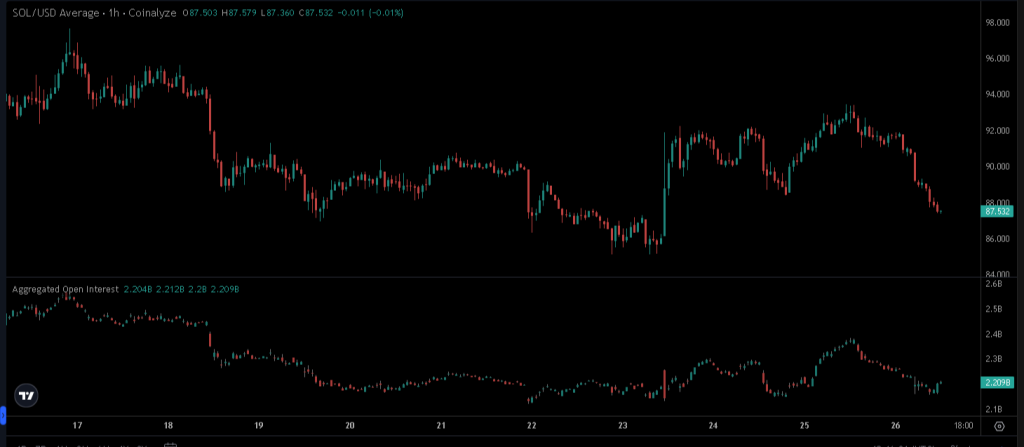
Solana (SOL) is trading at $87, still down 69% from its January 2025 peak near $295.91. The long-short ratio has skewed above 3:1 on some platforms with retail sitting 65.5% long. That is not a normal reading for an asset trading below every major moving average.

(Source – Coinalyze)
The open interest tells the real story. OI sits at roughly $2.2billion and is contracting, down, even as the long bias intensifies. Price moving up while open interest shrinks is a textbook squeeze signature. Not accumulation. Not conviction.
The math does not support a real rally here.
Discover: The best pre-launch token sales
SOL Derivatives Setup: Squeeze Risk or Breakout Fuel?
The long-short ratio is being misread by most traders watching it. It measures position count distribution, not capital weight. Longs and shorts are always structurally matched 1:1 in notional size on derivatives markets. A 3:1 long-short ratio means three times as many traders are positioned long, not that three times as much capital is long. That distinction is critical to understanding the actual risk here.
What makes the current setup unstable is the divergence between that bullish tilt and the absence of fresh capital. Sustained long bias with expanding open interest signals conviction. Sustained long bias with shrinking open interest signals a squeeze in progress, shorts being forced out, not bulls stepping in. The neutral funding rate of 0.0038% per 4-hour period confirms it: this is short covering, not new long entries.
On February 28, the largest single liquidation event pushed SOL to a 52-week low of $77.91, per exchange data. Short liquidations on March 5 totaled $2.58M, 75.6% of total liquidations, against just $0.83M in long liquidations. That 3:1 liquidation skew mirrors the ratio skew almost exactly. The squeeze mechanics are already running.

(Source – SOLUSD, TradingView)
Key technical levels define the binary. The 200-day moving average sits near $150 , structurally far above the current price and representing the ceiling of any meaningful recovery. Near-term, the Changelly model places April channel resistance at $102.51, with $100.37 as the lower bound of that zone. Below current price, the $77.91 February low is the last structural floor before open air.
The bull scenario: price clears $90–$92 with expanding open interest, funding rates tick positive, and the long bias becomes self-fulfilling as momentum traders pile in. SOL’s high-beta profile means a confirmed breakout accelerates fast, similar derivatives setups in other L1s have produced 20–30% moves within days once squeeze momentum flips to genuine accumulation.
The bear scenario: price stalls at resistance, overleveraged longs begin unwinding, and the same reflexivity that would accelerate upside now cascades downside. The Fear & Greed Index at 9, Extreme Fear, alongside a 65.5% long reading, puts the current positioning in the warning zone for pullbacks, as analysts describe it. A breach of $80 triggers the next liquidation cluster.
The long-short ratio is a pressure gauge. Right now it is elevated. That pressure resolves through continuation or liquidation, and without open interest expansion, the liquidation path carries a higher probability. Regulatory developments in crypto derivatives oversight also remain a macro overhang for leveraged positioning across the sector.
Discover: The best pre-launch token sales
Bitcoin Hyper Targets Early Mover Upside as Solana Tests Key Levels
While Solana navigates an unstable derivatives setup with no structural confirmation of reversal, smart money is rotating into Bitcoin Hyper, a Bitcoin-native L2 infrastructure project designed to bring EVM-compatible execution speed to BTC liquidity without wrapped token exposure.
The project differentiates itself through sub-second finality on a Bitcoin-settled chain, targeting the DeFi and perpetuals market currently dominated by Solana and Ethereum L2s. Its presale has raised $5.9M to date, with the current token price at $0.0115 and staking APY locked at 108% for early participants.
The presale window closes before the public DEX listing, which historically represents the highest-risk, highest-return entry point for infrastructure plays. Year-end SOL forecasts ranging from $250–$300 reflect broader L1 recovery expectations — but early-stage infrastructure projects with fixed presale pricing offer asymmetric upside independent of SOL’s near-term squeeze resolution.
Join the Bitcoin Hyper Presale Now
This article is for informational purposes only and does not constitute investment advice. Cryptocurrency investments carry significant risk, including total loss of capital. Always conduct your own research before making any financial decisions.
The post Solana Long-Short Ratio Signals Unusual Derivatives Positioning appeared first on Cryptonews.


Borrowers can pledge Bitcoin or USDC as down payment collateral without triggering a taxable event.
Coinbase and Better Home & Finance announced a partnership on Thursday to offer token-backed mortgages. The product aims to expand access to homeownership while carrying the same Fannie Mae backing as other conforming mortgages.
Qualifying Americans can now pledge Bitcoin or USDC as collateral to fund their cash down payment, securing a standard conforming mortgage without liquidating their digital assets or potentially triggering a taxable event.
How It Works
Instead of needing to come up with cash for the down payment, borrowers pledge their crypto holdings as collateral for a separate loan that covers the down payment. The result is two loans at closing: a standard Fannie Mae mortgage on the home, and a second loan secured by the pledged crypto. Both loans share the same interest rate and amortization term, so the borrower manages a single combined monthly payment — a structure the companies describe as a market first.
The mortgages are designed in accordance with Fannie Mae guidelines and structured as standard conforming loans, which the companies say will enable significantly lower interest rates than those traditionally associated with token-backed loans.
No Margin Calls
If Bitcoin’s value drops, the mortgage terms remain unchanged, and no additional collateral is required. Market movements alone never trigger liquidation. Collateral is only at risk of liquidation in the event of a 60-day payment delinquency, similar to conforming mortgages.
For borrowers who pledge USDC, the collateral earns rewards that can help offset mortgage payments, enabling borrowers to reduce their net effective interest rate.
Coinbase One members who close a crypto-backed or regular mortgage through Better are eligible for a rebate worth 1% of the mortgage value, capped at $10,000, to cover closing costs and fees.
Why It Matters
For decades, the path to homeownership has required Americans to sell assets, liquidate investments, or withdraw retirement savings to cover a cash down payment — often triggering capital gains taxes or early withdrawal penalties. Market reports suggest 52 million American adults, or roughly 20% of the adult population, have owned digital assets.
Until now, borrowers have not been able to get credit for those assets in the traditional mortgage underwriting process without first liquidating them. Crypto-backed mortgages change this by allowing onchain wealth to translate into real-world access, expanding the pathways to homeownership while preserving long-term investment positions.
Better CEO Vishal Garg said the partnership “introduces a new pathway to realizing the American Dream for the 52 million Americans who own digital assets.”
The companies plan to expand eligible collateral types over time to include tokenized equities, fixed income, and other tokenized real estate assets, pending market and regulatory conditions.
This article was written with the assistance of AI workflows. All our stories are curated, edited and fact-checked by a human.
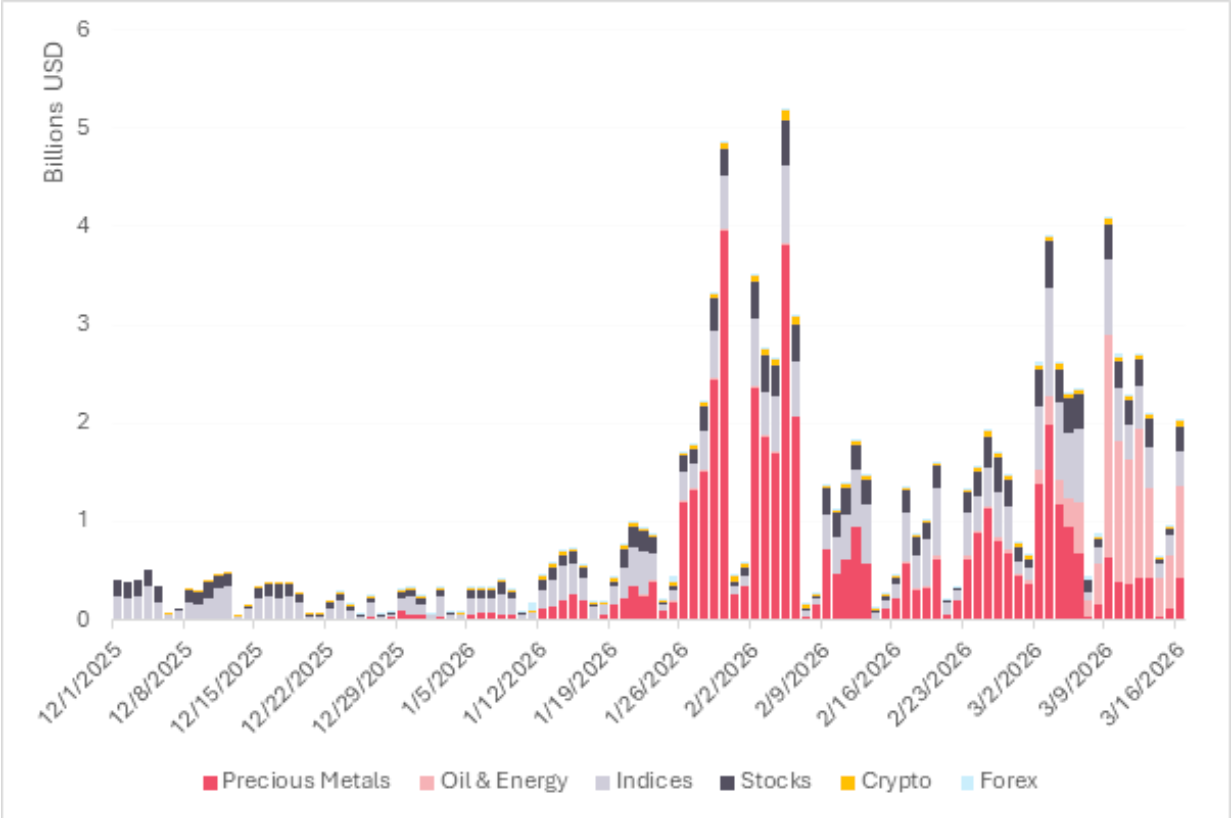
Onchain perpetual futures linked to real-world commodities like precious metals and oil have surged in trading volume, signaling an investor rotation from altcoins to commodity-linked digital assets, according to a report published Thursday by digital asset bank Sygnum.
Trading volume for oil and precious metals perpetual futures markets on the Hyperliquid decentralized exchange (DEX) accounts for over 67% of HIP-3 contracts in Q1 2026, also known as “Builder-Deployed Perpetuals,” on the Hyperliquid platform, according to the report.
Previously, indexes accounted for about 90% of HIP-3 trading activity, but this has fallen to about 17%, according to Sygnum.

Weekend HIP-3 trading activity has surged by about 9x since January 2026, the report said, adding, “This is likely due to an uptick in crypto-native traders rotating into traditional assets as the broader altcoin market continues to underperform.”
Lucas Schweiger, Sygnum digital asset ecosystem research lead, told Cointelegraph that this shift toward onchain digital assets is corroborated by a 250% year-over-year surge in the market cap of tokenized real-world assets (RWAs).
There are about $23 billion in tokenized real-world assets that are traded on permissionless blockchain networks at the time of this writing, he said.

He also said that traders are treating altcoins as “leveraged BTC proxies.” Schweiger told Cointelegraph:
“That creates an environment where crypto-native capital naturally gravitates toward traditional asset perps that can be traded through the same wallet, using the same margin, just a different trade.”
The ongoing war in the Middle East and the disruption to energy infrastructure have caused oil prices to spike, while many altcoins are already down 80-90% below their all-time highs, according to Sygnum.
Related: Bitcoin leads, altcoin indicators drop to intriguing lows: Time for an altseason?
Recessionary concerns mount as Middle East war drags on
The war between the United States, Israel and Iran has disrupted critical energy infrastructure across the Middle East, causing global oil prices to spike to a high of about $120 per barrel.
Oil prices have whipsawed since the start of the conflict, rising or falling in response to comments made by US President Donald Trump and the Iranian government or ongoing developments in the geopolitical crisis.
If the price of oil remains above $100 per barrel in 2026, it will cause inflation to spike, according to Nic Puckrin, market analyst and founder of the Coinbureau media channel.
Traders are still pricing in a potential de-escalation or a quick end to the conflict, but Puckrin warned they may be in for a “rude awakening ”if the crisis persists and higher inflation derails any hopes of further interest rate cuts in 2026.

Since the start of the conflict on February 28, the odds of a US recession have surged to 36% on the Polymarket prediction market platform.
The US economy now has a near 50% chance of entering a recession in 2026, according to ratings agency Moody’s.
Magazine: Bitcoin’s ‘narrative vacuum,’ Ethereum now inevitable: Trade Secrets
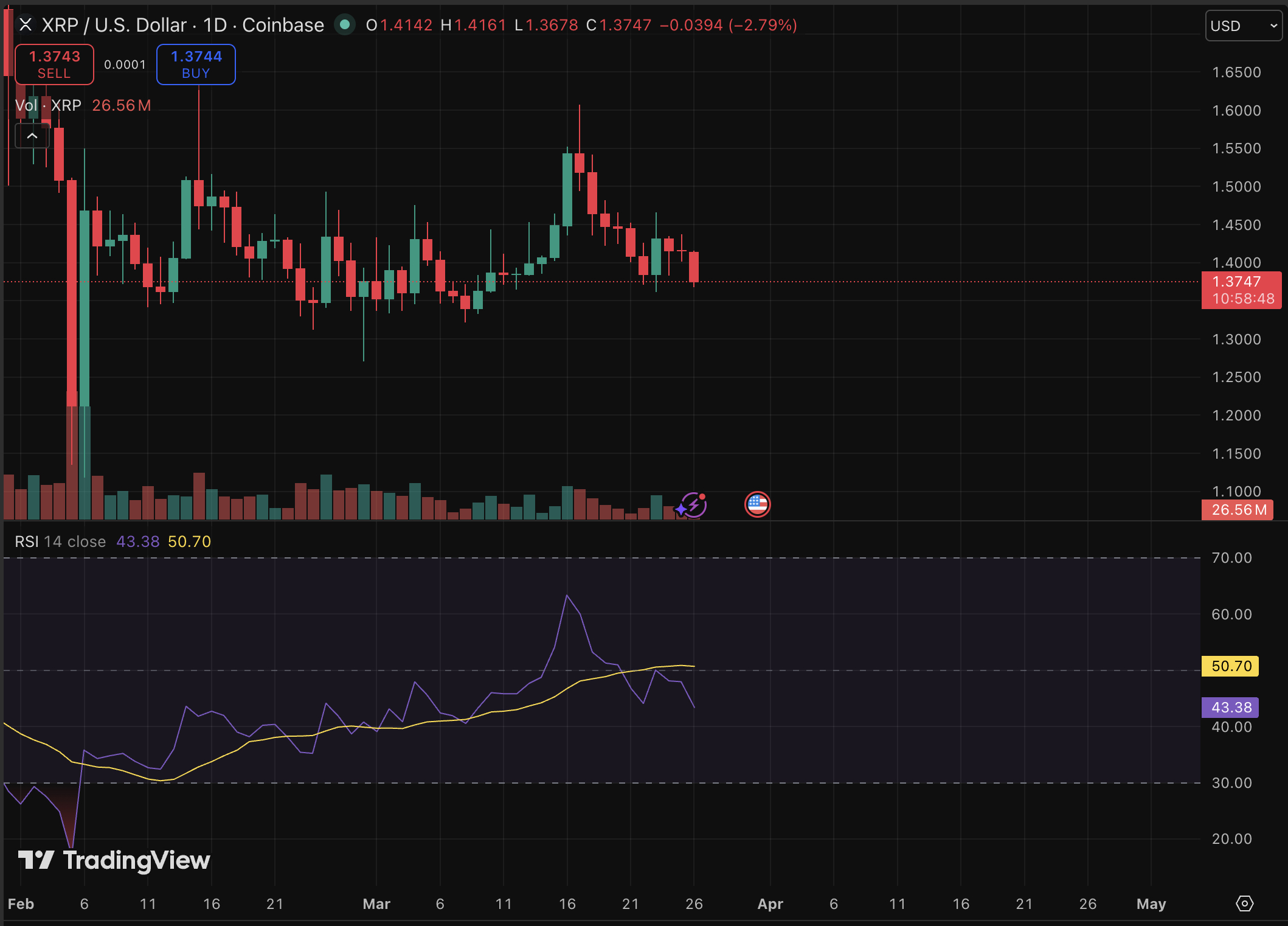
XRP price is trading at $1.37, down as much as 3.1% in the last 24 hours, and the frustrating part is that none of the recent bullish prediction and catalysts have mattered.
Goldman Sachs became the largest XRP ETF buyer. Mastercard integrated Ripple into its payments program on March 11. Whales accumulated 1.3 billion XRP in early March. The price barely flinched. But one regulatory event could change all of that, and it’s hanging by a thread in the Senate.
The CLARITY Act would formally classify XRP as a digital commodity under federal law, placing it on the same statutory footing as Bitcoin and Ethereum. The bill cleared the House 294–134 with bipartisan support, but has stalled in the Senate over a stablecoin yield dispute.
Regulatory uncertainty continues to weigh on the broader crypto market, and Galaxy Digital has warned that the bill must clear the committee by the end of April, or it is likely dead for 2026. This deadline is now just weeks away.
With macro headwinds still in play and technicals deteriorating, the XRP price structure deserves a close look before assuming a CLARITY Act bounce is already priced in.
Discover: The best pre-launch token sales
XRP Price Prediction: Can Ripple Breach $1.51 Before the Senate Deadline?
XRP rejected hard at $1.60 earlier this week, printing a bearish pin bar that triggered a 3.3% single-day drop, according to Finance Magnates analysts. Price is now consolidating at just around $1.37, with the 50-day SMA sitting at $1.43 acting as immediate overhead resistance.
RSI reads 50, neutral, but trending lower. The sentiment dashboard shows 26 of 30 technical indicators flashing bearish.

The critical floor is at $1.27, the 23.6% Fibonacci retracement level. A defense of that level opens a path back toward $1.51. Failure sends price toward $1.11–$1.13, a rangeanalysts are actively targeting on the downside.
The longer-term bull thesis, Elliott Wave targets of $5 then $27, depends entirely on legislative clarity materializing before institutional flows rotate elsewhere. That’s a meaningful “if.”
Discover: The best crypto to diversify your portfolio with
Bitcoin Hyper Attracts Early Movers as XRP Tests Key Support
For those watching XRP stall below resistance while a Senate deadline looms, the risk/reward calculus shifts. At the current market cap, a 2x from XRP requires billions in new capital. Even the most aggressive XRP targets remain constrained by its existing scale. Early-stage infrastructure plays offer a different entry profile.
Bitcoin Hyper ($HYPER) is positioning as the first-ever Bitcoin Layer 2 with Solana Virtual Machine (SVM) integration, combining Bitcoin’s security with transaction throughput that its developers claim surpasses Solana itself. The project targets Bitcoin’s three core limitations: slow finality, high fees, and absence of programmable smart contracts.
Wow! Now this looks like it'll lead somewhere nice. — Bitcoin Hyper (@BTC_Hyper2) March 26, 2026

Bitcoin just found its fast lane.  https://t.co/VNG0P4GuDo pic.twitter.com/ayZQyRm7m3
The presale has raised more than $32 million at a current token price of $0.0136, with staking available at high APY for early participants.
This article is for informational purposes only and does not constitute financial advice. Crypto assets are volatile. Always do your own research before investing.
The post XRP Price Prediction: Ripple To Run Once Clarity Act Passes? appeared first on Cryptonews.


The integration connects the dominant gold-backed token to BNB Chain’s RWA ecosystem amid a volatile stretch for spot gold prices.
Tether announced Wednesday that its tokenized gold product, XAU₮, is now available on BNB Chain, expanding the token’s reach to the third-largest decentralized finance (DeFi) ecosystem by total value locked (TVL).
Each XAU₮ token represents one fine troy ounce of physical gold held in Swiss vaults as a London Good Delivery bar. The token is issued by TG Commodities under El Salvador’s Digital Asset Issuance Law.
The move comes at a turbulent moment for gold markets. Spot gold is trading at roughly $4,400 per ounce, well below its all-time high of approximately $5,589 hit in January but still sharply higher year-over-year. Gold surged 64% in 2025, its largest annual gain in 40 years, as investors piled into safe-haven assets amid geopolitical tensions and trade uncertainty.
That rally fueled explosive growth in tokenized gold. The sector crossed $4 billion in market value in January, though the sector remains dominated by just two products, XAU₮ and PAXG, which control more than 95% of the market.
BNB Chain’s RWA Play
The expansion positions BNB Chain to capture more real-world asset activity.
Nina Rong, executive director of growth at BNB Chain, said the integration “extends what is already the second-largest RWA ecosystem by TVL” and gives users “a trusted, gold-backed asset they can use across DeFi without friction.”
Tether also said it has integrated XAU₮ via the USDT0 network, a cross-chain infrastructure layer that enables unified liquidity across blockchains.
Growing Competition
The listing comes as the tokenized gold sector faces growing scrutiny over its concentrated structure. The World Gold Council recently proposed shared infrastructure for tokenized gold products, arguing that the high barriers to entry, including the need to independently build custody relationships, compliance pipelines, audit frameworks, and redemption logistics, limit competition and hamper fungibility.
New entrants are also challenging the duopoly. In January, DeFi protocol Theo launched a yield-bearing tokenized gold product called thGOLD, designed to generate returns on idle gold exposure, something neither XAU₮ nor PAXG currently offers natively.
“People understand gold. They trust it because it has held value for millennia,” said Tether CEO Paolo Ardoino. “With XAU₮, we are not changing what gold is; we are making it usable in a modern financial system.”

The UK has sanctioned the operator of one of Cambodia’s largest scam compounds, and a major crypto-based Southeast Asia marketplace that sells stolen personal data to traffickers.
The measures are part of a wider international effort and seeks to protect UK residents from being scammed, aid Cambodia in its crackdown, and help stop human rights abuses.
The newly sanctioned firm Legend Innovation Co, and its director, Eang Soklim, ran a compound called #8 Park. The facility is believed to be the country’s largest such compound and can house up to 20,000 trafficking victims.
This compund is connected to the South Asian conglomerate Prince Group and its head, Chen Zi, who was arrested and extradited to China earlier this year.
The sanctions also targeted two of Chen’s allies, Thet Li, and Hu Xiaowei.

Read more: Cambodia has deported 48K foreigners since scam center crackdown began
One of the largest crypto-based criminal marketplaces, Xinbi, was also sanctioned.
Xinbi sells stolen personal data and satellite equipment to traffickers and has helped launder crypto assets stolen by North Korea.
The UK said the sanctions “will isolate the platform from the legitimate crypto ecosystem, significantly disrupting its operations by affecting its ability to send and receive cryptocurrency transactions.”
Crypto analytics firm Elliptic claims that Xinbi’s inflows have reached over $19.7 billion.
BSquare Technology, the sister firm of a Prince-linked crypto exchange BYEX, was also sanctioned today, alongside a Myanmar-based triad leader, and the wife of a Prince Group operator.
As a result of the latest sanctions, a number of London properties will be frozen. They join assets frozen as a result of previous action against the network, including a £100 million ($133 million) office block, two mansions, and a helicopter.
Joint effort to stop human trafficking scam networks
According to a UK government press release, “Across Southeast Asia, scam centers are using sophisticated schemes, including scams in which people are lured into fake romantic relationships, to defraud victims on an industrial scale, including in the UK.”
It added, “Today’s sanctions will have an immediate effect, further immobilising this scam network and its financial enablers, who have profited from the exploitation of vulnerable people.”
Read more: Billion-dollar scammer Chen Zhi arrested in Cambodia, extradited to China
Last month, Cambodia claimed to have deported over 48,000 foreign individuals recovered from scam center raids. Local authorities also claim to have targeted 2,500 compounds so far.
The government’s crackdown followed mounting international pressure from countries including China, the US, and South Korea.
Indeed, China has been busy executing scam center leaders, while the UK and the US sanctioned the Prince Group last year. This in turn led to the closure of the Prince Group-linked crypto exchange BYEX.
Got a tip? Send us an email securely via Protos Leaks. For more informed news and investigations, follow us on X, Bluesky, and Google News, or subscribe to our YouTube channel.
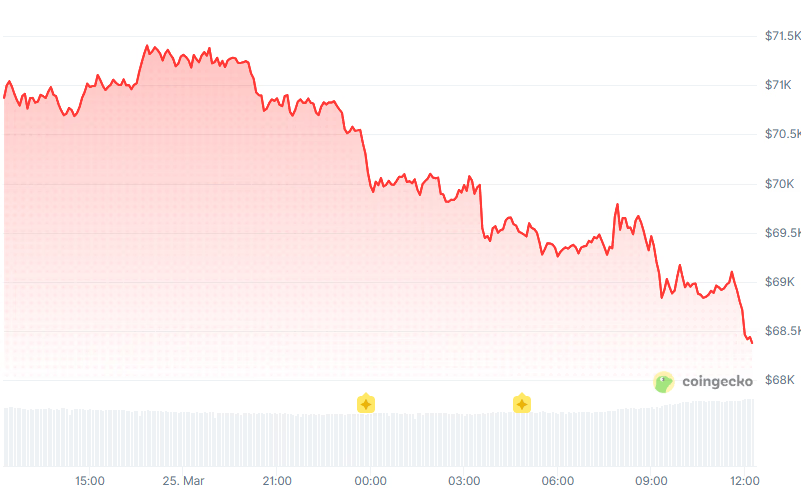
Major altcoins plunge, with ETH, SOL, and XRP dropping 5%.
Crypto markets sold off sharply on Thursday as oil surged back above $93 per barrel after U.S.-Iran peace talks stalled, dragging risk assets lower across the board.
Bitcoin (BTC) is trading at around $68,400, down 3.5% over the past 24 hours. ETH and SOL slipped 5% to $2,050 and $87, respectively. Meanwhile, Ripple (XRP) dropped 4.5%.

Total crypto market capitalization decreased 3.2% to $2.43 trillion, according to Coingecko.
ETF Flows
Spot Bitcoin ETFs posted net inflows of $7.8 million on Wednesday, with Fidelity’s FBTC leading the charge with $83 million. However, that was mostly offset by $70 million in outflows from BlackRock’s IBIT, according to SoSoValue.
Ethereum ETFs continued to underperform, recording net outflows of $8 million, led by BlackRock’s ETHA, with $33 million in withdrawals.
Big Movers
All of the Top 100 digital assets posted gains over the last 24 hours.
SIREN and MemeCore (M) are today’s biggest losers, plunging 30% and 13%, respectively.
Around 97,000 leveraged traders were liquidated for $305 million in the past 24 hours, according to CoinGlass. Bitcoin accounted for $93 million, while ETH made up $104 million.
Looking ahead, two catalysts loom on Friday: the PCE inflation report and the expiration of Trump’s five-day window for diplomacy with Iran.
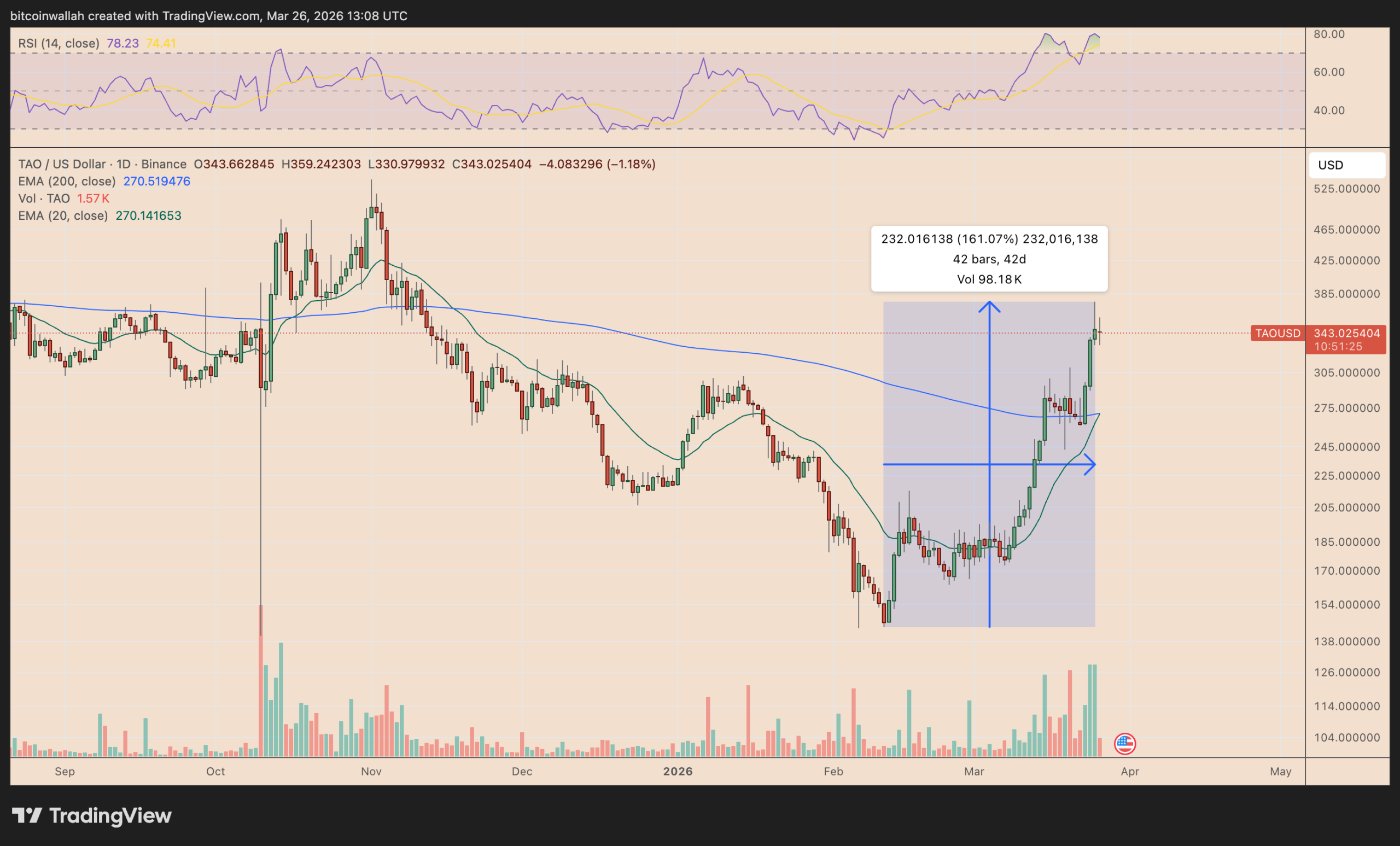
The latest 160% rally in Bittensor (TAO) shows signs of exhaustion as it forms a golden-cross pattern on the chart that previously preceded steep corrections.

Key takeaways:
-
TAO prints a golden cross that has preceded 40% drawdown on average in the past.
-
Social volume for Bittensor is high, but retail euphoria remains muted.
TAO price risks 40% drawdown in the coming weeks
As of Thursday, March 26, TAO’s 20-day exponential moving average (20-day EMA, the green line) was crossing above its 200-day exponential moving average (200-day EMA, the blue wave).
Traders typically view a short-term average moving above a long-term one as a bullish signal. In TAO’s case, however, the pattern has often appeared near local tops, sometimes triggering brief upside follow-through before reversing sharply.

In the last three similar crossovers, TAO dropped by roughly 38.50%, 32.50%, and 45.50% within five-six weeks. That amounts to an average drawdown of about 40%, raising Bittensor’s odds of falling to $200 by early May if the pattern repeats.
TAO’s downside risk is rising further as its relative strength index (RSI) has stayed above the 70 overbought threshold for weeks. The reading suggests the recent rally may have gone too far, too fast, raising the risk of profit-taking or a short-term cooldown.
Broader macro conditions add to the bearish case, as the escalating US–Iran war lifts oil prices, fuels inflation risks, and weakens the case for near-term Federal Reserve easing.
TAO rally still lacks euphoric retail sentiment
TAO’s rally has triggered a sharp increase in online discussion without the kind of euphoric sentiment that typically marks local tops, according to data resource Santiment.
Social volume across X, Reddit, Telegram, and other platforms has climbed to its second-highest level in six months, trailing only the frenzy seen near TAO’s $529 peak in November.

At the same time, sentiment remains relatively subdued, with only 1.5 positive comments for every negative one.
“This is generally a good sign that the rally can continue, with little interference from greedy traders that typically signal forming tops,” Santiment said.
Related: AI and stablecoins are winning despite 2026 crypto market slump
Still, TAO’s golden cross fractal suggests that even rallies driven by improving sentiment can turn into bull traps.
In the last three similar golden-cross setups, TAO still rallied by roughly 15.6%, 5.7%, and 42.6% before reversing lower.

That puts the average post-cross upside at around 21.30%, hinting at a short-term Bittensor price rally toward $420 or higher before exhaustion sets in.
This article does not contain investment advice or recommendations. Every investment and trading move involves risk, and readers should conduct their own research when making a decision. While we strive to provide accurate and timely information, Cointelegraph does not guarantee the accuracy, completeness, or reliability of any information in this article. This article may contain forward-looking statements that are subject to risks and uncertainties. Cointelegraph will not be liable for any loss or damage arising from your reliance on this information.

Key Takeaways
- James Quincey is departing as Coca-Cola CEO on March 31, identifying artificial intelligence’s emergence as a central reason for his exit.
- COO Henrique Braun will assume the CEO position, with Quincey believing he’s the right leader for the company’s future direction.
- Doug McMillon, who recently left Walmart’s CEO role, referenced AI similarly when explaining his December departure.
- Quincey emphasized the company requires “someone with the energy to pursue a completely new transformation of the enterprise.”
- These exits signal a growing pattern of departing executives recognizing AI as a pivotal moment requiring new leadership approaches.
James Quincey has revealed his departure as Coca-Cola’s chief executive at the close of March, identifying artificial intelligence’s accelerating development as a significant influence on his choice. The executive, who assumed leadership in 2017, shared with CNBC’s Squawk Box on Thursday that the moment had arrived to transfer authority to a leader better positioned for the organization’s future.
“My job is also to think who’s the best team to put on the field to get the next wave done,” he said. “And I concluded that, actually, it was time to put someone else on the field for the next wave of growth.”
According to Quincey, the beverage corporation achieved substantial advancement in what he described as a “pre-AI, pre-gen-AI mode,” though a fundamental transformation is now beginning. He expressed his view that the organization requires fresh leadership energy to drive what he characterized as a “completely new transformation of the enterprise.”
Henrique Braun, currently serving as COO, will assume the CEO position effective March 31. Quincey will continue his association with the corporation in the capacity of executive chairman.
This leadership transition isn’t happening in isolation. Walmart‘s former chief executive Doug McMillon offered comparable reasoning in December before his own exit. McMillon concluded his tenure exceeding ten years at the retail giant’s helm, transferring leadership to John Furner on February 1.
“With what’s happening with AI, I could start this next big set of transformations with AI, but I couldn’t finish,” McMillon told CNBC at the time.
McMillon revealed that approximately twelve months prior, he started recognizing the potential of “agentic commerce” alongside the expanded possibilities for AI-integrated retail experiences. This understanding convinced him the moment was appropriate for a leadership change.
Parallel Reasoning From Two Industry Leaders
Quincey and McMillon articulated remarkably similar rationale: the upcoming transformation phase demands a leader capable of executing the vision completely. Neither executive indicated forced departure. Both characterized their decisions as strategic positioning of appropriate leadership for the current business environment.
The retail giant has already integrated artificial intelligence throughout its business operations, spanning logistics optimization to consumer-facing applications. The organization additionally transitioned to Nasdaq listing in December, which McMillon positioned as representing the company’s technological transformation.
Coca-Cola has pursued its own artificial intelligence initiatives, though Quincey maintained discretion regarding detailed future strategies under Braun’s leadership.
Coca-Cola’s Path Forward Under New Leadership
The transition to Braun becomes official on March 31. His promotion from the chief operating officer position follows internal recognition as the logical choice to guide the company’s subsequent growth phase.
Quincey’s leadership extended nearly nine years and featured substantial investment in digital capabilities and data-centric business operations. His transition to executive chairman maintains his involvement with the organization while providing Braun autonomy to establish fresh strategic priorities.
KO shares declined modestly during trading, hovering around $68.32.

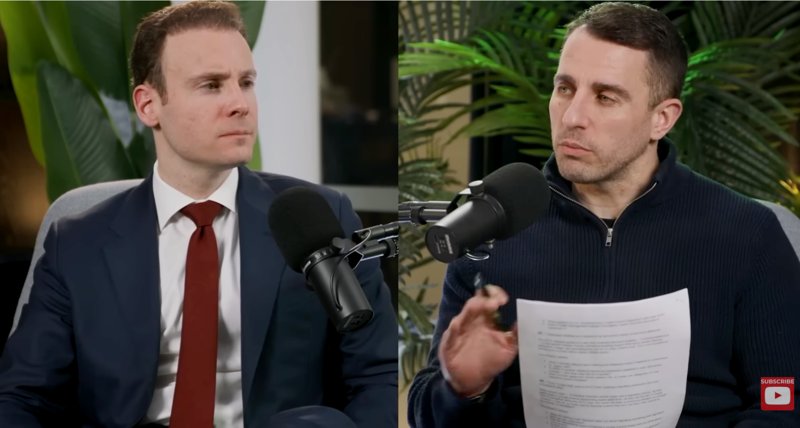
Michael Selig, chair of the US Commodity Futures Trading Commission, said blockchain could play a key role in verifying AI-generated content, contending the technology can help distinguish authentic media from synthetic outputs as concerns over misinformation grow.
During an appearance on The Pomp Podcast on Thursday, Selig was asked by host Anthony Pompliano about the use of AI-generated memes and images in markets, and whether intent matters or such content should be restricted altogether. He told Pompliano:
The private markets have solutions — blockchain technology is a great one. If you can timestamp things and make sure there’s an identifier for each meme or AI generated posts, you can verify if it’s real or generated by AI… Having these technologies here in the US is critical.
He said regulators are focused on maintaining US leadership in crypto, adding that “you can’t have AI without blockchain.”

Regarding how regulators are approaching AI agents, as autonomous trading becomes more prevalent in financial markets and authorities are being pressed to distinguish between automated tools and fully autonomous agents, and how the latter should be regulated, Selig responded:
I’m concerned that we over-regulate and strangle some of the technology here in the US… I’m taking a very much minimum effective dose of regulation approach, where we’re… making sure that we’re regulating the actors… and not the software developers. The software developers are the ones building the tools, but they’re not actually engaging in the financial transactions.
Selig said the CFTC is assessing how AI models are used in markets, emphasizing that enforcement should focus on participants engaging in financial activity.
Related: AI and stablecoins are winning despite 2026 crypto market slump
Blockchain and proof-of-personhood tools emerge for AI verification
A central challenge amid the surge in artificial intelligence use is distinguishing real content from synthetic media. Selig’s comments could be seen to reflect a broader push among policymakers and developers to use blockchain for content verification and provenance.
One approach is proof-of-personhood systems, which aim to confirm that an account belongs to a real, unique human rather than a bot. The most prominent example is Sam Altman’s World, whose World ID protocol allows users to prove their humanity without revealing personal data. The system uses encrypted biometric iris scans stored on the user’s device, though it has drawn criticism over privacy risks and potential coercion.
In March, World launched AgentKit, a toolkit that allows AI agents to prove they are linked to a verified human while interacting with online services. It integrates proof-of-personhood credentials with the x402 micropayments protocol developed by Coinbase and Cloudflare, enabling agents to pay for access while presenting cryptographic proof of human backing.
Ethereum co-founder Vitalik Buterin has proposed using cryptography and blockchain to make online systems more verifiable, including through zero-knowledge proofs and onchain timestamps that could help validate how content is generated and distributed without exposing sensitive data.
The proposals come as US policymakers weigh broader AI regulation. On March 20, the Trump administration released a national framework calling for a unified federal approach, warning that a patchwork of state laws could hinder innovation and competitiveness.
Magazine: Agent wastes 14 hours of scammers’ time, LLMs ‘poisoned’ by Iran: AI Eye

HP wants your next work PC to be an AI assistant

Premium UK chocolate company collapses into administration

Contour Ridge investment scaling Just Date


-
 Crypto World6 days ago
NIO (NIO) Stock Plunges 6.5% as Shelf Registration Sparks Dilution Worries
-

 Fashion6 days ago
Weekend Open Thread: Adidas – Corporette.com
-
 NewsBeat1 day ago
Manchester United reach agreement with Casemiro over contract clause amid transfer speculation
-

 Politics6 days ago
Jenni Murray, Long-Serving Woman’s Hour Presenter, Dies Aged 75
-

 Crypto World5 days ago
Best Crypto to Buy Now: Strategy Just Spent $1.57 Billion on Bitcoin During Fear While Early Investors Quietly Enter Pepeto for 150x Potential
-

 Crypto World5 days ago
Bitcoin Price News: Bhutan Sells $72 Million in BTC Under Fiscal Pressure, but the Smart Money Entering Pepeto Sees What the Market Does Not
-

 Tech7 days ago
inKONBINI Lets You Spend Summer Days Behind the Register
-

 News Videos17 hours ago
Parliament publishes latest register of MPs’ financial interests
-

 Sports3 days ago
Remo Stars and Kano Pillars Strengthen Survival Hopes in NPFL
-

 Business4 days ago
No Winner in March 21 Drawing as Prize Rolls to $133 Million for Next
-

 Sports3 days ago
Gary Kirsten Accuses Pakistan Cricket Board Of ‘Interference’, Mohsin Naqvi Responds
-

 Tech4 days ago
Give Your Phone a Huge (and Free) Upgrade by Switching to Another Keyboard
-

 Sports6 days ago
2026 Kentucky Derby horses, odds, futures, preview, date: Expert who nailed 12 Derby-Oaks Doubles enters picks
-

 Tech4 days ago
AI enters the chat: New Seattle dating app relies on tech to facilitate meaningful human connections
-

 Business7 days ago
DLocal: Entering 2026 At Escape Velocity
-
Business6 days ago
Columbia Sportswear enters $500 million credit agreement with JPMorgan Chase
-

 Tech5 days ago
Today’s NYT Connections Hints, Answers for March 22 #1015
-

 News Videos3 days ago
Ch 9 Financial Management Part 1 | Detailed One Shot | Class 12 Business Studies Boards 2026
-

 Business4 days ago
Will Duke Basketball Win It All? Duke Basketball Enters Second Round as Third Favorite to Claim NCAA Title
-

 Sports4 days ago
2026 Kentucky Derby horses, odds, futures, preview, date: Expert who hit 12 Derby-Oaks Doubles enters picks
You must be logged in to post a comment Login