CryptoCurrency
China seeks to shield investments after U.S. attack jolts Venezuela

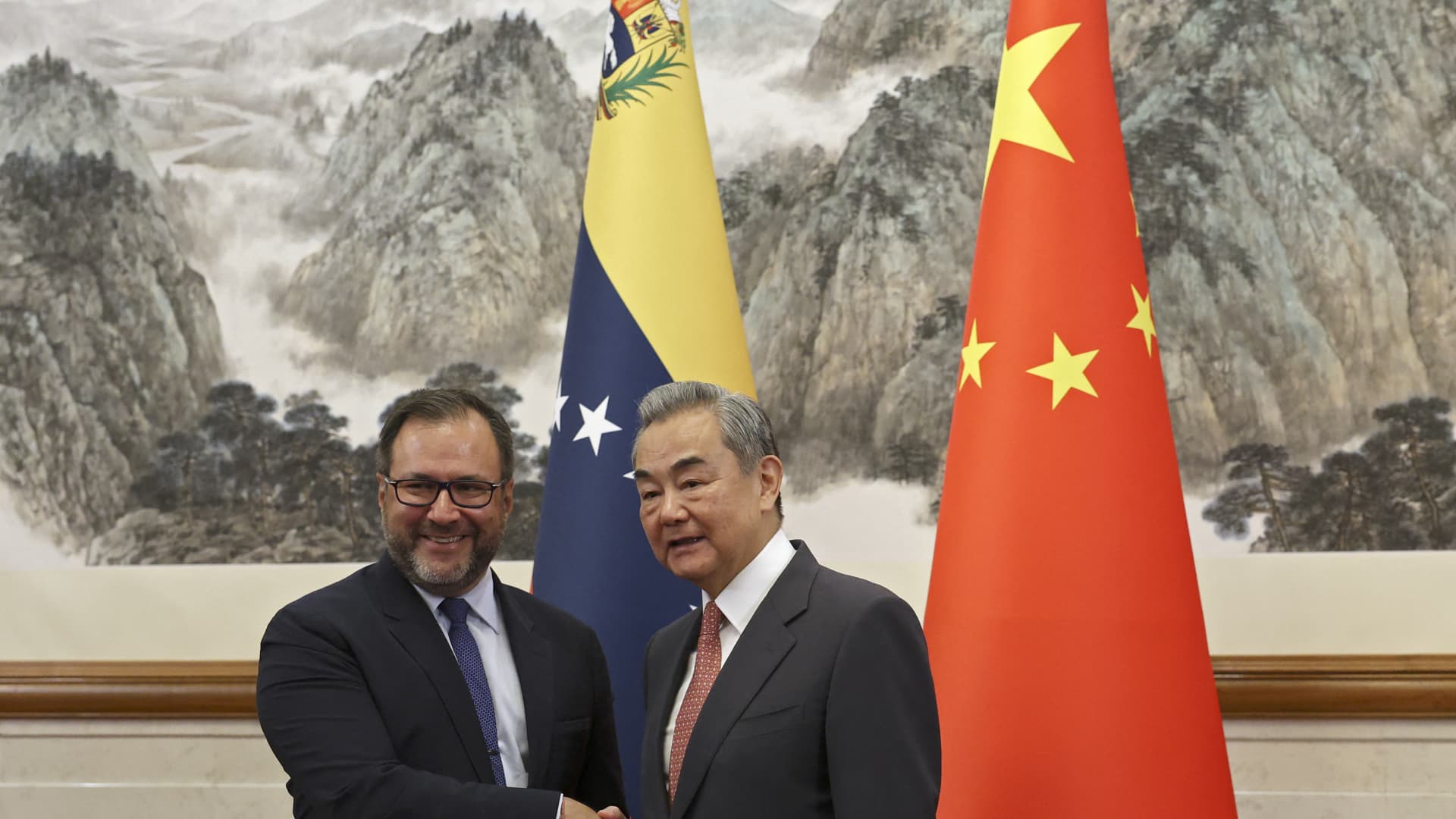
Chinese Foreign Minister Wang Yi (R) and Venezuela’s Foreign Minister Yvan Gil shake hands before their meeting at the Diaoyutai State Guesthouse in Beijing on May 12, 2025.
FLORENCE LO / POOL / AFP
BEIJING — Even as China eyes new opportunities to build global influence in the wake of the U.S. attack on Venezuela, Beijing’s immediate priority is protecting its economic interests, analysts said.
China reacted swiftly to the military strike on Saturday night, expressing shock and condemnation. Beijing subsequently called on the U.S. to release the ousted Venezuelan president Nicolás Maduro and his wife, and urged Washington to resolve the crisis through dialogue.
China’s Foreign Ministry spokesperson Lin Jian said at a press briefing Monday that China maintains “positive communication and cooperation” with the Venezuelan government and that its willingness to deepen cooperation, including on oil exports, would not change regardless of how the situation evolves.
He added that Chinese interests in Venezuela would be protected under the law.
The U.S. attack on Venezuela helps China bolster its position as a “force for stability” in the world, said Zichen Wang, a research fellow at the Beijing-based think tank Center for China and Globalization.
But Wang said the situation raises concerns for Beijing because of China’s exposure in the country.
“How this unfolds in the future is also very concerning, because China has a lot of commercial interests there,” he said, adding that the uncertainty could spill over to Chinese business across Latin America and beyond.
Beijing has made significant inroads in Latin America over the past two decades, persuading several countries, including Panama, Costa Rica, the Dominican Republic and El Salvador, to shift diplomatic recognition from Taiwan to China.
Chinese companies, mostly state-owned, have invested $4.8 billion in Venezuela over the last two decades, according to data compiled by the U.S.-based research firm Rhodium Group. Most of the deals occurred in the decade following the global financial crisis — and during the final years of former President Hugo Chávez’s rule — with a focus on energy projects.

State-owned oil giant China National Petroleum Corporation has joint ventures with its Venezuelan counterpart, Petróleos de Venezuela. In August, privately held China Concord Resources Corp. announced rare plans to invest more than $1 billion in a Venezuelan project, targeting production of 60,000 barrels of crude oil a day by the end of 2026, according to Reuters.
Protecting Chinese nationals and Chinese companies remains Beijing’s top priority, said Dong Shaopeng, a senior researcher at Renmin University of China. China’s Foreign Ministry said Monday it has received no reports of Chinese citizens being harmed by the U.S. strike.
China is likely to be wary of being dragged into this conflict, as Venezuela carries limited economic significance for China and little geopolitical proximity.
Yue Su
Principal economist, China, The Economist Intelligence Unit
Beijing also criticized what it described as bullying actions that violate another country’s sovereignty and said it opposes interference in the internal affairs of Latin American nations for any reason.
China said it follows a noninterference policy and will remain a “good friend” to countries in Latin America and the Caribbean “and does not draw ideological lines.”
“China never seeks spheres of influence, nor does it target any third party,” Lin added.
An imbalanced oil trade
China is the top destination for Venezuela crude, according to S&P Global.
But Venezuela accounted for only 2% of China’s crude oil and condensate imports in 2024, with the majority coming from the Middle East, according to figures published by the U.S. Energy Information Administration.
Imports from Iran and Iraq increased between 2023 and 2024, while those from Venezuela fell, the data showed.
“China is likely to be wary of being dragged into this conflict, as Venezuela carries limited economic significance for China and little geopolitical proximity,” said Yue Su, principal economist, China, at The Economist Intelligence Unit.
“Rather than choosing sides decisively, China’s priority has been to protect its interests, so long as partner countries do not take an explicit stance on Taiwan,” she said.

Subscribe now
China’s broader geopolitical posture remains unchanged, analysts added, including its approach to Taiwan, which Beijing considers part of its territory.
China staged live-fire drills around Taiwan last week in a massive military display, days after the U.S. announced a record-size arms package to Taiwan.
“This Venezuela episode is quite a big crisis, but it doesn’t change China’s playbook on Taiwan. It doesn’t change the expectation on what will happen between China and the U.S.,” Dan Wang, a director on Eurasia Group’s China team, said Monday on CNBC’s “Squawk Box Asia.”
What may change, she said, is Beijing’s thinking on the need to establish a legal framework for taking Taiwan, similar to how the U.S. justified Maduro’s capture with drug trafficking charges.
Against the backdrop of the U.S. attack on Venezuela, China’s high-level diplomacy continued in earnest on Monday.
Chinese President Xi Jinping met with Ireland’s Prime Minister Michael Martin — the first visit by an Irish leader in 14 years — and was set to host South Korea’s President Lee Jae Myung later in the day.
“China pulled from 6% to more than 20% of world GDP (PPP) in 15 years,” Nassim Nicholas Taleb, author of “The Black Swan,” wrote back in September. “So consider what the state of geopolitics would be in 2035.”
“In the future, discussions about war might need to happen in Beijing, not Washington.”
— CNBC’s Victoria Yeo contributed to this report.