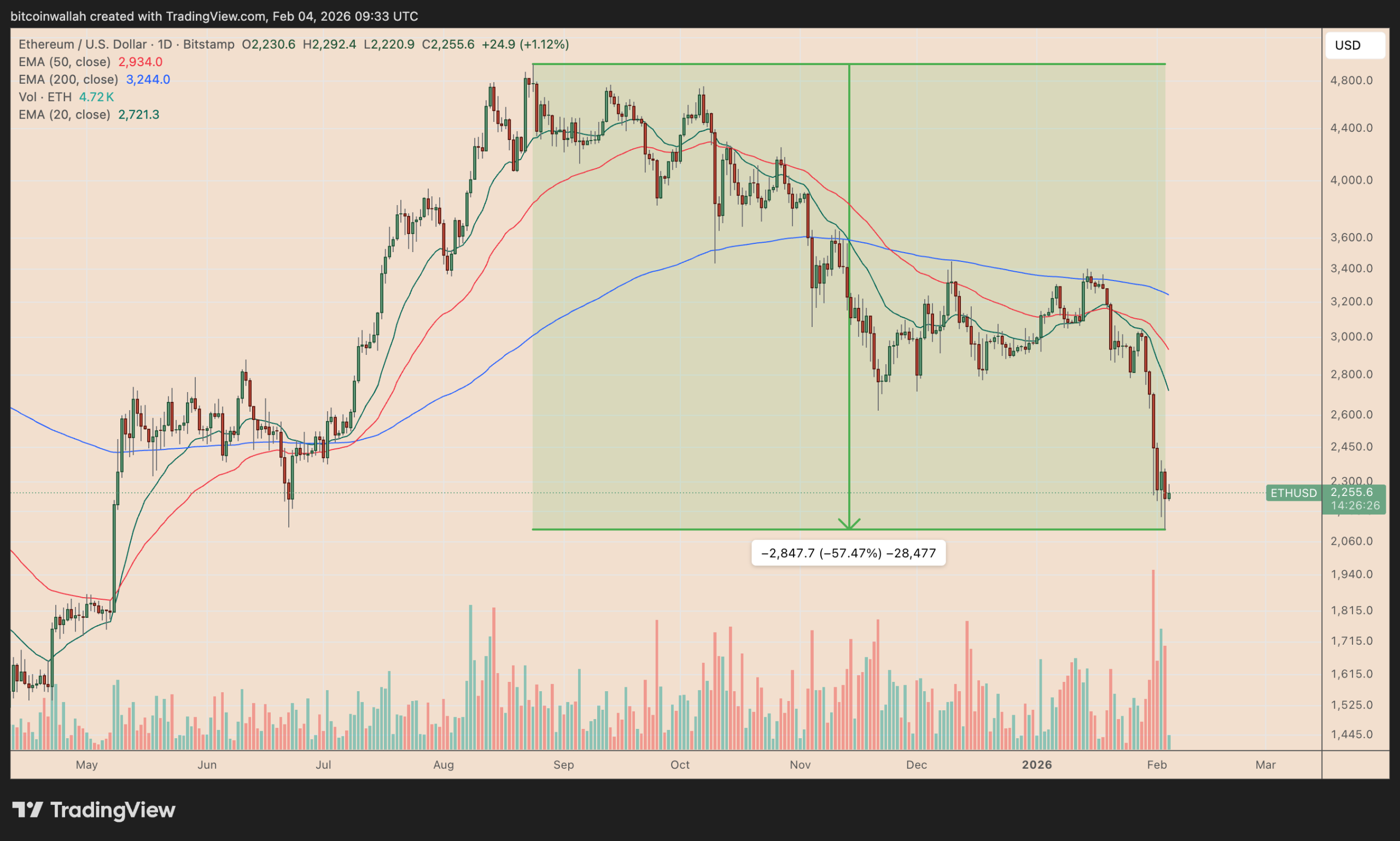
The price of Ethereum’s native token, Ether (ETH), risks sliding below $2,000 in February as a classic bearish setup plays out.
Key takeaways:
ETH breakdown keeps $1,665 downside target in focus.
MVRV bands also point to price sliding toward $1,725 or lower before a potential bottom.
ETH/USD daily chart. Source: TradingView
ETH risks declining 25% in February
As of Wednesday, ETH had entered the breakdown stage of its prevailing inverse-cup-and-handle (IC&H) pattern. This could extend a downtrend that has already erased about 60% from its August 2025 peak.
An IC&H pattern forms when price forms a rounded top and then drifts higher in a small recovery channel. It typically resolves when the price breaks below the neckline support, often falling by as much as the cup’s maximum height.
Ether broke below the inverse cup-and-handle neckline near $2,960 in January. It later rebounded to retest that level as resistance, a common post-breakdown move, only to resume its decline.
Advertisement
Ether inverse cup-and-handle. Source: TradingView
ETH’s rebound also stalled below the 20-day (green) and 50-day (red) EMAs, which acted as overhead resistance.
These confluence indicators raised ETH’s odds of declining toward the IC&H breakdown target at around $1,665, down 25%, in February or by early March.
Historically, the inverse cup-and-handle hits its projected downside target with an 82% success rate, according to a study by Chartswatcher.
From a macro perspective, Ethereum’s downside risk is increasing as traders cut back on crypto bets, worried the market could slip into a broader 2026 downturn similar to past “four-year cycle” pullbacks.
Fears of an “AI bubble” popping are also forcing traders to avoid riskier bets such as crypto.
Advertisement
Ethereum’s MVRV bands hint at $1,725 target
Ethereum’s technical downside target sat just below the lowest boundary of its MVRV extreme deviation pricing bands, currently at $1,725.
These bands are onchain price zones that show when ETH is trading below or above the average price at which traders last moved their coins.
Ethereum MVRV extreme deviation pricing bands. Source: Glassnode
Historically, ETH price plunged near or even below the lowest MVRV band before bottoming out.
That includes the April 2025 bounce, when the ETH price rose 90% a month after testing the lowest MVRV deviation band around $1,390. A similar rebound occurred in June 2018.
Therefore, Ether may decline toward $1,725 or below in February, which lines up with the IC&H downside target.
This article does not contain investment advice or recommendations. Every investment and trading move involves risk, and readers should conduct their own research when making a decision. While we strive to provide accurate and timely information, Cointelegraph does not guarantee the accuracy, completeness, or reliability of any information in this article. This article may contain forward-looking statements that are subject to risks and uncertainties. Cointelegraph will not be liable for any loss or damage arising from your reliance on this information.
The artificial intelligence revolution has captured Wall Street’s imagination, but amid the frenzy, investors may be overlooking some of the most compelling opportunities. While market attention fixates on a select few megacap darlings, a handful of established technology leaders are quietly generating substantial AI-driven revenue—without the valuation premium that comes with excessive hype. These aren’t moonshot gambles. They’re proven enterprises already monetizing artificial intelligence at scale, trading at multiples that may not reflect their true potential.
Alphabet: The Cloud and AI Engine Hiding in Plain Sight
It’s easy to pigeonhole Alphabet as simply a digital advertising powerhouse, but that perspective misses the broader transformation underway.
Google Cloud delivered explosive 48% revenue expansion in its most recent quarter, while the cloud pipeline surged 55% sequentially to reach $240 billion. The company surpassed $400 billion in annual revenue for the first time in its history. Gemini Enterprise continues to attract corporate clients, inference costs are declining, and the underlying infrastructure is expanding rapidly.
The compelling investment thesis centers on valuation discrepancy. If the market begins to assign separate multiples to Alphabet’s high-growth Cloud and AI operations versus its mature advertising segment, the current share price could prove dramatically undervalued. Today, Wall Street still treats it like a legacy digital media company rather than a diversified AI infrastructure leader.
Advertisement
Amazon: The AWS AI Infrastructure Powerhouse
While retail gets headlines, Amazon’s artificial intelligence narrative unfolds primarily through Amazon Web Services. AWS revenue expanded 20% annually in 2025, contributing to total net sales of $716.9 billion—a 12% increase. More importantly, operating income rose from $68.6 billion to $80.0 billion, demonstrating the company’s ability to maintain profitability despite aggressive infrastructure investments.
AWS has emerged as a preferred platform for enterprise AI implementation. Critics point to elevated capital expenditures, but these outlays directly support AI infrastructure buildout. Should this investment cycle translate into sustained high-margin cloud expansion, the market may be significantly underestimating Amazon’s future earnings potential by overweighting near-term spending concerns.
Taiwan Semiconductor: The Indispensable AI Infrastructure Foundation
TSMC operates somewhat below the radar compared to the chip designers it manufactures for, yet its financial performance speaks volumes. Fourth-quarter 2025 revenue climbed 20.5% in New Taiwan dollars—translating to 25.5% in U.S. dollar terms—while net income jumped 35%. This momentum stems from surging demand for AI accelerators, custom silicon designs, and sophisticated packaging technologies.
TSMC possesses an irreplaceable position in global semiconductor manufacturing. It serves as the foundational layer enabling the entire AI hardware revolution. Despite this strategic positioning, its valuation trades at a discount to many upstream chip designers. Part of this gap reflects Taiwan-related geopolitical concerns, but for investors willing to accept that risk profile, TSMC offers direct AI exposure through the industry’s most mission-critical manufacturer.
Advertisement
Alibaba: An AI Cloud Giant Hidden Behind China Concerns
Alibaba represents perhaps the most contrarian selection here—which may be precisely what makes it compelling.
Alibaba Cloud posted accelerating 34% revenue growth in the September quarter. AI-related products have delivered triple-digit revenue expansion for nine consecutive quarters. The company continues deploying its Qwen large language models throughout its ecosystem while substantially increasing infrastructure investment.
Wall Street’s skepticism stems from legitimate concerns—Chinese regulatory uncertainty, intensifying competition, and subdued consumer spending. However, these headwinds may be overshadowing the extraordinary growth trajectory of its cloud and AI division. If this momentum persists, investors may eventually revalue Alibaba as an AI infrastructure company rather than merely an e-commerce operator.
AMD: Carving Out Data Center Market Share
AMD has been methodically building credible AI presence in the data center segment. The company delivered record quarterly revenue of $10.3 billion in Q4 2025, with Data Center revenue climbing 39% to $5.4 billion.
Advertisement
The deployment of EPYC server processors and Instinct GPUs continues accelerating, with AMD securing more enterprise contracts than many analysts anticipated. While it’s not challenging Nvidia’s dominance directly, it doesn’t need to. In a market where AI infrastructure demand is expanding exponentially, multiple suppliers can thrive simultaneously.
The Bottom Line
These five companies—Alphabet, Amazon, TSMC, Alibaba, and AMD—share a critical characteristic. Each has established AI operations generating meaningful revenue, supported by strong growth metrics and valuations that haven’t fully recognized their positioning. In markets prone to momentum chasing and narrative-driven speculation, the most attractive opportunities often emerge where fundamental progress outpaces investor recognition.
Solana price fell 4% on Wednesday, moving closer towards the $90 support amid a broader market downturn triggered by hotter than expected U.S. PPI data.
Summary
Solana price fell 4% toward $90 after hotter than expected U.S. PPI data raised concerns of persistent inflation and delayed Fed rate cuts.
Market pressure increased as investors priced in a likely Fed pause, with odds above 99%, amid rising oil prices and geopolitical tensions.
Despite the decline, strong stablecoin supply and continued ETF inflows provide underlying support for a potential rebound.
According to data from crypto.news, Solana (SOL) price fell to an intraday low of $90.4, bringing its market cap lower to $51.6 billion.
The 7th largest crypto asset by market capitalization slipped after the U.S. Bureau of Labor Statistics revealed data that showed hotter than expected inflation at the producer level. Notably, PPI rose by 0.6% in February while core PPI climbed 0.3%, both figures overshooting economist forecasts and signaling persistent inflationary pressures.
Advertisement
The data comes just ahead of the Federal Reserve rate cut decision scheduled for 2:30 P.M. today, where the market largely expects the Fed to hold interest rates steady. Odds of a pause are as high as 99% on the CME Fed Watch tool.
The Fed is also likely to delay any rate cuts this year, especially with surging oil prices which came as a result of a blockade at the Strait of Hormuz amid the U.S.-Iran war.
Despite the bearish market scenario, there remains a few key fundamental metrics that could support Solana price action. Notably, the total stablecoin supply on the Solana network hit a record high of around $15.7 billion earlier this week.
Advertisement
A strong stablecoin supply means there is significant sidelined capital ready to buy the dip and often precedes a period of high liquidity and buying pressure.
Adding to this, spot Solana ETFs have continued to record back-to-back inflows for the sixth straight week, drawing in over $127 million in the funds.
Solana price analysis
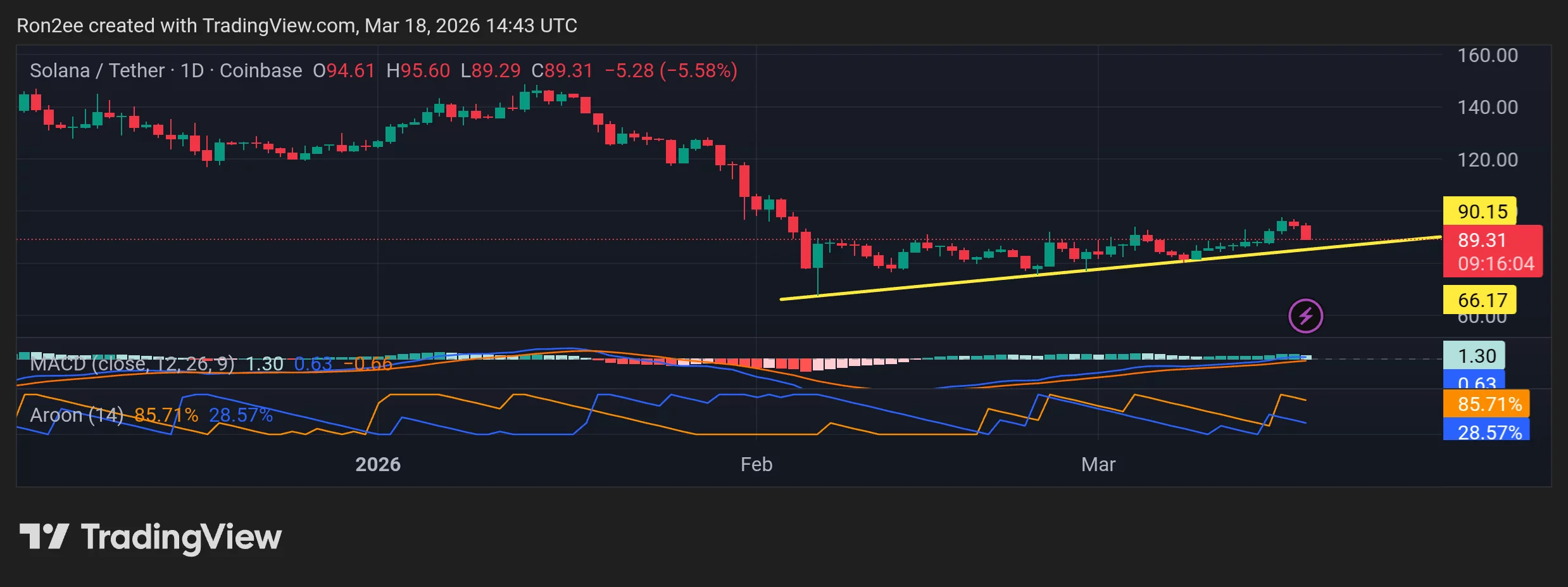
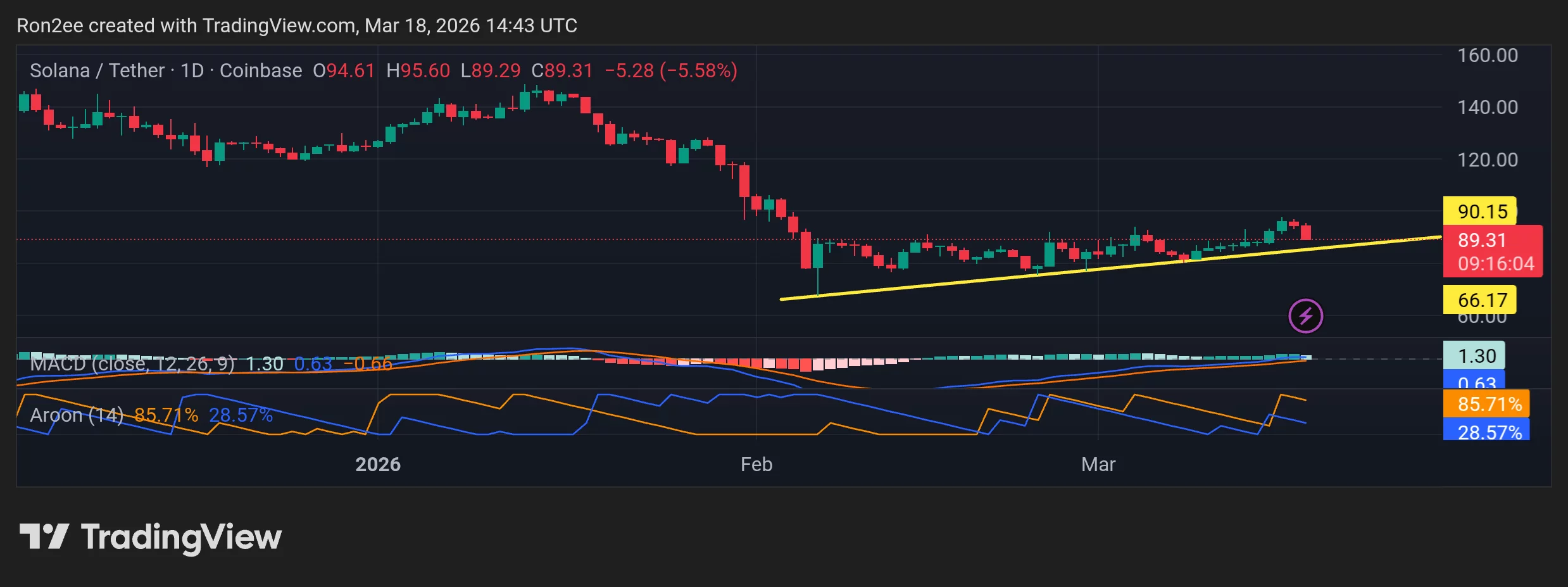
On the daily chart, Solana price has respected an ascending trendline that has been serving as a dynamic support since early February this year.
SOL/USDT price chart – March 18 | Source: crypto.news
Technical indicators like the MACD lines have pointed upwards, while the Aroon Up at 85.71% stood significantly higher above the Aroon Down.
Hence, Solana price could rebound back above the $90 support even if it were to drop temporarily due to the ongoing market downtrend observed at press time.
Advertisement
However, a drop below $80, the next key psychological support level, could invalidate the current bullish structure and lead to a deeper correction.
At press time, SOL price was trading at $89, down over 5% on the day.
Disclosure: This article does not represent investment advice. The content and materials featured on this page are for educational purposes only.
Canada’s FINTRAC has yanked 23 crypto MSBs from its registry in a single sweep, escalating an AML crackdown that now targets exchanges, ATMs and offshore operators alike.
Summary
FINTRAC revoked the registrations of 23 money services businesses offering crypto services, citing failures to respond to information requests, keep records updated, or meet AML eligibility conditions.
The move follows Finance Minister François‑Philippe Champagne’s February order to “mobilize resources” against illicit finance and high‑risk virtual currency businesses, including crypto ATMs and foreign operators.
Ottawa has already signalled its direction with a record C$176.96 million fine against Cryptomus operator Xeltox in 2025, and Tuesday’s sweep suggests systemic, not one‑off, enforcement is now the norm.
Canada’s financial intelligence agency delivered its most sweeping single-day enforcement action against the cryptocurrency sector on Tuesday, revoking the registrations of 23 money services businesses (MSBs) offering crypto-related services in one coordinated move. The action by the Financial Transactions and Reports Analysis Centre (FINTRAC) represents a significant escalation in Ottawa’s campaign to bring virtual currency operators into line with the country’s anti-money laundering and counter-terrorist financing framework.
All 23 of the affected businesses are registered as MSBs under Canada’s Proceeds of Crime (Money Laundering) and Terrorist Financing Act (PCMLTFA), and all offer cryptocurrency-related services. Two of the companies have no physical presence in Canada: Finax, operating out of Bratislava, Slovakia, and Commerce Plex, registered in Luton, England — both of which also provide currency exchange and money transfer services alongside crypto. According to FINTRAC’s official website, grounds for revocation include failure to respond to information requests in a timely manner, non-compliance with registration eligibility conditions, failure to update relevant records, and prior convictions related to money laundering or terrorist financing.
Advertisement
The mass revocation did not emerge in a vacuum. In February 2026, Finance Minister François-Philippe Champagne wrote directly to FINTRAC’s director ordering the agency to “mobilize resources” in response to the serious threat posed by illicit finance — explicitly calling on the Centre to take “immediate action” in supporting law enforcement partners and financial institutions. On Tuesday, Champagne characterised the enforcement sweep as a “significant acceleration of enforcement pace,” adding that the government would “continue to maintain this momentum”.
The minister’s public statement left little ambiguity about the government’s broader intent: “Our government will continue to monitor and pursue new measures to address risks posed by virtual currency businesses, such as cryptocurrency MSBs and crypto ATMs, which can be used to facilitate money laundering and fraud.”
The action follows a string of high-profile FINTRAC enforcement decisions against crypto operators. In October 2025, FINTRAC levied a C$176.9 million administrative monetary penalty against Xeltox Enterprises Ltd., operating as Cryptomus — the largest fine in the agency’s history — for 2,593 separate violations of the PCMLTFA, including failure to report over 1,500 large virtual currency transactions and repeated breaches of federal directives requiring the reporting of transactions linked to Iran. That case, according to law firm Bennett Jones, “highlights the regulatory perils that face cryptocurrency exchanges that operate in Canada outside the law”.
Advertisement
FINTRAC’s mandate covers a broad swathe of the financial sector. Registered MSBs handling crypto are required to implement customer due diligence, submit transaction reports, maintain records, and establish written AML compliance frameworks approved by senior management. Failure to comply can result in administrative penalties, removal from the MSB registry, or in the most serious cases, criminal exposure.
Canada has for several years positioned itself as a jurisdiction that treats virtual asset services as an integral part of its AML-regulated financial sector — with crypto exchanges required to register and comply at the federal level since June 2020. But Tuesday’s mass revocation suggests that Ottawa’s appetite for enforcement is moving beyond isolated penalties toward systemic sweeps. With crypto ATMs, cross-border operators, and foreign-registered entities explicitly named as priorities, the message from FINTRAC and the Finance Ministry is unambiguous: registration alone is no longer sufficient cover for those unwilling to meet Canada’s compliance bar.
Netflix has rounded out the main cast of its upcoming FTX collapse drama The Altruists, revealing six actors who have been chosen to appear alongside Julia Garner’s Caroline Ellison and Anthony Boyle’s Sam Bankman-Fried (SBF).
The series will reportedly cover the massive growth of SBF’s crypto exchange between 2019 and 2021 and its spectacular collapse in 2022 which wiped billions of dollars from the crypto market.
Netflix says the series will follow SBF and Ellison, “two hyper-smart, ambitious young idealists who tried to remake the global financial system in the blink of an eye… before they were accused of stealing $8 billion.”
Here are the major cast members announced so far.
Advertisement
Changpeng Zhao
Terry Chen will be playing the role of Changpeng Zhao.
Chen starred in the 2000 comedy Almost Famous and played a corrupt Chinese businessman in season two of House of Cards. The 51-year-old will be stepping into the shoes of SBF’s biggest rival.
Zhao and SBF met on occasions during FTX’s heyday, but Zhao would later contribute to the firm’s collapse when he announced that his crypto exchange Binance would liquidate the FTX-linked asset “FTT.”
Dr. George Lerner
William Mapother will be playing the role of FTX’s company therapist, Dr. George Lerner.
Lerner was SBF’s psychiatrist during the FTX years and was tasked with coaching 100 of the firm’s employees through its most chaotic period. Some employees reportedly wouldn’t share everything they knew with Lerner out of fear that SBF would find out.
Mapother’s character reportedly “knew SBF best,” and would help him to explore his “seeming rejection of earthly pleasures.”
Advertisement
Mapother has previously starred in the TV series Lost, and is known for his work in The Mentalist, and In The Bedroom. He is also Tom Cruise’s cousin, and co-founded the film financing firm Slated.
Sarah Fisher Ellison
Dirty Dancing and Ferris Bueller’s Day Off star Jennifer Grey has been cast to play Caroline Ellison’s mother, Sarah Fisher Ellison.
Ellison is a senior lecturer at the MIT Department of Economics, who, alongside her husband, struggled to grasp the damage their daughter caused while working for FTX and pleaded for leniency in her sentencing.
Duncan Rheingans-Yoo
Canadian actor Hudson Williams shot to fame in the hit hockey series Heated Rivalry, and will play the role of Duncan Rheingans-Yoo.
Advertisement
The full lineup of major roles in the Netflix FTX drama The Altruists.
Rheingans-Yoo co-founded crypto trading firm Modulo Capital, which received $475 million from FTX shortly before the exchange collapsed. Fellow co-founder Lily Zhang will be played by Marianna Phung, who starred in the series Poly is the New Monogamy.
A bankrupt FTX would later claw back $460 million from the firm.
Sam Bankman-Fried
The most important role in the series goes to Anthony Boyle, who will play FTX’s curly-haired CEO.
Boyle has starred in House of Guinness, Manhunt, Say Nothing, and featured in the Tolkien and Tetris movies.
Advertisement
SBF oversaw the operation that misappropriated billions of dollars worth of customer funds and used them to make investments through FTX’s sister firm, Alameda Research.
These days, SBF is spending his days serving out a 25-year sentence in jail while trying, and failing, to secure a pardon from US President Donald Trump.
Starring alongside Boyle will be Julia Garner, playing the role of SBF’s romantic partner and former FTX exec, Caroline Ellison.
Advertisement
Ellison and SBF worked together at trading firm Jane Street before the pair moved on to FTX. Ellison helped SBF grow his empire until it collapsed and she would later testify against him in court.
She said that for the duration of their relationship, SBF was her boss. At one court trial, she claimed, “I wanted more from our relationship but often felt he was distant or not paying much attention to me.”
Garner recently starred in the Oscar-nominated horror Weapons, and is known for her work in Ozark, Marvel’s Fantastic Four: First Steps, and The Assistant.
Advertisement
Julia Garner discusses The Fantastic Four: First Steps.
Playing the unknown characters of Lucy and Hannah are Hannah Galway and Elizabeth Adams.
Galway is known for her work on Billy the Kid and The Institute, while Adams is known for The Wayward and Trouble in Suburbia. It’s not clear how their characters fit into the FTX saga.
FTX execs
Other roles that have already been cast include a number of former FTX executives.
Advertisement
Among them are former Alameda Research CEO, Sam Trabucco, who’ll be played by Andor and Alien Earth star Alex Lawther. Trabucco resigned before the collapse of FTX and seemingly disappeared, leading to rumours that he was on the run.
Another prominent exec who will be featured is Ryan Salame, who’ll be played by Matt Rife. The former FTX exec used customer funds to help build SBF’s political influence through illegal political donations.
Other execs set to appear include Constance Wang, Nishad Singh, Gary Wang, and Claire Watanabe, who will be played by Madison Hu, Karan Sonit, Euguen Young, and Naomi Okada, respectively.
Advertisement
Paul Reiser will play SBF’s dad, Joe Bankman, while SBF’s mum, Barbara Fried, will be played by Robin Weigert.
SBF’s social fixer and former head of FTX luxury partnerships, Lauren Platt, will be played by Maddie Hasson.
Got a tip? Send us an email securely via Protos Leaks. For more informed news and investigations, follow us on X, Bluesky, and Google News, or subscribe to our YouTube channel.
The campaign includes an open letter to the deans and faculty of major U.S. business and law schools, co-signed by 20+ leading DeFi orgs.
1inch, the decentralized exchange aggregator with about $3 million in total value locked (TVL), has launched 1inch Forward, a DeFi education campaign across universities in the United States. According to a press release shared with The Defiant, the initiative was unveiled today, March 18, at the DC Blockchain Summit and is aimed at preparing students for a future career in decentralized finance.
Central to the campaign is an open letter to the deans and faculty councils of major U.S. business and law schools, co-signed by more than twenty crypto and DeFi organizations including the Blockchain Association, DeFi Education Fund, Aave Labs, Messari, Delphi Digital, and ETHGlobal.
The letter argues that DeFi and the tech behind it has long moved past its experimental phase — adopted by BlackRock, Franklin Templeton, JPMorgan, and the NYSE itself — yet most curricula still treat the subject as a fringe elective.
Advertisement
The coalition proposes four additions: blockchain architecture and decentralized technology applications as a core module; instruction on DeFi mechanisms like automated market makers and smart contract risk; digital asset regulatory frameworks; and hands-on engagement with live DeFi systems and on-chain data.
The broader 1inch Forward campaign also includes a campus tour of several institutions starting on March 27 at the University of Pennsylvania, with stops at Yale, Cornell Tech, Indiana University, Harvard, Stanford, and the University of Michigan across 2026 — featuring panels, mentorship, and one-on-one career sessions with 1inch staff.
Blockchain Job Searches Surge
1inch’s own analysis of Google search data, also included in today’s announcement, shows rapidly growing U.S. workforce interest in the space.
Comparing data from the past two years, searches for “Blockchain Jobs” rose 84% year-on-year, while “Crypto Jobs” more than doubled at +133%. At the specialist end, “DeFi Developer Jobs” searches nearly quadrupled, up 269%, and “Learn Blockchain Skills” climbed 44%.
Advertisement
“The 84% surge in blockchain job searches shows the next generation is already looking toward careers in the future of finance,” said 1inch co-founder Sergej Kunz.
With analysts flagging 2026 as the year DeFi goes fully mainstream, the question 1inch and the broader coalition of leading DeFi companies is placing before academia is how prepared U.S. graduates will be for the shift.
This article was written with the assistance of AI workflows. All our stories are curated, edited and fact-checked by a human.
Tom Brady looks on prior to an NFL game between the Baltimore Ravens and the Dallas Cowboys at AT&T Stadium in Arlington, Texas, Sept. 22, 2024.
Cooper Neill | Getty Images Sport | Getty Images
JPMorgan Chase has recruited some of the biggest names in American sports to help tackle a persistent problem: professional athletes going broke.
Advertisement
The bank on Wednesday announced an initiative called the JPMorgan Chase Athlete Council, led by two-time NBA Hall of Famer Dwyane Wade and featuring other high-profile athletes including Tom Brady, Sue Bird, Alex Morgan, Megan Rapinoe, A’ja Wilson and Jalen Brunson.
The stars will meet with JPMorgan executives to help the bank craft programs designed to serve athletes from college to professional life and retirement, JPMorgan said in a release.
The move reflects growing competition among banks and wealth managers to serve athletes, the most prominent of whom are increasingly becoming entrepreneurs, investors and media personalities.
Most athletes don’t receive personal finance education in school, and their relatively short careers leave a narrow earning window that requires careful planning, according to JPMorgan, the biggest U.S. bank by assets. About one in six NFL players declare bankruptcy within 12 years of retiring, the bank said.
Advertisement
“An athlete’s career and earning power are unique,” said Kristin Lemkau, head of JPMorgan Wealth Management. “Careers can be short and retirement unexpected. We want to develop a program by athletes for athletes.”
Wade said in the release that the initiative gives athletes a chance to share hard-won experiences with the next generation.
“Having the right educational resources and guidance is critical to making smart decisions about money as your career evolves,” he said.
The bank is also standing up an Athlete Center of Excellence staffed by financial professionals with sports experience and launching a content hub with checklists for athletes navigating the name, image and likeness, or NIL, system and guides for assembling a roster of advisors.
Gemini’s GEMI stock is down about 3% over 24 hours and trading below $6 even as Bitcoin, Ethereum and Coinbase rebound, signaling growing decoupling from the crypto rally.
Summary
GEMI opened near $5.95, about 3% below its 24‑hour level and near the bottom of today’s $5.92–$6.98 range, a pattern that suggests distribution rather than fresh accumulation.
After a 2025 IPO at $28 and a first‑day pop to ~$37, the stock has traced a classic post‑hype round‑trip as exploding losses, heavy spend and thin liquidity leave late‑cycle retail deep underwater.
Bitcoin and Ethereum have rebounded on ETF flows while Coinbase trades above $200, underscoring that institutions prefer COIN and spot BTC/ETH for beta, leaving GEMI as a second‑tier, execution‑risk bet on exchange earnings.
Gemini Space Station (GEMI), the listed parent of the Gemini crypto exchange, opened today at about 5.95 dollars per share, roughly 3 percent below where it changed hands 24 hours ago. While Bitcoin, Ethereum and the broader crypto complex have bounced into mid‑March, Gemini stock is drifting lower and bleeding off its IPO premium.
GEMI’s session opened near the bottom of today’s range at about 5.95 dollars, with prints so far between roughly 5.92 and 6.98 dollars. That profile – open near the low, fade from an early spike – screams distribution rather than accumulation. On free intraday feeds, the 24‑hour move screens at about -3 percent, leaving GEMI trading not only below the day’s high, but well under early‑March levels where dip‑buyers previously stepped in.
Advertisement
From IPO Darling To Sideways Grind
The context matters. Gemini priced its IPO at 28 dollars per share in September 2025 and opened around 37 dollars on debut, a 30‑plus‑percent first‑day pop that briefly pushed its valuation above 3 billion dollars. Yahoo Finance data now show a classic post‑hype pattern: a big initial squeeze, then months of sideways‑to‑down action as early investors recycle stock into a thinner secondary market. Retail that bought the story near the highs is deeply underwater; today’s sub‑6‑dollar print is brutal evidence of how quickly an exchange equity can round‑trip a cycle.
Fundamentals: Losses, Leverage And Reality
Pre‑IPO filings painted Gemini as a high‑beta growth vehicle with ugly near‑term P&L. Reported losses exploded over 580 percent in early 2025, with the firm burning roughly 282.5 million dollars in the first half as it piled spending into compliance, custody, and its GUSD stablecoin stack. That means GEMI is not just levered to trading volumes; it is also levered to management’s ability to slam the brakes on costs when the cycle cools. Unlike Bitcoin, which can rally on narrative alone, an exchange stock eventually has to show operating leverage in the numbers or the multiple compresses.
Against The Crypto Tape
The contrast with the underlying market is sharp. Bitcoin (BTC) clawed back from a flash crash to trade around 72,800 dollars last week, logging roughly 5 percent gains week‑on‑week, while Ethereum added close to 10 percent on ETF‑driven flows. Binance Research notes that February’s 21‑plus‑percent crypto drawdown is easing into a more constructive March as majors stabilize and alt rotation picks up. In that environment, a -3 percent 24‑hour move for GEMI says the stock is underperforming the asset class it is supposed to proxy.
Advertisement
Coinbase, the key listed comp, still trades above 200 dollars and enjoys green pre‑market prints tied to ETF flows and scale advantages. Institutions clearly prefer the incumbent with depth, derivatives, and regulatory moat to a newer IPO still digesting heavy losses. For traders, the message is simple: GEMI is becoming a second‑tier way to play the cycle. If you want clean beta to crypto, you own BTC, ETH or COIN; if you buy GEMI here, you are betting that management can close the gap by delivering real earnings leverage rather than just living off volatility.
Bitcoin’s latest update frames a period of geopolitical tension as a test of the asset’s maturity. The release notes Bitcoin has held a $65,000 to $76,000 range while outperforming gold and major equities, suggesting a broader base of demand beyond speculative trading. It points to growing institutional involvement, including spot Bitcoin ETFs, corporate treasury allocations, and sovereign wealth fund participation, and notes that more than 20 million Bitcoin have been mined, with over 95% of supply in circulation. For readers and market participants, the report signals how macro conditions and evolving demand dynamics could shape Bitcoin’s trajectory in the near term.
Key points
Bitcoin traded within a $65,000 to $76,000 range during the period described in the release.
Bitcoin outperformed gold, the S&P 500, and the Nasdaq in the same window.
Spot Bitcoin ETF inflows reached US$763 million last week, with additional institutional buying (US$1.28 billion) noted.
More than 20 million Bitcoin have been mined, placing over 95% of supply in circulation.
Why it matters
The pattern described points to a maturing market with stronger fundamental supports and institutional participation. If macro policy remains accommodative or the market absorbs supply-demand dynamics, Bitcoin could maintain resilience amid volatility and shifting risk sentiment, highlighting a potential longer-run framework for its price behavior.
What to watch
Federal Reserve policy signals on oil-driven inflation and the higher-for-longer rate path could influence risk assets, including crypto.
Guidance on rate cuts later in the year and how that might affect Bitcoin’s trajectory.
Ongoing spot ETF inflows and institutional demand trends to watch for sustained demand support.
Disclosure: The content below is a press release provided by the company or its PR representative. It is published for informational purposes.
Bitcoin Shows Resilience Amid Middle East Tensions, Outperforming Gold and Equities
Abu Dhabi, UAE – March 18, 2026
Bitcoin has demonstrated notable resilience amid ongoing geopolitical tensions in the Middle East, holding up better than many market participants anticipated, according to Josh Gilbert, Market Analyst at eToro.
Despite remaining approximately 45% below its October all-time highs, bitcoin has consolidated within a US$65,000 to US$76,000 range. This stability comes despite a backdrop of surging oil prices, a stronger US dollar, and heightened global uncertainty—factors that would historically have exerted significant downward pressure on risk assets.
“Bitcoin’s ability to hold its ground in the current environment signals a clear evolution in the asset’s maturity,” said Gilbert. “Rather than experiencing sharp sell-offs, we’re seeing consolidation, which reflects stronger structural support and more diverse demand drivers.”
Interestingly, bitcoin has outperformed traditional safe-haven and equity assets during this period, including gold, the S&P 500, and the Nasdaq. While gold initially rallied on safe-haven demand at the onset of the conflict, it has since pulled back amid a strengthening dollar and rising bond yields.
“Gold has had an exceptional run this year, while bitcoin entered this period already significantly retraced. This dynamic helps explain why bitcoin has shown relative strength, while gold has given back some gains,” Gilbert added.
The current market environment also highlights the growing institutionalisation of bitcoin. Compared to previous downturns—such as in 2022, when bitcoin fell between 60% and 70%—today’s market is underpinned by stronger fundamentals, including the presence of spot ETFs, corporate treasury allocations, and sovereign wealth fund participation.
Recent data underscores this shift. Spot bitcoin ETFs recorded inflows of US$763 million last week, while Strategy continued its accumulation with a US$1.28 billion purchase. Additionally, more than 20 million bitcoin have now been mined, meaning over 95% of the total supply is already in circulation, further tightening supply dynamics.
“We are seeing a unique convergence where supply is becoming increasingly constrained while institutional demand continues to build,” said Gilbert. “This creates a structurally supportive backdrop for bitcoin over the medium to long term.”
Looking ahead, macroeconomic policy—particularly from the US Federal Reserve—will play a critical role in shaping bitcoin’s trajectory.
Advertisement
“If the Fed signals that oil-driven inflation will keep interest rates higher for longer, risk assets, including crypto, could remain under pressure,” Gilbert explained. “However, if there is room for rate cuts later in the year, the combination of tightening supply and renewed institutional demand could see bitcoin retest its highs.”
While near-term uncertainty remains, bitcoin’s current performance suggests a more mature and resilient asset class, positioning it differently from previous market cycles.
Risk & affiliate notice: Crypto assets are volatile and capital is at risk. This article may contain affiliate links. Read full disclosure
BTC’s price action started to worsen as central bank decisions and oil prices outweighed crypto-specific drivers.
Bitcoin was trading below $72,000 on Wednesday after failing to hold within its post-shock range but showing limited ability to build momentum beyond its recent high.
According to a market update by QCP Capital, the cryptocurrency is no longer trading like a pure high-beta risk asset, but it is not yet attracting consistent safe-haven flows either.
Advertisement
Macro Dominance Grows
The broader market remains under pressure, although declines have been relatively contained compared to other macro-sensitive risk assets. The dip-buying activity at the lower end of the range has continued, while spot market volumes remain low. Such a trend indicates that near-term price direction is being driven primarily by macroeconomic factors rather than crypto-specific developments, QCP Capital explained.
In derivatives markets, the options backdrop remains firm but defensive, as 30-day implied volatility hovered around the 50 level. Still above both 10-day and 30-day realised volatility, maintained positive carry, and supported premium-selling strategies. The term structure is mildly in “contango,” though slightly softer on the day, while 30-day risk reversals continue to show higher demand for downside protection, as puts are priced richer than calls.
Skew levels are not at extremes, but implied volatility remains high relative to recent history. This means that volatility conditions are not significantly dislocated. The overall options surface points to a defensive positioning, as negative front-end skew and a residual geopolitical premium are embedded further along the curve.
Macro conditions remain the dominant influence, and the market is focused on a week for central bank decisions. The US Federal Reserve is set to conclude its March policy meeting on Wednesday, followed by the European Central Bank, Bank of Japan, and Bank of England on Thursday.
Advertisement
Expectations for monetary easing have been reduced as rising oil prices complicate the outlook for rate cuts, despite softer growth and labor market data. Oil prices are holding near the $100 level, and ongoing tensions in the Gulf are contributing to a stagflationary backdrop across global markets.
You may also like:
In this environment, QCP said that while Bitcoin is no longer trading purely as a high-beta risk asset, it has also not established itself as a consistent safe-haven, and its range-bound behavior is likely to persist until greater clarity emerges on monetary policy or geopolitical developments.
Downside Liquidity Expansion Risks
According to a Bitunix analyst, Bitcoin has entered a high-level consolidation phase after sweeping overhead liquidity. In a statement to CryptoPotato, they explained that the 75,000-76,000 zone represents a clear concentration of short-side liquidity, acting as a near-term resistance band subject to repeated testing.
“On the downside, the 72,800 level serves as a critical demand cluster, where long positioning overlaps with structural support. A breakdown below this region would likely trigger liquidity expansion toward 71,500-72,000, increasing the probability of cascading liquidations.”
SPECIAL OFFER (Exclusive)
Binance Free $600 (CryptoPotato Exclusive): Use this link to register a new account and receive $600 exclusive welcome offer on Binance (full details).
Advertisement
LIMITED OFFER for CryptoPotato readers at Bybit: Use this link to register and open a $500 FREE position on any coin!
Bitcoin is the most famous digital asset in the world. Most people think the only way to own it is by buying it or mining it with loud machines. A new platform called Bitcoin Everlight is changing that. It has built a simple way for anyone to help the Bitcoin network and earn real BTC rewards. This new system is called Everlight Shards.
Instead of needing a lot of technical skill, users can now support Bitcoin infrastructure through a very easy process. This is why many people are starting to look at Bitcoin Everlight as a better way to grow their Bitcoin balance.
What is a Bitcoin Everlight Shard?
An Everlight Shard is like a digital ticket that lets you join the network. In the past, if you wanted to help verify Bitcoin payments, you had to run a server or have a lot of computer knowledge. Shards take away all that hard work.
When you activate a Shard, you are helping Bitcoin process payments faster and cheaper. The network does the technical part, and you get rewarded for providing the support it needs. It is a simple way to “stack sats.” This means slowly building up your Bitcoin holdings over time.
Advertisement
Bank-Grade Security and Audits
Bitcoin Everlight is built with a Bank-Grade security plan. This means they use the same high standards that big financial companies use to keep money safe. To ensure total trust, the project has completed several major safety checks.
ISO/IEC 27001 Certification: The platform reached this gold standard for keeping information safe.
Smart Contract Audits: The code was 100% audited by Solidproof and Spywolf to prove it is secure.
Data Privacy: The network follows strict GDPR rules and has 24/7 monitoring to protect users.
4 Easy Steps to Start Earning
The team at Bitcoin Everlight wanted to make sure anyone could use this system. They have created a simple path that only takes four steps to complete.
Get BTCL Tokens: First, you acquire the BTCL utility tokens during the current presale phase.
Activate a Shard: Your Shard will turn on automatically once you have enough tokens in your balance to meet a tier.
Validate Transactions: Once your Shard is active, it starts helping the network route and verify Bitcoin payments.
Earn Real Bitcoin: As the network handles real transactions, you receive a share of the fees in native Bitcoin.
Understanding the Shard Tiers
The system uses different levels, or tiers, to help the network grow. The level you reach depends on how much you put into the project during the presale.
Azure Shard ($500): This is the entry level and gives you up to 12% rewards during the presale phase.
Violet Shard ($1,500): This is the middle level and increases your presale rewards to 18%.
Radiant Shard ($3,000): This is the top level for the biggest supporters and offers 28% or more in rewards.
If you have less than $500, your Shard is Dormant. This means it is waiting in line. Once you add more to reach the $500 mark, it turns on and starts earning for you.
Why Native Bitcoin Rewards Matter
Most crypto projects pay you in their own new tokens. If that new token drops in price, your rewards lose value quickly. Bitcoin Everlight is different because it pays you in Native BTC. This is the real Bitcoin that everyone knows.
After the network launches, you earn a share of the fees from people using the network. This means that as more people use Bitcoin for fast payments, your rewards can grow naturally. You are earning the strongest digital asset in the world just by helping the network run smoothly.
Advertisement
Phase 1 Presale: 6 Days Remaining
The project is currently in the very first stage of its launch. It is the best time to get involved because the price is at its lowest.
Current Stage: Phase 1
Token Price: $0.0008
Total Time: Six Days
Next Price Jump: $0.0010
There are only six days left in this phase. Once the six days are over, the price will automatically jump to $0.0010. Getting in now during Phase 1 means you can activate a higher Shard tier for a much lower cost.
Conclusion: A Simple Path to Bitcoin
Bitcoin Everlight has removed the hard parts of earning Bitcoin. You do not need to be a computer expert or buy expensive mining rigs. By using the Shard system, you can support the network and earn real rewards from your home. With strong security and a simple process, it is a great way for anyone to start stacking sats today.
Join Phase 1 and activate your Everlight Shard here.
Disclaimer: The above article is sponsored content; it’s written by a third party. CryptoPotato doesn’t endorse or assume responsibility for the content, advertising, products, quality, accuracy, or other materials on this page. Nothing in it should be construed as financial advice. Readers are strongly advised to verify the information independently and carefully before engaging with any company or project mentioned and to do their own research. Investing in cryptocurrencies carries a risk of capital loss, and readers are also advised to consult a professional before making any decisions that may or may not be based on the above-sponsored content.
Advertisement
Readers are also advised to read CryptoPotato’s full disclaimer.
SPECIAL OFFER (Exclusive)
Binance Free $600 (CryptoPotato Exclusive): Use this link to register a new account and receive $600 exclusive welcome offer on Binance (full details).
LIMITED OFFER for CryptoPotato readers at Bybit: Use this link to register and open a $500 FREE position on any coin!

























 Fashion5 days ago
 Tech3 days ago
 Sports7 days ago
 NewsBeat7 days ago
 Business3 days ago
 Business4 days ago

 Business4 days ago
 Business2 days ago
 Crypto World2 days ago
 Sports5 days ago
 Politics8 hours ago
 Crypto World7 days ago
 Business6 days ago
 Crypto World6 days ago
 Fashion2 days ago
 NewsBeat6 days ago

You must be logged in to post a comment Login