

Crypto World
Coinbase (COIN), Circle (CRCL) and Bullish (BLSH) among crypto names sharply lower as BTC tumbles



Stocks tied to the crypto sector continued big January declines on Thursday as bitcoin declined 6% to below $84,000.
Coinbase (COIN), the largest publicly traded crypto firm by market capitalization, is down 7% today, 17% year-to-date, and on track to register an eight-session losing streak, its longest since September 2024. At the current $195, the stock has retraced to its May 2025 level.
Shares of competing crypto exchange Gemini (GEMI) are down 8% Thursday and 21% year-to-date, while crypto platform Bullish (BLSH) and Circle (CRCL) are down 16% and 20% this year, respectively.
Read more: Here are key levels to watch as bitcoin plunges to $84,000
Aside from declines in crypto prices, exchanges are seeing lower spot trading volumes as the bear market lengthens. Data from TheTie shows that spot volume across exchanges in January was just $900 billion versus $1.7 billion seen a year prior.
“Bitcoin has been stuck around the $85,000 level, and you can feel the hesitation in the market,” Eric He, Community Angel Officer and Risk Control Adviser at crypto exchange LBank told CoinDesk. “With geopolitical tensions rising, investors are staying cautious,” he added, “and that’s showing up across assets, not just crypto.”
“While stocks and commodities are pushing higher, crypto is clearly in a wait-and-see phase,” he concluded.
Heading into February, analysts will be watching for signs of a rebound in trading volumes, easing geopolitical tensions, and broader signals from macroeconomic data that could signal a shift toward risk-on sentiment.
AI pivot keeps miners afloat
A port in the storm are those crypto companies that have pivoted away from crypto — namely the bitcoin miners who are using their energy and computing resources to cash in on data needs of the AI boom.
Though down sharply in today’s selloff, names like Hut 8 (HUT), IREN (IREN), CleanSpark (CLSK), and Cipher Mining (CIFR) are all posting year-to-date gains.
Another outperformer is Mike Novogratz’s crypto merchant bank Galaxy Digital (GLXY), also lower on Thursday but up strongly in 2026. The company has made a strong move into data centers, recently receiving approval from Texas’s grid operator ERCOT for expansion in that state.

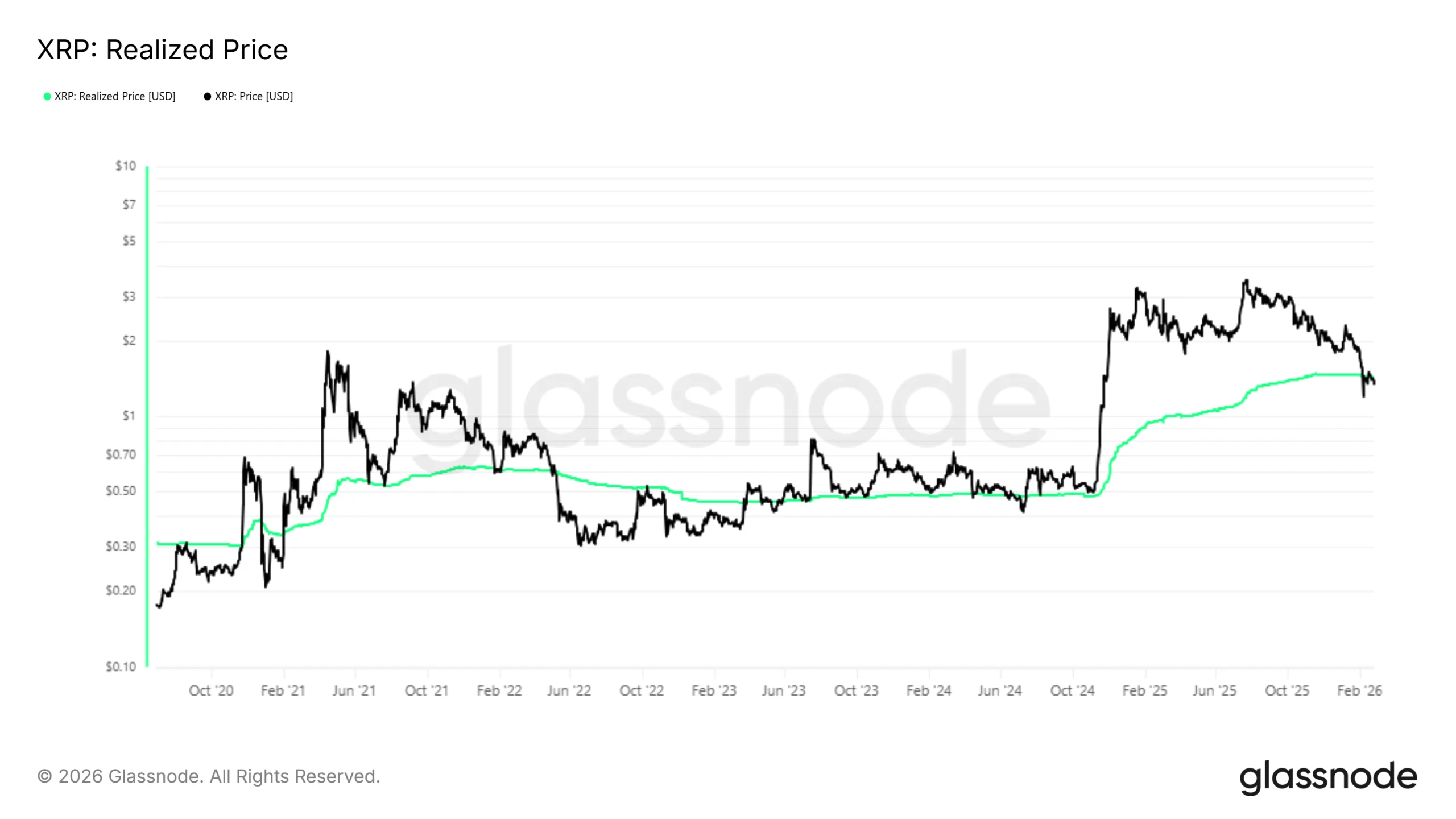
XRP price continues to trade under pressure as a persistent downtrend shapes short-term momentum. The token has struggled to break above descending resistance since the beginning of the month. This prolonged weakness has created uncertainty across the broader crypto market.
Despite the downturn, some investors view current levels as strategic entry points, forming the base for a potential recovery.
XRP Bottom In Sight
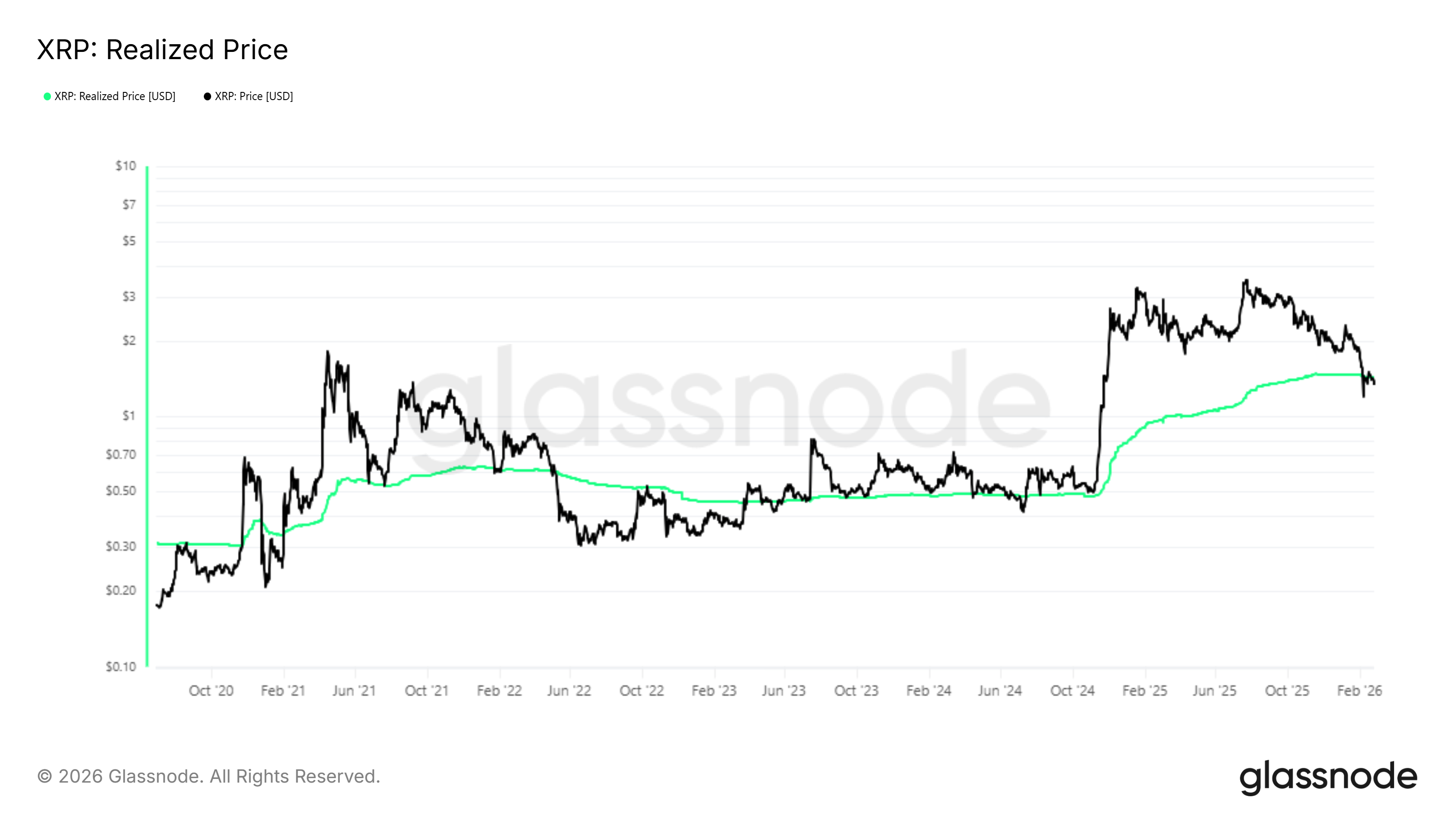
On-chain data shows XRP’s realized price now sits above the current market price. This metric indicates that the average holder is at a loss. When the market price falls below the realized price, assets are often considered undervalued from a historical perspective, marking a potential bottom.
Past cycles reveal that XRP rarely remains in this zone for extended periods. Similar conditions have preceded swift price rebounds. While no outcome is guaranteed, historical patterns suggest that undervaluation phases often attract accumulation and renewed buying interest.
Want more token insights like this? Sign up for Editor Harsh Notariya’s Daily Crypto Newsletter here.
How Are XRP Investors Acting?
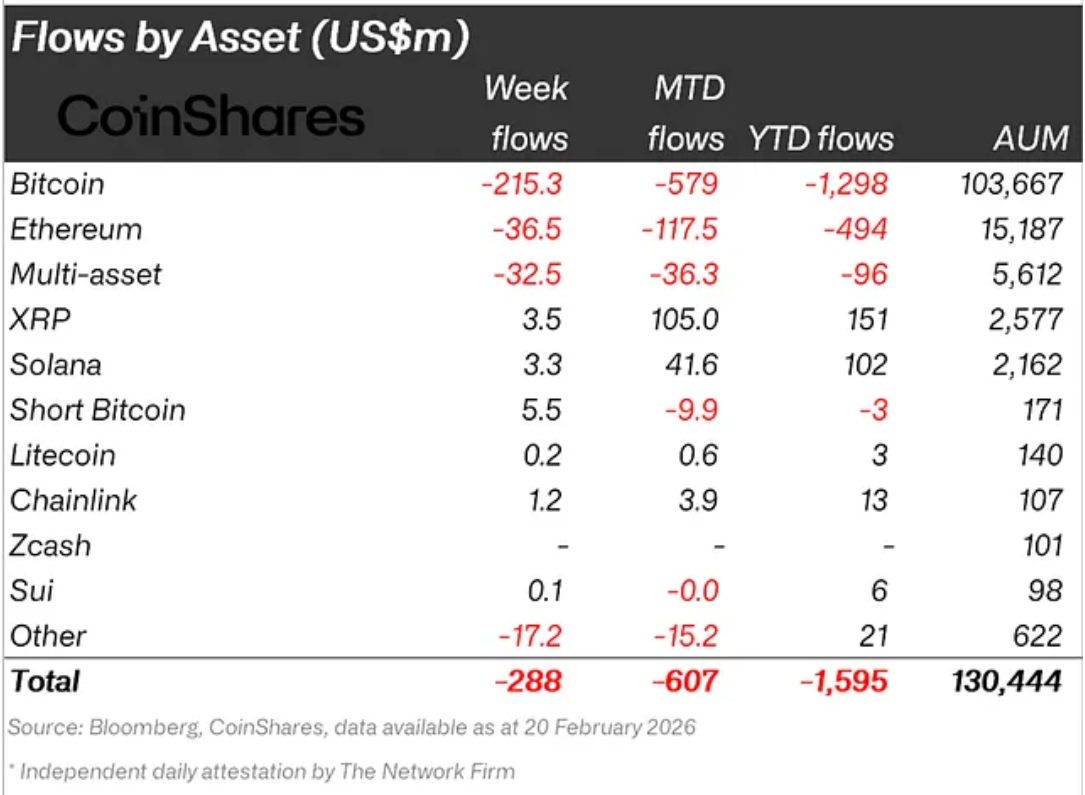
Institutional investors remain notably active despite broader market caution. For the week ending February 20, institutions added $3.5 million worth of XRP exposure. This brought month-to-date inflows to $105 million, a figure unmatched by Bitcoin or Ethereum, which both recorded net outflows.
Sustained institutional demand reflects strategic positioning rather than speculative trading. Professional investors often deploy capital during periods of weakness. Continued inflows may provide liquidity support and strengthen the structural foundation for XRP price stabilization.
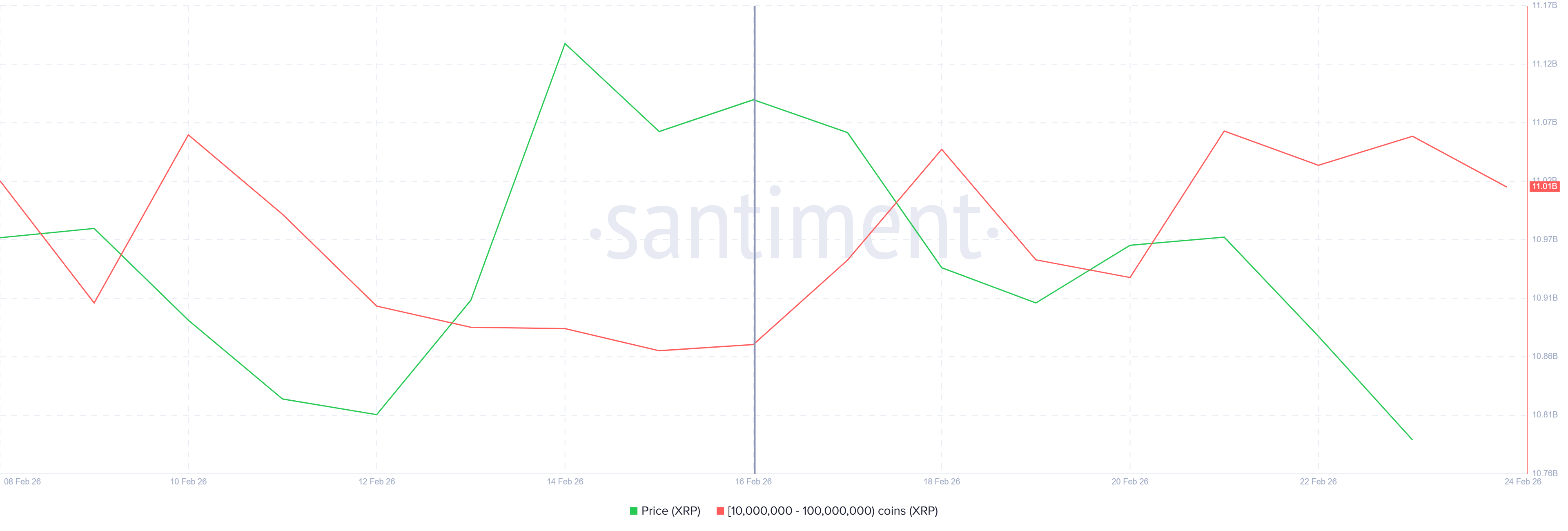
Large XRP holders also appear confident in the asset’s long-term outlook. Addresses holding between 10 million and 100 million XRP accumulated more than 170 million tokens over the past week. This buying activity occurred during a 9% price decline.
Accumulation during falling prices signals conviction among influential wallet holders. While the increase is not historically extreme, timing remains significant. Coordinated accumulation from whales and institutions may reduce circulating supply pressure and contribute to eventual upward momentum.
XRP Price Levels To Watch
XRP price is trading at $1.32 at the time of writing, remaining below a descending trendline established earlier this month. The asset continues to face technical resistance along this barrier. Without a clear improvement in broader market sentiment, XRP may struggle to break higher in the near term.
After losing support at $1.36, XRP now looks toward $1.28 as the next key level. Macro conditions worsened following US President Donald Trump’s 15% global tariff hike. Risk-off sentiment may weigh on digital assets. Continued pressure could push XRP toward $1.28 or even $1.21.
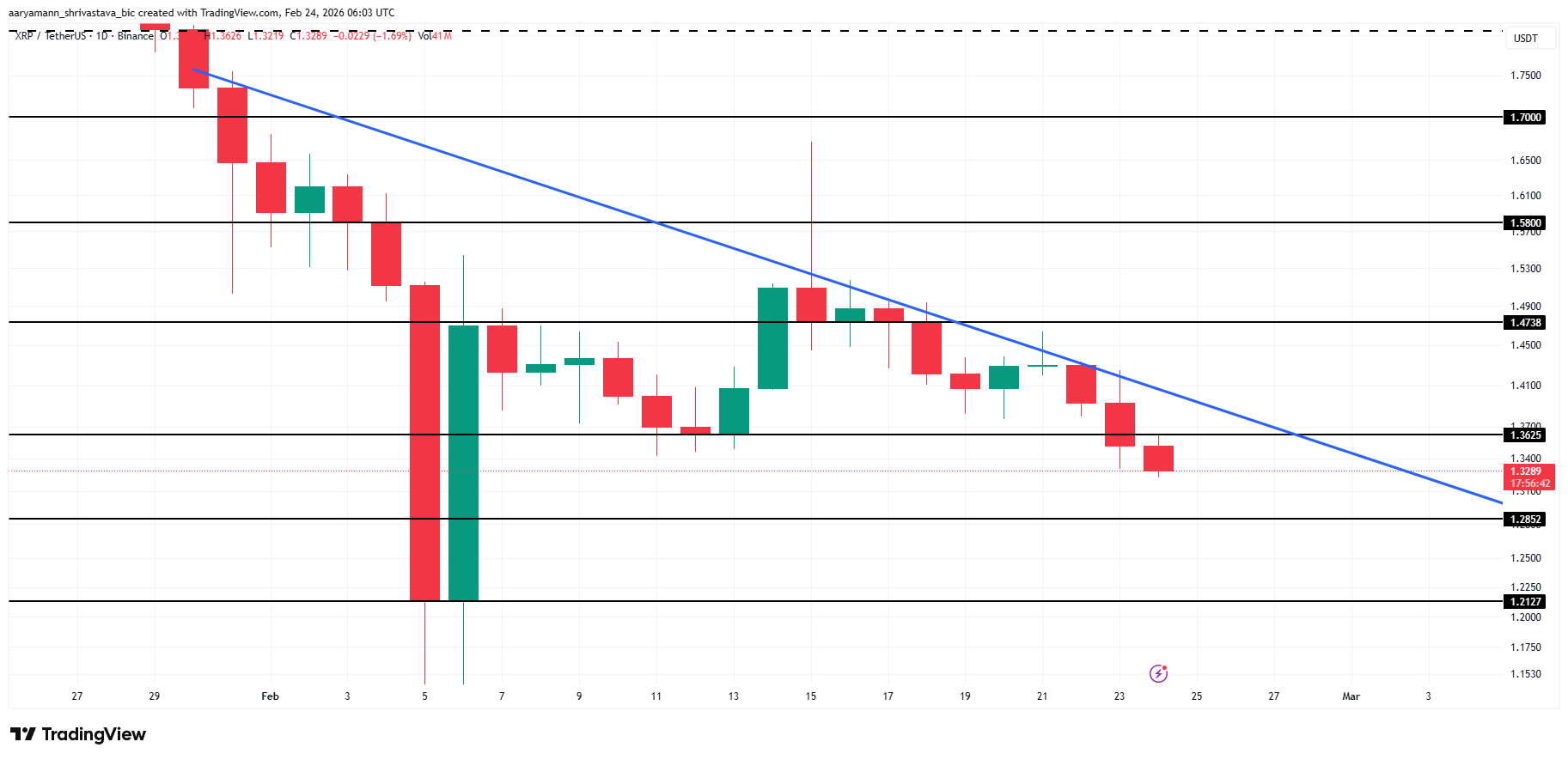
However, stabilization in global markets could shift momentum. Ongoing whale accumulation and institutional inflows may support recovery attempts. A breakout above the descending trendline would signal structural improvement. If XRP clears $1.47 resistance, the bearish thesis would be invalidated, and bullish momentum could reemerge.
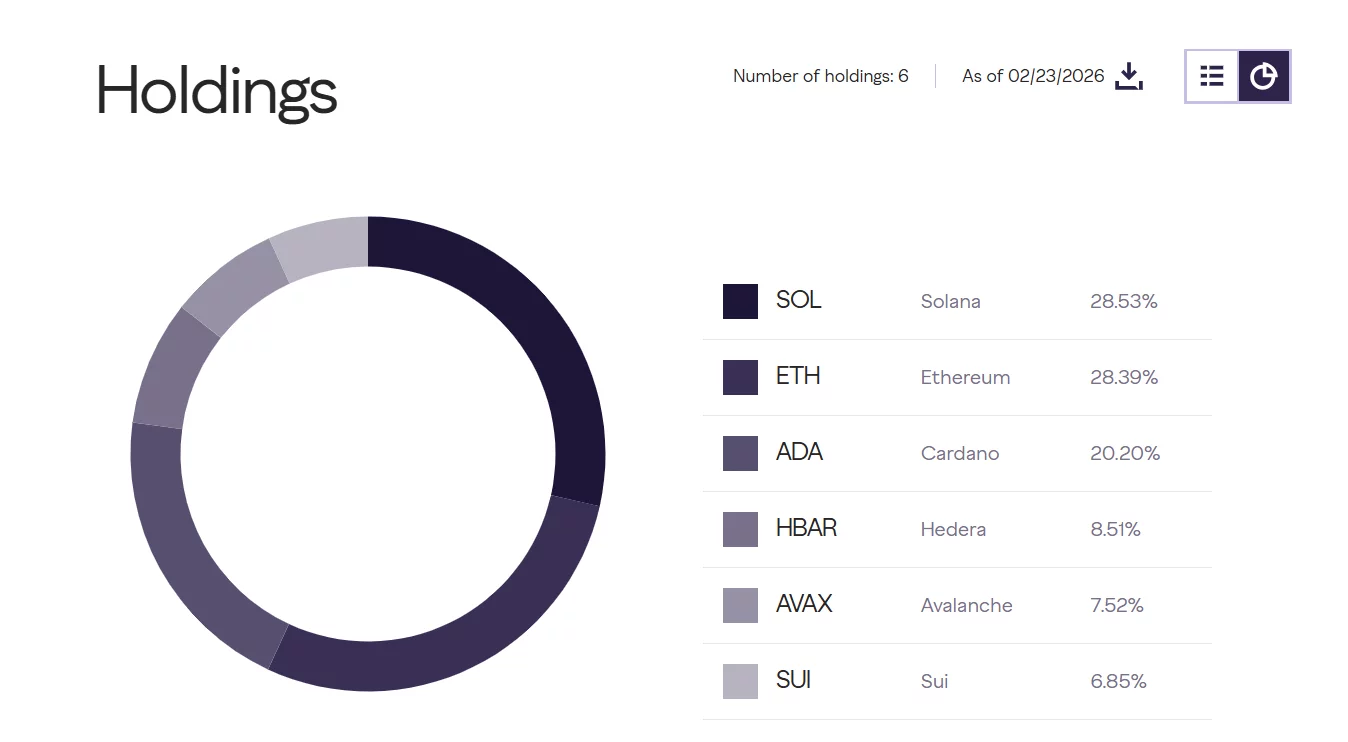
Digital asset manager Grayscale Investments has increased its allocation to Cardano in its diversified crypto holdings, signalling institutional interest in the smart contract platform even as broader market sentiment weakens.
Summary
- Grayscale Investments boosted its allocation to Cardano to about 20.2%, making ADA its third-largest holding.
- The move comes as Bitcoin fell below $65,000 following new tariff measures announced by Donald Trump, dragging the broader crypto market lower.
- Technically, ADA is trading near $0.257, with resistance at $0.30–$0.31 and key support at $0.24, while momentum indicators remain in bearish territory.
According to the latest portfolio breakdown, Cardano (ADA) now accounts for roughly 20.20% of the fund’s holdings, making it the third-largest allocation behind Solana (28.53%) and Ethereum (28.39%).
The adjustment highlights Grayscale’s growing confidence in Cardano’s long-term fundamentals at a time when digital assets are facing macro-driven volatility.
The rebalancing comes amid sharp turbulence across crypto markets. Bitcoin recently plunged below the $65,000 mark following fresh tariff measures announced by Donald Trump, triggering a broad risk-off move.
The sell-off spilled into altcoins, with Ethereum, Solana and Cardano all trading lower on the week.
ADA price analysis
Despite the institutional tailwind, ADA’s technical structure remains fragile. On the daily chart (ADA/USDT), the token is trading around $0.257, down nearly 2% on the session.
Price action shows a clear downtrend from January highs near $0.42, followed by a series of lower highs and lower lows into February.
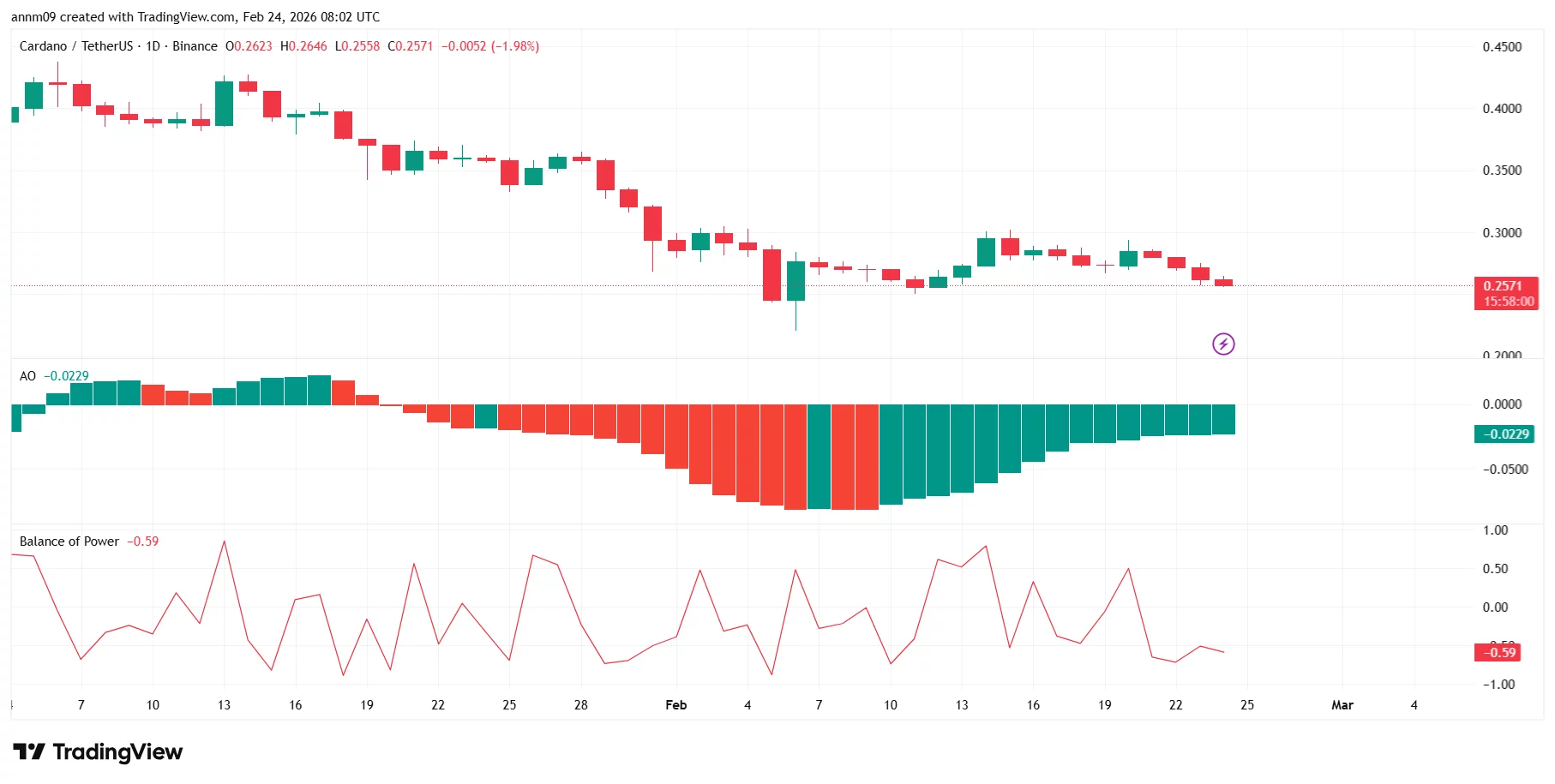
After a sharp sell-off in early February that pushed ADA toward the $0.23–$0.24 zone, bulls managed a modest rebound toward the $0.30 level. However, that recovery stalled, establishing $0.30–$0.31 as immediate resistance. A sustained break above that zone would be needed to shift short-term momentum.
On the downside, $0.24 remains key support, with stronger structural support seen near $0.22, the recent swing low. A decisive break below $0.24 could open the door to a retest of that lower range.
Momentum indicators remain cautious. The Awesome Oscillator is still in negative territory, though the histogram shows fading bearish momentum as green bars gradually build. Meanwhile, the Balance of Power reading sits below zero, suggesting sellers retain near-term control.
While Grayscale’s increased allocation underscores long-term institutional conviction, ADA’s short-term trajectory will likely depend on whether broader market sentiment stabilizes following Bitcoin’s tariff-driven drop.
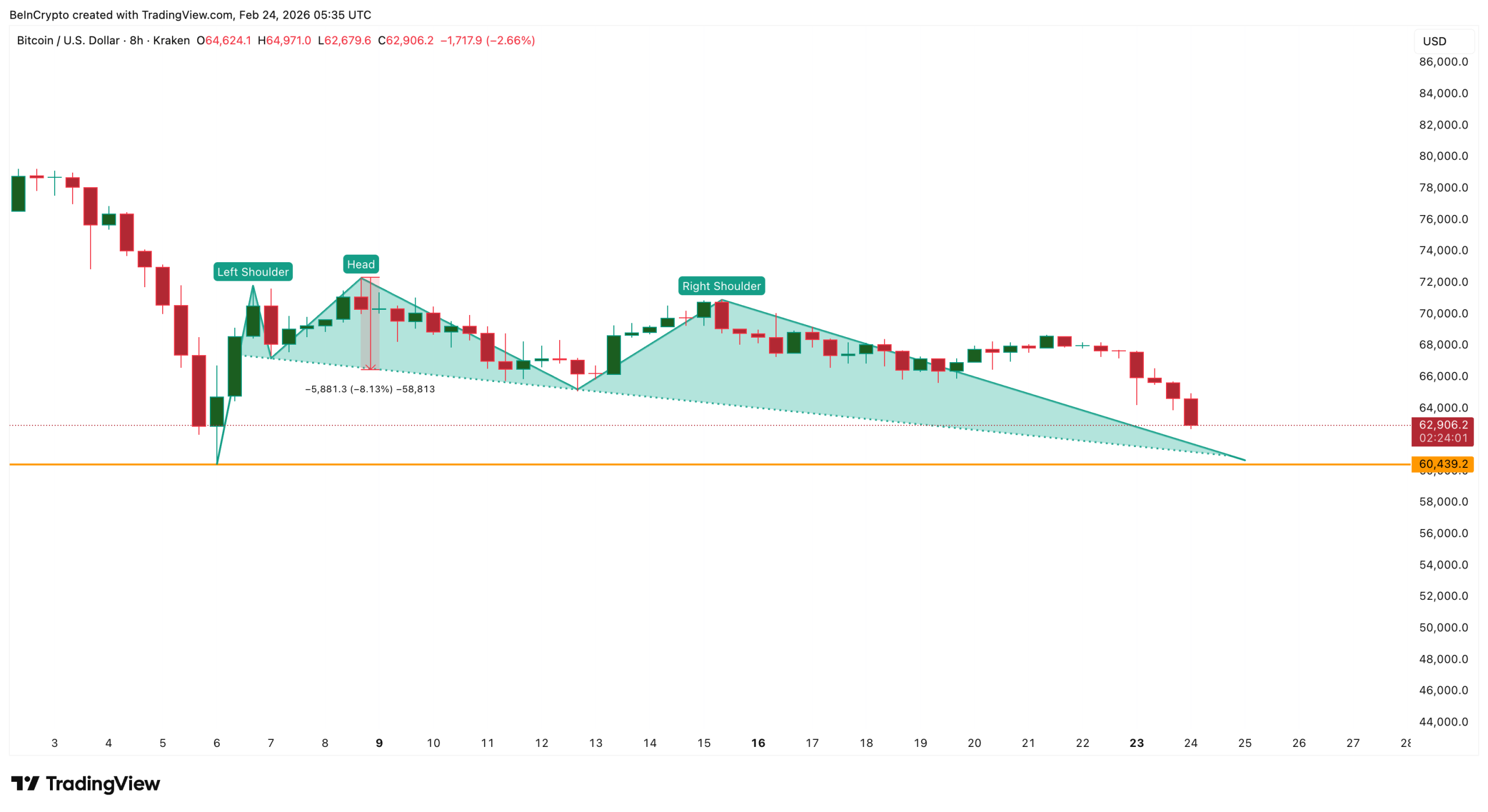
Bitcoin has slipped below the $63,000 level, extending its monthly decline to nearly 30%. The drop reflects more than short-term volatility. It shows deeper structural weakness building across the network and institutional flows.
This weakness is appearing even as Bitcoin enters its longest miner capitulation phase, year-on-year. At the same time, institutional demand through ETFs continues to deteriorate. Together, these forces are now pushing Bitcoin toward one of its most important support zones this cycle.
Bearish Pattern And Miner Income Collapse Explain Weakness
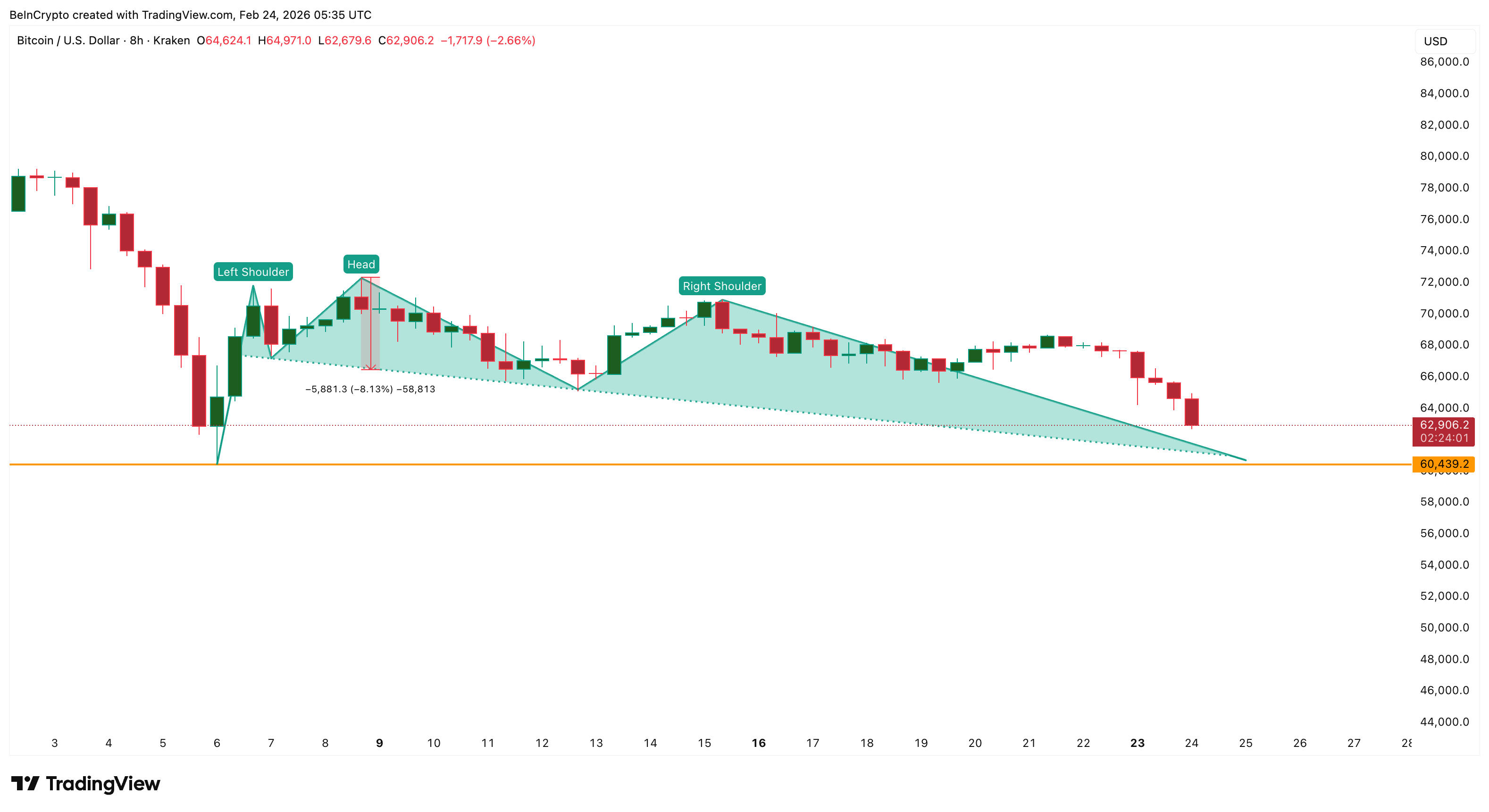
Bitcoin’s price structure has started to break down on the 8-hour chart. A head-and-shoulders pattern has formed, and the neckline of this pattern now sits near the $60,000 zone, making this level the most important short-term support.
Want more token insights like this? Sign up for Editor Harsh Notariya’s Daily Crypto Newsletter here.
This technical weakness comes as miners continue selling aggressively. Glassnode data shows the miner net position change metric has remained negative continuously from January 9 through February 23. This 46-day stretch marks the longest uninterrupted miner capitulation phase in the year-on-year timeframe. The peak of this stretch was seen on February 6, two days after the BTC price bottomed around $60,400.
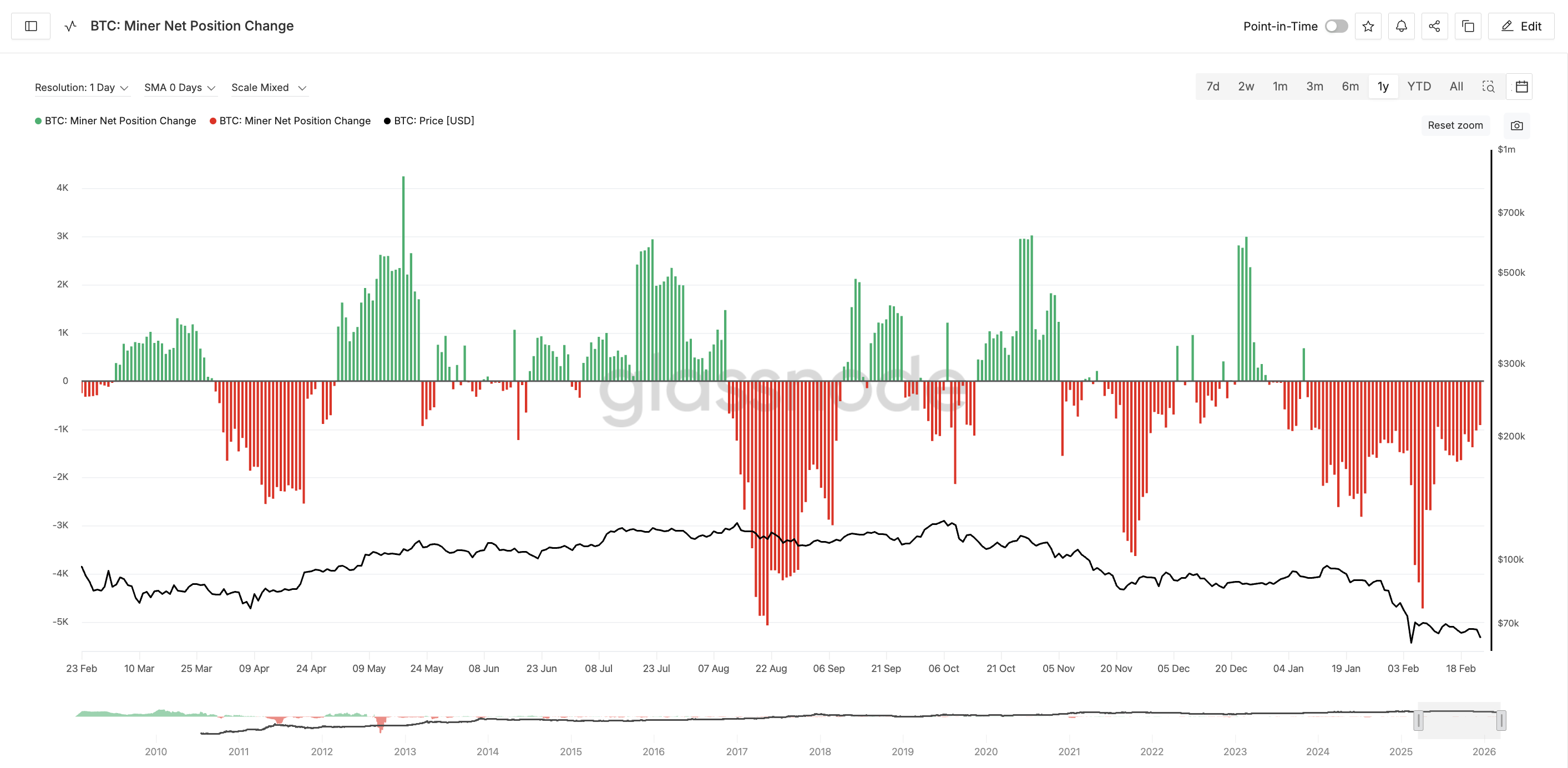
Miner capitulation happens when miners sell more Bitcoin than they accumulate. This usually reflects financial pressure rather than profit-taking.
BeInCrypto’s exclusive Dune dashboard helps explain the reason behind this shift. Bitcoin network revenue, which tracks transaction fees earned by miners, has collapsed sharply over the past year. Monthly fees fell from 194 BTC in May 2025 to just 65 BTC by February 2026. This represents a nearly two-thirds drop in miner income.
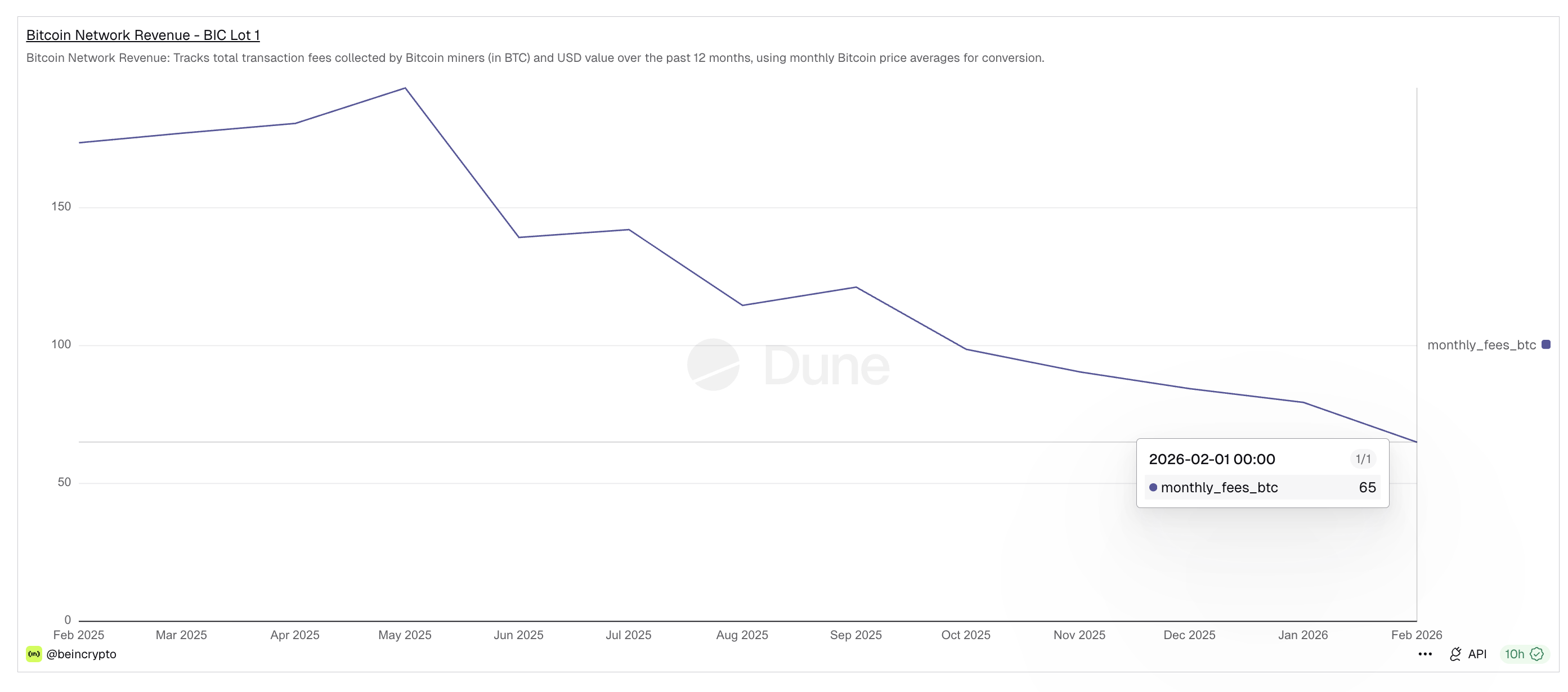
With earnings falling and BTC correcting, miners have fewer incentives to hold Bitcoin. Instead, they are forced to sell reserves, increasing supply in the market. This sustained selling pressure has weakened Bitcoin’s structure. But miners are not the only group stepping away.
Institutional demand has also started to deteriorate, raising new risks around the critical $60,000 support zone.
ETF Outflows And Realized Price Align With Bitget CEO’s Warning About Critical Support
Institutional demand through Bitcoin ETFs has weakened significantly in recent weeks. Bitcoin has now recorded six consecutive weeks of ETF outflows. This marks the longest sustained weekly exit period since spot Bitcoin ETFs launched.
These outflows signal that large investors are reducing exposure instead of accumulating.
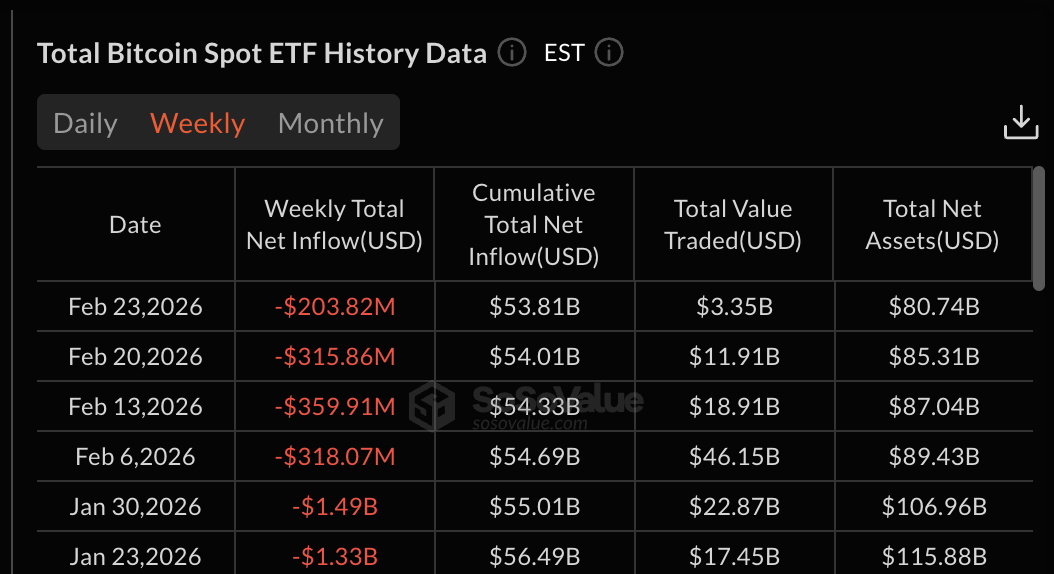
Gracy Chen, CEO of Bitget, directly addressed this fragile setup yesterday, right before BTC lost $63,000. She said:
“Today, Bitcoin is trading in the $64,000–$66,000 zone, and we believe macro factors are doing most of the work. Selling pressure is still tangible and heavy, so the asset has become highly sensitive to headlines, and recent turbulence around tariffs has put even more pressure on risk sentiment,” she said.
She also identified the most important level now:
“On the technical side, we think $60,000 remains the key support level so far, while a move lower, caused by a significant macro event, or accelerating ETF outflows could drag the asset down to $50,000. Liquidity there is deep, and support is substantial, so we’d expect a bounce from either level and a renewed attempt higher,” she added.
Her statement highlights how closely ETF flows and macro pressure are now tied to Bitcoin’s structure. This risk becomes clearer when compared with Bitcoin’s realized price.
Realized price currently sits near $54,700. This level represents the average cost basis of all Bitcoin in circulation. Historically, Bitcoin tends to stabilize near this level because it reflects the market’s aggregate holding cost.
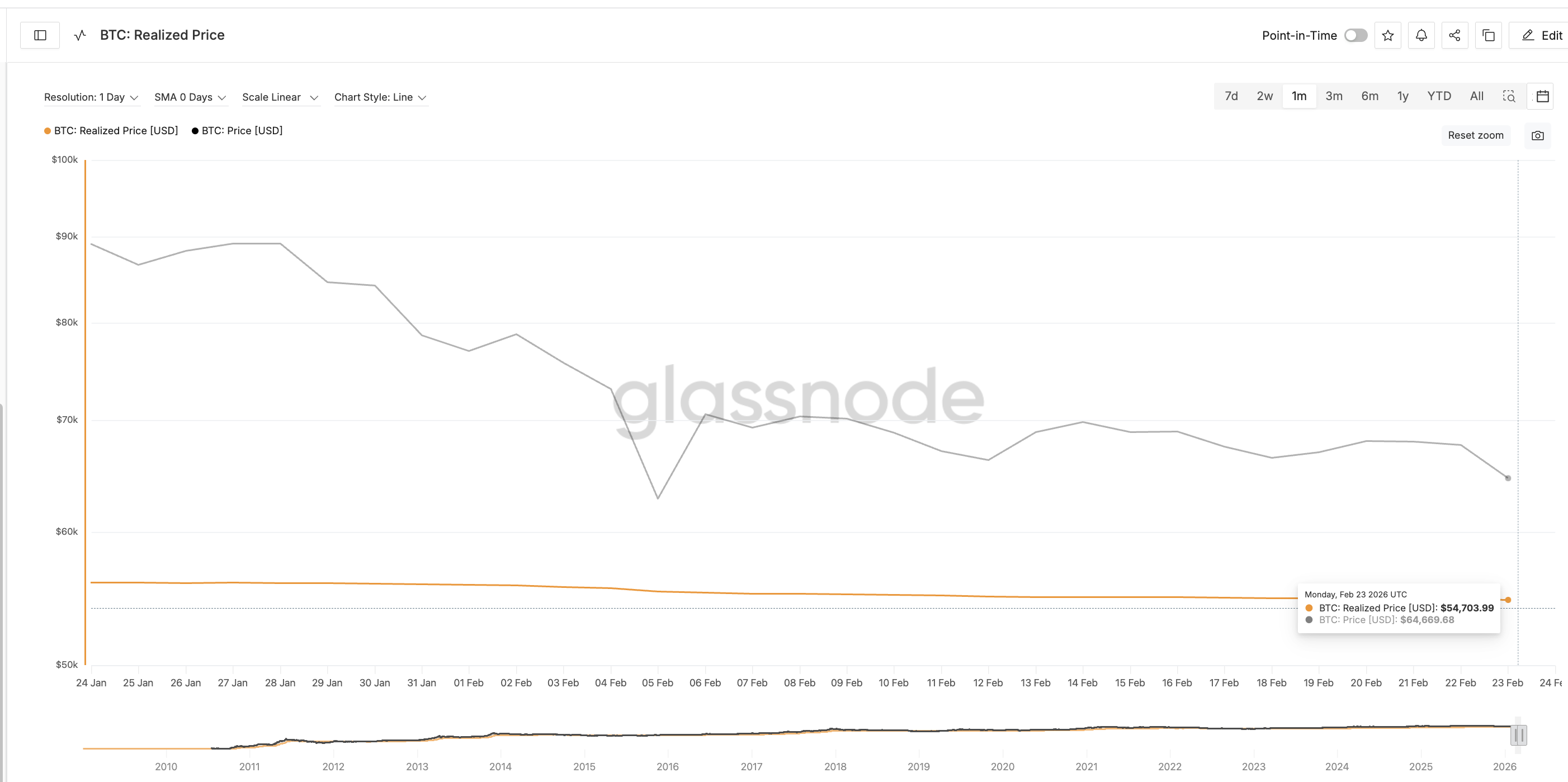
If ETF demand continues weakening and Bitcoin loses $60,000, the realized price could become the next major support zone. This makes the current BTC price region especially critical.
Bitcoin Price Levels Show Why The $60,000 Zone Is The Key
Bitcoin’s recent price action confirms the importance of the $60,000 zone, already highlighted by the Bitget CEO. This level previously served as support on February 6, around the time when miner capitulation reached its current cycle peak. The same level now aligns with a key Fibonacci retracement zone near $60,100.
This convergence makes the area both psychologically and technically important. If Bitcoin manages to hold above this zone, it could stabilize and attempt recovery.
However, a confirmed break below $60,000 would confirm the head-and-shoulders breakdown. Based on the pattern’s structure and technical retracement levels, this could trigger a decline toward $54,800. This level aligns almost exactly with Bitcoin’s realized price.
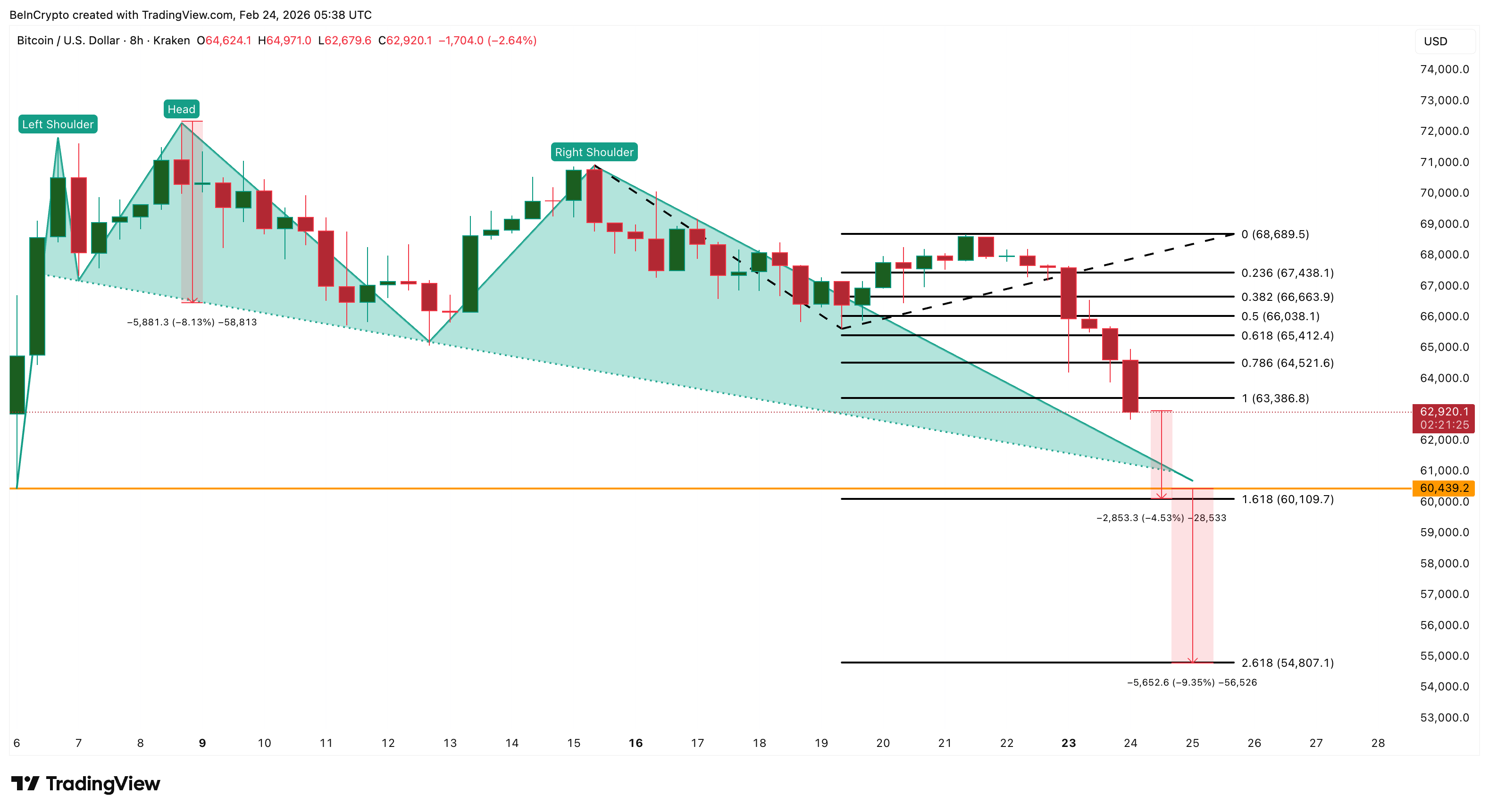
Gracy Chen’s warning reinforces why this zone matters. Her view that $60,000 remains key support, with deeper downside possible if ETF outflows continue, aligns closely with Bitcoin’s current technical structure. For now, Bitcoin stands at a decisive point.
Some strength returns if the BTC price recovers and reclaims the crucial resistance at $63,300, followed by $65,400. However, complete bearish structure invalidation remains out of bounds for now.
Miner capitulation continues to increase supply, while ETF outflows signal weakening institutional demand. Until these pressures ease, the $60,000 level remains the line separating stabilization from a deeper correction.
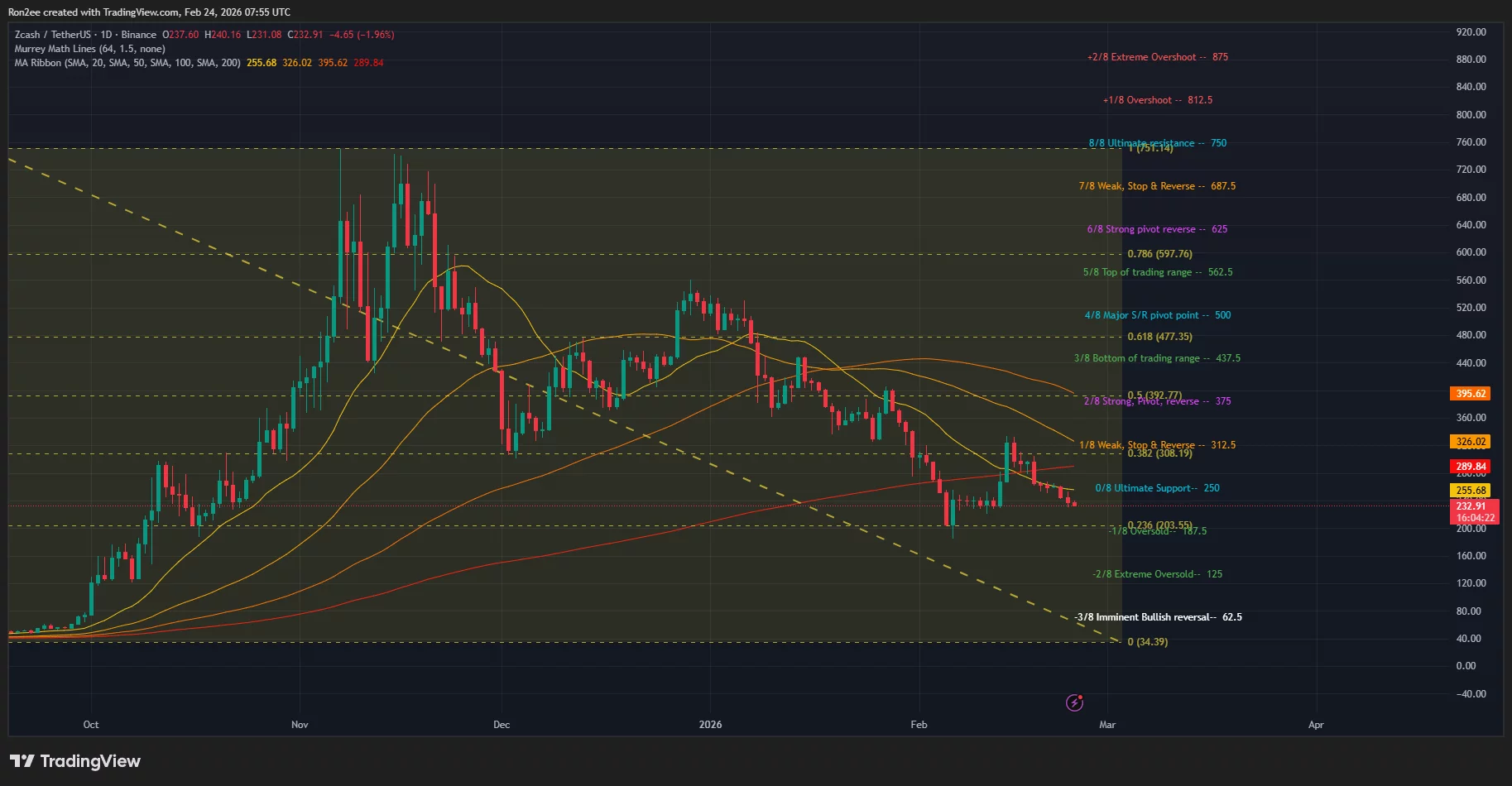
Zcash price has dropped over 20% in the past 7 days as the broader crypto market remained in a downtrend. The privacy token now risks a drop to $200 as a death cross appears to have taken shape on the daily chart.
Summary
- Zcash price has dropped 22% over the past 7 days largely weighed down by macroeconomic and geopolitical concerns affecting markets.
- It is close to confirming a death cross on the daily chart.
According to data from crypto.news, Zcash (ZEC) tanked nearly 22% to $231 last check Tuesday, Feb. 24. It has dropped by 28% from this month’s high and 56% from the beginning of this year.
Zcash price has been in a downtrend since the entire development team at the Electric Coin Company resigned from the project following a severe governance dispute with Bootstrap, the nonprofit organization that owns and oversees ECC.
While the organizational split did not lead to the forking of the Zcash blockchain and the ZEC token’s fundamentals remain unaffected, it has raised investor concerns over the future direction of the ecosystem.
The token’s crash was further exacerbated by a broader market drop triggered by persistent liquidations across leveraged markets as Bitcoin fell below several key support levels. The latest downturn comes as investor sentiment for risk assets has remained extremely fragile over the past weeks amid macroeconomic and geopolitical uncertainty.
Meanwhile, data from CoinGlass shows that futures demand for the token has dwindled since the start of this year. ZEC open interest has dropped to $306 million, nearly a fourth of the figures seen in early January.
On the daily chart, Zcash price has dropped below all moving averages, with the 50-day and 200-day SMAs appearing to be closing on a bearish crossover, which forms what traders call a death cross. Death crosses are some of the most feared bearish patterns in technical analysis.
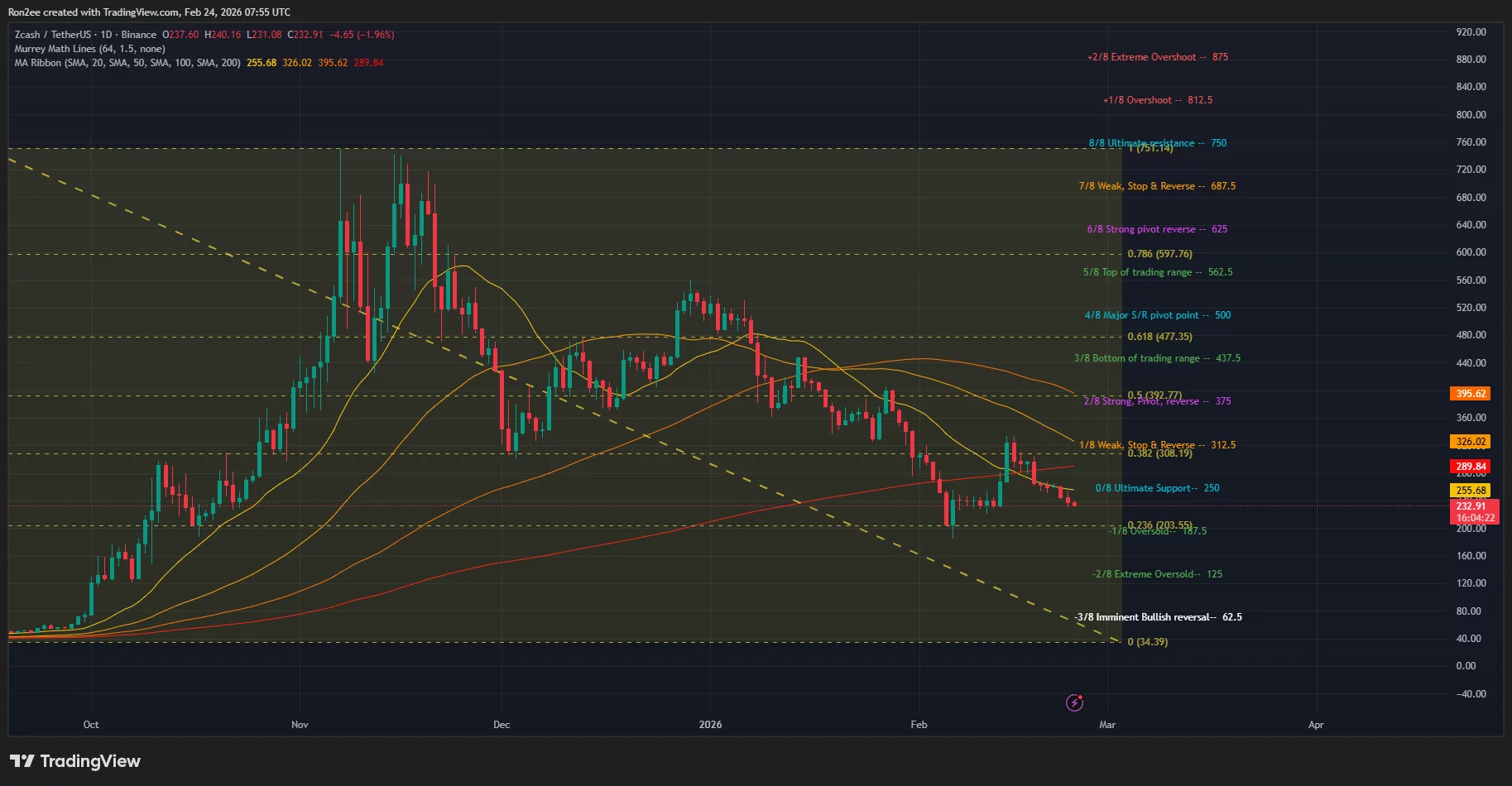
Zcash price action also shows that it has fallen below the Ultimate support level of the Murrey Math lines. A loss below this baseline means loss of bullish momentum and hints at further capitulation.
Hence, the token risks a drop to the next key psychological support level at $200 next, which also closely aligns with the 23.6% Fibonacci retracement level. At press time, the target price remained 14% below Zcash’s current price of $233.
Disclosure: This article does not represent investment advice. The content and materials featured on this page are for educational purposes only.


On-chain analytics platform Nansen is establishing an operational presence in Bhutan’s Gelephu Mindfulness City (GMC). The move marks another step in the small Himalayan kingdom’s push to build a sovereign digital asset ecosystem.
More broadly, the deal underscores Bhutan’s accelerating ambition to build a sovereign-backed digital asset jurisdiction from the ground up. For Nansen, it is a bet that the next wave of growth will come from exactly that kind of ecosystem.
Not a Relocation
Under the collaboration announced Tuesday, Nansen plans to incorporate a local entity in GMC and hire a Bhutan-based team. In addition, the company will develop on-the-ground analytics capabilities to support the special administrative region’s expanding digital asset infrastructure.
The move is not a relocation. Nansen CEO and co-founder Alex Svanevik told BeInCrypto the company is keeping its Singapore headquarters intact.
“We’re not leaving Singapore — this is an additional entity,” Svanevik said. “We chose GMC because of the vision behind it. Most crypto-friendly jurisdictions are optimizing for what exists today. Bhutan is building something fundamentally different — a values-driven economic zone with digital assets baked into the foundation, not bolted on as an afterthought.”
Why Bhutan
Established as a purpose-built special administrative region in southern Bhutan, GMC is designed around sustainable economic development. The region has attracted attention for its integration of digital assets at the sovereign level. That includes holding crypto in its strategic reserves and developing a regulatory framework purpose-built for the sector.
For Svanevik, that sovereign-level commitment is the key differentiator.
“GMC has crypto in its strategic reserves, a progressive regulatory framework purpose-built for digital assets, and genuine sovereign conviction behind it. That’s rare. We want to be pioneers in that ecosystem,” he said.
Expanding Beyond Analytics
The partnership reflects a broader shift in Nansen’s own strategy. The company in January rolled out AI-powered trade execution on Base and Solana and launched its AI agent on the web, moving beyond its roots as a wallet-labeling and analytics tool toward a full-stack on-chain trading platform.
“Nansen is becoming an AI-first platform for on-chain investing — analytics, trading execution, and AI agents working together,” Svanevik said. “In GMC’s ecosystem, that positions us well as the infrastructure matures around custody, tokenization, and institutional liquidity.”
Nansen currently tracks over 500 million labeled wallet addresses across major blockchains.
Building Blocks, Not Hype
Still, the Nansen collaboration is the latest in GMC’s series of digital asset partnerships, spanning custody infrastructure, tokenization, institutional liquidity, and legal frameworks.
Jigdrel Singay, a board director at GMC, framed the approach as deliberately incremental.
“At GMC, we are focused on building the supporting layers — data, governance, and human capability — that enable innovation to develop responsibly,” Singay said.
Svanevik described Bhutan’s model as forward-looking rather than reactive.
“Bhutan is building something genuinely new — a jurisdiction designed for the future of finance, not retrofitted from the past,” he said.
Meanwhile, specific details on team size, office setup, and hiring timelines are still being finalized. Svanevik said the operational buildout will take shape over the coming months.
Bitcoin price has lost the $65,000 psychological support level as investors remain wary of the impact of new U.S. global tariffs on trade.
Summary
- Bitcoin price lost the $65,000 psychological support level on Monday.
- Trump’s new tariffs and U.S.-Iran war concerns are keeping investors at bay from risky assets.
- A confirmed bearish double top pattern puts more downside pressure on Bitcoin’s price.
According to data from crypto.news, Bitcoin (BTC) price fell roughly 5% from its Monday high of $66,465 to an intraday low of $62,952, extending losses to 35% from its yearly high.
The price tanked amid market uncertainty ahead of the latest 10% tariffs on all nations for a 150-day period unless exempted. This comes after the administration rerouted its strategy under Section 232 after the U.S. Supreme Court blocked previous trade actions.
While the current 10% rate comes lower than the 15% feared earlier, the Trump administration is working to raise the figure to 15% through a separate order that the President would need to sign.
Investors have a clear memory of how previous U.S. tariffs on key trading partners led to significant volatility in the crypto market. Following the 145% tariff hike against China implemented in April 2025, the total crypto market cap fell by 20% to $1.8 trillion within two months. Bitcoin has historically borne the greatest brunt from such geopolitical friction.
Aside from the tariff drama, another key concern lowering investor appetite is the potential for a U.S.-Iran war. Reports reveal that the U.S. is preparing for military action, while the President himself has threatened to launch an attack on Iran within 10 days through a Truth Social post on Thursday, Feb. 19.
Bitcoin has so far failed to maintain its status as a safe-haven asset. It has remained in a downtrend since the beginning of 2026 while traditional assets like gold showed signs of strength amid the ongoing macroeconomic and geopolitical stress.
The liquidation cascade that followed the drop under the $65,000 psychological support, where several stop losses were likely concentrated, has also intensified the decline.
Notably, over $218 million in leveraged long positions were wiped out across derivatives markets in the past 12 hours alone. Over the 24-hour period, total crypto liquidations climbed to roughly $369 million, with Bitcoin accounting for nearly $152 million of that figure.
Meanwhile, the 12-spot Bitcoin ETFs have also failed to provide any support. Data from SoSoValue show these investment vehicles recorded $203.8 million in net outflows over the past day, largely led by BlackRock’s IBIT, which saw $116.4 million in redemptions.
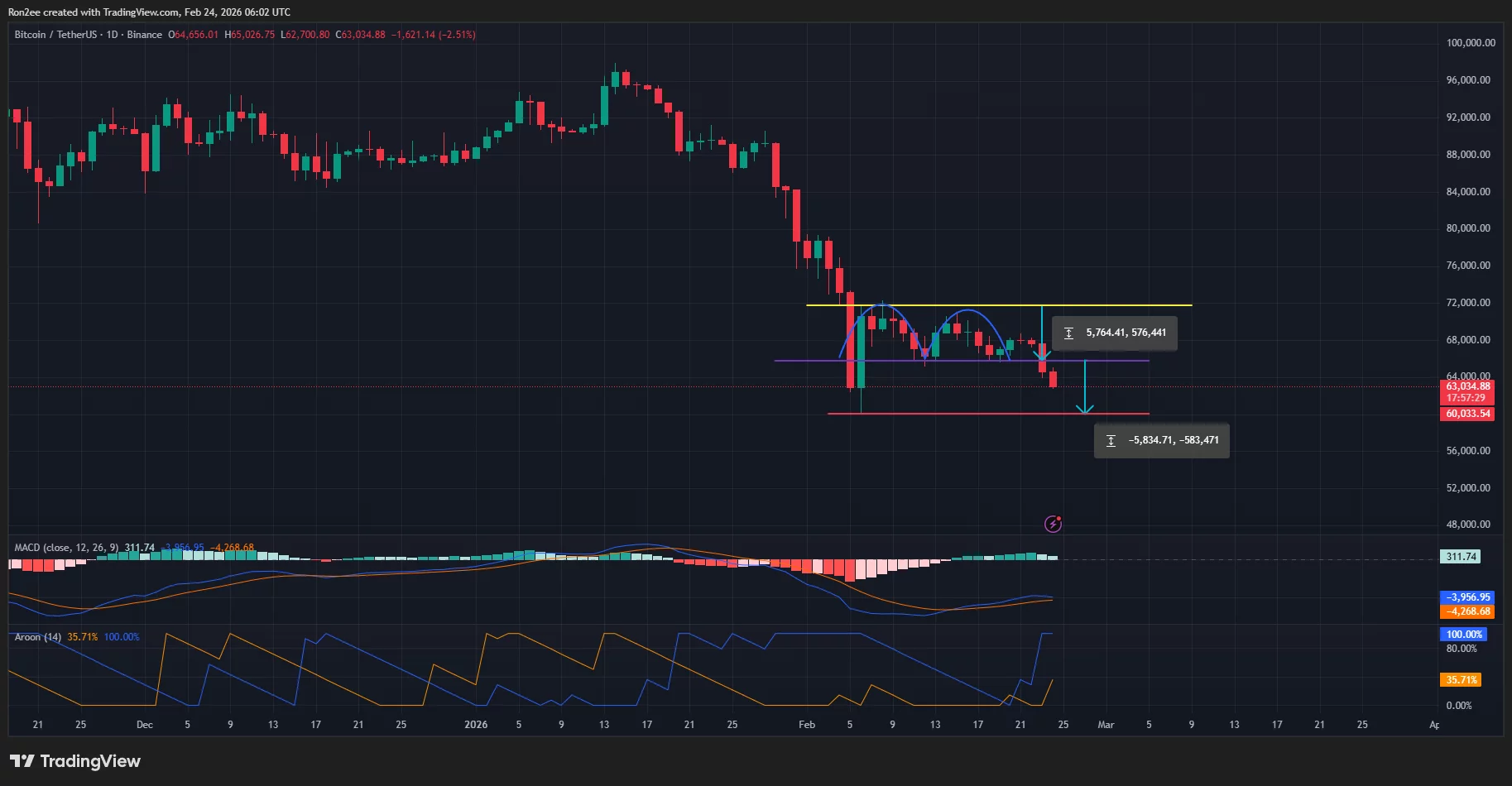
The daily BTC/USDT price chart shows weakness building for the bellwether asset over the coming weeks.
Bitcoin price action has formed a double top pattern, a major bearish indicator in technical analysis. It has also formed a bearish pennant pattern since mid-January, as reported by crypto.news earlier, adding to the negative outlook.
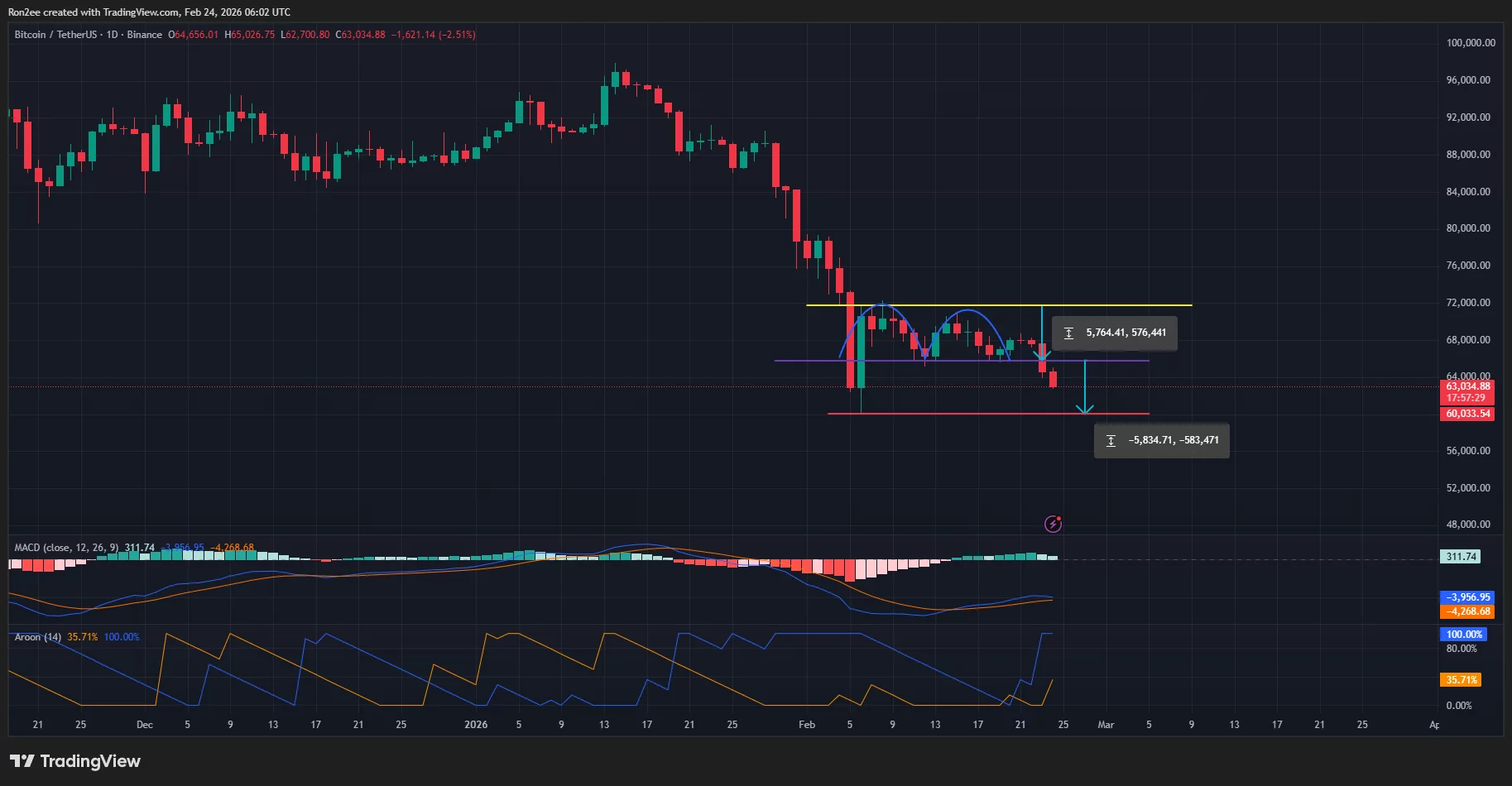
Furthermore, the MACD lines appear set for another bearish crossover below the zero line. The Aroon Down showing a 100% reading also suggests that bears are still dominating the market.
As such, Bitcoin is most likely to drop to $60,000 next as bears target the key psychological floor. This level resonates with the target calculated by subtracting the height of the double top pattern from the breakout point.
A drop below $60,000, which serves as the last line of defense, could trigger a much deeper correction toward the $50,000 range.
Disclosure: This article does not represent investment advice. The content and materials featured on this page are for educational purposes only.
Terraform Labs’ bankruptcy administrator has filed a lawsuit in Manhattan accusing trading giant Jane Street of playing a key role in the 2022 collapse of Terra’s ecosystem.
Summary
- Terraform Labs has sued Jane Street, alleging the firm played a central role in the 2022 Terra collapse by accelerating the UST depeg and profiting from the fallout.
- The lawsuit claims Jane Street dumped 85 million UST shortly after Terraform withdrew liquidity, triggering panic that led to LUNA’s hyperinflation and a $40 billion market wipeout.
- Meanwhile, Terra Classic is consolidating near $0.000035, trading below its 50-day moving average, with $0.000032 acting as key support and $0.000038 as major resistance.
Terraform blames Jane Street insider trading for collapse
The complaint alleges that Jane Street front-ran the depegging of UST and helped trigger the death spiral that wiped out roughly $40 billion in market value.
According to the filing, Terraform quietly withdrew 150 million UST liquidity from Curve in May 2022. Minutes later, Jane Street allegedly dumped 85 million UST, accelerating the depeg. Panic spread quickly, UST lost its dollar peg, and LUNA hyperinflated due to its mint-and-burn mechanism.
The suit further claims a Jane Street trader, a former Terraform intern, shared insider information in a private group chat dubbed “Bryce’s Secret.” The firm allegedly avoided more than $200 million in losses and profited during the meltdown. Jane Street has denied the allegations, calling the lawsuit baseless.
Terra Classic price analysis
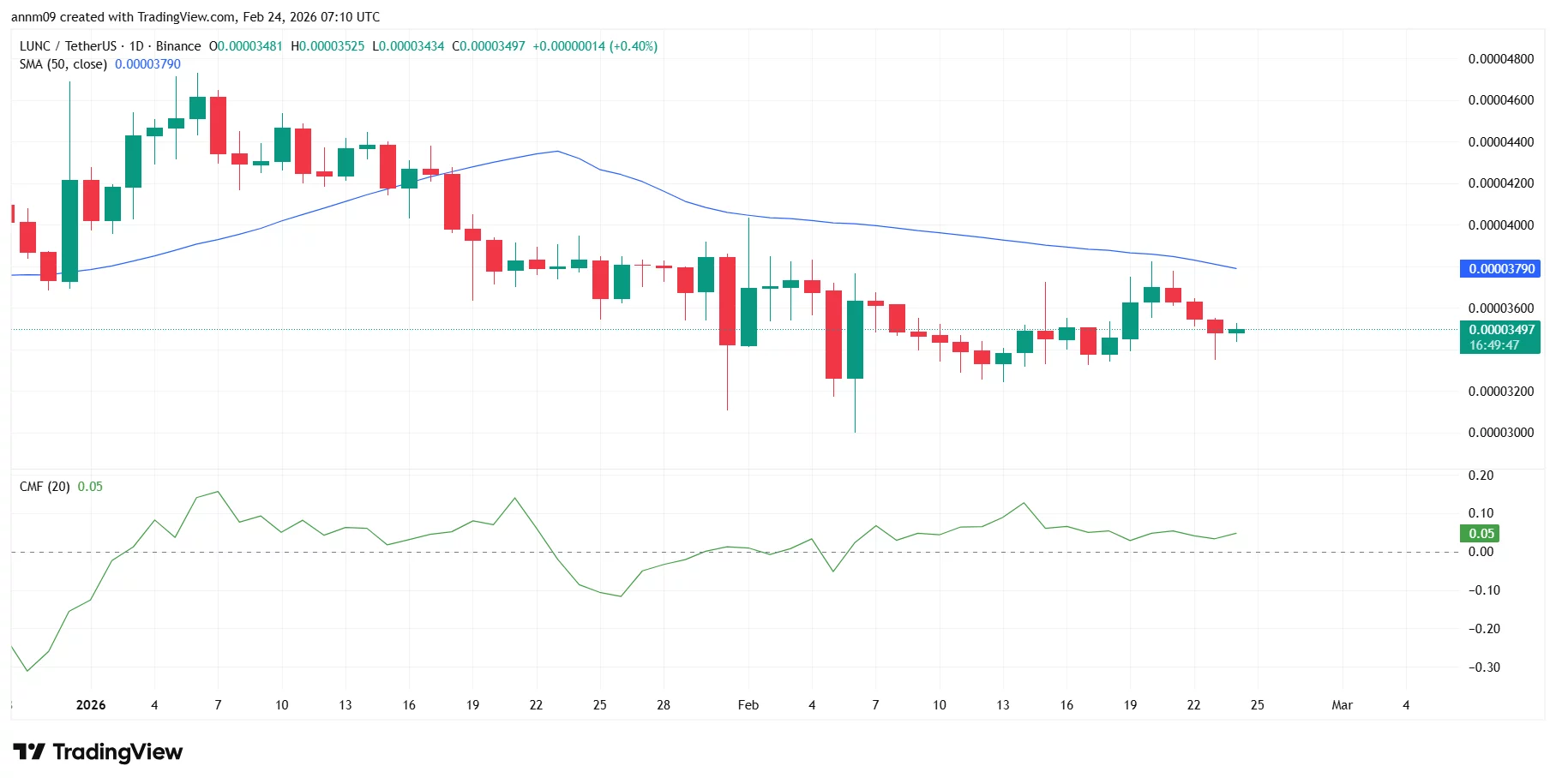
Amid the renewed headlines, Terra Classic (LUNC) is trading around $0.00003497 at press time on the daily chart. Price remains below the 50-day simple moving average, which sits near $0.00003790, signaling that the broader trend is still tilted to the downside.
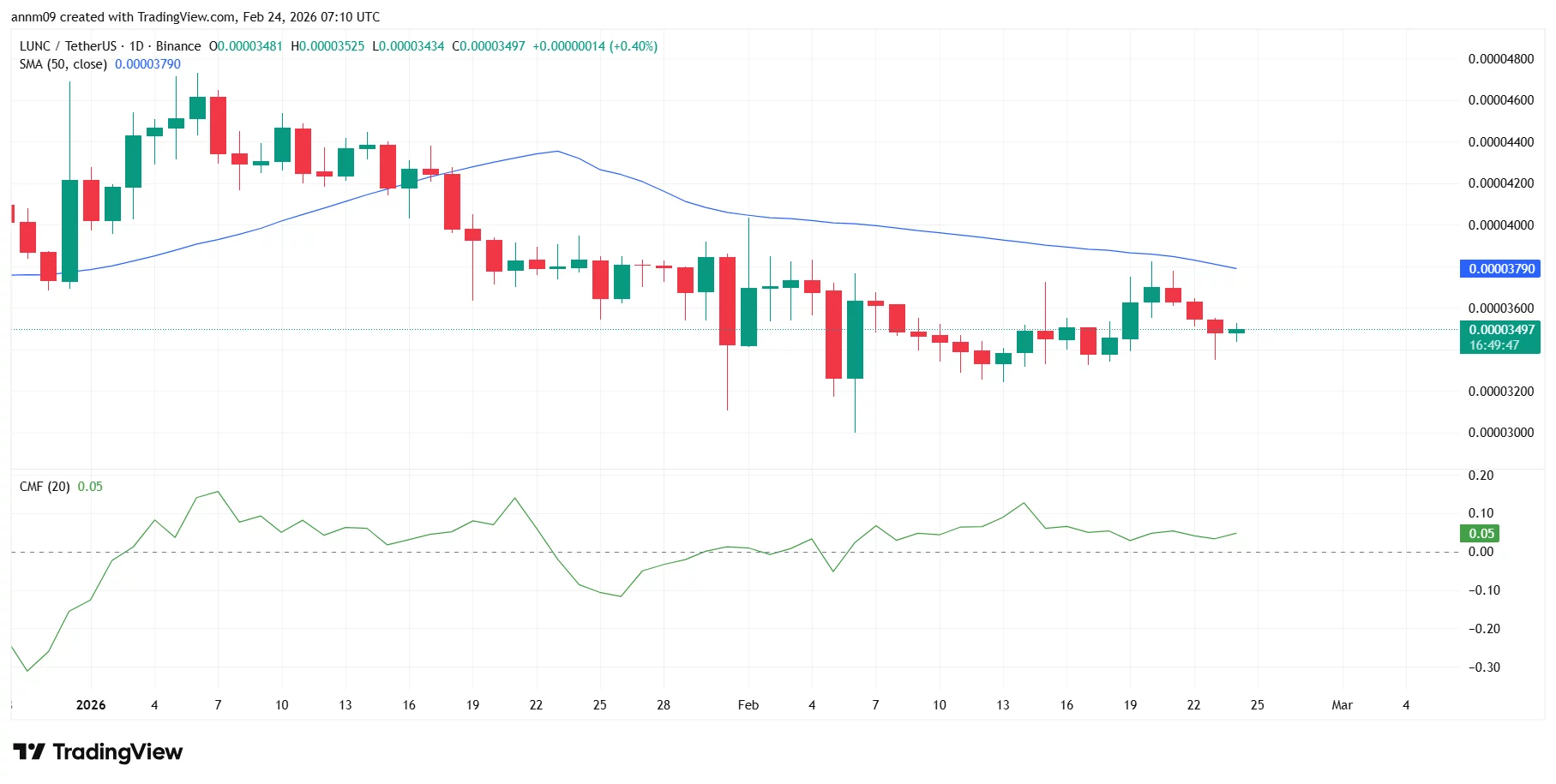
The chart shows a series of lower highs since early January, confirming bearish structure.
However, recent candles suggest short-term consolidation after a sharp early-February sell-off that briefly pushed price toward the $0.00003000–$0.00003200 support zone. That area now acts as key near-term support.
On the upside, immediate resistance sits at $0.00003600, followed by the 50-day SMA near $0.00003790. A sustained break above that level could open the door toward $0.00004000.
The Chaikin Money Flow (CMF) indicator is slightly positive at 0.05, suggesting mild capital inflows, but not strong accumulation. Unless LUNC reclaims its moving average, rallies may face selling pressure.
A breakdown below $0.00003200 would likely expose the psychological $0.00003000 level again.
XRP price is hovering near $1.30 as leverage on Binance hits cycle lows, putting focus on a potential breakout.
Summary
- XRP is trading near the lower end of its recent range with leverage at cycle lows.
- Derivatives positioning has cooled, reducing liquidation risk.
- A breakout above $1.50 or breakdown below $1.30 could decide the next move.
XRP was trading at $1.33 at press time, down 1.2% over the past 24 hours. The token is hovering at the bottom of its 7-day range between $1.33 and $1.49.
XRP is in the red across all major timeframes, down 10% over the past week, 30% in the last month, and nearly 50% over the past year. It has now retraced about 63% from its July 2025 all-time high of $3.65.
Spot activity has picked up despite the weak price action. XRP (XRP) recorded $3.13 billion in 24-hour trading volume, up 40.4% from the previous day.
Derivatives data from CoinGlass shows futures volume up 38.3% to $5.37 billion, while open interest slipped 3.7% to $2.29 billion, suggesting leverage is being reduced even as trading activity rises.
Binance leverage resets as speculative excess fades
A Feb. 23 report by CryptoQuant contributor PelinayPA shows XRP’s Estimated Leverage Ratio has dropped sharply to about 0.16, with both the 30-day and 50-day moving averages trending down.
This decline means that speculative positioning has cooled off. Forced liquidations have largely run their course, and neither longs nor shorts appear crowded. The derivatives market looks balanced rather than stretched.
The focus on Binance is significant. Binance is the main hub for XRP derivatives. Leverage shifts there often reflect global risk appetite. A sharp drop usually means risky positions have been cleared across the market.
Interestingly, price has continued drifting lower while leverage falls. That combination can be constructive. High leverage increases the risk of cascading liquidations. A low-leverage environment, by contrast, reduces forced selling pressure and creates cleaner conditions for larger players to build positions.
For now, XRP appears stuck in what is commonly called a “dead zone,” a phase marked by sideways-to-down movement, contracting volatility, and fading leverage.
XRP price technical analysis
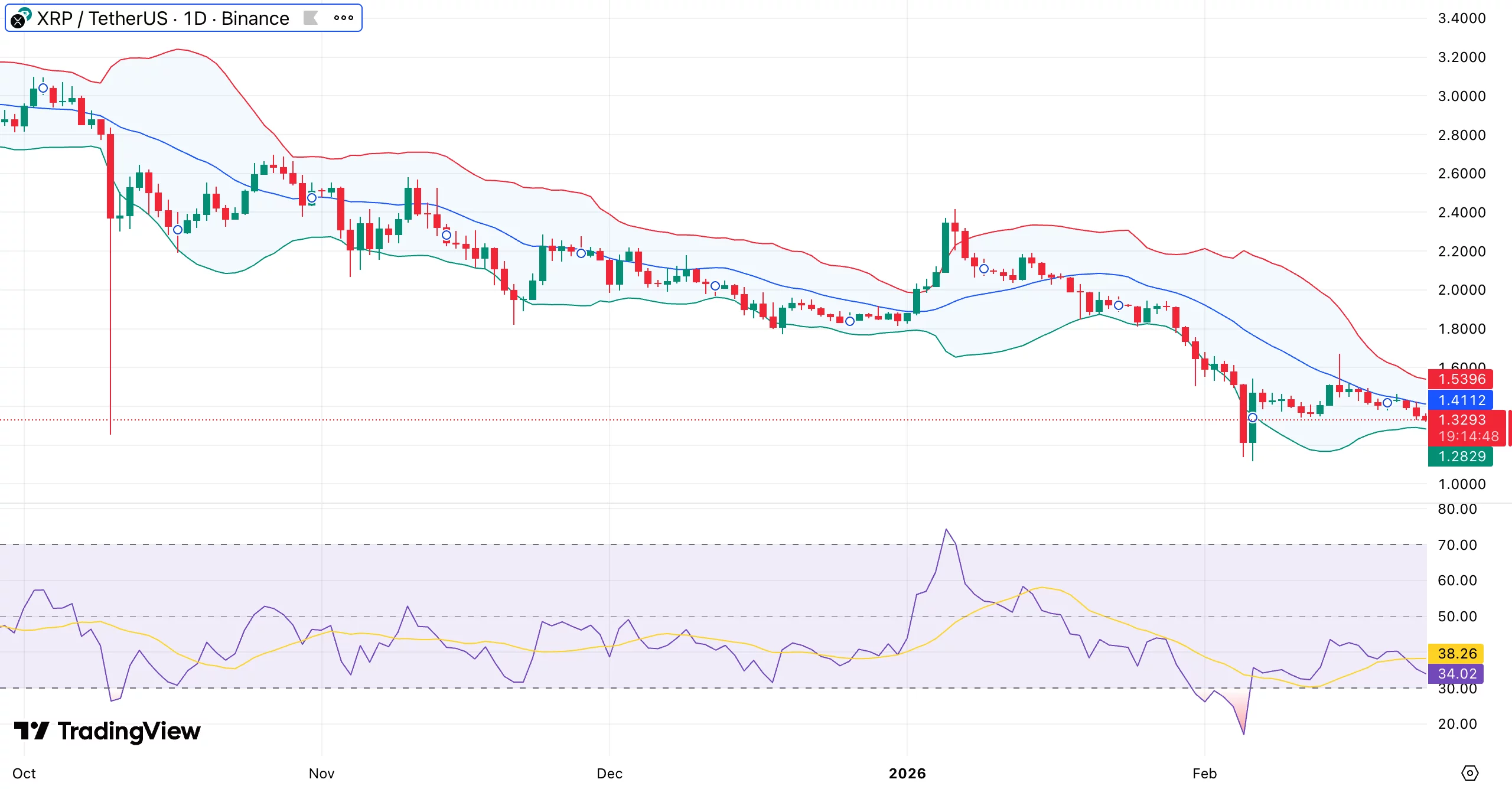
On the daily chart, XRP is forming lower highs and lower lows, but downward momentum has eased. Immediate support is around $1.30, a level that has held several times.
On the upside, $1.41 acts as the first resistance. A more critical barrier lies between $1.50 and $1.53, where the 30-day and 50-day moving averages cluster. Trading below both, which are sloping down, keeps the medium-term bias bearish.
The relative strength index is near oversold, hovering around 35, and the MACD is still bearish, despite the shrinking histogram suggesting that selling pressure is cooling. Low volatility is indicated by tightening Bollinger bands, a condition which often precedes sharp moves.
A move above $1.50–$1.53 with rising volume could shift momentum and open the door toward $1.60, potentially triggering a fresh build-up in leverage. Failure to reclaim resistance, followed by a daily close below $1.30, may lead to a slide toward $1.20.
Upbit, South Korea’s largest cryptocurrency exchange, has announced the listing of two new altcoins. The platform confirmed it will add spot trading support for Seeker (SKR) and Espresso (ESP).
In addition, Bithumb will also list ESP today. Following the listing announcements, both tokens recorded strong gains, with prices surging by double digits as trading interest accelerated.
Upbit and Bithumb Expand Offerings With New Token Listings
According to Upbit’s notice, SKR will be available to trade against three pairs: Korean Won (KRW), Bitcoin (BTC), and Tether (USDT). The exchange will open spot trading at 16:00 Korean Standard Time (KST) on February 24 and enable deposits and withdrawals within 90 minutes of the announcement.
“Deposits and withdrawals are supported only through the specified network (SKR-Solana). Please verify the network before making a deposit. The contract address for SKR supported by Upbit is: SKRbvo6Gf7GondiT3BbTfuRDPqLWei4j2Qy2NPGZhW3. Please confirm the contract address when depositing or withdrawing SKR,” the exchange added.
In a separate notice, Upbit announced support for ESP in the KRW, BTC, and USDT markets. Trading is scheduled to begin at 17:00 KST today.
Bithumb also announced the addition of ESP in its KRW market. The exchange stated that deposits and withdrawals will open within two hours of the announcement, with trading scheduled for 17:00 KST on February 24. The exchange set the reference price at 149 KRW.
Both exchanges outlined temporary restrictions designed to manage volatility during the initial trading period. Upbit will restrict buy orders for approximately five minutes after trading begins.
Sell orders priced 10% or more below the previous day’s closing price will also be restricted for about five minutes. Additionally, the exchange will permit only limit orders for approximately two hours after trading support begins.
Bithumb will similarly restrict buy orders for five minutes following the start of trading. During the same initial five-minute window, sell orders will be blocked if priced 10% or more below or 100% or more above the reference price. Like Upbit, Bithumb will allow only limit orders for roughly two hours after trading opens.
Exchange Listings Drive Sharp Moves in SKR and ESP
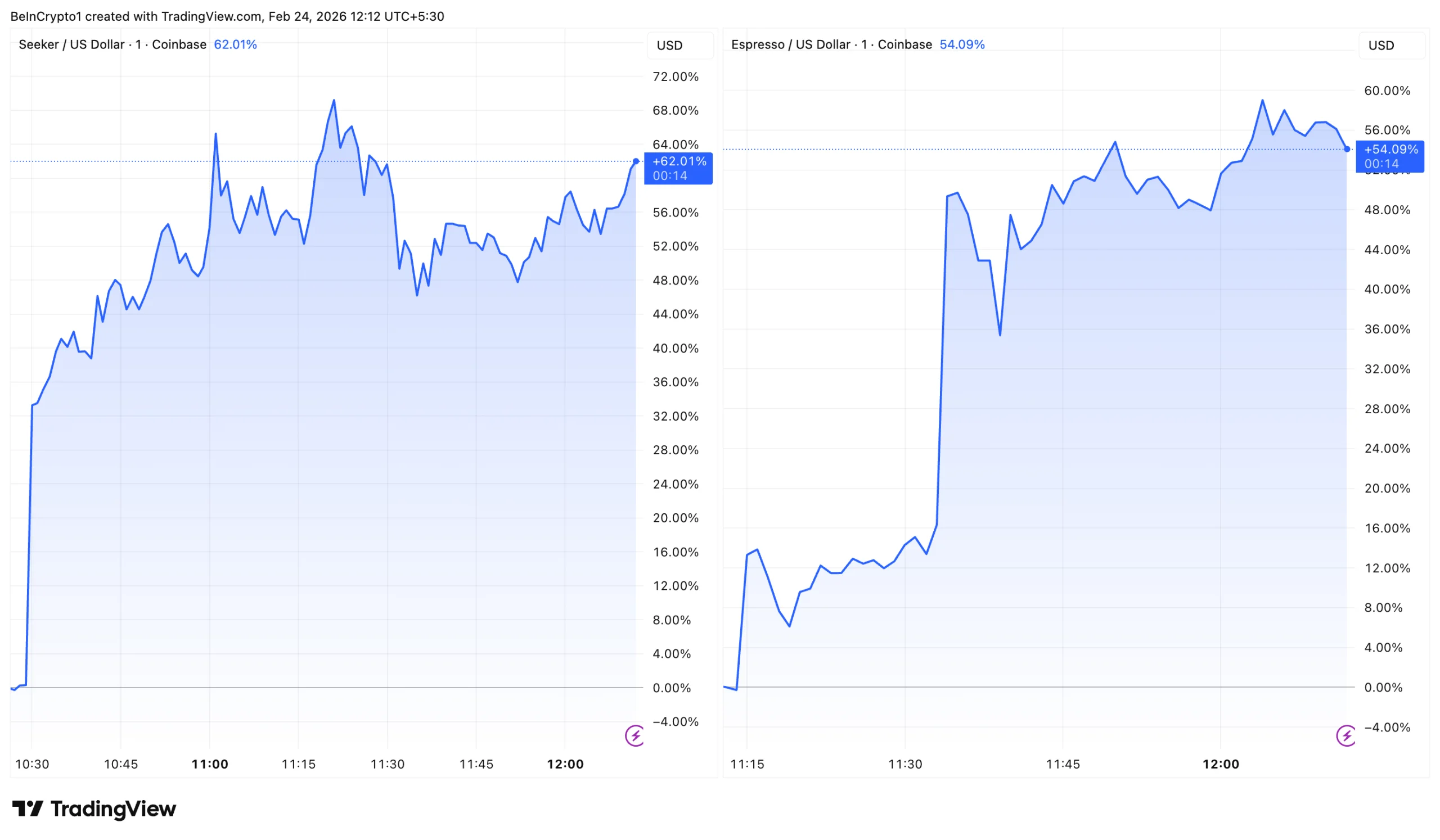
The listings triggered notable price movements in both tokens. Data shows that SKR, the native token of the Solana Mobile ecosystem, rose more than 62% following the announcement.
The daily trading volume increased by over 700%, with Bithumb accounting for approximately 33% of total activity, according to CoinGecko data. The figures suggest elevated trading interest from the South Korean market.
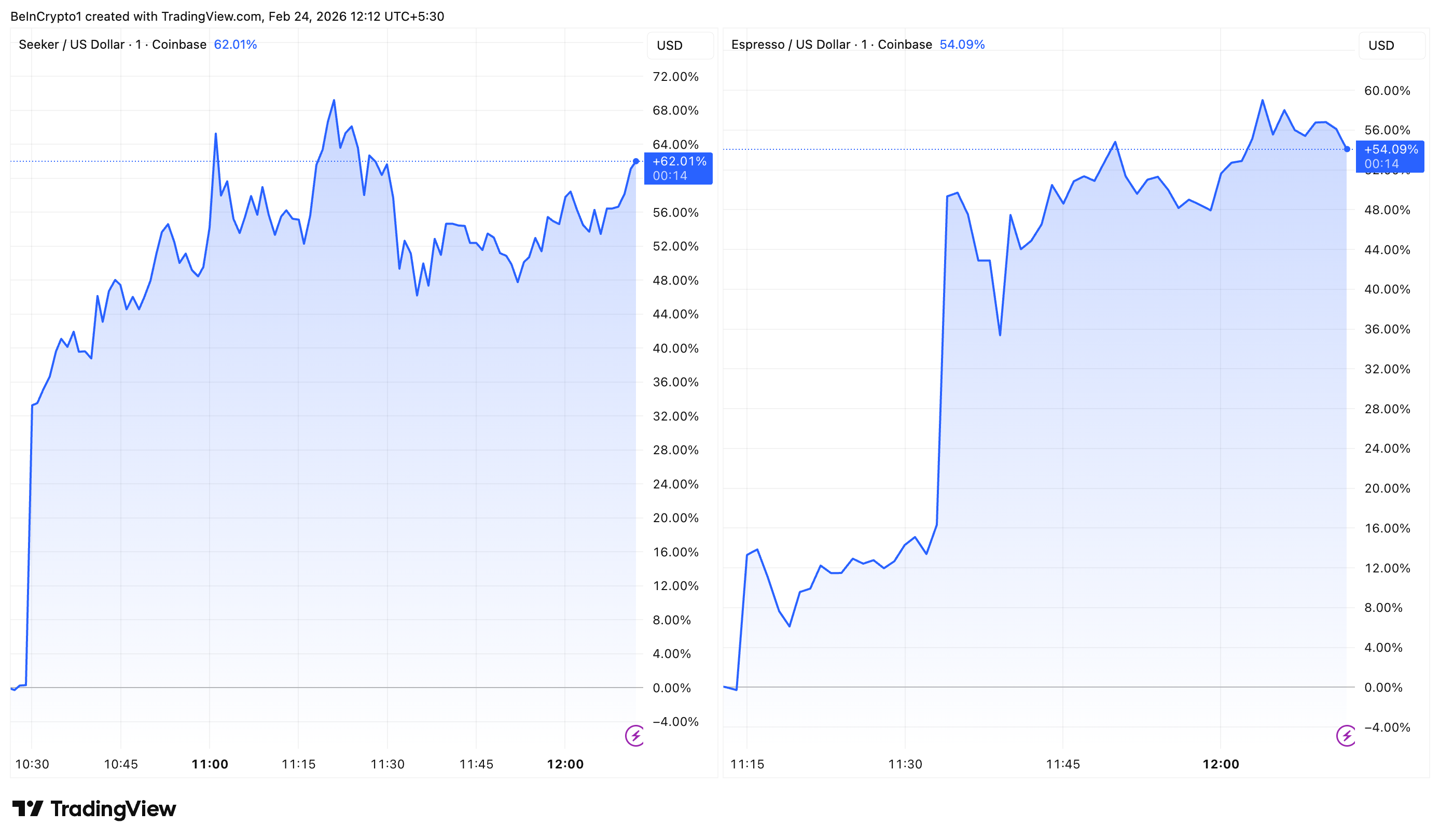
ESP also recorded significant gains, climbing more than 50% and reaching a new all-time high of $0.16. The token was launched earlier this month, making it a recent entrant to the market. ESP serves as the native token of the Espresso Network.
Espresso Network is a blockchain protocol that provides a shared sequencing and confirmation layer for rollups and other chains. It aims to improve scalability and interoperability by coordinating transaction ordering across multiple networks.
Crypto World
Who will ZachXBT expose as ‘insider traders’ on Thursday? Polymarket thinks these firms
Blockchain investigator ZachXBT hasn’t named the target yet. Polymarket bettors are already pricing it in.
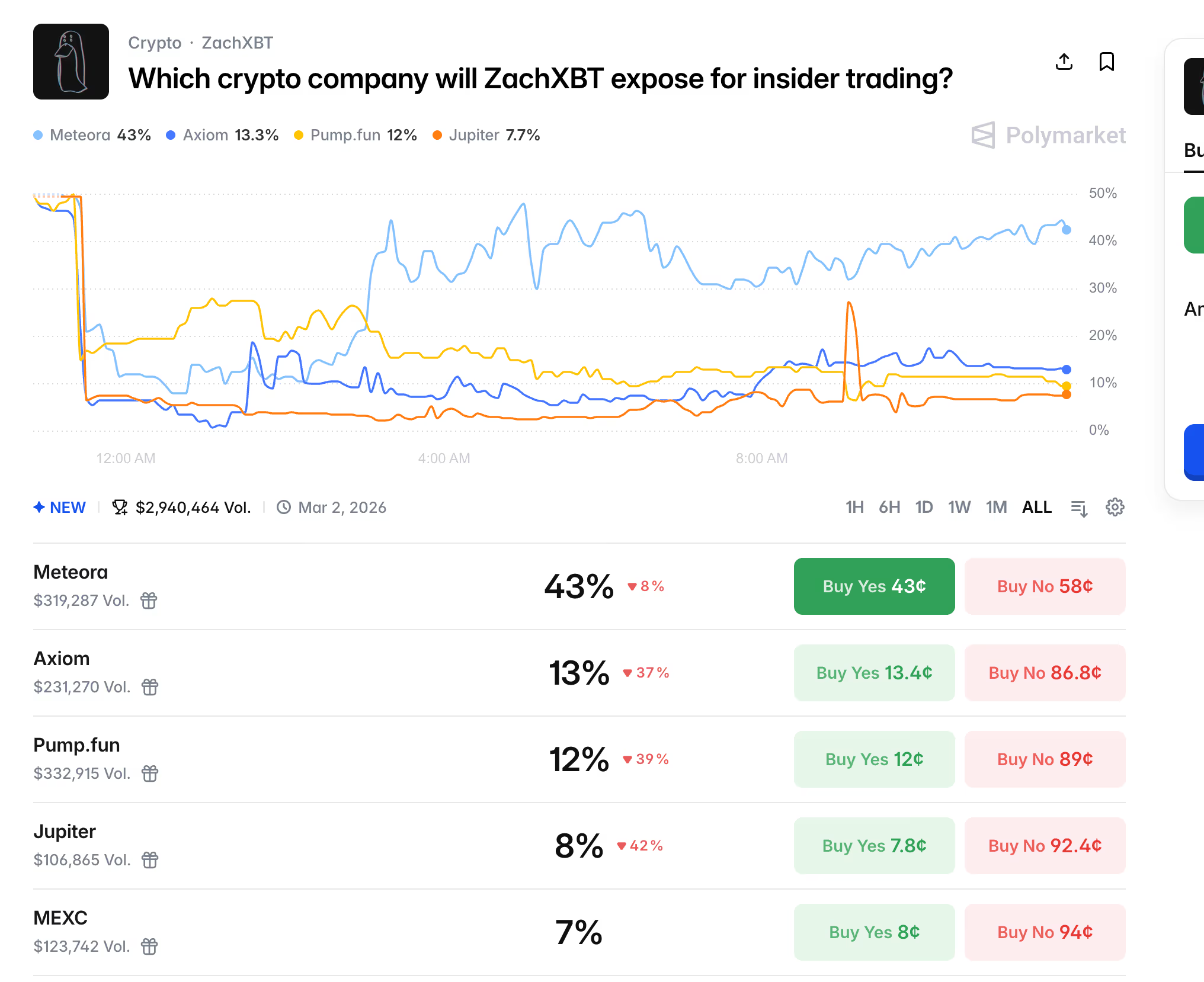
A prediction market asking which crypto company ZachXBT will expose for insider trading has drawn nearly $3 million in volume since the on-chain sleuth posted on X that a “major investigation” into one of crypto’s most profitable businesses would drop on February 26. He offered no specifics beyond alleging insider trading.
That was enough. Within hours, Polymarket traders began placing bets across several candidates, and the resulting odds function as a real-time map of where the market thinks the bodies are buried.
Polymarket is a blockchain-based prediction platform where users trade contracts on real-world outcomes using real money. The odds tend to reflect genuine conviction because bettors risk capital rather than just opinions. The platform gained mainstream credibility during the 2024 U.S. election cycle and has since become crypto’s de facto sentiment gauge for unresolved events.
As of Asian morning hours Tuesday, Meteora is the heavy favorite at 43%, with $319,000 in volume on that outcome alone. The Solana-based liquidity layer has been a recurring name in community discussions around meme coin market structure — particularly around how launch liquidity gets seeded and who ends up on the right side of early price moves.
Its proximity to politically linked token activity, including Trump-themed meme coins, has kept it in the spotlight.

Axiom sits at 13%, followed by Pump.fun at 12% with the highest single-outcome volume at $332,000 — suggesting heavy two-way action rather than consensus. Pump.fun’s inclusion tracks with months of scrutiny over early-wallet sniping on the platform, though the project has denied allegations of insider advantages.
Jupiter rounds out at 8% and MEXC at 7%. Jupiter’s presence reflects broader questions about Solana DeFi routing and fee extraction, while MEXC has faced persistent social media chatter about listing behavior and whale-friendly timing on meme coin markets.
The odds have shifted notably since the market opened. Axiom, Pump.fun, and Jupiter have all fallen 37-42% from their initial readings, while Meteora has consolidated its lead — a pattern that suggests early speculation has given way to more directional conviction as bettors parse ZachXBT’s prior work and posting patterns for clues.
None of this constitutes evidence, however. Prediction markets price belief, not fact, and Polymarket’s odds reflect the collective speculation of a few thousand traders rather than any inside knowledge of the investigation itself.
But the market is doing what prediction markets do best — forcing participants to put capital behind their hunches rather than just tweeting them.
The answer arrives in two days.

Gary Neville warns Michael Carrick will ‘kill’ Man Utd star if he doesn’t start him soon | Football

Legendary Boxers Agree to Rematch in Las Vegas

These 2 Big Spenders Hint At What’s Next


-

 Crypto World7 days ago
Can XRP Price Successfully Register a 33% Breakout Past $2?
-

 Video4 days ago
XRP News: XRP Just Entered a New Phase (Almost Nobody Noticed)
-

 Fashion4 days ago
Weekend Open Thread: Boden – Corporette.com
-

 Politics2 days ago
Baftas 2026: Awards Nominations, Presenters And Performers
-

 Sports13 hours ago
Women’s college basketball rankings: Iowa reenters top 10, Auriemma makes history
-

 Politics15 hours ago
Nick Reiner Enters Plea In Deaths Of Parents Rob And Michele
-

 Business6 days ago
Infosys Limited (INFY) Discusses Tech Transitions and the Unique Aspects of the AI Era Transcript
-

 Entertainment6 days ago
Kunal Nayyar’s Secret Acts Of Kindness Sparks Online Discussion
-

 Video7 days ago
Financial Statement Analysis | Complete Chapter Revision in 10 Minutes | Class 12 Board exam 2026
-

 Tech6 days ago
Retro Rover: LT6502 Laptop Packs 8-Bit Power On The Go
-
 Sports5 days ago
Clearing the boundary, crossing into history: J&K end 67-year wait, enter maiden Ranji Trophy final | Cricket News
-

 Business2 days ago
Mattel’s American Girl brand turns 40, dolls enter a new era
-

 Business2 days ago
Law enforcement kills armed man seeking to enter Trump’s Mar-a-Lago resort, officials say
-

 Entertainment5 days ago
Dolores Catania Blasts Rob Rausch For Turning On ‘Housewives’ On ‘Traitors’
-
 NewsBeat22 hours ago
‘Hourly’ method from gastroenterologist ‘helps reduce air travel bloating’
-

 Business6 days ago
Tesla avoids California suspension after ending ‘autopilot’ marketing
-

 Tech2 days ago
Anthropic-Backed Group Enters NY-12 AI PAC Fight
-

 NewsBeat2 days ago
Armed man killed after entering secure perimeter of Mar-a-Lago, Secret Service says
-

 Politics2 days ago
Maine has a long track record of electing moderates. Enter Graham Platner.
-

 Crypto World6 days ago
WLFI Crypto Surges Toward $0.12 as Whale Buys $2.75M Before Trump-Linked Forum