
Crypto World
Congress sneaks CBDC into housing bill, economist warns 80% of voters opposed



A viral warning from economist Peter St. Onge has spotlighted how an 89–10 Senate housing bill quietly folds in a temporary CBDC ban and reshapes the path for the CLARITY Act.
Summary
- Economist Peter St. Onge’s post warning that a CBDC provision is buried inside a must-pass housing bill drew nearly 196,000 views on X in under three hours.
- The U.S. Senate passed the 21st Century ROAD to Housing Act on March 12 with an 89–10 vote, embedding a ban on Federal Reserve-issued digital dollars through 2031.
- The bill must still pass the House, where Republican lawmakers are pushing for a permanent CBDC ban rather than the temporary prohibition in the Senate version.
A viral alarm from Heritage Foundation economist Peter St. Onge is reigniting one of crypto’s most contested political fights in Congress: the prospect of a U.S. central bank digital currency. In a post on X that amassed 195,700 views and 3,600 likes by the afternoon of March 26, @profstonge warned that “Congress is trying to sneak a CBDC into their must-pass housing bill,” adding that such a currency “would replace the US dollar with a government-controlled crypto-token that 80% of voters reject.”
The bill in question, the 21st Century ROAD to Housing Act, passed the Senate on March 12 by an overwhelming 89–10 margin. As reported by Yahoo Finance, the legislation is primarily a sweeping housing reform package crafted by Senate Banking Committee Chairman Tim Scott and Senator Elizabeth Warren, covering everything from FHA loan limits to institutional investor restrictions on single-family homes. Buried within it, however, is Title X — a provision that bars the Federal Reserve and its regional banks from issuing or creating a digital dollar, or any asset substantially resembling one, through 2031.
The inclusion was not accidental. According to Unchained Crypto, House conservatives pushed to embed anti-CBDC language into the legislation as a condition of broader bipartisan compromise, a strategy that allowed digital currency policy to advance without requiring a standalone crypto bill. The White House signaled support for the measure, with advisors recommending the president sign it if presented in its current form.
The CBDC Provision Dividing Washington
The debate cuts across party lines in ways that complicate easy narratives. While the Senate version imposes a ban through 2031, some House Republicans are pushing for a permanent prohibition, arguing that a time-limited restriction simply kicks the problem down the road. At the same time, critics on the left have argued the provision has no place in a housing bill and could muddy what should be a straightforward affordability package.
Wall Street commentator @WallStreetMav added another layer of skepticism in a separate post on X that drew 92,000 views, writing that “Republicans aren’t banning CBDCs, they’re redesigning them. Same surveillance, same control, just routed through banks so Wall Street gets its cut.” The post, which framed the compromise as a “revenue-sharing agreement” rather than genuine reform, accumulated 873 likes and 357 retweets within hours.
The housing bill CBDC fight arrives alongside a parallel battle over the CLARITY Act, the digital asset market structure legislation that has stalled in the Senate over a separate stalemate on stablecoin yield. Coinbase withdrew support for an earlier CLARITY Act draft after proposed language would have banned passive yield on stablecoins — a provision the exchange said was worse than the status quo. Senator Cynthia Lummis has since said sticking points on stablecoin yield and DeFi provisions are “largely reached,” framing April 2026 as a critical legislative window.
A Temporary Ban or a Political Signal?
For CBDC opponents, the housing bill provision is less about the technical details of digital currency design and more about drawing a political line before midterm elections. As Ledger Insights noted, the ban expires at the end of 2030 — after Trump leaves office — leaving the door open for a future administration. The Federal Reserve, for its part, has consistently maintained it would not launch a digital dollar without explicit congressional authorization, framing its existing research as exploratory rather than developmental.
Whether the CBDC provision survives a House-Senate conference process remains uncertain. House leaders have already indicated they are unlikely to accept the Senate version of the housing bill as written and may seek to renegotiate key provisions — including how long, and how broadly, any CBDC ban applies. As crypto.news previously reported, the Senate vote drew rare cross-aisle alignment, but that consensus may face pressure once negotiations with the House begin in earnest.


Elon Musk’s X has hired crypto-native product designer Benji Taylor as its new head of design, ahead of a wider rollout of the platform’s X Money payments product next month.
Taylor announced the move on X on Wednesday, saying he was “honoured” to join the company and looking forward to working closely with Musk and X’s head of product Nikita Bier. Taylor’s crypto-native background is notable, previously founding Los Feliz Engineering, a consumer software studio that was acquired by decentralized lending protocol Aave Labs in 2023.
Bier said that he had followed Taylor’s work for years and knew that he was “on track to become one of the best designers in the world,” and that X was “finally teaming up and building the greatest design team in the industry.”
The appointment comes as X prepares to expand X Money, an integrated payments and financial services layer that will introduce peer-to-peer payments, wallet services and a debit card tied to user accounts.
Aave and Base roles
After the Aave acquisition in 2023, Taylor became chief product officer until October 2025, according to his LinkedIn profile, overseeing the company’s product strategy and development for its decentralized lending protocol and related applications.

Before joining X, he led design for Coinbase’s Ethereum layer-2 network Base, where he was responsible for the network’s product and interface design across its user and developer-facing experiences. He earlier served as senior vice president of product and design at Avara, the renamed Aave Companies group.
Related: Musk confirms X Money beta testing ahead of planned 2025 launch
X Money rollout
The timing also stands out. In early March, Musk announced that X Money would begin public access next month, as an integrated payments and financial services layer for the social platform.
The product is currently in limited external beta and offers users a 6% annual percentage yield on cash balances held in an X Money wallet, a personalized metal Visa debit card engraved with the user’s X handle, and peer-to-peer payments linked directly to the X app.
Musk has described X Money as part of his plan to turn the platform into an “everything app” that combines social networking, messaging and financial services.
Magazine: How crypto laws changed in 2025 — and how they’ll change in 2026
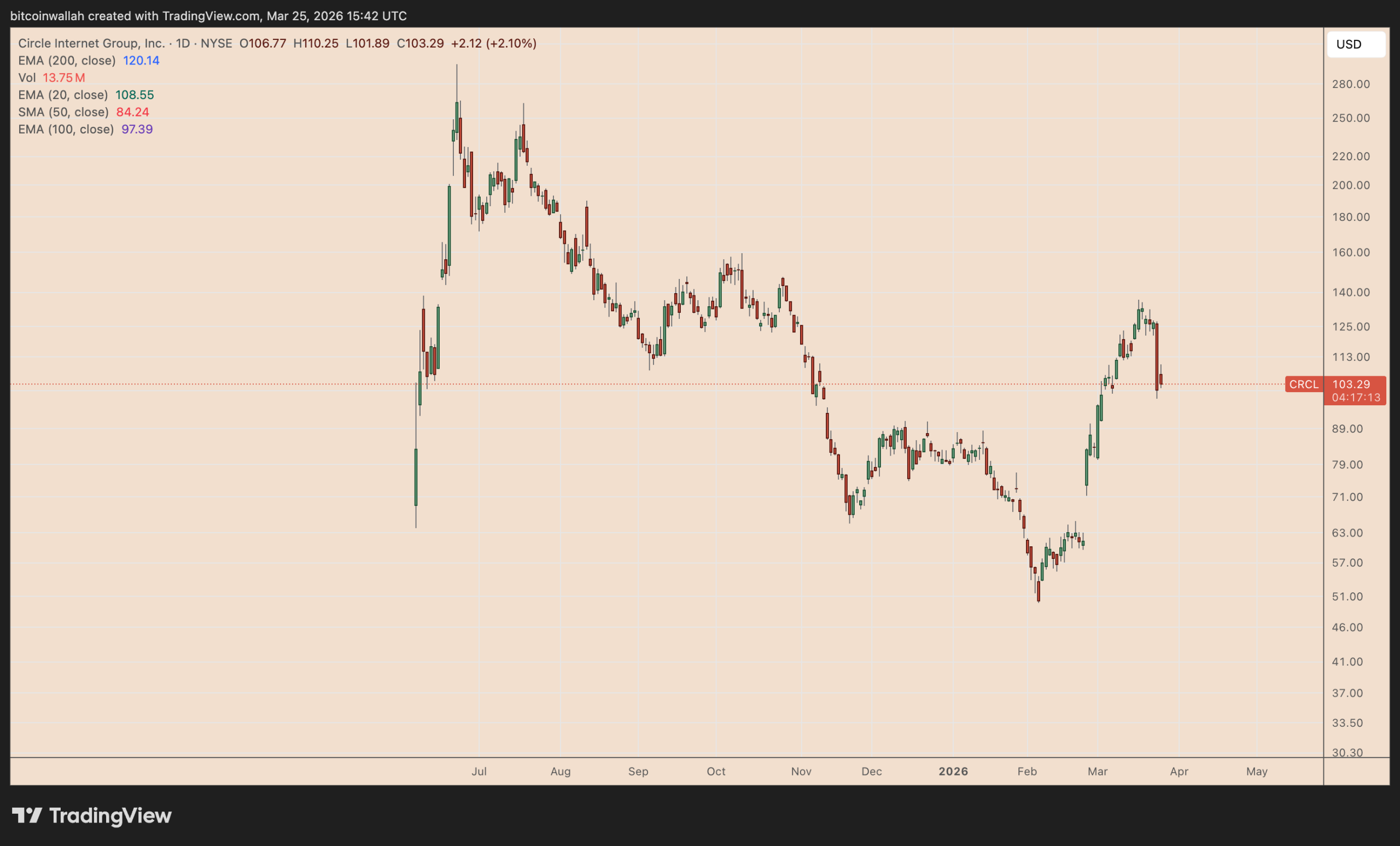
Circle Internet Group’s CRCL stock is showing signs of a potential 25% rebound after the market may have reacted too aggressively to fears surrounding draft CLARITY Act language tied to stablecoin yield restrictions.

Key takeaways:
-
CRCL is attempting to stabilize above a major support confluence near $100.75.
-
Analysts say draft CLARITY Act language may hurt distributor incentives more than Circle’s core reserve-income model.
CRCL stock holds support, opening path to $130
From a technical perspective, CRCL is trying to base near an important support cluster around $100.75, where the 100-day exponential moving average (100-day EMA) aligns with the 0.236 Fibonacci retracement level.

That confluence held even as the stock suffered a brutal 20% single-session decline, a sign that dip buyers stepped in around a historically relevant area on the chart.
The stock could rebound toward the 0.382 Fibonacci retracement level near $130 in the coming weeks if CRCL continues to hold the current floor, representing roughly 25% increase.
The bullish setup also gains some support from institutional buyers. Ark Invest bought about $16 million worth of Circle shares during the plunge on Tuesday, showing that some investors viewed the sell-off as an opportunity.

Still, the setup remains conditional. A decisive break below the $100.75 support confluence would weaken the rebound case and shift downside focus toward the 50-day EMA near $84.25.
That level also aligns with a pullback target shared by independent TradingView analyst Jackie.
CLARITY Act doesn’t affect Circle yield
CRCL fell after traders worried that draft CLARITY Act language could limit stablecoin-linked yield incentives and slow USDC growth.
But Bernstein kept its $190 price target, saying the proposal does not affect Circle’s ability to earn yield on reserves or pay distribution partners such as Coinbase, Binance, or OKX. Ark Invest’s Lorenzo Valente made a similar point.
I think people are misunderstanding what’s happening here.
The new draft of the CLARITY Act does not prohibit issuers from paying distributors such as @coinbase , @binance , or @okx . The discussion around yield is really about retail holders, meaning the end users who actually… https://t.co/hmXpIRyooi
— Lorenzo Valente (@LorenzoARK) March 25, 2026
Circle’s model is simple: it takes the cash backing its stablecoins, invests it in deposits and short-dated US Treasurys, earns yield on those reserves, and shares part of that income with partners.
In 2025, for instance, Circle earned about $2.64 billion in reserve income from roughly $75.3 billion worth of USDC reserves. It doesn’t pay yield directly to USDC holders but to its distribution partners.
Bernstein added that if yield competition becomes harder across the sector, Circle’s market position could actually improve.
Related: Circle taps African fintech Sasai to expand USDC adoption in cross-border payments
Presenting similar arguments, Bitwise said Circle’s market valuation may reach about $75 billion by 2030, almost three times its current worth.

This article does not contain investment advice or recommendations. Every investment and trading move involves risk, and readers should conduct their own research when making a decision. While we strive to provide accurate and timely information, Cointelegraph does not guarantee the accuracy, completeness, or reliability of any information in this article. This article may contain forward-looking statements that are subject to risks and uncertainties. Cointelegraph will not be liable for any loss or damage arising from your reliance on this information.


GameStop revealed on Tuesday that it pledged nearly all of its Bitcoin as collateral on Coinbase as part of a covered call strategy in January, ending two months of speculation over whether it had sold the coins.
In a 10-K annual report to the Securities and Exchange Commission on Tuesday, the video game retailer revealed it pledged 4,709 Bitcoin (BTC), nearly all of its Bitcoin, as collateral under an agreement with Coinbase Credit, using the position to sell covered call options.
The SEC filing clears speculation from January that GameStop was preparing to exit its Bitcoin position after onchain analysts pointed out that it transferred its entire Bitcoin holdings to Coinbase Prime.
The Bitcoin treasury industry has faced pressure in recent months as Bitcoin has fallen 45% from its all-time high, with some analysts casting doubt last year on the sustainability of buy-and-hold strategies.
The move shows GameStop sought to earn income on its Bitcoin by placing short-dated call options with strike prices between $105,000 and $110,000 that are set to expire Friday.
The disclosure shows a $2.3 million unrealized gain and a $700,000 liability tied to the options, while some covered-call contracts expired unexercised in January.
GameStop’s covered call strategy enables it to sell call options that give buyers the right to purchase its Bitcoin at a fixed price. GameStop earns premiums and retains the Bitcoin if the options aren’t exercised.
GameStop directly holds just one Bitcoin now
Since GameStop moved 4,709 Bitcoin to Coinbase, a counterparty that can rehypothecate or reuse the pledged Bitcoin, GameStop is no longer counting those assets as directly held.
Putting Bitcoin up as collateral “resulted in the derecognition of the pledged digital assets and the corresponding recognition of a digital asset receivable,” GameStop said in the filing.
“Although the classification of these assets has changed, our economic exposure is consistent with direct ownership of the underlying Bitcoin,” it added.
GameStop still holds one Bitcoin that wasn’t put up for collateral.
GameStop added that its pledged Bitcoin was worth $368.3 million by Jan. 31 and that it recorded an unrealized loss of $59.7 million on that date because of Bitcoin’s price drop.
Related: Bitcoin in ‘later stages’ of bear market: Watch these BTC price levels
GameStop launched a Bitcoin treasury after its CEO, Ryan Cohen, met with Strategy chair Michael Saylor in February 2025 to discuss how Bitcoin strategies can be implemented.
Prior to moving the 4,709 Bitcoin to Coinbase, GameStop’s Bitcoin stash ranked in the top 25 Bitcoin treasuries by holding size.
Magazine: Bitcoin may face hard fork over any attempt to freeze Satoshi’s coins
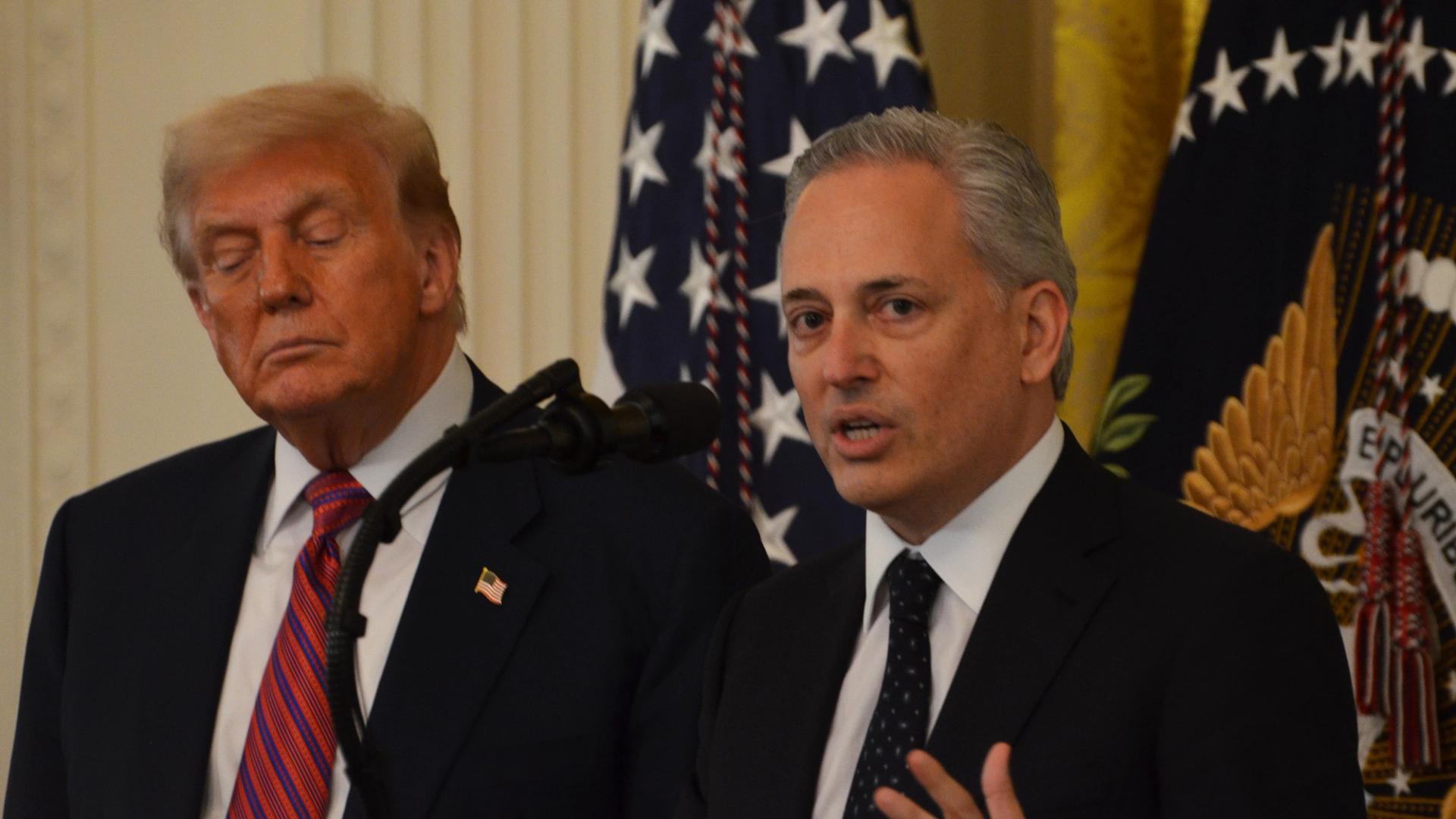
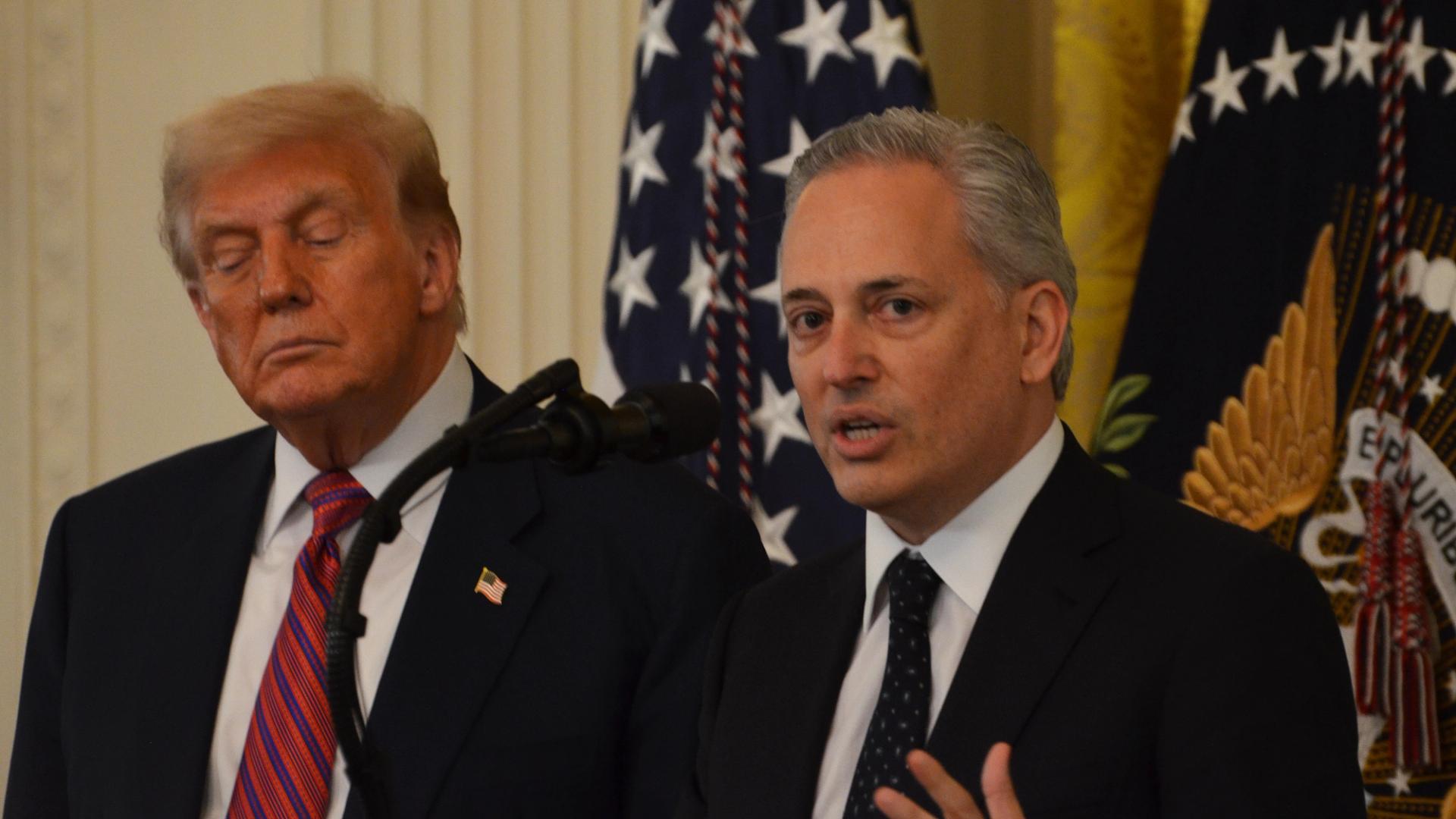
White House AI and Crypto Czar David Sacks is changing titles and joining the President’s Council of Advisors on Science and Technology as co-chair, he announced Thursday.
Sacks, who was named U.S. President Donald Trump’s crypto and AI czar before Trump retook office last January, has overseen the White House’s early work on crypto initiatives, including the passage of the stablecoin-focused GENIUS Act and more recently, work around the crypto market structure bill.
“PCAST is the principal body of external advisors tasked with shaping science, technology, and innovation policy for the President and the White House,” he said in a post on X (formerly Twitter). “Thirteen of the world’s most accomplished leaders in science and technology will join us as this PCAST’s initial members.”
Sacks told Bloomberg earlier Thursday that his czar role was designated as a “special government employee,” meaning he legally could only serve in that position for 130 working days. Democrats in Congress had already raised concerns that he had exceeded this period last fall.
He does not have this same issue serving as a co-chair on the advisory committee.
Sacks said in the Bloomberg interview that the council would make policy recommendations and conduct studies around artificial intelligence, quantum computing, nuclear power and other “cutting edge technologies.”
“I think you can expect us to make some recommendations in those areas. We want to push forward the president’s A.I. framework that was already released just last week,” Sacks said in the interview. “So you’ll see, I think, a lot of activity around that. But it will also be other areas as well.”
Sacks did not mention crypto in the interview.
Other members of the committee include Andreessen Horowitz co-founder Marc Andreessen, Google co-founder Sergey Brin, Dell founder Michael Dell, early Coinbase backer Fred Ehrsam, NVIDIA CEO Jensen Huang, AMD CEO Lisa Su and Meta (formerly Facebook) founder Mark Zuckerberg, among others. Michael Kratsios, who’s served in both of Trump’s administrations, will serve as the co-chair.
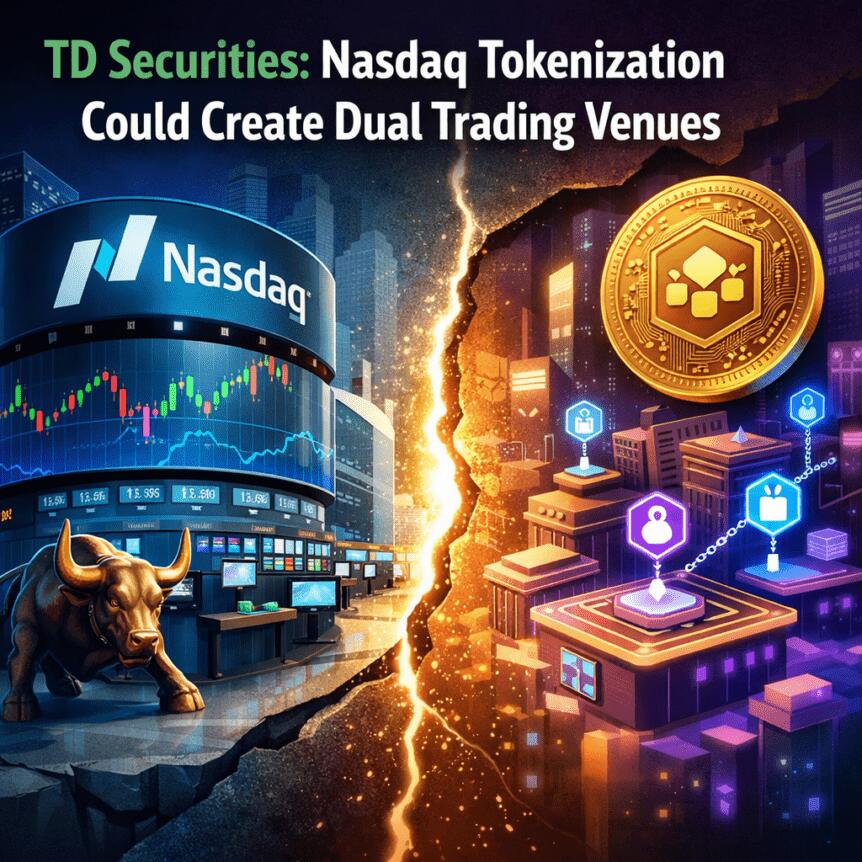
Nasdaq’s drive to tokenize equities could reshape capital markets by introducing a two-tier landscape where regulated US exchanges sit alongside blockchain-based trading venues. A TD Securities note suggests the move may create parallel systems capable of splintering trading activity and producing price differences across platforms as tokenized stocks gain traction.
The bank’s analysis highlights Nasdaq’s parallel push, joining NYSE’s tokenization efforts, to advance three main tracks: modernizing post-trade settlement for tokenized assets, enabling issuances of tokenized shares, and extending trading to offshore venues such as Kraken. Taken together, these efforts could lead to a split market where one stream operates within the traditional US regulatory framework and another on offshore, blockchain-enabled platforms.
TD Securities cautions that offshore venues—while backed by real securities—could escape the American regulatory perimeter. If tokenized shares trade on these platforms, prices could diverge from those on standard US venues, complicating price discovery and potentially siphoning activity away from established exchanges. Cointelegraph reached out to TD Securities for comment but did not receive a response in time for publication.
Key takeaways
- Nasdaq’s tokenization strategy comprises three parallel efforts: post-trade settlement upgrades, tokenized equity issuance, and offshore trading support on platforms such as Kraken.
- The initiatives could yield a two-tier market: a regulated US market and an offshore, blockchain-based trading ecosystem, with potential price differentials between venues.
- Tokenized equities are gaining real traction, as shown by Kraken’s xStocks platform, which has surpassed $25 billion in cumulative trading volume and grown about 150% since November.
- Trading across multiple venues may create 24/7 access and broader round‑the‑clock liquidity, but it also introduces new risks around activity concentration and inconsistent pricing.
- Industry context shows broader momentum: Coinbase expanding tokenized stock offerings and NYSE’s collaboration with Securitize to explore 24/7 tokenized securities, signaling growing competition for traditional equity trading.
Nasdaq’s tokenization roadmap could redefine how equities are traded
The TD Securities note frames Nasdaq’s tokenization ambitions as a triad of initiatives designed to integrate blockchain-based trading into mainstream markets without waiting for a single, wholesale overhaul of market structure. First, settlement modernization would adapt clearing and custody processes to handle tokenized shares more efficiently after trade execution. This is a prerequisite for reliable, scalable on-chain settlement that can coexist with existing post-trade infrastructure.
Second, Nasdaq is examining mechanisms to issue tokenized shares themselves, potentially enabling corporate issuers to digitalize equity ownership in a way that can be traded on both traditional venues and compatible blockchain networks. Third, the exchange is said to be exploring offshore trading opportunities, effectively enabling tokenized equities to be traded on platforms outside the domestic regulatory perimeter, with Kraken cited as an example of such a venue.
Taken together, these moves imply a market where the “same” stock could be represented and traded across different rails. In practice, that means investors might access tokenized versions of equities in a 24/7 framework outside normal exchange hours, while the same underlying share remains available through standard US listings during regular hours.
For market participants, the implications are twofold. On one hand, the potential for continuous liquidity and new liquidity pools could improve access and price discovery in certain scenarios. On the other hand, the emergence of parallel offshore venues raises questions about regulatory alignment, investor protection, and the coherence of pricing across ecosystems.
Markets adapting to tokenized competition and regulatory risk
Today’s crypto-enabled trading ecosystems already feature a growing set of tokenized equities, with traders increasingly engaging a broader, cross-border audience. Cointelegraph reported that Kraken’s xStocks platform, which provides tokenized versions of publicly traded shares on blockchain-based venues, has surpassed $25 billion in cumulative trading volume, reflecting around 150% growth since November. The momentum underscores a real appetite for around-the-clock access to equities in a tokenized format, even as traditional venues continue to operate within their established hours and rules.
Behind this expansion sits a broader industry trend: the push by major exchanges to experiment with tokenization while contemplating how to regulate, govern, and ultimately integrate these assets with existing equity markets. The NYSE, for its part, has been pursuing tokenization through a partnership with Securitize to develop a platform for tokenized securities that could support extended or non-traditional trading hours. This collaboration mirrors a wider market push toward an “everything exchange” model, where tokenized assets compete for space alongside conventional securities.
From an investor perspective, the emergence of multiple venues tied to the same underlying asset could alter how portfolios are constructed and how risk is assessed. If tokenized shares trade at different prices across regulated and offshore platforms, traders may need to track multiple price signals and navigate potential arbitrage opportunities. The prospect of 24/7 trading, while attractive for liquidity and access, also introduces new layers of risk—especially if regulatory guardrails diverge between venues or jurisdictions.
Regulators will likely weigh the benefits of broader access and innovation against the need to preserve investor protections and market integrity. The current conversation highlights a tension between accelerating tokenization and maintaining a cohesive, transparent market framework. As market participants deploy more tokenized offerings, observers will be looking for alignment in settlement standards, custody controls, and cross-venue price discovery mechanisms.
Beyond Nasdaq and NYSE, other industry players have already begun positioning for tokenized trading. Coinbase has pushed into tokenized stock offerings as part of an “everything exchange” strategy, signaling a competitive push from crypto-native platforms into equity trading. In parallel, NYSE’s collaboration with Securitize points to a broader ecosystem of tokenized securities designed to enable more flexible trading paradigms, including around-the-clock access that challenges traditional market hours.
What remains uncertain is how regulators will reconcile these parallel rails. Will there be harmonized standards for settlement and custody across on-chain and off-chain venues? How will investor protections translate when trading occurs on offshore platforms? And how quickly will price discoveries across venues converge or diverge under a regime of tokenized equities?
In interviews and briefings, contributors like Reid Noch of TD Securities emphasize that while tokenization promises to broaden access and liquidity, it also introduces new complexities. The coming months are likely to bring more concrete regulatory guidance, clearer cross-venue interoperability standards, and perhaps pilot programs that test tokenized trading in controlled environments before any broad rollout.
As the market digests these developments, investors and traders should monitor several cues: the pace at which settlement and custody workflows adapt to tokenized assets, the degree of cross-venue price convergence, and the regulatory responses that could either unlock or constrain offshore trading activity. The balance between innovation and oversight will shape how tokenized equities evolve from experimental concepts into mainstream instruments.
Readers should watch for updates from Nasdaq and NYSE on timing and scope of tokenized trading pilots, along with any new clarity from US regulators on cross-border trading and tokenized securities. The coming months could reveal whether tokenization simply augments existing markets or fundamentally reconfigures how equities are priced, traded, and owned.

TLDR
- Tether has launched XAUt on BNB Chain to expand access to its tokenized gold product.
- Binance has listed XAUt for spot trading against USDT, BTC, USDC, TRY, and U.
- XAUt holds a market cap of about $3.2 billion and is backed by roughly 1,800 gold bars in Swiss vaults.
- Spot gold reached $5,595 per ounce in January before falling to around $4,450 on March 26.
- Crypto.com now offers tokenized gold perpetual contracts alongside spot trading in XAUt and PAXG.
Tether has launched XAUt on BNB Chain to expand access to its tokenized gold product. Binance confirmed it will list XAUt for spot trading against USDT, BTC, USDC, TRY, and U. The move places tokenized bullion inside one of the largest exchange ecosystems as gold trading activity shifts into crypto markets.
XAUt and Tether Expand Tokenized Gold Access
Tether introduced XAUt on BNB Chain to widen the distribution of its gold-backed token. The company aligned the launch with Binance’s spot listing announcement. As a result, traders can access XAUt across several major trading pairs on the same day.
Binance stated it would enable spot trading for XAUt against USDT, BTC, USDC, TRY, and U. The exchange added the token to its main trading platform. Therefore, users can buy and sell tokenized gold within existing crypto portfolios.
BNB Chain reported that XAUt holds a market cap of nearly $3.2 billion. The network linked the token to about 1,800 gold bars stored in Swiss vaults. Reuters reported in January that XAUt controls about 60% of the global gold-backed stablecoin market.
BNB Chain ranks as the second-largest chain for RWAs by distributed asset value, according to RWA.xyz. The network also said it attracted new asset inflows and holders over the past month. Consequently, Tether gains broader onchain reach for its bullion-backed token.
Gold Price Swings Drive Crypto Market Activity
Gold prices recorded sharp moves earlier this year and drew fresh trading interest. Spot gold reached a record $5,595 per ounce in January as geopolitical tensions increased. However, prices later reversed direction and erased part of those gains.
Gold traded near $4,450 on March 26. The metal has fallen more than 15% since the war on Iran began on February 28. Higher oil prices, inflation concerns, and a stronger dollar pressured prices during that period.
Crypto platforms responded to the volatility by expanding gold-linked products. Crypto.com said its exchange now supports tokenized gold perpetual contracts. The platform also offers spot trading in XAUt and PAXG.
These products allow users to gain leveraged exposure to gold price movements around the clock. As a result, tokenized bullion now sits alongside traditional crypto assets. Traders can switch between digital tokens and gold exposure within the same exchanges.
Paolo Ardoino described the BNB Chain launch as a utility-driven step. He said the expansion aims to make gold more usable in digital markets. The rollout coincides with Binance activating spot trading for XAUt across multiple pairs.

Crypto World
Avalanche price holds near $9.70 as U.S. ‘digital commodity’ ruling meets subnet growth


Avalanche price is grinding around $9.70 as a U.S. “digital commodity” label, fee and subnet upgrades, and growing RWA and ETF activity push fundamentals ahead of AVAX’s stalled chart.
Summary
- Avalanche trades around $9.67 with a market cap near $3.8 billion and 24-hour volume above $220 million.
- AVAX is consolidating roughly 10–12% below key $10 resistance after a March ruling that classified it as a U.S. “digital commodity” and a series of scaling upgrades.
- Subnet expansion and rising real‑world asset activity contrast with subdued price action, mirroring a broader pause across large L1 tokens.
Avalanche (AVAX), the native token of the Avalanche Layer‑1 smart contract network, is trading at about $9.67 today, with 24-hour spot volume around $226.7 million and a market capitalization close to $3.88 billion. Yahoo Finance data show AVAX closing at $9.6793 on March 26, 2026, after opening near $9.67, continuing a tight range that has persisted for several sessions. CoinGecko lists daily trading volume near $1.01 billion when aggregating spot and derivatives, representing a 61.30% increase from the previous day, suggesting renewed activity even as price remains rangebound.
Price history from CoinMarketCap places Avalanche’s recent closes between $9.17 and $9.75 over the first week of March, with March 6 seeing an open at $9.3838 and close at $9.4534, underscoring how the token has spent much of the month pivoting around the $9–$10 zone. Investing.com’s historical series similarly shows AVAX closing at $8.99 on March 22 after trading between $8.93 and $9.34 that day, with 5.19 million AVAX changing hands. Put together, the tape shows a large‑cap L1 in consolidation rather than in a trending phase.
Beyond the chart, Avalanche has logged a string of structural developments in March. Phemex notes that Avalanche was formally described as a “digital commodity” by the U.S. SEC and CFTC on March 17, 2026, a designation that clarifies its status alongside assets like Bitcoin in certain regulatory contexts. In parallel, CoinMarketCap’s latest Avalanche update highlights a recent upgrade that implemented three proposals: ACP‑226, allowing validators to dynamically adjust minimum block times; ACP‑204, adding support for the secp256r1 cryptographic curve used in Apple’s FaceID and TouchID; and ACP‑181, which stabilizes the validator set for short periods to reduce gas costs and improve cross‑chain reliability. CoinMarketCap’s analysis notes that these changes are intended to make Avalanche faster, cheaper and more secure, particularly for mobile users and cross‑chain applications.
These improvements build on the earlier “Octane” hard fork in May 2025, which reduced subnet deployment costs by approximately 83%, cut the minimum base fee by 99.6% and introduced dynamic fee algorithms to prevent spam in periods of high demand. Together, the upgrades frame Avalanche as a high‑throughput L1 with a scaling strategy centered on subnets—custom, application‑specific blockchains that require AVAX for staking and fees.
Avalanche’s longer‑term growth thesis is increasingly tied to subnets and real‑world asset (RWA) tokenization. Yahoo Finance previously reported that the Avalanche Foundation committed 4 million AVAX—valued at around $290 million at the time—to attract gaming, DeFi and NFT projects to its subnet ecosystem, via the “Multiverse” incentive program. CoinMarketCap’s Avalanche updates also reference the Evergreen Subnet initiative for institutions and RWA partners such as BlackRock and Securitize, which are working on on‑chain products that would settle on Avalanche infrastructure. Binance’s recent deep dive points to more than 75 active subnets, a $40 million Retro9000 rewards program, and the launch of a Nasdaq‑listed AVAX treasury firm and spot AVAX ETF as signs of growing institutional involvement.
Despite these developments, WazirX’s March 2026 outlook characterizes AVAX as technically weak but fundamentally supported, identifying $10 as a key support‑turned‑resistance level and outlining a medium‑term consolidation band between $9 and $11. Within the broader L1 landscape, Avalanche’s sideways trading near $9.70 stands in contrast to the more explosive moves seen in smaller altcoins, but resembles a common pattern among major smart‑contract platforms where on‑chain fundamentals improve ahead of price. For real‑time data, readers can track AVAX on the crypto.news market‑cap dashboard via the Avalanche price page, and compare it against other large L1 tokens such as Ethereum and Solana on their respective price pages.
Crypto World
XRP Price Prediction Meets SEC ETF Deadline as Pepeto Outperforms and Investors Choose Exchange Tools Over Web3
The SEC faces its final deadline today on the remaining batch of spot XRP ETF applications, and with $1.44 billion already flowing into XRP funds and Goldman Sachs holding the largest institutional position at $153 million, the xrp price prediction hinges on whether that institutional capital wave finally arrives at scale.
While XRP waits for one more catalyst, attention shifts. The exchange that raised more than $8 million with verified tools already running is where investors are choosing to position before the listing. The XRP outlook shows strength in the infrastructure, but Pepeto with 100x projected by analysts offers the kind of return that XRP at $1.34 needs years to match.
The SEC reaches its 240 day maximum deadline on March 27 for the remaining spot XRP ETF applications from Grayscale, WisdomTree, and Franklin Templeton, with $1.44 billion in total inflows and Goldman Sachs holding $153 million as the single largest institutional allocation, according to CoinDesk.
Bloomberg analysts place the odds of at least one approval before year end at 95%, and the SEC commodity classification on March 17 removes the final regulatory obstacle, according to The Block.
The xrp price prediction benefits from ETF clarity, but the exchange already at presale pricing with a Binance listing confirmed is where the compressed return lives.
Where the ETF Catalyst Meets Presale Returns Before Trading Opens
Pepeto
XRP ETF volumes are rising, which shows institutions still enter crypto infrastructure even when prices swing. But sentiment flips fast and holding one token without protection exposes you to every shift.
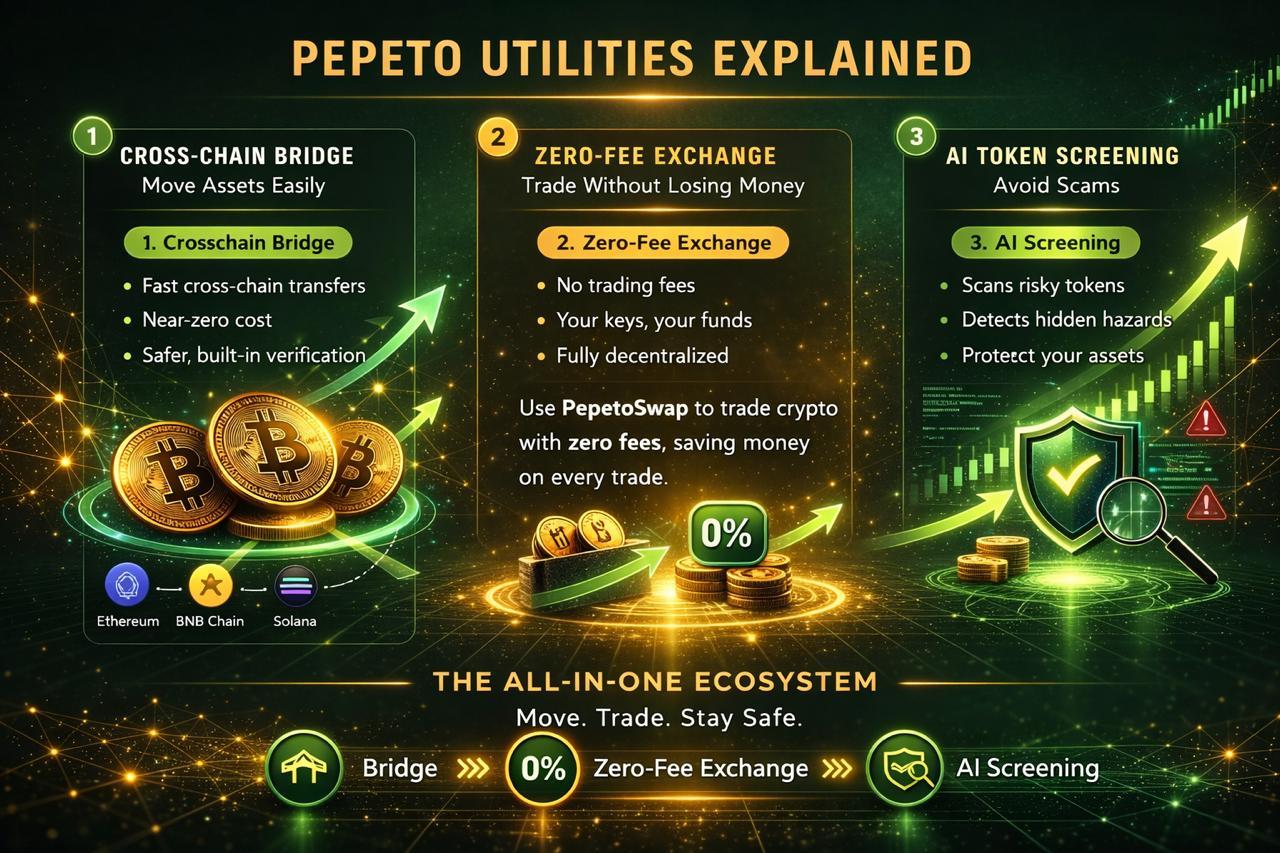
That is why Pepeto stands apart. It is not a bet on one coin recovering but on giving traders verified answers in every market. The exchange raised more than $8 million at $0.000000186, and wallets are buying access to tools that help them make verified decisions.
The xrp price prediction may show strength, but the risk scorer checks every contract before your capital touches it, PepetoSwap handles every trade at zero fees, and the cross chain bridge sends tokens at zero cost.
Inside the platform, the contract scanner, the real time risk checker, and the zero cost bridge all run from one fast verified exchange with 193% APY staking compounding early positions while stages fill faster. The SolidProof audit verified every contract, and the developer who created the original Pepe coin reaching $11 billion with the same 420 trillion supply built the exchange alongside a former Binance expert.
If crypto keeps growing, the need for verification only grows with it, and the demand for Pepeto grows alongside. Getting in before that demand becomes obvious is where 100x lives.
XRP Price Prediction: Can XRP Break $1.60 Before the ETF Decision Lands?
XRP trades at $1.34 as of March 27 forming a tightening ascending triangle with the SEC ETF deadline arriving today, according to CoinMarketCap.
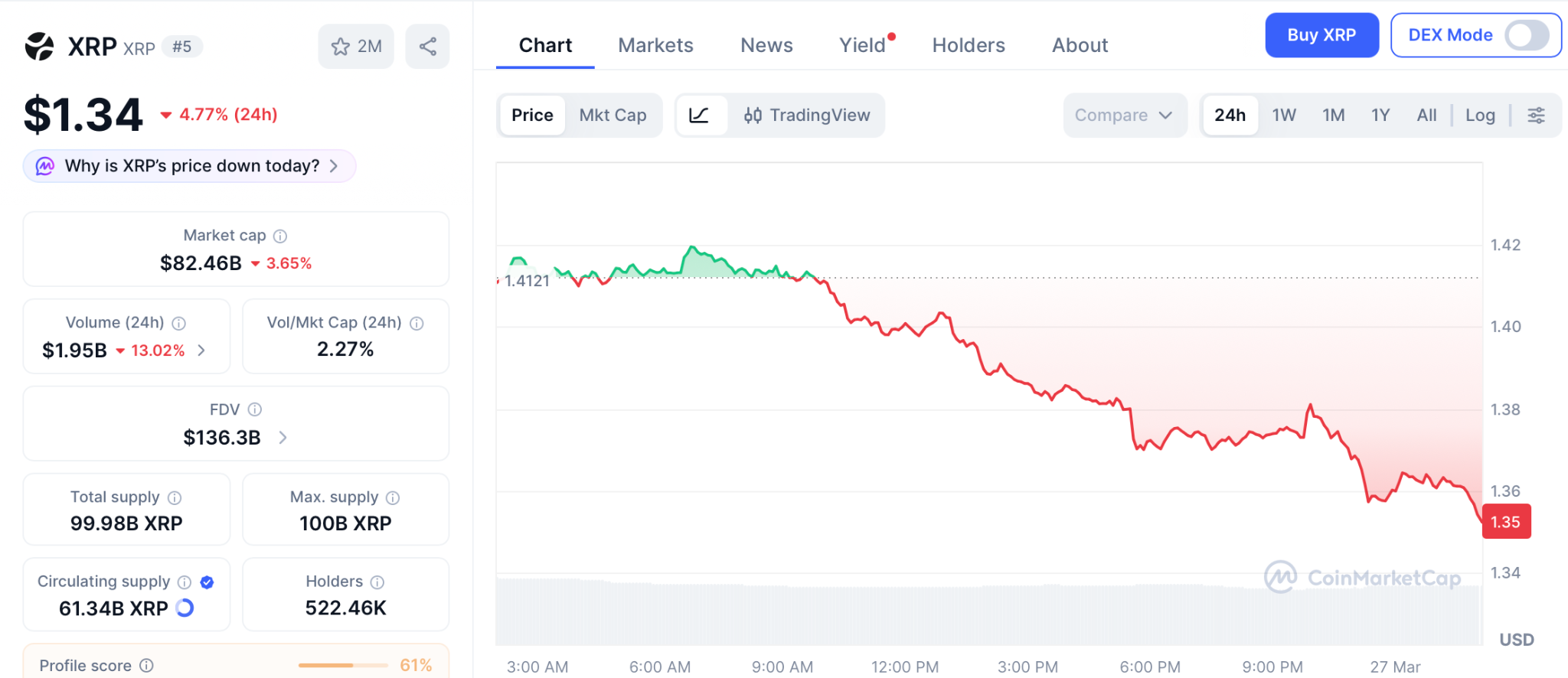
The xrp price prediction puts resistance at $1.45 then $1.55, with a break above $1.60 opening the path to $2.00. Support holds at $1.30 with $1.10 below if the triangle breaks down. Standard Chartered set the 2026 target at $2.80, citing rotation away from XRP. Weekly ETF inflows dropped from $200 million at launch to under $2 million by early March.
The XRP forecast for the year ranges from $2.50 to $4.00 if the CLARITY Act passes, but even the bullish case is a recovery play over quarters, not the 100x the presale delivers from one listing.
XRP Price Prediction Confirms the Pepe Cofounder Plus Exchange Tools Plus Binance Listing Is the Rarest Combination
The SEC ETF deadline landing today barely moved the price despite $1.44 billion already inside XRP funds, and that tells you where attention shifts in 2026. The real returns flow into early exchange infrastructure built before the listing.
Pepeto crossed $8 million with verified tools running and a Binance listing confirmed. Retail traders finally get exchange level tools at presale pricing, and early wallets get the full distance between this entry and the listing.
The Pepeto official website is where the Pepe cofounder plus exchange tools plus a Binance listing creates the rarest combination crypto produces, and entering before the listing is how you collect what the rest of the cycle references.
Click To Visit Pepeto Website To Enter The Presale

FAQs:
What does the xrp price prediction show after the SEC ETF deadline?
XRP targets $1.60 as the breakout trigger with $2.00 above if the ascending triangle resolves bullish, while $1.30 holds as support.
How do the latest XRP developments affect the market?
XRP ETFs pulled in $1.44 billion but weekly flows dropped to $2 million, and the commodity classification has not yet attracted the institutional wave. The Pepeto official website is where verified exchange tools at presale pricing offer stronger near term returns.
What are the key xrp price prediction levels right now?
XRP consolidates in a triangle with $1.45 and $1.55 as resistance, $1.30 as support, and Standard Chartered targeting $2.80 for 2026 if the CLARITY Act advances.
Disclaimer: This is a Press Release provided by a third party who is responsible for the content. Please conduct your own research before taking any action based on the content.
Crypto World
Kalshi Partners with ARK Invest to Meet Rising Institutional Demand for Prediction Markets
TLDR:
- Kalshi launches a formal market request pipeline to meet growing institutional investor demand.
- ARK Invest partners with Kalshi to list prediction markets aligned with its investment research.
- Live markets on Kalshi now cover non-farm payrolls, deficit-to-GDP ratios, and business KPIs.
- Crowd-sourced prediction markets are becoming alternative data signals for major financial institutions.
Prediction markets are gaining traction among institutional investors, and Kalshi is now at the center of this shift. The platform has partnered with ARK Invest to list markets used in investment research and analysis.
Tarek Mansour, co-founder and CEO of Kalshi, confirmed the collaboration publicly. Several markets are already live, covering non-farm payrolls, deficit-to-GDP ratios, and business KPIs. The move reflects growing institutional appetite for crowd-sourced financial signals.
Kalshi’s Formal Pipeline Now Serves Institutional Demand
Kalshi has been witnessing a steady rise in institutional interest in prediction markets. To address this, the platform developed a formal market request pipeline for institutional partners.
This pipeline allows institutions to work directly with Kalshi to list relevant markets. The structure gives major investors a standardized way to access crowd-sourced economic data.
The partnership with ARK Invest is one of the earliest collaborations built through this pipeline. ARK Invest, known for its research-driven approach to disruptive innovation, is using Kalshi to support its analysis process.
Through the pipeline, ARK can request specific markets aligned with its investment focus. This creates a direct link between institutional research needs and market creation on the platform.
Mansour took to X to confirm the partnership and outline its scope. He wrote: “As institutional adoption of prediction markets grows, Kalshi is seeing increased demand for a formal market request pipeline to help investors leverage the wisdom of the crowd.” He added that ARK Invest is actively working through the pipeline to list markets used in analysis.
The collaboration also points to a wider pattern among financial institutions. More investors are turning to prediction markets as alternative data sources for decision-making.
These markets aggregate collective public intelligence around key economic events. Kalshi is positioning itself to serve that growing need at an institutional level.
Live Markets on Kalshi Already Supporting ARK’s Research Process
Several markets created through the ARK partnership are already active on Kalshi. Non-farm payroll markets are among the live options available to investors today.
Deficit-to-GDP ratio markets and business KPI markets are also accessible through the platform. These give institutions a real-time, crowd-sourced view of major economic indicators.
Non-farm payroll data is one of the most closely watched monthly economic figures. A prediction market around it lets institutions gauge crowd expectations before official government releases.
This forward-looking signal can help firms calibrate their strategies more accurately. ARK Invest is actively incorporating this data into its research process.
Deficit-to-GDP ratio markets offer macroeconomic visibility that traditional data providers rarely surface. Tracking this ratio helps investors assess long-term fiscal sustainability trends.
A crowd-sourced market around it gives institutions an independent read on public sentiment. That kind of alternative signal is increasingly valued in institutional investment circles.
Mansour closed his post by noting “more to come,” suggesting additional markets are being planned. Kalshi appears set to grow the pipeline and bring more institutional partners on board.
The platform’s ability to convert research needs into live markets sets it apart. As institutional adoption of prediction markets continues to grow, Kalshi’s pipeline model may become a standard tool for major investors.


Opinion by: Samuel Owusu-Boadi, founder of WellsForAll
Over the past decade, crypto philanthropy has exploded. From a niche experiment to a transformative force channeling billions into global causes, crypto philanthropy’s moment has arrived.
According to data from The Giving Block, crypto donations exceeded $1 billion in 2024, proving that blockchain-based giving is now a legitimate, more transparent (in theory) and efficient alternative to traditional charity fundraising. While these figures show momentum, scale alone does not equate to success, especially in philanthropic projects across Africa.
Across the African continent, many crypto philanthropy initiatives are designed as moments — token launches, non-fungible token drops and campaigns designed to generate attention, capital and optimism in short bursts. These hype cycles rarely account for what happens after the launch window closes. No long-term systems are built to facilitate continued investment and oversight.
Why is this an issue? Public good projects cannot function on hype cycles. They require assets that endure for decades, with maintenance schedules, governance structures and local accountability.
There is no shortage of donation campaigns for philanthropic projects in Africa. What is lacking is long-lasting infrastructure. When philanthropy is structured around visibility rather than durability, the result is predictable: short-term relief followed by quiet failure.
The transparency illusion
Crypto philanthropy evangelists often point to blockchain’s transparency as a solution to these shortcomings. Onchain records can show where funds move, when they move and who authorized them. As valuable as this type of insight is, it is also incomplete.
Transparent records alone solve little without tangible truth on the ground. A transaction hash cannot confirm that infrastructure remains functional, that communities continue to benefit or that maintenance funding still exists. Blockchain systems can record intent, but they cannot verify tangible outcomes in the projects that crypto philanthropy seeks to enable. Academic research has highlighted that while blockchain may improve traceability, it does not automatically guarantee accountability or effect without additional systems that sit beside or within it to link the two.
Without on-the-ground presence and continuous oversight, onchain transparency risks becoming nothing more than performative in its credibility. Accountability must exist where the physical infrastructure exists, which means establishing frameworks outside of the distributed ledger that can track and measure tangible outputs. If effect is only measured at the transaction level, the most important question in any philanthropy project goes unanswered: Did lives meaningfully improve?
Ignoring local ownership makes failure inevitable
This gap between digital transparency and physical reality becomes more frustrating when projects are designed without the input from the communities they aim to serve. Many crypto philanthropy initiatives are conceived and executed by teams that have never visited the regions affected by their decisions.
Without local leadership overseeing these projects, responsibility evaporates once funding slows. Infrastructure that lacks community ownership will deteriorate quickly. Without clearly defined custodianship and locally managed maintenance resources, even well-funded projects deteriorate once initial enthusiasm fades.
At times, crypto-backed charitable initiatives in Africa treat local ownership as a cultural nicety, or an afterthought, rather than the heart and soul of the project. Communities must co-manage and protect assets if those assets are expected to survive. Projects that treat beneficiaries as end users rather than stewards inevitably collapse.
Charity tokens create dependency instead of dignity
Considering these observations, it becomes quite clear that most charity tokens and crypto fundraising models are designed to deliver temporary relief. They perform well at mobilizing attention and capital quickly but struggle to support systems that operate year after year.
Shifting the aim toward structural infrastructure enables philanthropic projects to function as a type of economic infrastructure, where longevity and sustainability are properly accounted for, and not merely as a charitable intervention. When clean water systems, schools or clinics remain operational over long periods, they reduce dependency rather than reinforce it.
Related: Ripple commits $25M to US school nonprofits
Dignity emerges not from receiving aid, but from creating systems from that aid that truly stand the test of time and endure.
Without long-term operational thinking, projects inadvertently recreate the very dependency dynamics they claim to disrupt.
Repeated failure harms the entire crypto industry
The consequences of these failures extend beyond individual projects. Whenever an initiative collapses, or public trust in a crypto-backed charity project erodes, not only is the power of philanthropy questioned, but so is belief in blockchain itself. With these failures, skepticism toward future crypto-powered initiatives only gets louder.
Africa experiences this damage the most. Failed experiments leave behind broken infrastructure and weakened confidence, making it harder for responsible models to gain support and traction. Philanthropy should never be treated as an experimental case study or showcase for blockchain technology. When human well-being is at stake, failure is not as abstract as we like to think.
For the crypto industry, this represents a credibility challenge. If blockchain is to play a meaningful role in global development, it must demonstrate discipline, restraint and accountability — not novelty for its own sake.
Maturity, not abandonment
With all this being said, is it time to abandon crypto philanthropy projects? Certainly not. Crypto advocates often highlight the advantages of digital assets in philanthropy, including borderless transfers, reduced transaction costs and immutable records. These benefits are real and largely undisputed.
For blockchain to contribute meaningfully to sustainable effects, then it must be treated as governance infrastructure rather than a marketing fundraising function. That means prioritizing local ownership, multi-year planning, maintenance funding and accountability frameworks that extend beyond the ledger.
Until crypto philanthropy builds systems instead of hype, it will continue to fail the communities it claims to serve.
Opinion by: Samuel Owusu-Boadi, founder of WellsForAll.
This opinion article presents the author’s expert view, and it may not reflect the views of Cointelegraph.com. This content has undergone editorial review to ensure clarity and relevance. Cointelegraph remains committed to transparent reporting and upholding the highest standards of journalism. Readers are encouraged to conduct their own research before taking any actions related to the company.

Met police constable fronts anti-Al Jazeera mob in Golders Green

Cardinals match Rays’ sixth-inning uprising with their own, win 9-7

Aetheon raises $1.2M to translate lived experiences into job-ready skills

Smart energy pays enters the US market, targeting scalable financial infrastructure

Why Israel is blocking foreign journalists from entering

Bitcoin: We’re Entering The Most Dangerous Phase

NEW YORK’S Governor ERUPTS After $7 Trillion Vanguard Builds Its Next Financial Center in Texas!

Divine Financial Breakthrough #Prayer #FinancialBlessing #ChristianMotivation #Faith #Breakthrough

Crypto Setup Looks TERRIFYING! – But It’s Not What You Think!!
-
 Crypto World6 days ago
NIO (NIO) Stock Plunges 6.5% as Shelf Registration Sparks Dilution Worries
-
 NewsBeat2 days ago
Manchester United reach agreement with Casemiro over contract clause amid transfer speculation
-

 Fashion6 days ago
Weekend Open Thread: Adidas – Corporette.com
-

 Politics6 days ago
Jenni Murray, Long-Serving Woman’s Hour Presenter, Dies Aged 75
-

 Crypto World5 days ago
Best Crypto to Buy Now: Strategy Just Spent $1.57 Billion on Bitcoin During Fear While Early Investors Quietly Enter Pepeto for 150x Potential
-

 Crypto World5 days ago
Bitcoin Price News: Bhutan Sells $72 Million in BTC Under Fiscal Pressure, but the Smart Money Entering Pepeto Sees What the Market Does Not
-

 Tech7 days ago
inKONBINI Lets You Spend Summer Days Behind the Register
-

 News Videos22 hours ago
Parliament publishes latest register of MPs’ financial interests
-

 Sports4 days ago
Remo Stars and Kano Pillars Strengthen Survival Hopes in NPFL
-

 Sports3 days ago
Gary Kirsten Accuses Pakistan Cricket Board Of ‘Interference’, Mohsin Naqvi Responds
-

 Business4 days ago
No Winner in March 21 Drawing as Prize Rolls to $133 Million for Next
-

 Tech4 days ago
Give Your Phone a Huge (and Free) Upgrade by Switching to Another Keyboard
-

 Sports6 days ago
2026 Kentucky Derby horses, odds, futures, preview, date: Expert who nailed 12 Derby-Oaks Doubles enters picks
-

 Tech4 days ago
AI enters the chat: New Seattle dating app relies on tech to facilitate meaningful human connections
-
Business6 days ago
Columbia Sportswear enters $500 million credit agreement with JPMorgan Chase
-

 Tech5 days ago
Today’s NYT Connections Hints, Answers for March 22 #1015
-

 News Videos3 days ago
Ch 9 Financial Management Part 1 | Detailed One Shot | Class 12 Business Studies Boards 2026
-

 Business5 days ago
Will Duke Basketball Win It All? Duke Basketball Enters Second Round as Third Favorite to Claim NCAA Title
-
 Crypto World6 days ago
Small-cap Russell 2000 enters correction territory
-

 Sports4 days ago
2026 Kentucky Derby horses, odds, futures, preview, date: Expert who hit 12 Derby-Oaks Doubles enters picks
You must be logged in to post a comment Login