
Crypto World
Cost to Build a Blockchain Platform in 2026: Pricing and Features


AI Summary
Blockchain platforms have become essential for enterprises in various industries, driving investments in scalable and secure systems. However, the cost of blockchain development in 2026 can vary significantly based on factors like architecture, infrastructure, and scalability planning. Different types of blockchain platforms, such as public, private, and consortium, have varying complexities and costs. The core components influencing the cost include architecture design, smart contract development, platform infrastructure, and integration systems. In 2026, the typical cost ranges for blockchain platforms are: basic platforms ($25,000 – $60,000), mid-scale platforms ($60,000 – $150,000), and large enterprise platforms ($150,000 – $400,000+). Ongoing infrastructure expenses are crucial for long-term planning, representing 10-25% of development costs annually. Choosing between building an internal team or hiring a blockchain development company impacts costs, with experienced teams often reducing long-term expenses. Careful planning and collaboration with reputable development teams are key to successful
Blockchain platforms are no longer experimental technologies. Enterprises across finance, supply chain, gaming, identity, and digital assets are investing in blockchain infrastructure to build scalable & secure systems. However, one of the first things that comes to the mind of the decision-makers is blockchain development cost 2026.
The answer depends on multiple factors, including architecture, infrastructure requirements, development scope, and long-term scalability planning. Unlike standard applications, blockchain platforms require specialized engineering, distributed infrastructure, and security-focused development practices.
Understanding the real cost structure helps organizations plan investments properly and avoid expensive redesigns later.
Reasons Behind the Varying Cost of Blockchain Platform Development
Blockchain platform development costs vary widely because platforms differ significantly in complexity and scale. A simple blockchain application is very different from a full enterprise blockchain infrastructure.
Several factors drive cost differences:
- Type of blockchain architecture (public, private, or consortium)
- Number of platform features
- Security requirements
- Transaction throughput requirements
- Infrastructure scale
- Integration with existing systems
For instance, a basic blockchain-based solution may involve limited smart contract functionality, while enterprise platforms require advanced permission management, auditing, analytics, and compliance layers. This is exactly the reason why blockchain development cost in 2026 can vary significantly depending on project scope.
What Defines a Blockchain Platform
Many organizations underestimate the scope of a blockchain platform. A blockchain platform is not just a smart contract or decentralized application; it is a complete software ecosystem.
A typical blockchain platform includes:
- Consensus mechanism implementation
- Smart contract infrastructure
- Node management systems
- User identity and permission layers
- APIs and integrations
- Admin dashboards
- Monitoring and analytics
- Security layers
Each of these components requires specialized development and testing. Blockchain software development services typically include both infrastructure engineering and application-layer development, which is why blockchain software development cost is higher than traditional application development.
Types of Blockchain Platforms Enterprises Build
Enterprise blockchain platforms vary depending on business objectives. Different types of platforms require different levels of investment.
Public Blockchain Platforms
Public blockchain platforms allow open participation and decentralized validation. These platforms typically require advanced token logic and high scalability. Typical use cases include:
- Tokenized ecosystems
- NFT marketplaces
- Web3 platforms
- Decentralized finance applications
Public platforms usually require higher security investments and extensive smart contract testing.
Private Blockchain Platforms
Private blockchain platforms restrict access to authorized participants and are commonly used by enterprises. Common use cases include:
- Supply chain tracking
- Identity management
- Enterprise data sharing
- Internal record management
Private platforms often require integration with internal systems, which increases development complexity.
Consortium Blockchain Platforms
Consortium blockchains are operated by multiple organizations. These platforms require advanced governance and permission models. Typical use cases include:
- Banking networks
- Healthcare data sharing
- Trade finance
- Logistics networks
Consortium platforms typically involve the highest coordination and development complexity.
Core Components That Determine Blockchain Development Cost
Several technical components directly influence blockchain software development cost. Understanding these components helps organizations estimate budgets more accurately.
Blockchain Architecture
Architecture design defines how nodes communicate and how data is validated. Poor architecture decisions often lead to expensive redesigns later. Architecture planning includes:
- Consensus mechanism selection
- Network topology design
- Data storage structure
- Security model definition
- Scalability planning
Architecture design alone can require significant engineering effort for enterprise platforms.
Smart Contract Development
Smart contracts form the logic layer of blockchain platforms. Secure smart contract development requires careful design and testing. Smart contract work includes:
- Token logic implementation
- Business rule automation
- Permission management
- Upgrade mechanisms
- Security testing
Smart contract errors can be extremely costly, making security-focused development essential.
Platform Infrastructure
Blockchain infrastructure cost represents a major portion of total investment. Infrastructure typically includes:
- Node hosting
- Cloud services
- Storage systems
- Monitoring tools
- Backup systems
- Load balancing
Enterprise-grade platforms require infrastructure designed for reliability and scalability.
Integration Systems
Most enterprises need blockchain platforms to integrate with existing systems. Typical integrations include:
- ERP systems
- Payment gateways
- Identity systems
- APIs
- Analytics platforms
Integration complexity significantly affects development cost.
Real Blockchain Development Cost Ranges
In 2026, the cost to build a blockchain platform depends largely on complexity and scale.Typical enterprise cost ranges include:
Basic Blockchain Platforms
Basic platforms with limited functionality typically cost:
$25,000 – $60,000
These platforms usually include:
- Basic smart contracts
- Simple dashboards
- Limited integrations
- Small-scale infrastructure
Suitable for prototypes or pilot deployments.
Mid-Scale Blockchain Platforms
Production-ready platforms typically cost:
$60,000 – $150,000
These platforms usually include:
- Advanced smart contracts
- Scalable infrastructure
- Multiple integrations
- Security testing
- Admin dashboards
Most enterprise projects usually fall into this range.
Large Enterprise Blockchain Platforms
Enterprise-grade blockchain platforms typically cost:
$150,000 – $400,000+
These platforms usually include:
- Custom blockchain architecture
- High transaction throughput
- Advanced security systems
- Complex integrations
- Compliance features
- Monitoring systems
Large platforms require extensive engineering and infrastructure planning.
These ranges represent typical enterprise blockchain development cost estimates in 2026. However, the actual costs depend on architecture complexity and feature requirements.
Blockchain Infrastructure Cost Explained
Blockchain infrastructure cost continues after development. Ongoing infrastructure expenses are an important part of long-term planning. Typical infrastructure costs include:
- Cloud hosting services
- Node operation costs
- Data storage
- Monitoring tools
- Security services
- Maintenance support
Infrastructure costs typically represent 10–25% of development cost annually, depending on platform scale. Planning infrastructure early helps avoid unexpected operational expenses.
Development Team vs Development Company
One major cost decision involves whether to build an internal team or hire a blockchain development company.
Internal Development Team
Building an internal team requires:
- Blockchain engineers
- Backend developers
- DevOps engineers
- Security specialists
- Project managers
Internal teams provide control but require significant hiring and training investment.
Hiring a Blockchain Development Company
On the other hand, many enterprises choose to hire a blockchain development company to reduce development risk. The key benefits include:
- Experienced blockchain engineers
- Established development processes
- Faster delivery timelines
- Proven architectures
- Lower hiring overhead
Blockchain software development services provided by experienced teams often reduce long-term costs by avoiding architectural mistakes.
Hidden Costs Enterprises Often Miss
Many blockchain projects exceed budgets because hidden costs are not considered early. Some of the common hidden costs include:
- Architecture redesign
- Security improvements
- Infrastructure scaling
- Compliance updates
- Performance optimization
- Integration changes
Planning these factors early improves cost predictability.
Get a Custom Quote for Your Blockchain Platform Development
Final Thoughts
Blockchain platforms require significant investment, but properly designed platforms provide long-term value through automation, security, and scalability.
The cost to build a blockchain platform in 2026 depends on architecture complexity, infrastructure requirements, and development scope. Organizations that plan carefully and work with experienced blockchain development teams are more likely to build platforms that scale successfully.
Enterprises planning blockchain platforms should focus not only on initial development cost but also on infrastructure and long-term scalability.
Working with an experienced blockchain development company like Antier plays a significant role in ensuring that blockchain platforms are built for both performance and long-term sustainability.


A bipartisan effort in Washington is gearing up to curb the use of CFTC-regulated prediction markets for sports betting and casino-style contracts, intensifying a broader regulatory push around these platforms. The move comes as lawmakers weigh how to balance potential innovation with consumer protection and state gaming prerogatives.
According to a Wall Street Journal report, Senators Adam Schiff and John Curtis are expected to unveil a measure on Monday that would bar listing sports bets and other casino-style contracts on prediction markets regulated by the Commodity Futures Trading Commission (CFTC). The authors of the bill argue that such activities should be governed at the state level rather than under federal oversight. “Too many young people in Utah are getting exposed to addictive sports betting and casino-style gaming contracts that belong under state control, not under federal regulators,” Curtis told the WSJ.
In a related development, Schiff has already introduced the DEATH BETS Act, which seeks to prohibit CFTC-regulated prediction markets from listing contracts tied to war, terrorism, assassination, and individual death. The bill text was released on March 10, and represents a more targeted expansion of the same policy impulse that informs the forthcoming bipartisan measure.
For readers tracking the broader regulatory arc, the evolving stance toward prediction markets intersects with renewed insider-trading concerns amid geopolitical volatility and a growing appetite in Congress to constrain markets tied to volatile events.
Key takeaways
- Lawmakers are preparing a bipartisan bill to bar CFTC-regulated prediction markets from listing sports betting and casino-style contracts, signaling a potential tightening of federal oversight.
- Senator John Curtis frames the move as protecting state sovereignty over gambling policy, while Senator Schiff’s DEATH BETS Act targets contracts linked to war, terrorism, assassination, and individual death.
- Sports-related contracts dominate activity on prediction-market platforms, with Dune data showing nearly half of Polymarket’s weekly notional volume and a substantial majority for Kalshi stemming from sports bets.
- CFTC activity is ramping up, including a staff advisory classifying event contracts as a financial asset class and an Advanced Notice of Proposed Rulemaking that could reshape how the CEA applies to these markets.
- Judicial and regulatory developments across Ohio and Nevada illustrate ongoing friction between federal authority and state gambling laws, creating a rapidly shifting risk landscape for operators and users.
Bipartisan bid targets prediction markets
The forthcoming bill, described by sources as a bipartisan initiative, would bar listing sports betting and “casino-style” contracts on prediction markets that fall under CFTC regulation. If enacted, the proposal would add a significant federal constraint at a moment when prediction-market platforms are expanding offerings beyond traditional politics and current events into entertainment and sports-oriented contracts. The aim, as outlined by Curtis, is to keep certain activities within state purview while reducing exposure to what lawmakers view as harmful or addictive products.
The DEATH BETS Act, introduced by Schiff, takes a similarly restrictive stance but with a focused scope on contracts tied to deadly human events. The combination of these measures underscores a broader shift in how policymakers are approaching the intersection of prediction markets, risk, and public policy. Schiff’s office released the bill text, and the proposal is expected to shape conversations around the future of these markets in the federal legislative agenda.
Regulatory push broadens beyond Congress
Beyond proposed legislation, the regulatory climate for prediction markets has intensified in recent weeks. The CFTC, which oversees designated contract markets (DCMs) like Polymarket and Kalshi, issued a staff advisory on March 12 that classifies event contracts as a “financial asset class.” In parallel, the agency released an Advanced Notice of Proposed Rulemaking to solicit input on how the Commodity Exchange Act should apply to prediction markets, signaling a potential overhaul of the regulatory framework governing these platforms.
These moves come amid a broader debate over federal versus state authority in the sector. While CFTC Chair Michael Seligman has argued that prediction markets fall under federal jurisdiction, lower courts have started to scrutinize that claim. An Ohio court ruling in early March found that Kalshi had not shown the CEA would necessarily preempt Ohio’s sports-gambling laws or that its contracts fell under the CFTC’s exclusive domain. Separately, a Nevada judge temporarily blocked Kalshi from offering sports, election, and entertainment event contracts for 14 days, citing the likelihood of violating state gambling statutes.
The regulatory climate thus blends rulemaking, judicial testing of preemption, and legislative action, creating a complex backdrop for operators as they navigate product design, compliance, and potential market exits or pivots. Kalshi and Polymarket remain under CFTC oversight as DCMS, but the ongoing legal and policy struggle injects a notable degree of uncertainty for market participants.
Sports markets drive trading volume and attention
Despite the policy spotlight, the economics of prediction markets continue to be driven by fast-moving event contracts—particularly in sports. Data from Dune Analytics highlights how sports bets dominate activity on major platforms. Polymarket’s weekly notional volume was heavily skewed toward sports contracts, accounting for about 47.7% of the week’s notional volume, while Kalshi’s sports-related contracts represented roughly 78.8% of its weekly activity. In raw figures, sports betting contributed approximately $1.2 billion in weekly notional trading for Polymarket and about $2.6 billion for Kalshi.
For investors and users, that concentration matters. A regulatory clampdown that constrains sports-related products could materially reduce liquidity, alter price discovery, and shift user interest toward other categories or away from prediction markets altogether. Operators might respond by adjusting product lines, tightening risk controls, or seeking additional state-level licenses to preserve some degree of activity within a more defined legal perimeter.
State and federal lines sharpened by courts and regulators
The tension between federal supervision and state-level gaming law has sharpened as courts weigh in on the reach of the CEA and the CFTC’s jurisdiction. The Ohio ruling suggested that federal preemption may not be as certain in practice as asserted in some regulatory circles, while Nevada’s temporary injunction against Kalshi underscores how state regulators can effectively pause or limit activity that touches local gambling statutes. These rulings do not settle the policy debate, but they do provide a glimpse into how turning points in law and regulation could shape the trajectory of prediction markets in the United States.
Meanwhile, the CFTC’s latest moves—namely the advisory and the open docket for public feedback—signal that the agency intends to be a central actor in shaping what is permissible. Market participants should monitor how the agency balances innovation with consumer protections and how courts continue to interpret the relationship between federal regulation and state gambling laws.
What happens next and why it matters
The unfolding story has clear implications for traders, developers, and investors in the prediction-market space. If Congress passes a bill restricting sports betting and casino-style contracts on CFTC-regulated markets, liquidity and product breadth could shrink, potentially pushing users toward state-regulated venues or other platforms with narrower offerings. Conversely, continued regulatory and judicial caution could preserve a larger role for prediction markets in information markets, research, and hedging across political and non-political events, albeit under tighter rules.
As lawmakers prepare to introduce the bipartisan measure and as CFTC rulemaking and court decisions proceed, industry participants should brace for a period of continued policy flux. The outcome will likely influence capital flows, platform strategies, and the pace at which prediction markets evolve from novelty to established financial infrastructure.
Readers should watch the forthcoming bill’s language, committee actions, and any amendments, alongside the CFTC’s rulemaking timetable and related court decisions. The convergence of policy, law, and market dynamics in the coming months will help define the operating landscape for prediction markets in the United States.
In the meantime, the market’s sensitivity to regulatory signals remains high, and investors should prepare for shifts in liquidity and product offerings as the regulatory framework takes clearer shape.
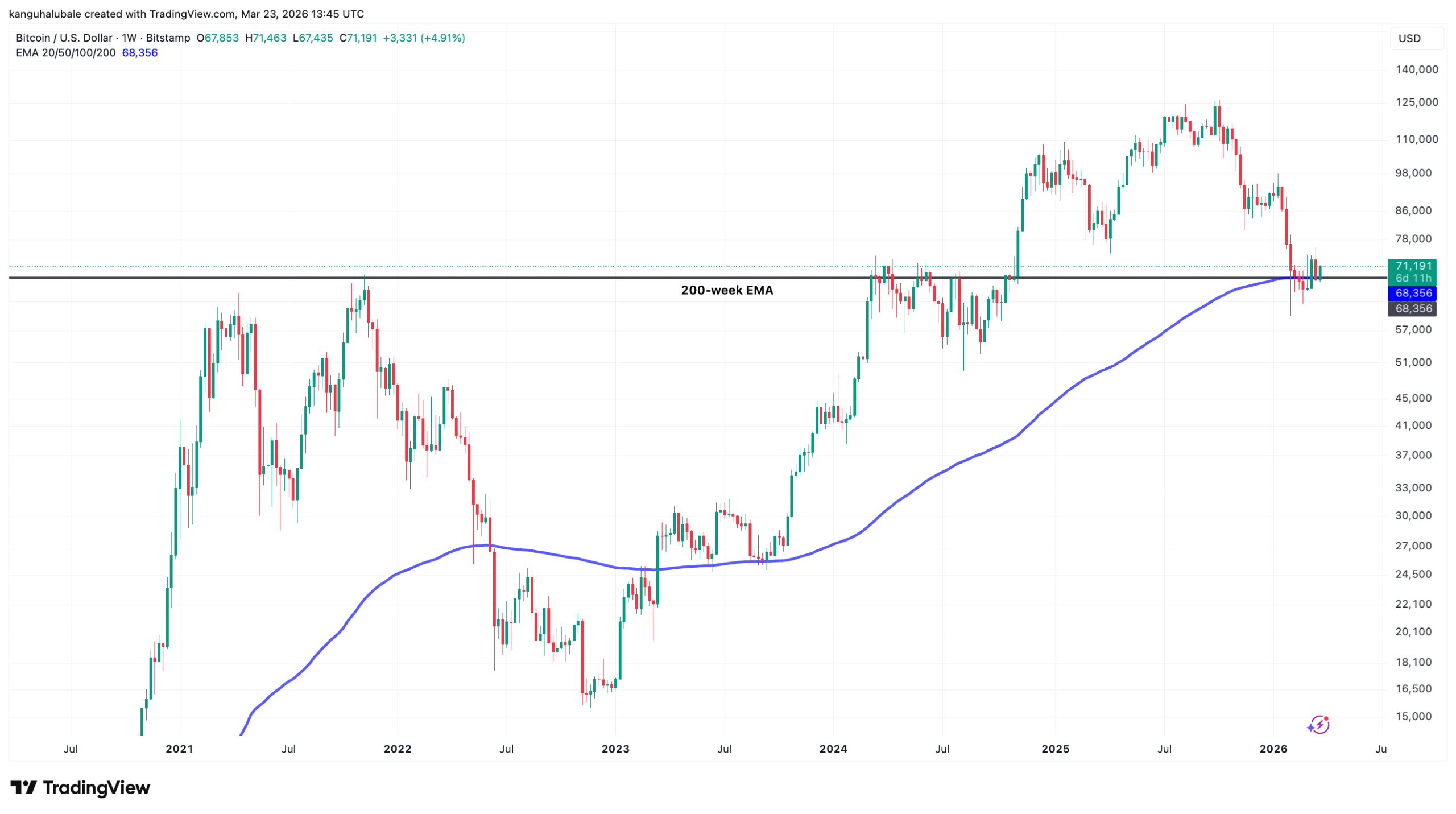
Bitcoin’s (BTC) failure to close the week above the 200-week exponential moving average (EMA) on Sunday put it at risk of another downward leg over the coming weeks or months.
Key takeaways:
-
Bitcoin price signals “structural weakness” with failure to close week above a key trend line.
-
Analysts say the next breakdown clears path for another sell-off toward $46,000.
-
The $47,000 level features as a deep structural support for Bitcoin.
Bitcoin price weakness sparks sub-$50,000 targets
Data from TradingView showed BTC/USD trading at $71,190, or 6% higher than its intraday low of $67,300.
The pair had failed to produce a weekly close above the 200-weekly EMA on Sunday, currently at $68,300, suggesting that last week’s relief rally to $76,000 was a possible bull trap.

There is evidence of profit-taking every time Bitcoin rises to key accumulation levels, and commenting on the current market setup, many traders warned that any downside could snowball quickly.
Related: Bitcoin risks 50% drop as BTC’s positive correlation with US stocks grows
“$BTC broke down from the rising wedge over the weekend,” said analyst Jelle in a Monday post on X, adding:
“Consolidate here for a day or two, and those untapped lows look ripe for the taking.”
The analyst was referring to the area between the local low of $65,500 and the range low of $59,930 reached on Feb. 6.

“BTC has lost the EMA50 once again, and the global crisis feels more insecure today than it did 2 weeks ago,” fellow analyst Stockmoney Lizards said in the latest Bitcoin analysis on X.
Combined with the technical weakness, “it looks like we could be revisiting the sub-$60K area,” the analyst added.
“Bitcoin is getting close to taking that next leg lower into the mid-$40Ks,” analyst Michael J. Kramer said, referring to the measured target of a bear flag around $46,600.

These targets echo prediction market traders, who price in a 70% chance that Bitcoin drops below $55,000 in 2026, while placing the odds of a drop below $45,000 at 46%.
“Deep structural” support for BTC is at $47,000
Bitcoin is trading near the 200-week EMA at $68,300, coinciding with the realized price of the “largest holder cohort (100-1K BTC),” according to CryptoQuant analyst Axel Adler Jr.
“As long as the price holds above $68K, the largest cohort remains near its cost basis and maintains a more resilient position,” Adler Jr. said in a Bitcoin analysis on Monday, adding:
“A move below this level would signal deteriorating structure and increase the likelihood of a more nervous reaction from large holders.”

Meanwhile, the realized price of the 10-100 BTC holder cohort sits notably lower around $46,700, forming a “deep structural threshold that would become meaningful only in the event of a full-scale deterioration in market regime,” the analyst added.
This article does not contain investment advice or recommendations. Every investment and trading move involves risk, and readers should conduct their own research when making a decision. While we strive to provide accurate and timely information, Cointelegraph does not guarantee the accuracy, completeness, or reliability of any information in this article. This article may contain forward-looking statements that are subject to risks and uncertainties. Cointelegraph will not be liable for any loss or damage arising from your reliance on this information.
Weekend trading refers to market activity outside standard trading hours, mainly in cryptocurrencies and selected CFD instruments. While most traditional markets are closed, certain assets remain accessible, although trading conditions may differ from weekday sessions.
Liquidity is typically lower during weekends, which may result in wider spreads and higher volatility. In these conditions, short-term price movements are often influenced more by positioning and sentiment than by fundamental drivers.
This article explains how weekend trading works, which markets remain accessible, and how trading conditions differ from standard sessions.
Understanding Weekend Trading
Can you day trade on the weekends? Weekend trading is possible, but limited to specific markets. Cryptocurrencies operate continuously, while forex and equity markets remain closed from Friday to Sunday. Some brokers also offer restricted weekend CFD trading, primarily linked to crypto instruments.
Market conditions during weekends differ from standard sessions. Liquidity is typically lower due to reduced institutional participation, which often results in wider spreads and less consistent order execution.
Market data from major exchanges indicates that even cryptocurrency trading volumes typically decline during weekends, reflecting reduced participation compared to weekday sessions.
Price behaviour also changes in thinner markets. Reduced order book depth can lead to less efficient price action, where short-term moves are driven more by positioning and sentiment than by fundamental factors. As a result, false breakouts and abrupt price spikes may occur more frequently.
At the same time, lower participation can produce temporary range-bound conditions, particularly in major cryptocurrencies. In such environments, mean reversion strategies may become more relevant than trend-following approaches.
News flow is generally lighter over the weekend. However, digital assets remain sensitive to social media activity, regulatory headlines, and macro developments, which can still trigger sharp volatility.
For experienced market participants, weekend trading is less about capturing sustained trends and more about managing execution risk, liquidity constraints, and short-term inefficiencies.
Key Characteristics of Weekend Trading:
- Limited market access (primarily cryptocurrencies)
- Lower liquidity and wider spreads
- Increased execution risk
- Greater influence of sentiment-driven price action
Why Most Markets Are Closed on Weekends
Forex and equity markets follow structured trading schedules aligned with global financial centres and institutional participation. As a result, weekend stock trading is generally unavailable, as activity across banks, exchanges, and liquidity providers declines.
These closures allow financial institutions to perform operational processes, including system maintenance, clearing, and risk management. In addition, most economic data releases and corporate announcements are scheduled during standard weekday trading hours.
Major exchanges, such as the New York Stock Exchange and the London Stock Exchange, operate within defined regional business calendars. This means that the stock market weekend period remains inactive, with trading in equities and related instruments paused until markets reopen.
In the context of Wall Street weekend activity, trading desks are typically inactive, reflecting the broader closure of US financial markets. This contributes to reduced liquidity and limited price discovery in traditional asset classes during this period.
Cryptocurrency markets operate differently, as they are decentralised and do not rely on centralised exchange schedules. This allows continuous trading regardless of time zones or traditional market hours.
What Markets Are Open on Weekends?
Weekend Trading Hours (By Market)
If you want to trade over 700 forex, stock, commodity, and index CFDs with tight spreads and low commissions (additional fees may apply), you can consider opening an FXOpen account.
Weekend trading, particularly in cryptocurrency, demands specific tools that are used to analyse lower liquidity and heightened volatility. Here are tools and resources that are used by traders when trading over weekends.
Market Analysis Platforms
Market analysis platforms are used for monitoring real-time price changes, viewing historical data, and identifying trends. Platforms like FXOpen’s TickTrader offer advanced charting capabilities with indicators and drawing tools to analyse price patterns, used to track critical support and resistance levels even over weekends.
Sentiment Analysis Tools
Sentiment analysis tools monitor public sentiment and news around assets, which can be especially useful in cryptocurrency markets where social media and news influence price moves. Tools like LunarCrush track mentions and sentiment for various crypto coins, allowing market participants to monitor sentiment shifts across digital assets.
Risk Analysis and Management Tools
Weekend trading can be volatile, making risk management tools important. Position-sizing calculators and volatility indicators are used to assess the optimal trade size and potential market risks. Tools like CryptoRank’s volatility tracker allow traders to stay informed on price fluctuations, used to monitor volatility conditions during lower liquidity periods.
Broker Platforms Offering Weekend Support
FXOpen provides cryptocurrency CFD trading* with continuous access to real-time market data, a stable trading interface, and responsive customer support. This ensures that traders can execute trades smoothly and respond to any sudden market changes, even during off-peak hours.
Key Weekend Trading Strategies
Weekend trading is characterised by lower liquidity and more volatile price behaviour compared to standard trading sessions. In such conditions, strategies are typically applied with a focus on short-term price dynamics and execution constraints.
Bollinger Bands and RSI Strategy
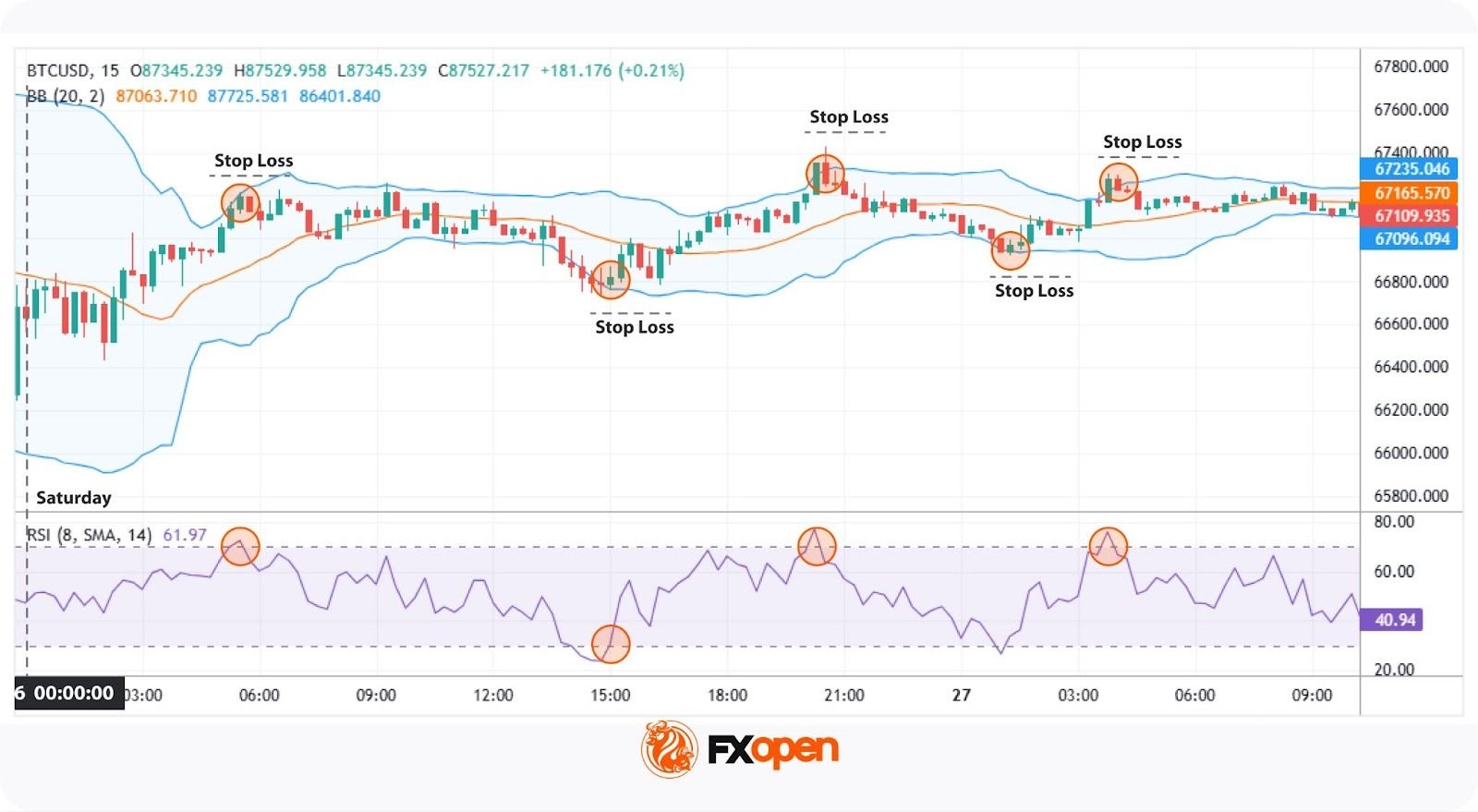
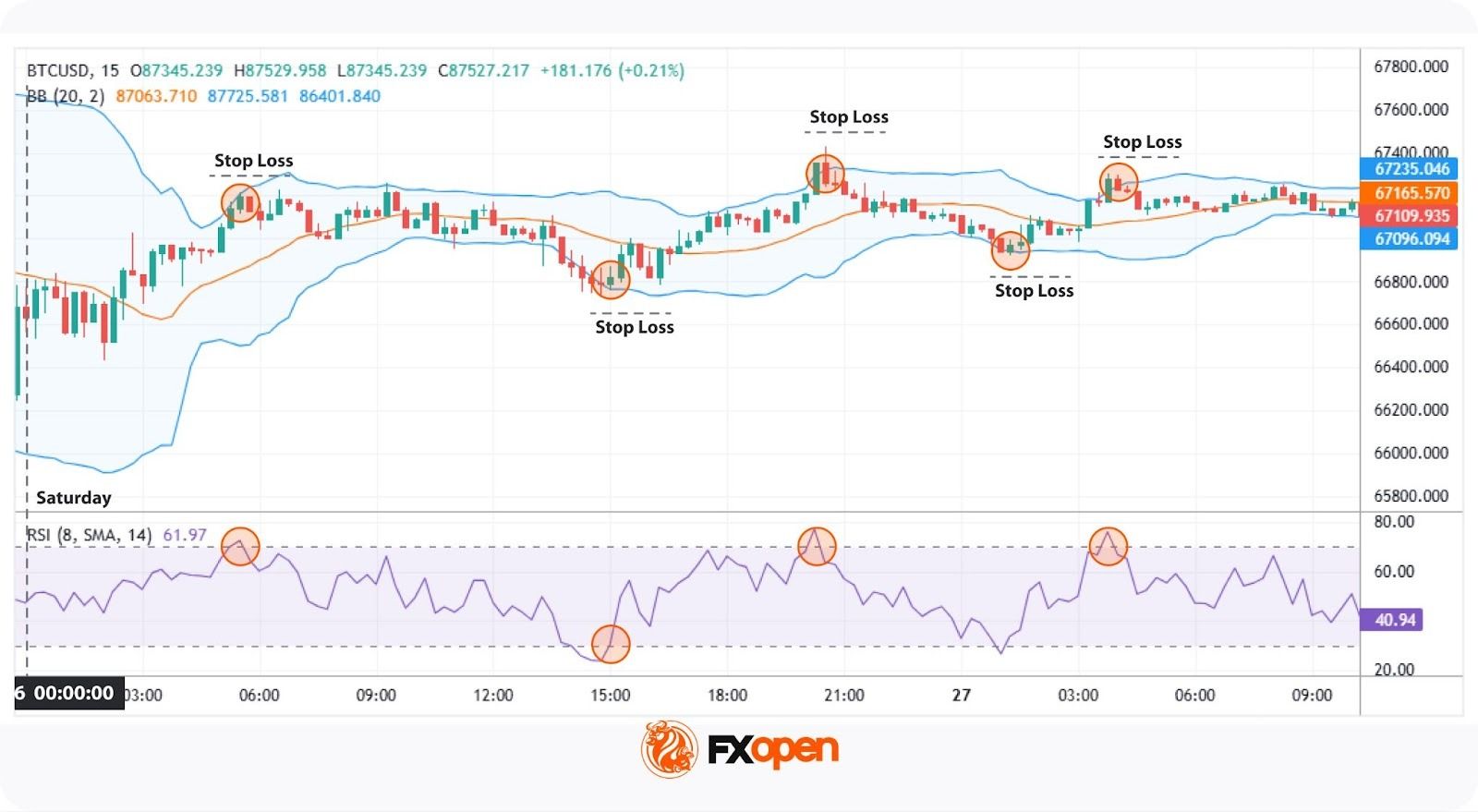
This weekend trading strategy combines Bollinger Bands and the Relative Strength Index (RSI) to analyse price behaviour in low-liquidity environments. During weekends, reduced order book depth can cause higher price volatility and increase the frequency of short-term mean reversion.
Bollinger Bands are used to identify deviations from average price levels, while RSI helps assess momentum extremes. Some market participants adjust RSI sensitivity by using shorter lookback periods to reflect reduced market activity.
When price touches the outer bands and RSI moves out of extreme zones, this may indicate an entry point in the direction of the mid-band or opposite range boundary of the Bollinger Band indicator, depending on prevailing conditions. Stop-loss levels are often placed beyond recent swing highs or lows to account for increased intraday volatility.
Note: signal reliability may be lower, as reduced liquidity can increase the likelihood of false breakouts.
Typical Workflow
Traders usually:
- Identify range-bound conditions and reduced volatility in the underlying market
- Monitor price interaction with Bollinger Band extremes and short-term deviations from average levels
- Assess RSI positioning relative to overbought and oversold thresholds
- Define entry zones when the price touches an outer Bollinger Band and the RSI leaves overbought or oversold area
- Place stop-loss orders beyond recent swing highs or lows
- Set exit targets at mid-range levels or near the opposite Bollinger Band
- Evaluate spread conditions and liquidity before executing positions
Weekend Gap Trading
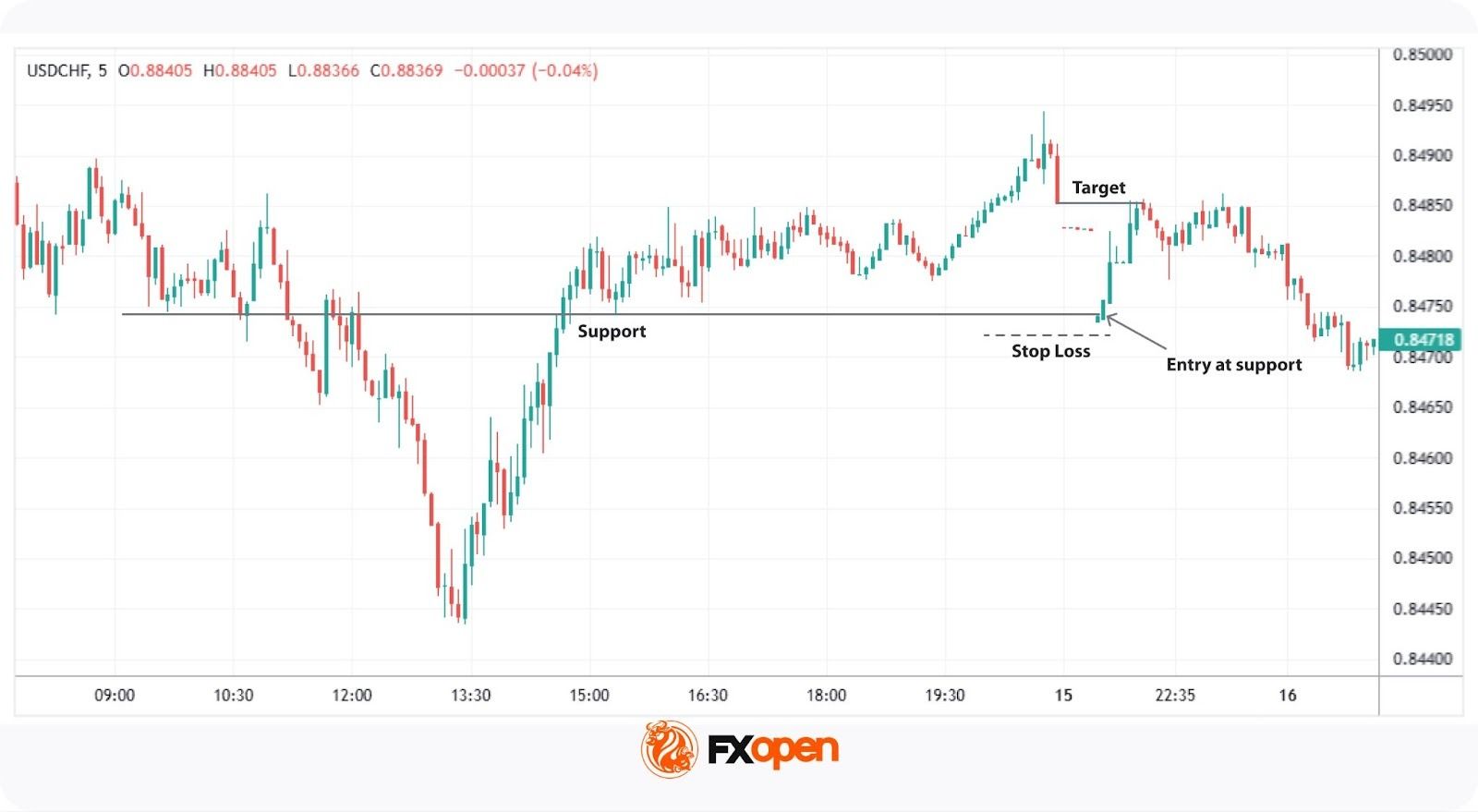
Futures data from exchanges such as the Chicago Mercantile Exchange shows that price gaps at the weekly open are common.
Weekend gap trading is based on price gaps that may occur when markets reopen after the weekend period. These gaps are typically driven by developments outside trading hours, including macroeconomic events or geopolitical factors. As a result, opening prices may differ significantly from previous closing levels observed before the weekend. A commonly observed outcome is partial or full retracement towards the prior closing price level.
In practice, instruments such as Dow futures weekend pricing or indications from DAX weekend markets are often monitored to assess potential opening gaps. These references may provide early signals of market sentiment before regular trading resumes.
Market participants often monitor key reference levels, including prior highs and lows, to assess potential scenarios. Technical frameworks such as support and resistance levels and moving averages are often used to confirm potential reversals. Execution timing remains important, as spreads at market open may be wider and liquidity conditions uneven.
Entries are typically considered after initial volatility subsides and price structure develops. Stop-loss levels are often placed beyond gap extremes. Exit levels are commonly aligned with the prior close or nearby technical levels, depending on market behaviour.
This approach can be applied to any market that closes over the weekend, meaning traders can trade FX pairs, stocks, and indices, e.g. DAX weekend movements.
Typical Workflow
Traders usually:
- Identify the presence and size of a weekend gap between closing and opening prices
- Assess fundamental drivers, including news developments and broader market sentiment
- Monitor price behaviour after market open to identify emerging structure
- Define entry zones based on confirmation signals and price stabilisation. The price should move to the previous closing price to fill the gap.
- Place stop-loss orders beyond the extremes of the gap move
- Set exit targets at prior closing levels or nearby technical reference points
- Account for spread expansion and reduced liquidity when planning execution
Is Weekend Trading Worth It?
While weekend trading is attractive, it is not suitable for all market conditions or trading styles.
Advantages
- Continuous market access. Cryptocurrency markets remain open throughout the weekend, allowing reaction to news and positioning outside standard trading hours.
- Flexible trading schedule. Weekend sessions may suit those unable to monitor markets during the trading week.
- Reduced competition and institutional presence. There is often lower participation from large institutions, which may create cleaner price action and more technically driven setups.
Limitations
- Lower liquidity. Weekend markets typically see reduced depth, which can result in wider spreads and less reliable execution.
- Highly volatile price behaviour. There is increased likelihood of false breakouts and abrupt moves driven by sentiment rather than fundamentals.
- Gap risk in traditional markets. Positions held over the weekend may be exposed to opening gaps when forex or equity markets reopen.
The Bottom Line
Weekend trading is characterised by limited market access and different conditions compared to standard trading sessions. Cryptocurrencies remain active, while most traditional markets are closed, with only selected CFD instruments available.
Lower liquidity and wider spreads can affect price behaviour and execution quality during this period. As a result, trading approaches often require adjustments to account for less stable market conditions. Understanding these differences may help in assessing price movements outside regular trading hours.
FAQ
Can You Trade on the Weekends?
Yes, you can trade on weekends, but only in specific markets such as cryptocurrencies. Forex and stock markets remain closed until Sunday evening or Monday.
Are Stocks Traded on Weekends?
Can you buy stocks on the weekend? No, weekend trading in stocks is unavailable due to the hours set by stock exchanges. For example, the New York Stock Exchange operates only from Monday to Friday. However, some venues may offer after-hours trading sessions, though these end on Friday evenings and resume on Monday mornings.
Can You Trade Forex on Weekends?
Forex trading usually pauses from Friday evening to Sunday evening.
What Can I Trade on Weekends?
The main assets available for weekend trading are cryptocurrencies, as they trade continuously. Certain brokers also offer weekend trading in select commodities or indices, though these options may vary and come with high transaction costs.
Why Do Brokers Work on Sunday?
The 24/7 nature of cryptocurrency trading has driven some brokers to offer support on Sundays, especially as demand for continuous trading access has grown.
Can You Trade on FXOpen on Weekends?
Yes, FXOpen provides access to weekend trading cryptocurrencies. For currency pairs, shares, and commodities, trading typically resumes on Sunday evening when global markets reopen.
*Important: At FXOpen UK, Cryptocurrency trading via CFDs is only available to our Professional clients. They are not available for trading by Retail clients. To find out more information about how this may affect you, please get in touch with our team.
This article represents the opinion of the Companies operating under the FXOpen brand only. It is not to be construed as an offer, solicitation, or recommendation with respect to products and services provided by the Companies operating under the FXOpen brand, nor is it to be considered financial advice.

This press release reports a sharp decline in gold prices, which fell 6% on Monday after a 10% slide last week as macro conditions shifted. March is shaping up as one of the weakest months on record, with prices down about 21% since the month began. The move is tied to rising inflation expectations and a evolving rate outlook, alongside higher oil prices driven by regional conflict. Investors are pushing back expected US rate cuts and pricing in the possibility of faster hikes in the UK and Europe. The report notes ETF outflows and profit-taking in a broader liquidation phase, while central-bank purchases provide longer-term support.
Key points
- Gold fell 6% on Monday after a 10% decline last week, with March down nearly 21% from the month’s start.
- US 10-year Treasury yield rose by about 0.5 percentage point to 4.421%, its highest since summer 2025.
- ETF outflows and profit-taking are contributing to a broader liquidation in bullion markets.
- Central-bank purchases provide ongoing structural support for gold over the longer term.
Why it matters
Gold’s appeal as a safe-haven asset is tested by higher yields and a shifting rate outlook, while ongoing central-bank purchases provide longer-term support; this combination suggests near-term volatility may persist for investors and markets. The dynamics affect traders, asset allocators, and policymakers assessing risk and diversification in a volatile macro environment.
What to watch
- Near-term volatility as markets adjust to higher rate expectations and inflation dynamics.
- Any shifts in rate expectations in the US, UK, and Europe based on evolving policy signals.
- Ongoing central-bank purchases and ETF flows shaping bullion demand.
Disclosure: The content below is a press release provided by the company or its PR representative. It is published for informational purposes.
Gold Slumps 6% as Interest Rates Rise
Abu Dhabi, UAE – March 23, 2026: Gold prices have come under significant pressure, falling 6% on Monday after a 10% decline last week, as shifting macroeconomic conditions weigh heavily on the precious metal. March is now shaping up to be one of the weakest months on record for gold, with prices down nearly 21% since the beginning of the month.
Traditionally viewed as a safe-haven asset during periods of geopolitical uncertainty, gold is currently facing headwinds from rising inflation expectations and a rapidly evolving interest rate outlook. The escalation of conflict in the Middle East has driven oil prices higher, fueling inflation concerns and prompting markets to reassess monetary policy expectations.
Investors are increasingly abandoning expectations of interest rate cuts in the United States, while preparing for the possibility of faster rate hikes in the UK and Europe. This shift has significantly altered the investment landscape, reducing the appeal of non-yielding assets such as gold.
At the same time, yields on US government bonds have surged, with the 10-year Treasury yield rising by nearly 0.5 percentage points since the start of the month to 4.421%—its highest level since the summer of 2025. Higher yields are strengthening currencies and exerting downward pressure on equities, further diminishing the relative attractiveness of gold.
In addition, the market is experiencing a wave of profit-taking following gold’s strong performance last year, when prices rose by approximately 66%. This has contributed to a broader liquidation phase, marked by ETF outflows, forced selling, and investors closing positions to offset losses in other asset classes.
Despite these short-term challenges, structural support for gold remains intact, particularly from ongoing central bank purchases, which have underpinned the longer-term bullish trend.
Jakub Rochlitz, Market Analyst at eToro, commented: “Gold is currently caught between two opposing forces. While geopolitical tensions would support demand for safe-haven assets, the inflationary impact of rising energy prices is driving expectations of higher interest rates, which is weighing heavily on gold.
What we are seeing resembles a classic liquidation phase, with investors taking profits after last year’s strong rally and repositioning in response to changing macro conditions. In the near term, volatility is likely to remain elevated as markets adjust to these dynamics.
Looking further ahead, the long-term outlook for gold has not been entirely undermined. Its performance will depend on how the geopolitical situation evolves, how inflation trends develop, and how central banks respond.”

KEY HIGHLIGHTS
- Ethereum stalls between MVRV levels, hinting at a major breakout soon
- ETH range tightens as bulls and bears battle for market direction
- Key MVRV zone puts Ethereum at a decisive technical crossroads
- Ethereum consolidation signals a potential sharp move ahead
- ETH volatility drops while pressure builds for a breakout move
Ethereum trades near $2,450 within a narrow MVRV-defined range, signaling an imminent directional move. The asset shows limited volatility, yet price compression suggests rising pressure. Market structure reflects balance, but conditions point toward a likely breakout or breakdown.
Short-term price action remains contained, and momentum signals stay mixed across indicators. Traders assess key levels while waiting for confirmation signals. This phase reflects a transitional period rather than a stable trend.
On-chain data highlights a midpoint position between historical valuation bands. This positioning often precedes sharp moves. Therefore, market participants anticipate a shift in direction soon.
Ethereum Range Reflects Market Indecision and Accumulation
Ethereum continues to trade between MVRV support and resistance zones, showing no clear trend. The lower band attracts buying interest, while the upper band limits price expansion. This balance creates a tight consolidation range.
Price behavior indicates that both bullish and bearish forces remain active. Buyers attempt to defend support zones, yet sellers apply pressure near resistance levels. As a result, the market maintains equilibrium without clear dominance.
This range typically signals preparation for a stronger move. Historical patterns show that such compression phases do not last long. Therefore, the current setup suggests a pending breakout scenario.
Ethereum Faces Critical Breakout or Breakdown Setup
A move above the upper MVRV band could trigger renewed bullish momentum. Such a breakout would likely attract fresh demand and strengthen price structure. Momentum indicators would need to confirm this shift.
Conversely, a drop below the lower band may lead to extended downside pressure. This scenario could trigger liquidations and weaken overall sentiment. Market structure would then shift toward a bearish continuation.
On-chain metrics show balanced positioning across participants. This balance increases the importance of confirmation signals. Volume expansion will likely validate the next directional move.
Ethereum Market Sentiment Remains Calm but Tense
Market activity appears subdued, yet underlying tension continues to build. Reduced volatility reflects hesitation rather than stability. Participants wait for a decisive signal before taking positions.
Technical and on-chain indicators offer mixed signals at current levels. This lack of alignment contributes to uncertainty in short-term direction. However, it also increases the probability of a strong move once clarity emerges.
The current environment reflects a calm phase before potential volatility expansion. Such conditions often precede rapid price movements. Therefore, the market may shift quickly once a trigger occurs.
Ethereum Highlights Shift Toward Data-Driven Analysis
Ethereum’s current setup reflects the growing role of on-chain metrics in market analysis. MVRV now serves as a key valuation tool alongside traditional indicators. This shift improves transparency in market behavior.
Institutional participation continues to influence data-driven strategies. Market participants increasingly rely on blockchain insights for decision-making. This trend reshapes how assets like Ethereum are evaluated.
Technical analysis now integrates with on-chain data to form hybrid strategies. This approach provides a broader view of price action and positioning. As a result, market interpretation becomes more precise and structured.
Ethereum just broke $2,300 🚀 pic.twitter.com/CD1oLQAbcV
— Ash Crypto (@AshCrypto) March 16, 2026
Ethereum Risks Persist Despite Clear Technical Setup
Despite defined levels, risks remain within the current structure. False breakouts may occur in low-liquidity conditions. Such moves can mislead short-term positioning.
Bitcoin’s influence continues to affect Ethereum’s direction. Broader market sentiment may shift due to macroeconomic developments. These external factors add uncertainty to the setup.
Momentum failure could also lead to sharp reversals. Therefore, confirmation remains critical before any directional bias. The market requires strong volume support for sustained movement.
Ethereum Prepares for a Decisive Market Move
Ethereum remains positioned at a critical inflection point between key MVRV levels. This phase reflects preparation rather than trend continuation. Market structure suggests that a resolution is approaching.
Traders now focus on breakout confirmation and volume signals. Changes in on-chain activity will provide further direction. These indicators will likely define the next phase of price action.
This consolidation phase may appear quiet, yet it carries significant implications. The next move could shape Ethereum’s medium-term trajectory. It may also influence broader cryptocurrency market trends.


Summary
- Bitcoin treasury firm Empery Digital sold 63 BTC for about $4.6 million to help fund share repurchases.
- The company simultaneously announced a $25 million registered direct equity offering at $5.39 per share plus warrants, largely to repay a $50 million repo facility.
- Empery now holds 3,439 BTC in treasury and is explicitly prioritizing stock buybacks over additional Bitcoin accumulation in the near term.
Bitcoin (BTC) treasury company Empery Digital Inc. has sold 63 BTC for an average price of $72,791 per coin, generating roughly $4.6 million in gross proceeds to fund an aggressive stock repurchase program. The sale, executed during the week ending March 20, 2026 and disclosed from its U.S. operations, is part of a broader effort to finance buybacks and reduce balance‑sheet leverage. Following the transaction, Empery said it still holds 3,439 BTC in its treasury, keeping it among the larger listed corporate Bitcoin holders.
The sale was announced alongside a $25 million registered direct equity offering, where Empery agreed to issue approximately 4.64 million shares of common stock at $5.39 per share, together with an equal number of warrants. Net proceeds, plus cash on hand, are earmarked to retire about $40 million of debt by fully repaying a $50 million repo facility and drawing an additional $10 million from an existing $100 million credit line with lender Two Prime. “We intend to use the proceeds from this offering, together with cash on hand, to meaningfully reduce our secured debt while continuing to return capital to shareholders via repurchases,” the company said.
Empery describes itself as being “built on principles, powered by Bitcoin,” with a strategy focused on maximizing bitcoin per share rather than simply stacking coins on its balance sheet. In a series of recent updates, the company has repeatedly sold small BTC clips — 60 BTC at an average of $66,583 in late February for roughly $4 million, and another 60 BTC at around $70,534 in mid‑March for about $4.2 million — and used the proceeds to buy back stock. As of February 27, Empery had repurchased 18,685,725 shares under its $200 million authorization; by mid‑March that tally had climbed to 21.3 million shares, with management signaling that “existing cash balances and reductions in bitcoin holdings” would continue to fund repurchases as needed.
The trade‑off is explicit: fewer BTC, but a smaller equity base and a less leveraged balance sheet, which could Empery more exposed if Bitcoin enters a deep drawdown, with the company itself cautioning that its stock price “may be highly correlated to the price of the digital assets that it holds” and pointing to the “highly volatile nature of the price of bitcoin and other cryptocurrencies” among key risk factors. Supporters counter that if BTC resumes its long‑term uptrend, shrinking the share count while keeping thousands of coins on the balance sheet could deliver outsized net asset value per share gains over time.
One macro takeaway is clear: after a decade where “Bitcoin treasury strategy” mostly meant one‑way accumulation, firms like Empery are now actively trading around their stacks — monetizing strength to pay down debt, repurchase stock, and manage risk rather than simply buying and holding at all costs.

Key Highlights
- Bitmine acquired 65,341 ETH during the past week, valued at approximately $138 million based on current market rates
- Company’s aggregate ETH position now reaches 4.66 million tokens — representing 3.86% of total circulating supply
- Acquisition velocity has accelerated over three straight weeks, surpassing the previous weekly average of approximately 50,000 ETH
- BMNR shares advanced more than 3% while ETH traded near $2,144
- Executive Chairman Tom Lee projects ETH is approaching the conclusion of a “mini-crypto winter”; the company maintains roughly $7 billion in unrealized losses
Bitmine Immersion Technologies (BMNR) continues its aggressive Ethereum accumulation strategy. The treasury firm acquired 65,341 ETH during the previous week — marking the third straight week of escalating purchases — as it reinforces a position that has accumulated substantial paper losses while maintaining aggressive expansion.
Bitmine Immersion Technologies, Inc., BMNR
This recent acquisition, valued at approximately $138 million based on prevailing market rates, pushes Bitmine’s aggregate holdings to 4,660,903 ETH. With tokens priced near $2,072 each, the treasury position exceeds $9 billion in value.
The company now owns roughly 3.86% of ETH’s 120.7 million token circulating supply. This percentage continues expanding as Bitmine increases its weekly acquisition rate, which historically averaged between 45,000 and 50,000 ETH.
Cash holdings expanded in tandem with crypto acquisitions, hitting $1.1 billion. The firm also maintains 196 Bitcoin, $200 million allocated to Beast Industries, and $95 million in Eightco Holdings. Combined crypto, cash, and speculative investment holdings totaled $11.0 billion as of March 22.
Investors reacted positively. BMNR shares climbed over 3% following the announcement as Ethereum price approached $2,144.
Staking Infrastructure Growth
Beyond accumulation, Bitmine is pursuing an aggressive staking strategy. As of March 23, the company had staked 3,142,643 ETH — approximately 67% of total holdings. This staked position currently produces $184 million in annualized staking revenue.
Tom Lee stated Bitmine has staked more Ethereum than any competing entity worldwide. When operations reach full capacity, projected annual rewards could reach $272 million, calculated using a 2.83% seven-day yield. The prevailing Composite Ethereum Staking Rate stands at 2.75%.
The firm is developing its Made in America Validator Network (MAVAN), collaborating with three staking service providers in preparation for an anticipated early 2026 launch.
Significant Paper Losses Persist
The strategy carries substantial downside risk. Notwithstanding the acquisition momentum, Bitmine currently holds approximately $7 billion in unrealized losses as ETH valuations have declined in recent months, per DropsTab analytics.
Lee maintains confidence in his investment thesis. “Our base case is ETH is in the final stages of the ‘mini-crypto winter,’” he stated in Monday’s announcement.
Bitmine holds the distinction of operating the world’s largest Ethereum treasury and ranks second among all global crypto treasuries, trailing only Michael Saylor’s Strategy, which controls 762,099 Bitcoin purchased for roughly $57.69 billion.
As of March 23, Ethereum was trading in the $2,072 to $2,144 range.

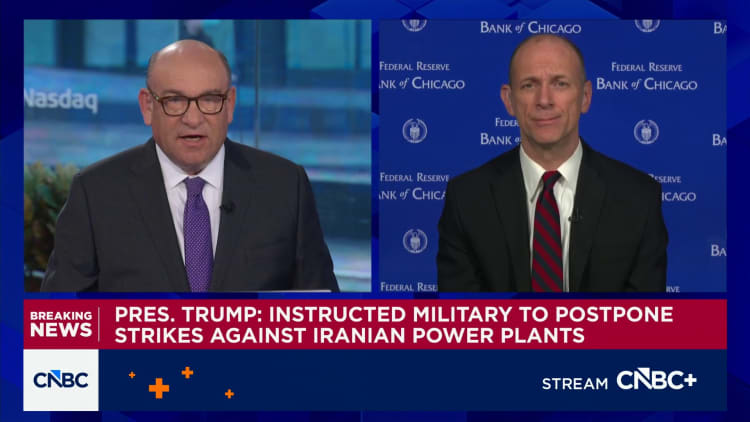

Chicago Federal Reserve President Austan Goolsbee said Monday that he’s more worried about inflation now than he is unemployment, even with apparent progress made on the war with Iran.
In a CNBC interview, the central banker said policymaking is difficult in the current environment. He spoke shortly after President Donald Trump announced that progress had been made in negotiations with Iran and that further attacks on energy infrastructure would be halted for five days as talks continue.
“The most important thing is to figure out the through line of what is happening,” Goolsbee said in a “Squawk Box” interview. “What makes this a fraught but intense moment is nobody can tell us what is going to happen on the ground in the conflict in the Middle East, and how long that lasts.”
Goolsbee had dissented on a rate cut in December and said he agreed with the majority to hold short-term rates steady at the January and March meetings of the Federal Open Market Committee. He is not an FOMC voter this year but will vote again next year.
Following Monday’s war news, traders, in volatile market action, upped bets of a rate hike by the end of the year but still expect a cut in 2027. Stocks spiked higher and oil prices plunged.
FOMC officials last week indicated a majority still expect a cut this year and another the next. However, Goolsbee said that his inclination will depend on the progress of inflation, and he cautioned against “a repeat of the team-transitory mistake” where the Fed underestimated the severity of inflation in 2021.
“I remain fairly optimistic that by the end of ’26 rates could go down, but I wanted to see proof that we’re back on an inflation headed to 2%. This [war] definitely throws a wrench into the plans. We do need to see progress,” he said.


Michael Saylor’s Strategy (MSTR) continued to add to bitcoin holdings last week, but at a vastly reduced pace from recent previous acquisitions.
The leading bitcoin treasury company last week added 1,031 bitcoin for a total cost of $76.6 million, or $74,326 per coin.
Strategy’s total holdings now stand at 762,099 BTC, acquired for approximately $57.69 billion, or an average price of $75,694 each.
The new buys were entirely funded via the sales of common stock, according to a Monday filing.
This latest acquisition was at a vastly reduced scale compared to the previous two weeks, when the company purchased more than $1 billion of bitcoin, taking advantage of the issuance of its STRC preferred shares.
Bitcoin is currently trading around $70,000. MSTR shares are higher by 1.7% in premarket trading.


H100 Group (H100), a Stockholm-based publicly listed bitcoin treasury company focused on providing institutional exposure to bitcoin, said it signed a letter of intent to acquire Norwegian peers Moonshot AS and Never Say Die AS to increase its holdings of the largest cryptocurrency.
If completed, the deal would roughly triple H100’s bitcoin stash to around 3,500 BTC, positioning it among Europe’s largest listed bitcoin treasury firms. Beyond that, H100 said it aims to strengthen its institutional profile, improve liquidity and expand its relevance in capital markets.
The announcement follows the company’s January announcement that it plans to combine with Future Holdings AG, a Zurich-based bitcoin treasury company. Both are backed by Adam Back, a British cryptographer and co-founder of Blockstream.
The transaction is structured as a bitcoin-for-bitcoin exchange, meaning ownership in the combined entity will be determined solely by the amount of bitcoin contributed. This approach preserves bitcoin exposure per share for existing investors, avoiding dilution while significantly scaling the company’s balance sheet.
The acquisition will be executed as an all-share transaction with no cash consideration.
The target companies collectively hold about 2,450 BTC.
Definitive agreements are expected by April 22, with completion anticipated shortly after the company’s annual general meeting in May, subject to final approvals.
The announcement sent H100 shares up 2% on the day.

Walmart: ChatGPT Checkout Converted 3x Worse Than Website

Senate Bill Targets Sports-Betting Ban on Crypto Prediction Markets

‘Paradise’s Creator and Stars Break Down Season 2, Episode 7 and What the Nosebleeds Actually Mean [Exclusive]


-
 Crypto World3 days ago
NIO (NIO) Stock Plunges 6.5% as Shelf Registration Sparks Dilution Worries
-

 Fashion3 days ago
Weekend Open Thread: Adidas – Corporette.com
-

 Politics3 days ago
Jenni Murray, Long-Serving Woman’s Hour Presenter, Dies Aged 75
-
 Tech6 days ago
Are Split Spacebars the Next Big Gaming Keyboard Trend?
-

 Business7 days ago
How the UK and China Trade Agreement Could Shape UK Businesses in 2026
-

 Crypto World2 days ago
Best Crypto to Buy Now: Strategy Just Spent $1.57 Billion on Bitcoin During Fear While Early Investors Quietly Enter Pepeto for 150x Potential
-

 News Videos5 days ago
RBA board divided on rate cut, unusually buoyant share market | Finance Report | ABC NEWS
-

 Crypto World2 days ago
Bitcoin Price News: Bhutan Sells $72 Million in BTC Under Fiscal Pressure, but the Smart Money Entering Pepeto Sees What the Market Does Not
-

 Politics5 days ago
The House | The new register to protect children from their abusers shows Parliament at its best
-

 Tech4 days ago
inKONBINI Lets You Spend Summer Days Behind the Register
-
 Politics6 days ago
Real-time pollution monitoring calls after boy nearly dies
-

 Crypto World5 days ago
Canada’s FINTRAC revokes registrations of 23 crypto MSBs in AML crackdown
-

 Sports6 hours ago
Remo Stars and Kano Pillars Strengthen Survival Hopes in NPFL
-
 NewsBeat5 days ago
Residents in North Lanarkshire reminded to register to vote in Scottish Parliament Election
-

 News Videos5 days ago
PARLIAMENT OF MALAWI – PAC MEETING WITH REGISTRAR OF FINANCIAL ON AMARYLLIS HOTEL – INQUIRY LIVE
-

 Business1 day ago
No Winner in March 21 Drawing as Prize Rolls to $133 Million for Next
-

 Politics4 days ago
Gender equality discussions at UN face pushbacks and US resistance
-

 Business5 days ago
Who Was Alex Pretti? 5 Key Facts About the ICU Nurse Killed by Federal Agents in Minneapolis
-

 Tech21 hours ago
Give Your Phone a Huge (and Free) Upgrade by Switching to Another Keyboard
-

 Sports5 hours ago
Gary Kirsten Accuses Pakistan Cricket Board Of ‘Interference’, Mohsin Naqvi Responds
You must be logged in to post a comment Login