
Crypto World
Crypto Fund Outflows Drop 89% to $187 Million

Crypto markets may be showing early signs of stabilization after weeks of intense selling, according to the latest CoinShares report on digital assets.
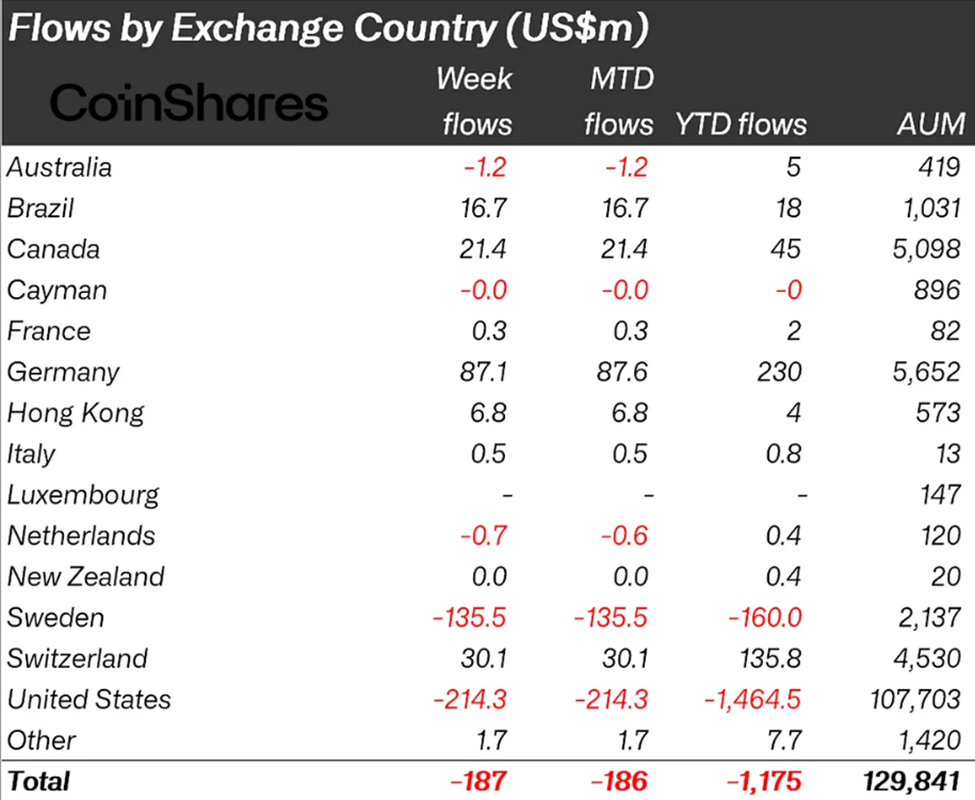
Investment products saw outflows collapse from over $1.7 billion recorded for two successive weeks to just $187 million last week.
Sponsored
Crypto Outflows Shrink to $187 Million, CoinShares Report Shows
CoinShares’ latest figures show that total assets under management fell to $129.8 billion, the lowest level since March 2025. This reflects the ongoing impact of the recent price slide.
Based on the chart below, regional trends hint at selective confidence, with institutional and region-specific strategies diverging even as global sentiment remains cautious.
Yet while investors were cautious, trading activity remained strong. Crypto exchange-traded products (ETPs) recorded a record $63.1 billion in weekly volume. With this, they surpassed the previous high of $56.4 billion set in October 2025.
Notably, high volumes amid slowing outflows indicate that investors are repositioning rather than abandoning the market, a subtle but important distinction.
Sponsored
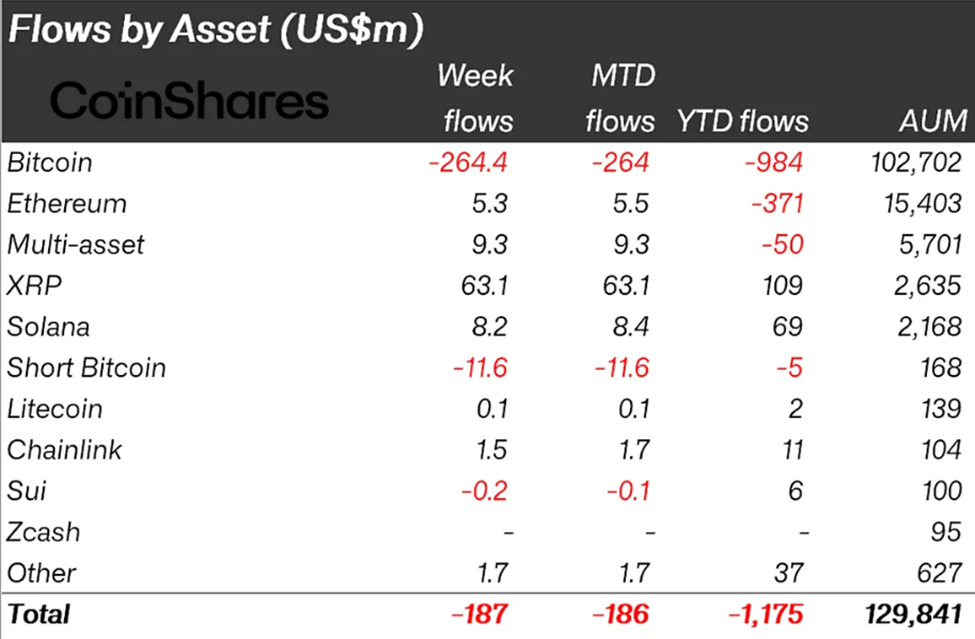
Bitcoin experienced $264 million in outflows, highlighting a rotation away from the pioneer crypto toward alternative digital assets.
Among altcoins, XRP, Solana, and Ethereum led inflows, receiving $63.1 million, $8.2 million, and $5.3 million, respectively. XRP, in particular, has emerged as a favorite, attracting $109 million year-to-date.
Crypto Capitulation Shows Signs of Slowing, But Bottom Not Yet Confirmed
Despite continued price pressure, it is worth noting that the sharp drop in outflows is no mean feat, following $1.73 billion in negative flows and $1.7 billion the week before. This sharp contraction in crypto fund flows across successive weeks is being interpreted as a potential inflection point.
Sponsored
According to analysts, such a deceleration often precedes changes in market momentum, suggesting the selling frenzy could be approaching its limit.
“The deceleration in outflows suggests selling pressure is easing, and capital flight may be reaching exhaustion. Historically, this shift often precedes a change in market momentum. Early signs of stabilization are starting to emerge,” stated Andre.
Historically, crypto cycles rarely reverse immediately following peak sell-offs. Instead, the market often experiences a gradual easing of outflows before inflows return, a pattern that seems to be emerging in the current correction.
Therefore, last week’s slowing outflows may be a leading indicator, but should not be misconstrued as a guarantee of recovery.
Sponsored
The broader implication is that the market may be transitioning from panic-driven capitulation to consolidation and selective accumulation.
While Bitcoin continues to see outflows, the inflows into altcoins and regional markets suggest that investors are rotating risk rather than exiting crypto entirely.
Still, caution remains warranted because one week of slower crypto outflows does not signal a confirmed bottom.

Crypto World
XRP Battles Descending Channel Resistance While Ripple Quietly Absorbs the Global Financial System
TLDR:
- XRP has dropped 5.8% in three days and remains trapped inside an eight-month descending channel near $1.45.
- A confirmed breakout above channel resistance could push XRP to a price target range between $2.50 and $4.00.
- Ripple has spent over $2.25 billion on acquisitions, building a full-stack financial platform around the XRP Ledger.
- XRP holds digital commodity status with both the SEC and CFTC, with an OCC banking charter application now under review.
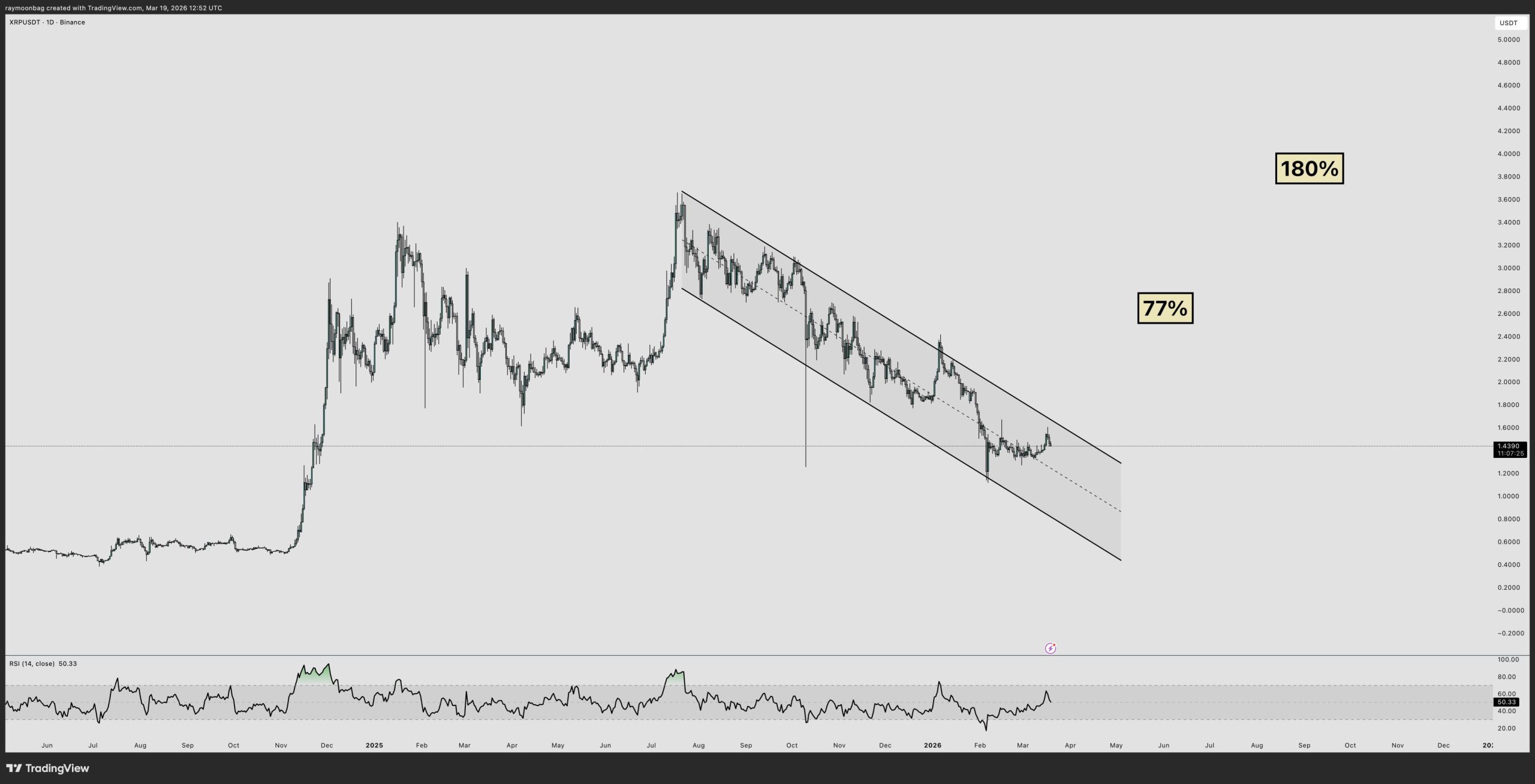
XRP remains at a critical technical juncture as the broader crypto market experiences a consolidation phase. The asset is down 5.8% over the last three days, currently trading near $1.45.
Chart analysts point to a descending channel resistance as the key barrier to recovery. Meanwhile, Ripple continues expanding its regulatory and institutional presence globally. Technical and fundamental forces are both shaping the asset’s near-term direction.
Technical Resistance Keeps XRP Below Key Breakout Levels
XRP is trading inside a long-standing descending channel that formed after the asset peaked at $3.6 in July. The upper trendline has acted as firm resistance for eight months.
The asset tested this trendline on October 2, 2025, and again on January 6, 2026. Both attempts failed to produce a sustained close above the resistance level.
Chart analyst Ray notes that a confirmed breakout could push XRP to between $2.50 and $4.00. That range reflects a potential gain of 77% to 180% from current levels.

However, the descending channel trendline remains the major barrier standing between current prices and those targets.
The recent pullback has come alongside a broader lull across the crypto market. XRP’s price action continues to follow the channel structure closely.
The Japan-to-Philippines corridor, cited as a key use case for XRP, carries billions in annual remittance volume. Traders are watching for a decisive close above the resistance line before confirming any directional shift.
Until that breakout occurs, the asset remains technically constrained within the channel. The pattern from the past eight months shows that resistance at the upper trendline has been consistent.
Each rejection has reinforced the channel’s relevance as an active price structure. A volume-driven close above the trendline would be the clearest signal of a trend reversal.
Ripple Builds Institutional and Regulatory Infrastructure Around XRP
Beyond chart patterns, Ripple has been assembling a vertically integrated financial stack. The company acquired Hidden Road for $1.25 billion and GTreasury for $1 billion. Other purchases include Rail, Palisade, Solvexia, Metaco, Standard Custody, Fortress Trust, and BC Payments.
These acquisitions bring payments, custody, treasury, and prime brokerage under one roof. Ripple now holds over 75 regulatory licenses globally. The company has filed for a VASP license in Brazil and holds a full EU EMI license. An OCC banking charter application is also under review.
X Finance Bull, a crypto commentator on X, drew attention to XRP’s advantages over traditional payment rails. The post noted XRP Ledger’s 3-5 second settlement and sub-cent transaction fees.
It compared these directly against SWIFT’s multi-day processing and a 6.5% average cost on a $200 remittance.
The asset has been classified as a digital commodity by both the SEC and the CFTC. The CLARITY Act is expected to bring further regulatory clarity to the digital asset space.
Ripple has also expanded operations across Dublin, London, Singapore, and Sydney. These moves position XRP collectively as a functional settlement layer within the modernizing global financial system.


Ethereum’s native token, Ether (ETH), may push higher in the coming months as the market’s richest whale cohort returns to profitability for the first time since early February. Fresh on-chain signals point to a potential bottoming process that could set the stage for a renewed rally, though investors should remain mindful of historical caveats.
Key takeaways
- The unrealized profit ratio of wallets holding more than 100,000 ETH has flipped back above zero, signaling that the largest holders are no longer sitting on aggregate losses.
- Historically, a transition to profitability for this whale group has preceded notable uptrends: roughly 25% gains in about three months, around 50% in six months, and even larger moves over the following year.
- If the pattern holds, ETH could target the $2,750 area by June and potentially exceed $3,200 by September, anchored by on-chain and chart signals aligning in a bullish configuration.
- Glassnode’s MVRV-based valuation bands suggest upside potential but outline key thresholds: reclaiming the realized price near $2,353 would open a path toward the -0.5 sigma band around $2,640; failing to reclaim could leave ETH vulnerable to further downside toward $1,651.
- Technical factors reinforce the bull case: ETH recently cleared an ascending triangle, with a retest of the breakout level as support, a setup that commonly precedes further upside if the trendline holds.
Whale profitability as a potential catalyst
CryptoQuant’s data on the 100,000 ETH-plus wallet cohort shows the unrealized profit ratio returning to positive territory. In practical terms, this means the largest holders are no longer in a net loss position on their outstanding, largely illiquid exposure. An on-chain analyst known as CW noted that such shifts have historically marked the onset of sustained upside moves, providing a support-for-optimism signal for the broader market.
From a historical perspective, a positive flip in this whale ratio has correlated with meaningful appreciation in ETH’s price: approximately 25% gains over roughly three months, about 50% over six months, and even larger moves within a year. While not a guaranteed predictor, the pattern underscores a common market dynamic: when big owners stop bleeding on paper losses, selling pressure can ease and conviction among the largest holders can re-emerge.
That dynamic matters because ETH’s price action often hinges on how much the whale cohort wants to realize profits and how quickly the broader market absorbs their moves. A fresh wave of on-chain confidence could feed into a broader narrative of accumulation among the richest ETH holders, potentially reinforcing a self-fulfilling rally.
Valuation signals align with a recovery path
Another supportive lens comes from on-chain valuation bands tracked by Glassnode. The data shows ETH rebounding from a low MVRV deviation, with similarities to prior cycles in Q2 2022 and what we observed in 2025. The current setup suggests ETH would need to reclaim its realized price—approximately $2,353—to unlock further upside toward the -0.5 sigma pricing band near $2,640.
Conversely, failing to reclaim the realized price keeps ETH exposed to downside risk, with the next meaningful support near the lowest deviation band around $1,651. In practical terms, the realized price is acting as a critical fulcrum: a successful reclaim would bolster the bullish thesis, while failure to recapture could invite renewed pressure to test deeper supports.
Technical picture: what the chart is signaling
On the price chart, ETH appears to have broken out of an ascending triangle, a textbook breakout signal. The next phase often involves a retest of the breakout level, where the market checks whether the former resistance has truly flipped into support. If this retest holds, the path toward the measured upside target near $2,625–$2,750 becomes more plausible, with a broader alignment to the on-chain recovery framework described above.
That target sits comfortably within the envelope of the on-chain recovery range highlighted by MVRV analysis, providing an additional layer of confluence for a bullish setup. However, a failed retest could undermine the breakout and re-open downside risk toward the lower support zone around $1,950–$2,000.
What this means for traders and holders
For traders, the convergence of on-chain profitability signals and a constructive chart pattern offers a clearer directional read than in weeks past. The combination of a profitability flip among the 100k+ ETH whale cohort and a successful breakout retest reduces near-term selling pressure from some of the market’s deepest liquidity pockets, potentially enabling a smoother climb higher if macro conditions stay supportive.
For long-term holders, the narrative centers on a potential re-accumulation phase among the wealthiest ETH wallets and a gradual re-anchoring above realized price levels. This alignment can bolster confidence in ETH’s resilience during broader crypto cycles, especially if macro risk sentiment improves or if fundamental rails such as network activity and developer engagement continue to strengthen.
Historical context and what remains uncertain
It’s important to temper optimism with caution. The 2018 era offers a reminder that a similar flip in profitability among large holders does not guarantee a sustained uptrend. In that period, ETH experienced a notable downside following the signal before eventually stabilizing and resuming its long-term ascent. As with any on-chain narrative, outcomes depend on a confluence of factors, including macro conditions, regulatory developments, and competing liquidity dynamics in DeFi and institutional markets.
Looking ahead, key milestones to watch include a decisive reclaim of the realized price, a sustained hold of the breakout level on retests, and how quickly the market digests the next round of on-chain data from sources like CryptoQuant and Glassnode. If the current signal persists and macro backdrop remains supportive, a test of the $2,750 region by mid-year and a challenge of $3,200 later in the year could be within reach.
This article does not constitute investment advice. Market conditions are subject to change, and investors should perform their own due diligence before acting on any on-chain or technical signals.
What happens next will hinge on how decisively ETH can defend the breakout and whether the largest holders maintain their renewed profitability. As the ecosystem evolves, traders and hodlers alike should keep a close watch on realized-price dynamics, MVRV deviations, and the evolving behavior of the 100k+ ETH cohort to gauge the durability of any emerging uptrend.


The Algorand Foundation on Wednesday joined the ranks of crypto firms slashing headcount, losing 25% of its fewer than 200 employees and citing “the uncertain global macro environment” and a broader crypto downturn.
The cuts arrived as a wave of layoffs proliferates across the industry. In February, Gemini Space Station (GEMI) said it would eliminate roughly 200 positions, about a quarter of its staff, a figure that had grown to 30% by mid-March. On Thursday, Crypto.com said it is trimming 12%, about 180 roles.
That’s on top of 20 employees who got the chop at OP Labs, the company building layer-2 blockchain Optimism, earlier this month and the five full-time employees and three contractors let go at PIP Labs, the team behind Story Protocol, 10% of its workforce. Messari, a crypto data provider that now bills itself as an AI-first company, announced its third round of layoffs since 2023 alongside a CEO change, without giving a number.
Official explanations varied. Algorand pointed squarely at macro conditions and weak token prices, though many framed their cuts as a pivot toward greater use of AI in the workflow.
“AI is now too powerful not to use at Gemini,” the company said in its letter to shareholders. “Not using AI at Gemini will soon be the equivalent of showing up to work with a typewriter instead of a laptop.”
“We are joining the list of companies integrating enterprise-wide AI,” a Crypto.com spokesperson told CoinDesk on Thursday, pointing to increased efficiencies needing fewer workers. CEO Kris Marszalek on X said companies that do not pivot toward integrating AI into their processes will fail.
Algorand’s cuts reportedly hit community management and business development roles, not positions obviously displaced by AI. To be fair, the company blamed the broader crypto environment. It’s ALGO token recently traded around $0.09, down 98% from its 2019 peak. Bitcoin , the largest cryptocurrency by market capitalization, has lost 20% this quarter.
Industry consolidation
Industry observers pointed to a broader consolidation dynamic. Entire crypto sectors like restaking, DePIN and layer 2s, which were once flush with talent have contracted sharply, while M&A activity is adding to redundancies as acqui-hires — employees acquired by buying a company — displace legacy employees.
“I see no real indication that these layoffs have anything to do with AI workforce replacement at scale,” said Dan Escow, the founder of crypto recruitment agency Up Top. “Entire categories like restaking, DePIN and L2s that were once robust with talent are basically non-existent. Companies are forced into cost-cutting mode to buy time to figure out how to execute on whatever comes next.”
The broader hiring picture supports that reading. New job postings across major crypto job boards ran at roughly 6.5 per day in January, down around 80% from the same period a year earlier.
Just the companies mentioned in this story — excluding Messari, which did not disclose numbers — have announced around 450 job cuts in a matter of weeks. Thay may be the tip of the iceberg, in crypto winter of 2022 CoinDesk tracked more than 26,000 job losses over the course of the year, a tally that took months to become apparent.

TLDR:
- XRPL now hosts $2.3 billion in tokenized real-world assets, drawing major institutional players worldwide.
- The XRP Ledger settles transactions in 3 to 5 seconds at fractions of a penny, far outpacing traditional wire transfers.
- Société Générale, SBI Holdings, and Braza Bank have all launched financial products directly on the XRPL platform.
- Ripple has processed over $100 billion in volume across a network of more than 300 global financial institutions.
The story of money spans thousands of years, from grain trades in ancient villages to decentralized digital ledgers. Each era of exchange solved a problem the previous one could not.
Today, the XRP Ledger stands at the end of that long chain of innovation. With $2.3 billion in tokenized real-world assets and three to five second settlement, XRPL represents the most complete financial infrastructure ever built on a blockchain.
How Every Era of Money Removed a Middleman
Ancient economies ran on barter, trading grain for cattle, salt for silk, and labor for shelter. That system worked within small communities where both parties held what the other needed.
However, it collapsed under its own limits. You cannot carry livestock to a market and expect a clean trade every time.
Coins and precious metals solved that problem. Gold and silver gave value a portable, universal form. For centuries, commerce expanded on the back of metal currency. Then governments stepped in, replacing metal with paper, and banks took control of the system entirely.
Wire transfers and SWIFT later allowed money to cross oceans for the first time. Yet the cost remained steep, ranging between $10 and $50 per transaction.
Settlements took days, not seconds. Worse, correspondent banking required roughly $27 trillion locked in idle accounts just to function.
Bitcoin arrived as the first serious break from centralized control. It proved that value could travel without a bank acting as intermediary.
But Bitcoin was slow, expensive, and never designed for everyday payments. The architecture that actually completed the journey came next.
Why XRPL Closes the Chapter That Bitcoin Opened
RippleXity described the arc plainly on X: “From Barter to Blockchain. The Story of Money and Why XRPL Is the Final Chapter.” XRPL was the first blockchain to support native tokenization of any currency.
Dollars, euros, yen, and reais can all be issued and traded directly on the ledger. No smart contracts, no complex programming, just trustlines, tokens, and a built-in decentralized exchange.
The numbers behind the ledger reflect that ambition. It processes up to 1,500 transactions per second at fractions of a penny per transfer.
Settlement completes in three to five seconds. The network also operates on a carbon neutral model, which matters to institutions with governance commitments.
Major financial players have already moved onto the ledger. Société Générale launched its euro stablecoin on XRPL. SBI Holdings issued a $65 million on-chain bond through the platform.
Braza Bank brought a Brazilian real stablecoin to the ledger as well. Ripple’s own RLUSD stablecoin has crossed $1.5 billion in market capitalization.
Ripple now counts over 300 financial institutions in its network and has processed more than $100 billion in volume.
The company has applied for a Federal Reserve master account and filed VASP licenses across multiple jurisdictions. Every stage of money’s history removed one layer of friction. XRPL appears to have removed the rest.
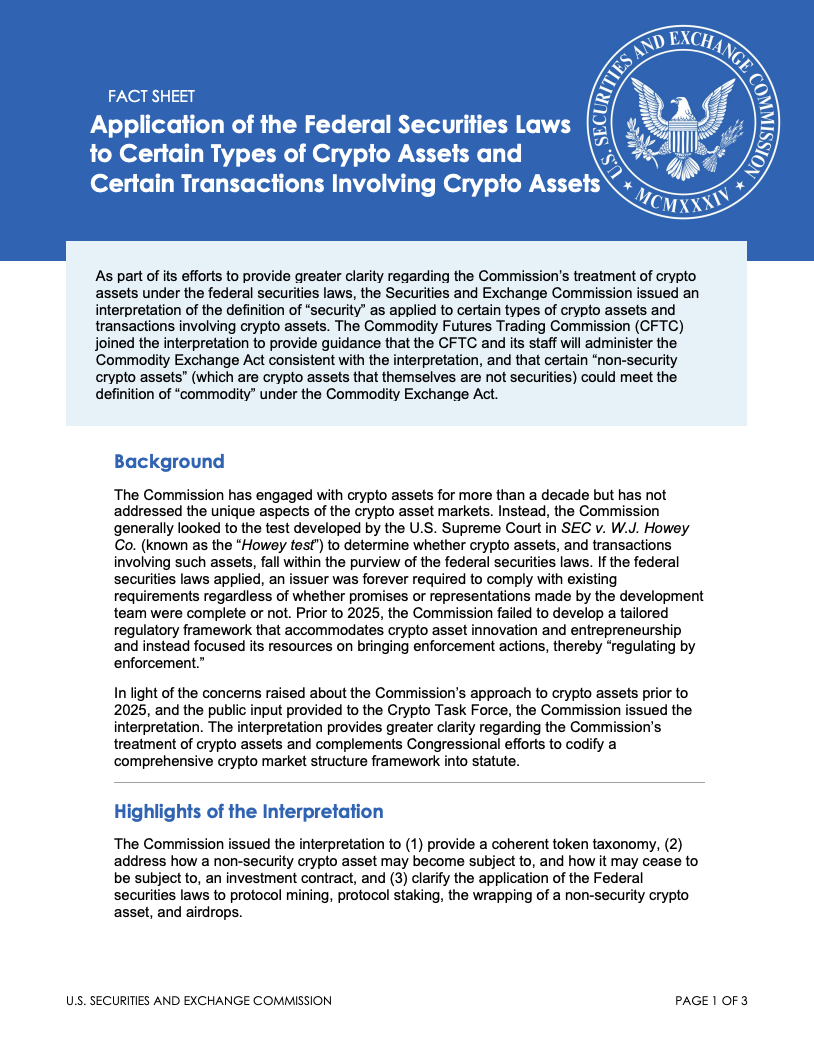
The recent guidance from the United States Securities and Exchange Commission (SEC) and the Commodity Futures Trading Commission establishing a taxonomy for digital assets put a “final nail” in the coffin of SEC policy under former Chairman Gary Gensler, according to Alex Thorn, the head of firmwide research at investment firm Galaxy.
The SEC guidance, published on Tuesday, established a taxonomy for digital assets, dividing them into five categories, including digital commodities, digital collectibles like non-fungible tokens (NFTs), digital tools, stablecoins, and tokenized securities.

Under the old SEC policy framework, the regulations governing which cryptocurrencies met the legal criteria of “investment contracts” were legislative rules, as opposed to the new 2026 guidance that was filed as an interpretive rule, Thorn said. He explained the significance:
“The distinction matters enormously under the Administrative Procedure Act (APA). A legislative rule or substantive rule goes through notice-and-comment rule-making, has the force and effect of law, and binds both the agency and regulated parties.
An interpretive rule is exempt from notice-and-comment requirements, does not have the force of law, and merely explains how the agency understands existing statutory provisions,” he continued.
The interpretive rule does not legally bind courts to enforce the policies, which gives the SEC and the crypto industry flexibility in adapting to future regulatory changes, he added.
The new regulatory approach gives the crypto industry much-needed clarity over the next 30 months, Thorn Said; however, he clarified that the CLARITY crypto market structure bill must be codified into law to cement the rules over the next several decades.
Related: SEC interpretation on crypto laws ‘a beginning, not an end,’ says Atkins
The CLARITY Act stalls, but rumors emerge of a tentative deal between White House and lawmakers
The CLARITY Act stalled in January 2025, after crypto exchange Coinbase and other industry players voiced concerns over the prohibition on stablecoin yield and a lack of protections for open-source software developers.
Crypto companies and industry thought leaders also cited provisions that would effectively gut the decentralized finance (DeFi) sector by imposing reporting requirements and know-your-customer controls on DeFi as a major cause of contention.

On Friday, Politico published a report of a tentative deal between the White House and lawmakers to move the CLARITY bill forward.
Specific details of the prospective deal have not yet been revealed, although Senator Angela Alsoboorks said the tentative deal includes a ban on stablecoin yield from “passive balances.”
Magazine: How crypto laws changed in 2025 — and how they’ll change in 2026
Crypto World
Grayscale wants to bring the world’s hottest crypto trading frenzy to your brokerage account
Grayscale has filed with the U.S. Securities and Exchange Commission (SEC) to launch a new exchange-traded fund for the HYPE token, amid the surging popularity of decentralized exchange Hyperliquid.
The Crypto asset manager’s proposed fund would hold the HYPE token and be listed on Nasdaq under the ticker GHYP, according to the S-1 registration statement.
Grayscale said it may stake some holdings in the future, though it cannot do so now. The filing doesn’t disclose a proposed fee. Other asset managers that have also filed for HYPE ETFs include Bitwise and 21Shares, which already operate a HYPE exchange-traded product in Europe with a 2.5% total expense ratio.
HYPE is the native token of the Hyperliquid network, which is home to the leading decentralized exchange of the same name. Its core layer handles perpetual futures and spot markets, while a second layer supports Ethereum-style smart contracts.
Perpetual futures contracts, or “perps,” are derivative instruments without expiration dates that allow investors to place bets on an asset’s price without owning it. Their infinite duration (perpetual futures contracts never expire, unlike traditional contracts), high-leverage options, and round-the-clock access have made them extremely popular in the crypto space.
The filing comes as Hyperliquid sees growing interest from traders betting on traditional financial assets, including oil and gold, while war rages in the Middle East. The platform has also recently added an S&P 500 perpetual contract.
In simple terms, the platform’s value proposition is not just crypto trading, but also the ability to bet on traditional assets around the clock, even when most markets are closed.
The trading frenzy has seen Hyperliquid’s weekly derivatives trading volume top $50 billion, with more than $6.5 billion being traded in the past 24 hours alone, according to DeFiLlama data.
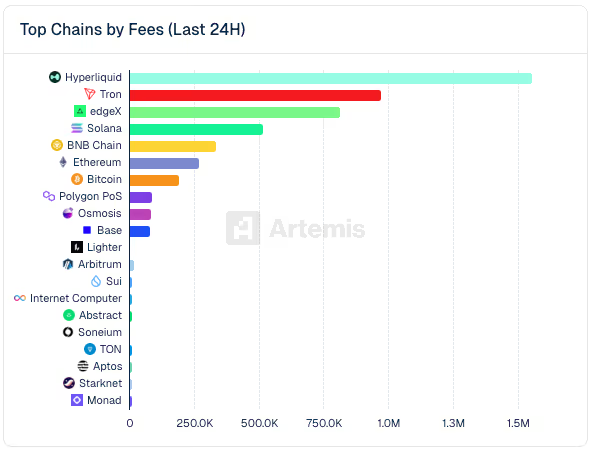
That has helped the Hyperliquid chain dominate in revenue, which stands at $1.6 million over the last 24 hours, compared to $335,000 for BNB Chain and $192,000 for the Bitcoin blockchain, according to Artemis data.

This increased activity has captured many bullish takes from crypto investors and market observers. Recently, Arthur Hayes, the co-founder of BitMEX and CIO of Maelstrom, said the platform’s strong revenue, real trading activity, and disciplined token supply could take its native token, HYPE, to $150.
The token currently trades around $40 and has risen by 57% this year, while bitcoin fell about 20% and Ethereum’s native token, ether, fell about 28%.


For years, tokenization has been framed as crypto’s bridge to Wall Street. Put Treasuries onchain. Issue tokenized money market funds. Represent equities digitally. The assumption was simple: if assets move onchain, institutions will follow.
But tokenization alone was never the endgame. As we recently argued in our institutional outlook, the real institutional unlock isn’t digitizing assets – it’s financializing yield.
Following the regulatory clarity that emerged in 2025, institutional interest in digital assets has shifted from exploratory exposure to infrastructure-level participation. Surveys increasingly suggest that institutional engagement with DeFi could rise sharply over the next couple of years, while a meaningful share of allocators are exploring tokenized assets. Yet large allocators are not entering crypto solely to hold tokenized wrappers. They are entering for yield, capital efficiency, and programmable collateral. That requires a different kind of DeFi than the retail-built one in 2021.
In traditional finance, fixed-income instruments are rarely held in isolation. They are repo’d, pledged, rehypothecated, stripped, hedged and embedded into structured products. Yield is traded independently of principal, and collateral moves fluidly across markets. The plumbing matters as much as the product.
DeFi is now beginning to replicate those core functions.
A tokenized Treasury or equity is only marginally useful if it behaves like a static certificate. Institutions want tokenized assets to become functioning, working financial instruments: collateral that can be deployed, financed and risk-managed; yield that can be isolated, priced and traded; and positions that can be integrated into broader strategies without breaking compliance constraints.
That is the shift from first-order tokenization to second-order yield markets.
Early design patterns already point in this direction. Hybrid market structures are emerging in which permissioned, regulated assets can be used as collateral while borrowing is facilitated by using permissionless stablecoins. At the same time, yield trading architectures are expanding the range of activities investors can undertake with tokenized assets by separating principal exposure from the yield stream. Once the yield component of an onchain asset can be priced, traded, and composed, tokenized instruments become usable in strategies that are much closer to what allocators already run in traditional markets.
For institutions, this matters because it turns real-world assets (RWAs) from passive exposure into active portfolio tools. If yield can be traded independently, then hedging and duration management become more feasible, and structured exposures become possible without rebuilding the entire stack off-chain. Tokenization stops being a narrative and starts becoming market infrastructure.
However, yield infrastructure alone will not bring institutional scale. Institutional constraints that shaped traditional markets have not disappeared; they are being translated into code.
One of the most important constraints is confidentiality. Public blockchains expose balances, positions, and transaction flows in ways that conflict with how professional capital operates. Visible liquidation levels invite predatory strategies, public trade history reveals positioning, and treasury management becomes transparent to competitors. For institutions accustomed to controlled disclosure and information asymmetry, these are not philosophical objections – they are operational risks.
Historically, privacy in crypto has been treated as a regulatory liability. What is emerging instead is privacy as compliance-enabling infrastructure.
Zero-knowledge systems can prove transactions are valid without revealing sensitive details. Selective disclosure mechanisms can enable institutions to share limited visibility with auditors, regulators, or tax authorities without disclosing the entire balance sheet. Proof systems can demonstrate that funds are not linked to sanctioned or illicit sources without disclosing broader transaction history. Even approaches such as fully homomorphic encryption point toward a future in which certain kinds of computation can occur on encrypted data, widening the set of financial actions that can be performed privately while retaining verifiability where required.
This is not ‘privacy as opacity’. It is programmable confidentiality, and it more closely resembles established market structures, such as confidential brokerage workflows or regulated dark pools, than it does anonymous shadow finance. For institutions, that distinction is the difference between a system that is unusable and one that can be deployed at scale.
A second constraint is compliance. Regulatory clarity has reduced existential uncertainty, but it has also raised expectations. Institutional capital demands eligibility controls, identity verification, sanctions screening, auditability and clear operational regimes. If the next phase of DeFi is going to intermediate real-world value at scale, compliance cannot remain an afterthought bolted onto a permissionless system. It has to be embedded into market design.
That is why one of the most important patterns emerging in institutional DeFi is a hybrid architecture combining permissioned collateral with permissionless liquidity. Tokenized RWAs can be restricted at the smart contract level to approved participants, while borrowing can occur via widely used stablecoins and open liquidity pools. Identity and eligibility checks can be automated. Asset provenance and valuation constraints can be enforced. Audit trails can be produced without forcing every operational detail into public view.
This approach resolves a long-standing tension. Institutions can deploy regulated assets into DeFi without compromising core requirements around custody, investor protection and sanctions compliance, while still benefiting from the liquidity and composability that made DeFi powerful in the first place.
Taken together, these shifts point to a broader reality where DeFi is not simply attracting institutional capital; it is, in fact, being reshaped by institutional constraints. The dominant narrative in crypto still centers on retail cycles and token volatility, but beneath that surface, protocol design is evolving toward a more familiar destination – a fixed-income stack where collateral moves, yield trades and compliance is operationalized.
Tokenization was phase one because it proved assets could live onchain. Phase two is about making those assets behave like real financial instruments, with yield markets and risk controls that institutions recognize. When that transition matures, the conversation shifts from crypto adoption to capital markets migration.
That shift is already underway.
Key takeaways:
-
Bitcoin traders are turning cautious as high oil prices and Middle East tensions fuel inflation and stall US interest rate cuts.
-
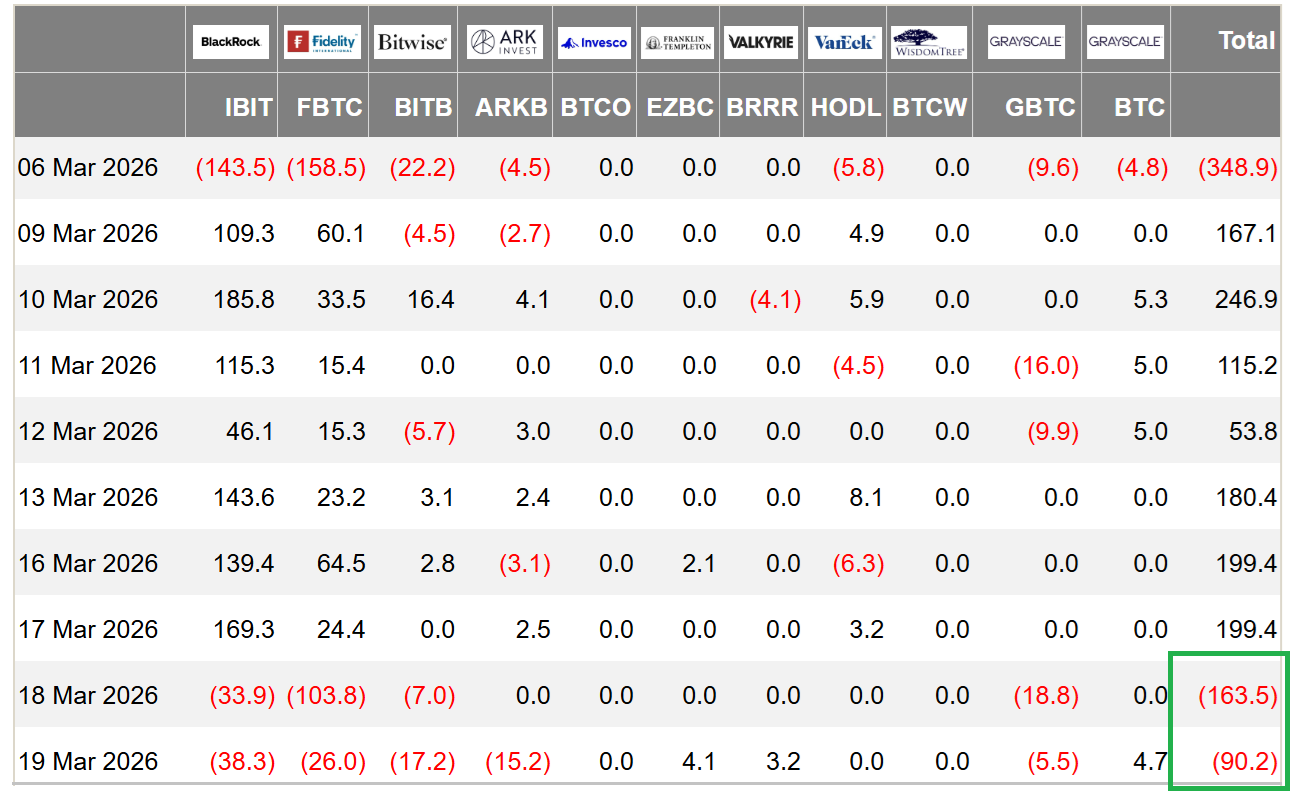
The $254 million in spot Bitcoin ETF outflows is too small to confirm a bearish flip, yet options markets show heavy hedging.
Bitcoin (BTC) price stagnated near $70,000 during the Friday trading session after failing to reclaim the $75,000 level on Tuesday. The decline marked two days of net outflows from US-listed Bitcoin spot exchange-traded funds (ETFs), reversing the trend from the prior seven days. Traders are now wondering if institutional investors are turning bearish, especially as the US stock market showed signs of weakness.

The bearish sentiment across global markets is weighing on Bitcoin as the S&P 500 plummeted to its lowest level in six months. Even gold, which typically acts as a hedge, faced a 10% sell-off over three days. As the US and Israel-Iran war triggers a broad move toward risk aversion, Bitcoin derivatives data now reflect increasing fear among traders.

Demand for put (sell) Bitcoin options premiums at Deribit was nearly 2.5 times larger than equivalent call (buy) instruments on Friday, indicating increased demand for neutral-to-bearish strategies. The prior surge in the metric occurred on Feb. 27 after Iran rejected negotiations to dismantle its key nuclear facilities and export its enriched uranium.
Traders frustrated by Bitcoin’s 17% lag behind the S&P 500
To confirm if the increased demand for put options has effectively been used for downside protection, one should assess the delta skew metric. When market makers fear imminent Bitcoin price correction risks, the put options tend to trade at a 6% or higher premium relative to equivalent call instruments. Conversely, periods of bullishness push the indicator below -6%.

The Bitcoin options delta skew (put-call) stood at 16% on Friday, meaning professional traders were not comfortable that the $69,000 level will hold. While distant from the extreme panic levels seen in late February, the current conditions reflect the stress caused by the 21% price drop in three months, while gold and the US stock market held relatively steady.

Regardless of whether Bitcoin successfully defends the $70,000 level, traders are not pleased with the 17% underperformance relative to the S&P 500 over three months. More importantly, the recent rally to $75,000 on Tuesday was unable to move the needle in Bitcoin options markets, a strong indicator that traders are acting overly cautious.
Related: Crypto Biz–Institutions aren’t waiting for the bottom
Part of the pessimism can be attributed to the surge in energy prices. WTI oil prices have sustained levels above $94 since March 12, a 50% increase versus the prior month. The disruption of oil and gas production and logistics in the Middle East negatively impacts economic growth expectations and limits the ability of the US Federal Reserve to slash interest rates due to inflationary pressure.
The fuel price surge is expected to cause consumers to pull back on spending, according to a new Oxford Economics analysis. Analysts warned that US manufacturers who rely on imports will also be impacted, causing further price increases and potential “outright shortages of some products,” according to Yahoo Finance.
The mere $254 million net outflows in two days are unlikely to be a sign of institutional investors flipping bearish, but traders are not confident that Bitcoin will hold above the $68,000 level. Traders’ sentiment has been largely driven by worsening macroeconomic conditions and uncertainty caused by the prolonged war, driving increased demand for downside protection using derivatives.
This article does not contain investment advice or recommendations. Every investment and trading move involves risk, and readers should conduct their own research when making a decision. While we strive to provide accurate and timely information, Cointelegraph does not guarantee the accuracy, completeness, or reliability of any information in this article. This article may contain forward-looking statements that are subject to risks and uncertainties. Cointelegraph will not be liable for any loss or damage arising from your reliance on this information.
TLDR:
-
- TRON DAO joined DC Blockchain Summit 2026 as a Diamond Sponsor, engaging policymakers on digital asset regulation.
- Justin Sun delivered a keynote on building unified financial infrastructure combining blockchain and traditional finance.
- TRON DAO’s Adrian Wall moderated a session on U.S. crypto regulatory clarity alongside Representative Dusty Johnson.
- TRON DAO hosted a VIP Lounge at Capital Turnaround, creating space for direct policy and ecosystem conversations.
- TRON DAO joined DC Blockchain Summit 2026 as a Diamond Sponsor, engaging policymakers on digital asset regulation.
TRON DAO joined the DC Blockchain Summit 2026 as a Diamond Sponsor in Washington, D.C. The Digital Chamber hosted the event on March 17–18, drawing policymakers, regulators, and industry leaders.
Discussions covered blockchain regulation, digital assets, and the future of financial infrastructure. TRON DAO used the platform to advance policy dialogue and present ecosystem developments.
The summit marked another step in the organization’s ongoing engagement with U.S. regulatory conversations.
Justin Sun Outlines a Blueprint for a Unified Financial System
Justin Sun, Founder of TRON, delivered a keynote on the Main Stage at the summit. The address was titled “Building the Rails for a Unified Financial System.”
Sun described TRON as a foundational settlement layer for the global digital economy. He also positioned the network as infrastructure suited for supporting Agentic AI payments.
Sun stressed that collaboration between traditional finance and emerging technology sectors is essential. He said this cooperation is key to building a unified and interoperable digital asset ecosystem.
The keynote drew attention from policymakers and industry leaders throughout the two-day event. It reinforced TRON’s standing as a meaningful contributor to global financial infrastructure.
Sun pointed to the U.S. as a market with a well-established financial infrastructure. He argued that blockchain and AI can help expand such systems into more open digital environments.
“In markets like the US, where financial infrastructure is already strong and well established, blockchain and AI can help expand that system into a more open and programmable digital environment,” Sun said. His remarks reflected the growing convergence of traditional and decentralized financial networks.
Sun further noted that creating the right infrastructure remains the most pressing challenge ahead. He emphasized that a unified financial system must bring together the best of both worlds.
“As we look ahead, the most important challenge is building the infrastructure that allows all parts of the financial system to work together,” he stated.
“A unified financial system will combine the strengths of traditional finance with the openness and efficiency of blockchain networks.”
TRON DAO Shapes Policy Dialogue Through Sessions and On-Site Engagement
Adrian Wall, Senior Director of U.S. Policy at TRON DAO, moderated a key Main Stage session. The session, titled “CLARITY: What It Took and What Comes Next,” examined key regulatory milestones.
It covered recent legislative developments shaping the digital asset landscape across the United States. Wall was joined by Dusty Johnson, U.S. Representative for South Dakota (R-SD).
The session gave attendees a direct look at the current U.S. digital asset regulatory environment. Both speakers addressed recent legislative progress and outlined what still lies ahead for the industry.
Their exchange reflected ongoing efforts to establish greater regulatory clarity in the crypto space. The discussion added a policy-driven perspective to the broader summit agenda.
TRON DAO also hosted a dedicated VIP Lounge at Capital Turnaround across both days of the summit. The lounge served as a central hub for industry leaders, policymakers, and community members.
Conversations covered TRON’s ecosystem developments, policy initiatives, and the evolving regulatory landscape. The setting allowed for direct engagement beyond the formal conference sessions.
As shared across TRON DAO’s official channels, its Diamond Sponsorship reflected a firm commitment to active policy engagement.
The organization continues to work alongside governments and institutions toward a more open financial system. TRON DAO remains focused on responsible blockchain innovation and constructive collaboration with regulators.
Its presence at the summit reflected a consistent and ongoing strategy to support the future of digital assets.
Crypto World
Silver Loses 43% in Eight Weeks as Gulf War Lays Bare Its Industrial Identity Over Monetary Role
TLDR:
- Silver fell 43% from its $121.67 all-time high to $69.50 in under eight weeks after Gulf war shocks hit.
- Over 60% of silver demand is industrial, leaving it exposed when energy costs and rate hike fears surged.
- Qatar’s helium facility destruction threatens chip fab output, reducing a core source of silver packaging demand.
- Gold dropped too but held ground as the PBOC bought for 16 straight months and 77% of central banks plan reserve increases.
Silver has dropped 43 percent since January 29, falling from an all-time high of $121.67 to $69.50 by Friday’s close. Gold also declined over the same period but found firmer ground through central bank demand.
The divergence between the two metals has raised fresh questions among commodity analysts and investors. These movements are reshaping how markets view silver’s role as both a monetary and industrial asset.
Silver’s Industrial Base Absorbs Three Simultaneous Shocks
More than 60 percent of silver demand is industrial, confirmed by JP Morgan’s commodities desk. Electronics, AI chip packaging, solar panels, and electric vehicle wiring are among its primary uses.
When hostilities closed the Strait of Hormuz, energy prices spiked and factory costs rose. Higher costs slowed industrial activity and pulled silver demand lower.
Analyst Shanaka Anslem Perera noted on social media that the divergence “is no longer a market event. It is a verdict.” The Federal Reserve now prices a 50 percent chance of a rate hike by October. The ECB and Bank of England are each repricing three or more hikes for 2026.
Qatar’s Ras Laffan complex supplied 30 to 33 percent of global helium before Iran struck it. SK Hynix sourced 64.7 percent of its helium from that facility alone.
Helium is essential for wafer cooling and lithography in chip fabrication. Fabs are reporting two to three months of buffer supply remaining.
When helium runs short, chip production slows and silver packaging demand falls. Energy spikes, rate hike expectations, and helium shortages hit silver’s industrial base at once.
The metal’s monetary narrative provided no shelter when factories came under economic pressure. Silver entered this environment with three demand shocks arriving simultaneously.
Gold Builds a Floor on Central Bank and Retail Demand
Gold fell from $5,589 in January to approximately $4,494 this week, but buying absorbed each drop. Chinese retail buyers cleared supplies in under 60 seconds each morning.
The People’s Bank of China extended its purchasing streak to 16 consecutive months. Chinese banks sold 600 kilograms of gold bars each morning in under a minute.
Seventy-seven percent of central banks plan to increase gold reserves, based on recent surveys. That sustained demand has built a structural floor under gold’s price.
Silver has no central bank buyer of last resort. Its floor rests entirely on industrial consumption, which is now under strain.
Gold’s support comes from institutional policy decisions, not factory orders. Silver’s support depends on factories now facing energy shocks and helium shortages.
The war revealed a structural difference between the two metals that many investors had not previously priced in. That difference now appears lasting rather than temporary.
Rate hike expectations in the United States and Europe continue to reinforce dollar strength. A stronger dollar adds persistent pressure on metals priced in that currency.
Silver enters this environment without central bank support. Whether industrial demand can stabilize will determine the metal’s next directional move.

This Key Airport Runway Safety Feature Can Stop A Plane In Seconds

Fiduciary Advisor vs Financial Advisor (Big Difference) #Fiduciary #TaxStrategy #financialplanning

Brighton 2-1 Liverpool: ‘If Reds play like that at PSG it could be 10-0’


-

 Tech6 days ago
Your Legally Registered ‘Motorcycle’ Might Not Count Under Proposed US Law
-

 Politics23 hours ago
Jenni Murray, Long-Serving Woman’s Hour Presenter, Dies Aged 75
-

 Fashion1 day ago
Weekend Open Thread: Adidas – Corporette.com
-
 Tech4 days ago
Are Split Spacebars the Next Big Gaming Keyboard Trend?
-

 News Videos3 days ago
RBA board divided on rate cut, unusually buoyant share market | Finance Report | ABC NEWS
-

 Business6 days ago
Search for Savannah Guthrie’s Mother Enters Seventh Week with No Arrests
-
 Crypto World19 hours ago
NIO (NIO) Stock Plunges 6.5% as Shelf Registration Sparks Dilution Worries
-

 Business5 days ago
Australian shares drop as Iran war enters third week
-

 Crypto World5 days ago
Crypto Lender BlockFills Enters Chapter 11 with Up to $500M in Liabilities
-

 Politics3 days ago
The House | The new register to protect children from their abusers shows Parliament at its best
-

 Fashion5 days ago
25 Celebrities with Curly Hair That Are Naturally Beautiful
-

 Tech2 days ago
inKONBINI Lets You Spend Summer Days Behind the Register
-

 Crypto World3 days ago
Canada’s FINTRAC revokes registrations of 23 crypto MSBs in AML crackdown
-
 Politics4 days ago
Real-time pollution monitoring calls after boy nearly dies
-

 Crypto World7 days ago
Crypto Losses Drop 87% in February, But Hackers Are Now Targeting People, Not Code
-
 NewsBeat3 days ago
Residents in North Lanarkshire reminded to register to vote in Scottish Parliament Election
-

 Business5 days ago
Meta planning major layoffs as AI spending and automation reshape workforce
-

 News Videos3 days ago
PARLIAMENT OF MALAWI – PAC MEETING WITH REGISTRAR OF FINANCIAL ON AMARYLLIS HOTEL – INQUIRY LIVE
-

 Politics6 days ago
9 Stylish Leather Jackets Perfect For Spring 2026
-
Crypto World6 days ago
U.S. Oil Companies Post Record Profits as Oil Prices Break $100
You must be logged in to post a comment Login