CryptoCurrency
Crypto Market Drops $100B as US Government Shutdown Fears Loom

Introduction
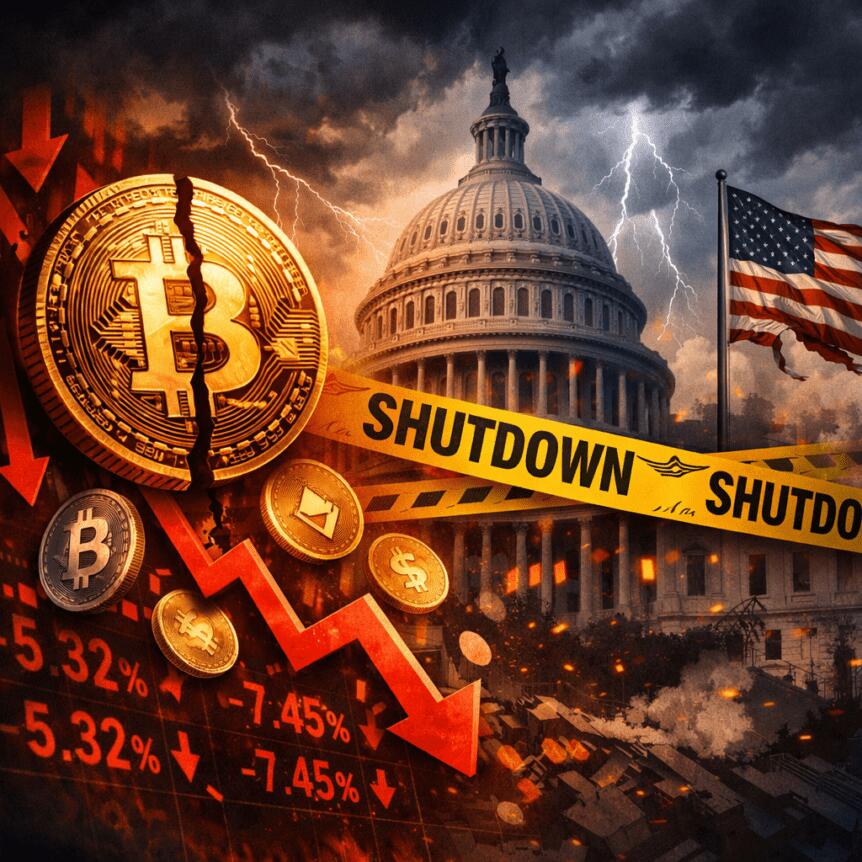
Crypto markets erased roughly $100 billion in value late Sunday as traders priced in the risk of a partial U.S. government shutdown tied to funding for the Department of Homeland Security. The dispute in Washington intensified after a Minneapolis shooting involving federal agents, prompting Senate Democrats to signal they would block any spending package that included DHS funding unless reforms were enacted. In the meantime, data showed the broader market slipping: the total crypto market capitalization fell from about $2.97 trillion to $2.87 trillion within roughly six and a half hours. Bitcoin (CRYPTO: BTC) slipped 3.4% in the past 24 hours, while Ether (CRYPTO: ETH) declined 5.3%. Amid the selling, more than $360 million in leveraged positions were liquidated, including about $324 million in long contracts, according to market data trackers. The evolving political backdrop underscored how sensitive crypto markets remain to macro headlines and policy risk.
Key Takeaways
- The crypto market cap declined by roughly $100 billion in under a day, moving from about $2.97 trillion to $2.87 trillion within six-and-a-half hours.
- Bitcoin (CRYPTO: BTC) fell about 3.4% over 24 hours, while Ether (CRYPTO: ETH) declined by roughly 5.3% in the same window.
- More than $360 million of leveraged crypto positions were liquidated in the period, with $324 million of that in long positions.
- Prediction markets priced in rising odds of a U.S. government shutdown by the end of January, with bets around 80% on both Kalshi and Polymarket.
- Political developments—ranging from DHS funding debates to broader tariff rhetoric—fed a risk-off mood that weighed on sentiment across crypto and traditional markets.
Tickers mentioned: $BTC, $ETH
Sentiment: Neutral
Price impact: Negative. The broad sell-off reflected elevated political risk and risk-off sentiment among investors.
Trading idea (Not Financial Advice): Hold. With headlines continuing to evolve, patience and risk-management remain prudent while monitoring policy developments.
Market context: The session illustrates how political risk and policy uncertainty can spill over into crypto markets, reinforcing the link between headline risk, liquidity conditions, and risk appetite in a sector still sensitive to macro drivers.
Why it matters
The weekend pullback underscores how closely crypto prices track geopolitical and regulatory headlines, especially when they touch the U.S. government’s funding machinery. The DHS funding fight sits at the intersection of security policy and immigration enforcement, issues that have historically influenced risk sentiment and capital flows across asset classes. As lawmakers volley rhetoric over DHS appropriations and ICE oversight, traders are recalibrating positions in a market that remains dominated by leveraged bets and fast-moving liquidity. The immediate consequence is a sharper pullback in the most liquid assets, with altcoins acting as attack points for broader downside given thinner order books and higher volatility during such episodes.
Market participants are also weighing broader catalysts beyond the budget debate. The same session that saw a crypto dump was punctuated by headlines such as tariff threats from U.S. leadership and intensified geopolitical tensions in the Middle East, factors that tend to compress risk appetite across risky assets, including digital currencies. In this environment, traders have turned to defensives and hedges, but even safe-haven narratives within crypto have not provided the usual insulation. The dynamics demonstrate how quickly sentiment can shift when political timelines intersect with policy decisions, testing traders’ capacity to manage leverage and maintain liquidity during stress periods.
Beyond the immediate policy friction, investors watched the unfolding risk indicators that have become a fixture of crypto markets during episodes of instability. The last extended U.S. government shutdown—lasting 43 days—offered a test case for how digital assets respond to prolonged political gridlock. Bitcoin fell from its earlier peak near $126,080 to just under $100,000 during that period, highlighting that even major assets can experience pronounced drawdowns when confidence wavers. The broader market narrative during that time included gold outperforming digital assets, suggesting that many investors favored traditional safe-haven assets amid heightened macro and geopolitical uncertainty.
The sentiment framework at the time also reflected in the Crypto Fear & Greed Index, which dipped further into “extreme fear” as investors consolidated risk-off bets, even as some accredit opportunity for mean reversion within risk-on altcoins. This recent episode reinforces the lesson that crypto markets, despite their growth and innovation, remain highly reactive to U.S. policy signals and the political calendar, particularly when combined with leverage-driven liquidity risks.
As the market digests the evolving stance in Washington, traders are closely monitoring the odds markets for any reassessment of the shutdown timeline. By Sunday, prediction markets were signaling a high probability—around 80% by January 31—reflecting a consensus that the political impasse could persist into the end of the month. This pricing reflects a mix of institutional caution and the historical tendency for policy friction to complicate asset pricing when funding bills hang in the balance.
Looking back, the combination of fiscal deadlines, immigration-enforcement policy debates, and broader macro uncertainty has created a difficult environment for risk assets. While some participants argue that such episodes eventually yield a reversion, the timing remains uncertain, and liquidity conditions in crypto markets can deteriorate quickly in the absence of clear policy resolution. In the near term, traders are likely to watch for any signs of compromise on DHS funding, as well as the evolving outlook for U.S. monetary and fiscal policy that could influence risk sentiment across asset classes.
Gold’s relative performance, historically a gauge of risk-off appetite, remains a factor to watch as a barometer against crypto’s volatility during political turbulence. The ongoing tension between risk-on and risk-off drivers ensures that price action in major crypto assets will continue to be shaped by headline-driven flows, even as longer-term fundamentals—including institutional adoption and network developments—continue to evolve behind the scenes.