
Crypto World
Crypto networks respond after Vitalik Buterin told them they ‘no longer makes sense’ for Ethereum

For years, Ethereum’s layer-2 networks have marketed themselves as extensions of Ethereum itself. “Arbitrum is Ethereum,” Offchain Labs co-founder Steven Goldfeder wrote on X in March 2024. “Base is Ethereum,” Coinbase’s layer-2 team posted in April 2025.
But following recent comments from Ethereum co-founder Vitalik Buterin questioning whether Ethereum still needs a dedicated layer-2 roadmap, many of those same teams are now emphasizing something different: that rollups are not Ethereum at all.
Goldfeder, for one, struck a noticeably different tone after Buterin’s post, writing on X instead: “Arbitrum is not Ethereum.”
“It’s a core part of the ecosystem, a close-knit ally, and has enjoyed a symbiotic relationship for the last half-decade. But it is not Ethereum,” he added in the post.
Buterin’s remarks, which suggested that as Ethereum becomes faster and cheaper, the original rationale for layer-2s may be shifting, reignited debate over whether rollups will become less necessary as the base layer improves.
Layer-2 networks were previously incorporated into Ethereum’s roadmap to scale the network by processing transactions off the main blockchain and settling them back to Ethereum, helping reduce congestion and fees.
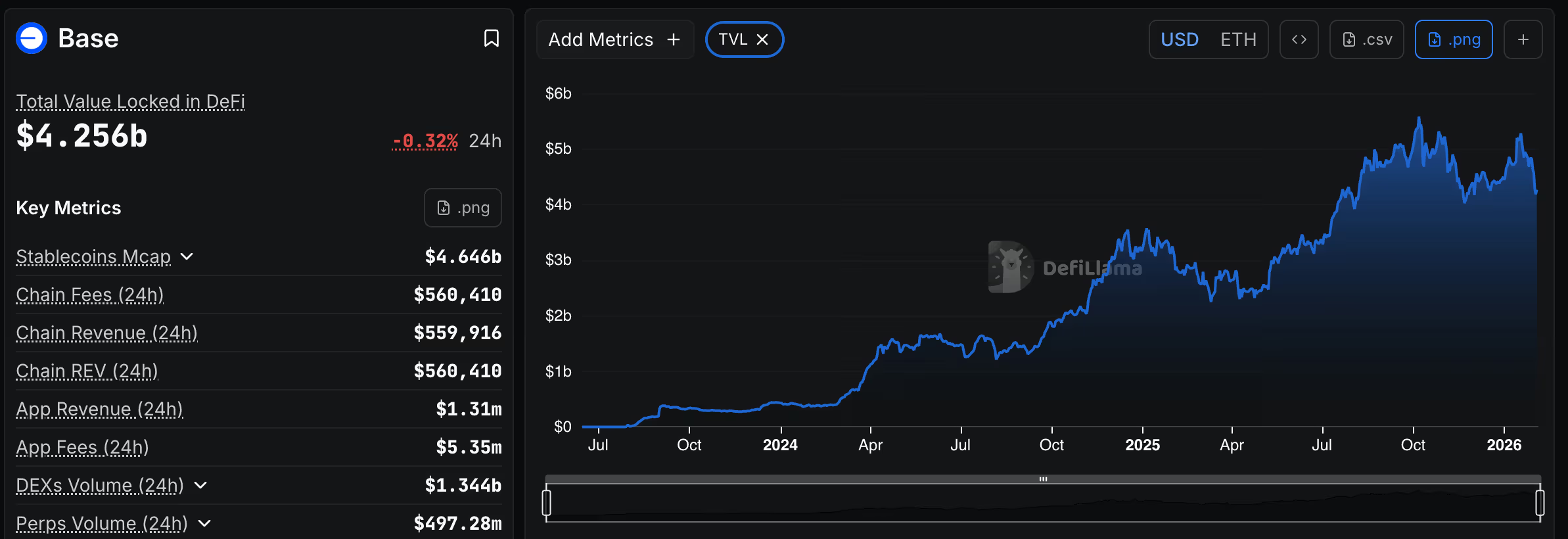
The debate is not abstract. Several layer-2 networks now secure billions of dollars in user funds, making them some of the largest platforms in crypto. Coinbase-backed Base holds roughly $4 billion in total value locked, while Arbitrum secures more than $2 billion, according to DefiLlama data.

‘Less relevant’
But leaders across the layer-2 ecosystem say this moment is being misunderstood.
Rather than signaling an existential threat, they argue, Ethereum’s progress is forcing rollups to clarify their purpose and to stand on their own.
Ben Fisch of the Espresso Foundation said Buterin’s comments reflect a logical evolution in how Ethereum’s scaling strategy is being framed.
“I think that Vitalik’s post is very consistent with that idea now that he’s saying, ‘The whole purpose of layer-2s in the first place was to scale Ethereum. Well, now we’re making Ethereum faster so they’re becoming less relevant,” Fisch said to CoinDesk in an interview.
Still, Fisch rejected the idea that this makes rollups obsolete.
“I think it’s the start of layer-2s flourishing and becoming independent from Ethereum,” he said.
“A layer-2 may use Ethereum as a service, but it by no means is beholden to Ethereum or what the leaders of Ethereum think.”
That perspective is increasingly echoed by layer-2 leaders themselves.
Base, Coinbase’s layer-2 network, welcomed improvements at the base layer, with Jesse Pollak, the head of Base, calling Ethereum scaling “a win for the entire ecosystem,” while stressing that rollups will need to offer more than lower fees.
“Going forward, L2s can’t just be ‘Ethereum but cheaper,’” Pollak said.
Polygon CEO Marc Boiron made a similar argument. Polygon recently said it would pivot its efforts to focus primarily on payments, and Boiron said Buterin’s comments were less about abandoning rollups than about raising expectations for them.
“Vitalik’s point was not that rollups are a mistake, but that scaling alone is insufficient,” Boiron told CoinDesk. “The real challenge is building a unique blockspace that works for real-world use cases like payments, where cost, reliability, and consistency matter.”
Others have gone further, arguing that rollups should be understood as independent platforms rather than extensions of Ethereum itself. Jing Wang, co-founder of the Optimism Foundation and CEO of OP Labs, compared layer-2s to standalone web services.
“L2s are websites. Every company will have its own, tailored to its needs. Ethereum is an open settlement standard,” Wang said to CoinDesk. “It’s important for Ethereum to stay true to those base layer values to give L2s the flexibility to customize.”
Taken together, the reactions suggest that while Buterin’s post has raised questions about the role of layer-2s, leaders across the ecosystem see it less as a threat than as a transition, one that is forcing rollups to reconcile how they’ve branded themselves with what they are now trying to become.

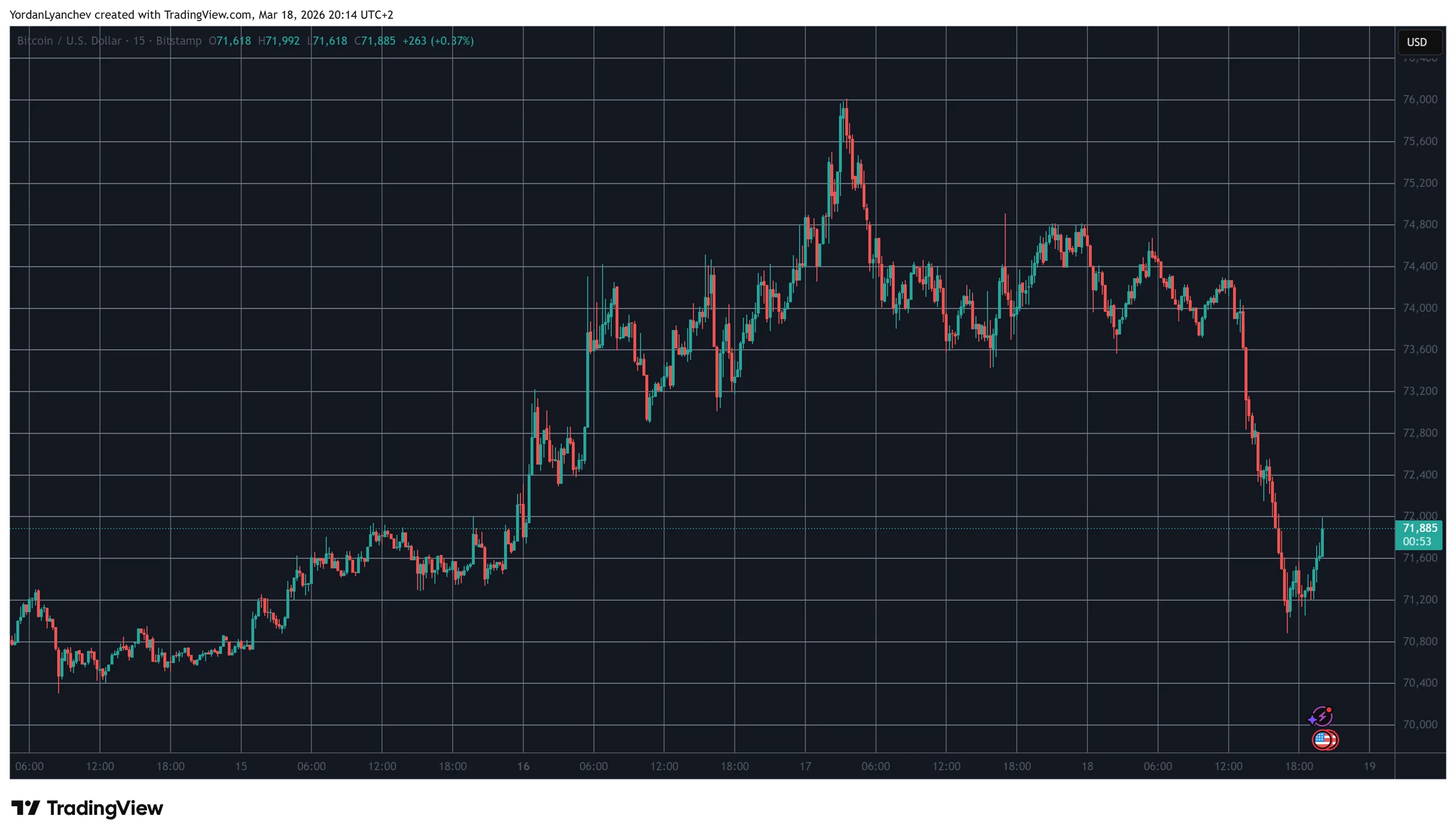
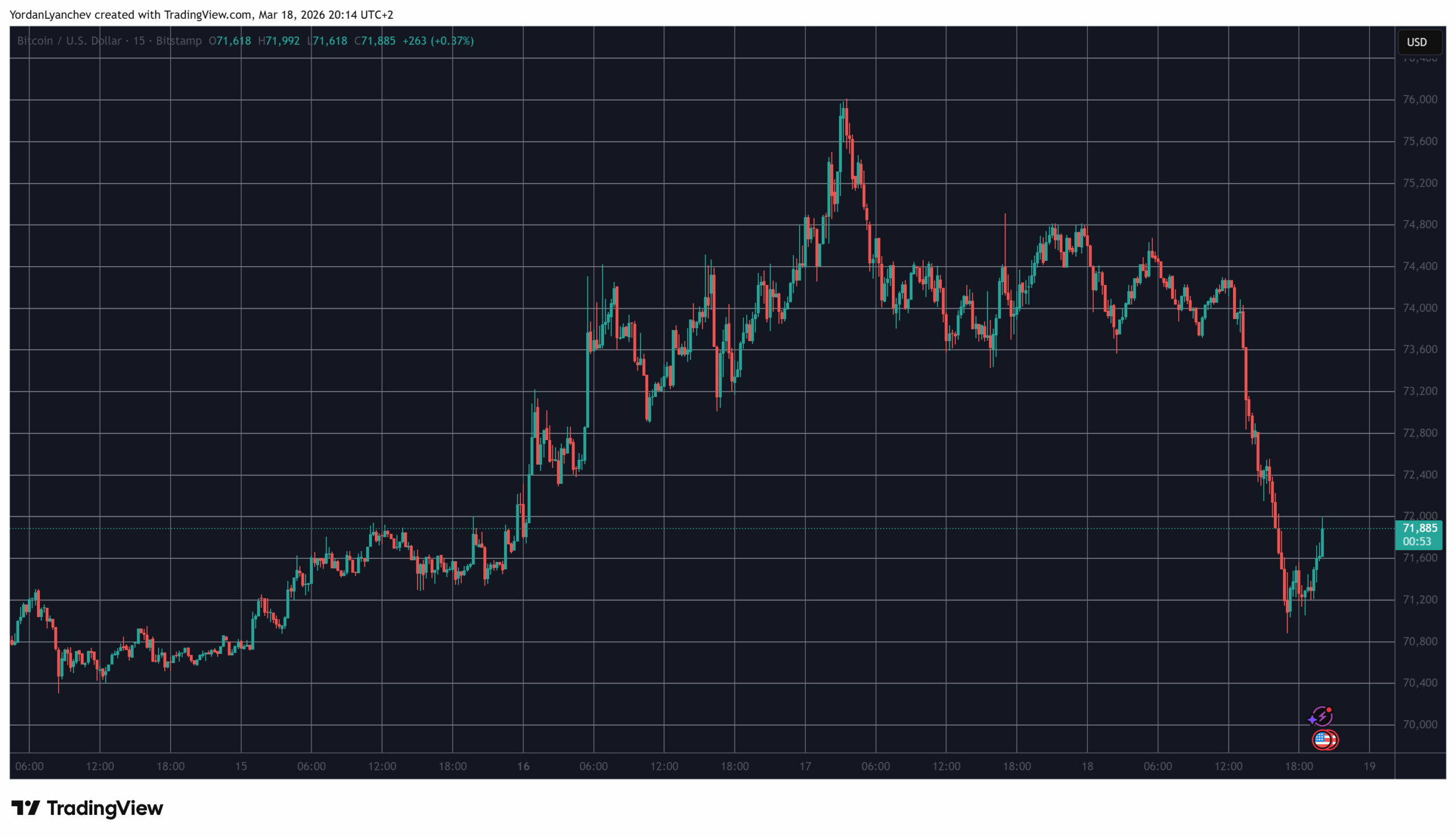
Bitcoin’s price tumbled before the news went out but it staged a minor recovery.
In alignment with most experts’ beliefs, the United States Federal Reserve kept the key interest rates unchanged for the second consecutive time in 2026.
BTC already experienced some volatility in the hours leading up to the second FOMC meeting of the year, dropping by $5,000 at one point. However, it has bounced toward $72,000 since the news went out.
America’s central bank maintained the federal funding rate, meaning what banks are charging each other for short-term loans, in the current range between 3.50% and 3.75%.
Experts noted before today’s announcement that the likely justification for this is the war that began in the Middle East, which has immediately impacted oil prices.
“The conflict with Iran has dramatically altered the backdrop to the March Federal Open Market Committee (FOMC) meeting and significantly increases the risks to inflation and the economy,” commented Oxford Economics’ chief US economist, Michael Pearce.
Bitcoin’s price reacted immediately to the news, even though it was expected. The asset had lost $5,000 earlier today in the hours leading up to the second FOMC meeting of the year, but bounced to $72,000 after the Fed’s decision went live.
Binance Free $600 (CryptoPotato Exclusive): Use this link to register a new account and receive $600 exclusive welcome offer on Binance (full details).
LIMITED OFFER for CryptoPotato readers at Bybit: Use this link to register and open a $500 FREE position on any coin!

Key Takeaways
- Cryptocurrency exchange Kraken postpones its anticipated $20 billion public offering due to unfavorable market conditions.
- Strategic acquisitions and platform expansion remain priorities as the company prepares for eventual market debut.
- Reduced trading activity and falling cryptocurrency valuations influence the timing delay.
- While some crypto companies proceed with listings, Kraken opts to wait for improved market sentiment.
- The exchange continues bolstering its infrastructure through key acquisitions ahead of future IPO attempt.
The cryptocurrency exchange Kraken has decided to postpone its public offering plans as digital asset markets experience an extended period of weakness. Following the submission of a preliminary S‑1 registration document to the Securities and Exchange Commission this past November, the company now faces challenging conditions characterized by depressed asset valuations and diminished trading activity.
Payward, the entity behind Kraken, achieved a $20 billion valuation following a successful $800 million capital raise. The financing round included a substantial $200 million investment from Citadel Securities, demonstrating institutional confidence in blockchain technology development. However, the cryptocurrency sector’s turbulence following Bitcoin’s peak price levels has created an unfavorable environment for public offerings.
Executives at the exchange have indicated plans to reconsider the public listing when market fundamentals demonstrate sustainable improvement. The combination of compressed valuations and subdued trading volumes has directly influenced decisions regarding IPO timing. Numerous cryptocurrency enterprises are carefully monitoring market dynamics before proceeding with their own public market debuts.
Cryptocurrency Sector Public Offering Landscape
The previous year witnessed an explosion of crypto-related IPO activity in 2025, with companies collectively securing $14.6 billion in capital. Notable participants included Circle, Bullish, and Gemini. This figure represented a dramatic leap from the modest $310 million accumulated during 2024. Positive regulatory developments from the SEC during that period created momentum for digital asset firms seeking public markets.
Currently in 2026, companies emphasizing infrastructure and compliance capabilities are leading the charge in public offering preparations. These organizations emphasize regulatory adherence, operational stability, and predictable revenue streams. Such characteristics resonate more effectively with conventional public market investors and meet stricter governance requirements.
BitGo emerged as 2026’s inaugural significant cryptocurrency public listing, successfully raising $213 million with shares priced at $18. Subsequently, the stock price declined roughly 44% amid broader market headwinds. This performance demonstrates how sensitive investor sentiment remains to cryptocurrency market fluctuations.
Strategic Positioning and Future Public Market Plans
Kraken has aggressively pursued strategic acquisitions to enhance platform capabilities, completing transactions for NinjaTrader and Backed Finance. The exchange also secured token management specialist Magna to diversify its digital asset service portfolio. Additionally, Kraken launched tokenized equity perpetual futures trading through its xStocks platform for international clients.
The postponement of public listing plans corresponds with organizational restructuring, including the earlier departure of CFO Stephanie Lemmerman this year. Leadership continues assessing optimal market timing for the eventual public debut. The acquisition strategy serves to strengthen operational infrastructure and market positioning ahead of renewed IPO efforts.
Meanwhile, other cryptocurrency platforms such as Securitize are advancing with public offering timelines despite challenging market dynamics. Securitize anticipates receiving SEC clearance and completing its Nasdaq listing during the second quarter. The company’s $225 million private investment in public equity (PIPE) financing provides financial cushioning amid ongoing market uncertainty.
Kraken’s public offering remains suspended as cryptocurrency markets work toward stabilization. Industry observers expect more favorable conditions will eventually emerge, catalyzing additional public offerings. The exchange’s current emphasis centers on operational excellence and sustainable expansion before ultimately pursuing its public market ambitions.

Crypto World
Kalshi co-founder fights back against Arizona’s ‘overstep’ in what a lawyer calls a federal-state turf war


Kalshi co-founder Tarek Mansour has called Arizona’s criminal case against the company a “total overstep,” casting the move as an attack on a federally regulated exchange rather than a standard gambling enforcement action.
Mansour said the charges “have nothing to do with gambling or the merits” and argued that Arizona is trying to short-circuit a broader court fight over who controls prediction markets. Speaking to Bloomberg, he said Kalshi will continue to defend the business even as the legal battle expands.
Kalshi didn’t reply to CoinDesk’s request for comments.
Arizona Attorney General Kris Mayes filed 20 criminal counts against Kalshi this week, accusing the company of operating an illegal gambling business and offering election wagering in the state.
Her office said Arizona law bars both unlicensed wagering operations and election betting.
Kalshi lets users trade contracts tied to real-world outcomes such as elections, sports and economic data. The company says those products are event contracts overseen by the Commodity Futures Trading Commission (CFTC), which recently signaled a more supportive federal stance toward these platforms. Kalshi, along with Polymarket, accounts for the lion’s share of prediction market activity, commanding more than 90% of notional volume, according to Dune data.
In a post on social media, CFTC Chairman Mike Selig called the matter a jurisdictional dispute and said criminal prosecution was “entirely inappropriate.” He said the agency is watching closely and evaluating its options.
The Arizona Attorney General today filed criminal charges against one of our registered exchanges related to prediction markets. This is a jurisdictional dispute and entirely inappropriate as a criminal prosecution. The @CFTC is watching this closely and evaluating its options.
— Mike Selig (@ChairmanSelig) March 17, 2026
State officials in Arizona and elsewhere have argued that some of them look more like wagers and should fall under state gambling rules.
That split now sits at the center of a larger national fight involving various states, including New York, Tennessee, and Massachusetts. Most state actions against Kalshi so far have relied on cease-and-desist orders, injunction requests or civil claims. Arizona’s case goes further by bringing criminal charges.
“It’s not surprising at all that states would bring new tools to bear in attempting to chill the federally regulated markets,” Aaron Brogan, founder and managing attorney of Brogan Law PLLC, told CoinDesk. “Because there is a fundamental conflict between states, which regulate and draw tax revenue from state-regulated gambling markets, and these federally regulated markets that are outside of state control.”
To Brogan, the question is ultimately whether or not federal law applies, meaning at the end of the day, “ this is a dispute between the federal government and state government and that’s where it should be determined.”


Visa Crypto Labs has launched an experimental product that lets AI agents make payments directly from the command line, without API keys or pre-funded accounts.
Visa has unveiled Visa CLI, the first product out of its newly branded Visa Crypto Labs division, targeting the emerging market for AI agent payments. The tool is currently in closed beta, with access available by request through GitHub authentication.
The product positions Visa’s payments infrastructure as a native layer for “command line commerce” — a term Cuy Sheffield, Visa’s head of crypto, has used to describe a new era in which AI agents transact autonomously rather than humans navigating web interfaces. The CLI tool is designed to let agents pay for external API calls on demand, removing the need for pre-configured accounts or credentials.
Initial use cases listed on the product page include image-generation APIs, music-generation endpoints, and proprietary data feeds, such as market data and research databases, locked behind paywalls.
The launch arrives as incumbent payment networks converge on agentic commerce from multiple angles. Stripe’s Tempo blockchain launched its mainnet today, simultaneously unveiling the Machine Payments Protocol, an open standard for agent-to-service micropayments that lets agents authorize a spending limit upfront and stream payments continuously.
Mastercard last week unveiled Verifiable Intent, an open trust framework co-developed with Google that creates a cryptographic record of what a user authorized when an AI agent acts on their behalf.
Meanwhile, Circle launched Nanopayments on testnet last week, built on the x402 standard, designed for sub-cent, gas-free USDC transactions for AI agents paying for pay-per-call APIs without accounts or credentials.
The competing approaches reveal a fault line emerging in how the industry envisions settling agent payments. Traditional finance players are building trust layers on top of existing payment rails, while crypto proponents argue blockchain infrastructure is better suited to a world where AI agents are first-class economic actors — a point underscored by Coinbase CEO Brian Armstrong, who noted that AI agents can own crypto wallets but cannot open bank accounts.
Visa CLI straddles that divide: card network rails with a developer-native, command-line interface designed for the same autonomous agent use cases crypto protocols are targeting.
This article was written with the assistance of AI workflows. All our stories are curated, edited and fact-checked by a human.

Crypto cards have gained attention as a convenience layer for spending digital assets, but a prominent founder argues they’re a transitional interface built on legacy rails. In a recent perspective, Vikram Arun, co-founder and CEO of Superform, makes the case that the real innovation lies in on-chain credit—where users can spend against productive, yield-bearing assets without selling them, and where risk is governed in public, transparent ways.
Arun’s central thesis is simple: the card is not the product. The true value comes from a credit line calibrated against a user’s on-chain balance sheet. As wallet infrastructure matures and on-chain credit becomes more capable, crypto cards risk becoming obsolete as a spender’s primary connection to value, replaced by systems that treat the card as a thin interface atop robust on-chain lending primitives.
Key takeaways
- Current crypto cards force asset liquidation to enable spending, creating taxable events and a false choice between liquidity and ownership.
- On-chain credit allows users to deposit yield-bearing assets, borrow against them, and spend without selling, so assets keep earning while debt increases with usage.
- Yield-bearing assets—such as certain stablecoins and DeFi positions—can provide meaningful returns (roughly 5% yield on staking-like yields, with DeFi strategies fluctuating around 5%–12%).
- Collateral can be diverse and productive, including vault shares, yield-bearing dollars, U.S. Treasuries, and strategy positions, enabling continuous earning until liquidation is required.
The problem with current crypto cards
According to Arun, today’s crypto cards rely on traditional financial rails: banks issue the cards, Visa or Mastercard anchor the networks, and compliance standards mirror conventional finance. This arrangement pushes users toward liquidating crypto to fiat to cover everyday purchases, which undermines the very premise of holding crypto-as-ownership.
From a tax perspective, the U.S. Internal Revenue Service treats conversions from cryptocurrency to fiat as taxable disposals. In practice, that means many routine purchases can trigger capital gains reporting, extracting value from productive holdings rather than letting assets compound. Even the revenue model for card issuers hinges on interchange fees—roughly 1% to 3% per transaction plus fixed fees—sustained by the existing interchange ecosystem. In short, the underlying architecture remains tethered to legacy liquidity and fee structures that reward selling over earning.
While the surface may appear decentralized, the dependencies run deep. The system’s friction comes not only from taxation and spend mechanics but from the incentive alignment that privileges immediate liquidity over long-term yield. The consequence is a spend interface that is compelling in the moment but structurally negative-sum for asset holders over time.
On-chain credit fixes these issues
The proposed alternative flips the paradigm. Instead of liquidating holdings to spend, users deposit yield-bearing assets and access a credit line against them. As the card is swiped, the user’s debt rises, yet the deposited assets continue to earn, and no asset is sold unless repayment fails. In this model, the “card” serves as an authorization surface, while the true product is the on-chain credit line, governed by transparent, programmable rules.
With on-chain credit, the spend is backed by a continually priced balance sheet. There are no forced conversions and no idle balances draining potential returns. Yield-bearing stablecoins can deliver about 5% yields, and DeFi lending and staking protocols historically offer roughly 5% to 12% returns depending on demand and incentive structures. This arrangement keeps users’ purchasing power intact while their assets keep generating value.
Crucially, this approach expands the set of eligible collateral beyond cash equivalents. Vault shares, yield-bearing dollars, Treasury-backed tokens, and strategy positions can all serve as collateral, allowing productive assets to compete for inclusion. The result is a system where the objective is to maximize productive use of capital, not simply convert assets into spendable fiat.
The card is just an interface
Under on-chain credit, the card becomes one of many possible interfaces to access credit. The essential question shifts from “What can I spend?” to “What can safely secure my credit?” Eligibility hinges on continuous pricing of collateral, risk bounds that are defined and enforced on-chain, and deterministic liquidation rules rather than discretionary, opaque risk assessments.
As Arun points out, the interface—whether a card, API, or wallet integration—can evolve without altering the core credit mechanism. If credit logic lives on-chain, cards become optional conveniences rather than essential rails. The same real-time authorization and risk checks can operate through programmable interfaces, while the collateral remains under the user’s control and continues to earn yield.
Visa’s recent coverage on crypto card usage—where spending surged in a growing ecosystem—illustrates both demand and friction: users want convenience, but the underlying model still adheres to traditional financial incentives. The move toward on-chain credit seeks to align incentives with user value: spending should not force asset liquidation, and risk should be transparent and governed by the community rather than a closed committee.
Managing risk through transparency
Risk and volatility are the immediate questions raised by any on-chain credit design. If collateral fluctuates, how can users avoid liquidation during a grocery run? The proposed solution is governance-driven conservatism: pre-set loan-to-value ratios that cap borrowing against collateral, paired with continuous pricing to reflect real-time risk. As collateral accrues yield, the buffer against liquidation can grow automatically, reducing sudden forced liquidations.
Unlike traditional credit models that mask risk behind adjustable rates and opaque terms, on-chain credit makes risk explicit. Governance parameters determine acceptable collateral types, pricing models, risk tolerances, and liquidation triggers. This transparency allows participants to opt in with a clear understanding of how their assets are protected (or liquidated) under stress scenarios.
In this framework, the card ceases to be the central product and becomes a user-friendly access point to a broader, programmable credit system. The long-term implication is a shift away from closed payment rails toward interoperable credit primitives that can be accessed via cards, wallets, or APIs, all anchored to on-chain governance and real-time risk management.
As Arun emphasizes, crypto cards won’t vanish simply because they fail; they’ll fade as on-chain credit proves to be a more productive, efficient, and transparent way to convert value into spendable power. The evolution—wallet-native credit with cards as optional interfaces—reads as a pathway to a more fluid, resilient on-chain economy where spending doesn’t require surrendering ownership prematurely.
Opinion by: Vikram Arun, co-founder and CEO of Superform.
The conversation around on-chain credit is ongoing. As wallets become more capable and the broader ecosystem experiments with programmable lending, readers should watch how governance frameworks mature, how collateral types expand, and how real-world spending adapts to a system that prioritizes continuous yield and transparent risk.

SBI Holdings’ crypto arm, SBI VC Trade, is rolling out a USDC lending product in Japan, enabling retail users to lend Circle’s stablecoin to the platform under fixed-term agreements in exchange for interest. The offering limits per-user exposure to 5,000 USDC, with the loan treated as an asset to SBI VC Trade rather than a traditional bank deposit. As such, customers bear counterparty risk, and funds cannot be withdrawn or transferred during the fixed term. SBI noted that borrowed USDC may be re-lent as part of its operational use.
The launch represents another step in Japan’s ongoing stablecoin rollout, bringing a consumer-accessible USDC yield product to market via a licensed domestic platform. While the product offers yield relative to typical cash deposits, it carries different protections and risk profiles compared with traditional deposits, a distinction SBI emphasized in its communication with users.
Key takeaways
- SBI VC Trade introduces a USDC lending product in Japan, offering fixed-term yields to retail users with a maximum of 5,000 USDC per offering.
- Participants lend USDC directly to SBI VC Trade, meaning they assume counterparty risk rather than enjoying bank-like deposit protections.
- Funds are not withdrawable or transferable during the fixed term, and SBI may re-lend the borrowed USDC as part of its operations.
- The move aligns with Japan’s broader strategy to expand stablecoin use, building on regulatory approvals that allowed a full-scale USDC launch in March 2025 and related partnerships to promote USDC adoption.
- Past milestones include a Circle joint venture announced in August to widen USDC usage in Japan and a December agreement with Startale to explore a yen-denominated stablecoin for tokenized assets and cross-border settlement.
A new yields channel within Japan’s stablecoin push
According to SBI VC Trade, the new USDC lending product is designed as a fixed-term loan to the trading platform. Retail users who participate will receive periodic interest payments, with the caveat that their principal remains tied up for the term’s duration. The 5,000 USDC cap per offering provides a practical limit intended to balance retail participation with the platform’s liquidity management.
From SBI’s perspective, the arrangement enables the company to monetize borrowed USDC through its business operations, which could include further lending or other use of the stablecoin within its ecosystem. For users, the arrangement differentiates itself from a traditional bank deposit by not offering typical deposit protections or insurance and by introducing explicit counterparty risk. The lack of withdrawal or transfer capability during the term further underscores the product’s fixed nature and the need for careful risk assessment by potential participants.
Japan’s evolving stablecoin landscape and SBI’s strategic cadence
Japan’s stablecoin framework has gradually matured over the past year, with USDC receiving regulatory clearance to operate as a fully licensed dollar stablecoin in the country. Circle announced that approval enabled USDC to be used as a fully approved global dollar stablecoin in Japan, marking a notable policy shift toward formalized stablecoin use in consumer and business finance.
In parallel with the USDC licensing progress, SBI has been advancing its broader stablecoin strategy. The firm previously disclosed plans in November to pursue a USDC lending product and to explore exchange-traded fund (ETF) offerings via its domestic network. The trajectory continued with a March 2025 milestone: SBI VC Trade launched a full-scale USDC service in Japan after receiving regulatory clearance earlier in the month, signaling a more formalized entry of USDC into Japan’s financial fabric.
Additionally, SBI’s collaboration slate includes notable partnerships aimed at expanding USDC utility in Japan. In August, SBI announced a joint venture with Circle to accelerate USDC adoption and develop new use cases for the stablecoin within the Japanese market. Later in December, SBI partnered with Startale to develop a regulated yen-denominated stablecoin intended for tokenized assets and settlement on a global scale, with a planned launch in 2026’s second quarter. These developments illustrate SBI’s multi-pronged approach to integrating stablecoins into everyday finance and cross-border settlement workflows.
What this means for users and the market
For retail participants, the new lending product offers a structured pathway to earn interest on USDC holdings, presenting a tangible yield option beyond cash equivalents. However, the fixed-term and counterparty-risk profile differ from traditional deposits. Users should weigh the potential yield against the absence of typical bank protections and the inability to react to market shifts during the term.
From a market perspective, the move reinforces Japan’s position as a testing ground for regulated stablecoins with consumer-facing products. It also underscores SBI’s ongoing commitment to expanding stablecoin infrastructure and use cases—aligning with regulatory clearances and partnerships that broaden USDC’s reach in Japan. For traders and builders, the evolving framework highlights a growing ecosystem where stablecoins can be leveraged beyond transfers and payments, into yield-bearing and asset-financing structures that require robust risk disclosures and clear regulatory alignment.
As SBI continues to expand its stablecoin footprint, observers will be watching for further details on risk management, liquidity provisions, and protection measures for users in future offerings. Market participants will also be keen to see how other licensed players in Japan respond—whether more fixed-term lending or yield-bearing products emerge, and how these services interact with evolving regulatory expectations and consumer protections.
Overall, SBI VC Trade’s USDC lending pilot reflects a broader shift toward productized stablecoin utilities in regulated markets, where consumer access to yields sits alongside explicit risk disclosures and the necessity for strong counterparty governance. The coming months should reveal how this model scales and how users balance return opportunities with the attendant risk framework in one of the world’s most scrutinized crypto jurisdictions.
Crypto World
Fastly (FSLY) Stock Soars to 52-Week Peak After Debt Maturity and Strong Q4 Performance

Key Highlights
- Fastly (FSLY) reached a 52-week peak of $25.80 on March 18, climbing from its yearly low of $4.65
- Shares have surged approximately 259% over the past 12 months and jumped 137% in 2025 alone
- Fourth-quarter revenue totaled $172.6 million, surpassing Wall Street expectations of $161.4 million — marking a 22% annual increase
- Investor sentiment improved significantly following the March 15 maturity of the company’s 0% convertible senior notes, eliminating debt-related uncertainty
- The edge cloud platform provider achieved its maiden profitable fiscal year, delivering Q4 EPS of $0.12 versus consensus of $0.06
Shares of Fastly (FSLY) climbed to a fresh 52-week peak of $25.80 on Tuesday, extending a remarkable rally that has propelled the stock from its $4.65 low point recorded within the past year.
The edge computing company’s shares closed at $25.81, representing an 11.08% single-day gain. This latest advance brings the year-to-date appreciation to approximately 137%, while the trailing 12-month performance stands at roughly 259%.
The upward momentum follows impressive fourth-quarter financial results. The company delivered quarterly revenue of $172.6 million, exceeding analyst projections of $161.4 million. This figure represents a robust 22% year-over-year growth rate.
Per-share earnings reached $0.12 for the quarter, doubling the Street’s $0.06 forecast. Operating income registered at $21.2 million, significantly outpacing the $10.2 million consensus estimate.
Equally significant to Tuesday’s price action was the March 15 maturation of Fastly’s 0% convertible senior notes. This debt instrument had generated investor apprehension in recent trading sessions, and its retirement appears to have eliminated a major concern.
The stock had experienced selling pressure leading up to the debt maturity deadline. Tuesday’s advance appears to represent a relief rally, with market participants returning to the stock following the removal of this overhang.
Wall Street Raises Targets
Sell-side analysts have been adjusting their price objectives upward. DA Davidson increased its price target to $13 from $9 following the fourth-quarter print, while maintaining a Neutral stance.
RBC Capital took a more aggressive approach, elevating its target to $20 from $12. The firm cited enhanced operational execution and the opportunity for valuation multiple expansion as catalysts for the revision.
Notably, that $20 target now trails the current market price significantly, indicating analyst forecasts have lagged behind the stock’s actual performance.
Fastly’s current market capitalization stands at $3.67 billion. The stock sees average daily volume of approximately 10 million shares, with technical indicators pointing to a buy signal.
Maiden Profitable Fiscal Year
The fourth-quarter performance marked the conclusion of what the company characterized as its inaugural profitable full fiscal year. This achievement represents a significant inflection point that has clearly resonated with investors.
According to InvestingPro metrics, the stock has delivered a 170% return over the trailing six-month period. The same analysis suggests the shares may be trading above their Fair Value calculation, placing the stock on a “Most Overvalued” watchlist.
In a separate corporate development, Fastly announced an auditor transition earlier this year, replacing Deloitte & Touche with KPMG for the fiscal year concluding December 31, 2026.
As of March 18, technical sentiment indicators continue to flash a buy signal for the stock.
The post Fastly (FSLY) Stock Soars to 52-Week Peak After Debt Maturity and Strong Q4 Performance appeared first on Blockonomi.

TLDR
- Barrick Gold (ABX) shares declined approximately 4.77% to $40.76 Wednesday
- Ontario Superior Court approved advancement of a securities misrepresentation class-action case against the miner
- Gold declined 1.7% to $4,917 per ounce, breaking below the $5,000 threshold for the first time since February’s end
- Silver spot prices also retreated 3% to $76.90 amid a 2% U.S. dollar rally this month
- Anticipation surrounding the Federal Reserve’s Wednesday afternoon rate announcement is weighing on precious metals equities
Barrick Gold (ABX) faced significant headwinds Wednesday. Shares of the precious metals producer tumbled nearly 5% as dual challenges—legal developments and declining bullion values—converged simultaneously.
The Ontario Superior Court granted permission for a securities misrepresentation class-action case targeting Barrick to advance. This judicial development unsettled market participants who must now contend with prolonged legal ambiguity and possible financial liabilities ahead.
This legal setback coincided with broader weakness in gold markets. The yellow metal shed 1.7% to reach $4,917 per ounce, marking its first close beneath the $5,000 level since tensions intensified in the Middle East during late February.
Silver experienced similar pressure, declining 3% to settle at $76.90 during the session.
The weakness across precious metals stems primarily from U.S. dollar strength. The greenback has advanced 2% this month and has rallied approximately 5% from its four-year trough reached in January.
HSBC market strategists anticipate continued dollar dominance if oil prices maintain current levels and market turbulence persists.
A stronger dollar makes commodities denominated in the currency more costly for international purchasers—generally suppressing both demand and pricing.
Federal Reserve Decision Looms Large
The Federal Reserve’s policy statement is scheduled for Wednesday afternoon. While market participants aren’t anticipating any rate adjustments, investors are scrutinizing Fed Chair Jerome Powell’s commentary regarding inflation dynamics.
Goldman Sachs economist David Mericle identified the Iranian situation and petroleum price surge as the most critical developments confronting monetary policymakers since their previous gathering.
Economist Mohamed El-Erian has elevated his recession probability forecast to 35%, citing elevated interest rates, decelerating economic expansion, and increasing joblessness as converging risks.
Goldman Sachs has additionally cautioned that financial markets may be discounting the economic ramifications of Middle Eastern tensions.
Following the escalation of Iran-related conflicts, the dollar has supplanted gold, the Japanese yen, and the Swiss franc as investors’ favored safe-haven asset. This shift presents challenges for gold producers reliant on robust precious metal valuations.
Legal Battle Advances to Next Phase
The Ontario Superior Court ruling represents another setback specifically for Barrick. The court’s authorization for the class-action to move forward commits the company to an extended legal battle with uncertain expenses and unpredictable results.
Institutional market participants responded by reducing positions, amplifying the technical deterioration already developing in the shares.
Given the absence of meaningful near-term catalysts capable of shifting investor sentiment, market analysts anticipate continued downward pressure on ABX in coming sessions.
At the time of publication, Barrick Gold (ABX) was trading down 4.77% at $40.76, according to Benzinga Pro.
The post Barrick Gold (ABX) Shares Plunge as Lawsuit Gets Green Light and Gold Tumbles appeared first on Blockonomi.
Crypto World
Investors need to brace for higher-for-longer interest rates after Middle East conflict shocks oil market


Since the Iran war began, the market narrative has been simple: the oil spike, inflationary impulse and wider market volatility will be temporary and die down once the conflict halts, allowing central banks to grease the economy and markets with easy money, as they have consistently done post-2008.
But there is a counter view that says scars from the Iran war will persist for long in the form of a structurally elevated global inflation floor. This could impact returns across all asset classes, including stocks, crypto and bonds.
The answer to that lies in the biggest takeaway from the Iran war: energy markets are fragile, and major economies are exposed to oil price spikes and energy supply disruptions.
For decades, several countries, including major economies, relied on global energy supply chains, price-driven markets, and comparative advantage. That model worked, but it has now crumbled amid the latest disruption in the Strait of Hormuz, which has led to massive energy shortages across the world, including in major economies like India, Japan and South Korea. If the conflict drags on, eventually countries like China, which have sizeable reserves, could suffer too, including the supposedly energy-independent U.S.
The result: Going forward, every nation is likely to make energy independence and security central to its national security strategy.
According to Energy Market Expert Anas Alhajji, this trend will trigger rapid de-globalisation of energy markets, prioritising control over cost and breeding sticky inflation.
“Once that mindset takes hold, global energy markets will never return to the old model of open, price-driven, largely commercial trade. Instead, capitalist economies—historically reliant on market efficiency, global supply chains, and comparative advantage—will increasingly mirror the Chinese approach: heavy state direction, strategic stockpiling, vertical integration, subsidies for domestic champions, and prioritization of self-reliance/control over pure cost minimization,” he said in an explainer on X.
He added that most nations lack China’s centralized supply chain, industrial base, and decision-making, which could result in slower innovation, fragmented markets, and higher costs.
“The result: higher costs, slower innovation in some areas, fragmented markets, and reduced overall efficiency for Western-style economies, all in the name of ‘security.’ Energy stops being just another commodity; it becomes a geopolitical weapon and a domestic fortress,” he noted.
In other words, the impact of the Iran war goes beyond the short-term oil price volatility.
There are already signs of widespread fallout, affecting everything from fertilisers and food production to industrial production and perhaps even chipmaking and the semiconductor industry, as the disruption in the Hormuz Strait chokes off supplies of helium and sulfur, which are crucial to chipmaking.
On top of that, the UN has already warned of higher food prices worldwide.
Impact on assets
All this means is that central banks may no longer have the room they once had to turn on the liquidity tap quickly to support the economy and asset prices.
From 2008 to 2021, the global consumer price index (CPI) or inflation rate averaged under 3% (briefly rising to 8% in 2022, only to fall back to 3% in 2024), according to data source St. Louis Fed. This allowed central banks, including the Fed, BOJ and others, to pursue ultra-easy monetary policies that set interest rates at or below zero, and pump liquidity via aggressive bond buying or quantitative easing, fueling epic gains across all markets. Bitcoin, for one, went from a single-digit dollar-denominated price in 2011 to $126,000 in October last year.
But with an expected structurally higher inflation floor, that paradigm shifts. Central banks can no longer assume they can always cut rates to drive growth. Liquidity could be more constrained, capping returns across asset classes.
The message is clear: Investors should brace for a world where inflation is sticky, monetary policy is less accommodative, and market volatility is the new normal.

The artificial intelligence revolution has captured Wall Street’s imagination, but amid the frenzy, investors may be overlooking some of the most compelling opportunities. While market attention fixates on a select few megacap darlings, a handful of established technology leaders are quietly generating substantial AI-driven revenue—without the valuation premium that comes with excessive hype. These aren’t moonshot gambles. They’re proven enterprises already monetizing artificial intelligence at scale, trading at multiples that may not reflect their true potential.
Alphabet: The Cloud and AI Engine Hiding in Plain Sight
It’s easy to pigeonhole Alphabet as simply a digital advertising powerhouse, but that perspective misses the broader transformation underway.
Google Cloud delivered explosive 48% revenue expansion in its most recent quarter, while the cloud pipeline surged 55% sequentially to reach $240 billion. The company surpassed $400 billion in annual revenue for the first time in its history. Gemini Enterprise continues to attract corporate clients, inference costs are declining, and the underlying infrastructure is expanding rapidly.
The compelling investment thesis centers on valuation discrepancy. If the market begins to assign separate multiples to Alphabet’s high-growth Cloud and AI operations versus its mature advertising segment, the current share price could prove dramatically undervalued. Today, Wall Street still treats it like a legacy digital media company rather than a diversified AI infrastructure leader.
Amazon: The AWS AI Infrastructure Powerhouse
While retail gets headlines, Amazon’s artificial intelligence narrative unfolds primarily through Amazon Web Services. AWS revenue expanded 20% annually in 2025, contributing to total net sales of $716.9 billion—a 12% increase. More importantly, operating income rose from $68.6 billion to $80.0 billion, demonstrating the company’s ability to maintain profitability despite aggressive infrastructure investments.
AWS has emerged as a preferred platform for enterprise AI implementation. Critics point to elevated capital expenditures, but these outlays directly support AI infrastructure buildout. Should this investment cycle translate into sustained high-margin cloud expansion, the market may be significantly underestimating Amazon’s future earnings potential by overweighting near-term spending concerns.
Taiwan Semiconductor: The Indispensable AI Infrastructure Foundation
TSMC operates somewhat below the radar compared to the chip designers it manufactures for, yet its financial performance speaks volumes. Fourth-quarter 2025 revenue climbed 20.5% in New Taiwan dollars—translating to 25.5% in U.S. dollar terms—while net income jumped 35%. This momentum stems from surging demand for AI accelerators, custom silicon designs, and sophisticated packaging technologies.
TSMC possesses an irreplaceable position in global semiconductor manufacturing. It serves as the foundational layer enabling the entire AI hardware revolution. Despite this strategic positioning, its valuation trades at a discount to many upstream chip designers. Part of this gap reflects Taiwan-related geopolitical concerns, but for investors willing to accept that risk profile, TSMC offers direct AI exposure through the industry’s most mission-critical manufacturer.
Alibaba: An AI Cloud Giant Hidden Behind China Concerns
Alibaba represents perhaps the most contrarian selection here—which may be precisely what makes it compelling.
Alibaba Cloud posted accelerating 34% revenue growth in the September quarter. AI-related products have delivered triple-digit revenue expansion for nine consecutive quarters. The company continues deploying its Qwen large language models throughout its ecosystem while substantially increasing infrastructure investment.
Wall Street’s skepticism stems from legitimate concerns—Chinese regulatory uncertainty, intensifying competition, and subdued consumer spending. However, these headwinds may be overshadowing the extraordinary growth trajectory of its cloud and AI division. If this momentum persists, investors may eventually revalue Alibaba as an AI infrastructure company rather than merely an e-commerce operator.
AMD: Carving Out Data Center Market Share
AMD has been methodically building credible AI presence in the data center segment. The company delivered record quarterly revenue of $10.3 billion in Q4 2025, with Data Center revenue climbing 39% to $5.4 billion.
The deployment of EPYC server processors and Instinct GPUs continues accelerating, with AMD securing more enterprise contracts than many analysts anticipated. While it’s not challenging Nvidia’s dominance directly, it doesn’t need to. In a market where AI infrastructure demand is expanding exponentially, multiple suppliers can thrive simultaneously.
The Bottom Line
These five companies—Alphabet, Amazon, TSMC, Alibaba, and AMD—share a critical characteristic. Each has established AI operations generating meaningful revenue, supported by strong growth metrics and valuations that haven’t fully recognized their positioning. In markets prone to momentum chasing and narrative-driven speculation, the most attractive opportunities often emerge where fundamental progress outpaces investor recognition.
The post 5 Undervalued AI Stocks Flying Under Wall Street’s Radar appeared first on Blockonomi.

Hawai’i’s Tough Tourney Road begins with 4-Seed Arkansas

Qihoo 360 accidentally exposed a private SSL key, putting its platform at risk

RIA RICIS BAGI THR BUAT ORANG TERTENTU #youtubeshort #riaricisbagiTHR #money #moneymindset #uangasli


-
Crypto World5 days ago
HYPE Token Enters Net Deflation as HyperCore Buybacks Outpace Staking Rewards
-

 Fashion5 days ago
Weekend Open Thread: Addict Lip Glow
-

 Tech3 days ago
Your Legally Registered ‘Motorcycle’ Might Not Count Under Proposed US Law
-
Sports4 days ago
Why Duke and Michigan Are Dead Even Entering Selection Sunday
-

 Sports7 days ago
PWHL, Senators discussing plan to keep Charge in Ottawa
-

 Business3 days ago
Search for Savannah Guthrie’s Mother Enters Seventh Week with No Arrests
-
 Tech1 day ago
Are Split Spacebars the Next Big Gaming Keyboard Trend?
-

 Business4 days ago
US Airports Launch Donation Drives for Unpaid TSA Workers as Partial Government Shutdown Enters Fifth Week
-
Crypto World4 days ago
Coinbase and Bybit in Investment Talks: Could Bybit Finally Enter the US Crypto Market?
-

 Business4 days ago
Country star Brantley Gilbert enters growing non-alcoholic beer market
-

 Business2 days ago
Australian shares drop as Iran war enters third week
-

 Crypto World2 days ago
Crypto Lender BlockFills Enters Chapter 11 with Up to $500M in Liabilities
-

 Sports5 days ago
College Basketball Best Bets: Conference Tournament Semifinal Picks
-

 Politics9 hours ago
The House | The new register to protect children from their abusers shows Parliament at its best
-
 Crypto World7 days ago
Three Binance Charts May Be Hinting at Bitcoin’s Next Move
-
 Business6 days ago
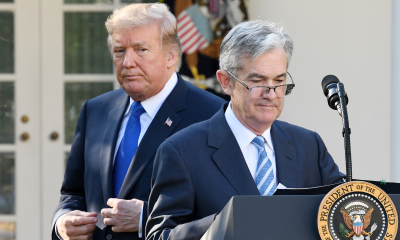
Trump demands Powell cut rates as Iran conflict raises energy prices
-

 Crypto World6 days ago
Senate Votes to Include CBDC Ban in Bipartisan Housing Bill
-

 Fashion2 days ago
25 Celebrities with Curly Hair That Are Naturally Beautiful
-

 NewsBeat6 days ago
Deane Road crash near Bolton colleges and university
-

 News Videos1 hour ago
RBA board divided on rate cut, unusually buoyant share market | Finance Report | ABC NEWS


You must be logged in to post a comment Login