
Crypto World
Crypto social isn’t dead, it’s just changing hands



In a 48-hour period at the end of January, the two largest decentralized social protocols underwent major leadership changes. Farcaster shifted stewardship of its protocol, flagship client, and leading Base launchpad, Clanker, to its primary infrastructure provider, Neynar. Concurrently, Lens Protocol announced its transition from Avara (the team behind Aave) to Mask Network.
The suddenness of these transitions was enough to rekindle a familiar debate: Do these restructurings by the sector’s most established projects signal a failure for crypto social? For many critics, the answer was an immediate yes. They argued that crypto social never moved beyond the crypto bubble, failed to compete meaningfully with Web2 giants, and ultimately imploded under its own momentum. For them, the ownership changes confirmed that decentralized social media is a dead end—at best, a niche experiment. However, this view misinterprets a necessary market correction as a complete collapse.
Why the first save struggled
What these transitions actually reveal is a long-overdue acknowledgement of reality: building social networks is not primarily a question of ideology or infrastructure, but of product quality, distribution and incentives. The first wave of crypto social struggled not because decentralization is inherently flawed, but because it attempted to recreate legacy social platforms while layering crypto’s complexity on top of them. Farcaster and Lens were ambitious efforts to reimagine social media around user-owned identity, open graphs and composable data. Both attracted top-tier capital and world-class engineers. And yet neither managed to break meaningfully beyond a crypto-native audience.
A key misstep was assuming social graphs would scale like blockchains, that you could build a shared, open layer first, and value would naturally accrue. In practice, social graphs do not compound simply by existing. And this is not uniquely a crypto lesson. Decentralized social graphs have existed for years, with Mastodon and Nostr as the obvious examples, yet neither has achieved sustained mainstream adoption. The pattern is consistent: users do not migrate for ideological reasons, and portability does not overcome the cold start. Without a flagship experience that feels materially better today, with better content, better loops, better status and better tools, decentralization remains an implementation detail that appeals to a committed minority, not a mass-market hook.
In addition, both ecosystems leaned too early into platform-building and developer ecosystems, overestimating their ability to solve the cold-start problem for builders. With user counts in the low tens of thousands, the economic pie was simply too small for third-party applications to thrive. Builders were asked to take on distribution risk before meaningful distribution existed, while competing, implicitly or explicitly, with flagship clients that controlled the primary surface area.
Social networks live and die by network effects, and crypto introduces additional friction at every layer: wallets, security assumptions, moderation trade-offs and identity management. Convincing users to abandon platforms where their social graphs already exist is difficult under any circumstances. Asking them to do so while navigating unfamiliar tooling raises the bar even higher.
From Social Media to Social Financial Networks
Rather than chasing a decentralized Twitter analogue, the narrative is shifting toward what might be better described as social financial networks. In these systems, the primary function is not broadcasting opinions or accumulating followers, but coordinating information, capital and collective belief. Success is measured less by engagement metrics and more by the quality of signal and the flow of value.
Seen through this lens, crypto may already have found its most compelling native social platform, just not in the form many expected. Prediction markets such as Polymarket function as social coordination engines. They aggregate opinion, surface collective intelligence and transform discourse into probabilistic outcomes. Crucially, this model is not a copy of Web2 social media. It does not rely on advertising, algorithmic outrage or attention extraction. And it has demonstrated relevance beyond a purely crypto-native audience.
But social financial networks are only the first wave of what crypto can unlock. Blockchains make certain end-user experiences possible in a way Web2 rails simply do not, and speculation is just the most legible early expression of that. Polymarket turns conversation into accountable belief. Products like FOMO show how trading itself can become social, with transparency, shared context, and real-time feedback loops baked into the graph.
The bigger opportunity goes well beyond a social + markets equation. It is social systems where ownership, identity and monetization are native rather than bolted on. Digital ownership can turn content and status into durable assets. Programmable incentives can align creators, curators, and communities around long-term behavior rather than short-term extraction. Onchain coordination can unlock new group behaviors, from collective funding to shared membership, shared governance and shared upside. The point is not that crypto makes social cheaper or more open, but rather it expands the design space for what social networks can be.
A reset, not an obituary
Declaring crypto social “dead” misses the point. What has ended is a particular vision of Web3 social, one that assumed legacy social media could be recreated on crypto rails with better incentives and better values.
What remains is a harder, more grounded challenge: identifying where crypto enables forms of social coordination that were previously impossible. Capital formation, information markets, community-owned infrastructure and new mechanisms for aligning incentives all remain open design spaces. Crypto social is not disappearing. It is shedding its earliest assumptions.
One reason the “dead” narrative feels premature is that we may have been looking for the next crypto social breakout in the wrong place. Moltbook is a deliberately weird experiment: a social network designed primarily for AI agents, with humans as observers. In a matter of days, tens of thousands of agents reportedly spun up emergent behaviors that look uncannily social, creating religions, organizing governance, publishing manifestos and even experimenting with privacy and encryption.
The surprising part is that watching it has been engaging for humans, precisely because it feels like observing a new social class forming in real time, negotiating norms, status and even revenue strategies, sometimes explicitly trying to evade human legibility. It is too early to know whether this is a durable phenomenon or a passing narrative, but it is a bold reminder that new forms of social can emerge when the participants, incentives and constraints change. If AI agents increasingly need to transact and coordinate across the digital world, blockchains are a natural substrate for them to do so.
For now, it turns out, the crypto social obituary was written for the wrong thing.
Long live crypto social!
Legal Disclaimer: This article is for general information purposes only and should not be construed as or relied upon in any manner as investment, financial, legal, regulatory, tax, accounting, or similar advice. Under no circumstances should any material at the site be used or be construed as an offer soliciting the purchase or sale of any security, future, or other financial product or instrument. Views expressed in the article are those of the individual 1kx personnel quoted therein and are not the views of 1kx and are subject to change. The article is not directed to any investors or potential investors, and does not constitute an offer to sell or a solicitation of an offer to buy any securities, and may not be used or relied upon in evaluating the merits of any investment. All information contained herein should be independently verified and confirmed. 1kx does not accept any liability for any loss or damage whatsoever caused in reliance upon such information. Certain information has been obtained from third-party sources. While taken from sources believed to be reliable, 1kx has not independently verified such information and makes no representations about the enduring accuracy or completeness of any information provided or its appropriateness for a given situation. 1kx may hold positions in certain projects or assets discussed in this article.
The views and opinions expressed in this article are solely the authors’ own and do not reflect the views of their employer, 21Shares, or any affiliated organizations.

Crypto World
AI Bots for Crypto Trading: The Complete 2026 Guide to Automated Profits Without the Guesswork

If you have ever left a Telegram signal group feeling burned — prices already moved by the time the alert hit your phone, the caller quietly deleted the post, and you were left holding a bag — you already understand the core problem that AI bots for crypto trading are designed to solve. Speed, discipline, and 24/7 execution. No emotion. No deleted posts.
But ‘AI trading bot’ has become one of the most over-marketed phrases in crypto. Every platform claims intelligence. Few deliver genuine quantitative edge. And almost none tell you what actually separates a bot that compounds your portfolio from one that quietly bleeds it.
This guide cuts through the noise. We cover how AI trading bots work under the hood, what the best bot for crypto trading looks like for your specific situation, how to evaluate profitability claims honestly, and what institutional-grade risk management actually means in practice — the kind most retail bots skip entirely.
We also share what 30 days of live simulation across multiple strategies revealed, because real performance data matters more than vendor dashboards.
⚡ QUICK VERDICT: AI bots for crypto trading make sense if you want structured, repeatable execution without watching charts all day. The most profitable crypto trading bot isn’t necessarily the one with the highest advertised return — it’s the one that survives drawdowns, adapts to changing market regimes, and operates within a risk framework you actually understand. Set-and-forget is a myth; strategic automation is the reality.
Key Takeaways
- Best overall for passive income seekers: Platforms with pre-built, institutional-grade quantitative strategies requiring minimal configuration
- Best for active traders upgrading to automation: Multi-exchange terminals with signal routing, DCA, and grid bots
- Critical reality check: AI bots optimise around historical patterns — when market regimes shift, performance can degrade rapidly without human oversight
- Institutional edge: True institutional-grade risk management includes position-level stops, portfolio-level drawdown limits, volatility-adjusted sizing, and regime detection — most retail bots provide only the first two
- Telegram signals vs. automation: Signal-based trading has an average latency of 2–8 minutes from publication to execution; automated bots execute in milliseconds
- The ‘trading while I sleep’ promise is achievable — but only with the right infrastructure, strategy diversification, and monitoring protocols
How AI Trading Bots Work: The Real Mechanism
Understanding how AI trading bots work isn’t optional — it’s the difference between deploying a strategy intelligently and hoping a dashboard number goes up.
At their core, all AI bots for crypto trading operate on a loop:
| Phase | What Actually Happens |
| 1. Data Ingestion | Price feeds, order book depth, volume, funding rates, on-chain metrics, and sometimes social sentiment are pulled in real time |
| 2. Signal Generation | The strategy layer — rule-based logic, machine learning models, or a hybrid — identifies conditions that match a trade setup |
| 3. Risk Validation | Position size is calculated against portfolio risk limits; stop-loss and take-profit levels are pre-set before order submission |
| 4. Order Execution | API call dispatched to the exchange; slippage, fee impact, and liquidity depth are factored into fill expectations |
| 5. Monitoring & Feedback | Live positions are tracked; trailing stops adjust; the strategy layer re-evaluates at each new candle or tick |
What ‘AI’ Actually Means on Most Platforms
Genuine machine learning in a crypto trading context means the model was trained on labelled historical data, can identify non-obvious patterns, and updates its parameters as new data arrives. In practice, most consumer-facing platforms use lighter implementations:
- Rule-based automation marketed as AI (if RSI < 30, then buy)
- Natural language prompt-to-config tools (GPT wrapper that converts your English description into pre-set parameters)
- Scoring and ranking systems that filter marketplace strategies by momentum or volatility metrics
- True adaptive ML models that retrain on rolling windows and adjust position sizing — rarer, and more associated with institutional or quantitative platforms
In practice, what this looks like is: a platform labels its parameter-suggestion tool ‘AI Assistant’, while a genuine quant platform runs ensemble models that weight momentum, mean-reversion, and volatility signals simultaneously and size positions based on Kelly Criterion or similar frameworks. Both call themselves AI. Only one is.
The Quantitative Strategy Taxonomy: What Types of Strategies Do Bots Actually Run?
Most reviews stop at ‘grid bot’ and ‘DCA’. Here is the full spectrum relevant to AI bots for crypto trading:
| Strategy Type | How It Works | Best Market Condition |
| Grid Trading | Places buy/sell orders at fixed price intervals, profiting from oscillation within a range | Sideways / ranging market |
| DCA (Dollar Cost Averaging) | Buys at regular intervals regardless of price, averaging down into dips | Long-term accumulation in any market |
| Momentum / Trend Following | Enters positions in the direction of established price momentum using moving averages or breakout signals | Strong trending markets |
| Mean Reversion | Bets that prices revert to a statistical mean after deviating significantly — often using Bollinger Bands or Z-score | High-volatility, range-bound |
| Statistical Arbitrage | Exploits price discrepancies between correlated assets or the same asset across exchanges | Any — market-neutral |
| Market Making | Simultaneously posts bid and ask orders to profit from the spread, providing liquidity to the market | High-liquidity pairs, low-volatility |
| Sentiment-Driven | Uses NLP models to parse news, social media, and on-chain signals, taking positions ahead of anticipated price moves | Event-driven / news cycles |
Most retail bots support grid and DCA. Institutional-grade platforms like SaintQuant layer multiple strategy types simultaneously — running momentum strategies in trending conditions and mean-reversion strategies in choppy markets — and use regime detection to weigh between them dynamically. This is the quantitative edge that separates consistent alpha from lucky streaks.
What AI Bots Cannot Do — The Honest Section Most Guides Skip
A GPS suggests the fastest route and reroutes when traffic changes. But it cannot predict a sinkhole that opens 10 minutes from now. AI bots for crypto trading work the same way.
- Black swan events (exchange hacks, regulatory bans) are not in the training data — models extrapolate poorly in genuinely novel conditions
- Liquidity crises distort execution — during a flash crash, your stop-loss triggers at a price far worse than intended because there are no buyers at your target level
- Strategy decay is real — an edge that worked in 2021 may be fully arbitraged away by 2024 as more capital chases the same signal
- Hallucination risk in prompt-based tools — GPT-powered config generators can confidently recommend inappropriate parameters; always validate against backtests
- Regulatory grey zones — automated trading on unlicensed platforms carries legal exposure in some jurisdictions, including Australia, where ASIC scrutinises crypto trading product providers
Telegram Signals vs. AI Bots for Crypto Trading: Why Most Traders Make the Switch
If you have spent time in paid Telegram signal groups, the pattern is familiar: a call goes out, you scramble to execute manually, prices are already moving, and slippage eats your entry. The caller posts a win screenshot. You got a worse fill.
| Factor | Telegram Signals | AI Trading Bots |
| Execution Speed | 2–8 min average (manual entry) | Milliseconds (API execution) |
| Consistency | Human execution errors frequent | Rules followed exactly every time |
| Emotional Bias | High — FOMO, hesitation, revenge trading | Zero — no emotional override |
| Risk Management | Caller-defined, often inadequate | Configurable at position and portfolio level |
| Transparency | No audit trail, results cherry-picked | Full trade history, verifiable logs |
| Overnight Coverage | Signals stop when caller sleeps | Operates 24/7 without interruption |
| Cost | $50–$500/month for signal groups | $15–$120/month for bot platforms |
| Accountability | None — deleted posts, no recourse | Verifiable backtest and live performance data |
The core problem with Telegram signals isn’t the strategy — sometimes the underlying analysis is sound. The problem is the delivery mechanism. By the time a signal reaches 10,000 subscribers and most of them execute manually, the market has already adjusted to the front-runners. Automation closes that gap entirely.
The Best AI Bots for Crypto Trading: Platform-by-Platform Review
Rather than ranking by advertised returns — which are meaningless without knowing the strategy, market period, and risk taken — we evaluate platforms across six dimensions: AI capability depth, strategy breadth, risk management quality, ease of use, exchange coverage, and pricing transparency.
1. SaintQuant — Best for Passive Income Seekers and Automated Quantitative Strategies
Best for: Users seeking institutional-grade quant strategies without building from scratch
SaintQuant stands apart from template-based bot platforms because it was built as a quantitative trading infrastructure — not a consumer interface layered on top of simple rules. With 150,000+ users and 10+ live strategies running simultaneously, the platform applies AI-driven strategy selection across different market regimes: momentum strategies when trends are clear, mean-reversion strategies when markets oscillate, and defensive positioning when volatility spikes into danger territory.
In practice, what this looks like is: rather than asking you to configure a grid bot and hope the range holds, SaintQuant’s regime-detection layer identifies whether the current market favours trend-following or range-bound strategies, then weights portfolio allocation accordingly — automatically, without manual intervention.
- 10+ live quantitative strategies across multiple asset classes and market conditions
- Institutional-grade risk management: position-level stops, portfolio drawdown limits, volatility-adjusted position sizing
- AI-powered regime detection that shifts strategy weighting based on market conditions
- 24/7 automated execution — the closest thing to genuinely trading while you sleep
- Transparent, verifiable strategy performance history — not curated screenshots
Risk note: No strategy performs consistently across all market conditions. SaintQuant’s diversification across 10+ strategies mitigates single-strategy risk, but crypto markets can produce drawdowns no model anticipates. Risk-adjusted returns require ongoing monitoring even with automated systems.
Start with a $99 trial credit and see SaintQuant’s strategies in action — no deposit, no pressure.
2. 3Commas — Best for Multi-Exchange Active Traders
Best for: Traders who want hands-on control with structured entry/exit workflows across multiple exchanges
3Commas offers a SmartTrade terminal that centralises order management, DCA automation, and TradingView signal routing. Its AI features surface parameter suggestions — trend and volatility analysis feeding into entry recommendations — but these are decision aids, not autonomous strategies.
- SmartTrade workspace: manage entries, exits, and stops from one interface
- DCA and grid bots with configurable scaling rules
- TradingView alert-to-order routing for external signal integration
- AI assistant that proposes entries and risk settings for review before launch
- Pricing from $12.42/month (annual); demo trading available
Who should skip it: Anyone expecting a fully passive experience. 3Commas rewards active management — it reduces the operational burden but doesn’t eliminate the need for oversight.
3. Cryptohopper — Best for Strategy Marketplace Users
Best for: Traders who want access to a marketplace of pre-built strategies and automatic strategy rotation
Cryptohopper’s Algorithm Intelligence layer scores strategies using trend strength, volatility, and volume metrics, then rotates the active strategy automatically. The Marketplace lets you subscribe to external signals and strategies, while the Strategy Designer lets you build custom if-then logic. Copy trading adds a social dimension with configurable risk controls.
- Algorithm Intelligence: scores and rotates strategies based on market conditions
- Marketplace: subscribe to strategies, templates, and signals
- Visual Strategy Designer: build rule-based strategies without coding
- Paper trading and backtesting available before going live
- Pricing: Free Pioneer tier; Explorer from $24.16/month (annual)
Who should skip it: Traders seeking a stable, single-strategy system. Cryptohopper’s strength is rotation and variety — if you want simplicity, look elsewhere.
4. Pionex — Best for Beginners Entering Automation
Best for: Crypto newcomers who want built-in bots with minimal setup friction
Pionex is an exchange with bots built in — no API connection required, no separate subscription for bot access. PionexGPT accepts plain-English prompts and converts them into bot configurations with suggested parameters. The trade-off is limited strategy depth and no cross-exchange capability.
- No separate bot subscription — fee-based model (0.05% spot)
- PionexGPT: type ‘build a grid for BTC with a 2% stop loss’ and receive a configured strategy
- Core strategies: grid, DCA, infinity grid, signal following
- Demo trading available; simple onboarding for non-technical users
Who should skip it: Advanced traders who need cross-exchange routing, custom logic, or portfolio-level risk management beyond basic stops.
5. Bitsgap — Best for Multi-Exchange Terminal Users
Best for: Traders active on multiple exchanges who want unified management
Bitsgap connects to 15+ exchanges and consolidates bot management into a single terminal. Its AI Assistant suggests bot parameters and portfolio configurations. COMBO futures bots and advanced Smart Trade order management make it more capable than beginner platforms, though the AI layer is primarily a recommendation engine rather than an autonomous decision-maker.
- Unified terminal: manage bots across Binance, Bybit, OKX, Coinbase, Kraken and more
- AI Assistant: suggests configurations and portfolio allocations
- Demo mode and backtesting before live deployment
- Pricing from $18/month (annual)
6. HaasOnline — Best for Developers and Advanced Quantitative Traders
Best for: Developers and quant traders who want scripting-level control over strategy logic
HaasOnline’s differentiator is HaasScript — a full visual and code editor for building custom strategies, market-making bots, arbitrage logic, and scalping systems. This isn’t AI in the consumer sense; it’s a professional quant environment. The ceiling is high, but so is the learning curve.
- HaasScript: visual + code editor for custom strategy development
- Supports market making, arbitrage, scalping, and complex conditional logic
- Built-in backtesting and paper trading on historical data
- Pricing from $23/month (annual)
Who should skip it: Non-technical users. HaasOnline requires meaningful time investment to use effectively.
7. Coinrule — Best for No-Code Rule Builders
Best for: Beginners and non-programmers who want visual if-then automation
Coinrule uses simple conditional logic (‘if RSI drops below 30, buy 5% of portfolio; set stop-loss at -8%’) with a library of templates to accelerate setup. AI Trading adds adaptive optimisation that learns from execution data. Demo exchange testing is available before live deployment.
- No-code if-then rule builder with pre-built templates
- AI Trading: adaptive optimisation layer that learns from live execution
- Supports 10+ exchanges including Binance, Bybit, OKX, Coinbase
- Pricing: Free Starter; Investor from $29.99/month
Full Platform Comparison: AI Bots for Crypto Trading
| Platform | True AI Depth | Strategy Types | Risk Mgmt Quality | Beginner Friendly | Price/mo | Best For |
| SaintQuant | ★★★★★ | Quant multi-strategy | Institutional | ★★★★☆ | Varies | Passive income / automation |
| 3Commas | ★★★☆☆ | DCA, Grid, Signal | Moderate | ★★★☆☆ | From $12 | Active multi-exchange traders |
| Cryptohopper | ★★★☆☆ | Rules, Marketplace | Moderate | ★★★★☆ | From $24 | Marketplace / strategy rotation |
| Pionex | ★★☆☆☆ | Grid, DCA | Basic | ★★★★★ | 0.05% fee | Crypto newcomers |
| Bitsgap | ★★★☆☆ | Grid, DCA, COMBO | Moderate | ★★★☆☆ | From $18 | Multi-exchange terminal |
| HaasOnline | ★★☆☆☆ | Custom / Script | Advanced (manual) | ★★☆☆☆ | From $23 | Developers / quant traders |
| Coinrule | ★★☆☆☆ | Rule-based | Basic-Moderate | ★★★★★ | Free / $30 | No-code beginners |
What ‘Trading While I Sleep’ Actually Requires
The ‘built an AI bot that trades crypto for me while I sleep’ dream is real — but it requires more infrastructure than most guides admit. Here is what genuinely hands-off automated trading demands:
- Strategy diversification: A single bot running one strategy is not passive income — it’s a concentrated bet. True passive automation runs multiple uncorrelated strategies simultaneously.
- Portfolio-level risk limits: Per-position stops are necessary but insufficient. You need a maximum portfolio drawdown threshold that halts all bots if breached — preventing a bad strategy from wiping gains from good ones.
- Exchange health monitoring: API connections fail. Exchanges go down for maintenance. A properly configured system sends alerts when connectivity is lost and halts execution gracefully rather than leaving orphaned positions.
- Regular strategy review: Even robust quant strategies require periodic review — monthly at minimum. Markets evolve; edges erode; parameter drift happens.
- Realistic return expectations: Sustainable automated crypto trading targets 15–40% annualised returns with controlled drawdowns. Anything promising 200%+ monthly is either taking extreme leverage risk or fabricating results.
Institutional-Grade Risk Management vs. Retail Bot Defaults
The phrase ‘institutional-grade risk management’ gets thrown around liberally. Here is what it actually means in a crypto bot context:
| Risk Layer | Retail Bot Default | Institutional Grade |
| Position Stop-Loss | Fixed % stop (e.g., -5%) | Volatility-adjusted stop (e.g., 2× ATR) |
| Position Sizing | Fixed $ or % per trade | Kelly Criterion or volatility-weighted sizing |
| Portfolio Drawdown | Rarely implemented | Hard halt if portfolio drops >X% from peak |
| Regime Detection | None — strategy runs regardless | ML model detects trend/range/crisis regimes and adjusts |
| Correlation Management | Not considered | Strategies are de-correlated to avoid simultaneous drawdowns |
| Slippage & Fee Modelling | Ignored in backtests | Built into all performance calculations |
| Strategy Decay Monitoring | Manual (if at all) | Automated performance degradation alerts |
How to Choose the Right AI Bot for Crypto Trading: A Decision Framework
Use these four filters in sequence to eliminate platforms that don’t fit your situation before investing time in setup:
Filter 1: Define Your Involvement Level
- High involvement (daily monitoring, manual intervention): 3Commas, HaasOnline, Bitsgap
- Medium involvement (weekly review, strategy selection): Cryptohopper, Coinrule
- Low involvement (monthly review, pre-built strategies): SaintQuant, Pionex
Filter 2: Match Strategy to Your Market View
- Bullish long-term accumulator: DCA-focused platforms (Pionex, Coinrule)
- Range-bound market trader: Grid bots (3Commas, Pionex, Bitsgap)
- No strong market view, want diversification: Multi-strategy quant platforms (SaintQuant)
- Advanced directional trader: HaasScript custom momentum strategies
Filter 3: Assess Your Technical Capability
- No coding, minimal configuration: Pionex, Coinrule
- Comfortable with settings and parameters: 3Commas, Cryptohopper, Bitsgap
- Developer or quant background: HaasOnline
- Want institutional infrastructure without building it: SaintQuant
Filter 4: Evaluate Risk Management Quality
Before committing capital, ask the platform provider three questions: How does the strategy perform during a -30% market drawdown? What is the maximum portfolio-level loss limit? Can you show me a verified trade history, not just a backtest?
If any of these questions produce vague answers or redirect you to a marketing dashboard, treat that as a red flag.
Backtesting AI Trading Bots: What the Numbers Actually Mean
Every platform shows backtest results. Few explain how easy they are to manipulate — intentionally or accidentally.
The Four Ways Backtests Lie
- Lookahead bias: The strategy uses data that wouldn’t have been available at the time of the trade signal
- Survivorship bias: Only successful historical periods are tested; the strategy is tuned to past winners
- Overfitting: Parameters are optimised so precisely to historical data that the strategy fails on any new data it hasn’t seen
- Ignoring costs: Fees, slippage, and funding rates can turn a 40% backtest return into a 12% live return
Minimum Reliability Checklist Before Going Live
- Backtest covers at least 2 years of data, including at least one major drawdown period
- Out-of-sample testing: strategy was tested on data completely excluded from the optimisation process
- Fees and slippage included in all calculations
- Paper trading results match backtest results within 15% variance
- Sharpe ratio above 1.0 (risk-adjusted return per unit of volatility)
- Maximum drawdown is one you could sustain emotionally and financially
Security Essentials for AI Bots for Crypto Trading
API key exposure is the primary attack surface for all bot platforms that connect via API. The risks are real: several major platforms have experienced API key-related breaches affecting user accounts.
Non-Negotiable Security Practices
- Trade-only permissions: Never enable withdrawal permissions on API keys used by bots — ever
- IP allow-listing: Restrict API key usage to the bot platform’s specific IP range where the exchange supports it
- Separate exchange accounts: Consider a dedicated exchange account for bot trading, separate from your primary holdings
- Key rotation: Regenerate API keys quarterly or after any suspected security incident
- Two-factor authentication: Enable on both the exchange and bot platform accounts
- Withdrawal address whitelisting: Restrict exchange withdrawals to pre-approved wallet addresses only
- Monitor for unusual activity: Set exchange alerts for any large or unexpected withdrawal attempts
Practical Setup Guide: How to Deploy an AI Trading Bot Safely
This workflow applies regardless of which platform you choose:
Step 1: Account and API Setup (Day 1)
- Create bot platform account and complete KYC if required
- Create or designate a trading-only exchange account
- Generate API keys with trade-only permissions (no withdrawals)
- Apply IP allow-listing if the exchange supports it
- Connect API to bot platform and verify connection status
Step 2: Strategy Selection and Configuration (Days 1–3)
- Select strategy type based on your market view and involvement level
- Configure position size — start with 10–20% of intended allocation maximum
- Set stop-loss at both position level and portfolio level
- Run backtest with fees and slippage included
- Validate backtest against an out-of-sample period
Step 3: Paper Trading Validation (Days 4–14)
- Run strategy in paper trading mode for a minimum of 7–14 days
- Compare live execution to backtest expectations — flag any variance >15%
- Monitor for connectivity issues, missed signals, and fill quality
- Adjust parameters if necessary and re-validate before going live
Step 4: Live Deployment (Day 15 onwards)
- Deploy with 25–50% of intended capital allocation for the first month
- Set monitoring alerts for connectivity loss, unexpected drawdowns, and unusual order activity
- Review performance weekly for the first month
- Scale allocation only after live performance validates backtest expectations
Frequently Asked Questions: AI Bots for Crypto Trading
Is using an AI bot for crypto trading profitable?
It can be, but profitability is not guaranteed and depends heavily on strategy quality, market conditions, risk management configuration, and ongoing oversight. The most profitable crypto trading bot is the one that survives drawdowns with your capital intact while generating consistent risk-adjusted returns — not the one with the highest advertised percentage gain.
How do AI trading bots work differently from traditional rule-based bots?
Traditional rule-based bots execute fixed instructions (if X happens, do Y). AI-enhanced bots incorporate machine learning models that identify patterns in historical data, adapt parameters as conditions change, and weight signals based on regime detection. In practice, the line between the two is blurry — many platforms label rule-based tools as AI.
Can I genuinely build an AI bot that trades crypto for me while I sleep?
Yes — but ‘while you sleep’ doesn’t mean ‘without any oversight’. Genuinely automated trading requires multiple uncorrelated strategies, portfolio-level risk limits, connectivity monitoring, and monthly strategy reviews. Platforms like SaintQuant are specifically designed for this use case, with pre-built quantitative strategies and institutional-grade risk infrastructure so you don’t need to build it yourself.
What is the best AI bot for crypto trading for beginners?
Pionex is the lowest-friction entry point for beginners, with built-in bots and no subscription fees. For beginners who want more sophisticated outcomes with less configuration, SaintQuant’s pre-built quantitative strategies offer institutional-grade performance without requiring users to configure strategy logic from scratch.
What is a realistic return from an AI crypto trading bot?
Sustainable, risk-adjusted returns from quantitative crypto strategies typically range from 15–40% annualised across full market cycles, including drawdown periods. Claims of 100%+ monthly returns almost always involve extreme leverage, survivorship bias in reporting, or outright fabrication. Consistent alpha over multiple years is the benchmark that matters.
Closing Thoughts: The Most Profitable Crypto Trading Bot Is the One You’ll Actually Use Correctly
AI bots for crypto trading are genuinely powerful tools. They enforce discipline where human psychology fails. They execute in milliseconds when manual trading takes minutes. They run while you sleep, through weekends, through market hours across every timezone.
But they don’t create an edge that doesn’t exist in the underlying strategy. A poorly configured bot executes a bad strategy faster. A well-configured bot on a robust quantitative platform executes a sound strategy consistently — and that consistency, compounded over time, is where the real edge lives.
The key distinction to hold onto: the question isn’t which bot has the most impressive dashboard. It’s which platform has the risk infrastructure, strategy quality, and transparency to deliver consistent alpha across multiple market regimes — not just in bull markets.
SaintQuant was built with exactly that question in mind. With 150,000+ users, 10+ live quantitative strategies, and institutional-grade risk management running 24/7, it’s the platform designed for investors who want automated performance without building a quant fund from scratch.
Disclaimer: This is a Press Release provided by a third party who is responsible for the content. Please conduct your own research before taking any action based on the content.

TLDR:
- Trident’s RLUSD Ghana pilot targets 2.1M MSMEs with faster settlement and lower transfer friction.
- The rollout adds RLUSD/GHS liquidity pools to support stablecoin and cedi business settlement flows.
- Automated tax rails place blockchain payments directly into Ghana’s revenue collection systems.
- Mid-2026 remains the target launch window, pending regulatory approvals and system readiness.
Trident Digital Tech Holdings plans to bring Ripple RLUSD infrastructure into Ghana through a blockchain payments and tax pilot set for mid-2026.
The rollout targets cross-border settlements for 2.1 million MSMEs, aiming to cut transfer costs and improve transaction speed. Ghana stands as the first launch market, with broader African expansion already outlined in the initial framework.
Regulatory approval remains the final condition before the pilot moves into live deployment.
Ripple RLUSD Pilot Targets Ghana MSME Cross-border Payments
The partnership centers on Ripple Strategy’s RLUSD stablecoin stack and blockchain payment rails. According to Chad Steingraber’s post, the system will support always-on settlement for businesses in Ghana.
The core use case focuses on reducing delays tied to correspondent banking networks. Trident said the rail will help MSMEs move funds across borders in real time.
A dedicated RLUSD/GHS liquidity pool forms a key part of the infrastructure. That pool will help local firms convert between stablecoin balances and Ghanaian cedi flows efficiently.
The initial design also links payment activity with government revenue systems. Trident stated the integration will support automated tax collection for compliant business transactions.
Trident Digital Expands Ripple RLUSD Infrastructure Beyond Payments
The Ghana rollout extends beyond simple merchant transfers. Trident’s framework places RLUSD inside broader digital finance and compliance workflows for small businesses.
The company said the system will connect with private sector commercial ecosystems first. That approach allows MSMEs to settle supplier invoices, payroll obligations, and trade payments onchain.
Chad Steingraber’s source thread also noted that Ghana serves as the first regional test market. Trident plans to use the pilot as a model for other African corridors.
Founder Lim Soon Huat said the project focuses on utility-driven financial infrastructure rather than speculative use cases. The company’s roadmap ties RLUSD settlement directly to trade liquidity and formal revenue channels.
With mid-2026 as the target, the next phase depends on local regulatory clearance. Until then, Trident and Ripple Strategy appear focused on infrastructure readiness and liquidity design.


Bitwise Asset Management has taken another step in its effort to launch a spot Hyperliquid exchange-traded fund in the United States.
Summary
- Bitwise added a ticker and fee to its Hyperliquid ETF filing with the SEC.
- Eric Balchunas said the latest filing details suggest the fund could launch soon.
- Hyperliquid posted strong token gains and rising derivatives volume during the first quarter.
The firm filed a second amendment with the US Securities and Exchange Commission, adding new details to its proposed product as competition in the category continues to grow.
The updated filing included the ticker BHYP and a management fee of 0.67%. Bloomberg senior ETF analyst Eric Balchunas said those additions often suggest a product may be getting closer to market, while other issuers continue to pursue similar funds tied to Hyperliquid.
Balchunas said in a post on X that Bitwise had updated its filing to include the BHYP ticker and a 67-basis-point fee. He said such details usually mean the fund may “launch soon.” He also noted that HYPE had risen sharply over the past year as issuers move to meet growing investor interest.
If approved, the Bitwise product will trade on NYSE Arca and aim to track the spot price of Hyperliquid. The filing marks the latest move in Bitwise’s push to bring a fund linked to the crypto perpetual futures protocol and blockchain to the US market.
In addition, Bitwise was the first asset manager among the current group to file for a Hyperliquid ETF. The company submitted its proposal in September. 21Shares followed one month later, while Grayscale entered the race in late March with its own filing.
The latest amendment keeps Bitwise in focus as firms compete to launch the first spot fund tied to HYPE. The category remains new, and approval would give investors a regulated way to gain exposure to the token through a traditional exchange-traded product.
Staking feature sets Bitwise apart
In its earlier amended filing from December, Bitwise said the fund could also seek added returns through HYPE staking. That feature sets its proposal apart from the filings submitted by Grayscale and 21Shares, which have not clearly stated that their products would include staking income.
That structure may give Bitwise a different position in the current race. It also shows how issuers are trying to shape crypto ETF products beyond simple spot exposure as they wait for the SEC to decide on approval.
Hyperliquid posts strong market growth
Hyperliquid has continued to gain traction in 2026. CoinGecko data showed HYPE was up about 65% since the start of the year, trading around $42 at the time of writing. Over the past 12 months, the token had gained about 176%.
The network has also expanded its share of derivatives trading activity. CoinGlass reported in early April that Hyperliquid had entered the top 10 crypto derivatives platforms by volume.
The platform generated $492.7 billion in trading volume during the first quarter, placing it just below Coinbase by roughly $90 billion.

Bitcoin price is still rallying, even as one sovereign seller is getting louder, despite this one bullish technical prediction. Bhutan’s Royal Government transferred another 319.7 BTC ($22.68 million) on Thursday, continuing a liquidation that has trimmed its holdings by 70% since October 2024.
Bhutan quietly sold 70% of its BTC — Lucky (@LLuciano_BTC) April 11, 2026
 in 18 months as per ARKHAM
• From 13,000 BTC → 3,954 BTC
• $215M sold in 2025 alone
• Remaining worth $280M
Avg selling likely around $60K–$70K
Meanwhile… institutions are buying  pic.twitter.com/jN8YRb4KCn
According to Arkham Intelligence data, about 250 BTC from Thursday’s transfer was routed to a wallet previously used for sales via Galaxy Digital and OKX. Another 69.7 BTC went to a new, unmarked address. Bhutan’s stack has collapsed from 13,000 BTC to just 3,954 BTC, worth still at $280 million, with $215 million exiting its holding addresses in 2025 alone.
While Bhutan is selling, Michael Saylor’s Strategy added 4,871 BTC last weekend, U.S. spot ETFs absorbed roughly 50,000 BTC in March, and options markets are stacking $80K calls.
The divergence between Bhutan’s exit and institutional accumulation is setting up one of the more interesting technical moments Bitcoin has seen this cycle.
Discover: The best pre-launch token sales
Bitcoin Price Prediction: $80K on the Table?
Bitcoin has clawed back from lows of $67,000, carving higher lows along an ascending trendline. The current price of $72,000 sits above the 50-day EMAs, a stacked configuration that historically precedes continuation moves. MACD is showing bullish divergence. RSI holds at 60, leaving meaningful room before overbought territory.
Analyst targets split into two camps, some see $79K–$80K as the immediate destination, citing the H4 consolidation pattern and healthy retracement from recent highs. Another agrees on the near-term target of $79K–$84K, but warns of a sharp reversal after, with $40K–$48K as a possible re-test.
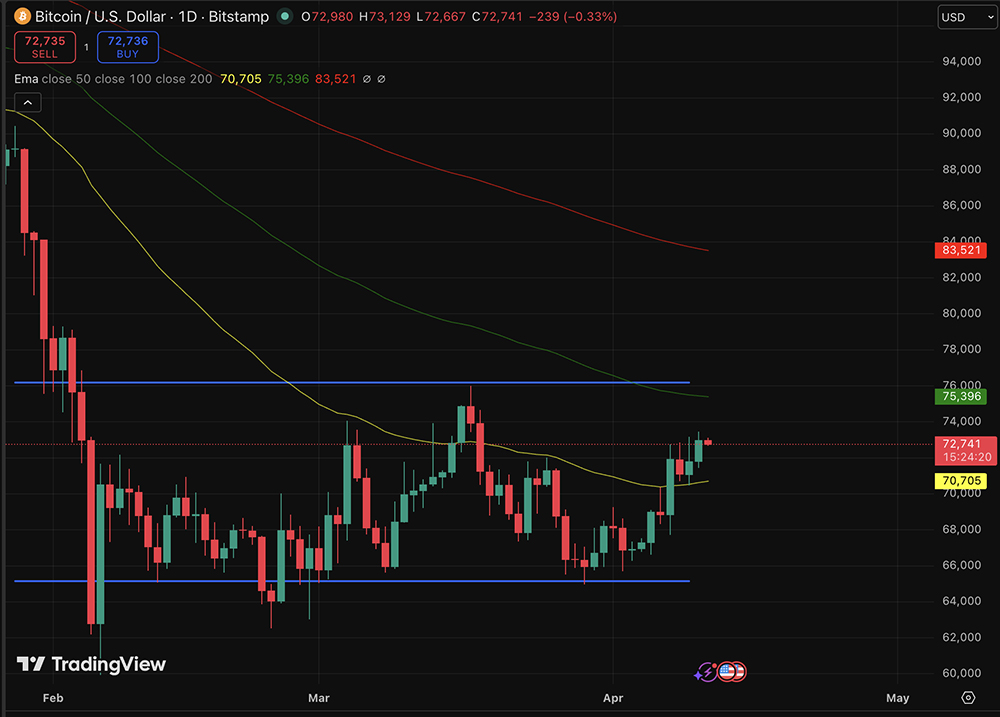
For Bitcoin, a clean break above $77,500 on strong IBIT inflows can trigger a run toward $80,000. Or there will be more consolidation between $70,000–$72,000 as the market digests Bhutan’s selling pressure.
However, a close below $70,000 reopens the $67,000 support cluster and puts the recovery thesis at risk.
Discover: The best crypto to diversify your portfolio with
Bitcoin Hyper Targets Early-Mover Upside as Bitcoin Tests Key Levels
Here’s the tension with buying Bitcoin now. The upside to $80K is real, but it’s just a 10% gain. The risk-reward calculation differs at earlier stages of the ecosystem. As BTC tests its critical resistance band, attention is shifting to infrastructure plays building directly on Bitcoin’s rails, where the multiples are still open.
Bitcoin Hyper ($HYPER) is positioning itself at that intersection. The project bills itself as the first Bitcoin Layer 2 with Solana Virtual Machine (SVM) integration, targeting sub-second finality and smart contract execution that the base chain simply cannot deliver.
The pitch isn’t theoretical: the presale has already raised more than $32 million, with $HYPER currently priced at $0.0136. Staking is live with high APY incentives for early participants. The Decentralized Canonical Bridge handles native BTC transfers, keeping the security model anchored to Bitcoin itself.
For those already researching the space, Bitcoin Hyper’s full presale details are available here.
The post Bitcoin Price Prediction: Bhutan Selling, But Technical Indicators Says $80K Next appeared first on Cryptonews.


The US Commodity Futures Trading Commission has named the first members of its new Innovation Task Force as the agency steps up its work on crypto regulation.
Summary
- CFTC named five task force members as it expands work on crypto market oversight.
- Mike Selig also launched an innovation tracker covering crypto, AI, and prediction markets.
- Agency roles still depend on whether Congress passes the CLARITY Act into law.
The move comes as lawmakers continue to debate the CLARITY Act, which would define the roles of the CFTC and the Securities and Exchange Commission in digital asset oversight.
CFTC Chairman Mike Selig first launched the task force on March 24 and appointed Michael Passalacqua to lead it.
On Friday, the agency confirmed the first five members and outlined broader efforts tied to its push for clearer rules for new technologies.
The CFTC said Passalacqua will lead the group alongside five initial members. They include Hank Balaban, Sam Canavos, Mark Fajfar, Eugene Gonzalez IV, and Dina Moussa. The agency described the team as part of its effort to support work on crypto, prediction markets, and other emerging sectors.
Selig said the team brings strong legal and policy experience to the agency. He stated,
“The Innovation Task Force brings together a leading team that exhibits deep expertise and an enthusiastic commitment to deliver clear rules of the road for American innovators.”
On the same day, Selig also announced the launch of the CFTC’s innovation tracker. The agency said the tracker will show the work completed under his leadership to support regulatory clarity, market integrity, and responsible technology development.
According to the CFTC, the tracker covers three main areas. These include crypto and blockchain, artificial intelligence and autonomous systems, and contracts and prediction markets. The new page is meant to show the scope of the agency’s work in each area.
Crypto oversight debate remains active
The latest announcement comes as the debate over crypto oversight continues in Washington. The CFTC could take on a larger role if lawmakers approve a framework that places more digital assets under its watch.
That process remains incomplete because the CLARITY Act has not yet become law. SEC Chair Paul Atkins said on X that both agencies are “ready to implement the CLARITY Act” and added, “It’s time for Congress to future-proof against rogue regulators and advance comprehensive market structure legislation to President Trump’s desk.”


Coinbase Chief Executive Brian Armstrong has renewed support for the Digital Asset Market Clarity Act, backing a recent call from US Treasury Secretary Scott Bessent for Congress to move the bill forward.
Summary
- Brian Armstrong backed the CLARITY Act after Coinbase opposed the bill’s earlier version in January.
- Senate Banking Committee action remains pending as lawmakers continue talks on crypto market structure rules.
- Treasury Secretary Scott Bessent urged Congress to pass the bill as negotiations moved forward.
The public statement marks a shift from Coinbase’s position in January, when Armstrong said the company could not support the measure in its earlier form before a key Senate committee vote.
Armstrong said in a post on X that Coinbase now supports the latest version of the bill after months of talks between lawmakers and industry groups. He also backed Bessent’s recent Wall Street Journal opinion piece, which called on Congress to act on crypto market structure legislation.
Armstrong wrote, ”It’s time to pass the Clarity Act.” His new statement came about three months after he said the exchange could not support the bill ”as written,” a position that contributed to a delay in Senate Banking Committee action.
The CLARITY Act still faces several steps before reaching a full Senate vote. The Senate Agriculture Committee approved its part of the bill in January, but the Senate Banking Committee must still address provisions tied to securities and commodities oversight.
As of Friday, no markup had been scheduled in the Banking Committee. The bill has remained stalled for months as lawmakers debated issues tied to ethics, tokenized equities, stablecoin yield, and other digital asset matters.
In addition, Coinbase Chief Legal Officer Paul Grewal said last week that lawmakers were ”very close to a deal” on the bill. That comment added to signs that negotiations had continued behind the scenes even as the measure remained off the committee calendar.
The latest support from Armstrong suggests Coinbase believes the bill has improved since January. His earlier comments had pointed to concerns over the wording of the draft, while the current version now appears to have the exchange’s backing.
Crypto policy ties stay in focus
The bill’s progress has drawn attention to the crypto industry’s role in Washington. Coinbase and Ripple executives have both taken part in talks with administration officials on crypto policy, while Armstrong reportedly met President Donald Trump before Trump publicly called for action on market structure legislation.
Coinbase’s renewed support for the bill also comes shortly after the Office of the Comptroller of the Currency approved the company’s application for a national bank trust charter. The approval followed similar decisions for Paxos, Ripple Labs, BitGo, Circle, and Fidelity Digital Assets in December.


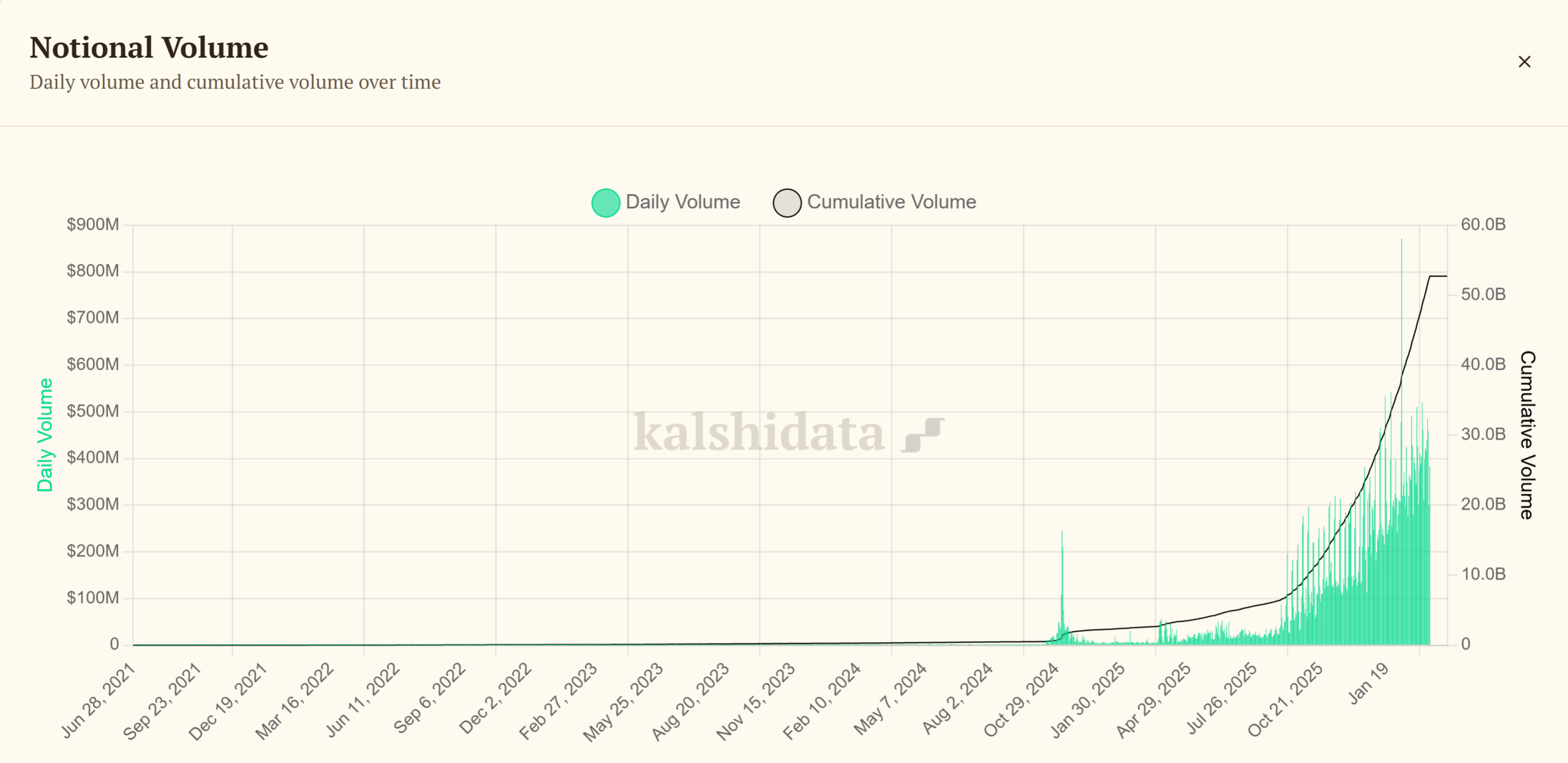
Prediction market users turned to Kalshi and Polymarket as NASA’s Artemis II mission returned to Earth, placing trades not only on future Moon landing timelines but also on words that might appear in the agency’s post-splashdown briefing.
Summary
- Kalshi users traded contracts on NASA briefing words after Artemis II completed its Moon flyby.
- Prediction markets expanded beyond mission outcomes to bets on language used during NASA’s news conference.
- Artemis II returned safely after launch on April 1, renewing attention on NASA’s lunar plans.
The activity added a new space-related category to the broader event-contract market that has recently drawn more attention from lawmakers and regulators.
Artemis II launched from NASA’s Kennedy Space Center in Florida on April 1, 2026, and completed a crewed lunar flyby before splashing down in the Pacific Ocean off San Diego at 8:07 p.m. EDT on April 10. NASA described the mission as the first crewed Artemis flight and the first human mission around the Moon in more than 50 years.
As the mission neared its end, traders used prediction platforms to take positions on Artemis-related outcomes. Polymarket hosted Moon landing markets and Artemis-linked event pages, while Kalshi continued to offer event contracts tied to real-world outcomes on its regulated exchange.
Some of the trading centered on what NASA officials might say after splashdown rather than only on mission milestones. Traders tracked possible references tied to government officials, radiation, and damage during the post-mission news cycle, showing how event contracts can extend beyond launch and landing results into conference language and public statements.
Other contracts focused on longer-term Moon exploration timelines. Polymarket pages showed active interest in human Moon landing markets, while broader Moon landing prediction pages listed live trading across related science and space questions.
Debate over event contracts continues
Prediction markets have faced scrutiny as users place trades on sensitive geopolitical and public-interest events. That debate has widened as platforms expand into more areas, including science, government activity, and major public announcements.
The Artemis II trading activity arrived as prediction markets remained under close watch in Washington. The attention reflects ongoing questions about how far event-contract offerings should extend and what kinds of real-world events should be available for trading.
Furthermore, interest in space-linked markets has also overlapped with crypto and infrastructure stories. In March, Starcloud said it planned orbital data centers that could support Bitcoin mining from space using solar power and ASIC miners, adding another speculative commercial angle to the space sector.
CoreWeave has signed a multi-year agreement with Anthropic to support workloads for the Claude family of AI models.
Summary
- CoreWeave signed a multi-year Anthropic agreement to support Claude AI workloads across its data centers.
- The company said it now serves nine major developers of large language models.
- AI demand is drawing miners away as lower margins pressure traditional Bitcoin mining operations worldwide.
The deal adds another major customer to CoreWeave’s cloud business as the company expands its role in artificial intelligence infrastructure.
CoreWeave said Anthropic will use its cloud data centers to run AI workloads tied to Claude models. The company added that the agreement will roll out in phases and may grow over time as demand increases.
The announcement gave investors a fresh look at CoreWeave’s position in the AI sector. The company said the new agreement means it now serves nine of the 10 major developers of large language models.
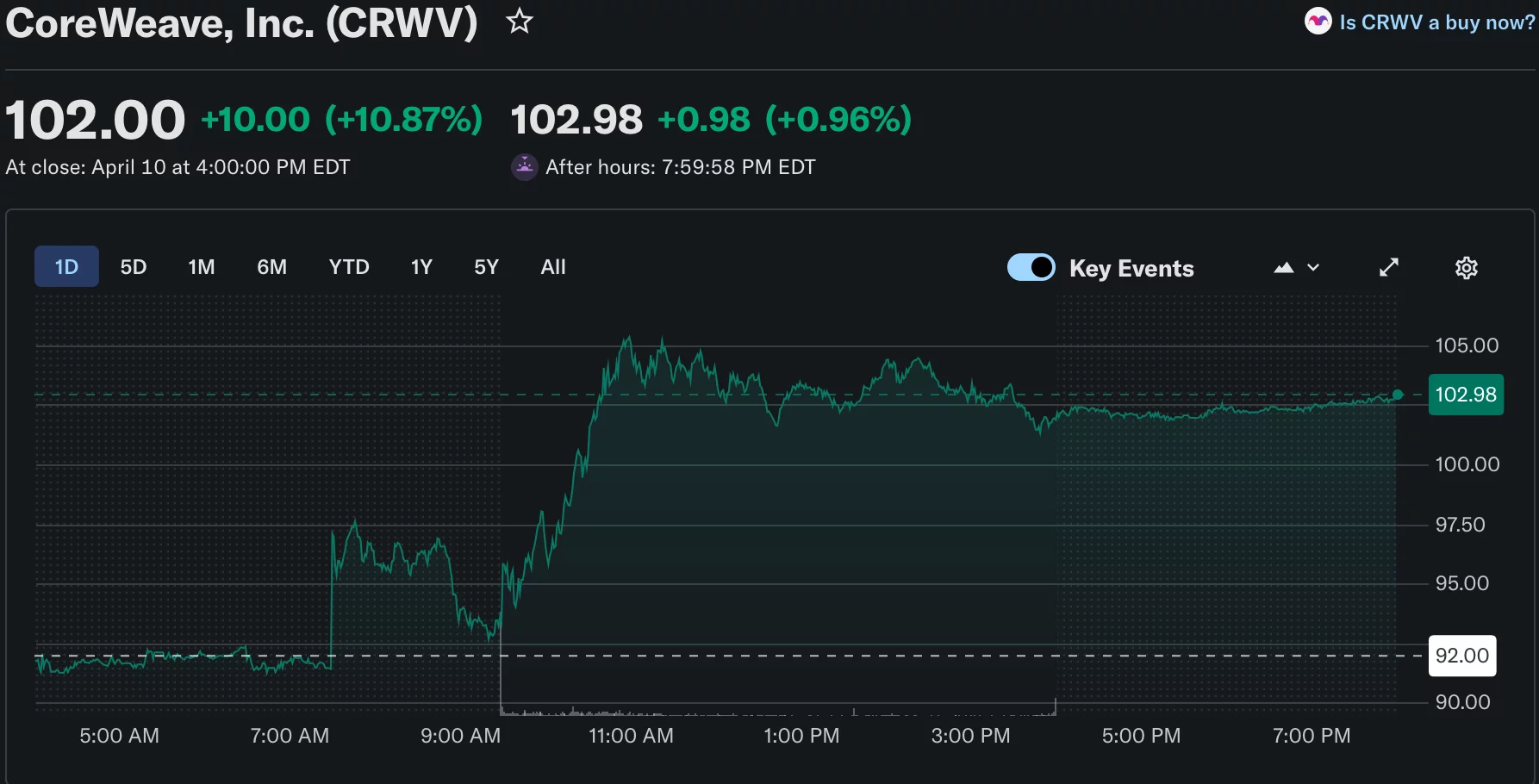
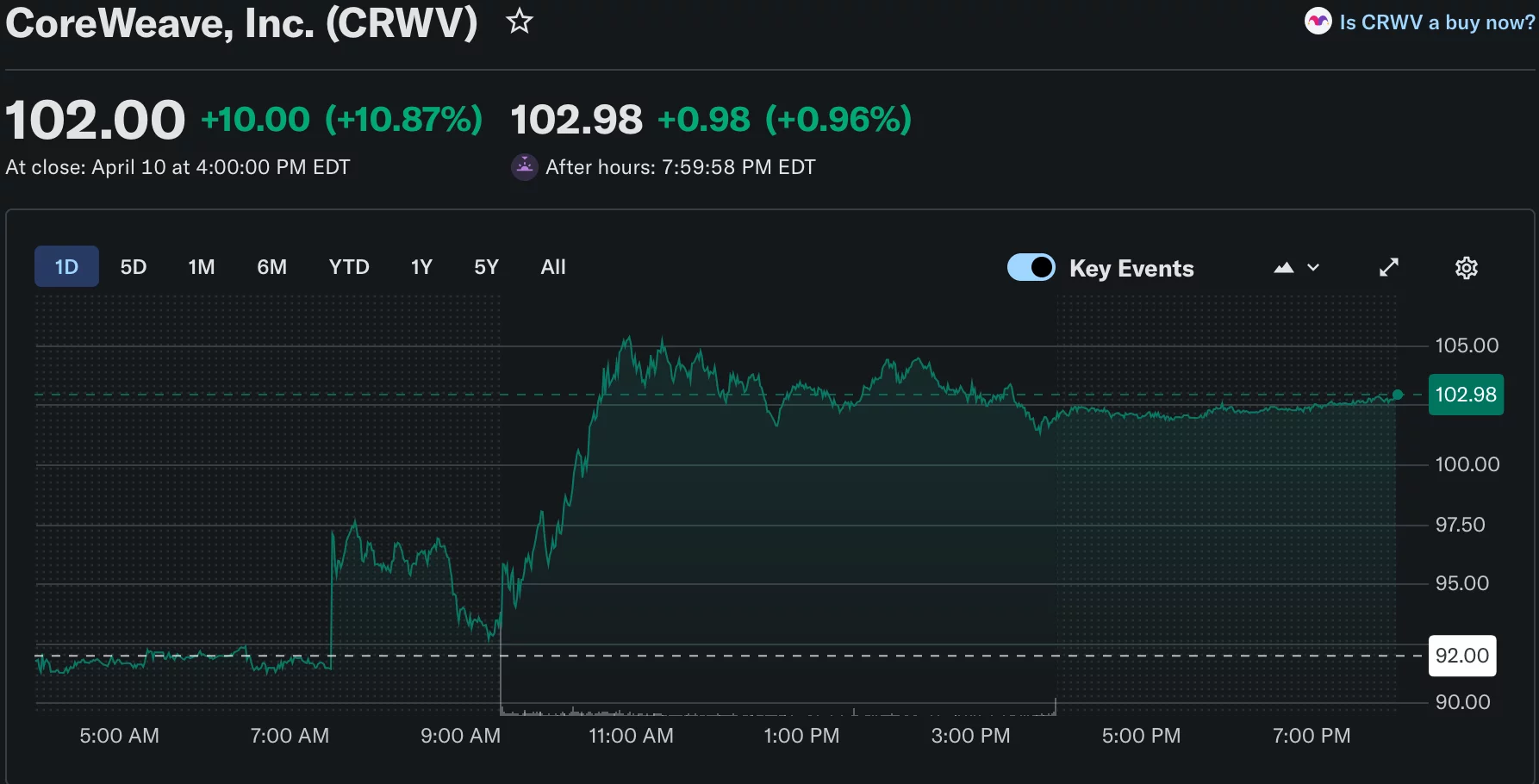
CoreWeave shares rose more than 10% on Friday after the company announced the deal. The stock traded at around $102 at press time, showing a strong reaction from investors to the latest customer win.
The agreement came shortly after CoreWeave completed an $8.5 billion capital raise led by Meta Platforms. The financing was tied to deployed computing capacity and expected cash flows rather than graphics processing unit hardware, marking a different structure from older crypto mining funding models.
Moreover, CoreWeave shifted away from crypto mining and rebranded as an AI infrastructure company in 2019. The change came after mining economics weakened following the 2018 crypto market downturn.
That transition has become more relevant as more mining firms look at AI workloads for new revenue. Rising energy costs, lower block rewards, and weaker crypto prices have continued to pressure Bitcoin miners.
AI demand draws attention from miners
CoinShares said up to 20% of Bitcoin miners are now unprofitable in the current market. The report shows how tighter margins have made traditional mining harder to sustain for many operators.
Some firms are now looking to AI computing as a stronger use of power and hardware. Market analyst Ran Neuner noted,
”Both industries compete for the same thing: electricity, and right now, AI is willing to pay much more for it.”
His comment reflects a wider shift as miners weigh whether AI can offer steadier returns than crypto mining.
A federal judge in Arizona has temporarily barred state officials from enforcing gambling laws against Kalshi, siding with the CFTC.
A federal judge in Arizona has temporarily barred state officials from enforcing gambling laws against Kalshi, siding with US regulators in a growing dispute over how event-based trading products should be classified.
In an order issued on Friday, Judge Michael Liburdi of the US District Court for the District of Arizona granted a request from the Commodity Futures Trading Commission (CFTC) and the federal government to halt any state-level action targeting contracts listed on CFTC-regulated markets .
The ruling centers on whether Kalshi’s “event contracts” fall under federal derivatives law or state gambling statutes. Last month, Arizona authorities sought to pursue enforcement against Kalshi under local gambling rules, but the CFTC asked a court order on Wednesday to stop the action.
The court said that the CFTC is likely to succeed in arguing that such contracts qualify as “swaps” under the Commodity Exchange Act, placing them within federal jurisdiction. The law grants the agency exclusive authority over swaps traded on designated contract markets.
Related: Prediction market users await Artemis II mission splashdown
Court halts Arizona enforcement against Kalshi
As part of the decision, Arizona officials are temporarily prohibited from initiating or continuing civil or criminal enforcement tied to Kalshi’s event contracts on regulated exchanges .
The restraining order will remain in effect until April 24, while the court considers whether to issue a longer-term preliminary injunction.

The case adds to a broader debate over prediction markets in the United States, particularly as regulators and states clash over whether such products resemble financial instruments or online betting. Last month, Utah lawmakers also passed a bill targeting Kalshi and Polymarket that classifies proposition-style bets on in-game events as gambling, aiming to block such offerings in the state.
Related: US appeals court upholds preventing New Jersey enforcement against Kalshi
Nevada judge extends ban on Kalshi
Last week, a Nevada judge extended a ban preventing Kalshi from offering event-based contracts in the state, siding with regulators who argue the products amount to unlicensed gambling.
The court found that the platform’s offerings closely resemble traditional sports betting. The judge said there is no meaningful distinction between placing a wager through a sportsbook and buying a contract tied to an event outcome, concluding that such activity falls under Nevada’s gaming laws.
Magazine: How crypto laws changed in 2025 — and how they’ll change in 2026
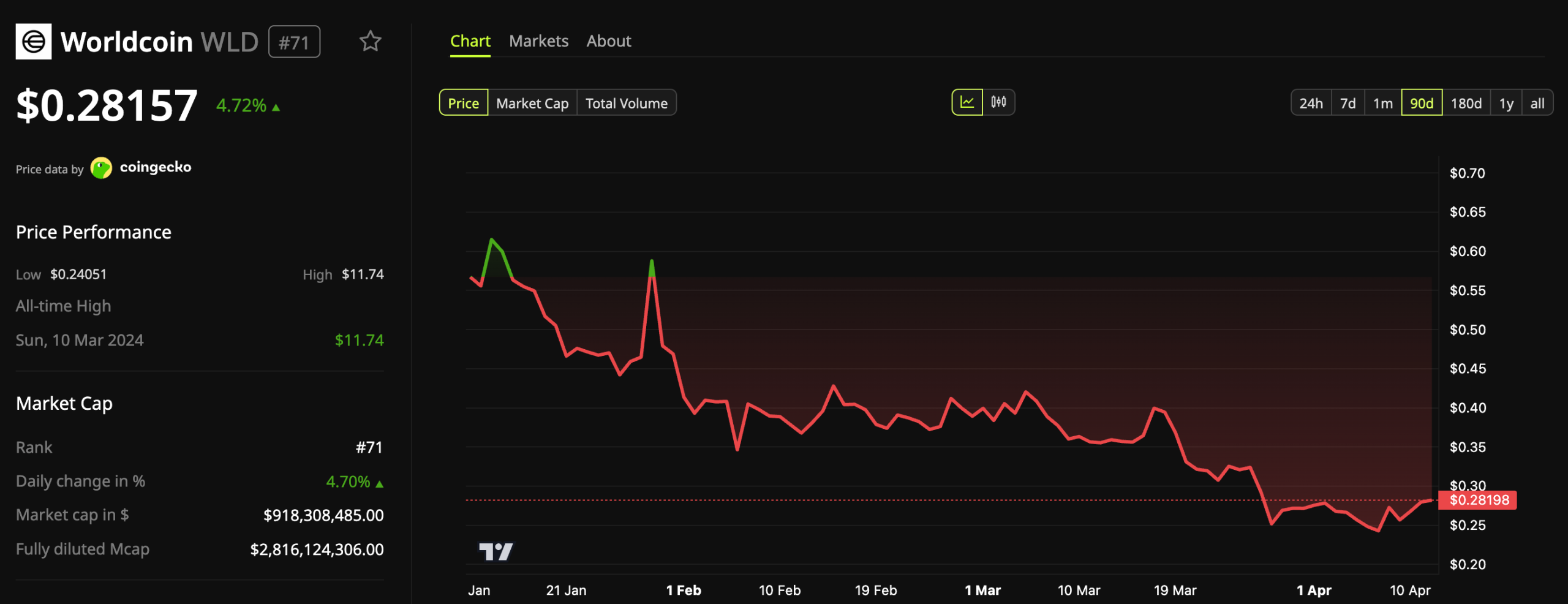
World, a cryptocurrency project founded by OpenAI CEO Sam Altman, announced a significant reduction to the Worldcoin (WLD) daily token unlock rate starting July 24.
The change affects community, team, and investor allocations at different rates. It comes as WLD faces continued market headwinds, having hit a new all-time low earlier this month.
Worldcoin (WLD) Token Unlock Rate To Drop By 43% in July 2026
According to the announcement, the daily unlock rate will fall by 43% on July 24. The largest reduction affects the World Community allocation.
That rate will be cut in half, dropping from 3.2 million WLD per day to 1.6 million. Tools for Humanity (TFH) Investor and Team token unlocks will also decline by 32%, falling from 1.9 million WLD per day to 1.3 million.
In total, daily emissions will fall from roughly 5.1 million WLD to 2.9 million. As of April 10, 4.9 billion WLD tokens are unlocked, representing 49% of the 10 billion total supply. Of this, 3.3 billion are actively circulating.
“In July 2024, a majority of the Team and Investor tokens were made subject to additional extended lock-ups, while remaining on a daily unlock schedule. Importantly, there are no unlock cliffs. A live unlock schedule of all WLD tokens is available on Dune. As a result of these lock-up schedules, on July 24, 2026, the unlock rate for all token allocations will automatically decrease,” the team noted.
Subscribe to our YouTube channel to watch leaders and journalists provide expert insights
Sell Pressure Meets Structural Headwinds
The announcement arrives weeks after the World Foundation completed a $65 million over-the-counter token sale at roughly $0.27 per WLD.
WLD has lost over 45% of its value since the start of 2026 and trades roughly 97% below its March 2024 peak near $11. At press time, WLD traded at around $0.28, up 4.7% with the broader market.
Follow us on X to get the latest news as it happens
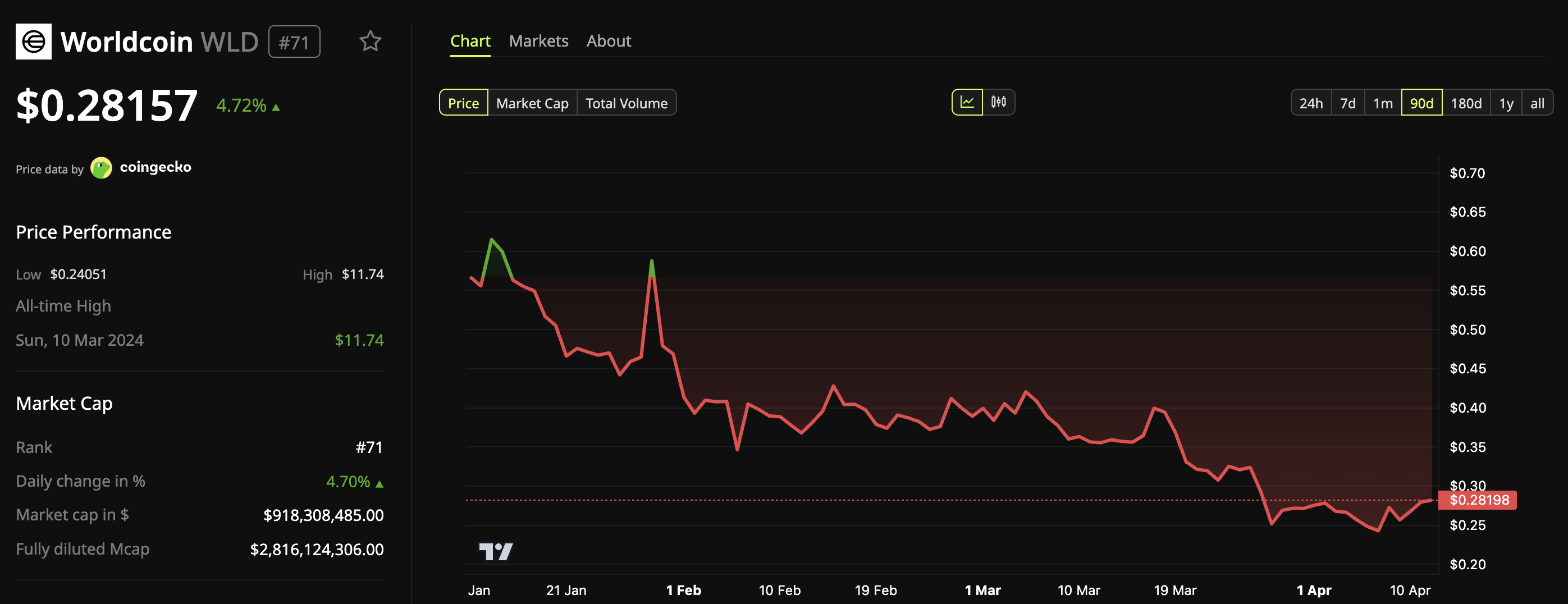
Whether the reduced unlocks will meaningfully ease selling pressure remains to be seen. While the lower emission rate could offer some short-term relief, any meaningful recovery will likely depend on a broader return in risk appetite and improved market conditions.
Until then, WLD’s ongoing downtrend and weak sentiment may continue to weigh on price action, limiting the near-term impact of the reduced token unlocks.
The post Worldcoin Slashes Token Unlocks by Nearly Half, Will It Impact Price? appeared first on BeInCrypto.

Shisa Kanko: Japanese Method Can Help Avoid Mistakes

Carragher reveals why Arsenal cannot afford to lose the title race

Geshelli’s Torc DAC at AXPONA 2026 Lets You Have It Your Way Because Different Strokes for Different Folks


-

 Business5 days ago
Three Gulf funds agree to back Paramount’s $81 billion takeover of Warner, WSJ reports
-

 Sports6 days ago
India men’s 4x400m and mixed 4x100m relay teams register big progress | Other Sports News
-

 Politics15 hours ago
US brings back mandatory military draft registration
-

 Fashion15 hours ago
Weekend Open Thread: Veronica Beard
-

 Tech3 days ago
How Long Can You Drive With Expired Registration? What Florida Law Says
-

 Business6 days ago
No Jackpot Winner, Prize to Climb to $231 Million
-

 Fashion5 days ago
Massimo Dutti Offers Inspiration for Your Summer Mood Board
-
 Sports16 hours ago
Man United discover Nico Schlotterbeck transfer fee as defender reaches Dortmund agreement
-

 Fashion4 days ago
Let’s Discuss: DEI in 2026
-

 Crypto World3 days ago
Bitcoin recovers as US and Iran Agree a Ceasefire Deal
-

 Business12 hours ago
Tesla Model Y Tops China Auto Sales in March 2026 With 39,827 Registrations, Beating Cheaper EVs and Gas Cars
-

 Business6 days ago
Akebia Therapeutics, Inc. (AKBA) Discusses Pipeline Progress and Strategic Focus on Kidney Disease Treatments at R&D Day – Slideshow
-

 Crypto World2 days ago
Canary Capital Files SEC Registration for PEPE ETF
-

 Business21 hours ago
OpenAI Halts Stargate UK Data Centre Project Over Energy Costs and Copyright Row
-

 Tech5 days ago
Haier is betting big that your next TV purchase will be one of these
-

 Tech5 days ago
Gamer Restores the Original PlayStation Portal From Two Decades Ago
-

 Tech5 days ago
The Xiaomi 17 Ultra has some impressive add-ons that make snapping photos really fun
-

 Tech5 days ago
Samsung just gave up on its own Messages app
-

 Tech5 days ago
Save $130 on the Samsung Galaxy Watch 8 Classic: rotating bezel, sleep coaching, and running coach for $369
-

 Tech5 days ago
Italian court says Netflix must refund customers up to $576 over price hikes
You must be logged in to post a comment Login