CryptoCurrency
Custom Token Development for Enterprises: Practical B2B Use Cases

If you manage operations or transformation inside an enterprise, you already know how messy approvals, partner workflows, and internal handoffs can get. Teams use different tools, data lives in various systems, and simple processes slow down because someone is always waiting for an update. This is why more leaders are exploring custom token development as a practical way to create digital objects that carry their own rules, permissions, and workflow updates. Instead of chasing status checks, tokens move through teams and systems independently, keeping everything aligned in real-time.
In this blog, you’ll discover the real B2B use cases where custom tokens solve long-standing enterprise challenges and how they help organizations streamline operations without disrupting their existing architecture. If your enterprise is looking for a smarter, scalable way to simplify workflows, this is the right place to start.
A Deep Dive Into Industry Use Cases of Custom Token Development
See how businesses across sectors are using custom token development to cut costs, unlock automation, and create powerful new engagement models. This deep exploration reveals the most profitable and scalable token use cases today:
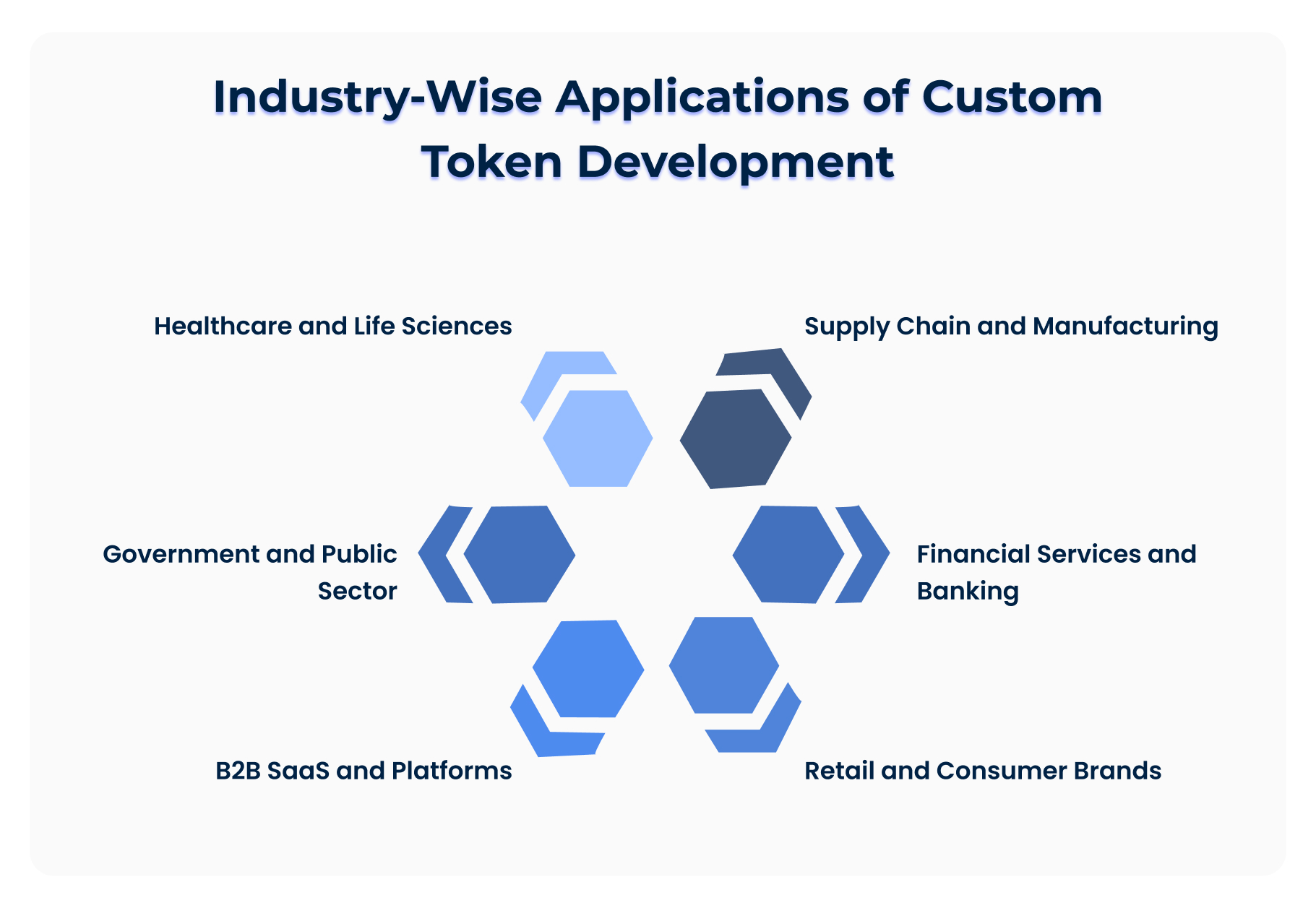
- Supply Chain and Manufacturing
The Problem
Supply chains depend on dozens of handoffs between suppliers, logistics partners, quality teams, storage units, distributors, and retail points. Every handoff carries risk. Documents get mismatched. Status updates lag. Quality checks are inconsistent. When something goes wrong, it becomes difficult to trace the origin of the issue. This lack of real-time, unified traceability slows down decision-making.
The Token Solution
Create a digital token for every batch, unit, or shipment. This token becomes the container of truth that reflects the principles of token development in real enterprise environments. It stores batch details, timestamps, quality checks, certifications, ownership logs, and even environmental conditions if needed. As the product moves, the token updates automatically. Teams no longer chase paperwork. They reference the token.
The Enterprise Impact
- Faster dispute resolution
- Transparent supplier accountability
- Cleaner audits
- Predictable quality management
- Lower risk of fraud or duplication
Manufacturers prefer tokens because they make every movement easy to verify. When operations depend on dozens of partners, a single digital object that reflects real-time truth becomes invaluable.
- Financial Services and Banking
The Problem
Banks and financial institutions manage internal transfers, settlement flows, reconciliation cycles, and client operations that touch multiple back office systems. This results in slow confirmations, duplicate entries, and operational bottlenecks. Even minor misalignment creates regulatory risk.
The Token Solution
Create internal settlement tokens that represent controlled value units inside the bank. These tokens move between departments, client desks, and settlement rails. Each transfer updates its state and provides an instant record of who authorized it, when it moved, and what condition triggered the movement. This is where leadership teams begin exploring token development services for long-term operational structures.
The Enterprise Impact
- Instant reconciliation
- Lower operational risk
- Better governance alignment
- Real-time audit trails
- Predictable settlement flows
Banks appreciate this model because it does not replace core infrastructure. It simply adds an intelligent coordination layer that makes existing systems more reliable.
- Retail and Consumer Brands
The Problem
Large retail enterprises operate multiple customer tiers, reward structures, seasonal programs, and partner benefits. Managing all of this becomes messy. Different branches use different systems. Customers lose track of points. Fraud becomes harder to detect. Personalization becomes limited.
The Token Solution
Create a membership or reward token that updates automatically based on customer behavior. Every purchase, milestone, or event interaction modifies the token. The enterprise can attach rules, dynamic tiers, expiry timelines, or partner restrictions directly to it. This is where marketing teams start exploring flexible crypto token development mechanics because they see how tokens simplify the entire loyalty structure.
The Enterprise Impact
- Unified customer identity
- Fraud-resistant rewards
- Easier partner integrations
- Real-time reward updates
- Higher customer engagement
Retail brands like tokens because they offer clarity and flexibility across thousands of customer touchpoints.
- B2B SaaS and Platform Companies
The Problem
B2B platforms handle user roles, API access, credit limits, feature gates, usage rights, and subscription tiers. These controls are typically stored across multiple tables and systems. This makes permission management difficult, especially when clients scale or require custom configurations.
The Token Solution
Create programmable access tokens. Each token represents a customer’s plan, API permissions, rate limits, or add-ons. When a client upgrades, the token updates. When a plan expires, the token enforces restrictions. When special permissions are granted, the token reflects the new rules instantly. This is typically the moment when CTOs and product architects start evaluating crypto token development for flexible access control and automated entitlement management.
The Enterprise Impact
- Less manual intervention
- Automated feature access
- Clear entitlement logic
- Lower engineering workload
- Cleaner onboarding and offboarding
SaaS platforms prefer this approach because it removes the complexity of scattered permission systems and replaces them with a predictable, programmable object.
- Government and Public Sector
The Problem
Government agencies handle large volumes of applications, permits, approvals, certificates, utility services, and public benefit programs. Most of these workflows depend on multiple departments. This slows down approvals, creates ambiguity, and invites inconsistencies.
The Token Solution
Create service tokens for every application or citizen request using a structured approach aligned with token development services. Each token carries applicant data, supporting documents, eligibility checks, department reviews, and approval status. As every department completes its part, the token updates in real time.
The Enterprise Impact
- Reduced administrative backlog
- Lower fraud risk
- Transparent public audits
- Faster service delivery
- Clear allocation of responsibility
Governments adopt tokens when they want visible improvements in trust, efficiency, and citizen satisfaction.
- Healthcare and Life Sciences
The Problem
Hospitals, labs, insurers, and pharmaceutical companies handle sensitive health records. Access management becomes difficult because every role requires different permissions. Data governance rules vary across regions. Systems do not communicate well.
The Token Solution
Create tokens that represent access rights, patient data snapshots, clinical trial statuses, or sample verification details. The token updates as medical staff, labs, or insurers interact with it. This is the stage where enterprises shortlist a token development company that can align strict security, compliance, and integration standards with the healthcare environment.
The Enterprise Impact
- Stronger patient data protection
- Automated permission control
- Accurate medical histories
- Reduced administrative overhead
- Real-time verification for labs and insurers
Healthcare organizations value tokens because they simplify access management without compromising compliance.
Ready to simplify workflows? Talk to Antier’s enterprise experts.
Across these industries, one truth becomes clear. Custom tokens help enterprises streamline workflows, strengthen governance, and eliminate the friction caused by disconnected systems. As leaders explore advanced token development to support approvals, permissions, data control, and partner collaboration, tokens emerge as the most reliable way to bring structure and real-time accuracy into complex operations. With this foundation in place, enterprises are better positioned to build future-ready digital ecosystems that scale with confidence.
Why Modern Enterprises Are Switching to Token-Based Architecture
Across industries, one insight is becoming impossible to ignore. Custom tokens function as intelligent carriers of truth that remove data silos and simplify collaboration across large teams. As enterprises deepen their investment in Token Development, they consistently choose tokens for four powerful reasons.
- Predictability: Tokens update in real time and behave consistently across every system they touch.
- Automation: Workflows advance on their own, reducing manual intervention and operational delays.
- Interoperability: Tokens move smoothly across departments, business units, and partner ecosystems without losing context.
- Governance Strength: Rules and permissions live inside the token itself, creating a single, reliable source of control instead of scattered, tool-based logic.
Your Next Strategic Upgrade Starts With a Custom Token
Custom token creation is becoming a strategic advantage for enterprises that want predictable workflows, cleaner governance, and smoother collaboration across teams and partner networks. When tokens carry permissions, approvals, and operational updates on their own, the organization gains a level of clarity and speed that traditional systems rarely deliver. This is why more enterprises are exploring structured token models for internal use rather than limiting the concept to customer-facing initiatives.
If your team is considering this shift and wants guidance from a trusted token development company, Antier can help you design and implement token structures that fit naturally into your existing architecture and long-term strategy.
Explore what tokens can do for your enterprise. Talk to Antier.
Frequently Asked Questions
01. What are custom tokens and how do they help streamline enterprise operations?
Custom tokens are digital objects that carry their own rules, permissions, and workflow updates, allowing them to move independently through teams and systems. They help streamline operations by providing real-time updates and reducing the need for status checks, thus simplifying workflows.
02. How can custom tokens improve supply chain management?
Custom tokens can enhance supply chain management by serving as a digital container for each batch or shipment, storing essential details like timestamps, quality checks, and ownership logs. This ensures real-time traceability, faster dispute resolution, and improved accountability among suppliers.
03. In what ways do custom tokens benefit the financial services sector?
In financial services, custom tokens can facilitate faster internal transfers, streamline settlement flows, and improve reconciliation cycles by providing a unified and real-time view of client operations across multiple back office systems, ultimately enhancing efficiency and reducing delays.