
CryptoCurrency
DeFi Token Development Cost in 2026: What Founders Must Know

2026 is not the year to cut corners on DeFi tokens. The industry has moved past simple contract deployments and speculative hype cycles. The market has matured, investors demand real utility, regulators expect clarity, and exchanges only list projects that demonstrate strong fundamentals and long-term viability. Every part of the DeFi ecosystem has raised its standards, which means founders must raise theirs as well when planning any DeFi token development initiative.
If you are planning to create a token this year, understanding the true cost drivers is your first competitive advantage. This guide is built to help you make smarter decisions, avoid costly mistakes, and approach your token with the same strategic clarity that top-performing projects rely on. If your goal is to build a token that not only launches but actually thrives in today’s DeFi ecosystem, you are in the right place.
What Makes DeFi Token Development Different in 2026?
DeFi token development entering 2026 is shaped by two major forces: tighter global regulation and a market-wide shift toward genuine token utility. In 2025, over 30 jurisdictions representing roughly 70% of global crypto markets implemented clearer digital asset and stablecoin frameworks, transforming regulation from a barrier into a competitive advantage. Projects that were built with compliance in mind gained smoother access to institutional capital, while those ignoring KYC, AML, and cross-border standards struggled to secure listings or funding.
Utility also became a defining factor. DeFi TVL reached $123.6 billion in Q2 2025, and the top 100 DeFi tokens surpassed $98.4 billion in market cap, driven by real usage rather than speculation. DeFi token development is now a full-scale product build involving regulatory architecture, modular tokenomics, institutional-grade audits, and cross-chain readiness. The projects that succeed in 2026 are those that treat token development as a holistic product strategy, not just a smart contract deployment.
Understanding What Drives DeFi Token Development Costs
Here are the factors that matter far more than the code itself.
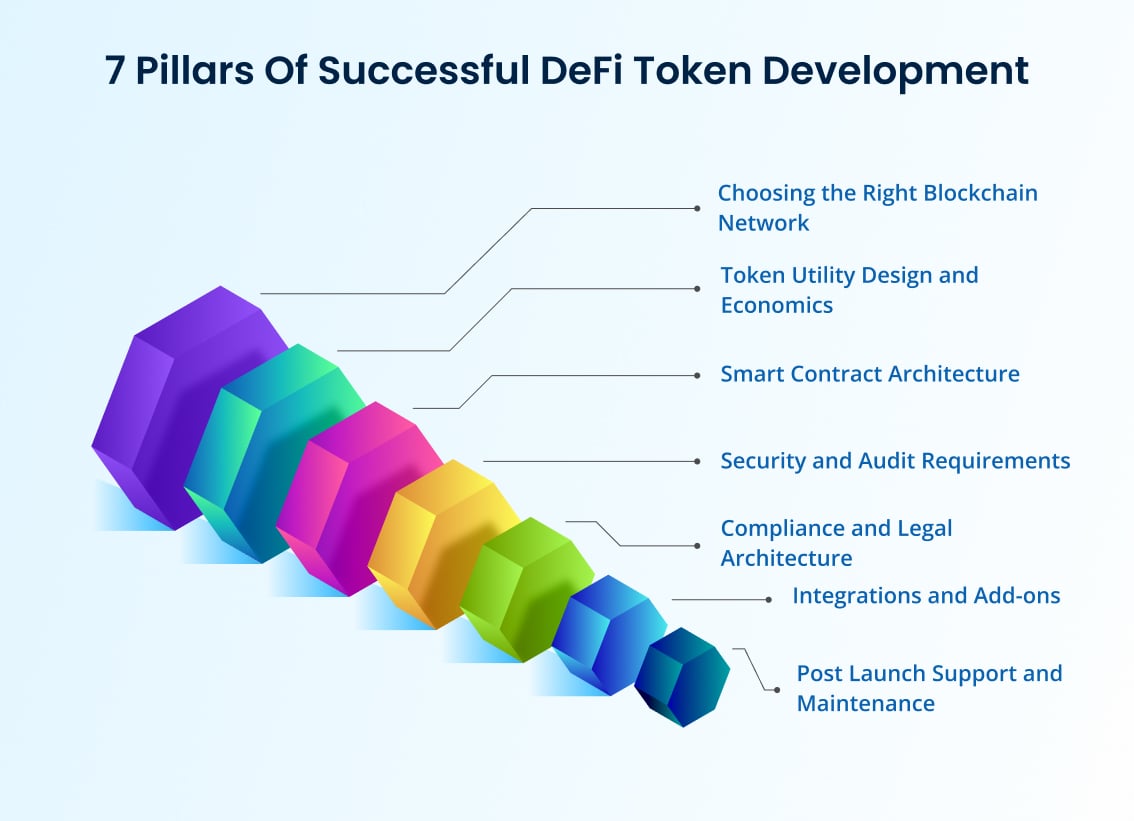
- Choosing the Right Blockchain Network
The network impacts everything, including:
- TPS
- Gas fees
- Scalability
- Ecosystem support
- Security
- Integration needs
Popular chains include Ethereum, Solana, BNB Chain, Avalanche, Polygon, Sui, and Base. Your choice depends on your target market, liquidity goals, and app infrastructure. This alone influences timelines and architecture complexity, which affects DeFi token development costs.
- Token Utility Design and Economics
Token economics is the heart of your DeFi model. Here is what gets factored into the token build:
- Supply logic
- Incentive structure
- Vesting
- Reward mechanisms
- Burn models
- Governance mechanics
- Staking and liquidity planning
Investors in 2026 will not consider a token without clear economic sustainability. This is where a Defi token development company adds massive strategic value because they build utilities that support long term liquidity, not pump and dump cycles.
- Smart Contract Architecture
The complexity depends on:
- Number of contracts
- Yield and staking logic
- Liquidity pools
- Governance modules
- DAO integration
- Reward automation
- Oracle integration
Each layer increases the development hours, audits required, and overall project involvement. Smart contracts must follow updated 2026 security guidelines, vulnerability checks, and automated testing frameworks.
Avoid Costly Mistakes. Get a Professional Token Roadmap Now
- Security and Audit Requirements
A DeFi token without an audit is a failed project waiting to happen. Audits validate:
- Access control
- Overflow and underflow protection
- Economic exploits
- Price manipulation routes
- Wallet vulnerabilities
- Attack surface coverage
- A reputable auditor is essential for investor trust.
This is another major element that influences the total DeFi token development cost.
- Compliance and Legal Architecture
2026 is a regulation-heavy year for DeFi. Compliance adds active cost components like:
- Legal frameworks
- Industry guidelines
- Jurisdiction alignment
- KYC compatibility
- Documentation
- Token classification reports
Tokens today must be designed to meet global investor and regulatory expectations.
- Integrations and Add-ons
Depending on your vision, development may include:
- Staking modules
- Vesting dashboards
- Liquidity farming UI
- Exchange listing support
- Wallet integrations
- Multi chain deployment
- Governance portals
- Real time analytics
The richer the token ecosystem, the more extensive the development lifecycle.
- Post Launch Support and Maintenance
This includes:
- Upgrades
- Continuous monitoring
- Feature improvements
- Security updates
- Scaling support
Founders who want long term success partner with teams providing DeFi token development services that cover post launch maintenance as a core offering.
Hidden Factors Founders Overlook When Estimating Token Development Cost
Founders often underestimate how many variables influence the true scope of a DeFi project. These overlooked elements directly impact timelines, architecture, and overall execution. Here is what really shapes the budget behind modern Defi token development.
- Token vs Full DeFi Ecosystem Needs: Some visions require more than a token. If your roadmap includes staking modules, liquidity pools, DAOs, or utility layers, the development scope expands into a full ecosystem.
- Team Expertise and Technical Depth: The quality of your technical team determines how efficiently the project moves. Limited expertise leads to rework, security vulnerabilities, and slower delivery cycles.
- Fundraising Model and Token Structure: If you plan to raise capital, your token must be designed with vesting schedules, emissions logic, treasury controls, and governance frameworks. Each of these adds complexity to the build.
- Liquidity Strategy and Long Term Planning: Tokens that require liquidity pools, yield mechanics, or staking rewards need advanced architecture. Proper planning ensures sustainability beyond launch.
- User Experience and Frontend Requirements: If your vision includes dashboards, onboarding flows, real time data views, or Web3 grade frontend features, the development timeline increases accordingly
Take Your First Step Toward a Successful DeFi Launch
What You Should Actually Prioritize Instead of Asking About Cost
If you want your token to survive past launch and actually compete in a maturing DeFi landscape, you must shift your focus from short term DeFi token development cost to the foundational elements that determine long term viability. The strength of your token depends on how well you prioritize:
- Security First
- Utility Driven Economics
- Multi Chain Readiness
- Enterprise Grade Compliance
- Long Term Scalability
- Audit Quality
- Liquidity Strategy
- Technical Documentation
Instead of focusing on development cost alone, founders should evaluate whether their token is built to withstand real market conditions and long term growth. These priorities shape how investors perceive your project, determine how fast you can scale, and influence your ability to attract liquidity, partnerships, and regulatory acceptance.
When a token is designed with strong security, meaningful utility, clear compliance alignment, and a scalable architecture, it becomes far easier to earn user trust and institutional interest. Professional development teams structure their DeFi token development services around these principles because they play a defining role in how successful a token becomes after launch.
When Should You Start Your DeFi Token Development in 2026?
Start early. The earlier you begin:
- The smoother your audits become because your team has enough time to detect vulnerabilities and resolve them without pressure.
- The easier your investor conversations get since you can present a well prepared plan, realistic timelines, and stronger technical clarity.
- The stronger your tokenomics evolve as you iterate through models that support sustainability instead of relying on last minute assumptions used in many Defi token development cycles.
- The less technical debt you accumulate by avoiding rushed development choices that become expensive to fix later.
- The faster you can enter the market with a polished, audit-ready product rather than scrambling to meet deadlines.
Modern DeFi competition rewards those who start early and build properly.
Conclusion
Building a token in 2026 is about more than launching on a blockchain. It is about making the right decisions early, so your project can scale, attract liquidity, and survive real market conditions. When you prioritize strong architecture, compliance, security, and long term vision, you lay the foundation for a token that investors and users can trust.
If you want your project to move from concept to a fully market ready asset, partnering with the right DeFi token development company is the most important decision you will make. The right team brings clarity, structure, and confidence to every stage of your build. If you are ready to take the next step, Antier can help you evaluate your options and guide your development with precision and expertise. Let’s move your token forward with a strategy built for long term success.
Frequently Asked Questions
01. What are the key factors influencing DeFi token development in 2026?
The key factors include tighter global regulation and a market shift towards genuine token utility, requiring projects to focus on compliance and real usage rather than speculation.
02. Why is understanding cost drivers important for DeFi token development?
Understanding cost drivers provides a competitive advantage, helping founders make informed decisions, avoid costly mistakes, and develop tokens that thrive in the evolving DeFi ecosystem.
03. What should founders consider when choosing a blockchain network for their DeFi token?
Founders should consider factors such as transaction speed (TPS), gas fees, scalability, ecosystem support, security, and integration needs, as these will impact their token’s performance and market reach.



