
CryptoCurrency
Digital Asset Treasuries: Why Hodling Isn’t Enough

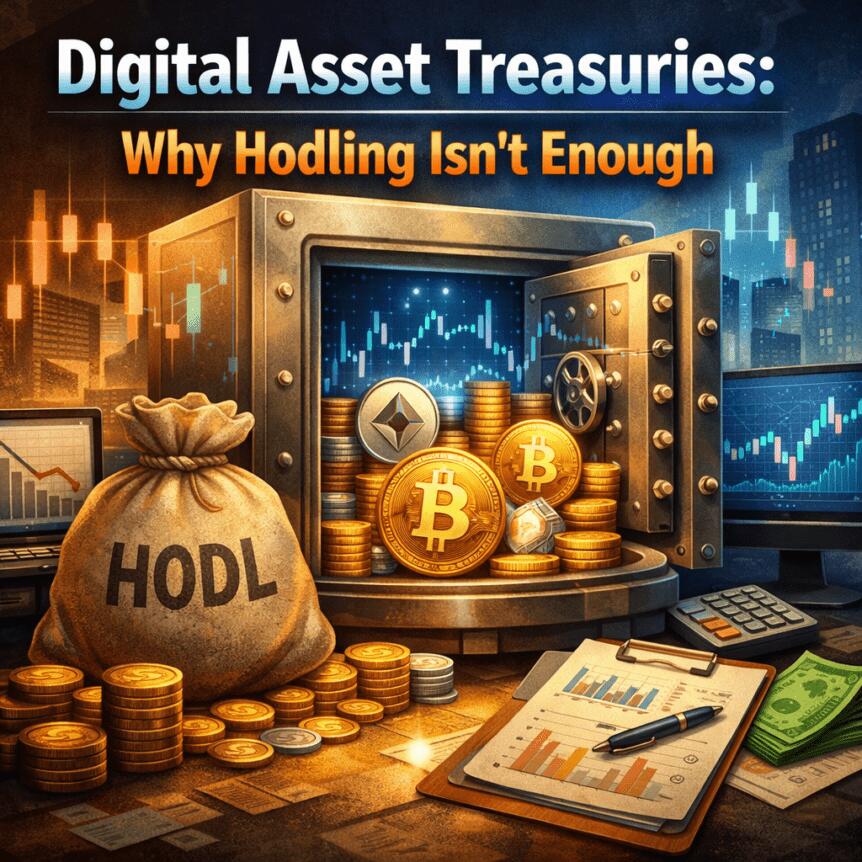
Digital asset treasuries began in earnest in 2020 when Strategy opted to accumulate Bitcoin as a core balance-sheet asset. That decision helped launch a treasury model with a market footprint well into the tens of billions of dollars and inspired a wave of imitators. These vehicles raise substantial capital to acquire crypto assets and, in some cases, merge with publicly traded companies to offer investors exposure to crypto through traditional equities. Yet, as markets cooled, questions emerged about whether a buy-and-hold approach could consistently meet shareholder expectations and whether such strategies truly address the crypto ecosystem’s need for patient capital.
“Doing nothing with crypto on the balance sheet is not a strategy,” the argument goes. Strategy’s Bitcoin accumulation narrative fed the creation of numerous DATs, but many did not evolve beyond simply holding assets. That approach risks balance-sheet FX exposure and governance risk, rather than delivering a clear ROI for investors and for the communities that rely on these networks. If a treasury cannot generate real value beyond price gains, it may fail to justify its existence to stakeholders.
Moreover, the critique extends to the broader issue of capital allocation. Treasuries that assume perpetual appreciation by themselves is not a robust treasury framework; it’s a form of leveraged speculation that can invite regulatory scrutiny and misalignment with long-term corporate goals. By keeping capital idle or deployed only to chase price peaks, DATs miss opportunities to strengthen liquidity, liquidity infrastructure, and the operational layers that sustain crypto networks. The argument, then, is not merely about stockpiling Bitcoin or other assets; it’s about building a deliberate strategy that enhances market stability and adoption.
The DAT 2.0 approach leverages crypto to support the ecosystem
The proposed evolution from DAT 1.0 to DAT 2.0 rejects the premise that crypto wealth must ride entirely on future price surges. Instead, it emphasizes channeling capital into real ecosystem improvements—mining, custody, payments, lending, and liquidity infrastructure—that support Bitcoin and wider crypto ecosystems. The aim is to diversify risk while creating tangible benefits for users and developers who rely on robust financial rails. In essence, the argument is that sustainable growth in crypto requires a foundation of capital that can endure market cycles and regulatory shifts.
“Rather than depending on an ever-rising price, DATs 2.0 would diversify across projects that contribute to the network’s growth and longevity,” the author writes. Bitcoin, as a proof-of-work system, stands to benefit from sustained investments in the infrastructure that underpins it. This approach envisions DATs acting like traditional financial institutions—providing “slow capital” that supports a broad base of ecosystem initiatives over time, rather than chasing short-term price momentum.
DATs can become the source of slow capital
Traditional finance has long relied on patient, permanent capital to back major banks and market infrastructure. For crypto to mature beyond an alternative asset class, it requires a similar reservoir of capital capable of supporting the ecosystem’s growth. DATs are positioned to fill that niche—not as venture funds or hedge funds, but as steady, long-horizon financiers that seed and sustain critical projects. This could allow the crypto sector to scale in ways that improve liquidity, custody solutions, and on-chain funding mechanisms that strengthen the entire network.
The author contends that the venture capital and hedge fund models are ill-suited to this role, given their ROI pressures and liquidity timelines. In contrast, DATs 2.0 could serve as a foundational layer of capital that nurtures crypto infrastructure, promotes adoption, and stabilizes the ecosystem across cycles. This may offer a new pathway for capital to actively support the networks it seeks to monetize, rather than merely monetizing the asset price itself. The discussion ultimately frames DATs 2.0 as a potential cornerstone for a more mature, crypto-native financial system.
Opinion by: Mike Maloney, Chairman of 21 Vault.
This opinion article presents the contributor’s expert view and it may not reflect the views of Cointelegraph.com. This content has undergone editorial review to ensure clarity and relevance, Cointelegraph remains committed to transparent reporting and upholding the highest standards of journalism. Readers are encouraged to conduct their own research before taking any actions related to the company.
This piece argues that the next phase for crypto treasuries is to evolve into engines of ecosystem growth—deploying patient capital that supports network infrastructure, adoption efforts, and long-term value creation. If adopted on a broad scale, DATs 2.0 could help align corporate capital with the industry’s broader mission: to establish a resilient, inclusive, and scalable crypto economy.



