
Crypto World
Fed Could Print Money to Back US-Iran Conflict, Hayes Says

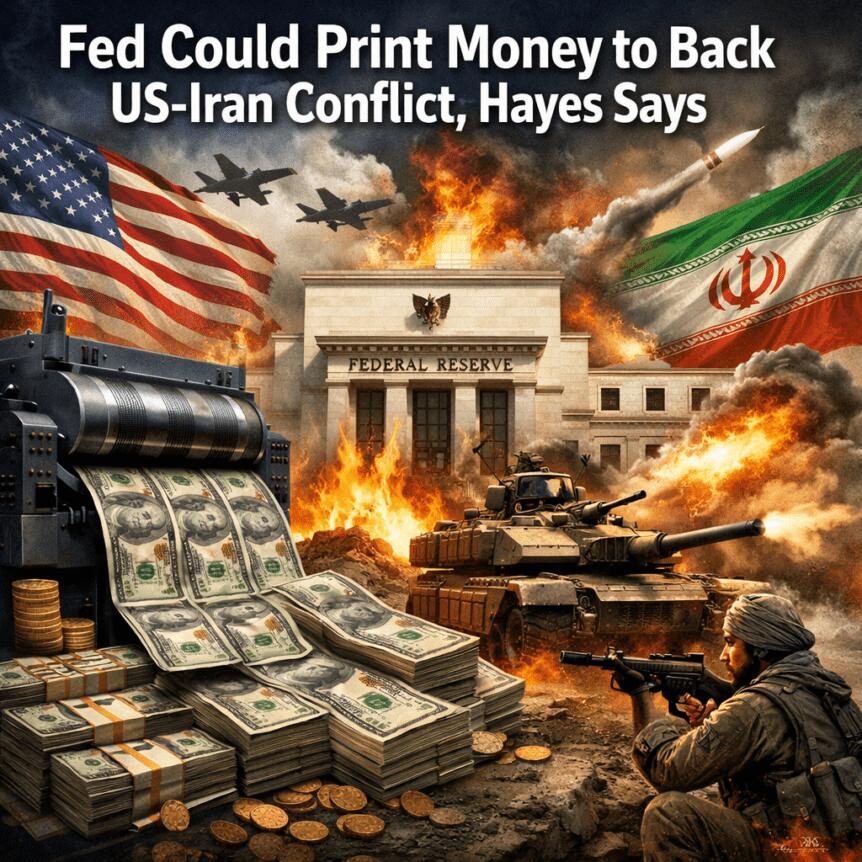
Analysts say that shifting US monetary policy could hinge on geopolitical developments in the Middle East, with crypto markets watching for signals from the Federal Reserve. BitMEX co-founder Arthur Hayes argues in a Monday blog post that American presidents have repeatedly engaged in Middle East action, and the Fed has historically responded by cutting rates or expanding the money supply to finance those campaigns. He writes that the longer an administration pursues Iran-focused objectives, the greater the likelihood the Fed will “lower the price and increase the quantity of money” to support those efforts, a pattern he sees echoed in past conflicts. Hayes cites the Gulf War of 1990, the post-9/11 wars, and the 2009 Afghan surge as episodes where monetary easing followed military action. Over the weekend, Israel and the US conducted airstrikes on Iran that killed Ali Khamenei, a development President Donald Trump has pledged to continue.
Key takeaways
- The analytically argued link between wartime financing and Fed easing suggests policy pivots could accompany geopolitical shocks, with crypto markets potentially benefiting from increased liquidity.
- Historical precursors—Gulf War (1990), the post-9/11 era, and the 2009 Afghan surge—are cited as episodes where rate cuts or aggressive money printing supported wartime aims, according to Hayes.
- The weekend strikes on Iran introduced fresh geopolitical risk, intensifying scrutiny of how policy makers balance inflation, growth, and security concerns while markets price in potential easing.
- Crypto-market chatter around “World War III” spiked on social media after the latest flare-up, though observers noted that current dynamics are not comparable to peak speculative periods in 2025.
- Hayes has floated liquidity tools such as Reserve Management Purchases and other easing measures, signaling how policymakers might adapt if macro risks escalate, a thread that dovetails with ongoing debates about liquidity in crypto markets.
Tickers mentioned: $BTC
Price impact: Positive. The piece frames geopolitical risk and potential Fed easing as supportive for crypto markets, implying upside for BTC if policy shifts materialize.
Market context: The narrative sits at the intersection of macro policy, geopolitics, and crypto liquidity. As risk sentiment shifts with geopolitical headlines, traders monitor whether Fed actions—or lack thereof—will unlock liquidity channels that typically buoy risk assets including digital currencies.
Why it matters
The episode highlights how macro policy and geopolitical trajectories can influence the behavior of crypto markets. If the Federal Reserve were to pivot toward rate cuts or quantitative easing in response to ongoing conflict dynamics, liquidity could expand and risk appetite could rise, creating a more favorable environment for digital assets like Bitcoin. The discussion also underscores the fragility of markets that are sensitive to policy signals; investors may pivot quickly in anticipation of liquidity injections or policy tightening, reinforcing the need for disciplined risk management.
For market participants, the perspective from Hayes — that policy responses to geopolitical frictions can be both reflexive and pro-cyclical for crypto — adds a layer of nuance to how traders interpret price movements. It also draws attention to liquidity tools and central-bank balance-sheet dynamics as structural drivers that could shape the next phase of the crypto cycle. While none of this guarantees a specific price path, it emphasizes that policy and geopolitics remain key variables in the crypto trading playbook.
What to watch next
- Federal Reserve communications and any signals about rate cuts or new liquidity programs, including Reserve Management Purchases.
- Developments in the Iran-Israel conflict and leadership dynamics in the region, alongside any shifts in geopolitical risk assessments.
- Bitcoin price action in response to macro news and policy signals, with attention to test levels around major milestones.
- Regulatory and institutional flows that could affect BTC-related products and overall market liquidity.
Sources & verification
- BitMEX blog: Arthur Hayes on iOS warfare and monetary policy implications — https://www.bitmex.com/blog/ios-warfare
- Cointelegraph coverage: Israel-US airstrikes on Iran and the described leadership developments — https://cointelegraph.com/news/bitcoin-recovers-to-68k-following-reported-death-of-iranian-supreme-leader
- Kobeissi Letter remark on futures and WW3 framing — https://x.com/KobeissiLetter/status/2028251687572688942
- Santiment data on World War III mentions in crypto discourse — https://x.com/santimentfeed/status/2028285118553493784
- Jane Street discussion on Bitcoin price narratives — https://magazine.cointelegraph.com/bitcoin-price-manipulation-jane-street-bitcoiners-debate-cointelegraph/
Market reaction and key details
The central thread running through this discourse is the tension between geopolitics and macro policy and how that tension spills into crypto markets. Hayes’ framing rests on a historical pattern: wartime actions tend to be financed through monetary easing, which, in turn, broadens liquidity and tends to support assets that thrive on risk-taking. In the current moment, observers watch for any official signal from the Fed that policy might shift toward easing, a move that could catalyze a broader crypto rally if liquidity taps are opened.
Beyond the macro angle, the conversation threads in public commentary include market data points such as marginal moves in stock futures and shifts in energy prices, which can influence risk appetite across asset classes. As noted in related analyses, Bitcoin and other crypto narratives have at times mirrored shifts in traditional markets, but the relationship remains imperfect and highly context-dependent. The social-media chatter around WW3 underscores how fast sentiment can pivot on headlines, even if the underlying price action is more nuanced than headline narratives suggest.
Notably, the discourse extends to liquidity tools and policy mechanisms that could shape the trajectory of crypto markets. Hayes has previously floated ideas like Reserve Management Purchases as a potential tool to soothe markets, and he has linked these constructs to broader money-printing dynamics that could accelerate crypto adoption during periods of policy stress. In parallel, market observers have debated whether large participants and market makers have the capacity to influence price through strategic liquidity provisioning, a theme that has featured in discussions around Jane Street and other firms in analyses like the one titled “Would Bitcoin really be at $200K if not for Jane Street? Trade Secrets.”
As with any geopolitical and macro narrative, investors should command a cautious, context-aware approach. The next few weeks could deliver clarity on the Fed’s stance, the evolution of the conflict in the Middle East, and the way crypto markets weigh fresh liquidity signals against ongoing macro uncertainties. While Hayes’ framework provides a lens to interpret potential policy responses, it is one of many factors driving price discovery in Bitcoin and other digital assets.

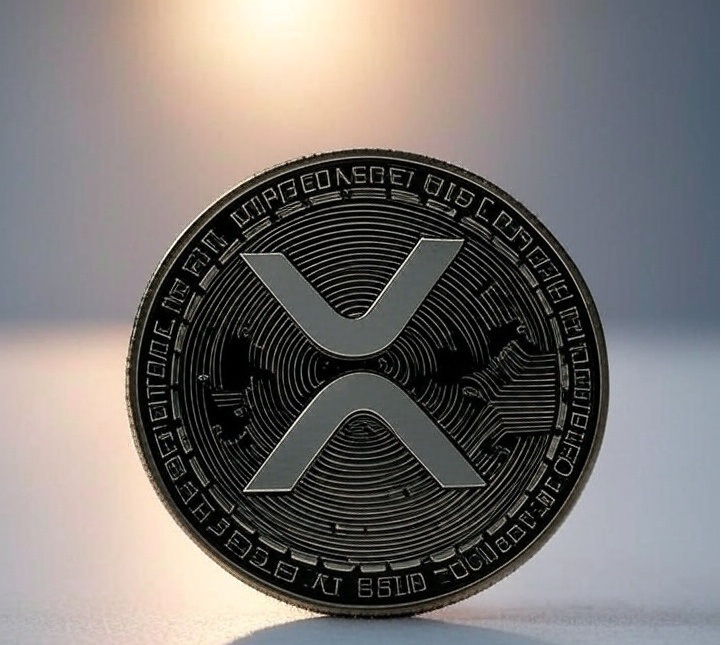

- Active XRP addresses dropped over 40% in four days.
- XRP price remains stuck between a tight trading range.
- Retail holders have grown, but overall network activity is slowing.
XRP has entered a tight and uncertain phase after a brief rally following an announcement by US President Donald Trump that the United States will pause strikes on energy and power installations in Iran after the expiry of the 48-hour ultimatum on opening the Strait of Hormuz.
BREAKING PRESIDENT TRUMP: 🇺🇸🇮🇷 We had very good and productive conversations regarding a complete and total resolution of hostilities in the Middle East.
Military strikes postponed for 5 days. pic.twitter.com/wiZh9F1H5p
— Donald J Trump Posts TruthSocial (@TruthTrumpPost) March 23, 2026
The momentum that initially lifted prices following Trump’s announcement now appears to be fading as the market struggles to find direction.
At the time of writing, XRP is trading around $1.43.
The price has moved within a narrow range between $1.36 and $1.46, reflecting hesitation among traders after a week where XRP slipped by about 5%, extending its broader downward trend over the past year.
While the recent rally gave traders hope, the follow-through has been weak.
XRP Ledger activity drops sharply
One of the most notable developments is the sharp decline in XRP Ledger (XRPL) network activity.
Notably, XRP’s active addresses have fallen by more than 40% within just a few days, according to the data obtained from CryptoQuant.

This drop signals a slowdown in user engagement, which often reflects reduced demand in the short term.
Fewer active participants usually translate to less transaction volume and weaker momentum.
This decline contrasts with the earlier optimism that surrounded XRP’s growing number of wallet holders.
While more people may be holding XRP, fewer are actively using it.
This gap between ownership and activity suggests that investors are choosing to wait rather than act.
Such behaviour is common during uncertain market conditions.
Retail growth continues despite the slowdown
Even as activity drops, the number of smaller XRP holders continues to grow steadily.
This trend points to increasing retail interest in the asset.
A rising base of small holders often signals long-term confidence, even if short-term sentiment is mixed.
It also suggests that XRP is becoming more widely distributed rather than concentrated in a few large hands.
However, growing ownership alone does not guarantee price growth.
Without strong network activity to support it, price movements can remain limited.
This is the situation XRP appears to be facing now.
XRP price outlook
XRP’s current price movements reflect a market caught between opposing forces.
On one hand, there is optimism driven by broader adoption and past rally attempts.
On the other hand, there is clear evidence of weakening participation and fading momentum.
The asset remains well below its previous peak, showing that recovery is still incomplete.
Short-term price action suggests consolidation rather than a decisive move in either direction, with the immediate support level at near $1.33 holding for now.

At the same time, resistance around $1.54 to $1.60 continues to limit upward movement, creating a narrow trading range that traders are watching closely.
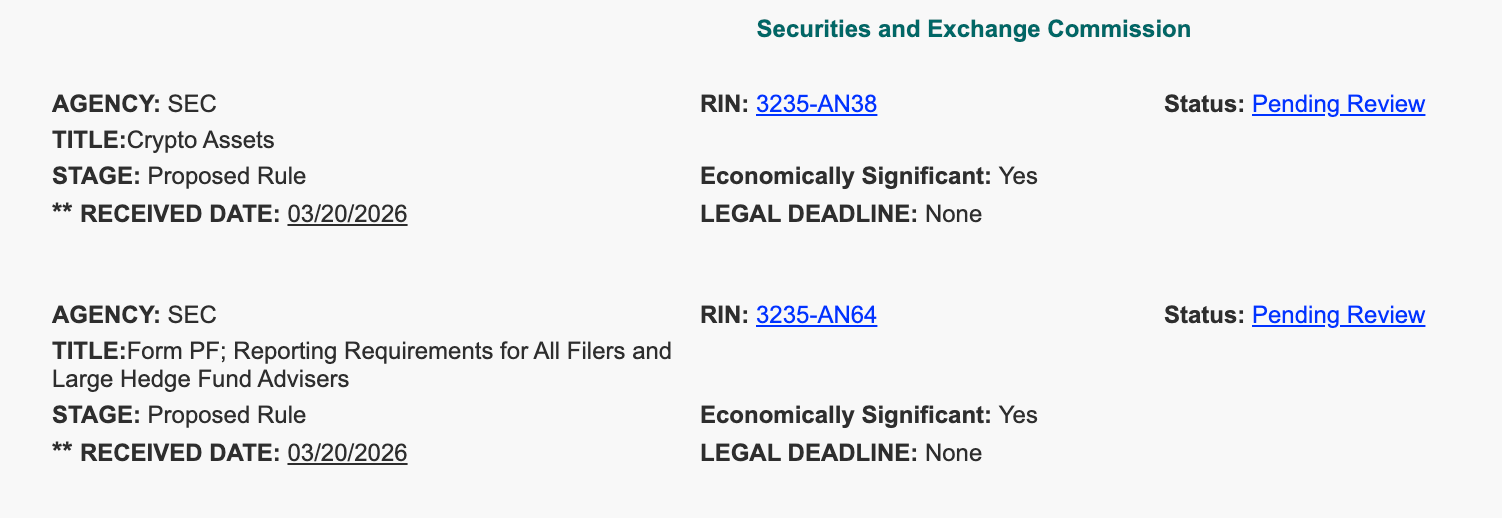
The financial regulator’s plan to reinterpret how federal securities laws apply to crypto assets is ”pending review” by the White House’s Office of Management and Budget.
The US Securities and Exchange Commission (SEC) has forwarded its proposal to have most crypto assets not treated as securities under federal law to the White House’s Office of Management and Budget.
According to information available through the US General Services Administration, on Friday the SEC sent two proposed rules to the White House for review, including its interpretative notice from last week regarding which digital assets the agency could consider a security under federal law.
As of Monday, government records showed the proposal as “pending review” by the White House, potentially changing how the SEC handles regulation and enforcement of digital assets.

In a notice issued by the SEC last week, Chair Paul Atkins said that the agency would not consider four types of digital assets as securities under its purview: digital commodities, digital tools, digital collectibles — including non-fungible tokens — and stablecoins. The interpretation said that it would provide the agency with a “coherent token taxonomy” for the four types of assets and address how a “non-security crypto asset” may or may not be considered an investment contract.
The SEC rule, if finalized, would provide a bridge to crypto regulation until Congress were to pass a market structure bill to clarify comprehensive regulations of digital assets. The interpretation of federal securities laws followed the signing of a memorandum of understanding with the Commodity Futures Trading Commission (CFTC) — the other federal financial regulator expected to regulate digital assets under the proposed market structure bill — earlier this month.
Related: CFTC staff clarify expectations on using crypto as collateral
White House reportedly reached “agreement in principle” on crypto bill
Politico reported on Friday that representatives from the White House and Congressional lawmakers reached a deal on stablecoin yield that could advance the market structure bill in the Senate Banking Committee. The panel indefinitely postponed its markup of the bill, called the CLARITY Act, in January following Coinbase CEO Brian Armstrong saying the exchange could not support the legislation as written.
As of Monday, the banking committee had not publicly announced a new date for the bill’s markup. Senate Majority Leader John Thune reportedly said in March that the chamber intended to prioritize a vote on the SAVE America Act — legislation that would require voters to provide proof of US citizenship in person to register — before bills with bipartisan support, such as CLARITY.
Magazine: Are DeFi devs liable for the illegal activity of others on their platforms?


Polygon‑incubated Katana has acquired veteran DEX IDEX to launch Katana Perps, folding a decade of exchange tech into its DeFi stack as it races Hyperliquid and dYdX for onchain derivatives volume.
Summary
- Polygon‑incubated DeFi chain Katana has acquired veteran DEX IDEX to power Katana Perps, a new perpetual futures platform that natively integrates spot and derivatives trading.
- CEO Matthew Fisher says the goal is to “own more of the trading stack and the revenue that comes with it” as onchain derivatives volumes and always‑on markets surge.
- Market makers including GSR, Selini Capital, and Auros are seeding liquidity, positioning Katana as a full‑stack DeFi chain spanning spot, lending, launches, and perps.
Katana, a DeFi‑focused Ethereum scaling chain incubated by Polygon Labs and trading firm GSR, has acquired decentralized exchange IDEX, using its infrastructure to launch Katana Perps, a perpetual futures venue built directly into the Katana app. The deal, announced on March 23, 2026, brings nearly a decade of exchange technology from the 2017‑founded DEX into Katana’s stack, with IDEX now “relaunching as Katana Perps” and serving as the native derivatives engine for the chain. “The goal is to own more of the trading stack and the revenue that comes with it,” Katana CEO Matthew Fisher said, calling the acquisition the “first major step” of his tenure as he formalizes the strategy he has led since joining the project.
Fisher argued that as crypto trading migrates to always‑on venues, infrastructure that blends CEX‑like performance with onchain settlement will define winners. “We’re building for 24/7 markets where price discovery happens onchain, not during bank hours,” he said, pointing to U.S. regulators’ recent signals about a path for crypto perpetual futures as an inflection point for the sector. Under the new setup, IDEX’s order book and AMM architecture becomes the backbone for Katana Perps, which routes spot liquidity, perps, and order flow through a single interface rather than siloing derivatives as a separate product.
Katana’s broader DeFi stack now spans four pillars: Sushi for spot trading, Morpho for lending, Kensei for token launches, and Katana Perps for leveraged derivatives, all coordinated by the KAT and vKAT token model. Over time, vKAT holders will be able to direct incentives toward perps markets and earn a share of fees, folding derivatives revenue into the same flywheel that powers spot and lending on the chain. At launch, Katana Perps is supported by major market makers GSR, Selini Capital, and Auros, which Fisher said were drawn by IDEX’s “nearly a decade” of live infrastructure and the chain’s performance‑oriented design.
Founded in 2017, IDEX was “the first decentralized exchange to combine a high‑performance matching engine with onchain settlement” and, through 2019, “consistently ranked first by trading volume and transaction count among all DEX protocols,” Katana noted. Bringing that stack in‑house lets Katana offer a more CEX‑like experience — deep API support, higher throughput, and tighter spreads — while keeping custody and settlement onchain.
The acquisition lands as perpetuals DEXes are seeing rising volumes and attracting more professional flow, with venues like Hyperliquid, dYdX, and GMX competing to lock in whales and market makers. Recent crypto.news coverage has highlighted how new onchain products — from Hyperliquid’s HIP‑4 proposal for outcome markets to high‑stakes perps traders posting multi‑million‑dollar PnL — are pulling structurally sticky liquidity into derivatives rails. In that context, Katana’s decision to acquire rather than simply integrate a third‑party DEX is a clear statement: the chain wants to control its own economic engines instead of renting them.
As Fisher put it, “Owning perps is not just owning a product, it’s owning the heartbeat of your chain,” a line that neatly captures where the DeFi race is headed.
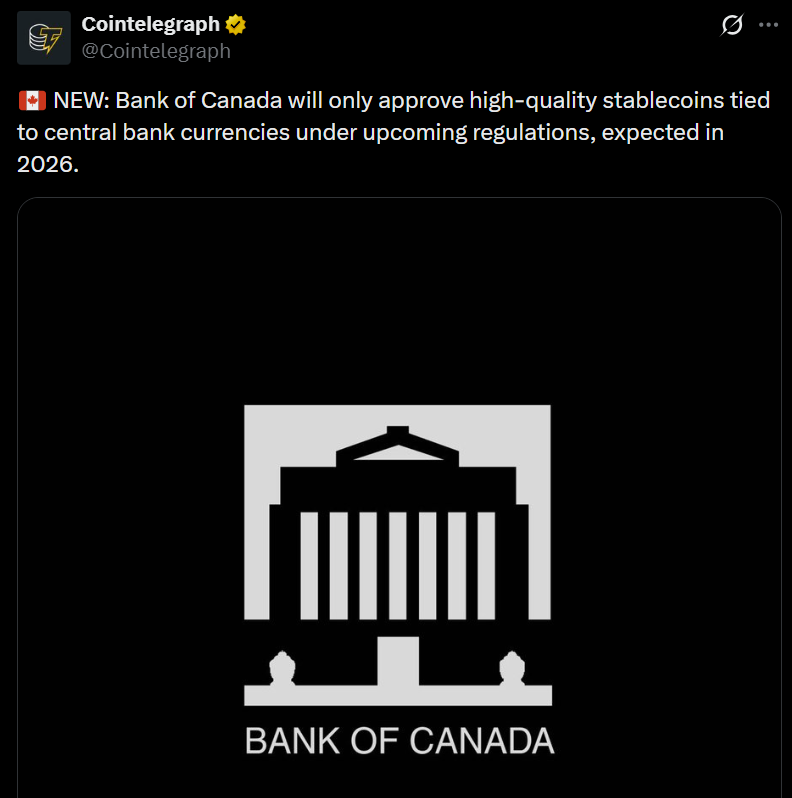
Deloitte Canada and Stablecorp are collaborating to develop stablecoin infrastructure for Canadian financial institutions, as federal regulators move closer to establishing rules for fiat-backed digital assets.
In a Monday announcement, the professional services firm said it plans to integrate Stablecorp’s Canadian dollar-pegged stablecoin, QCAD, into payment and settlement workflows for institutional clients.
Stablecorp is a Toronto-based fintech company and the issuer of QCAD, a fiat-backed stablecoin designed to maintain a one-to-one value with the Canadian dollar.
Soumak Chatterjee, a partner in Deloitte Canada’s financial services division, said the initiative is aimed at helping banks and other institutions prepare for the adoption of stablecoins once a regulatory regime is established.
The companies said potential use cases include enabling around-the-clock payments, improving settlement efficiency compared to traditional banking systems and using blockchain-based recordkeeping for transaction transparency. They also pointed to the possibility of new financial products built on tokenized infrastructure.
No bank partners or rollout timeline were provided.

Related: Canada’s budget promises laws to regulate stablecoins, following US lead
Canada moves toward stablecoin rules as global regulatory race intensifies
The development comes as the Canadian government advances a federal framework for stablecoins under Bill C-15, a budget implementation bill introduced last November that includes a proposed federal framework to regulate fiat-backed stablecoins.
While Canadian Prime Minister Mark Carney has previously expressed skepticism about crypto, he has lately acknowledged that the technologies underpinning digital assets could “improve financial stability; support more innovative, efficient and reliable payment services as well as have wider applications.”

The Bank of Canada has also called for clearer rules governing stablecoins, arguing that regulatory certainty is needed to modernize the country’s payment systems. The central bank has said any framework should ensure stablecoins are fully backed by high-quality liquid assets and redeemable at par, while warning that delays in regulation could leave Canada lagging behind other jurisdictions.
The push comes as stablecoin regulation in the United States has gained traction, culminating in the passage of the GENIUS Act for payment stablecoins last summer.
Currently, the market for Canadian dollar-denominated stablecoins remains limited, particularly compared to the dominant US dollar segment, where Tether’s USDt (USDT) and Circle’s USDC (USDC) account for the vast majority of global stablecoin supply and usage.
The Bank of Canada shelved plans for a central bank digital currency in September 2024 after more than seven years of research, including a public consultation process that drew nearly 90,000 public responses.
Related: Crypto part of Canada’s ‘core’ financial system, but risk concerns remain


MoonPay has released an open-source wallet standard designed to let AI agents hold funds and execute transactions across blockchains, addressing a key gap in how autonomous software interacts with crypto systems.
According to Monday’s announcement, the standard introduces a shared way for AI agents to access and use wallets across tools and blockchains, replacing fragmented setups where each system manages its own keys and balances. It allows agents to operate from a single pool of funds rather than across multiple disconnected accounts.
“AI agents can employ standard building blocks, such as APIs, to communicate with other agents and humans, receive and send money, and access and interact with the internet,” according to researchers at MIT Sloan.
MoonPay said recent efforts to enable machine-driven payments focus on transaction rails but do not address how wallets and keys are managed.
The new system stores private keys in an encrypted local vault and signs transactions in an isolated process, keeping keys out of the AI agent’s runtime. It also includes policy controls that let users set spending limits and restrictions before transactions are approved.
The standard is open source and modular, with components covering storage, signing, policy controls and chain support, and is available through developer platforms including GitHub, npm and PyPI.
Founded in 2019, MoonPay is a financial technology company that provides infrastructure for businesses and consumers to move funds between fiat and digital assets, offering services such as on- and off-ramps, trading and crypto payments across global markets.
The company said more than a dozen companies contributed to the new specification, including PayPal, OKX and Circle, alongside several blockchain foundations and infrastructure providers.
Related: MoonPay launches enterprise stablecoin suite with M0, taps ex-Paxos leaders
Companies expand tools for AI-driven crypto transactions
Crypto companies are increasingly building infrastructure to support AI agents as economic actors.
In a separate announcement on Monday, BitGo, a digital asset custody and infrastructure company, said it had launched a Model Context Protocol (MCP) server that allows AI-driven tools to access its developer platform using natural language, enabling agents to navigate wallet functions, transaction flows and staking systems.
The integration connects BitGo’s infrastructure to AI-native development environments, allowing tools such as ChatGPT and code editors to retrieve documentation, API references and product information directly within workflows.
The move reflects a broader push to integrate crypto services into AI systems, as companies experiment with ways for software to interact with financial infrastructure without relying on traditional user interfaces.
Other efforts have focused on enabling machine-driven payments, including Coinbase’s x402 protocol, which enables stablecoin transfers over HTTP for APIs, apps and AI agents, as well as tools launched last week by Visa and Stripe-backed Tempo that allow AI systems to initiate payments and execute transactions programmatically.
Magazine: Are DeFi devs liable for the illegal activity of others on their platforms?


Aave V4 has successfully completed the Aave Request for Comments stage, with the protocol’s team now preparing for final AIP deployment and mainnet launch.
Aave V4 has passed the ARFC (Aave Request for Comments) stage, according to an announcement from Aave founder Stani Kulechov on March 23. The protocol is now moving toward final AIP (Aave Improvement Proposal) deployment and a controlled mainnet launch with a focus on security, Kulechov said.
The ARFC stage represents a preliminary governance phase where protocol proposals are discussed before formal on-chain voting. Aave’s development team has been working to bring V4 to mainnet, with the next steps involving final AIP deployment followed by the launch itself.
Sources: Stani Kulechov (X/Twitter)
This article was generated automatically by The Defiant’s AI news system from publicly available sources.
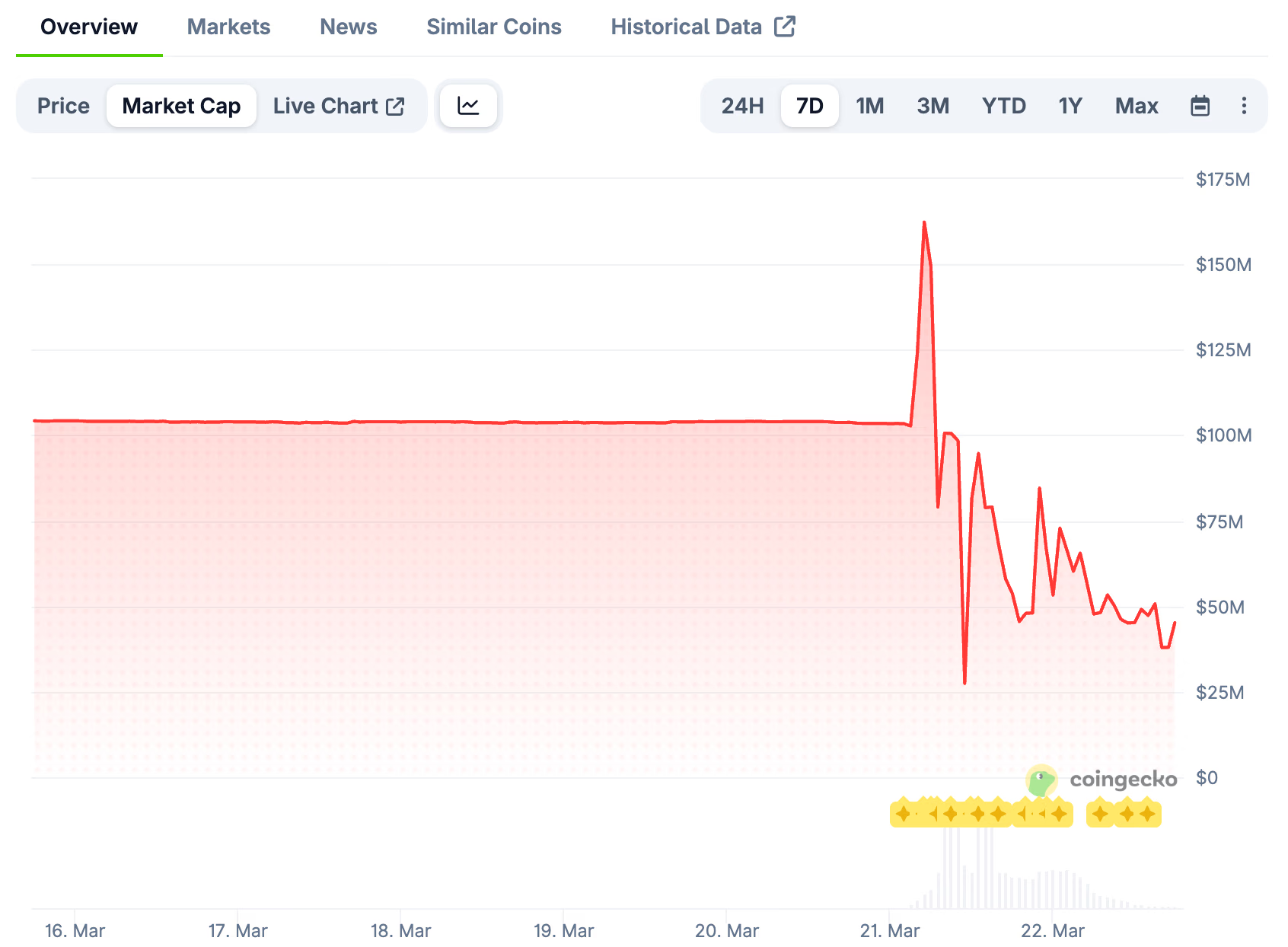
The Resolv hack wasn’t a surprise. The same structural flaw has drained hundreds of millions from Morpho, Euler, and Fluid over the past year and the industry kept building on top of it anyway.
On a quiet Sunday morning, someone turned $100,000 into $25 million in about seventeen minutes.
The target was Resolv, a yield-bearing stablecoin protocol. By the time Resolv paused its contracts, its dollar-pegged stablecoin USR had crashed to pennies. It remains deeply depegged, trading around $0.25 as of this writing, down more than 70% on the week.
The blast radius extended well beyond Resolv. Fluid/Instadapp absorbed more than $10 million in bad debt and had outflows of over $300 million in a single day, the worst outflow in its history. Fifteen Morpho vaults were hit. Euler, Venus, Lista DAO, and Inverse Finance all moved to pause USR-related markets.

The mechanism that caused the initial hack to spread its damage – pricing a depegged stablecoin at $1 in a lending market– is not new. It happened at least four times in the past fourteen months.
How the Hack Worked
USR’s minting followed a two-step off-chain process: a user deposited USDC via the `requestSwap’ function, and a privileged off-chain signing key, the `SERVICE_ROLE’, finalized the amount of USR to issue via `completeSwap’. The contract enforced a minimum output but had no maximum. Whatever the key holder signed, the contract honored.
The attacker gained access to that key through Resolv’s AWS Key Management Service. They submitted two USDC deposits, totaling roughly $100,000–$200,000, and used the compromised key to authorize 80 million USR in return. Etherscan shows two transactions worth 50 million USR and 30 million USR, minted in minutes.
“The Resolv USR exploit wasn’t a bug — it was a feature working exactly as designed. And that’s the problem,” said on-chain analyst Vadim (@zacodil).
The SERVICE_ROLE was a regular externally owned address, not a multisig. The admin key had multisig protection, but the mint key didn’t.
“Resolv was audited 18 times,” Vadim said. “One finding was literally called ‘Missing upper [limit]’”
The attacker exited methodically, converting minted USR into wstUSR (the staked wrapped version) to slow the market impact, then rotating through Curve, Uniswap, and KyberSwap into ETH. The attacker’s wallet holds approximately 11,400 ETH (~$24M). Resolv’s collateral pool, the ETH and BTC backing the system, survived intact even as the stablecoin crashed.
How the Contagion Spread
The Resolv hack is two incidents stacked on top of each other. The first is the mint exploit. The second is a cascading lending market failure.
When USR and wstUSR collapsed, every lending market that had accepted them as collateral faced the same problem: their oracle was still pricing wstUSR near $1.
Omer Goldberg, founder of risk analytics firm Chaos Labs, documented the mechanism. His key finding was that “The oracle is hardcoded and thus never repriced. wstUSR was marked at $1.13 while trading at ~$0.63 on secondary markets.”
Traders bought cheap wstUSR on the open market and posted it as collateral at the oracle’s $1.13 valuation on Morpho or Fluid, then borrowed USDC against it and walked away.
At Fluid, the team secured short-term loans to cover 100% of the bad debt and committed to making every user whole. At Morpho, co-founder Paul Frambot said ~15 vaults had significant exposure, all in high-risk, long-tail collateral strategies.
Prominent curator Gauntlet said that “A few high-yield vaults had limited exposure.”
But D2 Finance challenged that framing directly, posting onchain data showing Gauntlet’s flagship “USDC Core vault” had $4.95M allocated to the wstUSR/USDC market. Goldberg later said Gauntlet vaults accounted for 98% of lender liquidity in that market.
“I think the curator industry is poorly designed because there’s not actual curation happening,” said Marc Zeller on X.
Resolv, Gauntlet, Morpho and Fluid did not respond to The Defiant’s requests for comments by press time.
A Recurring Failure
This is not a novel attack. In January 2025, Usual Protocol’s USD0++ was hardcoded at $1 on Morpho vaults by curator MEV Capital. Usual abruptly changed its redemption floor to $0.87 without warning, leaving lenders stuck in the MEV Caital vault as utilization spiked to 100%.
In November 2025, Stream Finance’s xUSD collapsed after curators had routed USDC deposits into leverage loops backed by the synthetic stablecoin, leaving an estimated $285M–$700M at risk across Morpho, Euler, and Silo when its oracle refused to update. Moonwell suffered back-to-back oracle failures in October and November 2025, generating more than $5 million in combined bad debt.
What It Means for the Curator Model
Morpho’s architecture outsources all risk decisions to third-party “curators” who build vaults, choose collateral, set loan-to-value ratios, and select oracles. The theory is that specialist firms have deeper expertise, competition drives better risk management, and the protocol enforces rules.
But curators earn fees on yield generated, which creates an incentive to accept riskier, higher-yield collateral, like yield-bearing stablecoins. The downside is that when those stablecoins depeg, the losses fall on depositors, not on the curator. In the Resolv case, some curators had automated bots still refilling affected vaults hours after the exploit started, deepening losses.
The reason to hardcode oracles for yield-bearing stablecoins is to prevent short-term volatility from triggering unnecessary liquidations. But that protection only works as long as the stablecoin remains stable.
Chainalysis said in a post-mortem that real-time chain detection is needed.
“The on-chain smart contract worked perfectly. The broader system design and off-chain infrastructure apparently did not,” the analytics firm said.
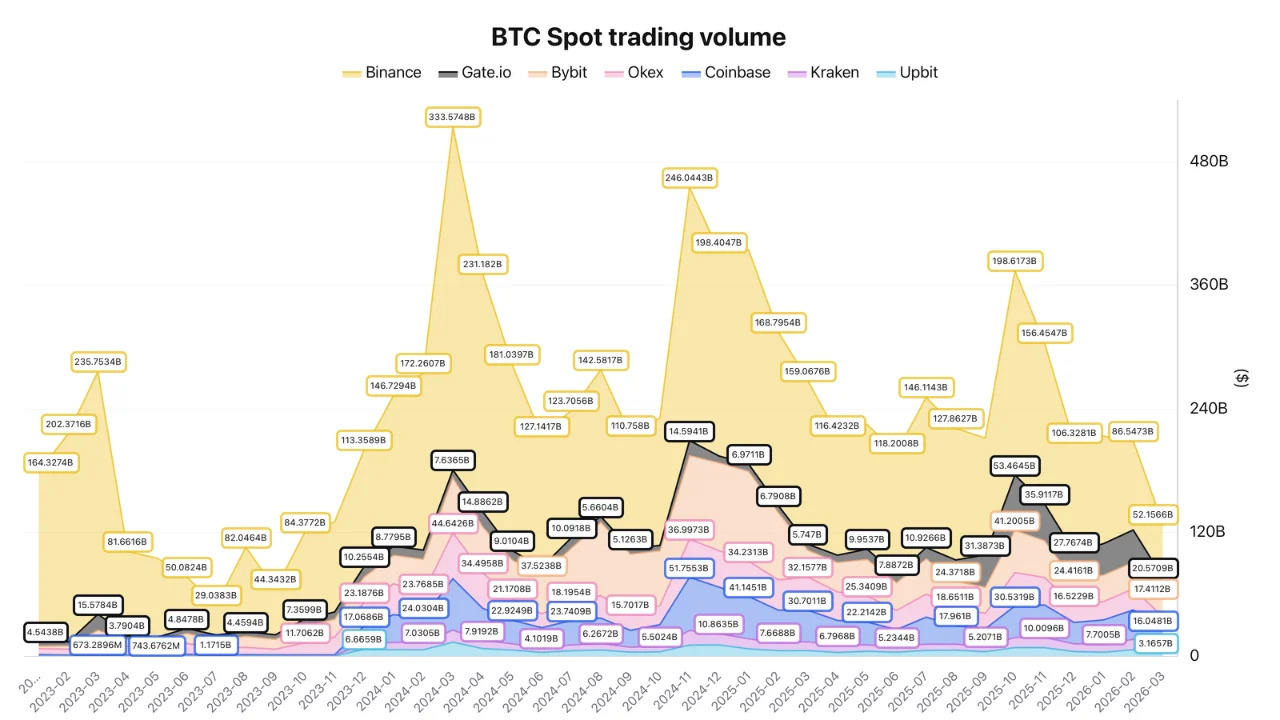
Bitcoin (BTC) spot volumes on Binance have dropped to their lowest level since September 2023, indicating that the current intraday price rise may not be backed by strong demand.
The rally above $71,700 on Monday appears to be driven mainly by news headlines and liquidations in the Bitcoin futures markets.
Binance volumes and exchange flows signal the demand gap for BTC
Crypto analyst Darkfost said that March is on track to record the lowest Binance spot volume since Q3 2023, at roughly $52 billion, compared to the $88 billion recorded in September 2023. The activity levels align with the prior bear market conditions, pointing to the reduced participation.

The exchange flow data shows a similar slowdown. Crypto analyst Arab Chain reported $6.38 billion in seven-day cumulative flows on Binance and $5.14 billion on Coinbase. The Binance flows have dropped to the lowest level since 2024, indicating reduced deposit activity.
However, the lower inflows may also coincide with a reduced supply to sell, as fewer coins move onto the exchanges. The Coinbase flows remain relatively stable, reflecting the steadier participation from the long-term investors.
The large-holder activity added another layer. Market analyst Gaah identified a record surge in the whale inflow momentum, which tracks the rate of change in large transfers to the exchanges.
The current reading of 74.3 surpasses all prior cycle peaks over the past 11 years, with a higher level last recorded at 124.6 in 2015.
The elevated inflow velocity signals an aggressive capital rotation and hedging, increasing BTC’s sensitivity to short-term volatility over the next few weeks.

Related: Bitcoin rebounds to $71K as oil drops after Trump signals pause on Iran strikes
Bitcoin liquidation activity shows traders lack conviction
The BTC rally followed reports that President Trump had deferred the planned US strikes on Iran’s energy infrastructure for five days after citing progress in the diplomatic discussions, a claim later rejected by Iran’s foreign ministry, which denied that any talks had taken place.
BTC still pushed to a weekly high of $71,789 on Binance during the US market session, driven by the above external catalyst rather than by spot demand or futures positioning, leading the move.
Data shows the rally coincided with a reduction in leverage. The aggregated open interest declined by about 9,700 BTC, marking a 4% drop over 13 hours.
The open interest tracks the total number of active futures contracts, and the decline during a price increase signals that the positions were being closed rather than new ones being opened.

This type of move typically occurs when short positions are forced out of the market, reducing the total exposure while pushing the price higher. Binance recorded over $44 million in short liquidations within one hour, the largest since the one-hour long liquidations of $53 million on Feb. 6.
The Coinbase premium (in percentage terms) remained negative during the move, indicating limited spot demand from US participants.
The falling open interest, high liquidations, and weak premiums suggest the move higher was driven by positions being closed rather than new money entering the market, with most of the activity clustered around the $71,000–$72,000 range.
Related: Gold slides as traders eye sub-$50K BTC: Five things to know in Bitcoin this week
This article does not contain investment advice or recommendations. Every investment and trading move involves risk, and readers should conduct their own research when making a decision. While we strive to provide accurate and timely information, Cointelegraph does not guarantee the accuracy, completeness, or reliability of any information in this article. This article may contain forward-looking statements that are subject to risks and uncertainties. Cointelegraph will not be liable for any loss or damage arising from your reliance on this information.
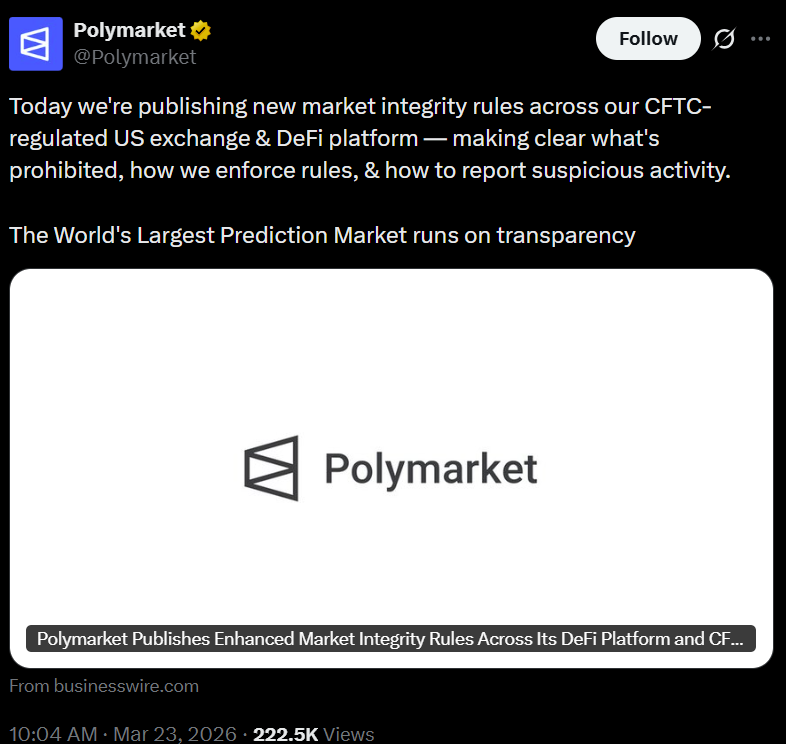
Prediction platform Polymarket has updated its market integrity rules to align more closely with regulatory standards and expand its presence as a regulated trading platform amid growing scrutiny of manipulation and insider trading risks.
In a Monday announcement, the company outlined updated rules governing both its global decentralized finance platform and its US exchange, which operates under compliance oversight by the Commodity Futures Trading Commission (CFTC).
The changes come amid growing scrutiny from regulators and politicians over risks tied to insider trading, market manipulation, and the proliferation of controversial event-based contracts.

Polymarket said the updates include stricter market design standards, clearer resolution criteria — which determine how outcomes are settled — and more defined data sources. The company said it was also enhancing monitoring and surveillance measures to detect suspicious trading activity.
In addition, Polymarket said it would limit certain types of markets, including those deemed easily manipulated or ethically sensitive.
Last week, the company said it had banned and reported users who pressured an Israeli journalist with death threats to amend a news article about an Iranian missile strike that was the subject of a $17 million prediction market.
Related: Bitcoin prediction markets see 70% chance BTC price crashes to $55K in 2026
Prediction market boom continues to draw regulatory pushback, ethics concerns
Prediction markets have surged in popularity, attracting a growing base of active traders wagering on real-world events. The momentum helped Polymarket raise $200 million in July and reportedly seek a valuation of up to $10 billion.
However, regulators remain cautious. Several US states have taken action against prediction platforms, alleging they operate as unlicensed gambling services.
Monday’s announcement came days after Major League Baseball signed a deal with Polymarket, alongside a separate agreement with the CFTC focused on so-called “integrity protections.” The arrangements signal a broader push to legitimize prediction markets through partnerships and regulatory alignment.

Ethical concerns have also intensified. In one widely cited case, a small group of Polymarket accounts reportedly generated roughly $1 million in profits by correctly timing bets on US strikes on Iran, raising concerns about potential insider trading and market fairness.
As Bloomberg reported, all six accounts were newly created in February and had only ever wagered about whether the strikes would occur.
Magazine: Are DeFi devs liable for the illegal activity of others on their platforms?
Crypto World
UnitedHealth (UNH) Stock Faces Pressure from Analyst Downgrades and Regulatory Challenges
Key Takeaways
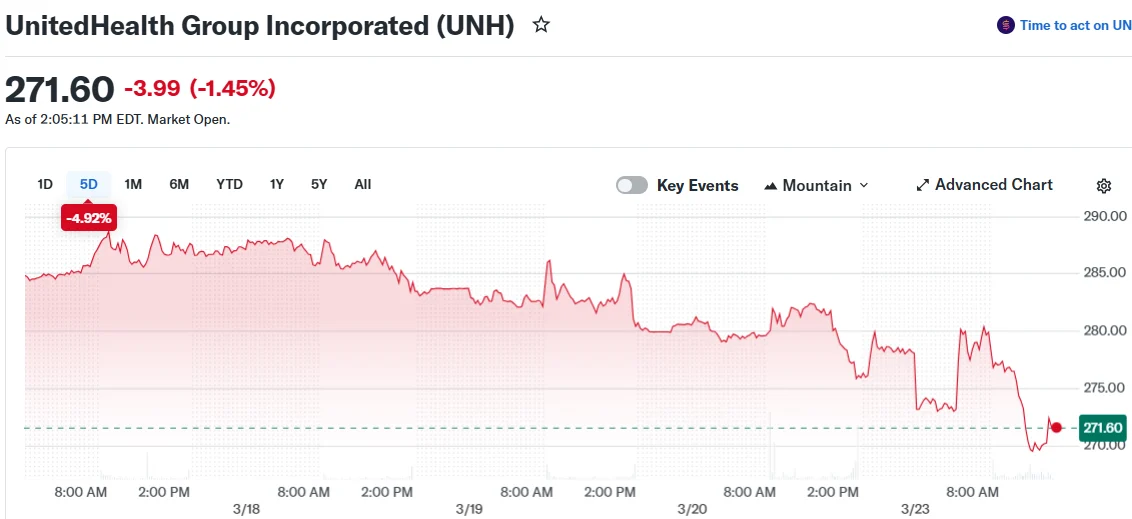
- Shares began trading at $277.32, significantly below the 52-week peak of $606.36
- Wall Street firms reduced price targets — JPMorgan to $389, Truist to $370, UBS to $410
- Weiss Ratings issued a Sell recommendation in early March
- Fourth-quarter EPS of $2.11 slightly exceeded forecasts; revenue climbed 12.3% to $113.73 billion
- Consensus rating stays at Moderate Buy with a $372.13 mean target according to MarketBeat
UnitedHealth Group (UNH) has experienced significant turbulence recently. Shares opened Monday’s session at $277.32, trading considerably beneath both the 50-day moving average of $297.19 and the 200-day moving average of $324.39.
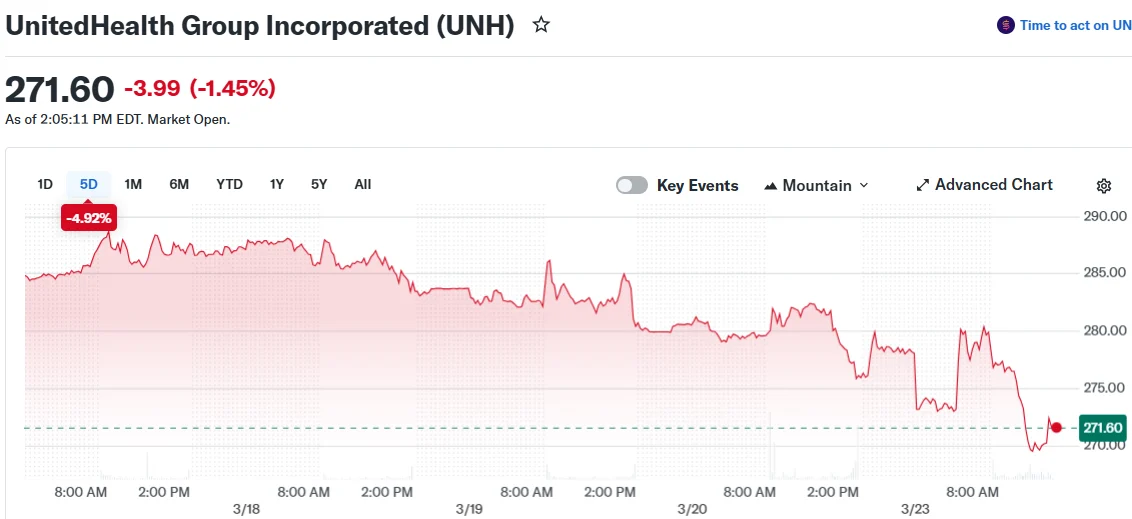
This marks a substantial decline from the 52-week peak of $606.36. The stock’s 52-week bottom rests at $234.60.
The healthcare giant’s market capitalization presently registers at $251.71 billion, accompanied by a price-to-earnings multiple of 21.02 and a beta of 0.41.
The company maintains a debt-to-equity ratio of 0.72, while both current and quick ratios stand at 0.79.
During January, UnitedHealth disclosed fourth-quarter earnings of $2.11 per share, marginally surpassing the consensus forecast of $2.09. Revenue totaled $113.73 billion, representing a 12.3% year-over-year increase and slightly exceeding Wall Street projections.
However, the Q4 EPS figure represents a significant decline compared to the $6.81 posted during the corresponding quarter last year.
Wall Street Firms Reduce Price Targets
Multiple prominent investment banks have decreased their price objectives in recent weeks.
JPMorgan reduced its target from $425 down to $389, Morgan Stanley adjusted downward from $411 to $409, and UBS lowered its projection from $430 to $410. Truist executed the most aggressive reduction, dropping from $410 to $370. Despite these cuts, all four firms preserved Buy or Overweight recommendations.
Weiss Ratings took a more bearish stance, downgrading UNH from Hold to Sell during early March.
According to MarketBeat, the current consensus rating remains at Moderate Buy, featuring 17 Buy recommendations, 8 Hold ratings, and 2 Sell ratings. The mean 12-month price objective stands at $372.13 — suggesting approximately 34% potential upside from present levels.
Regarding institutional investors, significant movements have occurred. Wealth Enhancement Advisory Services reduced its position by 40.6% during Q4, liquidating 170,643 shares. Conversely, Norges Bank, Berkshire Hathaway, and Capital Research Global Investors all increased or established new positions throughout 2024. Institutional investors collectively control 87.86% of outstanding shares.
Ongoing Regulatory Concerns
Department of Justice investigations concerning Medicare Advantage reimbursement methodologies continue creating headwinds for investor sentiment. While the company has secured at least one favorable legal outcome in that matter, broader regulatory pressures surrounding prior-authorization procedures and coverage denial practices persist.
Executives have previously disclosed intentions to reduce certain Medicare Advantage membership and adjust product pricing in response to changing cost dynamics.
Management provided fiscal year 2026 EPS guidance of approximately $17.75. Wall Street analysts currently project full-year EPS of $29.54 for the ongoing fiscal year.
UNH distributed a quarterly dividend of $2.21 per share on March 17, translating to an annualized yield of approximately 3.2%. The current payout ratio stands at 67.02%.
On a constructive note, UnitedHealth recently unveiled a nationwide expansion of its doula benefit initiative, which may enhance member retention and drive improved outcomes within its value-based care framework.


XRP hits a snag after Monday’s relief rally, active addresses down 40%

Kirklees council pushes through privatisation of dementia homes

Report: Raptors sign guard Markelle Fultz to 10-day contract


-
 Crypto World3 days ago
NIO (NIO) Stock Plunges 6.5% as Shelf Registration Sparks Dilution Worries
-

 Fashion3 days ago
Weekend Open Thread: Adidas – Corporette.com
-

 Politics3 days ago
Jenni Murray, Long-Serving Woman’s Hour Presenter, Dies Aged 75
-
 Tech6 days ago
Are Split Spacebars the Next Big Gaming Keyboard Trend?
-

 Business7 days ago
How the UK and China Trade Agreement Could Shape UK Businesses in 2026
-

 Crypto World2 days ago
Best Crypto to Buy Now: Strategy Just Spent $1.57 Billion on Bitcoin During Fear While Early Investors Quietly Enter Pepeto for 150x Potential
-

 News Videos5 days ago
RBA board divided on rate cut, unusually buoyant share market | Finance Report | ABC NEWS
-

 Crypto World2 days ago
Bitcoin Price News: Bhutan Sells $72 Million in BTC Under Fiscal Pressure, but the Smart Money Entering Pepeto Sees What the Market Does Not
-

 Politics5 days ago
The House | The new register to protect children from their abusers shows Parliament at its best
-

 Tech4 days ago
inKONBINI Lets You Spend Summer Days Behind the Register
-
 Politics6 days ago
Real-time pollution monitoring calls after boy nearly dies
-

 Crypto World5 days ago
Canada’s FINTRAC revokes registrations of 23 crypto MSBs in AML crackdown
-

 Sports8 hours ago
Remo Stars and Kano Pillars Strengthen Survival Hopes in NPFL
-

 News Videos5 days ago
PARLIAMENT OF MALAWI – PAC MEETING WITH REGISTRAR OF FINANCIAL ON AMARYLLIS HOTEL – INQUIRY LIVE
-
 NewsBeat5 days ago
Residents in North Lanarkshire reminded to register to vote in Scottish Parliament Election
-

 Politics4 days ago
Gender equality discussions at UN face pushbacks and US resistance
-

 Business1 day ago
No Winner in March 21 Drawing as Prize Rolls to $133 Million for Next
-

 Business5 days ago
Who Was Alex Pretti? 5 Key Facts About the ICU Nurse Killed by Federal Agents in Minneapolis
-

 Tech23 hours ago
Give Your Phone a Huge (and Free) Upgrade by Switching to Another Keyboard
-

 Sports7 hours ago
Gary Kirsten Accuses Pakistan Cricket Board Of ‘Interference’, Mohsin Naqvi Responds
You must be logged in to post a comment Login