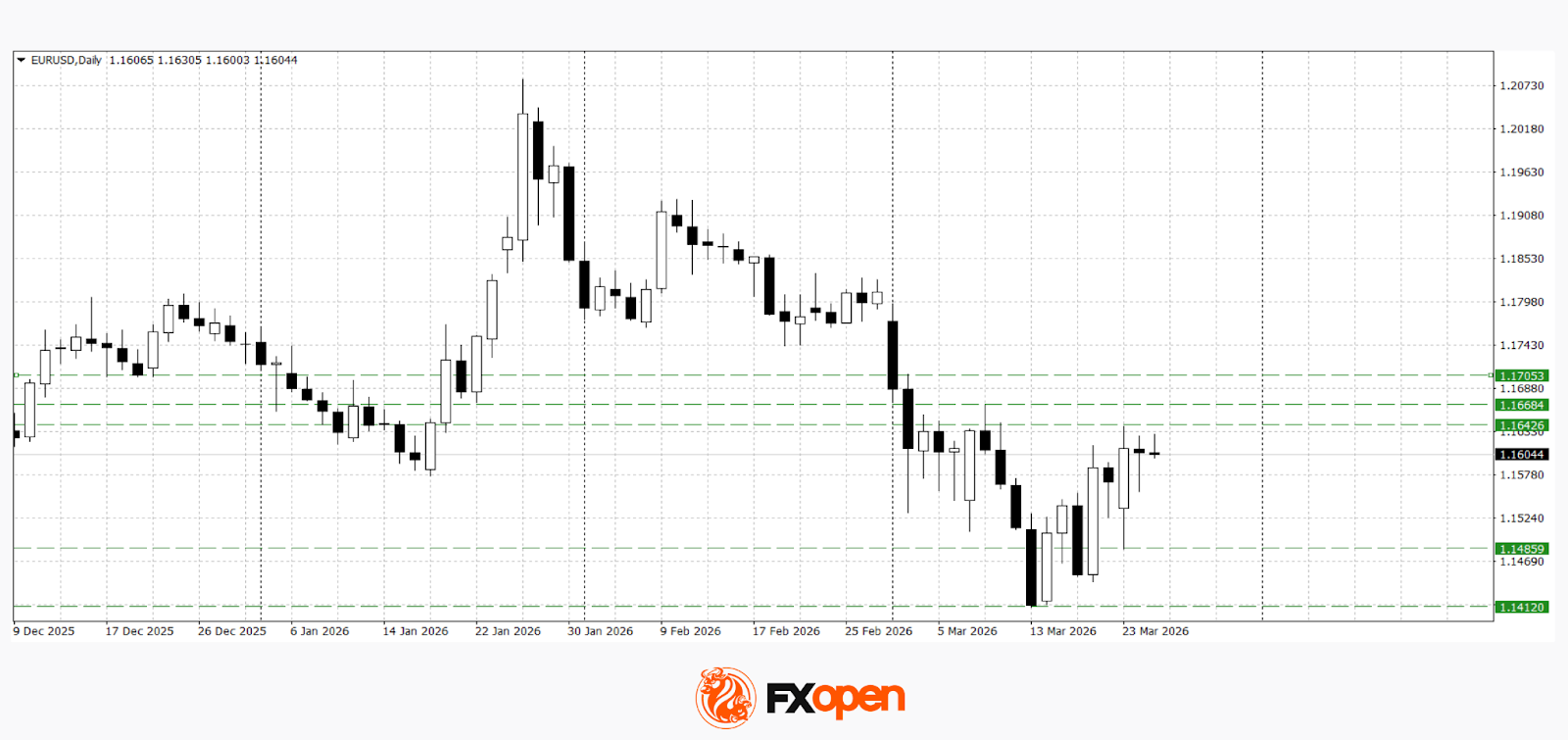
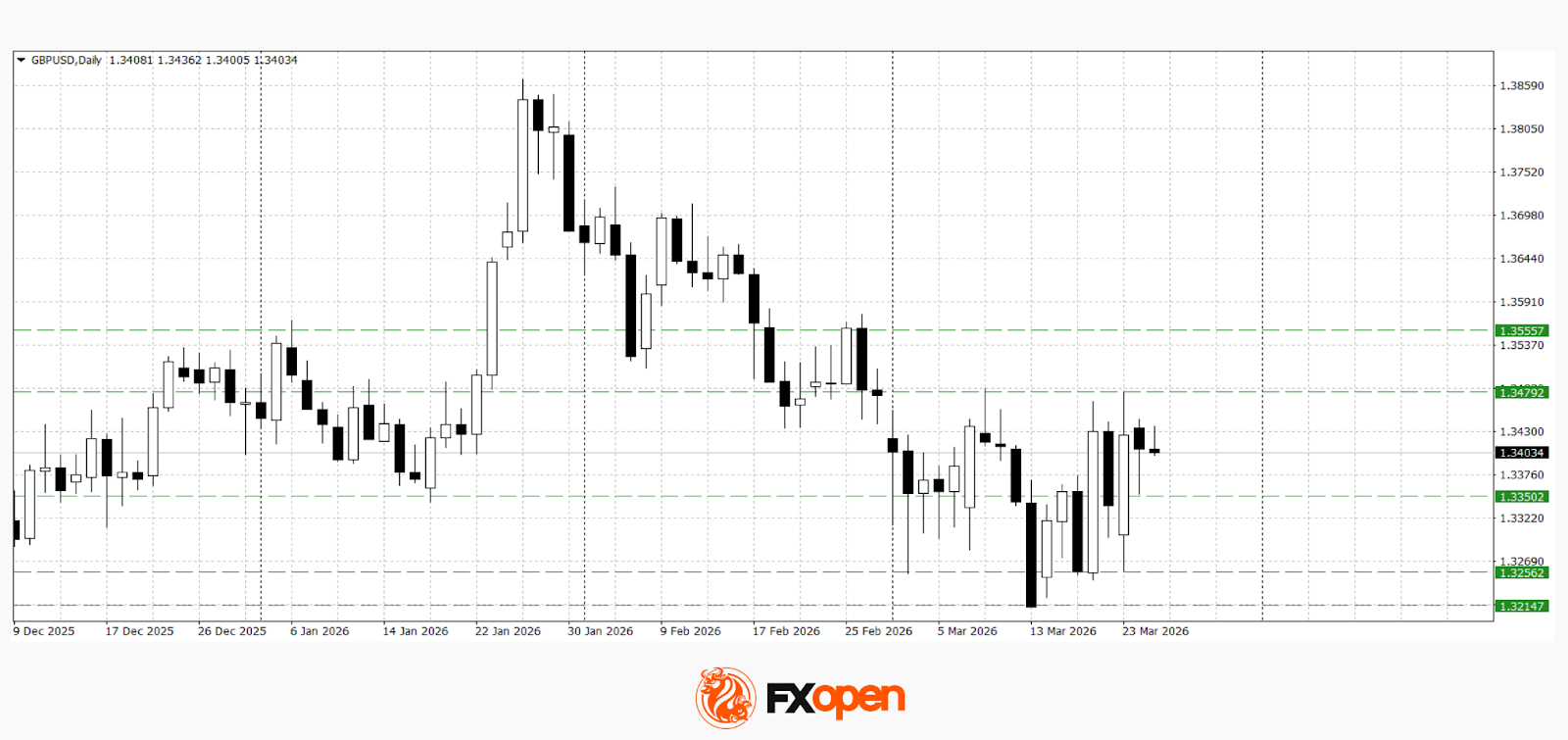
European currencies are trading without a clear direction against the US dollar, remaining in a consolidation phase following the earlier decline driven by USD strength. At the start of the week, both EUR/USD and GBP/USD attempted a recovery, but the upside proved limited, and the pairs are now testing the upper boundaries of their short-term trading ranges.
Market participants are adopting a wait-and-see approach ahead of the release of key macroeconomic data, which could determine the next direction for the dollar and major currency pairs. Geopolitical uncertainty in the Middle East remains an additional factor weighing on sentiment. Reports of ongoing tensions and risks to energy supply disruptions continue to support elevated oil prices, fuelling inflation expectations and prompting investors to reassess the outlook for central bank policy.
Today, the focus is on business activity and inflation data from Europe and the UK, as well as housing market and consumer activity figures from the US. These releases could significantly impact interest rate expectations, prompting traders to refrain from opening large positions ahead of the data.
EUR/USD
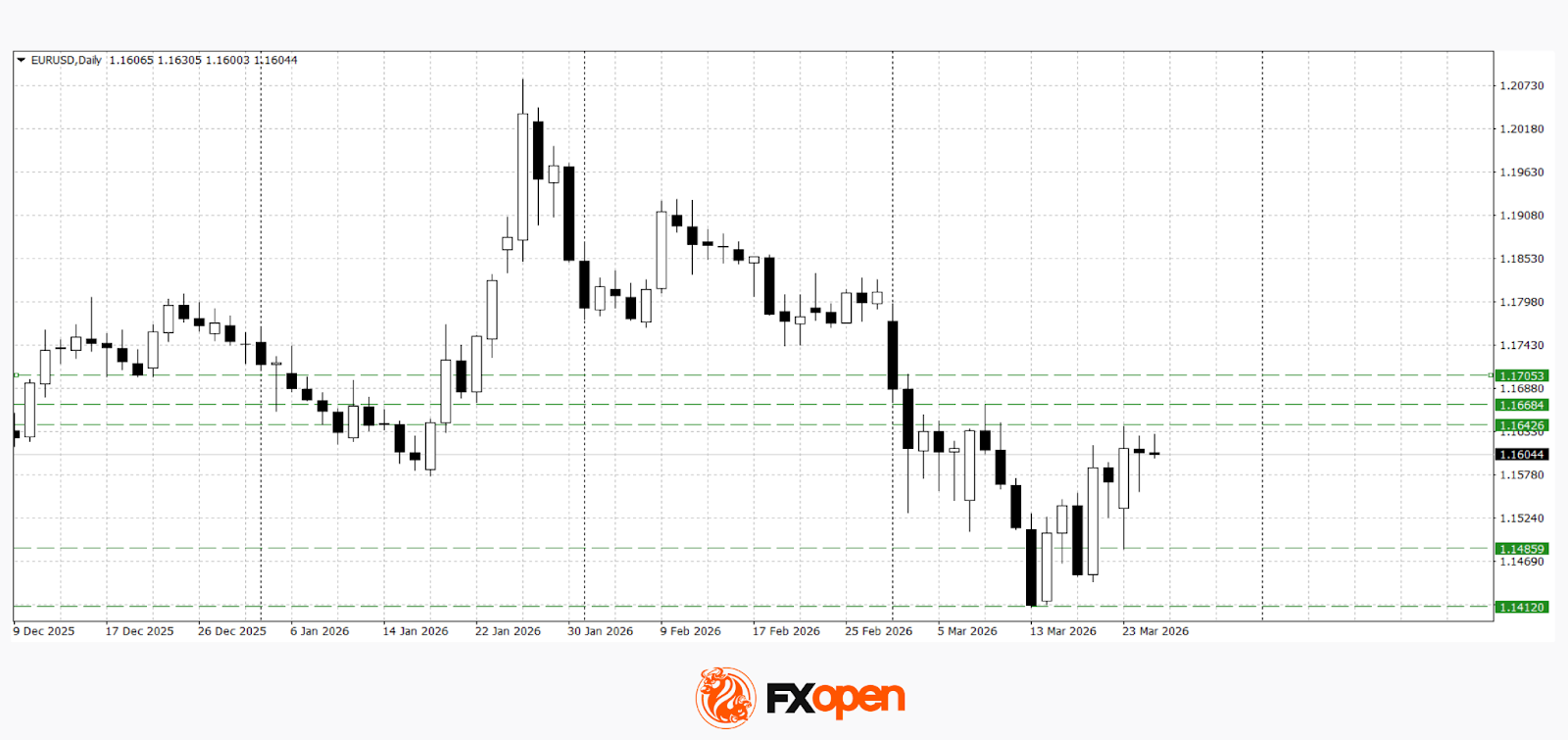
At the start of the week, EUR/USD tested key support near 1.1480 before rebounding above 1.1600. Technical analysis suggests a range-bound market: a rejection from the key resistance level at 1.1640 could lead to a renewed test of recent lows in the 1.1420–1.1480 area. Conversely, a firm break above 1.1640 and a move out of the range could open the way for further gains towards 1.1680–1.1710.
Advertisement
Key events for EUR/USD:
Today at 11:00 (GMT+2): Germany business expectations index
Today at 13:00 (GMT+2): Bundesbank monthly report
Today at 14:30 (GMT+2): US current account balance
GBP/USD
GBP/USD is also trading within a range. Following last week’s Bank of England meeting, the pair strengthened towards 1.3480 but failed to sustain upward momentum, retreating to 1.3250 on Monday. Technical analysis points to the potential for a retest of the recent high; however, in the event of weak UK data, a move lower towards the 1.3350–1.3250 area is equally possible.
Key events for GBP/USD:
Today at 09:00 (GMT+2): UK Consumer Price Index (CPI)
Today at 11:30 (GMT+2): UK house price index
Tomorrow at 11:30 (GMT+2): Speech by Bank of England Financial Policy Committee member Sarah Breeden
Trade over 50 forex markets 24 hours a day with FXOpen. Take advantage of low commissions, deep liquidity, and spreads from 0.0 pips (additional fees may apply). Open your FXOpen account now or learn more about trading forex with FXOpen.
This article represents the opinion of the Companies operating under the FXOpen brand only. It is not to be construed as an offer, solicitation, or recommendation with respect to products and services provided by the Companies operating under the FXOpen brand, nor is it to be considered financial advice.
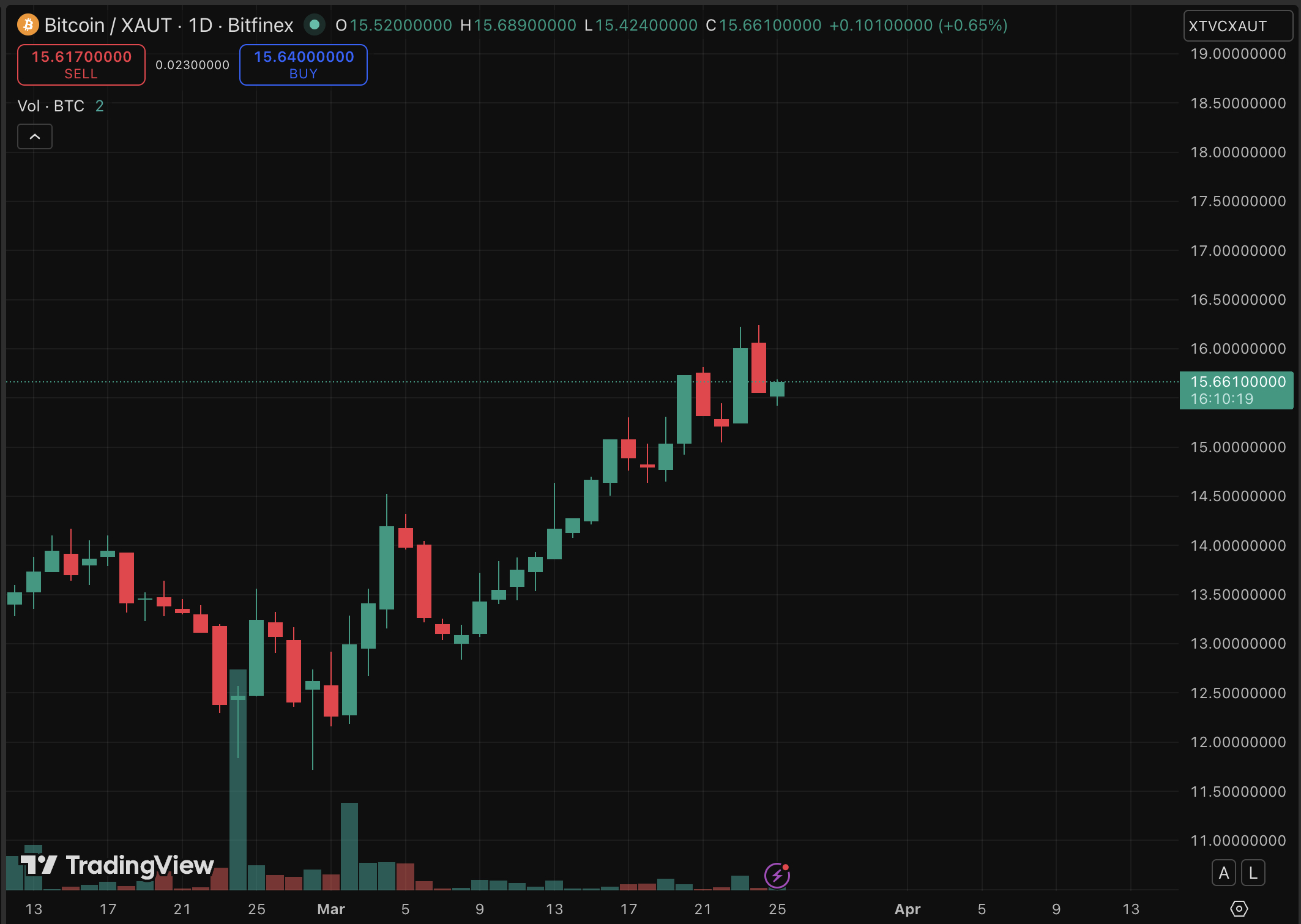
Investors fled major gold funds as geopolitical tensions escalated, marking a distinct shift in capital allocation strategies. While gold spot ETFs bled, Bitcoin price has demonstrated resilience, holding the $70,000 level amid prediction of market whipsaws. This divergence suggests a potential changing of the guard, according to Bloomberg analyst.
The latest data paints a stark picture of this rotation. In the last week alone, top gold ETFs like GLD and IAU saw approximately $3.8 billion in exits. Conversely, Bitcoin investment products absorbed roughly $2 billion over the past few weeks, signaling that institutional appetite is shifting toward digital scarcity.
“Since the Iran strike, Bitcoin, surprisingly, has looked like a good safe haven and gold hasn’t,” noted Eric Balchunas, senior ETF analyst at Bloomberg Intelligence.
BTC XAUT, TradingView
Currently, Bitcoin trades above $71,000, noting a fractional bounce by 0.3% in the last 24 hours.
This decoupling challenges the traditional narrative that crypto assets are purely risk-on vehicles. With Bitcoin behaving as a store of value while gold falters, we are closely watching the $70,000 support zone for the next directional cue.
Bitcoin Price Prediction: Can BTC Hold $70,500 Support Amid Volatility?
Bitcoin’s price action over the last 48 hours has been defined by tight consolidation, oscillating between a high of $72,000 and a low of $69,000. While the asset remains down 18% year-to-date, the immediate short-term structure shows buyers stepping in aggressively near the $68,000 mark.
Volume data indicates a standoff and cautious optimism. However, overhead resistance at $71,800 remains a formidable barrier. If bulls fail to reclaim this level, a retest of the monthly low at $65,000 becomes a viable bearish scenario. Conversely, a breakout above $72,500 could open the path toward this year’s high.
BTC USD, TradingView
The technical setup suggests a market in waiting. Geopolitical catalysts are currently priced in, but the lack of a clear breakout keeps margin traders largely sidelined. For those seeking aggressive multiples, Bitcoin’s maturity into a “safe haven” may limit short-term explosive upside compared to emerging ecosystem plays.
Bitcoin Hyper Targets Early Mover Upside as L2 Narrative Heats Up
While Bitcoin stabilizes as a macro asset, the race to scale its network is accelerating. Capital is rotating into infrastructure layer-2 solutions that promise to unlock programmability for the world’s largest digital asset. Leading this charge is Bitcoin Hyper ($HYPER), the first-ever Bitcoin Layer 2 to integrate the Solana Virtual Machine (SVM).
The project is capitalizing on the demand for high-speed, low-cost execution on Bitcoin. By utilizing the SVM, Bitcoin Hyper delivers transaction finality faster than Solana itself, addressing Bitcoin’s core limitations—slow transactions and high fees—while maintaining a decentralized canonical bridge to the main chain. The market response has been quantifiable: the presale has already raised more than $32Million.
Early participants can enter at a price of $0.0136 per token with 36% APY on staking rewards. Beyond the technology, the protocol offers high APY staking incentives to secure the network early. As Bitcoin continues to trade sideways in the $70k range, the risk-reward ratio for pre-market infrastructure plays like $HYPER is drawing attention from traders looking to front-run the L2 ecosystem boom.
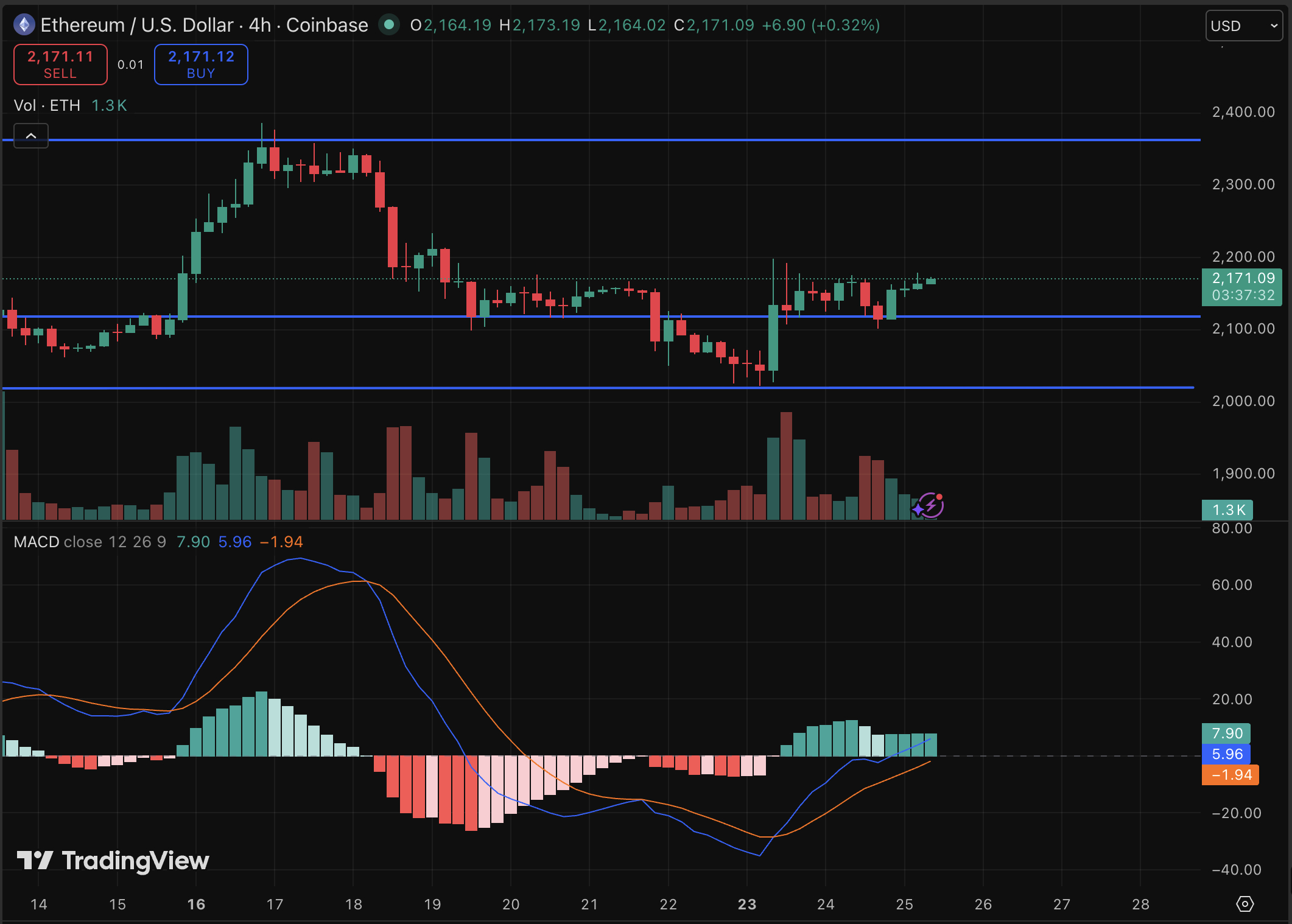
Ethereum price entered a pivotal stretch this week, trading at $2,170, a subtle +0.73% in the last 24 hours, as the network confronts deep existential questions regarding its roadmap prediction.
Following critical remarks from co-founder Vitalik Buterin regarding the ecosystem’s fragmented scaling approach, markets are reacting with caution. Data from prediction markets currently imply downside risks.
[X] I affirm the direction set out in the mandate, will help translate it into thoroughly reasoned strategies for my domain, and will maintain an exclusive and energetic focus on the mission-critical tasks necessary for its implementation, from today until my last day at the EF. https://t.co/D3puYiQzhB
The technical landscape has shifted violently in early 2026. While developers previously assumed applications would absorb complexity, Buterin argues that current Layer-2 (L2) proliferation may not fully deliver on Ethereum’s original design goals. This introspection arrives as the network attempts to secure itself against quantum threats and integrate AI capabilities.
Advertisement
This uncertainty regarding scaling architecture often leads capital to rotate. As established networks grapple with legacy cohesion, the market is pricing in the next generation of infrastructure plays.
Ethereum Price Prediction: Can ETH Hold Support This Week?
Ethereum’s price action suggests a battle for directional control. Currently changing hands at $2,170, ETH remains pinned between a critical support floor at $2,100 and overhead resistance at $2,350. Recent data reveals seller-skewed order books (47/43), indicating that bears are attempting to force a retest of the psychological $2,050 zone.
Advertisement
Technical indicators flash warning signs. While the MACD remains positive at 6, the histogram has turned red (-1.93), signaling that the bullish momentum seen during recent L2 testnet expansions is fading. A break below the 9-day DEMA at $2,300 has already occurred, forcing bulls to defend the lower range.
ETH USD, TradingView
The 24-hour trading range ($2,150-$2,180) reflects tight consolidation. If ETH can reclaim $2,300 and close above $2,400, analyst targets suggest a breakout toward the 200-EMA at $3,260 is possible.
LiquidChain Targets Unified Liquidity as Ethereum Segments
While Ethereum struggles with the fragmentation caused by disconnected Layer-2s—a concern highlighted explicitly by Buterin—investors are looking toward protocols that solve the liquidity fracture. This narrative shift has directed significant volume toward LiquidChain ($LIQUID), a Layer-3 infrastructure project designed to unify execution across chains.
Advertisement
Unlike current scaling solutions that isolate liquidity, LiquidChain fuses Bitcoin, Ethereum, and Solana into a single execution environment. The project’s presale has already raised more than $600K, with more than 1700% APY rewards.
Priced at $0.0143 during the current tranche, the project offers a verifiable settlement layer that appeals to traders fatigued by bridging risks. While high-cap assets like ETH face resistance in established price channels, early-stage infrastructure plays like LiquidChain are capturing the “solution utility” premium.
Investors holding silver positions opened in early this year are staring at significant unrealized losses today. Silver price finished yesterday’s session down to $68 per ounce, a sharp retraction from the $120 highs seen in late January following a turbulent market analysis.
Following a volatile trading window where prices collapsed as low as $61 during the Asian session, market participants are scrambling to reassess the geopolitical premiums previously baked into the commodity. This 40% drawback highlights the dangers of chasing assets that climb “like fireworks.”
Silver Price Analysis: Can The Metal Stabilize After Double-Digit Drop?
$69 is the number currently defining traders’ screens. The session low of $61, printed at 3 a.m. ET, now serves as the critical support floor. The volatility stems directly from macro-geopolitical developments involving the United States and Iran, specifically regarding the Strait of Hormuz. While the threat of immediate escalation has been postponed by five days to allow for talks, the market reaction suggests the risk premium is eroding faster than bulls anticipated.
Technical indicators scream caution. The swift drop from $120 suggests the parabolic phase has fractured. Volume on the downdraft was significant, indicating institutional liquidation rather than mere retail panic.
XAG USD, TradingView
If the $61 level fails to hold during the next testing of liquidity, analysts suggest further downside is probable. Conversely, a stabilization here requires a distinct shift in sentiment, perhaps fueled by safe-haven narratives reversing back to precious metals. Capital seems to be rotating, and fast.
Bitcoin Hyper Targets Early Mover Upside as Commodities Stumble
While silver investors lick their wounds from an 18.5% correction, smart capital is actively hunting for infrastructure plays that offer yield rather than just a volatile store of value. The heavy volatility in traditional commodities is driving a rotation into programmable assets—specifically Bitcoin Layer 2s.
Enter Bitcoin Hyper ($HYPER), the first-ever Bitcoin Layer 2 solution integrating the Solana Virtual Machine (SVM).
This project is not relying on geopolitical fear; it is building structural utility. Bitcoin Hyper has already raised an exact $32 million in its presale, signaling massive demand for high-speed Bitcoin infrastructure.
By bridging Bitcoin’s trust with Solana’s speed, $HYPER offers low-latency transaction execution and high APY staking with 36% rewards. The token is currently priced at $0.0136.
Investors tired of commodity whiplash are increasingly looking to research Bitcoin Hyper as the next growth frontier.
Disclaimer: This article is for informational purposes only and does not constitute financial advice. Cryptocurrency and commodity investments are highly volatile. Please do your own research.
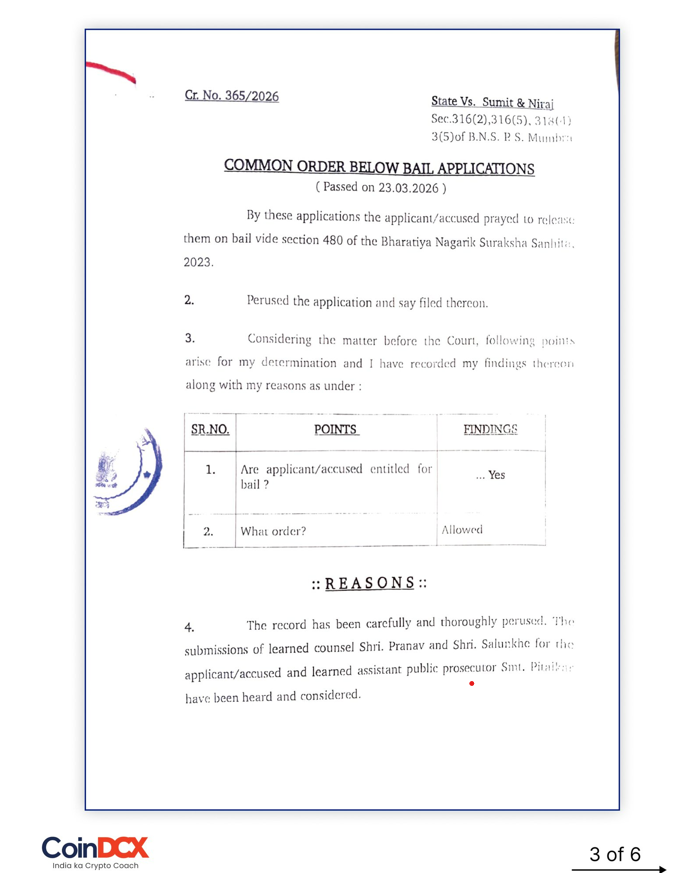
A magistrate court in Thane, India, has granted bail to CoinDCX co-founders Sumit Surendra Gupta and Niraj Ashok Khandelwal, ruling that no prima facie case was made out against them in a 71 lakh Indian rupees ($75,000) cheating complaint linked to a fake trading platform posing as the Indian crypto exchange.
The court’s common order on March 23 on their bail applications concluded that they were entitled to bail because no case was made out against them, even on an initial look at the available evidence. The founders were taken in for questioning on Saturday and remanded over the weekend after a complaint alleged they had duped an investor.
In the order, the magistrate recorded that the investigation officer had “no objection” to their release and that the applicants were not present in Mumbra when the alleged offence took place, adding that “some other person by representing as accused cheated the informant,” a fact the informant has admitted in court.
CoinDCX says bail order backs “third‑party impersonation”
In a March 24 statement on X, CoinDCX said the court proceedings supported a “third-party impersonation” scenario and that the fraud occurred on a lookalike site, coindcx.pro, which it said had no connection to the company.
The judge noted that the informant filed an affidavit stating that another accused, Rana, had repaid him the cheated amount and that the applicants are not the persons he met at a café in Kausa Mumbra where the fraudulent deal was struck.
With the matter “amicably settled” between the informant and the main accused, the court said there was no question of the founders tampering with evidence or witnesses.
Each was ordered released on bail upon executing a 50,000 Indian rupee bond (roughly $530) on condition that they cooperate with the investigation and trial.
CoinDCX framed the episode as part of a broader rise in impersonation and phishing scams targeting well-known brands in India’s financial and crypto sectors, urging users to verify domains and only interact with the exchange’s official platform and social media profiles.
Advertisement
Prior scrutiny surrounding CoinDCX
Established in 2018 and headquartered in Mumbai, CoinDCX ranks among India’s most prominent cryptocurrency exchanges. The company reached an estimated valuation of around $2.45 billion following a funding round led by Coinbase Ventures in October 2025.
The platform has previously come under scrutiny for security concerns after a July 2025 incident in which hackers drained approximately $44 million from one of its internal operational accounts, although CoinDCX emphasized that no customer funds were compromised.
Cointelegraph is committed to independent, transparent journalism. This news article is produced in accordance with Cointelegraph’s Editorial Policy and aims to provide accurate and timely information. Readers are encouraged to verify information independently. Read our Editorial Policy https://cointelegraph.com/editorial-policy
SWIFT is building blockchain-based cross-border payment infrastructure with more than 40 global banks targeting a live scheme by mid-2026, and the plumbing it is laying quietly positions XRP crypto as an optional liquidity rail inside that network.
The mechanism is not a partnership announcement or a headline integration, it runs through Thunes, a payments company now embedded in SWIFT’s network, whose connections reach Ripple’s payment products and, by extension, XRP’s on-demand liquidity functions.
The market is watching because SWIFT’s blockchain push is no longer a pilot program. Bank of America, JPMorgan Chase, HSBC, Deutsche Bank, BNP Paribas, and Lloyds Bank are among the institutions involved. That is not a proof-of-concept roster. That is the institutional settlement stack deciding which rails to wire.
Key Takeaways:
Advertisement
Settlement Context: SWIFT’s blockchain scheme, targeting an MVP in H1 2026 with 40-plus banks, completed ISO 20022 migration in November 2025 and has run successful trials involving USDC, tokenized deposits, and tokenized bonds.
XRP Position: The SWIFT-Thunes integration gives more than 11,000 banks optional access to Ripple’s liquidity products, including XRP as a bridge asset — but participation is not mandated.
Market Signal: Institutional infrastructure decisions like this create structural demand optionality for XRP, not guaranteed volume; the difference matters for how traders should frame this narrative.
How the SWIFT-Thunes-XRP Connection Actually Works
The mechanics are not theoretical. SWIFT completed its full migration to the ISO 20022 messaging standard on November 22, 2025, enabling richer, structured data flows that are prerequisite infrastructure for digital asset settlement.
That migration was the foundation. What is being built on top of it is a blockchain-enabled shared ledger scheme with enforceable rules on fees, FX rates, and traceability, with Chainlink providing interoperability between private and public blockchains while remaining ISO 20022 compliant.
The Thunes integration is where XRP enters the picture. SWIFT connects to Thunes’ pay-to-bank service, which now sits inside SWIFT’s network and links to more than 11,000 banks worldwide. Thunes can offer Ripple’s payment products. Those products can leverage XRP for on-demand liquidity, specifically as a bridge asset, eliminating the need for pre-funded nostro accounts in destination currencies.
Advertisement
What if sending money across borders felt as seamless as sending it domestically? Last year, we set out to transform the cross‑border payment experience with the launch of a new Swift payments scheme – designed to deliver fast, predictable and transparent payments worldwide.… pic.twitter.com/bDsfV64nVk
The routing sequence: a company sends a payment via SWIFT; SWIFT routes through Thunes; Thunes offers access to Ripple’s ODL infrastructure; XRP settles the leg. No step in that chain forces a bank to use XRP. The optionality is built in, not mandated.
That optionality is structurally meaningful. SWIFT ran a successful trial with Citi using USDC in November 2025 and completed a proof-of-concept with HSBC and Ant International for tokenized deposit transfers the following month.
A January 2026 trial with BNP Paribas Securities Services, Intesa Sanpaolo, and Societe Generale FORGE settled tokenized bonds against fiat and digital payments. The institution is stress-testing every digital asset rail available — and XRP’s rail is now wired in.
Advertisement
What this unlocks is distribution at a scale XRP has not had access to through direct Ripple partnerships alone.
Why SWIFT’s Pivot Changes the Cross-Border Rail Debate
For years, the XRP settlement narrative rested on Ripple’s direct bank partnerships and regulatory outcomes. SWIFT’s blockchain pivot reframes the question entirely.
The debate is no longer whether banks will adopt blockchain for cross-border payments, SWIFT’s 40-bank scheme settles that. The debate is over which digital asset serves as the liquidity provider when payments require real-time currency bridging.
Chainlink’s interoperability role in SWIFT’s scheme also hints at a multi-asset settlement environment rather than a single-winner outcome.
MASSIVE: $XRP JOINS OIL AND GOLD AS A MAJOR COMMODITY ASSET According to several sources interpreting recent statements by the SEC and CFTC, @Ripple's $XRP token is now deemed a digital commodity in the eyes of US regulators.$XRP is not the only asset to have claimed… pic.twitter.com/f7ZEXIAkSV
The infrastructure phase of cross-border payments is being decided now. Institutional players are wiring digital settlement rails into legacy systems across the board, and first-mover positioning inside those rails compounds. XRP’s advantage is that it is already connected. Its risk is that connected does not mean preferred.
Advertisement
The asset that becomes the default settlement infrastructure inside SWIFT’s network will not announce it. The volume data will.
CoinDCX co-founders Sumit Surendra Gupta and Niraj Ashok Khandelwal have secured bail from a magistrate court in Thane, India, after a cheating complaint linked them to a fake platform that posed as the crypto exchange.
Summary
CoinDCX founders received bail after the court found no prima facie case against them initially.
The court said another person impersonated the accused and carried out the cheating scheme there.
CoinDCX linked the complaint to a fake website and warned users about phishing risks.
Meanwhile, the court said no prima facie case was made out against them in the 71 lakh Indian rupees complaint and allowed their release on bond. The magistrate court issued a common order on March 23 on the bail applications filed by Gupta and Khandelwal. The order said the available material did not show a case against them, even at an initial stage.
The court also recorded that the investigation officer had “no objection” to their release. It added that the two founders were not present in Mumbra when the alleged offence took place, which weakened the complaint filed against them.
Advertisement
The case began after an investor claimed he had been cheated in a deal linked to CoinDCX. The founders were taken in for questioning on Saturday and remained in custody over the weekend before the court heard their bail plea.
During the hearing, the court noted that “some other person by representing as accused cheated the informant,” and said the informant had admitted that fact in court. This point became central to the bail order because it shifted focus away from the CoinDCX founders and toward other individuals tied to the alleged fraud.
In a March 24 statement posted on X, CoinDCX said the court process supported a “third-party impersonation” case. The company said the fraud took place through a lookalike website, coindcx.pro, which it said had no link to its official business.
Advertisement
The judge also referred to an affidavit filed by the informant. In that affidavit, the informant said another accused, Rana, had repaid the lost money and confirmed that the two CoinDCX founders were not the people he met at a café in Kausa Mumbra where the deal happened.
Bail conditions and fraud warning
The court said the matter had been “amicably settled” between the informant and the main accused. Based on that, it found no risk that the founders would interfere with witnesses or evidence if released.
Each founder was granted bail on a 50,000 Indian rupee bond. They must cooperate with the investigation and trial. CoinDCX later said the case reflects a wider rise in phishing and impersonation scams in India’s financial and crypto sectors, and urged users to verify website domains and use only official company channels.
BNB price surged back towards the $650 mark as futures traders aggressively positioned for further upside following a bullish prediction. After touching an intraday low of $627 on Sunday, the asset rebounded to $645, signaling a potential sentiment shift across the broader altcoin market.
The bounce coincides with a cooling of geopolitical tensions and a sharp decline in crude oil prices below $90. This macro relief has injected liquidity back into risk assets, pushing Bitcoin back above $71,000 and dragging major altcoins upward.
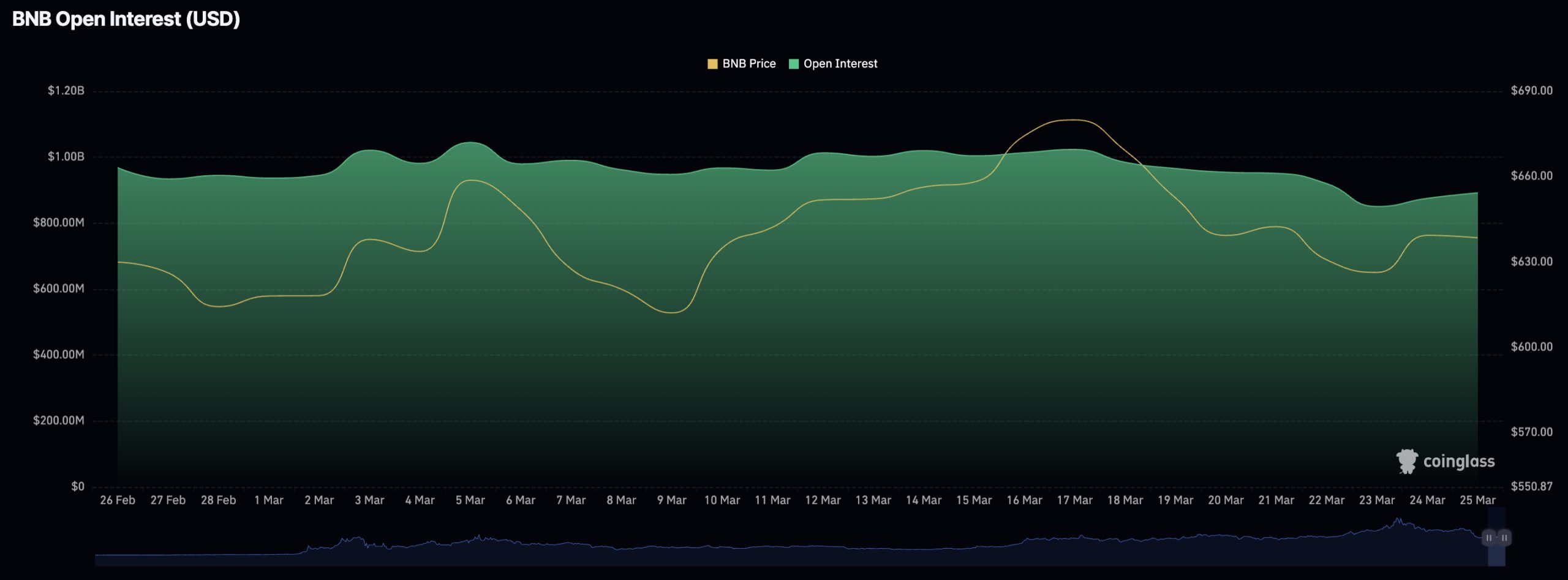
While the spot market shows recovery, the derivatives data paints a more aggressive picture; open interest for BNB futures has spiked 6.5% to $891 million in just 24 hours. The market is waking up.
Source: CoinGlass
This surge in leverage suggests institutional confidence is returning to the Binance ecosystem despite recent regulatory quiet periods. With bulls targeting a breakout, current price action hinges on reclaiming key resistance levels established earlier in the quarter.
BNB Price Prediction: Can Open Interest Drive Prices to $690?
The technical structure and prediction for BNB price has shifted from consolidation to accumulation. Trading at $646 at the time of this analysis, the price action is respecting a multi-week ascending trendline that has served as dynamic support. As long as the token holds above the $630 floor, the path of least resistance appears upward.
Derivatives metrics provide the strongest bullish signal. Data from CoinGlass indicates a long/short ratio of 2.11 on Binance, meaning buyers are overwhelming sellers by more than two to one. This creates a high-pressure environment where a move past immediate resistance could trigger a short squeeze.
Source: CoinGlass
Analysts are eyeing the $690 level as the critical breakout point. A clean 4-hour close above this line could open the door for a rapid extension toward the $700-$720 range. Conversely, failure to hold the $639 7-day SMA would invalidate the immediate bullish thesis, potentially sending price action back toward $620 support.
Traders Rotate to L3 Infrastructure as Gains Consolidate
While BNB offers stability and consistent ecosystem growth, the sheer market capitalization of major L1s often limits the potential for exponential short-term multiples (can a $90B asset 10x overnight? Unlikely). Consequently, volume often rotates from established giants into emerging infrastructure plays during consolidation phases.
Smart money is increasingly tracking Layer 3 (L3) solutions that promise to unify fragmented liquidity. LiquidChain ($LIQUID) has emerged as a focal point in this narrative, positioning itself as the “Cross-Chain Liquidity Layer” capable of fusing Bitcoin, Ethereum, and Solana execution environments.
The project distinguishes itself through a “Deploy-Once Architecture” and single-step execution, aiming to solve the user experience nightmare of bridging assets manually. The LiquidChain presale has already raised more than $600K, with early participants securing an entry price of $0.0143 with more than 1700% APY bonus. The contract is also audited by Certik, a benchmark in crypto safety.
Disclaimer: This article is for informational purposes only and does not constitute financial advice. Cryptocurrency investments are highly volatile and risky. Always do your own research.
Siren price shot up 127% to $2.34 on Monday morning, becoming the best-performing crypto asset of the day.
Summary
SIREN surged 127% to an intraday high of $2.34, driven by a sharp rise in futures demand, with open interest jumping nearly 120% to $121 million.
The rally occurred without major fundamental updates, with derivatives positioning showing a bullish bias as the long-short ratio remained above 1.
The token remains vulnerable to a reversal, with past price action showing a 70% drop from its peak amid concerns over high supply concentration among large holders.
According to data from CoinGecko, Siren (SIREN) price soared to an intraday high of $2.34 on Monday morning before stabilizing at $2.19 at the time of writing. Its market cap stood at $1.56 billion, making it the 50th largest crypto asset in the market.
While there was no particular news on development or ecosystem updates to account for SIREN’s rally today, it was likely linked with significant demand for the token in the futures market.
Advertisement
Notably, data from Coinglass show that SIREN futures open interest surged nearly 120% to $121 million over the past 24 hours. At the same time, the long/short ratio sat at over 1, a sign that more traders were going in with a bullish outlook.
While such rallies often spark excitement, it should be noted that they often face a deep retracement as investors rush to book in profits.
For instance, Siren previously rallied to an all-time high of $3.61 on March 22 after climbing up for several straight days owing to its rebrand into an autonomous AI agent on the BNB Chain and a successive perpetuals listing on multiple major crypto exchanges like Binance, Bybit, and MEXC. However, it came crashing down by over 70% from its peak after concerns about its supply concentration gained traction.
Advertisement
As reported by crypto.news earlier, on-chain data compiled by Bubblemaps revealed that nearly 50% of SIREN’s supply was held in one cluster. Subsequently, later reports revealed that the concentration could be as high as 88% of the total supply.
While the token has regained some momentum as seen by today’s surge, the token could be at risk of a reversal again should those large holders decide to sell off their positions.
Disclosure: This article does not represent investment advice. The content and materials featured on this page are for educational purposes only.
NTGR opened at $24.75 on Tuesday and traded near $25.15 — marking a 15.9% increase
The FCC instituted restrictions on new consumer router models produced outside the United States due to security vulnerabilities
Approximately 60% of U.S. routers are believed to originate from Chinese manufacturing facilities
While NETGEAR produces devices abroad, the company may pursue Conditional Approval through the DoW or DHS to market new products domestically
Stifel Nicolaus maintains a Buy recommendation on NTGR with a $36 target, suggesting potential upside exceeding 63%
Shares of NETGEAR experienced a remarkable Tuesday session, climbing almost 16% following the Federal Communications Commission’s declaration that it would restrict new consumer routers produced outside American borders. This policy shift created ripples throughout the networking industry and drove investors toward NTGR.
Trump just banned essentially all routers from being sold in the USA, including routers made by TP-Link, NetGear, Amazon, Linksys, Google, etc. All illegal now. What kind of insanity is this? How are businesses and data centers supposed to function with no routers? Once again,…
The regulatory agency cited escalating cyberattack incidents targeting American consumers and small enterprises since 2024 as justification for the restriction. The FCC highlighted vulnerabilities associated with internationally-manufactured routers, emphasizing that roughly 60% of U.S. routers originate from China.
The restriction applies exclusively to newly introduced router models. Products already carrying FCC authorization — regardless of their manufacturing origin — retain permission for domestic sales.
NETGEAR develops its technology within the United States but relies on international facilities for production. This business model means its upcoming products would technically fall within the ban’s scope. Nevertheless, the company maintains the option to pursue Conditional Approval through the Department of War or Department of Homeland Security, which would permit continued sales of foreign-manufactured routers domestically.
Advertisement
It bears mentioning that no major networking manufacturers currently produce consumer routers on American soil — placing NETGEAR in the same boat as its competitors.
Market enthusiasm for NTGR seemed rooted in two primary assumptions: international competitors will encounter heightened barriers to the U.S. market, and NETGEAR might ultimately relocate production domestically to circumvent the restriction altogether.
Tuesday’s advance followed a 5.85% gain during the prior session, indicating upward momentum had already begun developing before the FCC’s policy announcement.
Latest Financial Performance
NETGEAR’s latest quarterly earnings provided additional momentum for the stock. The company delivered earnings per share of $0.26, significantly surpassing the $0.05 consensus projection. Revenue reached $182.47 million, outperforming analyst expectations of $177.26 million.
Advertisement
Despite exceeding estimates, the overall financial health presents challenges. NETGEAR operates with a negative net margin of 2.56% and a P/E ratio of -41.24. Market watchers currently project full-year EPS of -1.84.
The stock’s 50-day moving average rests at $21.19, with the 200-day average positioned at $25.82. Tuesday’s closing price of $25.15 returned NTGR to proximity of its long-term average.
Wall Street Perspective
Analyst coverage for NTGR remains sparse. During the previous three months, Stifel Nicolaus analyst Tore Svanberg assigned a Buy rating with a $36 price target — indicating potential appreciation exceeding 63% from present levels.
The overall analyst consensus includes two Buy recommendations, one Hold rating, and one Sell rating, with a mean price target of $36.00. Zacks recently upgraded the security from “strong sell” to “hold” in early March, while Wall Street Zen reversed course, downgrading to “sell” at the month’s beginning.
Advertisement
Institutional stakeholders control approximately 82.97% of NTGR shares. Insider ownership represents 2.3%, though insider Pramod Badjate divested 3,000 shares in early February at $20.97 per share.
For the year-to-date period, NTGR continues trading down 10.07%, and has declined 11.05% across the trailing twelve months despite Tuesday’s substantial gain.
Vienna-based crypto broker Bitpanda is launching a new blockchain network aimed at bringing tokenized assets into Europe’s regulated financial system, as institutions look to move toward always-on markets.
The company said Wednesday that its “Vision Chain,” built with the Vision Web3 Foundation and Optimism OP$0.1126, will provide infrastructure for banks and fintechs to issue and settle tokenized assets under EU rules such as MiCA and MiFID II.
The network uses compliant euro-denominated stablecoins for transaction fees to avoid the volatility tied to typical crypto payments on public chains. It also relies on Optimism’s Ethereum-based infrastructure to handle settlement and scaling.
The move comes as firms across global finance push deeper into tokenization to upgrade market plumbing for around-the-clock trading. The technology is widely seen as a way to streamline how assets are issued, traded and recorded, cutting reliance on fragmented legacy systems. It’s potentially a massive market: tokenized assets could grow 53% a year, reaching $18.9 trillion by 2033 across asset classes, a joint report by Boston Consulting Group and Ripple estimated.
Advertisement
The initiative reflects a wider race among financial firms. Rival digital broker Robinhood (HOOD) is currently testing its proprietary blockchain dubbed Robinhood Chain, built specifically for tokenized stocks trading and connecting to decentralized finance (DeFi) applications. Wall Street behemoths such as Nasdaq and NYSE also work on their blockchain platforms for tokenized securities, merging crypto rails with the same compliance and safeguards as for traditional systems.
Bitpanda’s chain fits into the firms broader strategy to bridge crypto rails and traditional finance, offering banks and financial institutions blockchain plumbing to provide digital asset services to their customers.
“Tokenization is expected to redefine capital markets,” Lukas Enzersdorfer-Konrad, CEO of Bitpanda, said in a statement. “European financial institutions have been ready for this shift for years, but the infrastructure has been missing.
“With Vision Chain, we are building a public blockchain designed around Europe’s regulatory standards, combining the openness of public networks with the reliability institutions require,” he added.







 pic.twitter.com/bnGCAFJmRa


 https://t.co/VNG0P4GuDo pic.twitter.com/XHI9QxT4Tv


 MASSIVE: $XRP JOINS OIL AND GOLD AS A MAJOR COMMODITY ASSET



 ⟁https://t.co/vqvBcdSj94 pic.twitter.com/R7ZeZ0NPGl











 Fashion5 days ago
 Politics5 days ago
 Crypto World3 days ago
 News Videos7 days ago
 Crypto World4 days ago
 Tech5 days ago
 Crypto World7 days ago
 Sports2 days ago

 News Videos7 days ago
 Politics6 days ago
 Business3 days ago
 Business7 days ago
 Sports2 days ago
 Tech3 days ago
 Tech7 days ago
 Sports5 days ago
 News Videos6 days ago
You must be logged in to post a comment Login