
Crypto World
Game developer Sillytuna reports losing $24M of crypto in UK ‘wrench’ attack



Game developer and erstwhile crypto enthusiast Alex Amsel, aka Sillytuna, has reported being forced to hand over almost $24 million worth of crypto in a violent robbery.
The attack involved “weapons, kidnap and rape threats,” according to Amsel’s post on X. He reports being “bruised,” and suggests that attackers had “axes over [his] hands and feet.”
He’s also appealed to “all those who trace such things,” and has offered a 10% bounty of any funds recovered, “even if you were involved.”
Read more: Copy, Paste, Rekt: Ethereum address poisoning strikes again
The transfer was flagged by blockchain security firm Peckshield, which seemingly assumed the loss was due to “address poisoning.” Amsel responded to the post to deny the claim, but multiple crypto news outlets ran with the address poisoning angle regardless.
These reports also mention the physical attack, indicating either a misunderstanding of what an address poisoning attack is, or an inability to differentiate between a copy-paste error and a violent kidnapping.
Similarly, Alex Svanevik, CEO of analytics platform Nansen, posted an AI analysis which identified the incident as address poisoning, and recommended contacting Maker to freeze the DAI (which isn’t possible).
However, Svanevik does admit that the analysis is “experimental” and may be “incorrect.”
In a message to Protos, Amsel said, “I can’t divulge any more info than I have on Twitter but it’s nothing to do with poisoning.
“I’m not anon so not hard to track down IRL, nor are many other peope who sadly this is going to happen to if we don’t crack down and show you can’t walk away with the money.
“There are substantial efforts behind the scenes as I’m acutely aware that timing is critical.”
Follow the money
Shortly after 5pm UTC on Wednesday, $23.6 million of Aave-USDC was transferred to the attackers on Ethereum.
Blockchain analytics firm Arkham traced the onward movement of funds. The majority of funds are held in two Ethereum addresses which hold $20 million in the (unfreezable) DAI stablecoin.
Additionally, the attackers bridged around $2.5 million to Hyperliquid via Arbitrum, using Wagyu accounts to withdraw as privacy coin monero. A further $1 million was bridged to bitcoin via LiFi.
Wagyu’s developer came under harsh criticism from the crypto security community for not blocking the transfers. The developer, who goes by the pseudonym PerpetualCow, defended themselves, claiming they were sleeping while the transactions were ongoing; they also insist they “didn’t make any money off this.”
Yesterday’s incident is the latest in a line of increasingly common physical attacks on crypto users, often dubbed “wrench” attacks, in reference to a viral xkcd comic.
These attacks often follow the leaks of personal data of crypto-linked individuals.
Read more: DeFi karma: Garden hacked for $11M after bridging Lazarus’ loot
End of the road
In December of last year, Sillytuna posted a blog to Medium, in which he says he’s left crypto behind.
The industry, he wrote, “became dominated by Silicon Valley, the worst of tech bros, and the ever present scammers.”
Despite crediting crypto with being able to “semi-retire and go back to my love of making indie games,” he felt unable to “stand by and support the direction things have gone, politically and otherwise.”
In response to the robbery, he jokingly said the “worst thing about all this” is being called a crypto influencer. The funds were “long-term holdings” set aside for “future causes, open source, that kind of thing.”
Got a tip? Send us an email securely via Protos Leaks. For more informed news, follow us on X, Bluesky, and Google News, or subscribe to our YouTube channel.


Ethereum isn’t waiting for quantum computers to become a problem before figuring out how to survive them.
The Ethereum Foundation launched pq.ethereum.org on Wednesday, a dedicated resource hub for the protocol’s post-quantum security effort. The site consolidates a roadmap, open-source repositories, specifications, research papers, EIPs, and a 14-question FAQ written by the EF’s post-quantum team.
More than 10 client teams are already building and shipping devnets weekly through what the foundation calls PQ Interop, the foundation said in an X post earlier Wednesday.
Today, several teams at the EF are launching https://t.co/L9ZOUoRNNB, a dedicated resource for Ethereum’s post-quantum security effort.
What started with early STARK-based signature aggregation research in 2018 has grown into a coordinated, multi-team effort, all open source.…
— Ethereum Foundation (@ethereumfndn) March 24, 2026
The technical challenge is substantial. Quantum computers are widely believed to will eventually break the public-key cryptography that secures ownership, authentication, and consensus across Ethereum.
The EF’s position is that a cryptographically relevant quantum computer isn’t imminent, but migrating a decentralized global protocol takes years of coordination, engineering, and formal verification.
The migration touches every layer of the protocol.
At the execution layer, post-quantum signature verification through a vector math precompile would let users transition to quantum-safe authentication through account abstraction without a disruptive “flag day” where everyone has to upgrade simultaneously.
At the consensus layer, the current BLS validator signature scheme gets replaced with hash-based signatures called leanXMSS, with a minimal zk-based virtual machine handling aggregation to restore scalability since post-quantum signatures are larger.
At the data layer, post-quantum cryptography extends to blob handling for data availability.
This connects directly to the strawmap piece from earlier this month where Ethereum co-creator Vitalik Buterin called the document “very important” and walked through the finality improvements. The post-quantum push stood out then because it treated quantum threats as a concrete engineering problem with specific fork targets rather than a hypothetical.
While quantum computing represents a threat category that attacks the cryptographic foundations rather than the physical infrastructure, the protocols that prepare earliest will be the most resilient when such a system eventually materializes.
Crypto World
BitGo Adds CIP-56 Token Standard Support on Canton Network, Enabling Custody for USDCx and cBTC

TLDR:
- BitGo extends its Canton Network infrastructure to support CIP-56 token standard assets including USDCx and cBTC.
- The CIP-56 standard offers privacy-preserving transfers and atomic settlement tailored for regulated financial institutions.
- Canton Network now processes over $350 billion in on-chain assets daily, reflecting rapid institutional blockchain adoption.
- BitGo, the largest Bitcoin custodian globally, is expanding qualified custody across Canton’s growing financial ecosystem.
BitGo has announced support for CIP-56 token standard assets on the Canton Network, adding USDCx and cBTC to its qualified custody platform.
This move builds on the company’s October 2025 launch of Canton Coin custody. The Canton Network now processes over $350 billion in on-chain assets daily.
The expansion positions BitGo as a key infrastructure provider for institutions operating within Canton’s growing financial ecosystem.
CIP-56 Brings Institutional-Grade Features to Canton
The CIP-56 token standard functions similarly to ERC-20 on Ethereum, providing a common interface for wallets, custodians, and applications.
However, it includes additional capabilities tailored to regulated financial markets. These features make it more suitable for institutions handling large-scale transactions.
The standard supports privacy-preserving transfers, which protect sensitive trading data during settlement. It also enables atomic Delivery-vs-Payment settlement, reducing counterparty risk across transactions.
Multi-step transfers allow administrators to control asset movement between approved parties. Together, these features create a compliant, composable environment for real-world assets moving on-chain.
Deterministic finality within seconds and predictable transaction costs further support institutional workflows. These qualities are critical for organizations managing large volumes of trades or settlements.
By integrating CIP-56, BitGo can now support any asset issued under this standard across the Canton Network. This reduces friction for institutions seeking custody solutions on the platform.
BitGo has expanded its @CantonNetwork infrastructure to support CIP-56 token standard assets, bringing qualified custody to USDCx, and cBTC.
Chen Fang, Chief Revenue Officer at BitGo, spoke on the growing role of the network. “Canton is rapidly becoming one of the most important networks for institutional digital finance,” Fang said.
“By supporting CIP-56 assets, BitGo provides the custody infrastructure needed for institutions to participate in Canton’s growing ecosystem.” His remarks reflect the company’s broader commitment to expanding institutional blockchain infrastructure.
Melvis Langyintuo, Executive Director and Head of the Canton Foundation, also weighed in on the development. “CIP-56 is the standard that enables interoperability across the Canton ecosystem,” Langyintuo stated.
“BitGo’s support for CIP-56 assets strengthens the network’s institutional infrastructure and makes it easier for participants to build applications and financial products on Canton.” Both statements point to a shared goal of deepening institutional access to the network.
Three Assets Mark the Start of BitGo’s CIP-56 Rollout
BitGo’s CIP-56 launch covers three assets addressing different institutional needs. USDCx is a USDC-backed stablecoin issued through Circle’s xReserve protocol.
It combines dollar liquidity with Canton’s privacy architecture, making it suitable for on-chain repo settlement and other capital markets workflows. The asset is already being used in live capital markets operations.
cBTC brings Bitcoin liquidity into Canton’s financial infrastructure. The asset is fully backed 1:1 by Bitcoin, allowing institutions to use BTC for collateral, settlement, and trading.
As the largest Bitcoin custodian globally, BitGo is well-positioned to serve institutional cBTC users on the network. This makes the pairing between cBTC and BitGo a natural fit for the market.
USDXLR, issued by Excellar, generates rewards on stablecoin holdings through delta-neutral strategies. It can be used for settlement, liquidity, and collateral workflows while returning yield to holders.
This makes it attractive for institutions seeking returns on stable assets. As a CIP-56 asset, it fits within the broader Canton composable financial infrastructure.
BitGo stated it will continue expanding support for additional Canton assets as more financial institutions and tokenization platforms adopt the network.

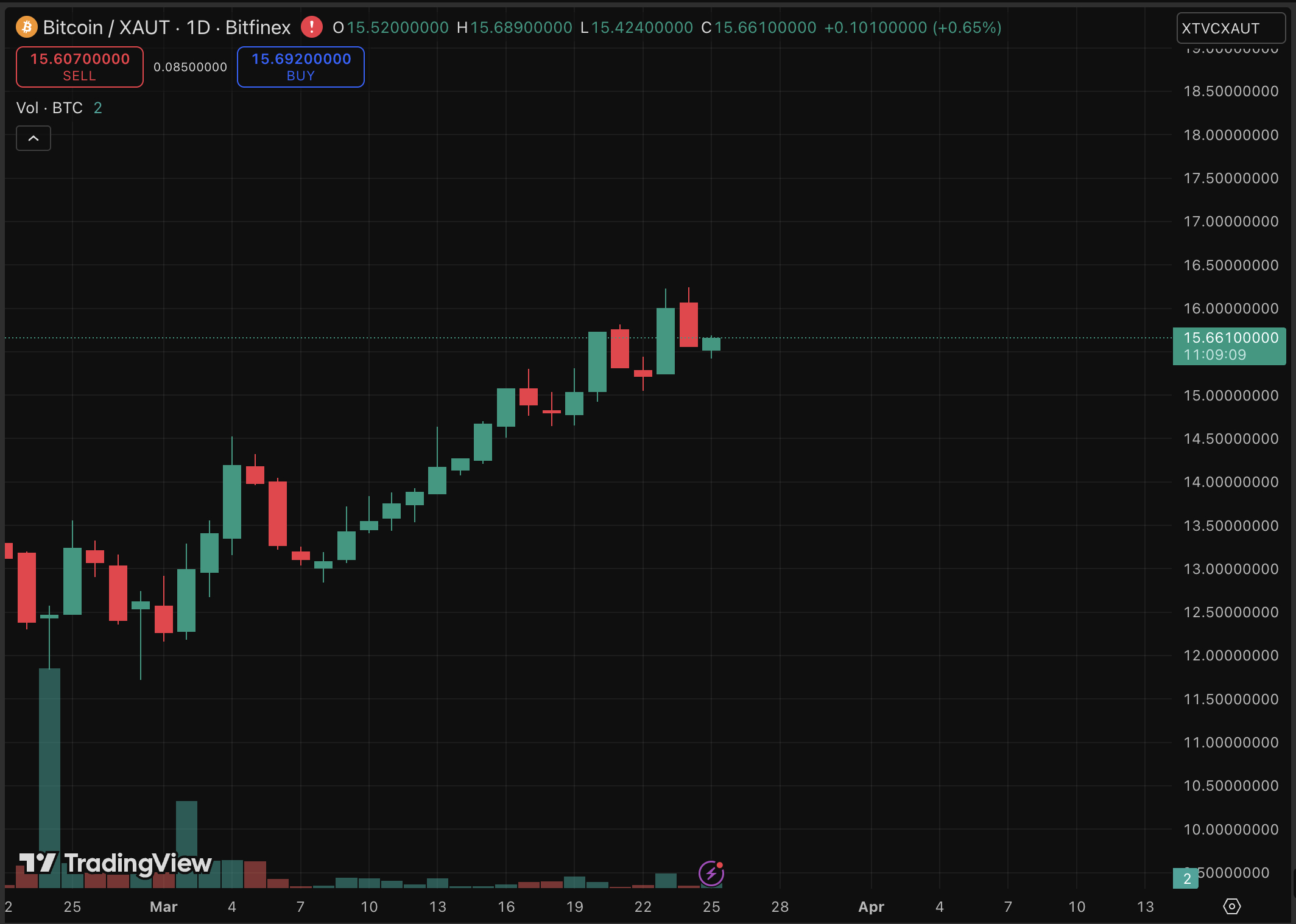
While gold suffers its worst losing streak since February 1920, plummeting for 10 consecutive days, the BTC USD price is consolidating its dominance as the premier alternative asset. Since the start of the Middle East conflict, the Bitcoin-to-gold ratio has surged roughly 30%, with the digital asset currently holding the $70,000 line despite macro headwinds.

The yellow metal has dropped as much as 27% from its January all-time highs, finding support only at the $4,090 mark. In sharp contrast, Bitcoin trades near $71,493, signaling distinct institutional strength even as Fed policy decisions regarding March 2026 rates momentarily shook risk assets. As capital rotates, the technical setup suggests a pivotal moment for digital markets.
Discover: The best pre-launch token sales
Can BTC USD Break $71,500 Price Resistance Post-FOMC?
Bitcoin is currently trading in a tight range between $71,000 and $72,000 following the Federal Reserve’s decision to maintain rates at 3.5%–3.75%. The immediate price action reflects a recovery from a 5% decline tested earlier in the week, where BTC briefly touched $72,100 before sellers stepped in.
For bulls to regain control, a confirmed breakout above the $72,000 resistance level is required. If achieved. However, loss of the middle Bollinger Band at $69,555 could retest lower liquidity zones near $67,500. This resilience aligns with recent BTC USD price volatility signals, indicating a potential bottom formation.
JACK MALLERS JUST SAID: "BITCOIN’S PRICE IS JUST NOISE. EVERY DIP IS A CHANCE TO OWN A BIGGER SLICE OF MONETARY FREEDOM." — CryptoSavingExpert ® (@CryptoSavingExp) March 24, 2026
 pic.twitter.com/39LCtBQ66l
The divergence from gold is stark. While Bloomberg analysts note gold’s “exhaustion” after falling 12% since late February, Bitcoin’s ratio has climbed from 12 ounces to just below 16 ounces per coin. If history repeats, where gold leads and consolidates before Bitcoin catches up, the current crypto consolidation may be the precursor to an aggressive repricing event.
Discover: The best crypto to diversify your portfolio with
Bitcoin Hyper Targets Infrastructure Upside as Layer 2s gain Traction
As Bitcoin cements its role as a store of value comparable to gold, the narrative is shifting toward utility and scalability, specifically through Layer 2 solutions. Just as the mainnet establishes a $70,000 floor, capital is beginning to flow into infrastructure plays designed to unlock Bitcoin’s programmable potential. This rotation favors projects like Bitcoin Hyper ($HYPER), which aims to bridge the speed of Solana with the security of Bitcoin.
Bitcoin Hyper positions itself as the first-ever Bitcoin Layer 2, integrating the Solana Virtual Machine (SVM). This architecture allows for sub-second finality and smart contract execution on Bitcoin, addressing the core limitations of slow transactions and high fees.
The data suggests the market is hungry for this utility: the project has raised an impressive $32 million in its presale phase to date.
Hyper offers a speculative angle on the ecosystem’s growth. The token is currently priced at $0.0136, with high staking APY incentives for early participants.
Disclaimer: Crypto is a high-risk asset class. This article is provided for informational purposes only and does not constitute investment advice. always DYOR.
The post BTC USD Price Outlook: Bitcoin Resurgence and Gold Losing Streak appeared first on Cryptonews.
TLDR:
- Hyperliquid HIP-3 recorded a $5.4 billion all-time high in perpetual trading volume on March 23, 2025.
- Silver led all assets with $1.3 billion in volume, followed by WTI Crude Oil at $1.2 billion on that day.
- Brent Crude Oil and gold added $940 million and $558 million, making commodities the dominant trading category.
- HIP-3 is establishing product-market fit as an on-chain venue for commodity and macro derivatives trading.
Hyperliquid HIP-3 recorded an all-time high in perpetual trading volume on March 23. Total volume reached $5.4 billion in a single day, based on Artemis data.
The milestone marks a notable shift in how traders are using the protocol. Commodities and macro assets drove the bulk of that activity. Silver, crude oil, and gold led the volume charts on that day.
Commodities Dominate HIP-3 Trading Volume
Silver topped the leaderboard with $1.3 billion in volume on March 23. WTI Crude Oil followed closely, recording $1.2 billion in trades on the same day.
Brent crude oil came in third with $940 million in total activity. Gold also posted $558 million, adding to the commodity-heavy trading picture on HIP-3.
The Nasdaq and S&P 500 contributed $370 million and $271 million, respectively, to the overall total. Together, these macro instruments accounted for a large share of the day’s recorded volume.
The data shows traders are actively using HIP-3 to access traditional financial market exposure. This range of assets reflects the growing breadth of the platform’s appeal.
Artemis data confirmed the record was achieved in a single trading session on March 23. The performance points to rising demand for commodity and macro derivatives on-chain.
HIP-3 is emerging as a preferred venue for traders reacting to real-world asset price movements.
HIP-3 Finds Product-Market Fit in Macro Trading
The record volume follows a pattern of macro news events driving activity on Hyperliquid HIP-3. Traders appear to use the platform to quickly respond to commodity price changes. This behavior mirrors how professional macro traders typically operate in traditional financial markets.
The trading breakdown shows a clear preference for assets tied to global economic developments. Silver and crude oil alone accounted for over $3.4 billion of the total recorded volume.
That concentration around commodity assets points to a specific trader behavior forming on the platform.
Artemis data supports the view that trading patterns are closely tied to macro news cycles. The platform is gaining traction among traders who monitor global economic developments closely. As macro activity grows, HIP-3 is positioning itself as a key on-chain venue for commodity derivatives.


Elon Musk’s social media platform X has hired a new head of design with deep roots in crypto product development, as the platform continues to expand into payments and financial services.
Benji Taylor said in Wednesday post that he now leads design for X under its ties to xAI and SpaceX.
Taylor founded Los Feliz Engineering, the team behind self-custody crypto wallet Family. Aave Labs, the development firm behind $42 billion decentralized lender Aave, acquired the company in 2023, after which Taylor served as chief product officer until October 2025. Most recently, he was head of design at Base, the Ethereum-based blockchain network built by crypto exchange Coinbase (COIN).
X product lead Nikita Bier said he had tracked Taylor’s work for years and pushed to bring him on, calling one of his past products among the best designed he had seen.
The hire adds a designer with hands-on crypto experience at a time when X telegraphed its plans to roll out features to support payments and broader financial features on the platform.
Earlier this month, Musk said that X Money is set to launch in April, offering peer-to-peer transactions, bank deposits, a debit card and cashback rewards in more than 40 U.S. states. It was also proposed to pay a 6% yield on balances.
However, there wasn’t any mention of blockchain or crypto element in X Money at the time.
Crypto World
Utila Integrates TRON Resource Management, Offering Fintechs Up to 80% Reduction in Transaction Costs
TLDR:
- Utila now supports native TRX staking, wallet delegation, and energy rental within a single enterprise platform.
- TRON processes over $20 billion in daily transfers, making cost-efficient resource management critical for operators.
- Energy rental through JustLend and TronScan providers can cut single USDT transfer costs by up to 80%.
- The integration eliminates third-party signing systems, keeping compliance, visibility, and policy controls fully intact.
Utila, an institutional-grade digital asset infrastructure platform, has launched native TRON resource management capabilities.
The new integration allows users to stake TRX, delegate resources across wallets, and rent energy programmatically.
It targets fintechs, payment companies, and exchanges on the TRON network. The solution reduces transaction costs while keeping security, policy controls, and transaction visibility intact.
Streamlining TRON Resource Management for Enterprise Operations
TRON serves as the dominant settlement layer for USDT, with a circulating supply of roughly $85 billion. Daily transfer volumes on the network regularly exceed $20 billion.
For businesses where TRC-20 USDT forms a core payment flow, managing network resources efficiently is a direct operational priority.
Every TRC-20 transfer on TRON requires energy and bandwidth to process. At high volumes, the cost of acquiring and allocating these resources adds up quickly. Utila’s new capabilities bring staking, delegation, and energy rental into one unified platform.
Previously, managing these resources at scale often meant routing transactions through third-party signing systems.
Those systems frequently sat outside existing wallet infrastructure, policy controls, and audit processes. Utila’s integration removes that gap entirely.
Bentzi Rabi, Co-Founder and CEO at Utila, spoke to the core problem the integration solves. “The scale of TRON’s blockchain infrastructure as the backbone of global stablecoin payments creates a clear need for enterprise-grade tooling that reduces costs without introducing operational risk,” he said.
He added that organizations can now optimize transaction economics directly within their existing infrastructure, with no external providers, no separate signing flows, and no compliance gaps.
Multiple Resource Mechanisms Available for High-Volume Operators
Teams using Utila can stake TRX to a super representative of their choice. This generates energy and bandwidth that cover transaction fees while also earning staking rewards through delegated voting rights. Once a wallet’s transactions are fully covered by staked energy, no TRX is burned on those transactions.
After obtaining resources through protocol staking, teams can delegate them across wallets within their organization via the API.
This gives operators flexible control over how resources are distributed without relying on external processes. The approach suits payment aggregators, remittance services, and payout platforms operating at scale.
For teams that prefer not to commit capital to long-term staking, Utila also supports energy rental. Platforms such as JustLend and TronScan-integrated providers are supported for this purpose.
This rental approach can reduce the cost of a single USDT transfer by up to 80%, depending on baseline fees.
Sam Elfarra, Community Spokesperson for TRON DAO, pointed to the broader need for this kind of tooling. “As a leading settlement layer for stablecoin transactions, the efficient management of TRON’s resource model, alongside strong security and compliance standards, is essential,” he said.
Elfarra noted that Utila’s native integration consolidates these capabilities into a single platform, giving payment companies and fintechs the tools needed to scale with greater efficiency and confidence.
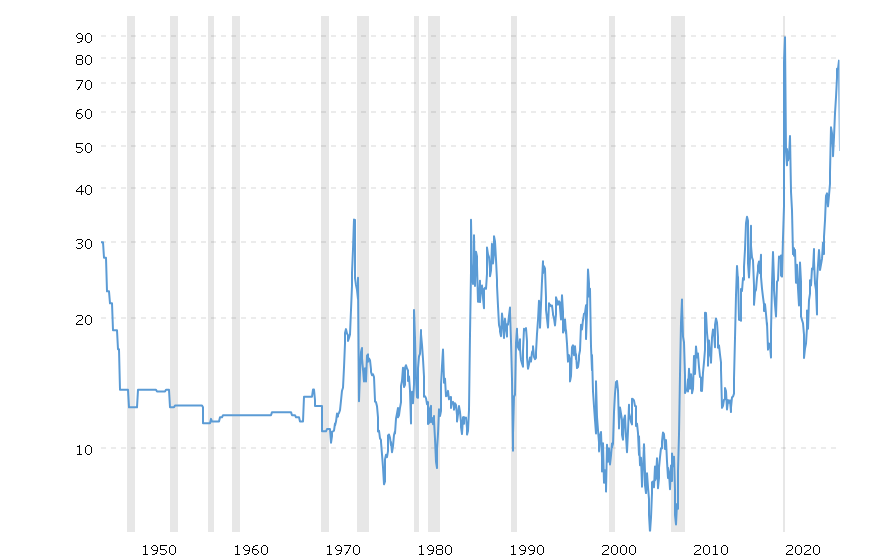
Brent crude has slid toward $116 per barrel, while Today gold rebounds toward $4,550, a divergence that has historically served as one of the clearest diagnostic signals of stagflation. Top analysts framing this as a revived safe-haven bid capture the mechanics: energy falls on demand destruction, bullion rises on inflation fear, and the combination compresses every asset class that depends on either growth or purchasing power stability.
Bitcoin is trading at $71,043 at the time of this analysis, recovering from a test of $70,000 support after ETF outflows hit $708 million in a single week on hawkish Fed positioning at 3.50%–3.75%. The stagflation crypto thesis is no longer speculative; it is playing out in real time across commodity and digital asset markets.
Discover: The best pre-launch token sales
Today Gold Surges as Oil Slips: Is This the Stagflation Tell Markets Feared?

(Source – Gold Vs Oil Ration, Macro Trends)
The Gold vs Oil ratio has spiked sharply, a move that historically coincides with regime shifts rather than routine corrections. When oil falls due to recession fear, while gold rises due to currency debasement anxiety, markets are not pricing two independent events. They are pricing a single macro condition: slowing output, sticky inflation, and collapsing confidence in central bank credibility.
The 1970s episode remains the reference point. During that decade’s stagflation cycle, gold appreciated by more than 2,000%, while oil-linked equities eventually cratered amid a demand collapse. Bloomberg analysts note a similar pattern of divergence is re-emerging, with gold’s current trajectory reflecting what they describe as structural safe-haven rotation rather than a tactical trade. The Brent decline of roughly 8% over recent weeks against gold’s concurrent push toward all-time highs near $4,550 reinforces that framing.
What makes the current setup more acute is the Fed’s position. Rates held at 3.50%–3.75% signal the central bank is not prepared to sacrifice inflation control to defend growth, the textbook stagflation trap. Fiat-denominated assets absorb both sides of that squeeze. Hard-capped assets do not. That distinction is driving the capital rotation visible in both gold’s sustained climb and the crypto market’s underlying accumulation data.
Does Bitcoin Decouple From Oil and Track Gold in a Stagflation Regime?

(Source – Zerocap)
On-chain accumulation data from Zerocap’s weekly market wrap shows massive underlying BTC buying even as ETF outflows registered surface-level bearish sentiment. That divergence — institutional paper selling while spot wallets accumulate — is a structural tell. Bitcoin is beginning to mirror gold’s behavior rather than oil’s, consolidating its Digital Gold narrative in real time.
The BTC/Gold ratio has remained remarkably stable amid recent volatility, a stark divergence from the correlation patterns that dominated 2022, when BTC tracked risk assets lower alongside equities. Fortune data confirms Bitcoin’s recovery to $71,043 is occurring in an environment where traditional risk-on assets remain under pressure, suggesting the decoupling thesis is gaining structural support rather than just narrative momentum.
Strategy, Metaplanet, and American Bitcoin Corp have all deepened BTC treasury positions through this cycle. Smart money is not treating Bitcoin as a risk-on speculative asset, it is treating it as a fixed-supply hedge against the exact macro regime now unfolding. As capital rotates toward digital scarcity, the next wave of appreciation may not stop at Bitcoin mainnet.
Discover: The best crypto to diversify your portfolio with
Bitcoin Hyper Targets Digital Gold Upside as Stagflation Pressure Mounts
As Bitcoin cements its role as a stagflation hedge, capital is beginning to flow into infrastructure plays designed to unlock its programmable potential. Enter Bitcoin Hyper, the first Bitcoin Layer 2 integrating the Solana Virtual Machine (SVM), built to deliver near-zero-cost microtransactions, DeFi applications, and tokenized real-world assets with seconds-level finality, all settled on Bitcoin L1 security.
The Bitcoin Hyper presale has raised over $28 million with daily inflows averaging approximately $50,000, placing the current token price at $0.01367750 against a total supply of 1,000,000,000 HYPER. Staking is live during the presale with an APY of approximately 41%, designed to bootstrap network security and reward early liquidity providers before exchange listings trigger Phase 2.
The BTCHyper investment case aligns closely with the stagflation thesis. Bitcoin’s fixed supply is the macro argument. Bitcoin Hyper’s SVM execution layer, using a Bitcoin Canonical Bridge for cross-chain wrapped BTC, is the infrastructure that makes that argument programmable. Analysts projecting 2026 highs between $0.10 and $0.50 are pricing in Layer-2 adoption, DeFi integrations, and the same institutional BTC tailwind that is driving mainnet accumulation right now.
Investors tired of commodity whiplash are increasingly researching the Bitcoin Hyper presale as the next growth frontier. With stagflation crypto positioning accelerating and the Digital Gold narrative finding fresh macro confirmation, the window at $0.01367750 is priced for early movers, not latecomers.
Join the Bitcoin Hyper Presale Now
Crypto is a high-risk asset class. This article is provided for informational purposes only and does not constitute investment advice. Always DYOR.
The post Stagflation 2.0: Today Gold Surges, Oil Slips, Bitcoin Hyper Fills the Gap appeared first on Cryptonews.
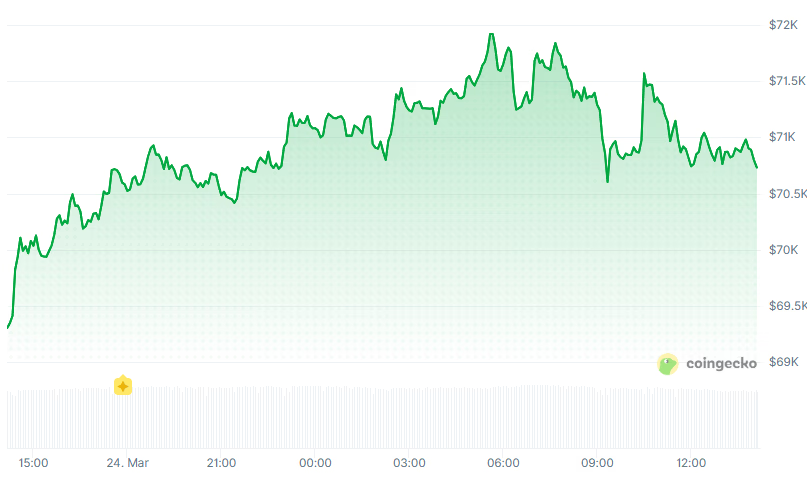
Spot BTC ETFs had $74 million in outflows on Tuesday as traders await Friday’s PCE data.
Crypto markets drifted sideways on Wednesday as spot ETF flows whipsawed between inflows and outflows, and lawmakers grilled witnesses at a hearing on tokenized securities.
Bitcoin (BTC) is trading at around $71,000, up 2% over the past 24 hours. ETH and SOL gained 3% to $2,175 and $91.5, respectively. Meanwhile, Ripple (XRP) climbed 1.5%.

Total crypto market capitalization incresed 2% to $2.51 trillion, according to Coingecko.
ETF Flows Flip Negative
Spot Bitcoin ETFs posted net outflows of $74.5 million on March 24, with Fidelity’s FBTC leading the selling at $45.3 million, followed by Bitwise’s BITB at $16.6 million. The reversal came just one day after the products attracted $167 million in net inflows, led by IBIT’s $160.8 million contribution, according to SoSoValue.
Ethereum ETFs continued to underperform, recording net outflows of $40.8 million on March 24, led by BlackRock’s ETHA with $25 million.
Despite the daily volatility, Bitcoin ETFs have logged roughly $2.5 billion in gross inflows in March, translating to about $1.6 billion in net flows, according to Bloomberg analyst Eric Balchunas.
House Holds Tokenization Hearing
The House Financial Services Committee convened on Wednesday to examine how tokenization is reshaping capital markets. Lawmakers broadly agreed that tokenized securities need the same regulatory guardrails as traditional instruments, though committee Democrats raised concerns about anonymous wallets masking foreign ownership and the “gamification” of trading, according to CoinDesk.
Big Movers
Nearly all of the Top 100 digital assets posted gains over the last 24 hours.
Today’s top gainers are SIREN and MemeCore (M), which surged 114% and 40%, respectively.
Monero (XMR) and Near Protocol (NEAR) are the biggest losers.
Around 81,000 leveraged traders were liquidated for $222 million in the past 24 hours, according to CoinGlass. Bitcoin accounted for $73 million, while ETH made up $63 million.
Friday’s PCE inflation reading is the next major macro catalyst — a print above 3% could pressure Bitcoin as rate-cut expectations evaporate, while a reading below 2.8% could spark a rally.


Franklin Templeton and Ondo are launching tokenized ETFs that trade 24/7 directly in crypto wallets, giving non-U.S. investors round-the-clock access to U.S. stocks, bonds and gold.
Summary
- Franklin Templeton and Ondo Finance announced tokenized ETFs on March 25 that can be traded directly inside crypto wallets around the clock, bypassing traditional brokerage accounts.
- The product suite spans U.S. equities, fixed income, and gold, with an initial rollout across Europe, Asia-Pacific, the Middle East, and Latin America.
- A U.S. launch remains contingent on regulatory clarity around on-chain distribution of registered funds.
Franklin Templeton is partnering with Ondo Finance to offer tokenized versions of its ETFs tradeable 24/7 directly from crypto wallets, the firm announced on Wednesday in a move that sidesteps the brokerage accounts and fixed trading hours that have defined fund investing for decades. According to Bloomberg, the products span U.S. equities, fixed income, and gold, with an initial rollout targeted at investors in Europe, Asia-Pacific, the Middle East, and Latin America.
Franklin Templeton, which manages more than $1.6 trillion in assets, said the U.S. market launch will depend on further regulatory clarity around how third parties can distribute registered funds on-chain. The asset manager has been steadily building its on-chain infrastructure since 2021, when it launched the world’s first blockchain-integrated U.S.-registered mutual fund, and has since expanded to networks including Stellar, Polygon, and Arbitrum. In a previous crypto.news story, Sandy Kaul, Head of Innovation at Franklin Templeton, stated that tokenized digital wallets will eventually hold the “totality” of an individual’s financial life — a thesis this latest product launch moves materially closer to reality.
Ondo Finance, for its part, brings a distribution network that has scaled rapidly. The platform crossed $2.5 billion in total value locked and surpassed $12 billion in cumulative trading volume since launching in September 2025, listing more than 250 tokenized stocks and ETFs across Ethereum, Solana, and BNB Chain. A previous crypto.news story detailed how Ondo’s Nexus initiative already expanded tokenized Treasury backing to include Franklin Templeton alongside BlackRock and PayPal.
The choice to prioritize non-U.S. markets first reflects both the regulatory landscape and existing infrastructure. Ondo secured regulatory passporting from Liechtenstein authorities, giving it access to over 30 European Economic Area countries. That framework is already active — in February 2026, Ondo partnered with Blockchain.com to make 200+ tokenized U.S. stocks and ETFs available via the Blockchain.com DeFi wallet to eligible EEA users. Binance and MetaMask have also integrated Ondo’s tokenized offerings, with Binance reviving tokenized stock trading through its Alpha program and MetaMask enabling eligible non-U.S. users to access Ondo assets from mobile wallets.
Franklin Templeton’s latest move lands against a backdrop of accelerating institutional tokenization. The tokenized real-world asset market has exceeded $22 billion globally, with tokenized Treasuries alone surpassing $3 billion in total value locked by 2024. CEO Jenny Johnson has stated that 2026 would see increased institutional investment flowing into tokenized vehicles beyond simple Bitcoin holdings.
The products are designed to give investors outside traditional brokerage ecosystems — particularly in emerging markets — fractional, around-the-clock access to U.S. asset classes that have historically required intermediaries and banking infrastructure. In a previous crypto.news story, Franklin Templeton’s on-chain money market fund on Arbitrum was already laying the groundwork for this kind of multi-chain distribution. Wednesday’s announcement represents the clearest step yet toward making that vision a commercial reality.
Crypto World
Monument Bank and Midnight Foundation Launch UK’s First Retail Deposit Tokenization Program
TLDR:
- Monument Bank targets £250M in tokenized deposits on Midnight’s privacy-enhancing public blockchain network.
- Deposits remain fully backed, redeemable in GBP, and protected under the UK’s Financial Services Compensation Scheme.
- Phase two opens retail access to private equity, commodity funds, and structured products via the Monument app.
- Phase three introduces Lombard-style lending, letting customers borrow against investments without liquidating their assets.
Monument Bank is set to become the first UK-regulated bank to tokenize retail customer deposits on a public blockchain. The bank, regulated by the Bank of England, manages roughly £7 billion in deposits.
Working with the Midnight Foundation, Monument plans to bring up to £250 million in deposits onto the Midnight network.
The program targets mass-affluent customers seeking access to modern financial tools while retaining full regulatory protection under existing UK frameworks.
Tokenized Deposits Open New Doors for Retail Banking Customers
Monument’s approach centers on representing customer savings as digital tokens on Midnight’s privacy-enhancing blockchain.
Each token corresponds one-to-one with funds held at the bank, functioning as a digital mirror of a traditional deposit. Customers will earn interest just as they would with a standard savings account.
The deposits remain fully backed by Monument and redeemable in pounds sterling. They also stay protected under the Financial Services Compensation Scheme, preserving the same safeguards customers already rely on.
Blockchain infrastructure operates behind the scenes, requiring no direct handling of digital assets by the customer.
Midnight’s architecture ensures that transaction data stays shielded and accessible only to Monument Bank and its customers.
This privacy-focused design addresses one of the central challenges facing blockchain adoption in regulated finance. It allows the bank to operate on a permissionless network without exposing sensitive financial information.
Fahmi Syed, President of the Midnight Foundation, addressed this directly. “Financial institutions around the world are exploring how blockchain infrastructure can support regulated financial products, but one of the persistent challenges has been balancing transparency with the privacy requirements of modern banking,” he said.
Monument’s model demonstrates how a regulated bank can bring traditional products on-chain while staying within compliance and consumer protection frameworks.
Monument’s Founder, Mintoo Bhandari, framed the move as a continuation of the bank’s core mission. “Monument was founded on the promise of bringing the most innovative and valuable financial offerings, safely and securely, to the often overlooked and underserved mass-affluent community in the UK and beyond,” he said.
With over 100,000 customers, the bank is embedding these capabilities directly into the consumer experience, setting this initiative apart from institutional-only tokenization efforts seen elsewhere.
Three-Phase Rollout Targets Investments and Lending Access
Beyond deposits, Monument has outlined a broader three-phase roadmap to expand what customers can do within its platform.
The second phase will introduce tokenized real-world asset products managed by global asset managers, accessible directly through the Monument app.
Customers will gain exposure to private equity, commodity funds, and structured products without buying or managing digital assets themselves.
These asset classes have historically been available only to ultra-high-net-worth individuals and institutional investors.
Monument’s structure is designed to change that by delivering institutional-grade products through a retail banking interface. The blockchain infrastructure running underneath remains invisible to the end user.
The third phase will introduce Lombard-style lending, allowing customers to borrow against their investments without selling them. Monument CEO Ian Rand noted the broader ambition behind this rollout.
“By combining these innovative capabilities with our exceptional client-centric service model, and the protections provided by the regulated banking framework of the UK, we are excited to deliver services that help our clients manage, and build, their prosperity,” he said.
This model has long been a feature of private banking services, offering more cost-effective credit access than standard borrowing. Bringing it to mass-affluent customers marks a notable shift in how consumer lending could work.
Daniel Fozzati, Founding Partner of The Building Blocks, called it “a world first by leveraging the UK’s innovation ecosystem.”
Research from Boston Consulting Group estimates tokenized financial assets could reach between $4 trillion and $16 trillion by 2030, and Monument’s initiative positions it early in that market.
Ethereum Foundation launches post-quantum security hub with more than 10 client teams
William Shatner shuts down 'woke'“ Star Trek ”backlash after“ Starfleet Academy” cancellation

USA Treasury Reports We Are Bankrupt…Blackrock, “Solution Is Crypto”


-
 Crypto World5 days ago
NIO (NIO) Stock Plunges 6.5% as Shelf Registration Sparks Dilution Worries
-

 Fashion5 days ago
Weekend Open Thread: Adidas – Corporette.com
-

 Politics5 days ago
Jenni Murray, Long-Serving Woman’s Hour Presenter, Dies Aged 75
-
 NewsBeat12 hours ago
Manchester United reach agreement with Casemiro over contract clause amid transfer speculation
-

 Crypto World4 days ago
Best Crypto to Buy Now: Strategy Just Spent $1.57 Billion on Bitcoin During Fear While Early Investors Quietly Enter Pepeto for 150x Potential
-

 Crypto World4 days ago
Bitcoin Price News: Bhutan Sells $72 Million in BTC Under Fiscal Pressure, but the Smart Money Entering Pepeto Sees What the Market Does Not
-

 Tech6 days ago
inKONBINI Lets You Spend Summer Days Behind the Register
-

 Sports2 days ago
Remo Stars and Kano Pillars Strengthen Survival Hopes in NPFL
-

 Politics6 days ago
Gender equality discussions at UN face pushbacks and US resistance
-

 Business3 days ago
No Winner in March 21 Drawing as Prize Rolls to $133 Million for Next
-

 Sports2 days ago
Gary Kirsten Accuses Pakistan Cricket Board Of ‘Interference’, Mohsin Naqvi Responds
-

 Tech3 days ago
Give Your Phone a Huge (and Free) Upgrade by Switching to Another Keyboard
-

 Sports5 days ago
2026 Kentucky Derby horses, odds, futures, preview, date: Expert who nailed 12 Derby-Oaks Doubles enters picks
-
Sports7 days ago
Vikings Free Agency Enters Phase 2 with Key Questions
-

 Tech3 days ago
AI enters the chat: New Seattle dating app relies on tech to facilitate meaningful human connections
-

 News Videos7 days ago
Amazing Cardboard Gadget That Turns Paper Into Money #techgadgets #ytshorts
-

 Politics6 days ago
Scotland’s rejection of assisted dying is a victory for humanity
-

 Tech7 days ago
Corsair K100 Air Wireless Mechanical RGB Keyboard Packs Full Power Into a Slim Frame
-

 Business6 days ago
DLocal: Entering 2026 At Escape Velocity
-
Business5 days ago
Columbia Sportswear enters $500 million credit agreement with JPMorgan Chase
You must be logged in to post a comment Login