
Crypto World
Grayscale Calls for Quantum-Resistant Blockchain Upgrades to Combat Risk


Grayscale Research has called for the early rollout of quantum-resistant blockchain upgrades following a new warning from Google Quantum AI. The report suggests that quantum computing could undermine current cryptographic encryption methods sooner than previously anticipated. As a response, Grayscale highlights the XRP Ledger and Solana’s efforts in post-quantum cryptography as potential solutions to address these emerging security risks.
XRP Ledger’s Quantum-Resistant Efforts
The XRP Ledger (XRPL) has begun experimenting with quantum-resistant technologies to prepare for future threats posed by quantum computing. The ledger is currently testing ML-DSA signatures on its AlphaNet. Although these efforts are still in the early stages, Grayscale notes that they represent a critical step toward enhancing the security of blockchain systems in a post-quantum world.
Grayscale emphasizes the need for the blockchain community to accelerate the implementation of such solutions. The crypto industry faces challenges like engineering and consensus-building, which require significant collaboration across networks. Moreover, any quantum-resistant upgrade must address potential issues, including a reduction in transaction throughput, which could affect the network’s scalability.
While XRPL is not entirely ‘quantum-proof,’ the experiments on the AlphaNet represent meaningful progress in preparing for quantum threats. Grayscale advocates for further testing and the eventual deployment of these cryptographic updates to safeguard the blockchain from quantum attacks. The project is still evolving, but it is an important step forward in the industry’s readiness.
Solana’s Post-Quantum Cryptography Research
Solana is also taking proactive steps in response to the potential risks posed by quantum computing. The network has partnered with Project Eleven to experiment with quantum-resistant cryptographic signatures. These efforts aim to secure the blockchain from future quantum threats that could undermine the existing encryption methods.
However, Grayscale cautions that quantum-resistant upgrades on Solana have shown the potential to significantly reduce network speed. The tests indicate that the implementation of quantum-resistant signatures could lead to a 90% decrease in the network’s speed. While security is a top priority, the challenge remains to balance quantum resistance with maintaining the blockchain’s scalability.
Despite these challenges, Grayscale views Solana’s initiative as another significant step toward ensuring the blockchain ecosystem’s resilience. The company emphasizes that the crypto industry must continue to experiment with and refine these solutions. Solana’s involvement in post-quantum cryptography is just one example of how blockchain networks are preparing for the future.
The Impact of Quantum Computing on Bitcoin
Grayscale’s report also highlights how quantum computing poses different risks to blockchains based on their structures. Bitcoin, for example, uses a UTXO (unspent transaction output) model, which Grayscale argues makes it less susceptible to quantum threats than blockchains with an account model, such as Ethereum. Bitcoin’s lack of native smart contracts further reduces its exposure to quantum computing vulnerabilities.
However, Grayscale points out that the primary concern with quantum computing is the potential loss of private keys. If a private key becomes inaccessible, it could lead to the loss or inaccessibility of coins. This situation could result in coins being burned, deliberately withheld, or simply left unused.
Bitcoin’s network also faces challenges in reaching consensus on protocol changes. Grayscale references last year’s debate over the inclusion of image data in blocks as an example of the hurdles the Bitcoin community must overcome when addressing security upgrades. The road ahead for quantum-resistant solutions will require significant collaboration and decision-making within the community.

Cardano’s ADA climbs about 4–5% to the mid‑$0.24s on Tuesday as traders rotate into high‑beta majors, but futures data shows churny perps and weak open interest behind the move.
Summary
- Cardano price jumps about 4–5% intraday, outpacing most large‑caps outside Bitcoin and Ethereum.
- Perps volume climbs while open interest lags, pointing to short‑term churn rather than committed longs.
- ADA trades as high‑beta L1 DeFi infrastructure, echoing broader liquidity‑driven flows across majors.
Cardano’s price rallied roughly 4–5% on Tuesday, extending a short burst of outperformance versus most large‑caps outside Bitcoin and Ethereum as traders rotated into higher‑beta names.
ADA (ADA) Spot prices hovered around $0.24–$0.25, up from the $0.23–$0.24 range seen earlier in the week, leaving ADA still far below its 2026 peak but firmly green on the day. The move comes as liquidity conditions across majors improve marginally and traders look for catch‑up plays after focusing on Bitcoin for most of the recent macro‑driven rally.
On centralized venues, Cardano was recently quoted near $0.2417 with a 24‑hour trading volume of about $1.91 million and a market cap of roughly $8.91 billion, representing around 0.44% of total crypto market capitalization.
Historical data from CoinMarketCap shows ADA closing at $0.2479 on April 5, $0.2462 on April 4, and $0.2394 on April 3, underscoring how modest the absolute price move has been even as percentage gains look eye‑catching on the day.
Over the past month, ADA remains down about 5% and roughly 58% over the last year, highlighting the gap between short‑term momentum and longer‑term underperformance.
Derivatives data paints a more cautious picture behind the headline price spike. Cardano futures open interest climbed as high as $416 million in February, according to Coinglass figures cited by MEXC, but has struggled to hold above the $400–$500 million band as speculative interest faded into March and early April. A February report noted total ADA derivatives volume near $669.6 million with funding skewed long, yet that backdrop has since softened, with Yahoo Finance recently flagging open interest stalling below $500 million and slipping toward $431 million.
That mix—rising intraday volume, modest fresh open interest, and funding that has flipped from aggressively long to more neutral—suggests the latest leg higher is being driven by perp churn rather than big structural positioning. From a technical perspective, external trackers show ADA’s daily RSI grinding up from mid‑range toward the low‑60s, a constructive but not yet overbought setup that typically characterizes flow‑driven beta rallies rather than full‑blown breakouts.
As a proof‑of‑stake layer‑1 focused on DeFi and smart‑contract infrastructure, Cardano is trading in line with other L1s that are acting as liquidity proxies rather than idiosyncratic narratives. A recent crypto.news story on Cardano’s price after its rollout across 137 Spar stores in Europe noted that ADA had been locked in a tight $0.26–$0.30 range, with dwindling volatility before today’s nudge higher, while another crypto.news story on ADA’s broader market analysis framed the token’s near‑term path between $0.41 and $0.45 if liquidity conditions improve. In parallel, crypto.news coverage of Bitcoin’s recent drawdown below $70,000 and risk‑off jitters around U.S.–Iran tensions shows how fast flows can reverse across the complex, reinforcing the idea that ADA’s latest beta burst may fade quickly without a durable pickup in open interest and spot demand.
Changpeng “CZ” Zhao became a household name in the cryptocurrency sector after founding Binance, the world’s largest crypto exchange. Following a series of legal and regulatory challenges that culminated in a prison sentence, Zhao has authored an autobiography recounting his rise — and subsequent fallout.
The 364-page manuscript, titled Freedom of Money, presents a first-person account of Zhao’s life and career. The foreword is written by Yi He, a Binance co-founder who has worked with Zhao since 2014.
Zhao writes that his story has been shaped by media coverage, court filings and public commentary. He describes the book as an account intended to provide additional context to those narratives.
Throughout the memoir, Zhao emphasizes the human dimension behind Binance’s rapid ascent — and his personal and professional downfall — which he argues has been lost in soundbite-driven coverage.
The memoir covers his early life and career in finance and technology, as well as the founding of Binance in 2017. It outlines the company’s rapid growth into one of the world’s largest cryptocurrency exchanges.
Regulatory failures and accountability
Zhao served a four-month prison sentence in the United States in 2024 after pleading guilty to violating US Anti-Money-Laundering laws, as part of a broader settlement with authorities that also required him to step down as Binance CEO.
The case marked a major enforcement action by the US Department of Justice, which had initially sought a longer sentence to reflect the severity of the violations. Binance, for its part, agreed to pay billions of dollars in penalties and implement sweeping compliance reforms.
US regulators had for years scrutinized Binance over alleged failures related to anti-money laundering controls, sanctions compliance and operating without proper licensing. The settlement effectively closed one of the most high-profile investigations in the crypto industry.
In the memoir, Zhao reflects on the decisions and missteps that led to these outcomes. He recounts the events surrounding the settlement, his guilty plea and his resignation, describing the tradeoffs made during Binance’s rapid growth.
The book also includes detailed descriptions of his time in federal prison, including the adjustment from leading a global company to living in a confined environment.

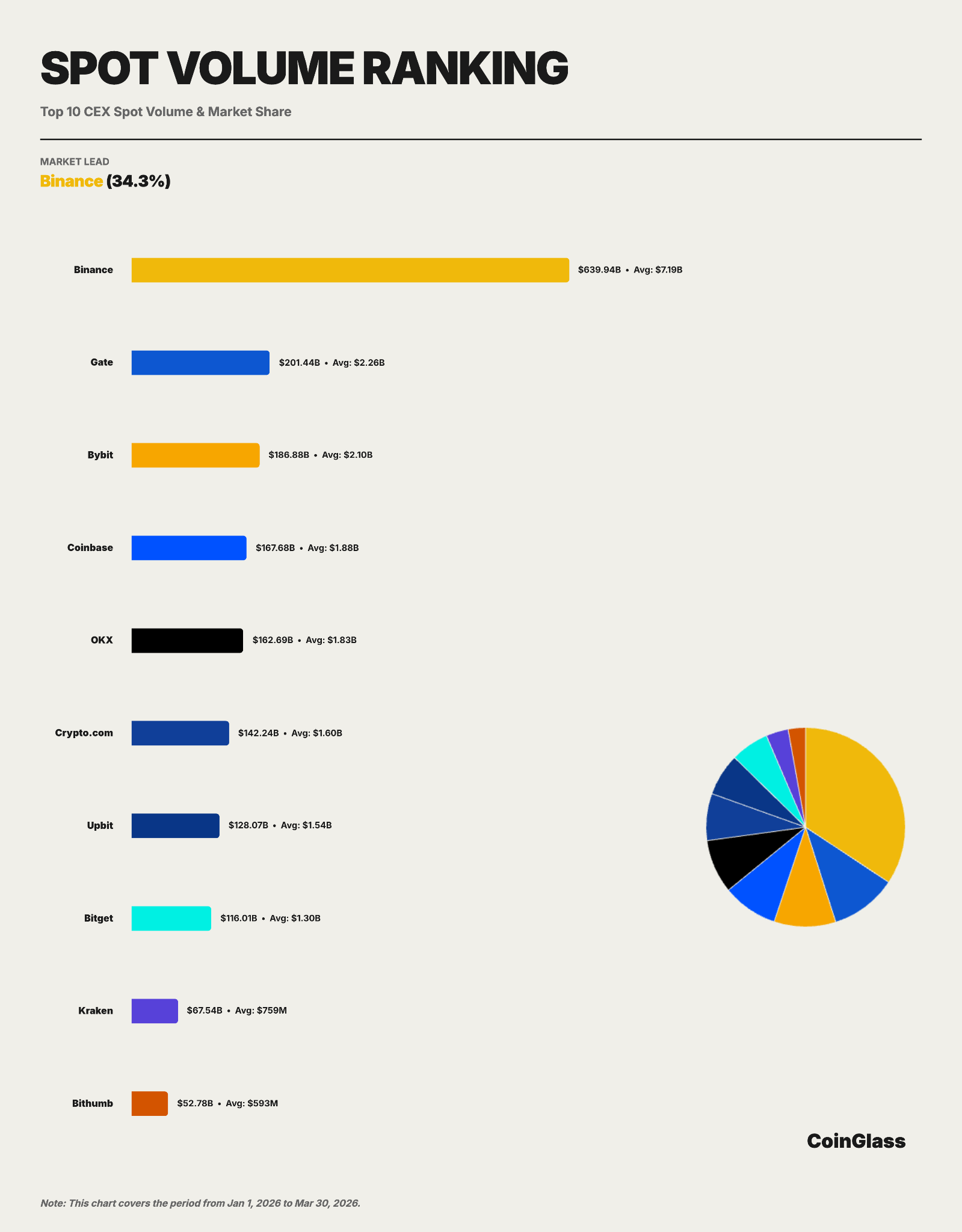
Related: Binance led Q1 crypto derivatives as Hyperliquid cracked top 10: CoinGlass
“Freedom of money”
The book’s title reflects a central theme of the memoir. Zhao describes the “freedom of money” as the idea that cryptocurrency can address barriers to financial access, particularly in countries with limited banking infrastructure or strict capital controls.
He links part of Binance’s growth to users in emerging markets who used the platform to move funds across borders, hedge against local currency volatility and access global financial markets.
Zhao also acknowledges that expanding access at scale introduced challenges. He writes that Binance’s rapid growth often outpaced regulatory frameworks, contributing to gaps in compliance and oversight that later drew scrutiny from authorities.
Related: Crypto’s 2026 investment playbook: Bitcoin, stablecoin infrastructure, tokenized assets

TLDR
- Bitcoin’s long-term holder supply has turned positive over the past 30 days.
- More Bitcoin is now being held by investors for the long term rather than being sold.
- The change in supply comes from coins aging past six months and entering the long-term holder category.
- Despite the price dropping below $70,000, long-term holders have increased their supply by 308,000 BTC.
- Currently, 29% of long-term holder supply is in loss, which is still below past cycle bottom levels.
Bitcoin (BTC) has seen a shift in long-term holder supply over the past month. Data indicate that investors are holding onto their assets, with long-term supply rising in recent weeks. Despite recent price challenges, this trend shows a change in investor behavior.
Bitcoin Faces Selling Pressure Despite Increased Long-Term Holdings
On April 6, Bitcoin briefly surpassed the $70,000 mark but was unable to sustain this price level, dropping to around $68,000. Despite the downward price action, Bitcoin’s long-term holder supply has flipped positive over the past 30 days. This increase stems from coins transitioning from short-term to long-term holdings as they age past six months.
The rise in long-term holder supply marks a shift in the market, as more Bitcoin is now being retained in wallets. This trend reflects a decision by investors to hold rather than sell their coins. Data from analyst Darkfost confirms this, highlighting a jump from -674,000 BTC to a positive +308,000 BTC over the past 30 days. This shift indicates a growing number of investors holding onto their Bitcoin.
Data Suggests a Long-Term Holding Trend
The increase in Bitcoin’s long-term supply comes from coins that have not been moved for over six months. Darkfost clarified that this data does not necessarily reflect new buying, but rather coins that have simply aged into the long-term holder category. These coins have remained untouched for a significant period, reflecting a preference for holding rather than selling.
According to the analyst, this shift in behavior is notable, as it signals a growing inclination to retain Bitcoin even during periods of low spot demand. Historically, similar changes in long-term holder supply have preceded price increases, although Darkfost cautioned that it is too early to confirm a lasting trend. The current data suggests that more investors are making the choice to hold Bitcoin in anticipation of future gains.
Bitcoin Long-Term Holder Supply in Loss Still Below Past Cycle Levels
Although long-term holder supply is increasing, a significant portion of this supply remains in loss. At present, 29% of Bitcoin held by long-term investors is in the red. This figure is still well below previous market cycle bottoms, where losses reached 44% to 53%. This suggests that Bitcoin’s market has not yet reached its lowest point, despite the rise in long-term holder supply.
Market analysts, including Ardi, have noted that similar loss levels in previous years, 2015, 2018, and 2022, marked the bottom of market cycles.
While the current loss percentage remains lower, it continues to rise, signaling that Bitcoin may be heading towards new lows. This increase in long-term holders could potentially influence Bitcoin’s price trajectory, but investors remain cautious as the market adjusts.



The US politics news today midterm election Georgia Trump test is live: polls opened this morning in the deeply conservative Georgia-14 district that Marjorie Taylor Greene vacated, where Republican Clay Fuller faces Democrat Shawn Harris in a runoff that analysts say could be the clearest early signal yet of whether the Iran war is beginning to hurt Republicans’ electoral standing.
Summary
- Democrat Shawn Harris, a retired Army brigadier general and cattle farmer, led the March 10 primary with 37% in a district Trump won by 37 points in 2024, prompting Trump himself to urge Republicans to “be careful” and post a personal get-out-the-vote message Monday night
- If Harris wins or comes significantly closer than expected, it would signal elevated Democratic enthusiasm heading into November’s midterms, where Republicans hold a razor-thin 218-214 House majority
- The Iran war has become a central issue: Harris has explicitly tied rising gas prices to the conflict, telling voters “they will have to stop at the pump, and that’ll be the last thing they think about before they go and vote”
The US politics news today midterm election Georgia Trump dynamic arrived at its most visible test yet when polls opened this morning in Georgia’s 14th Congressional District, a stretch of northwest Georgia that runs across 10 counties from suburban Atlanta to Tennessee. Bloomberg reported the race as a direct test of Trump’s standing with his own base amid the Iran war, with Harris, a retired Army brigadier general, running against Trump-endorsed district attorney Clay Fuller in the runoff to replace MTG.
The district is the most Republican-leaning congressional seat in Georgia, according to the Cook Political Report. Trump carried it by 37 points in 2024. Harris won the March 10 all-party primary with 37% against 17 candidates — 12 of whom were Republicans — a result that rattled enough people in Washington that Trump posted a personal appeal Monday night: “I am asking all Republicans, America First Patriots, and MAGA Warriors, to please GET OUT AND VOTE for a fantastic Candidate, Clay Fuller.”
Harris has positioned gas prices as his closing argument. “When they go to the polls, they will have to stop at the pump, and that’ll be the last thing they think about before they go and vote,” he told Fox News. “And they’re going to say, ‘You know what, Shawn Harris is the only one that’s talking about bringing down costs.’” National gas prices now average $4.14 per gallon, up from $2.98 before the war began.
Harris has also used his military background to credibly challenge the war. “We will win this war militarily. However, if we don’t watch it and be clear with the American people, based on these gas prices and diesel prices, we could actually lose this war politically,” he said.
Fuller’s counter: “The voters in Georgia-14 support the president in this endeavor.” He has described himself as a “MAGA warrior” and called voters ready to support the district’s continued representation under Trump’s agenda.
What the Margin Will Tell November’s Candidates
Even a Harris loss by a small margin would carry significant information for both parties. As one analyst noted, the key question is “the margin by which he loses, and whether or not it’s narrower compared to 2024” — and whether Harris can demonstrate that Democratic infrastructure built during the special election translates into broader midterm momentum in Georgia.
The stakes for crypto policy are real as well. As crypto.news reported, the Fairshake crypto super PAC has $116 million set aside for the 2026 midterms, targeting congressional races where candidates’ positions on digital asset legislation will shape November’s outcomes. A House that shifts Democratic in November would significantly change the calculus for the CLARITY Act. As crypto.news noted, Democrats may have little incentive to accelerate crypto legislation if they believe they can regain House control — and tonight’s result in Georgia-14 will be the first data point on whether that scenario is becoming more credible.
“What I’m looking at is the improvement compared to 2024,” one Georgia political analyst told MS NOW. “That improvement suggests enthusiasm among Democrats that could be a harbinger going into the November midterm elections.”


The bitcoin price prediction latest crypto news Iran deadline today tells a familiar story: BTC briefly reclaimed $70,000 on Monday ceasefire hopes before retreating to the $68,000 range on Tuesday as Iran rejected the deal and Trump’s 8 PM ET deadline drew closer, with ETH, SOL, and XRP all posting losses of 2% to 4%.
Summary
- Bitcoin touched $70,200 on Monday on ceasefire optimism, then pulled back to around $68,200 on Tuesday as Iran rejected the 45-day proposal and geopolitical risk overwhelmed bullish sentiment
- Spot Bitcoin ETFs recorded $471 million in inflows on April 6, the sixth-largest single-day total of 2026 and the highest since late February, signaling sustained institutional demand even as price action weakened
- Analysts say a confirmed deal tonight could push BTC toward $75,000, while a major escalation risks breaking the $66,500 support level and opening a path toward $60,000
The bitcoin (BTC) price prediction latest crypto news Iran deadline today is being driven entirely by geopolitics. Bitcoin pulled back to around $68,228 on Tuesday morning after Monday’s brief touch of $70,200, as Iran formally rejected the US-backed 45-day ceasefire proposal and Trump confirmed his 8 PM ET strike deadline remained in force. The crypto market cap fell roughly 2% to $2.42 trillion as traders positioned defensively heading into the evening.
Ethereum dropped 2.9% to $2,090. Solana fell 3.8% to $79.44. XRP slid 3.3% to $1.31. The pattern is the same one that has played out across six weeks of this conflict: a de-escalation headline sparks a rally, Iran rejects the terms, and the gains get erased within hours.
The one data point bucking the bearish narrative is spot Bitcoin ETF flows. Monday’s $471 million in inflows marked the sixth-largest single-day total of 2026 and the highest since late February, according to Bloomberg. Binance Research found this month that Bitcoin’s correlation with its Global Easing Breadth Index, which tracks 41 central banks, turned strongly negative after the launch of spot ETFs, suggesting institutional investors are treating dips as accumulation opportunities regardless of short-term price moves.
As crypto.news reported, a confirmed agreement tonight could open the door to a move toward $75,000, as easing tensions would support risk appetite across financial markets. Failure to reach a deal points in the other direction, with $66,500 identified as the key support zone and, below that, a Glassnode-flagged negative gamma setup that leaves BTC exposed to a faster move toward $60,000.
The Two Scenarios Traders Are Pricing
“This move looks less like a shift in fundamentals and more like positioning getting caught offsides,” said Diana Pires, chief business officer at sFOX. “Heading into the weekend, sentiment was heavily skewed bearish and short interest had built up across the market. Once ceasefire headlines hit, that positioning had to unwind.”
The six-week trading range of $65,000 to $73,000 that has defined Bitcoin during the Iran war remains intact. Breaking above it requires either a genuine ceasefire or a significant improvement in the macro backdrop — neither of which looks imminent at press time.
What the Fed Overlay Adds
Oil above $111 per barrel means inflation expectations remain elevated, which reduces the Federal Reserve’s room to cut rates. The market currently prices in little near-term Fed movement. Bitcoin, which performs best in easing liquidity environments, is caught between institutional accumulation demand and a macro backdrop that keeps capital defensive. That tension is precisely why BTC has held its war range rather than breaking either way.
As crypto.news noted, the Strait of Hormuz situation is the single most important variable. Tonight’s 8 PM ET deadline is the clearest binary event Bitcoin has faced in the six weeks since the war began.
Iran’s hashrate has plummeted over the past quarter amid an ongoing conflict with the US and Israel, though the war itself has not dragged down global hashrate, according to a new report from Hashrate Index.
Iran has lost roughly 7 exahashes per second (EH/s) quarter-over-quarter, said Ian Philpot, marketing director at Luxor Technology, in a report published Monday. The country’s hashrate now sits at about 2 EH/s according to the Hashrate Index heatmap.
Philpot noted that while the regional conflict clearly impacted Iran, it could have triggered a ripple effect for neighboring countries such as the United Arab Emirates and Oman, yet so far, neither has been affected.
“The impact was contained to Iran; neighboring UAE and Oman remained stable. The global hashrate at ~1,000 EH/s persists because no single region has enough capacity to threaten network continuity. Regional disruptions redistribute hashrate rather than destroy it,” he said.
The Middle East conflict escalated in February after the US and Israel launched strikes against Iran, which has led to retaliatory strikes from both sides. A deal for a two-week ceasefire between the US and Iran was reached on Tuesday. Iran is estimated to have 427,000 active Bitcoin (BTC) mining rigs.
Miners are the backbone of the Bitcoin network. They validate and record all Bitcoin transactions into new blocks. The more miners participate, the higher the hashrate, which helps secure the network.
Global hashrate down due to Bitcoin price slump
The 30-day simple moving average network global hashrate declined from 1,066 EH/s in Q1 to around 1,004 EH/s in Q2, a 5.8% quarter-over-quarter decline that Philpot attributed to a slump in Bitcoin prices.
Miners earn Bitcoin for each block they solve, but with prices down, those rewards do not always cover the cost of running their rigs.
Meanwhile, Bitcoin has fallen more than 45% from its all-time high of $126,000, set in October, pushing hash prices to record lows. Philpot said mining profitability, not energy costs or regulatory policy, is the primary driver of today’s geographic shifts in hashrate.
“At these levels, older-generation equipment, 25+ J/TH efficiency, operates at negative gross margins, forcing shutdown. We estimate 252 EH/s of marginal capacity sits offline—most legacy hardware already retired,” he added.
Related: Solo Bitcoin miner bags $210K Bitcoin block reward
“This pattern is cyclical. Mining profitability drives machine deployment and retirement more than energy costs or regulatory frameworks. Geographic shifts observed in Q1 and Q2 reflect operators testing which regions can sustain operations once the down-cycle ends and hashprice normalizes.”
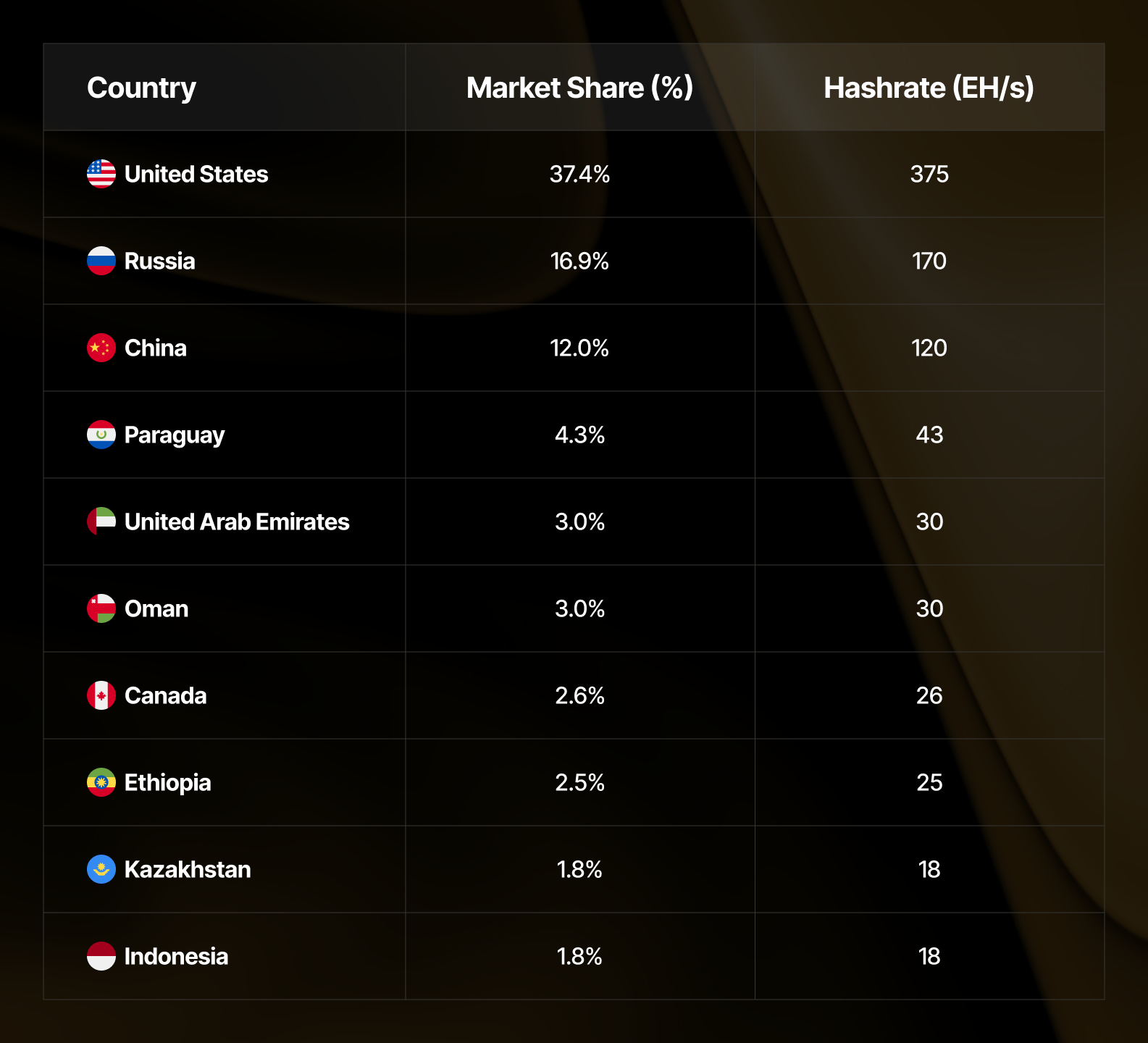
Top three countries control 65.6% of the global hashrate
The US holds the largest share of global hashrate at over 37%, followed by Russia at around 17% and China at 12%, according to the Hashrate Index heatmap.

Philpot said the hashrate among the largest players is roughly flat, however the composition is changing, with legacy equipment forced offline and modern hardware deployed selectively to regions where it can remain profitable long term.
“Growth is characterized by deployment of modern hardware alongside retirement of legacy equipment. Canada shows similar dynamics: slight quarter-over-quarter pullback but positive year-over-year growth, reflecting optimization rather than exodus,” he added.
Magazine: Bitcoin may take 7 years to upgrade to post-quantum — BIP-360 co-author
TLDR
- Binance.US is focused on diversifying its offerings by expanding into derivatives and prediction markets.
- Under CEO Stephen Gregory, Binance.US aims to regain market share lost to competitors like Coinbase and Kraken.
- The platform is committed to rebuilding trust with regulators and users through a strengthened compliance framework.
- Binance.US seeks to offer event-based markets and products tied to real-world outcomes as part of its new strategy.
- The company hopes that restoring trust and improving liquidity will help increase trading volumes and assets on the platform.
Binance.US is working to regain its footing in the U.S. crypto market by introducing new offerings. The company aims to move beyond basic crypto trading by exploring new product areas like derivatives and prediction markets. Under the leadership of Stephen Gregory, who became CEO in March, Binance.US seeks to rebuild its reputation and market share.
Expanding Beyond Spot Trading
Binance.US is setting its sights on product diversification as it attempts to make a comeback in the competitive U.S. market. The platform, once holding about 20% of the U.S. crypto market share, now operates at near-zero levels. Gregory’s leadership marks a shift as he pushes for offerings like retail derivatives and prediction markets. “Prediction markets are super hot. Everybody’s talking about that,” Gregory shared, highlighting the company’s interest in emerging market trends.
In addition to spot trading, the company plans to offer event-based markets and products linked to real-world outcomes. Binance.US sees these moves as essential in differentiating itself from other platforms such as Coinbase and Kraken. As trading fees compress, platforms are forced to explore new ways to generate revenue, and Binance.US is positioning itself at the forefront of this change.
Binance.US Focuses on Compliance to Rebuild Trust
One of the primary goals of Gregory’s plan is to rebuild trust with regulators and users. Binance.US has faced regulatory challenges, especially due to its association with Binance’s global brand. Gregory, however, emphasizes that the U.S. entity now operates independently with its own governance and a stronger compliance framework.
“We’ve really built a very, very strong compliance program,” Gregory stated, signaling the company’s commitment to adhering to U.S. regulations.
Gregory believes that restoring trust is crucial to regaining market share. He suggests that trust could help attract assets back to the platform, boosting liquidity and trading volumes. As Binance.US works to re-establish itself, it remains focused on offering a more diverse set of products while reinforcing its commitment to compliance and transparency.
Competitive Landscape and Market Challenges
Despite the potential product expansion, Binance.US faces a challenging environment. Regulatory clarity in the U.S. remains uncertain, which creates difficulties in its efforts to attract new customers and grow its market share. Competitors like Coinbase have strengthened their positions while Binance.US retrenched, making it harder for the platform to reclaim its former standing.
Nevertheless, Binance.US is betting on its broader product offerings and regulatory focus to drive future growth. With these strategic shifts, the company is looking to re-enter the conversation in the U.S. crypto market, hoping to return to its former prominence.


The new tool from the Solana-based DEX aggregator lets DEXs, launchpads, and AI agents build verification into their token creation flows.
Jupiter, the largest decentralized exchange aggregator by trading volume, today announced a new developer tool, the Express Verification API by Jupiter VRFD.
The verification API allows launchpads, DEXs, and AI agents to integrate verification into their token creation flows, so that tokens can be verified programmatically.
The three-step API flow involves a developer creating and signing a Solana transaction burning 1,000 JUP, then submitting the verification request alongside any token metadata updates in a single call. As Jupiter’s documentation explains, verification and metadata updates are reviewed independently, meaning a metadata change can go through even if a verification request is declined. Submissions can also be repeated as needed.
The API call transaction doesn’t required gas, meaning devs don’t need SOL to pay transaction fees, just a wallet holding at least 1,000 JUP to submit a request, the documentation notes.
Jupiter is positioning VRFD as standard plumbing for any project launching on Solana — a timely move given growing scrutiny over the role of private, closed-source AMMs routing an ever-larger share of Jupiter’s volume.
The launch extends Jupiter’s infrastructure play beyond pure trading. The Solana-based protocol is the world’s largest DEX aggregator by both weekly (~$2 billion) and 30-day (~$12 billion) volumes, according to DefiLlama. KyberSwap, which operates across 23 chains, is currently beating Jupiter on the daily timeframe, with nearly $444 million in the past 24 hours.
Jupiter currently carries a combined total value locked of $1.7 billion. In August, Jupiter Lend attracted $500 million in TVL within a single day of its beta debut, and that number has almost doubled to about $934 million by press time.
JUP is currently trading near $0.16, down over 90% from its all-time high in early 2024.
This article was written with the assistance of AI workflows. All our stories are curated, edited and fact-checked by a human.

This release summarizes new findings from SAS and IDC regarding how banks deploy AI. It notes that rising AI spend has not yet translated into robust governance or guardrails, undermining trust in AI systems. The study finds that only 11% of banks achieve both high internal confidence in AI and demonstrable trust, while 47% sit in a trust dilemma between underuse and overreliance. With regional digital transformation advancing in the UAE and beyond, the report underscores the need for governance, transparency, and solid data foundations as banks scale AI. The rest of this article highlights key takeaways and near-term watchpoints.
Key points
- Only 11% of banks achieve both high internal confidence in AI and demonstrably trustworthy AI.
- 47% fall into the trust dilemma between underusing reliable AI and overrelying on unvalidated AI.
- 19% operate with siloed data infrastructure, the worst rate among the study’s focus industries.
- 45% lack effective data governance and 41% lack centralized or optimized data infrastructure.
- 60% expect AI spending growth between 4% and 20%.
Why it matters
These findings have practical implications for banks, regulators, and technology teams. Without strong data foundations, governance, and explainability, AI investments may fail to deliver reliable results or earn customer and regulator trust. The emphasis on responsible innovation indicates that meaningful ROI depends on aligning AI ambition with governance and transparent decision-making before scaling. For readers, the report signals where weaknesses exist and what foundational work should be prioritized as AI initiatives move from pilots to production.
What to watch
- 52% plan to expand their AI architecture; 43% plan to form or grow dedicated AI teams.
- 31% plan to focus on developing and tuning AI models themselves.
- Nearly one-third plan increases in trustworthy AI investment to support more autonomous systems.
- 60% expect AI spending growth between 4% and 20%.
Disclosure: The content below is a press release provided by the company or its PR representative. It is published for informational purposes.
Study: Only 11% of banks have cracked the code on trustworthy AI
Even as AI spending surges, few banks have established the necessary governance and guardrails – and nearly half misjudge their own AI readiness
Dubai, United Arab Emirates, 7 April 2026 – In banking, trust isn’t optional – it’s everything. Yet, even as banks accelerate AI investment faster than other sectors, most are deploying AI without the oversight and infrastructure needed to earn that trust. That’s the central tension revealed in new banking insights from SAS’ Data and AI Impact Report: The Trust Imperative, with research insights by IDC.
Among the four sectors examined in the study, banking outpaces government, insurance and life sciences both in AI spending and adoption of trustworthy AI practices. In fact, about one-quarter (23%) of banks operate at the highest level of IDC’s Trustworthy AI Index. But even with these advantages, most banking institutions fall far short of the report’s “ideal state,” which combines high trust with high trustworthiness. According to the report:
- Only 11% of banks have achieved both high internal confidence in AI and AI systems that are demonstrably trustworthy.
- Nearly half (47%) fall into what IDC calls the “trust dilemma” – either underusing reliable AI because they don’t sufficiently trust it or overrelying on AI systems that haven’t been adequately validated.
“On trustworthy AI, banking leads every sector in this study – and even so, most banks’ foundational readiness is nowhere near where it needs to be,” said Stu Bradley, Senior Vice President of Risk, Fraud and Compliance Solutions at SAS. “Roughly nine in 10 banks have yet to fully align trust with proof, and about one in five are still running on siloed data. Closing the gap between AI ambition and AI readiness should be a top-down priority for all banks.”
As the UAE’s Vision 2031 and wider digital transformation efforts continue to gain momentum, banks across the Middle East are increasingly adopting advanced technologies to improve efficiency, strengthen resilience, and deliver better customer experiences.
Michel Ghorayeb, Managing Director at SAS UAE, said: “Banks in the Middle East are well-positioned to build on strong foundations, with robust data, clear governance, and effective oversight enabling AI investments to scale and deliver reliable results. At the same time, prioritizing transparency and making AI decisions easier to understand will play a key role in strengthening confidence. Banks that place responsible AI at the heart of their strategy will be best positioned to drive innovation, earn trust, and create sustainable long-term value.”
Investment is rising, but foundations remain fragile
The report, based on a global, cross-industry survey of 2,375 IT and business leaders, reveals a troubling pattern: Investment in AI capabilities is not being matched by investment in the responsible innovation pillars that make AI dependable. In an industry where a single model failure can trigger regulatory penalties or erode consumer confidence overnight, that’s a dangerous disconnect.
And the problem isn’t a lack of investment: Banks’ AI spending trajectory exceeds all other sectors in the study, with most banks (60%) expecting growth between 4% and 20%. A smaller subset (12%) anticipates even steeper increases. Despite this momentum, the study found significant foundational weaknesses remain, including:
- Data silos. Nearly one in five banks (19%) still operate with a siloed data infrastructure – the worst rate among the study’s focus industries.
- Insufficient data foundations. A significant portion of banks lack effective data governance (45%) and/or a centralized or optimized data infrastructure (41%).
- Talent gaps. Many banks (42%) also face shortages of specialized AI skills.
To address these issues, more than half (52%) of banks plan to expand their AI architecture; another 43% plan to form or grow dedicated AI teams. But fewer than one-third (31%) plan to focus on developing and tuning AI models themselves. The takeaway: These aren’t abstract or theoretical barriers; they’re structural.
“The banking sector clearly understands AI’s potential, but understanding and execution are not the same,” said Kathy Lange, Research Director of the AI and Automation Practice at IDC. “Without strong data architectures, governance frameworks and talent pipelines, banks risk pouring money into AI initiatives that can’t deliver ROI – or worse, that undermine the very trust they depend on.”
Responsible innovation, not cost savings, drives AI ROI
The report also challenges the assumption that AI’s primary value in banking is cost cutting. To the contrary, banking stands alone in ranking product and service innovation above process efficiency as the leading source of AI-driven value.
Cross-industry ROI figures show banks are onto something. Organizations using AI to improve customer experience reported the highest return – $1.83 for every dollar invested – followed closely by those centered on expanding market share ($1.74). Those focused on cost savings reported the lowest – $1.54 per dollar. Moreover, organizations that prioritized trustworthy AI were 60% more likely to report doubling overall return on their AI initiatives. That’s solid proof that responsible innovation is a growth accelerator that more than pays for itself.
Banks are also moving more decisively than other sectors toward agentic AI, with nearly one-third planning increases in trustworthy AI investment to support more autonomous systems. But as AI systems gain greater decision-making authority, the consequences of weak governance grow more significant.
“Regulators are watching. Customers are watching. And right now, nearly half of banks are using unproven AI – or hesitating to tap AI they’ve validated,” said Alex Kwiatkowski, Director of Global Financial Services at SAS. “No bank wants to become an ‘also-ran’ in this highly competitive race, and cost savings alone won’t keep them in it.
“The banks that win will be ones that invest in governance, explainability, transparency and strong data foundations before they scale, not after something breaks.”
To learn more and access the full Data and AI Impact Report, published in September 2025, visit SAS.com/ai-impact.
SAS is a global leader in data and AI. With SAS software and industry-specific solutions, organizations transform data into trusted decisions. SAS gives you THE POWER TO KNOW®.
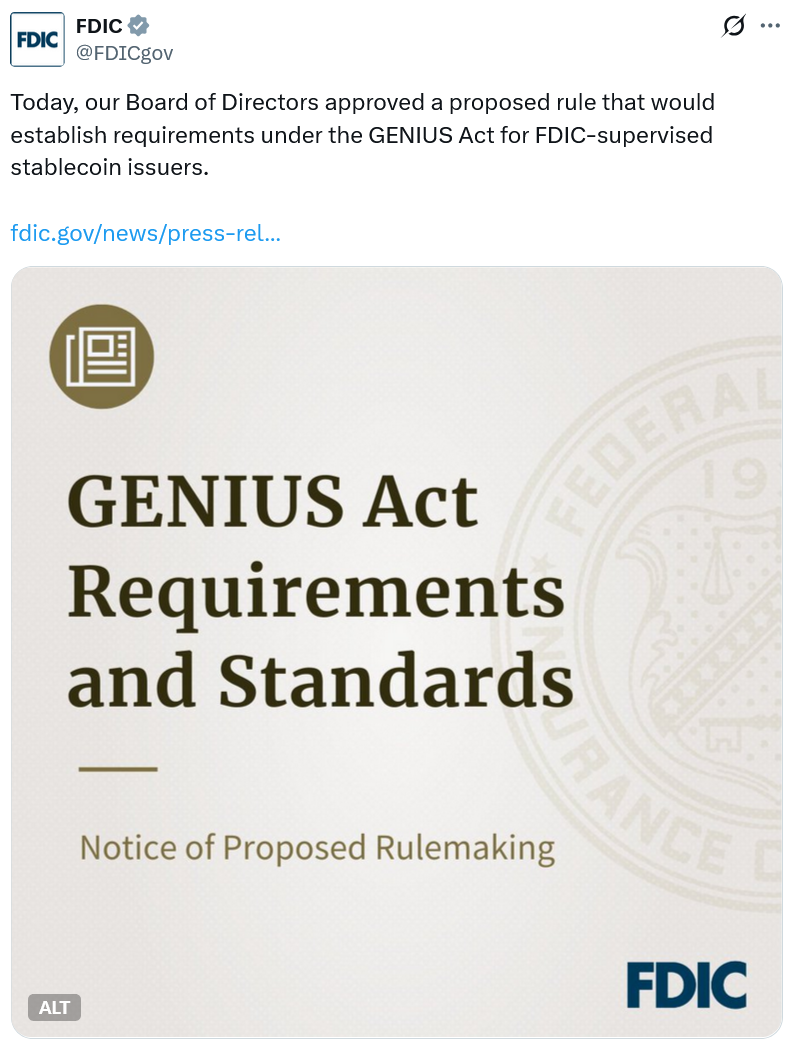
The US Federal Deposit Insurance Corporation (FDIC) has proposed new rules to regulate FDIC-supervised stablecoin issuers in accordance with the Guiding and Establishing National Innovation for US Stablecoins (GENIUS) Act, which was signed into law nine months ago.
In a statement on Tuesday, the FDIC said its board of directors voted to issue a proposal that would set reserve, redemption, capital, risk management and custody standards for stablecoin issuers and insured depository institutions under its supervision.

The FDIC insures deposits at more than 4,000 financial institutions and supervises over 2,700 banks and savings associations to maintain stability in the US financial system.
The GENIUS Act granted the FDIC authority to oversee stablecoin activity within the banks and institutions that it supervises when it was signed into law in July, though it is scheduled to take effect on Jan. 18, 2027, if not earlier.
FDIC insurance won’t directly protect token holders
While reserve deposits backing a payment stablecoin would be insured under the FDIC’s proposed rules, that protection won’t extend to stablecoin holders, the FDIC said.
The FDIC argued that treating stablecoin holders as the insured depositors “seems inconsistent” with the GENIUS Act’s prohibition on payment stablecoins being subject to Federal deposit insurance.
Related: Stablecoins flip automated clearing house volume in February
However, the FDIC said its rules would still provide a more “secure environment” for stablecoin holders by offering them “increased assurance that their payment stablecoins are subject to elevated regulatory and supervisory standards.”
FDIC welcomes feedback
The FDIC invited the public to offer feedback on 144 questions related to how it should regulate stablecoin issuers. Comments will be accepted for the next 60 days.
It marks the FDIC’s second proposal for implementing the GENIUS Act, following a Dec. 19 plan to establish an application procedure for IDIs seeking approval to issue payment stablecoins through subsidiaries.
The Office of the Comptroller is also working to implement the GENIUS Act. The OCC would cover a broader scope of stablecoin activity than the FDIC, as it oversees national bank subsidiaries and certain nonbank issuers.
Magazine: Would Bitcoin really be at $200K if not for Jane Street? Trade Secrets
Vikings Linked to Bizarre Trade Partner in Draft

Tech Moves: Microsoft leader jumps to Anthropic; Tagboard gets new CEO; Expedia names tech VP

UK weather map shows area where the mercury is expected to peak at 26C TODAY


-

 NewsBeat5 days ago
Steven Gerrard disagrees with Gary Neville over ‘shock’ Chelsea and Arsenal claim | Football
-

 Business5 days ago
No Jackpot Winner and $194 Million Prize Rolls Over
-

 Fashion4 days ago
Weekend Open Thread: Spanx – Corporette.com
-

 Crypto World6 days ago
Gold Price Prediction: Worst Month in 17 Years fo Save Haven Rock
-

 Business2 days ago
Three Gulf funds agree to back Paramount’s $81 billion takeover of Warner, WSJ reports
-

 Sports3 days ago
India men’s 4x400m and mixed 4x100m relay teams register big progress | Other Sports News
-

 Business4 days ago
Expert Picks for Every Need
-

 Business6 days ago
Login and Checkout Issues Spark Merchant Frustration
-

 Tech5 hours ago
How Long Can You Drive With Expired Registration? What Florida Law Says
-
Business3 days ago
No Jackpot Winner, Prize to Climb to $231 Million
-

 Tech6 days ago
Commonwealth Fusion Systems leans on magnets for near-term revenue
-

 Tech6 days ago
Drawing Tablet Controls Laser In Real-Time
-

 Crypto World6 days ago
Ripple rolls out enterprise crypto treasury platform for corporates
-

 Fashion2 days ago
Massimo Dutti Offers Inspiration for Your Summer Mood Board
-

 Crypto World6 days ago
Why It’s Partnering, Not Issuing
-
Politics5 days ago
Wings Over Scotland | The quality of mercy
-

 Business3 days ago
Akebia Therapeutics, Inc. (AKBA) Discusses Pipeline Progress and Strategic Focus on Kidney Disease Treatments at R&D Day – Slideshow
-

 Fashion7 days ago
Debenhams Occasion Dresses for Girls 2026 Collection
-
 Sports6 days ago
Steal Gary Woodland’s subtle power move for longer drives
-
 Tech6 days ago
Battery Tester Outperforms Cheaper Options
You must be logged in to post a comment Login