
Crypto World
Hegseth fires Army chief in Iran war



The political news from the Pentagon on April 2 shocked military officials: Defense Secretary Pete Hegseth fired Army Chief of Staff Gen. Randy George — the Army’s most senior officer — while the 82nd Airborne Division was actively deploying to the Middle East, replacing him immediately with Gen. Christopher LaNeve, a former personal aide to Hegseth.
Summary
- CBS News first reported the ouster; Axios confirmed with defense officials; Hegseth also fired Gen. David Hodne, commander of Army Transformation and Training Command, and Maj. Gen. William Green Jr., the Army chief of chaplains — three generals removed on the same day
- George, confirmed by the Senate as Army Chief in 2023 under Biden and three years into a typical four-year term, learned of the decision via a phone call from Hegseth while he was in a meeting; Pentagon spokesman Sean Parnell announced his retirement as “effective immediately”
- Two US officials confirmed to Axios the firing was driven by clashing personalities, not policy disagreement; it is the latest in a string of more than a dozen generals and flag officers Hegseth has removed since taking office, including Joint Chiefs Chairman Gen. C.Q. Brown and Navy CNO Adm. Lisa Franchetti
As Axios reported, one US official’s response to the timing was blunt: “you fire him? In the middle of a war?” LaNeve, who previously called into the Commander in Chief’s Ball after Trump’s inauguration to congratulate the president, was described by Parnell as “completely trusted by Secretary Hegseth to carry out the vision of this administration without fault.” The firing coincides with the fifth week of the Iran war and the Army’s active deployment of forces for integrated air and missile defense.
George was not a figurehead. He was actively coordinating the deployment of 82nd Airborne forces and integrated air and missile defense systems to the Middle East — capabilities the Army is primarily responsible for delivering to the joint force. Two US officials told Axios that George was in a meeting working through those logistics when Hegseth called. His abrupt departure interrupts continuity at the senior-most level of Army coordination at the precise moment those functions are most operationally critical. Hodne’s simultaneous removal from Army Transformation and Training Command — a unit created months ago to accelerate technology deployment — leaves that mission without confirmed leadership during active combat operations.
A Growing Pattern of Wartime Leadership Disruption
Hegseth has now removed more than a dozen generals and flag officers since taking office. The firings have prompted concern from both military officials and bipartisan observers about the politicization of senior military leadership and the erosion of the tradition of frank, nonpartisan advice flowing from uniformed commanders to civilian leadership. Five former defense secretaries, including retired Gen. Jim Mattis, sent a joint letter to Congress in the past year describing the pattern as “reckless” and calling for hearings on national security implications. Congress scheduled none.
Why the Pentagon Purge Matters for Markets
The Iran war has been a consistent factor in bitcoin price consolidation throughout early 2026. As crypto.news has reported, BTC has remained range-bound between $65,000 and $73,000 with ceasefire signals producing brief rallies above $70,000 before reversing on hawkish news. As crypto.news has noted, geopolitical volatility in the Iran conflict has been a primary market signal in 2026 — and a destabilized military command structure during active combat introduces new uncertainty into that calculus.

Key takeaways:
-
The US and Iran ceasefire boosted stock markets and Bitcoin, but BTC derivatives suggest limited bullish momentum.
-
Legislative setbacks and a “fragile truce” between the US and Iran keep bears active with a potential $68,000 correction on the cards.
Bitcoin (BTC) rallied 6% in less than four hours on Tuesday, following gains in global stock markets after the US and Iran reached a two-week ceasefire deal. The rally caught traders off guard, triggering a $280 million liquidation event in Bitcoin futures markets.
Bitcoin bears could be in trouble if the war in Iran effectively winds down, but BTC derivatives signal that sustainable bullish momentum above $80,000 could take longer than anticipated.

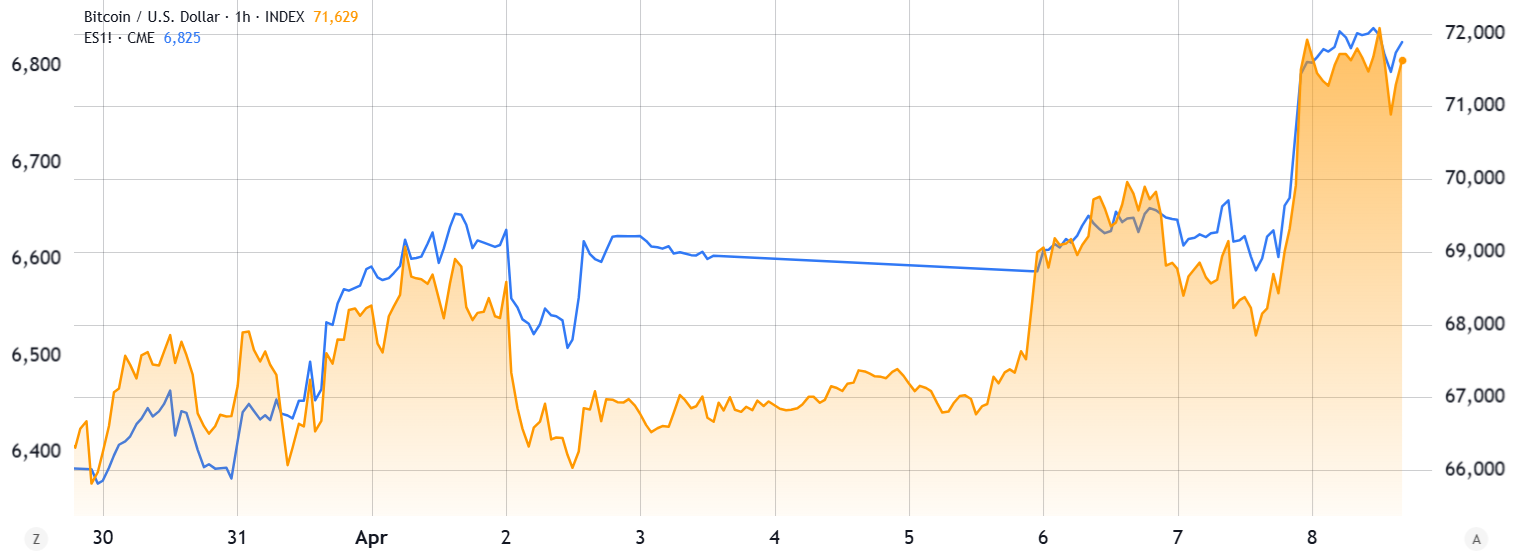
Bitcoin’s high correlation with the S&P 500 futures suggests that BTC’s rally was mainly led by the potential reopening of the Strait of Hormuz. US President Donald Trump said that Iran’s nuclear program will be deactivated in exchange for tariff and sanctions relief. However, Bitcoin bears’ hopes jumped after US Vice President JD Vance said that the Iran ceasefire is a “fragile truce.”
Persistent inflationary pressure and weak Bitcoin derivatives metrics
A sustainable de-escalation would likely lead to lower oil prices and reduced inflationary pressure, potentially paving the way for expansionist monetary policies. The US Federal Reserve has remained reluctant to trim interest rates despite signs of a weakening job market. Traders who previously exited risk markets changed their minds as the odds of a severe economic impact declined.
While $280 million in forced liquidations of bearish leveraged positions accelerated the rally, BTC derivatives positioning showed no major shifts.

Bitcoin futures aggregate open interest reached 593,930 BTC on Wednesday, up 2.5% from Tuesday. Crucially, liquidations of $200 million to $300 million are relatively common, having occurred five other times over the past 90 days. This $280 million instance remains minor compared to the total $42 billion aggregate futures position.

The Bitcoin futures annualized premium relative to regular spot markets stood at 3% on Wednesday, flat from two days prior. The lack of demand for bullish positions has pushed the indicator below the neutral 4% threshold since late January.

Demand for downside protection Bitcoin options has prevailed over the past two weeks. Premiums on put (sell) options have outpaced the buy (call) instruments, although distancing themselves from the extreme fear levels seen on March 26.
Will regulatory hurdles nix the Bitcoin rally?
Bitcoin bulls’ confidence had already been hit from the Oct. 10, 2025, flash crash, the disappointment with regulation and the lack of progress on the US Strategic Bitcoin Reserve. The latest draft of the PARITY Act failed to include tax exemptions for small Bitcoin payments or deferred capital gains for mining. Additionally, David Sacks stepped down from his role as the White House AI and cryptocurrency czar on March 26.
Related: Iran is weighing crypto tolls for ships using Strait of Hormuz–Report
Despite multiple mentions from US Treasury Secretary Scott Bessent in 2025 regarding “budget neutral” strategies to acquire Bitcoin without adding new taxes, no clear path was ever disclosed. Simultaneously, the US Democratic Party has requested that regulators scrutinize the Trump family’s cryptocurrency ventures based on potential conflicts of interest.
There is no indication that Bitcoin bears are rushing to close their shorts despite the recent rally. Inflationary pressure has not yet faded, as Brent crude oil prices held at $95 per barrel, up from $72 per barrel in late February. More importantly, a two-week ceasefire is far from a long-term solution, leaving the odds of a correction to $68,000 wide open.
This article is produced in accordance with Cointelegraph’s Editorial Policy and is intended for informational purposes only. It does not constitute investment advice or recommendations. All investments and trades carry risk; readers are encouraged to conduct independent research before making any decisions. Cointelegraph makes no guarantees regarding the accuracy or completeness of the information presented, including forward-looking statements, and will not be liable for any loss or damage arising from reliance on this content.
The Ethereum Foundation (EF) announced it will convert 5,000 ETH into stablecoins using CoW DAO’s time-weighted average price feature to fund research, grants, and donations.
The swap, worth roughly $11 million at current prices, follows the treasury management framework the EF published in June 2025.
Why the EF Is Selling ETH Now
The EF is one of the largest single holders of Ether, and its selling activity has historically drawn community scrutiny.
This latest conversion signals that the organization is actively executing the treasury policy it published in June 2025.
That policy sets annual operating expenses at 15% of total treasury value. It also maintains a 2.5-year cash buffer.
Periodic checks determine whether fiat reserves meet the target; any shortfall triggers ETH sales over the following quarter.
The Foundation confirmed on X that CoW DAO’s TWAP mechanism will execute the trade. TWAP spreads large orders over time to reduce market impact.
A Broader Shift Toward “Defipunk” Principles
Beyond simple liquidation, the treasury document reveals a broader philosophical shift. The Foundation committed to deploying capital through what it calls “Defipunk” principles.
Those principles favor permissionless, privacy-preserving, open-source protocols.
The EF’s on-chain strategy now includes solo staking, lending through established protocols, and potentially borrowing stablecoins for yield.
The policy also outlines concrete criteria for evaluating DeFi protocols. Projects must offer self-custody, use free and open-source code, and minimize reliance on oracles and admin keys.
Privacy features receive particular emphasis. The EF argues that privacy protects market participants from front-running, targeted phishing, and physical coercion.
Five-Year Spending Glide Path
The EF has signaled it intends to reduce annual spending from the current 15% rate down to a 5% baseline over five years. The organization plans to gradually narrow its operational scope during that period.
However, the policy framed 2025 and 2026 as pivotal years for Ethereum. That justifies elevated spending now while planning for a leaner future structure.
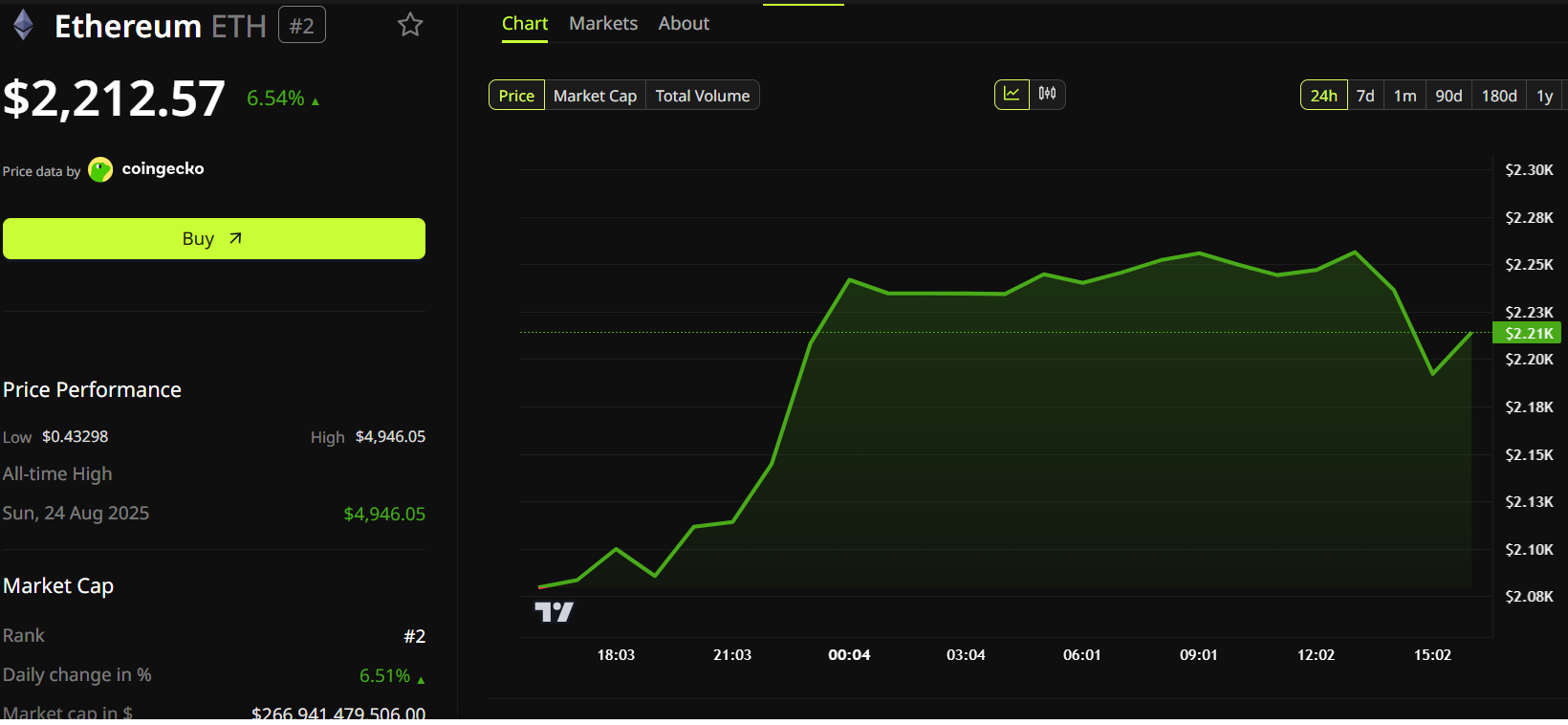
ETH traded at $2,212 at press time, up 6.5% over the previous 24 hours. Markets have absorbed the conversion news without significant selling pressure so far.
The post Ethereum Foundation Dumps 5,000 ETH Amid Secret Treasury Overhaul appeared first on BeInCrypto.
Two Bitcoin (BTC) whales have taken massive opposing leveraged positions worth a combined $51 million, as the fragile US-Iran ceasefire showed signs of fracturing over Lebanon.
The high-stakes bets reflect the extreme uncertainty now gripping crypto markets, with BTC trading near $71,500 after a 4.5% overnight rally tied to the ceasefire announcement.
Whale Showdown Puts $51 Million on the Line
On-chain tracker Lookonchain flagged two whale wallets taking polar opposite positions. Wallet 0x2fc3 opened a 30x leveraged long on 325.88 BTC, worth approximately $23.22 million, with a liquidation price of $70,092.
In the opposing corner, wallet 0xedf2 opened a 40x short on 400 BTC, worth roughly $28.5 million, with liquidation at $72,183.
The tight spread between both liquidation zones and BTC’s current price makes this one of the most compressed whale standoffs in recent weeks.
A move of just 2% in either direction could trigger millions in forced liquidations.
Ceasefire Cracks Threaten the Rally
The macro picture is equally unstable. The Kobeissi Letter reported that Iran warned it would withdraw from the two-week ceasefire if Israel continued its military operations in Lebanon.
Minutes later, the White House reportedly told Axios the agreement does not include Lebanon at all.
Pakistan’s Prime Minister Shehbaz Sharif urged all parties to exercise restraint, noting that violations had already been reported.
“Violations of ceasefire have been reported at few places across the conflict zone which undermine the spirit of peace process,” stated Sharif.
Trump Slams Unauthorized Ceasefire Claims
Adding another layer of confusion, US President Donald Trump posted on Truth Social that numerous unauthorized agreements and letters were circulating from parties with no role in the negotiations.
He called the authors “total Fraudsters” and “Charlatans,” warning that a federal investigation would expose them.
Trump stressed that only one set of meaningful points formed the basis of the ceasefire, and those would be discussed behind closed doors.
He also took aim at CNN for headlining a source he said had no authority to claim involvement.
The statement adds further ambiguity to what the ceasefire actually covers. With Iran threatening withdrawal, Israel pressing ahead in Lebanon, and Trump dismissing rival frameworks, the truce appears fragile at best.
The implications are direct for Bitcoin. Shorts worth $252 million were liquidated within 24 hours of the initial truce announcement.
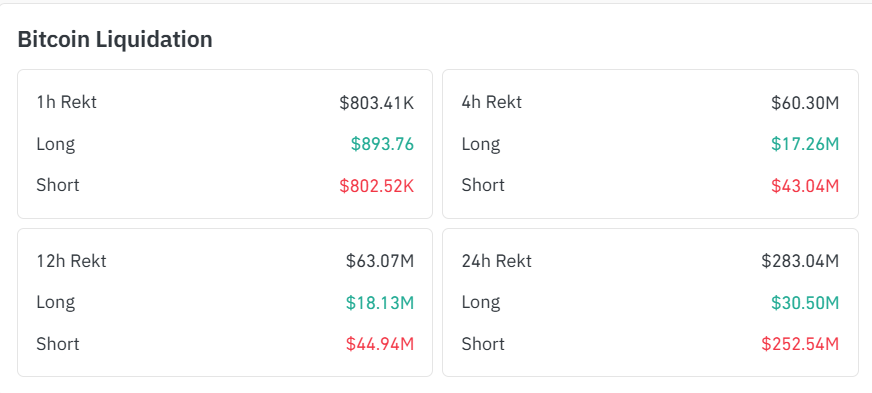
Whether the rally holds may depend less on whale positioning and more on what happens next in Beirut, Islamabad, and Washington.
The post Whales Wage $51 Million Bitcoin Battle as Iran Ceasefire Fractures Over Lebanon appeared first on BeInCrypto.


The AI news out of OpenAI this week has a sharp edge: the company launched a paid Safety Fellowship offering $3,850 weekly stipends to external researchers studying what could go wrong with advanced AI — announced within hours of a New Yorker investigation reporting that OpenAI had dissolved its internal safety teams and quietly removed the word “safely” from its IRS mission statement.
Summary
- The OpenAI Safety Fellowship, announced April 6, runs from September 14, 2026 through February 5, 2027; fellows receive a $3,850 weekly stipend, approximately $15,000 in monthly compute resources, and mentorship from OpenAI researchers, but will not have access to the company’s internal systems
- Priority research areas include safety evaluation, ethics, robustness, scalable mitigations, privacy-preserving methods, agentic oversight, and high-severity misuse — applications close May 3, with fellows notified by July 25
- The New Yorker’s Ronan Farrow reported the same week that OpenAI had dissolved its superalignment team, its AGI Readiness team, and its Mission Alignment team since 2024, and that an OpenAI representative responded to a journalist asking about existential safety researchers with: “What do you mean by existential safety? That’s not, like, a thing.”
OpenAI announced the fellowship on April 6 as “a pilot program to support independent safety and alignment research and develop the next generation of talent.” The program pays $3,850 per week, over $200,000 annualized, plus roughly $15,000 in monthly compute and mentorship from OpenAI researchers. Fellows work from Constellation’s Berkeley workspace or remotely, and applications close May 3. The fellowship is not limited to AI specialists — OpenAI is recruiting from cybersecurity, social science, and human-computer interaction alongside computer science.
The timing is the story. Ronan Farrow’s investigation in The New Yorker, published the same day, documented that OpenAI had dissolved three consecutive internal safety organizations over 22 months. The superalignment team was shut down in May 2024 after co-leads Ilya Sutskever and Jan Leike departed. Leike wrote on his way out that “safety culture and processes have taken a backseat to shiny products.” The AGI Readiness team followed in October 2024. The Mission Alignment team was disbanded in February 2026 after just 16 months. The New Yorker also reported that when a journalist asked to speak with OpenAI’s existential safety researchers, a company representative replied: “What do you mean by existential safety? That’s not, like, a thing.”
The fellowship explicitly does not replace internal infrastructure. Fellows receive API credits and compute resources but no system access, positioning the program as arm’s-length research funding rather than a rebuild of the dissolved teams.
What the Fellowship Requires Fellows to Produce
The research agenda spans seven priority areas: safety evaluation, ethics, robustness, scalable mitigations, privacy-preserving safety methods, agentic oversight, and high-severity misuse domains. By the program’s end in February 2027, each fellow must produce a substantive output — a paper, benchmark, or dataset. Specific academic credentials are not required; OpenAI stated it prioritizes research ability, technical judgment, and execution capacity.
Why This Matters Beyond the AI Industry
As crypto.news has reported, confidence in frontier AI companies’ stated safety commitments is a market signal that affects capital allocation across AI infrastructure, AI tokens, and the DePIN and AI agent protocols sitting at the intersection of crypto and artificial intelligence. As crypto.news has noted, OpenAI’s spending trajectory and the credibility of its operational priorities are tracked closely by investors evaluating the AI infrastructure sector — a sector with growing overlap with blockchain-based systems. Whether external fellows working without internal access can meaningfully influence model development is a question the first cohort’s research will begin to answer in early 2027.


The AI jobs picture at Meta is contradictory on paper: the company is eliminating 198 California positions via state WARN Act filings effective May 2026, even as it projects $115 billion to $135 billion in 2026 capital expenditure with a large share directed at AI infrastructure.
Summary
- California WARN Act filings show Meta is cutting 124 jobs at its Burlingame office on Airport Boulevard, effective May 22, and 74 jobs at its Sunnyvale office on Discovery Way, effective May 29 — all permanent per the filings, first reported by the San Francisco Chronicle
- The May round brings Meta’s confirmed 2026 California WARN total to 519, following a January round of 219 at Burlingame and additional March reductions; job functions at both offices have included hardware, augmented reality, and infrastructure work, though the WARN filings do not break down cuts by role
- CEO Mark Zuckerberg has called 2026 “a turning point for AI in the workplace”; Meta’s projected capex of $115 billion to $135 billion for the year is being directed toward data centers, servers, and AI model infrastructure even as headcount in California continues to fall
The California Employment Development Department’s WARN Act database is the primary public record for the cuts. The filings identify the affected locations as Meta’s Burlingame campus on Airport Boulevard and its Sunnyvale campus on Discovery Way, with effective termination dates of May 22 and May 29, respectively. Meta’s spokesperson described the reductions as “standard operational planning,” without specifying the roles or teams affected.
The 198 May positions are not an isolated event. When added to the 219 cut in January at the same Burlingame campus and additional reductions in March, Meta has now eliminated 519 confirmed California positions via WARN filings in the first four months of 2026. WARN filings only capture mass layoffs at covered locations that meet statutory thresholds, meaning the actual total of Meta’s California workforce reductions in 2026 is likely higher than what the public record reflects. The pattern across four months is one of continuous restructuring rather than a single defined reduction event.
The Paradox of Rising Capex and Falling Headcount
The tension in Meta’s labor strategy is not unique to the company. As crypto.news has reported, a broad wave of technology firms in 2026 has cited AI integration as a driver of workforce reductions, framing cuts as efficiency gains rather than financial distress. In Meta’s case, Zuckerberg’s own language has been explicit: if AI can handle tasks previously requiring large teams, the company needs fewer humans. Even as California headcount shrinks, the company says it is hiring actively for specialized technical roles in AI development.
What Comes Next for Affected Workers
The WARN Act requires 60 days’ written notice before mass layoffs, meaning the filings made public this week reflect decisions finalized around late March. Workers at both locations are entitled to notice rights and may have claims if the notice period was not properly observed. As crypto.news has noted, competition for AI talent between Meta and frontier labs has been intense throughout 2025 and 2026, and some affected workers may find themselves immediately recruited by other companies in the AI buildout. Meta has not indicated whether the May round represents the end of California reductions for 2026.
Morgan Stanley’s spot Bitcoin (BTC) ETF began trading on NYSE Arca under the ticker MSBT, logging 1.6 million shares and roughly $34 million in inflows on its first day.
The launch makes Morgan Stanley the first major US bank to issue a spot Bitcoin ETF under its own name.
Cheapest BTC ETF Enters a Crowded Field
MSBT charges a 0.14% expense ratio, undercutting BlackRock’s iShares Bitcoin Trust (IBIT) at 0.25%.
The fund joins more than 10 spot Bitcoin ETFs launched over the past two years, which collectively command over $85 billion in assets.
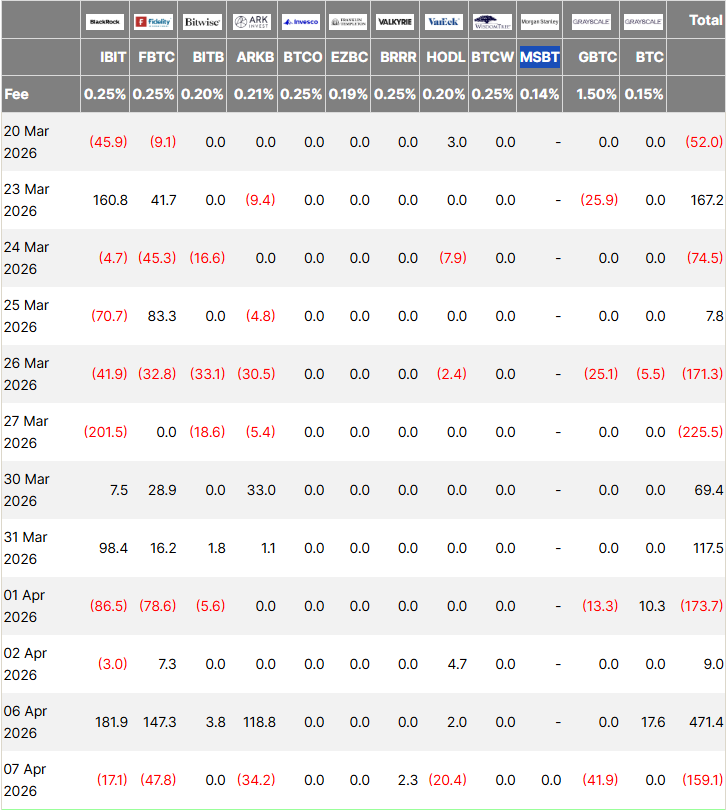
Bloomberg ETF analyst Eric Balchunas projected MSBT could reach $50 million in first-day volume. He placed it among the top 1% of all ETF launches in the past year.
Distribution Power vs. Liquidity
Morgan Stanley employs approximately 16,000 wealth management advisors overseeing $9.3 trillion in client assets.
That network gives MSBT a distribution advantage no previous Bitcoin ETF issuer has matched.
Nate Geraci, president of NovaDius Wealth Management, called distribution “king in the ETF space” and said Morgan Stanley’s advisor network combined with the lowest fee creates a strong formula.
The bank also plans to launch retail crypto trading on E-Trade in the first half of 2026, creating a multi-channel approach to digital asset access.
Whether MSBT can sustain momentum against IBIT’s deep liquidity and options market dominance will determine if Wall Street’s entry reshapes the competitive balance.
The post Morgan Stanley’s Bitcoin ETF Goes Live With Massive Inflow appeared first on BeInCrypto.


The immigration news out of California on Tuesday drew national attention within hours: ICE agents shot a man during a targeted traffic stop near Interstate 5 in Patterson, California, dashcam footage of the incident was obtained and published by KCRA Sacramento, and the FBI immediately took over as the primary investigating agency.
Summary
- Acting ICE Director Todd Lyons identified the target as Carlos Ivan Mendoza Hernandez, describing him as an undocumented immigrant and alleged 18th Street Gang member wanted in El Salvador for questioning in connection with a murder; Lyons said Hernandez “weaponized his vehicle in an attempt to run an officer over,” prompting agents to fire in self-defense
- Dashcam footage shows at least three law enforcement agents surrounding a black vehicle before it reverses and strikes another car, then moves toward agents; the footage does not include audio and does not clearly show the exact moment shots are fired — Hernandez was transported to a hospital in critical condition
- Hernandez’s attorney said ICE may have targeted “the wrong man”; California Gov. Gavin Newsom’s office called for federal agents to “appropriately collaborate with state and local law enforcement”; FBI Special Agent in Charge Eugene Wu issued a public plea for additional witness video
KCRA Sacramento was first to obtain the dashcam footage; KTVU Fox 2 also published the video alongside detailed reporting on the sequence of events. The Stanislaus County Sheriff’s Office confirmed it was assisting the investigation but was not involved in the original stop. ICE officers say they were executing a targeted arrest operation. The shooting happened at the intersection of Sperry Avenue and Rogers Road in Patterson, approximately 90 miles south of Sacramento, and closed the intersection for several hours.
The footage obtained by KCRA shows at least three agents positioned around a black SUV near Interstate 5. The vehicle reverses, with its passenger-side door striking another car on the road. Agents raise their firearms. The car then turns left across a lane divider while one agent moves out of its path. The footage does not contain audio and does not clearly capture the moment gunfire occurs. Multiple news organizations published the video Tuesday afternoon. ICE’s account — that Hernandez drove toward agents — is broadly consistent with the visible movement in the footage, though the full sequence of events is now subject to an FBI investigation rather than a DHS one.
Why the FBI’s Role Matters
DHS has faced a credibility problem in 2026 following incidents where its initial accounts of ICE use-of-force were contradicted by independent video. Most visibly, the Minneapolis shooting of a Venezuelan man in January 2026 — originally described by DHS as occurring after he attacked officers with a shovel — was directly contradicted by new video released by the city. Two ICE officers were subsequently suspended, with the agency stating they “appeared to have made untruthful statements.” The FBI’s immediate assumption of primary investigative authority in Patterson reflects the heightened scrutiny now applied to federal use-of-force incidents involving immigration enforcement, and removes DHS from controlling the evidentiary record.
What the Patterson Shooting Adds to the 2026 Immigration Enforcement Debate
As crypto.news has reported, immigration enforcement policy is one of several US political pressures contributing to economic uncertainty in 2026, with broader market effects tracked across sectors. As crypto.news has noted, political volatility from the Iran war and domestic enforcement controversies has been a consistent factor in the bitcoin price consolidation that has kept BTC range-bound below $73,000 through the first quarter. The FBI investigation is ongoing and no charges have been filed; the full sequence of events on Tuesday remains under active review.

Bitcoin briefly touched $72,700 on Wednesday as traders cheered a US-Iran ceasefire deal, only to retreat below $71,000 within hours as fresh Middle East violence shattered the optimism.
The rally was real — but it didn’t last long enough to matter.
Hormuz Still Blocked, Oil Bounces Back
Israel launched its largest assault on Lebanon yet, striking over 100 Hezbollah sites across Beirut in under ten minutes. Iran’s parliament speaker declared that three ceasefire clauses had already been violated, sending WTI crude up 2.8% to $97.03 and Brent up 2.5% to $97.14 a barrel, reversing most of the previous session’s 16% plunge.
The Strait of Hormuz, which normally sees around 135 ships daily, recorded just three transits on Wednesday. Over 800 vessels remain stuck in the Gulf, awaiting clarity on safe passage.
Ether dropped 1.1% to $2,185, tracking Bitcoin’s retreat amid broadly weakening risk appetite. Gold edged slightly lower to $4,713, while the dollar held steady, suggesting markets were cautious but not in full panic mode.
Market analysts noted the rally had been driven largely by algorithmic and momentum strategies rather than genuine fundamental improvement. The rebound lacked staying power once geopolitical pressure returned.
Fed Adds Another Layer of Pressure
Minutes from the US Fed’s March meeting, released Wednesday, showed growing concern among policymakers about persistent inflation. Some officials argued the Fed should keep rate hikes on the table if oil prices stay elevated.
A prolonged Hormuz blockade would keep energy costs high, delaying any Fed pivot that crypto markets have been counting on. Higher rates historically weigh on risk assets like Bitcoin, making war uncertainty and hawkish Fed signals a tough combination for bulls.
For Bitcoin, the macro backdrop remains uncomfortable — caught between fading hopes of a ceasefire and a Fed in no rush to ease.
The post Bitcoin’s Ceasefire Rally Dies Fast as War Chaos Returns appeared first on BeInCrypto.
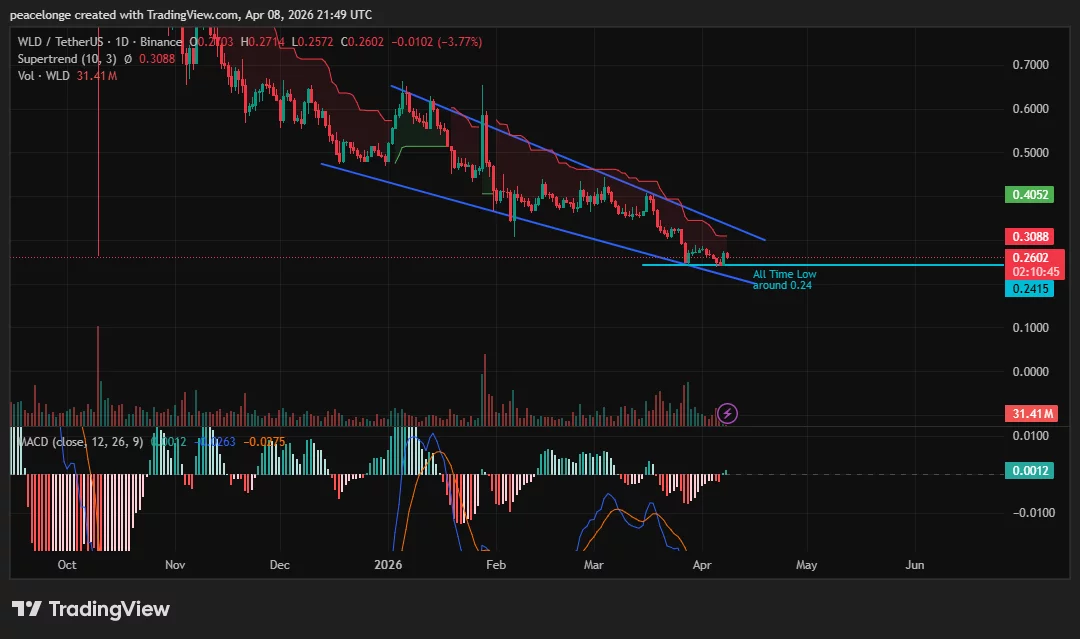
Worldcoin price is trading at $0.2602, down 3.77% on the day, with the lower boundary of a six-month descending channel now pressing directly on price — and the all-time low at $0.2415 offering the only remaining floor before uncharted territory.
Summary
- Worldcoin price is trading at $0.2602, down 3.77% on the day, with the lower boundary of a six-month descending channel now converging directly on price near the all-time low of $0.2415.
- The daily Supertrend at $0.3088 has acted as a rolling resistance ceiling rejecting every recovery attempt, while the MACD line at -0.0263 and signal at -0.0375 both remain below zero despite a marginally positive histogram of 0.0012.
- A confirmed daily close below $0.2415 would mark a new all-time low and open the next downside target at the $0.20 psychological level, with no prior support between the two.
The descending channel has been defined by two parallel downward-sloping trendlines since October 2025. The upper boundary sits near $0.4052, and the lower boundary is pressing toward the $0.24 zone. The daily Supertrend at $0.3088 has acted as a rolling resistance ceiling throughout the channel structure, rejecting every recovery attempt in recent weeks. Worldcoin (WLD) has not produced a sustained daily close above the Supertrend since late 2025.
The chart pattern is unambiguous. WLD has produced a textbook descending channel on the daily timeframe across six months, with consistent lower highs and lower lows. The lower trendline is now converging with the all-time low at $0.2415, creating a critical confluence zone. A daily close below $0.2415 would confirm a new historic low for WLD and open a path toward territory the token has never traded on a closing basis.
The daily MACD histogram has crept to 0.0012, barely above zero, while the MACD line at -0.0263 remains above the signal at -0.0375, producing a tentative early crossover. Both lines are still below zero, which means no confirmed bullish reversal signal has printed. The marginally positive histogram indicates only that downward momentum has slowed, not reversed.
Analyst @bpaynews noted on X that WLD “eyes a move near $0.30 as momentum stays bearish on MACD,” adding: “Watch for key level at $0.30 or $0.25.”
Key Levels and Price Targets
Immediate support: $0.2415, the all-time low. A confirmed daily close below this level represents structural deterioration, with no prior support below it on a daily close basis.
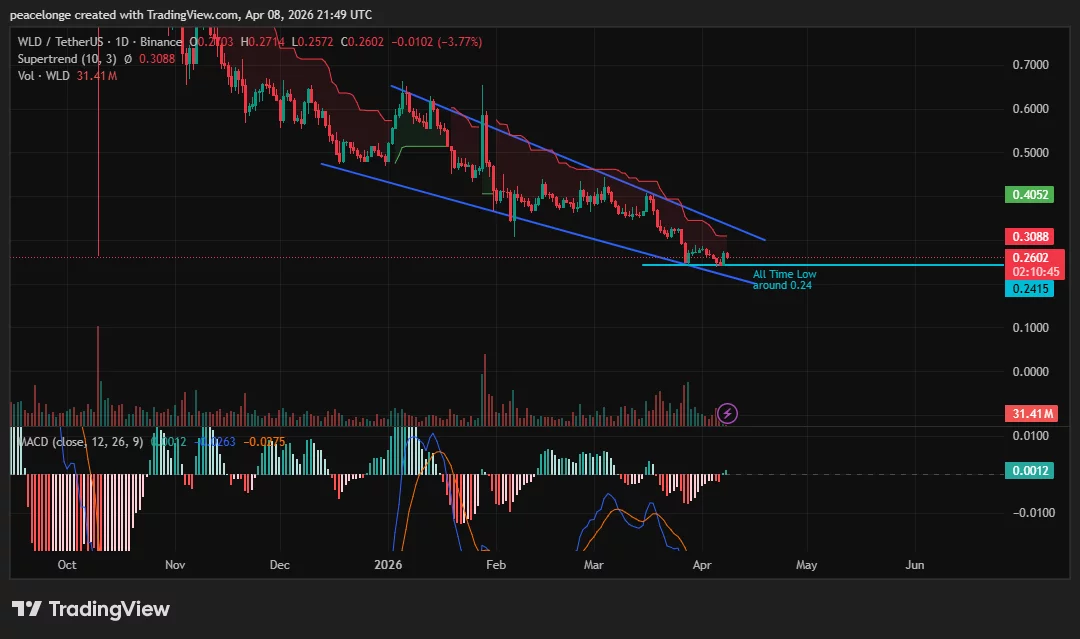
Extended downside target: $0.20, the psychological level that aligns with the projected lower boundary of the descending channel over the coming weeks.
Bull case: a daily close above the Supertrend at $0.3088 is the minimum required for a structural shift in bias. A sustained recovery from that level opens the medium-term path toward the upper channel boundary at $0.4052. Invalidation: $0.3088.
On-Chain and Fundamental Pressure
Nansen data shows the total balance of WLD held across centralised exchanges rose over 25% to approximately $742 million in the week ending March 27, as the Worldcoin team moved roughly $26 million in WLD to exchange wallets. Elevated exchange balances increase near-term selling risk, and that dynamic has not meaningfully reversed.
Binance announced the delisting of COIN-M futures for WLD in early April, removing a key leveraged trading venue and reducing derivatives liquidity. Nasdaq-listed Eightco Holdings disclosed a 277 million WLD position worth approximately $326 million on April 2, yet the disclosure produced no sustained upside response, reflecting the depth of sell-side pressure the market continues to absorb.
A daily close below $0.2415 opens a direct path to $0.20. Until WLD reclaims the Supertrend at $0.3088, the descending channel structure keeps the bias firmly bearish.

Bitcoin extended a sharp intraday move higher on Tuesday, rising about 6% within four hours as risk appetite improved in tandem with a broader rally in global equities after news of a two-week ceasefire between the United States and Iran. The swift price surge coincided with a wave of liquidations in Bitcoin futures, totaling roughly $280 million, as traders repriced risk in a volatile macro environment. Yet despite the immediate bounce, derivatives data indicate that the market has yet to establish a durable uptrend above key levels.
Bitcoin’s move has been closely correlated with S&P 500 futures, underscoring how macro headlines continue to drive crypto sentiment. President Donald Trump emphasized that Iran’s nuclear program could be deactivated in exchange for tariff and sanctions relief, a narrative that helped tilt sentiment toward risk-on assets. Still, observers warn the rally may be constrained by ongoing geopolitical uncertainties and a fragile ceasefire, with some voices labeling the truce a temporary pause rather than a lasting resolution. In a separate signal, Vice President JD Vance described the Iran ceasefire as a “fragile truce,” reinforcing the sense that the path forward remains uncertain.
Key takeaways
- The ceasefire between the US and Iran helped lift Bitcoin and global equities, but traders remain sensitive to the durability of that diplomatic development.
- Bitcoin futures saw a $280 million forced liquidation event during the rally, a reminder of the market’s leverage-driven risks even as prices move higher.
- Derivatives metrics show only modest bullish momentum: the two-month futures annualized premium sits near 3%, below the neutral 4% line that has held since late January.
- Put options dominate the options market recently, indicating persistent demand for downside protection even as the price rebounds.
- Regulatory and geopolitical headwinds — from the PARITY Act debates to ongoing energy and inflation dynamics — cap enthusiasm and leave room for abrupt reversals if the ceasefire falters.
Market dynamics: risk-on impulse meets fragile macro footing
Bitcoin’s roughly 6% jump in a matter of hours followed a broad upshift in risk assets after the announced two-week ceasefire. TradingView data illustrate a visible divergence between S&P 500 futures and Bitcoin, with BTC mirroring equities’ risk-on tone rather than moving decisively on the basis of crypto-specific catalysts alone. The immediate move, while sizable, appears tied to headlines rather than a broad change in fundamentals for the asset class.
In the futures market, activity highlighted the fragility of the move. According to data tracked by Coinglass and summarized by Cointelegraph, about $280 million of leverage-driven liquidations occurred as traders rushed to chase the rally. Open interest in Bitcoin futures rose 2.5% to roughly 593,930 BTC, underscoring continued appetite for premium exposure but also exposing participants to sharp reversals if funding dynamics shift. On the day, liquidations of $200 million to $300 million are not unusual in this regime, a pattern observed at several points over the past three months, though this $280 million instance is small relative to the overall futures market, which has hovered around tens of billions in notional exposure.
Two-month Bitcoin futures were priced with an annualized premium of about 3% over spot on Wednesday, a level that has lingered below the longer-run neutral zone of about 4% since late January. The muted premium indicates constrained willingness to fund aggressive bullish bets, even as spot markets gained momentum. In parallel, the options market has shown sustained demand for downside protection; put options have held the lead over call options over the past two weeks, though the gap has retreated from the fear extremes observed in late March.
Regulatory and geopolitical uncertainties temper the glow
Even with the current relief rally, the longer-term trajectory for Bitcoin remains entangled with policy and regulatory developments. The PARITY Act’s latest draft did not include tax exemptions for small Bitcoin payments or deferral options for mining-related gains, a setback that could limit wider mainstream adoption or create friction in payments and mining economics. At the same time, the administration’s regulatory posture continues to evolve, with ongoing scrutiny over crypto markets and tax treatment.
In a broader sense, inflation dynamics and energy prices loom as important macro drivers. Brent crude has held near the mid-$90s per barrel, contributing to persistent inflationary pressure that complicates the Federal Reserve’s policy path. The Fed has signaled caution on rate cuts amid mixed labor-market signals, reinforcing the need for the market to watch macro indicators alongside crypto-specific catalysts. These tensions help explain why even a positive geopolitical development may not translate into a sustained, long-term Bitcoin rally until inflation pressures ease and policy clarity improves.
Beyond policy, market participants balanced claims of de-escalation with the real possibility that any halt in hostilities could be fragile or temporary. The mix of headlines, from potential strategic accommodations to regulatory ambiguity, has kept the downside risk intact while offering only a tentative basis for higher confidence in a durable uptrend.
What to watch next: potential forks in the road for BTC
The coming weeks will be pivotal in determining whether the ceasefire translates into a lasting macro tailwind for Bitcoin or whether the bear case remains intact. Key signals to monitor include: the trajectory of oil prices and broader inflation indicators, any concrete regulatory provisions that offer tax clarity or mining relief, and ongoing diplomatic developments that could alter risk premia across both traditional markets and crypto assets. The two-week ceasefire is a logistical pause, not a cure for structural risks hanging over BTC, making a move to higher levels contingent on more durable macro and policy shifts.
As the market digests these layers, traders will likely keep a close eye on whether Bitcoin can sustain price action above notable levels without becoming vulnerable to an abrupt shift in sentiment. The current data suggests the market remains susceptible to macro-driven reversals even as the near-term risk-on impulse lingers.
Looking ahead, observers should watch for a more decisive break in either direction. If de-escalation takes hold and inflation pressures ease, the case for a broader crypto rally strengthens. If not, the combination of regulatory headwinds and geopolitical risk could reintroduce pressure on Bitcoin and keep the 68,000 level in play as a potential corrective target should sentiment deteriorate again.

Seattle startups combine: Inflection.io acquires Keyplay, reuniting longtime entrepreneurs

French toast is tastier if you stop frying it and do one easy task instead

Oil Price Today (April 9): Crude oil prices rebound, hover close to $100 despite Iran war ceasefire. Here’s why


-

 NewsBeat6 days ago
Steven Gerrard disagrees with Gary Neville over ‘shock’ Chelsea and Arsenal claim | Football
-

 Business6 days ago
No Jackpot Winner and $194 Million Prize Rolls Over
-

 Fashion5 days ago
Weekend Open Thread: Spanx – Corporette.com
-

 Business5 days ago
Expert Picks for Every Need
-

 Business3 days ago
Three Gulf funds agree to back Paramount’s $81 billion takeover of Warner, WSJ reports
-

 Sports4 days ago
India men’s 4x400m and mixed 4x100m relay teams register big progress | Other Sports News
-

 Business7 days ago
Login and Checkout Issues Spark Merchant Frustration
-

 Tech1 day ago
How Long Can You Drive With Expired Registration? What Florida Law Says
-
Business4 days ago
No Jackpot Winner, Prize to Climb to $231 Million
-

 Tech6 days ago
Commonwealth Fusion Systems leans on magnets for near-term revenue
-

 Fashion3 days ago
Massimo Dutti Offers Inspiration for Your Summer Mood Board
-
Politics6 days ago
Wings Over Scotland | The quality of mercy
-

 Fashion1 day ago
Let’s Discuss: DEI in 2026
-

 Business4 days ago
Akebia Therapeutics, Inc. (AKBA) Discusses Pipeline Progress and Strategic Focus on Kidney Disease Treatments at R&D Day – Slideshow
-

 Fashion6 days ago
Statement Sunglasses: The Accessory Shaping Modern Fashion
-
 Business7 days ago
Investor reactions to Trump’s speech on Iran war
-

 Tech7 days ago
Daily Deal: The Modern No-Code Development Bundle
-
Sports7 days ago
Justin Jefferson’s Situation Remains Unchanged after JSN’s Deal
-

 Tech7 days ago
Every 3D Printable Film Camera, In One Place
-

 Politics6 days ago
East Jerusalem Palestinian families eviction orders
You must be logged in to post a comment Login