
Crypto World
Hive Digital reaches AI cloud milestone in Paraguay


Hive Digital Technologies announces an AI cloud milestone in Paraguay, describing the development as a step in expanding its cloud capabilities for AI and research. The notice also references Columbia University LLM research spanning New York to Asuncion, indicating the initiative may involve cross-border collaboration or access to regional compute resources. While the full details are not included here, the announcement highlights a shift in the company’s cloud footprint in an important Latin American market. Readers should watch for additional disclosures on scope, participants, and practical implications as the company provides more specifics.
Key points
- AI cloud milestone reached in Paraguay, as described by the company.
- Release references Columbia University LLM research connecting New York and Asuncion.
- Statement implies cross-border compute resources linked to AI research.
Why it matters
The milestone matters because it signals progress in cloud-enabled AI and potential regional access for researchers and institutions. If the initiative enables cross-border collaboration with Columbia University, it could influence how researchers plan experiments, require infrastructure, and coordinate efforts across North and South America. The public details are limited, but the move may shape attention on AI cloud deployments in Latin America and may guide investors and developers monitoring compute availability and academic partnerships in the region.
What to watch
- Clarification of the milestone’s scope, including services and capacity.
- Any partners or institutions involved beyond Columbia University.
- Upcoming disclosures or timelines for broader availability.
Disclosure: The content below is a press release provided by the company or its PR representative. It is published for informational purposes.
HIVE Digital Technologies Reaches AI Cloud Milestone in Paraguay, Powers Columbia University LLM Research from New York to Asunción
This news release constitutes a “designated news release” for the purposes of the Company’s prospectus supplement dated November 25, 2025 to its short form base shelf prospectus dated October 31, 2025.
San Antonio, Texas, March 18, 2026 — HIVE Digital Technologies Ltd. (TSX.V: HIVE) (Nasdaq: HIVE) (FSE: YO0) (BVC: HIVECO) (the “Company” or “HIVE”), a global leader in sustainable digital infrastructure and AI compute, today announced that its BUZZ AI Cloud platform in Asunción, Paraguay is now operational with live GPU compute nodes serving workloads on the platform by an academic research team from Columbia University in New York.
The Asunción deployment is the first GPU cluster to go live under HIVE’s phased strategy to layer AI and high-performance computing (“HPC”) infrastructure onto its existing renewable energy footprint in Paraguay. The cluster is hosted within a Tier-III data center operated by Paraguay’s largest telecommunications provider and is purpose-built to handle AI model training, inference, and computationally intensive research workloads.
HIVE expects to use the results of the cluster to establish the proof of concept for AI compute between New York and Asuncion. From this proof-of-concept, the Company expects to build future Tier III data center capacity in Yguazú, with infrastructure upgrades required to provide high-availability, low-latency GPU AI cloud compute from Paraguay. Paraguay’s hydroelectric generation capacity and the telecom partner’s nationwide fiber backbone provide the energy and connectivity foundation to support that growth. As regional South American institutional and commercial demand for HPC and AI Cloud develops, the pace and scale of the Company’s Tier III expansion in Paraguay will be guided by customer adoption and the Company’s capital position.
Columbia University Research Team Goes Live on BUZZ Cloud
The Columbia University team is using BUZZ Cloud GPU infrastructure to conduct research focused on large language model (“LLM”) pre-training, including end-to-end training of foundation models. The research team’s use of BUZZ Cloud infrastructure is a non-commercial research engagement intended to generate performance data that will inform the Company’s roadmap for scaling commercial HPC capacity in Paraguay. The team is developing optimization algorithms that improve model quality while reducing computational and memory costs, evaluating their methods using standard training metrics such as loss and perplexity, as well as downstream benchmarks.
Their work begins with small- to medium-scale models (0.2B to 2B parameters, including GPT-2-class and LLaMA-style architectures) and is scaling to larger models (8B+ parameters) using multi-GPU distributed training frameworks. The team’s recent focus includes improving and understanding Muon and MuonClip, the latter of which has been used in training industry-level LLMs such as Kimi K2. In early experiments, Muon has shown roughly 1.3x greater efficiency¹ than standard baselines by exploiting the structure of model weights. The team’s LLM reasoning research was recently accepted for publication by Transactions on Machine Learning Research (“TMLR”), a peer-reviewed journal hosted by the Journal of Machine Learning Research (“JMLR”).
Having the Columbia University research team run active LLM training jobs from New York on GPU infrastructure in Asunción provides HIVE with real-world performance data across latency, throughput, and workload management. The Company intends to use these findings to shape its roadmap for scaling HPC capacity in Paraguay, with initial deployment targets through 2027.
Paraguay: The Western Hemisphere’s Next Potential AI Infrastructure Frontier
Paraguay’s President Santiago Peña earned his Master’s degree in Public Administration from Columbia’s School of International and Public Affairs (“SIPA”) in 2003, creating a notable link between the institution whose researchers are now training LLMs on BUZZ Cloud and the nation whose clean energy powers it.
Management believes large-scale AI compute requires two resources Paraguay can deliver in abundance: reliable, low-cost electricity and fiber connectivity with the bandwidth and security to move data across long distances without degradation. HIVE’s existing 300-megawatt (“MW”) renewable power base, sourced from hydroelectric generation, combined with the telecom partner’s enterprise-grade network infrastructure, creates a platform that can serve demanding workloads originating outside Paraguay’s borders, including from North American institutional clients.
Paraguay’s economy has posted strong growth in recent quarters, backed by stable governance and a policy environment that has welcomed foreign infrastructure investment. HIVE believes those conditions, paired with the country’s distinctive energy profile and expanding digital connectivity, position the country to play a growing role in South America’s AI and high-performance computing future.
Strategic Outlook from HIVE Leadership
Frank Holmes, Executive Chairman of HIVE, stated, “HIVE has 300 MW of renewable hydroelectric power operational in Paraguay, with another 100 MW in development. Before scaling an AI factory, it’s prudent to beta test. This deployment marks our first live GPU compute workload in Asuncion and provides the real-world performance data we need to guide our Tier-III expansion roadmap. We started in Paraguay with Bitcoin mining. Layering AI and HPC infrastructure onto that existing energy base is the next phase, and this cluster is the first step in validating that approach.”
Aydin Kilic, President and CEO of HIVE, added, “We are taking a meaningful and impactful approach to developing a solution to being a leader of GPU AI compute and HPC in South America. Having a research team from Columbia University running LLM training workloads on HIVE’s BUZZ Cloud infrastructure in Asunción is a powerful validation of what we are building. We will use this data to validate our proof of concept for GPU Cloud AI compute from New York to Asunción and to build our roadmap for large-scale HPC capacity in Paraguay by 2027.”
About HIVE Digital Technologies Ltd.
Founded in 2017, HIVE Digital Technologies Ltd. is the first publicly listed company to mine digital assets powered by green energy. Today, HIVE builds and operates next-generation Tier-I and Tier-III data centers across Canada, Sweden, and Paraguay, serving both Bitcoin and high-performance computing clients. HIVE’s twin-turbo engine infrastructure-driven by hashrate services and GPU-accelerated AI computing-delivers scalable, environmentally responsible solutions for the digital economy.
For more information, visit hivedigitaltech.com, or connect with us on:
X: https://x.com/HIVEDigitalTech
YouTube: https://www.youtube.com/@HIVEDigitalTech
Instagram: https://www.instagram.com/hivedigitaltechnologies/
LinkedIn: https://linkedin.com/company/hiveblockchain
On Behalf of HIVE Digital Technologies Ltd.
“Frank Holmes”
Executive Chairman
For further information, please contact:
Nathan Fast, Director of Marketing and Branding
Frank Holmes, Executive Chairman
Aydin Kilic, President & CEO
Tel: (604) 664-1078
¹ Claim of efficiency relates to research methods
Neither the TSX Venture Exchange nor its Regulation Services Provider (as that term is defined in policies of the TSX Venture Exchange) accepts responsibility for the adequacy or accuracy of this news release.
Forward-Looking Information
Except for the statements of historical fact, this news release contains “forward-looking information” within the meaning of applicable Canadian securities laws, which may include but is not limited to statements regarding: the performance of the BUZZ AI Cloud platform in Asunción, Paraguay; the ability to replicate and scale this performance; the benefits and advantages of power supply and Internet connectivity in Paraguay, the reorientation of the Swedish facilities to HPC standards; the expected deployment, timing, capacity, and expansion of BUZZ HPC’s GPU-accelerated infrastructure in general; and any other future-oriented statements. Forward-looking information is based on current expectations, estimates, forecasts, and projections, as well as management’s beliefs and assumptions, including that the benefits of the operations in Paraguay can be replicated and scaled, infrastructure will be deployed on the expected timelines and within budget across all sites, demand for AI computing will continue to grow, and regulatory requirements will remain consistent with current expectations, and other related risks as more fully set out in the Company’s disclosure documents under the Company’s filings at www.sec.gov/EDGAR and www.sedarplus.ca.
Forward-looking information involves known and unknown risks, uncertainties, and other factors that may cause actual results, performance, or achievements to differ materially from those expressed or implied by such forward-looking information. Such factors include, but are not limited to the following risks: deployment timelines may change; costs may exceed expectations; performance expectations may not be achieved; demand for AI infrastructure may be lower than anticipated; partnerships or regulatory approvals may not materialize as expected; and the risk factors described in the Company’s continuous disclosure documents available on SEDAR+ at www.sedarplus.ca. Readers are cautioned not to place undue reliance on forward-looking information. The Company disclaims any obligation to update or revise any forward-looking information, whether as a result of new information, future events, or otherwise, except as required by law.



AI agents built on Anthropic’s Claude now have a hosted production infrastructure behind them, as the company launched Claude Managed Agents in public beta on April 8, handling the sandboxing, state management, credential handling, and error recovery that previously took engineering teams three to six months to build before writing a single line of agent logic.
Summary
- Claude Managed Agents is available now on the Claude Platform at $0.08 per runtime hour plus standard Claude model usage costs; an agent running around the clock costs approximately $58 per month in runtime before token costs, and the service runs exclusively on Anthropic’s infrastructure
- Early adopters already in production include Notion, which delegates coding, slides, and spreadsheet tasks to Claude in parallel across dozens of simultaneous sessions; Rakuten, which deployed specialist agents across product, sales, marketing, finance, and HR, each live in under a week; and Asana, whose CTO says the company shipped advanced features “dramatically faster” than prior methods allowed
- Two features are in research preview: the ability for agents to create additional sub-agents for complex tasks, and an automatic prompt quality enhancement that improved structured file generation success rates by up to 10 points in internal testing
Anthropic’s @claudeai account announced the launch on April 8 at 5:14 PM ET, drawing 5.09 million views. The service is built around what Anthropic calls a brain versus hands design philosophy: Claude itself is the reasoning layer, while each session runs in a disposable, isolated Linux container that handles code execution, file manipulation, and tool calls. When the next Claude model ships, the infrastructure does not need to be rebuilt. The brain upgrades and the hands remain the same.
Pricing is usage based. The $0.08 per runtime hour applies to the session; standard Claude token pricing applies to model usage on top of that.
The deployment patterns across Notion, Asana, and Rakuten illustrate three distinct enterprise use cases. Notion integrated Claude directly into workspaces, allowing engineers to ship code and knowledge workers to generate presentations and websites without leaving the platform, running dozens of parallel tasks while teams collaborate on outputs simultaneously. Asana built what they call AI Teammates, agents embedded in project management workflows that pick up assigned tasks, draft deliverables, and hand back outputs for human review. Rakuten stood up agents across five business functions, each plugged into Slack and Teams, accepting task assignments and returning structured deliverables, with each function live in under a week. Sentry took a different path, pairing its existing debugging agent with a Claude-powered counterpart that writes patches and opens pull requests autonomously from a flagged bug to a completed pull request with no human intervention.
What Developers Need to Know Before Building
Developers define the agent by specifying the model, system prompt, tools, MCP server connections, and guardrails, then configure a cloud environment with pre-installed packages and network access rules. Anthropic’s infrastructure handles tool orchestration, context management, checkpointing, and crash recovery. Sessions persist through disconnections, a practical requirement for complex workflows. The one significant constraint is that the service runs only on Anthropic’s infrastructure and is not currently available through Amazon Bedrock or Google Vertex AI, which matters for organizations with multi-cloud strategies.
Why This Launch Matters for the Broader AI Market
As crypto.news has reported, the AI integration driving enterprise decisions in 2026 increasingly determines headcount, and the operational overhead that Claude Managed Agents eliminates has been a significant barrier to adoption for teams without specialist DevOps resources. As crypto.news has noted, the AI infrastructure buildout, of which Anthropic’s agent platform is a direct example, is one of the primary drivers of capital allocation decisions that have ripple effects across crypto-adjacent AI token markets. The multi-agent coordination feature, which allows agents to spawn sub-agents for complex tasks, is in research preview, with early access available through the Claude Platform console.
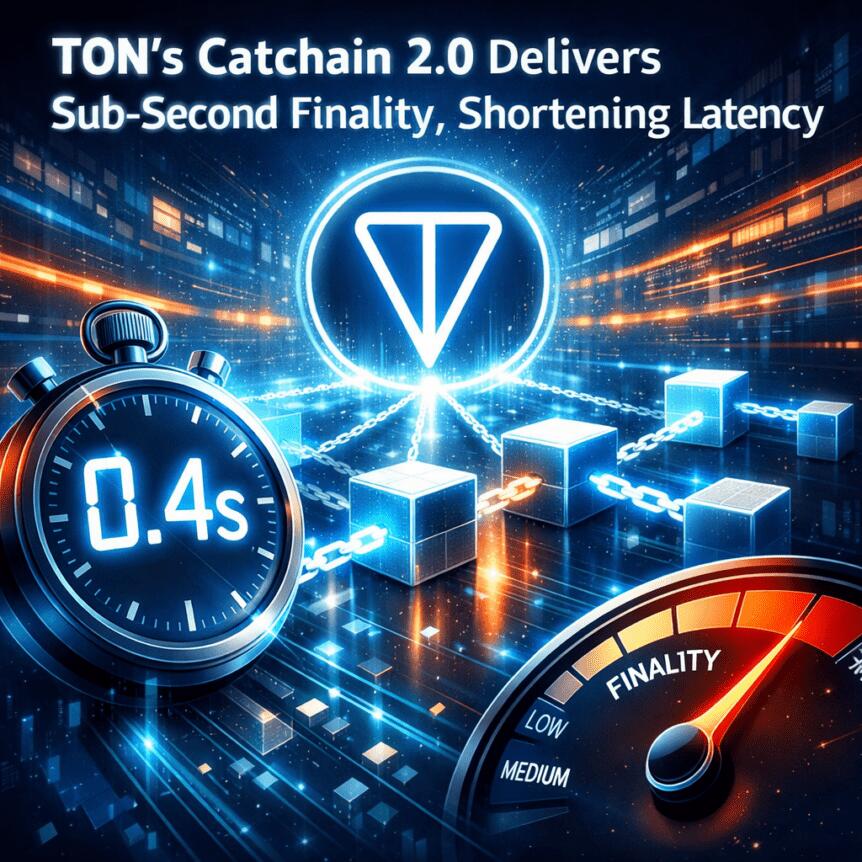
The Open Network (TON), the independent layer-1 blockchain closely integrated with Telegram, has rolled out Catchain 2.0, dramatically shortening block times to 400 milliseconds. The upgrade is designed to push settlement speeds toward real-time for both payments and trades, while enabling decentralized applications to run with performance closer to traditional apps.
According to TON’s announcement, payment transactions now settle in about one second, and trades settle in near real time. The upgrade strengthens TON’s position as a platform aiming to blend messaging with on-chain functionality, a path already underscored by its ongoing Telegram integration. The update comes alongside an inflationary shift in TON’s token economics: annual inflation is projected to rise six-fold, to roughly 3.6% from about 0.6%, driven by the increased rate of block production.
“More blocks mean more validator rewards, which create stronger staking incentives and bring more TON into the network,” TON stated in its release. The Catchain 2.0 upgrade builds on TON’s Catchain consensus architecture, a BFT-style algorithm first proposed in 2020, and brings near-instant settlement to a network already embedded in an app ecosystem with approximately 1 billion users globally.
Market data captures a snapshot of how the upgrade is being received. TON was trading up about 2.3% to roughly $1.28 on Thursday, with volume around $130 million and a market capitalization near $3.17 billion, according to CoinMarketCap. Observers noted a surge in activity on TON’s network following the upgrade, including spikes in transactions per second tracked by TON Explorer, underscoring the immediate demand for faster settlement and more responsive smart-contract activity.
The announcement frames Catchain 2.0 as a natural evolution of TON’s thrust to merge everyday communications with on-chain finance, a vision that has been reinforced by Telegram’s growing crypto toolkit. In February, Telegram added self-custodial vaults to its in-app wallet, enabling users to earn yield on Bitcoin, USDT and ETH. Earlier this month, the wallet extended into perpetual futures trading, launching a new feature set in collaboration with the perpetual DEX Lighter. The integration enables TON-based payments and on-chain interactions directly within Telegram’s user interface, broadening the potential scale of user adoption and on-chain activity.
Key takeaways
- Block time slashed to 400 milliseconds. Catchain 2.0 delivers substantially faster block finality, aiming to improve throughput and responsiveness for both financial transactions and developer applications.
- Settlement accelerates to near real-time. Payments settle in about one second; trades settle in real time, enabling a smoother user experience for rapid on-chain exchanges.
- Inflation expected to rise to 3.6%. The increase from roughly 0.6% reflects higher block production and the ongoing minting/burning dynamics within TON’s ecosystem.
- Stronger staking incentives. More blocks translate into more validator rewards, reinforcing incentives to run validators and participate in securing the network.
Catchain 2.0: what changes and why it matters
At the core of the upgrade is TON’s Catchain consensus algorithm, a mechanism designed to achieve Byzantine fault tolerance while maintaining speed and finality. By accelerating block production, Catchain 2.0 effectively raises throughput across the network, which has several practical implications for users and developers. First, faster blocks reduce the latency between submitting a transaction and its confirmation, a critical factor for payment rails and decentralized finance (DeFi) applications that rely on quick settlement to minimize front-running and slippage. Second, the higher block rate inflates the expected rewards for validators, potentially strengthening the security of the network through deeper staking participation and a larger base of committed validators.
The inflationary shift, while potentially dilutive in the short term, is positioned by TON as a byproduct of increased activity and network security. The organization argues that the higher issuance supports a more robust staking economy, which can, in turn, bolster long-run network reliability and validator health as adoption grows. Investors and builders should weigh the inflationary impact against the benefits of faster settlement and a more responsive ecosystem, particularly as TON deepens its ties with Telegram’s user base and integrated financial features.
Telegram: turning messaging into a multi-asset financial channel
The upgrade arrives amid a broader narrative: TON’s alignment with Telegram is not merely cosmetic. The Telegram integration is positioned to enable users to send TON-enabled crypto payments within chats, bridging everyday communication and on-chain activity. The platform’s wallet features have evolved to offer in-app yield opportunities across major assets, including BTC, USDT, and ETH, and the ecosystem already supports perpetual futures trading through Lighter within the Telegram app. This progression points to a broader strategy of embedding crypto functionality into a widely used messaging interface, lowering the friction for mainstream users to engage with digital assets and on-chain commerce.
Pavel Durov, co-founder of Telegram, has highlighted how real-world restrictions and VPN workarounds in certain jurisdictions—such as Iran and Russia—have driven users to seek more resilient, open channels for communication. The TON-Telegram integration exemplifies a complementary model: users can exchange value alongside messages, with the possibility of automated payments and more sophisticated DeFi interactions embedded into the chat experience. For builders, this signals a shift toward app-layer ecosystems where identity, messaging, and asset transfer are increasingly interwoven.
Market response and next steps for TON
From a market perspective, TON’s price and on-chain activity suggest cautious enthusiasm for Catchain 2.0. The token’s modest near-term gain aligns with a broader pattern of traders evaluating how faster settlement and higher block production could influence user uptake, validator participation, and overall network throughput. The surge in on-chain activity reported by TON Explorer after the upgrade offers a tangible signal that developers and users are experimenting with new throughput capabilities and real-time interactions across the TON ecosystem.
Beyond immediate price moves, the key questions for investors and developers center on the durability of the new throughput gains, the sustainability of the higher inflation regime, and the extent to which Telegram’s in-app crypto features catalyze meaningful, recurring usage. Will higher staking rewards translate into deeper validator participation, and how will that impact network security and governance over time? How quickly will the on-chain experiences inside Telegram translate into real-world transaction volumes, merchant integrations, or consumer wallets?
Analysts will also be watching how Catchain 2.0 scales with continued ecosystem support. The near-term trajectory will depend on the balance between attracting new users through Telegram’s reach and maintaining robust validator participation to preserve the benefits of faster finality. In the meantime, developers can start leveraging the improved throughput to experiment with more sophisticated DeFi primitives, cross-chain liquidity, and real-time settlement use cases that were previously limited by latency.
What remains uncertain and what to watch next
While the upgrade delivers clear technical and user-facing benefits, several uncertainties deserve attention. The sustainability of the 3.6% inflation target hinges on adoption rates and the ongoing cycle of block production. The pace at which Telegram-integrated features translate into measurable user engagement and on-chain value remains to be seen, as does how regulatory developments may shape in-app crypto features and wallet services. Market participants will want to monitor validator health, network security metrics, and any changes in staking participation as Catchain 2.0 matures.
In sum, TON’s Catchain 2.0 represents a meaningful step toward faster, more interactive on-chain experiences embedded in a widely used messaging platform. For traders and developers, it signals a broader opportunity: a more responsive, scalable environment for payments, DeFi, and user-centric apps that live at the intersection of daily communication and digital assets. As TON continues to evolve its ecosystem—balancing security, inflation dynamics, and user adoption—the coming quarters will reveal how deeply this integration can redefine mainstream crypto usage.
Readers should watch for updates on validator participation, new application experiments on TON’s mainnet, and any material shifts in on-chain activity as Telegram-enabled features gain traction in real-world usage.
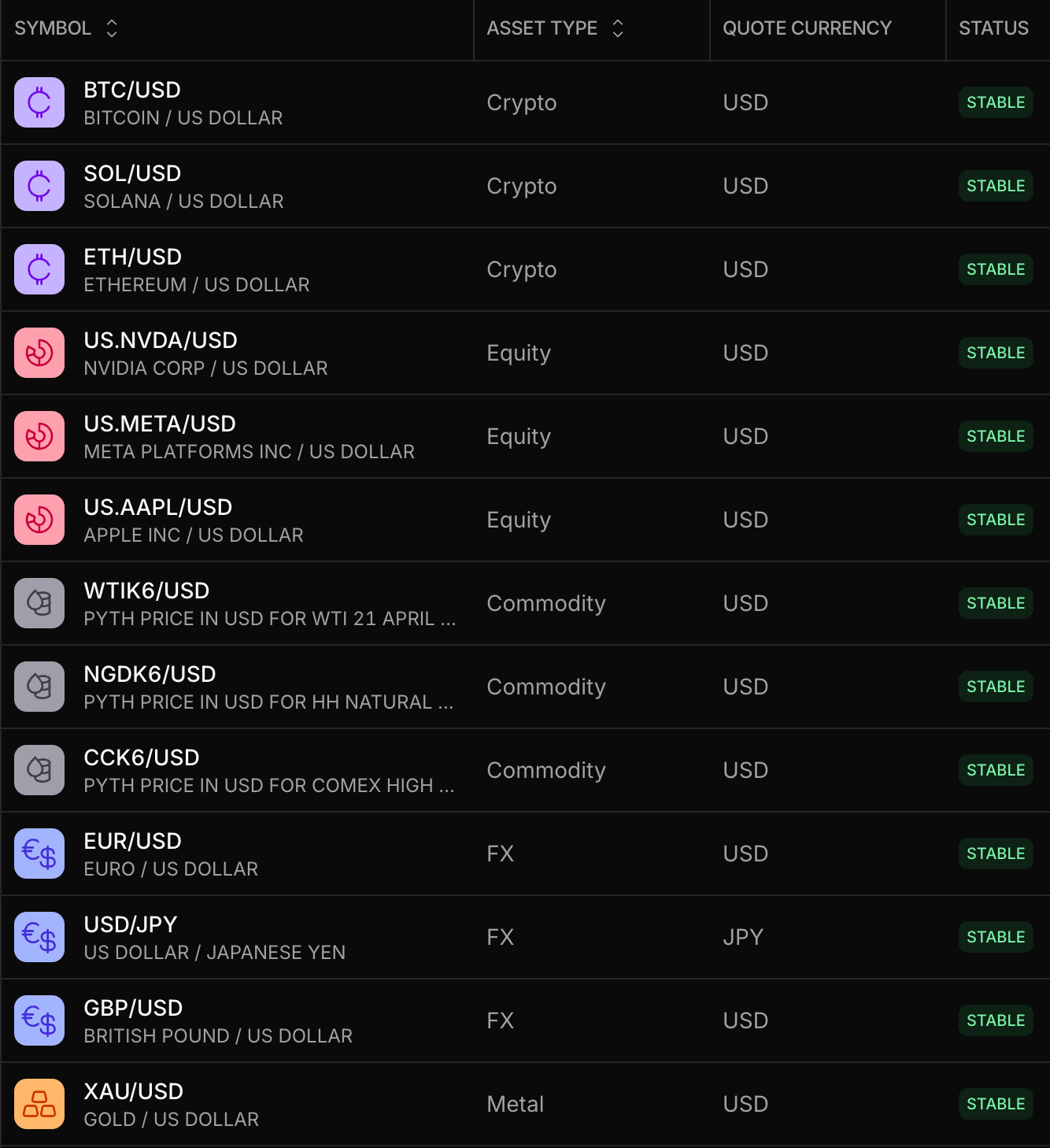
Pyth Network, a blockchain data oracle provider, is launching a platform for financial institutions to publish and monetize their market data across blockchain networks.
The Pyth Data Marketplace will initially support datasets for spot foreign currency exchange markets (FX), precious metals and crude oil swaps, while allowing publishers to retain “full control” over the data they share, according to Thursday’s announcement.
Seven new institutional data providers will publish price feeds on the marketplace at launch, the announcement said.

These include stock exchange Euronext, data provider Exchange Data International, asset manager Fidelity Investments, financial exchange OTC Markets Group, Singapore Exchange FX and the Tradeweb trading platform.
The announcement reflects how blockchain technology can democratize access to financial data, which has traditionally been controlled by a handful of service providers who charge exorbitant fees for high-quality market pricing data.
Related: Polymarket expands into equities and commodities with Pyth price feeds
Pyth to enable customers to “pull” data rather than traditional “push”
Pyth’s data pull model allows customers to pay for market data on demand, instead of traditional push-based oracle models that force users to pay for entire datasets, which they may or may not need.
This reduces the cost for the end user, according to Michael James, the head of institutional business development at Douro Labs, the main developer behind the Pyth Network.
Traditional service providers monopolize the $50 billion financial data industry, James told Cointelegraph at Consensus 2025. That is now being challenged by new emerging blockchain alternatives like Pyth and Chainlink.
“These data vendors have no competition in traditional finance, and so they have all the pricing power in the world,” he said.
Banks, hedge funds, trading firms and other financial institutions are forced to buy this financial data for “compliance” reasons, James added.

In August 2025, the US Department of Commerce selected Pyth and blockchain oracle provider Chainlink to publish economic data onchain.
Pyth was initially selected to publish quarterly gross domestic product (GDP) data, including five years of historical GDP figures, according to a previous announcement from the oracle provider.
However, Pyth anticipates adding support for more government economic data sets in the future.
Magazine: Can blockchain solve its oracle problem?
Florida Attorney General James Uthmeier has announced a formal investigation into OpenAI, accusing ChatGPT of facilitating the 2025 FSU mass shooting.
The probe follows newly released court records showing the suspected gunman held over 270 conversations with ChatGPT before the attack.
What the ChatGPT Logs Revealed
On April 17, 2025, Phoenix Ikner allegedly opened fire at Florida State University’s Student Union, killing two people and injuring six.
Chat logs obtained by the State Attorney’s office show Ikner asked ChatGPT about firearms, campus foot traffic, and the fates of prior mass shooters hours before the attack.
Attorneys for victim Robert Morales’ family plan to file a wrongful-death lawsuit against OpenAI. Uthmeier’s office said subpoenas are forthcoming.
AI Tokens React as Scrutiny Grows
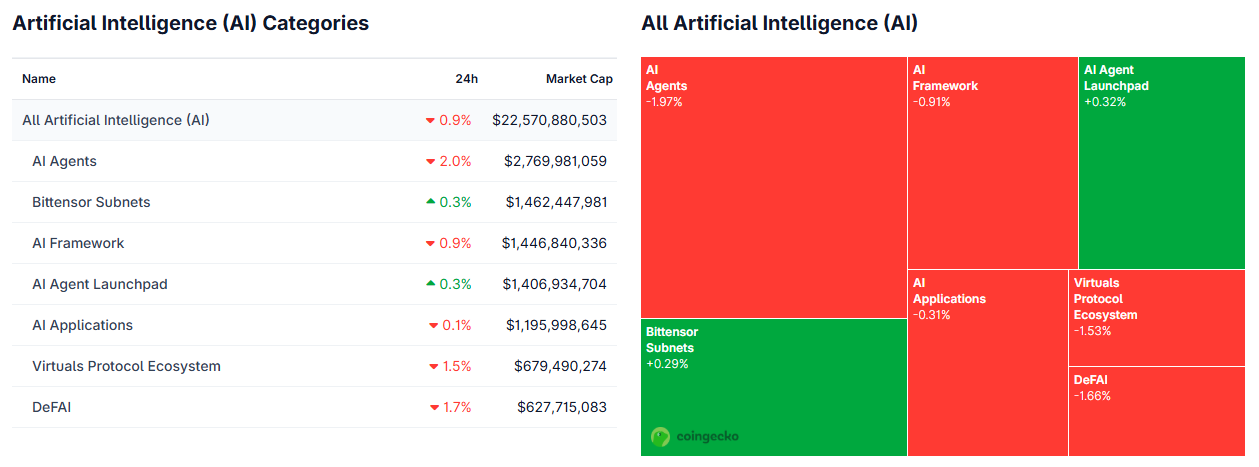
The broader Artificial Intelligence (AI) crypto sector slipped 0.9% to a combined $22.5 billion market cap, per CoinGecko data. AI Agents tokens fell 2%, while DeFAI dropped 1.7%.
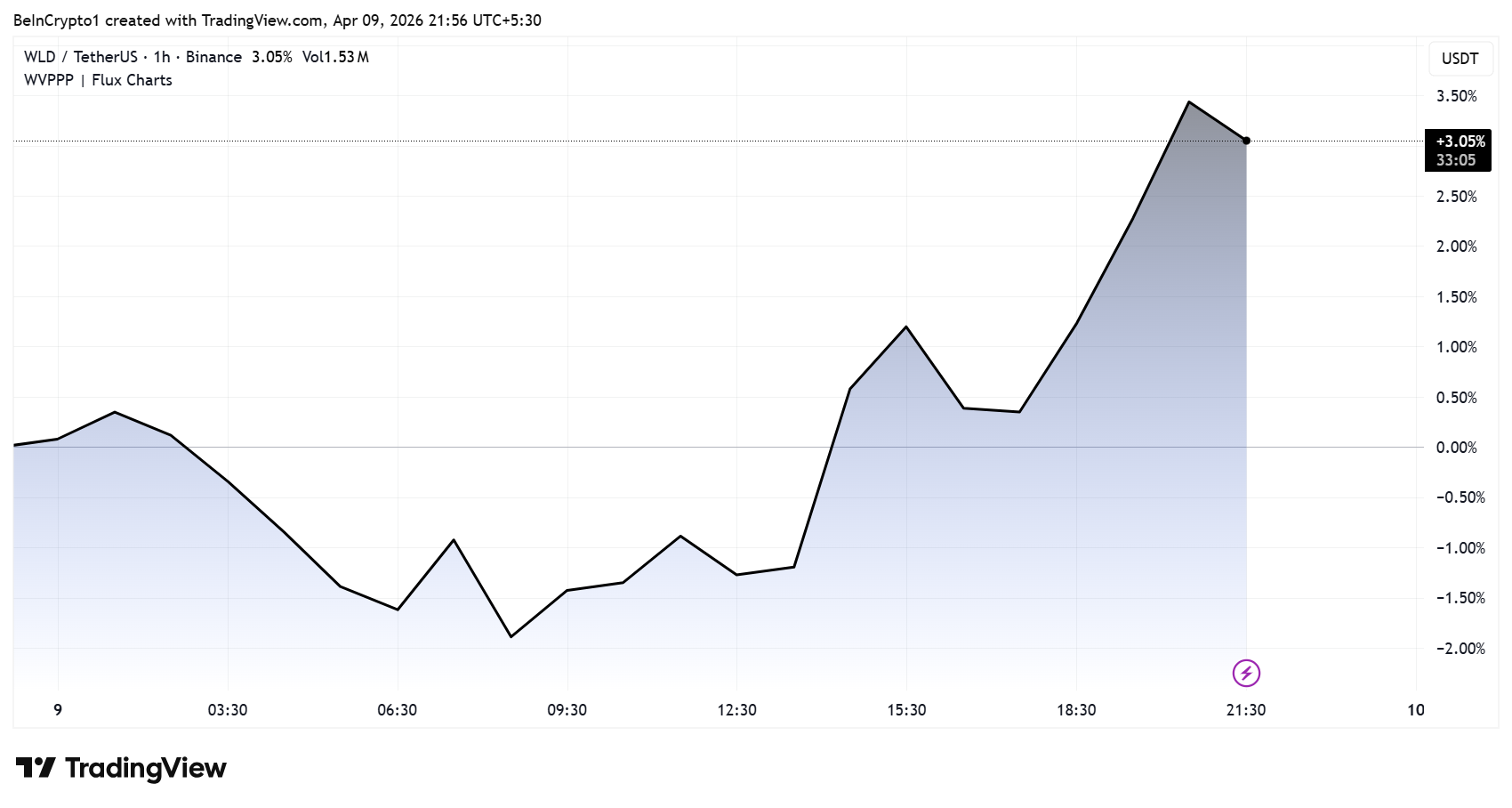
However, Worldcoin (WLD), the token co-founded by OpenAI CEO Sam Altman, bucked the trend, gaining 3% on Binance. WLD traded near $0.26 with volume at 1.53 million USDT. The token remains down 97% from its all-time high of $11.74.
The investigation adds to mounting legal pressure on OpenAI as it reportedly prepares for a potential IPO.
Whether the probe triggers deeper sell-offs across AI tokens or WLD continues to diverge from the sector may depend on how aggressively Uthmeier’s office pursues its case.
The post Florida Launches Investigation Into ChatGPT On University Mass Shooting appeared first on BeInCrypto.
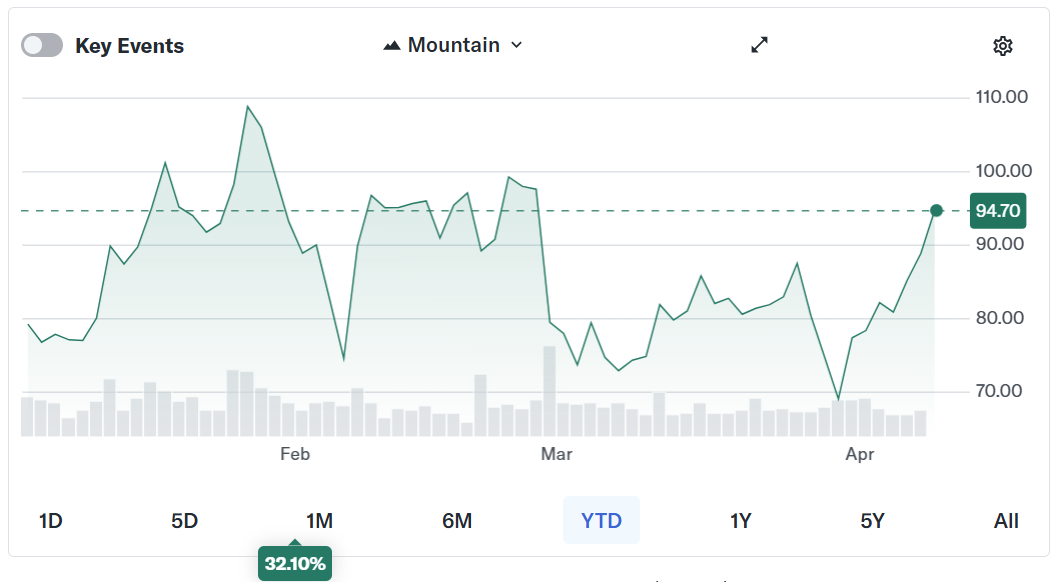
CoreWeave’s recent $8.5 billion AI-backed loan highlights a major transition in how Wall Street finances digital infrastructure, marking a shift from “MinerFi” to “ComputeFi,” according to TheEnergyMag.
In its latest Miner Weekly newsletter, TheEnergyMag examined CoreWeave’s multibillion-dollar raise from a group of banks and investors, backed by Mark Zuckerberg’s Meta Platforms. As Bloomberg reported, the financing underscores how companies are finding new ways to fund data center construction and expand GPU capacity.
Although CoreWeave has pivoted away from the digital asset sector toward AI-focused data center compute, the move offers a broader lesson on the shortcomings of Bitcoin (BTC) mining finance.
Historically, lenders funded Bitcoin mining operations using application-specific integrated circuits, or ASICs, as collateral. However, these models proved fragile due to crypto price volatility and rapid hardware depreciation. When markets declined, both revenues and collateral values fell sharply.
CoreWeave’s financing structure is “what MinerFi tried — and failed — to become,” TheEnergyMag said.
Unlike prior models, CoreWeave’s deal ties financing to active AI infrastructure with contracted customers and predictable cash flows. GPUs must be deployed, operational and revenue-generating before capital is extended, which reduces lender risk.

Related: Bitcoin mining’s 2026 reckoning: AI pivots, margin pressure and a fight to survive
Bernstein: CoreWeave pivot strengthens position in neocloud market
CoreWeave’s early pivot away from crypto mining has helped position it as a leading “neocloud” provider, a term used to describe companies offering GPU-based cloud infrastructure for artificial intelligence workloads, according to a recent analyst note by Bernstein.
The report compared CoreWeave with peers IREN and Nebius, highlighting differences in scale, infrastructure and financing strategies.
CoreWeave’s head start has translated into a significantly larger backlog of roughly $67 billion, compared with about $9.7 billion for IREN and $47 billion for Nebius.
While all three companies are expanding into AI infrastructure, IREN still generates most of its revenue from Bitcoin mining as it continues its transition.

The Bernstein analysts gave CoreWeave top marks for its “commercial model,” thanks to the “depth in the software stack, a mix of contracted and on-demand revenue, strong backlog and an increasingly diversified customer base.”
However, they said IREN has an advantage in infrastructure, citing its sizable real estate footprint rather than its reliance on leased data center capacity.
Related: Crypto Biz: Mining weakness tests Bitcoin’s market cycle


The crypto market’s most significant regulatory variable may not be a Senate committee vote but the November 3 midterm elections, with TD Cowen, TD Securities, and multiple legal analysts warning that the CLARITY Act could slip off the congressional calendar entirely if it does not clear the Senate before summer.
Summary
- TD Cowen Washington Research Group managing director Jaret Seiberg warned in a January note that Senate Democrats may withhold support for the CLARITY Act if they believe they can flip the House, and even a full Republican vote still requires at least seven Democratic senators for the 60-vote cloture threshold
- If Democrats take control of either chamber in November, Senator Elizabeth Warren would likely become Senate Banking Committee chair, making CLARITY’s passage described as slim to none; the crypto PAC Fairshake has $193 million earmarked for midterm spending in response
- Senator Bernie Moreno has warned that missing the May Senate window risks the bill entirely; Fireblocks’ policy director called the legislation “at risk altogether if its passing cuts too close to the midterm elections”
The CLARITY Act passed the House in July 2025 by a 294 to 134 vote and has stalled in the Senate since, caught between disputes over stablecoin yield, DeFi oversight, and ethics provisions targeting crypto holdings by government officials. The Senate Banking Committee markup was originally scheduled for January 15, postponed when Coinbase pulled support hours before the vote, and has not been formally rescheduled. As TheStreet reported, TD Cowen’s Seiberg warned that resolving the standoff will require President Trump’s personal intervention to force both sides toward compromise.
The May deadline is not arbitrary. The Senate avoids controversial floor votes in the months immediately preceding midterms, and the August recess effectively closes the calendar for legislation requiring broad bipartisan support.
The electoral math is structural. Republicans hold slim majorities in both chambers. Even with full Republican support, the CLARITY Act needs Democratic votes, and Democratic senators facing competitive seats have no political incentive to vote for a bill the White House is claiming as a win, particularly while ethics provisions targeting Trump family crypto holdings remain unresolved. Legal analyst John E. Deaton put it directly: “If we get into the summer months, it’s just probably not going to happen.” TD Securities’ Seiberg put the probability of pre-midterm passage at more likely 2027 than this year in January, with full implementation pushed to 2029.
What Happens to the Crypto Market If CLARITY Dies
JPMorgan analysts had described CLARITY Act passage by midyear as a positive catalyst for digital assets, citing institutional scaling and tokenization growth as direct beneficiaries. Standard Chartered estimated that an open-ended yield provision could redirect up to $500 billion in deposits, making the bill’s outcome material to stablecoin market structure. The Georgia-14 and Wisconsin Supreme Court results on April 7, both showing Democratic overperformance against historical baselines, added urgency to the calculus.
What Needs to Happen in the Next Six Weeks
As crypto.news has reported, the bill still faces a Senate Banking markup, a Senate Agriculture markup, a floor vote, and a conference process before reaching the president’s desk. As crypto.news has noted, the GENIUS Act’s stablecoin framework advances independently, but the market structure provisions in CLARITY, including SEC and CFTC jurisdictional clarity and DeFi oversight rules, have no alternative legislative path. Deaton’s warning may prove to be the most accurate single-sentence forecast for where the bill stands by June: “Come summer, the midterms are going to consume everything in this country.”


The brief career of William Banks is one of the crypto industry’s most bizarre tales, involving months of staged content, a fake jailbreak that earned over 10 million views, and two memecoin rug pulls that he claimed raised approximately $50,000 for Palestinian aid organizations.
On memecoin platform Pump Fun, where over 99% of tokens collapse to near-$0, the self-proclaimed comedian tried to stand apart by using philanthropy to justify his antics.
“Thank you to the crypto community for buying my pretend memecoin and helping me to raise $50,000 for the crisis in Gaza,” he said about a very real, not-at-all pretend memecoin that he created
“Free Palestine,” he added.
He also proclaimed, “William Banks is Robin Hood,” childishly assuming that everybody who lost money in his memecoin deserved their assets less than leaders of foreign aid organizations.
Moreover, the mythical Robin Hood didn’t create deep-fake videos to harm his Merry Men before giving to the poor.
William Banks creates content for his upcoming promo
Banks’ curious story began in December 2023, when the 20-something comedian from Brooklyn stole Israeli yard signs from lawns in Westport, Connecticut. Police charged him with sixth degree larceny.
He duly took advantage of his new-found infamy, plastering his mugshot on social media in an effort to shift some merch. In October 2024, he announced an eight-month prison sentence on X, even though he received no such punishment.
He then spent four months posting content from what appeared to be a jail cell. This included football tosses, theological discussions, and on February 20, 2025, a video of himself crawling under a security fence during a supposed prison riot.
However, the Connecticut Department of Corrections has no record of Banks being incarcerated. Public records turned up a backstage casting call for a project titled Jail Saga Reality Show, posted by a company that lists Banks as a co-owner.
When Cryptopolitan pressed him directly, Banks answered, “It’s real. I recreated it of course, but it’s real. It happened.”
Read more: ‘Thanks for the 20 bandos!’ Teen behind QUANT rug pull misses out on $4M profit
Another crypto bro claiming to hate crypto bros
The escape video attracted precisely the kind of attention from crypto promoters that Banks claimed he didn’t want. For months, he’s vehemently espoused hatred for crypto, despite his extensive use of the industry’s tactics.
Among those who reached out to Banks was “Jester,” a self-proclaimed “memecoin marketer” who uses a Retardio NFT profile picture.
Banks denied working with him directly, although Jester claims he helped Banks launch four tokens.
Either way, in the media wave of his manufactured prison break, memecoin operators sent Banks unsolicited portions of token supply in the hopes that he’d mention them to his growing following.
“They were using me, so I decided to use them back,” Banks justified.
He launched White Moses (MOSES) on Solana-based Pump Fun. After pumping to a market capitalization of a few hundred thousand dollars, Banks sold his holdings in three liquidations.
The first sale of about $14,000 caused a 75% price drop within eight seconds. After a partial recovery, two further sales drove the token down 96% within a few more seconds.
He followed MOSES with a second token called William Banks (BANKS), and ran the same sequence.
His total haul was approximately $50,000.
On social media, he then shared receipts showing payments totaling that amount to Palestinian aid organizations.
Got a tip? Send us an email securely via Protos Leaks. For more informed news, follow us on X, Bluesky, and Google News, or subscribe to our YouTube channel.

Binance co-founder Changpeng Zhao (CZ) confirmed he is officially divorced and offered OKX founder Star Xu a $1 billion bet to prove it.
The challenge came after Xu questioned CZ’s marital status as part of a broader dispute triggered by CZ’s 457-page memoir “Freedom of Money,” released on April 8.
Star Xu Questions CZ’s Marital Status
Xu demanded that CZ produce a divorce agreement signed by both parties.
He said he would publicly apologize if CZ could present the document. If not, he argued, the claim would amount to public misrepresentation.
I typically ignore all these false claims and attacks. But… You can apologize now. I am officially divorced,” wrote CZ.
CZ responded by confirming his divorce and proposing a permanent wager of $1 billion. He stated he would not share legal documents online out of respect for his ex-wife’s privacy.
However, he offered to have lawyers verify the agreement if Xu accepted the bet.
“I am happy to bet $1 billion USD (or any number you choose) that: I am officially divorced (way before today),” CZ added.
He gave Xu a 24-hour window to respond, adding that silence would reveal who had been misleading the public.
A Feud Rooted in a Decade of Rivalry
The divorce dispute is the latest front in a conflict that dates back to 2014. CZ served as chief technology officer at OKCoin, the predecessor to OKX.
Their falling out over equity, a Bitcoin.com domain contract, and forgery allegations have resurfaced multiple times.
CZ’s memoir also claims Huobi founder Li Lin told him in 2025 that Xu had reported him to Chinese authorities. Xu has denied that claim.
“Both OKX and Binance are regulated by multiple regulators. As the UBO of a regulated company, publicly offering a $1 billion bet is hardly professional conduct,” Xu responded to CZ’s invitation.
The OKX executive also called on the attention of Binance’s regulators to CZ’s offer, questioning whether Changpeng Zhao’s Binance stake has been legally separated with his ex-wife.
“Bill Gates and Jeff Bezos have already shown what proper asset separation looks like in a divorce,” he added.
Yi He, the co-CEO of Binance, is the long-term life partner (romantic and business) and the mother of three of CZ’s children. Reportedly, CZ has five kids total, two from his previous marriage.
They met in 2014 while working at the crypto exchange OKCoin (she recruited him), and became a couple around that time, and co-founded Binance together in 2017.
Amid the ongoing talks between CZ and Star Xu, Yi He has come to her own defense, highlighting her role as the second largest shareholder and Co-CEO of Binance.
“I’m not some delicate wife literature female protagonist; I’m the second largest shareholder and Co-CEO of Binance who continues to fully suppress competitors even after CZ stepped down,” she articulated.
The post Binance’s CZ Offers OKX Founder $1 Billion Bet Over Divorce Dispute appeared first on BeInCrypto.

Bitcoin is sitting at 43% below its October peak, and yet Wall Street hasn’t blinked. The institutional product machine is still running at full speed. What happens next to the price may surprise both bulls and the newly converted suits.
Morgan Stanley has rolled out its first dedicated Bitcoin fund, the latest in a string of Wall Street moves that signal a structural, long-term commitment to the asset class regardless of short-term volatility. The launch arrives as Bloomberg analysts note the “speculative heat” has clearly exited the market, the 40% drawdown from peak levels is evidence enough.
— BSCN (@BSCNews) April 8, 2026
 BULLISH: MORGAN STANLEY'S BITCOIN ETF MAKES HISTORY ON DAY 1$MSBT printed $34,000,000 in trading volume on day one, putting it among the most successful ETF debuts in market history.
This is the first spot Bitcoin ETF issued directly by a major US bank. Morgan Stanley… pic.twitter.com/dTCV7pJS73
But product launches don’t follow price; they follow conviction. Macro headwinds still remain real, with global trade disruption from the Iran conflict weighing on risk assets broadly. Though the divergence between institutional product activity and spot price weakness is the story we shouldn’t ignore.
Discover: The best pre-launch token sales
Can Wall Street Pump Bitcoin Price to $80K?
Bitcoin is consolidating near the $71,000 level following a sharp multi-month correction. Volume has thinned during this drawdown phase, a pattern consistent with distribution giving way to accumulation. Technical readings suggest momentum is compressed, with the 200-day moving average acting as a line in for medium-term trend direction.
The $68,500–$70,000 band represents the key near-term support cluster. A clean hold there keeps the recovery thesis intact. Resistance sits in the $76,000–$78,000 range; a weekly close above that level would shift the technical picture meaningfully.
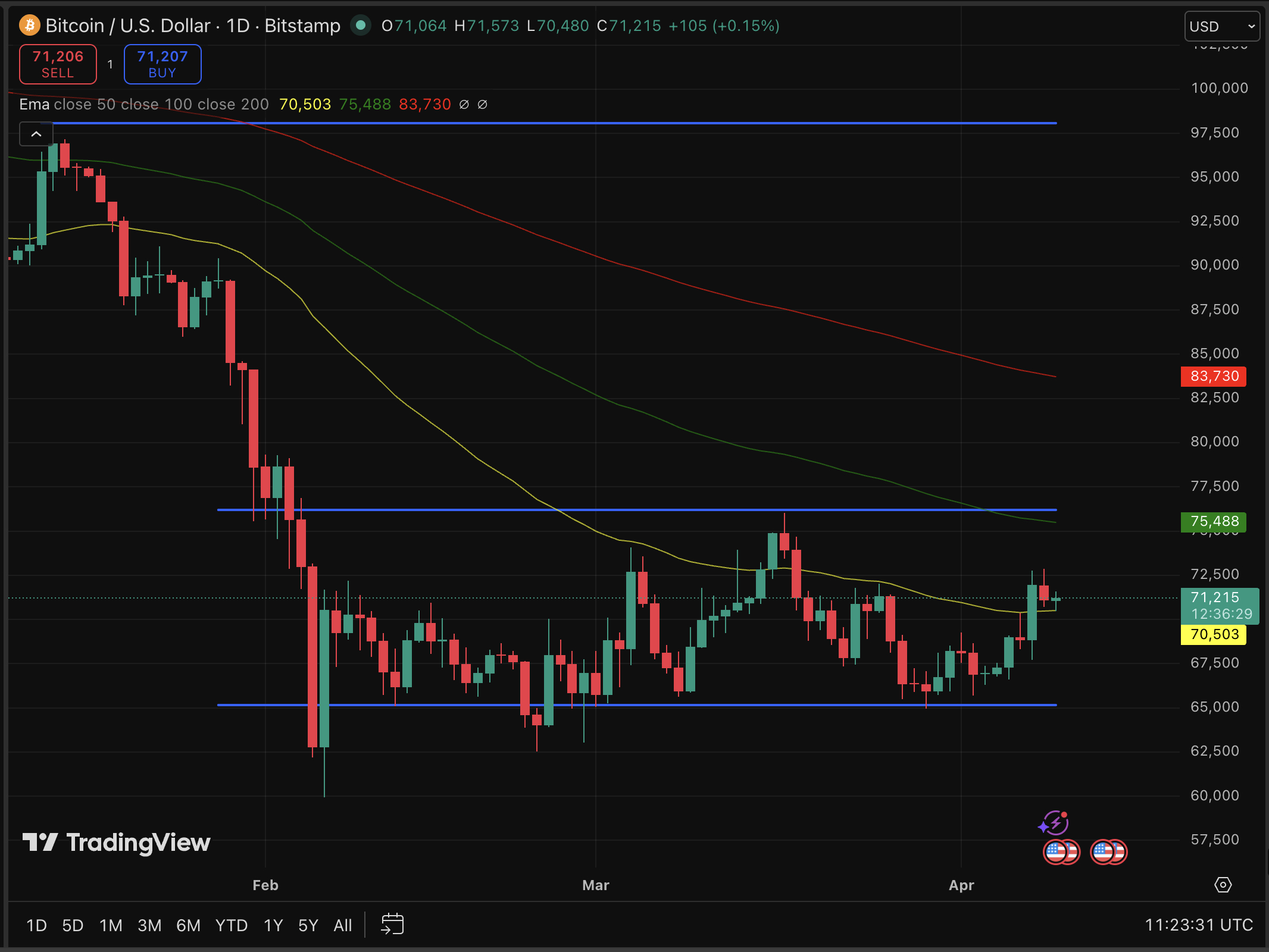
Institutional, especially from Wall Street, Bitcoin buying pressure from the new Morgan Stanley fund flows, absorbs sell-side supply, forcing the price to grind back toward $80,000–$85,000 over four to six weeks.
However, a weekly close below $67,000 invalidates the recovery structure and opens a retest of the $60,000 psychological level.
The data points to patience being required here. Institutional conviction is building the floor; it isn’t yet building the ceiling.
Discover: The best crypto to diversify your portfolio with
Bitcoin Hyper: It’s Bitcoin, But Hyper
When Bitcoin itself trades sideways, capital historically rotates toward higher-beta opportunities in the Bitcoin ecosystem, not away from Bitcoin entirely, but toward projects that amplify its thesis. That’s the window presale investors are currently watching.
Bitcoin Hyper ($HYPER) is positioning directly inside that rotation. It’s the first Bitcoin Layer 2 integrating the Solana Virtual Machine, meaning developers get Bitcoin’s security and trust layer combined with sub-second smart contract execution that, by design, targets performance exceeding Solana’s own throughput.
The project addresses Bitcoin’s three structural constraints simultaneously: slow transactions, elevated fees, and the absence of native programmability.
The numbers are concrete. Currently, presale price stands at $0.0136, with approaching $33 million raised to date. Staking is live with a high 36% APY also available to early participants. The presale has already crossed significant milestones, suggesting genuine demand rather than manufactured momentum.
Traders looking for asymmetric exposure while BTC consolidates can research Bitcoin Hyper here.
The post Bitcoin Wall Street Love Affair: Honeymoon Phase Cooling Down, But Affection appeared first on Cryptonews.


Ben Delo, co-founder of crypto exchange BitMEX, said he donated 4 million pounds ($5.1 million) to Nigel Farage’s Reform UK party, in an opinion piece for The Telegraph Wednesday.
Delo wrote that the contribution was made “since the start of this year” to help build Reform UK into “a genuine alternative party of government.”
The op-ed does not specify whether the donation was made in fiat currency or cryptocurrency, though he also expressed support for a proposed U.K. government moratorium on political donations made in cryptoassets, citing regulatory complexity.
Guidance from the U.K. Electoral Commission, last updated April 7, 2026, states that crypto donations are currently not prohibited under electoral law, but are treated as non-monetary donations and must be valued in pounds at the time of receipt. Parties must also verify donor identity, particularly for contributions above 500 pounds.
The Commission also noted government plans to introduce a moratorium on crypto donations, potentially applying retrospectively to contributions received from March 25, 2026, though no legal changes have yet taken effect.
Late last month, U.K. Prime Minister Keir Starmer’s government announced an immediate moratorium on cryptocurrency donations to political parties, citing concerns that digital assets could be used to obfuscate the origin and motivation behind donations in British politics.
The move placed crypto at the centre of a broader crackdown on foreign interference, signaling that regulators view digital payments as a democratic risk rather than a financial one.
Electoral Commission data does not reveal any contributions listed under Delo or BitMEX.
Delo did not respond to a CoinDesk request for further information.
Farage acknowledged the support on X, writing that “brave people like Ben Delo” were becoming “even more determined” to back Reform UK.
In December, British multi-billionaire Christopher Harborne, a Thailand-based entrepreneur who has invested in stablecoin issuer Tether and crypto exchange Bitfinex, made a donation of 9 million pounds to Reform.

Morning prayer | For career and Financial Breakthrough

Pregnant mum shot dead after honking horn at man in car park | News US

Rise in the number of Welsh shoppers on the high street


-

 Business7 days ago
No Jackpot Winner and $194 Million Prize Rolls Over
-

 Fashion6 days ago
Weekend Open Thread: Spanx – Corporette.com
-

 Business4 days ago
Three Gulf funds agree to back Paramount’s $81 billion takeover of Warner, WSJ reports
-

 Business6 days ago
Expert Picks for Every Need
-

 Sports5 days ago
India men’s 4x400m and mixed 4x100m relay teams register big progress | Other Sports News
-

 Tech2 days ago
How Long Can You Drive With Expired Registration? What Florida Law Says
-
Business4 days ago
No Jackpot Winner, Prize to Climb to $231 Million
-

 Fashion3 days ago
Massimo Dutti Offers Inspiration for Your Summer Mood Board
-
Politics6 days ago
Wings Over Scotland | The quality of mercy
-

 Fashion2 days ago
Let’s Discuss: DEI in 2026
-

 Business5 days ago
Akebia Therapeutics, Inc. (AKBA) Discusses Pipeline Progress and Strategic Focus on Kidney Disease Treatments at R&D Day – Slideshow
-

 Fashion7 days ago
Statement Sunglasses: The Accessory Shaping Modern Fashion
-

 Crypto World1 day ago
Bitcoin recovers as US and Iran Agree a Ceasefire Deal
-

 Politics7 days ago
East Jerusalem Palestinian families eviction orders
-

 Politics7 days ago
Why so many children are now classified as ‘disabled’
-

 Fashion7 days ago
For Love & Lemons’ Spring 2026 Line is for the Romantics
-

 Politics7 days ago
Nuclear rockets, moon bases and NASA’s Mars plan
-

 Tech7 days ago
The Threadless Ball Screw Never Took Off, But Don’t Write It Off
-
 Business7 days ago
HPS FY 2025 slides: SaaS inflection drives 22% revenue growth
-

 Fashion6 days ago
Tory Burch’s Spring 2026 Campaign Goes on a Getaway
You must be logged in to post a comment Login