
CryptoCurrency
How Much Does DeFi Development Cost in 2026? MVP vs Enterprise


DeFi in 2026 is no longer about experimentation. It is about building financial infrastructure that can handle real capital, real users, and real scrutiny. As the market matures, DeFi platforms are judged on architecture, security, and cost discipline, not just speed to launch. Yet many teams still underestimate development costs by focusing on features instead of responsibility, and short-term builds instead of long-term scale.
This blog breaks down the true costs of DeFi development in 2026, the differences between MVP and enterprise builds, and how serious teams structure budgets to attract capital and survive audits. If your goal is to create a DeFi product that earns trust and scales confidently, cost clarity is where the conversation must begin.
Let’s start by clearly defining the difference between an MVP and an enterprise-grade DeFi platform.
MVP vs. Enterprise DeFi: The Strategic Difference
Before estimating timelines or budgets, one strategic question must be answered:
Are you validating an idea or building infrastructure meant to scale capital, users, and regulatory exposure?
This distinction defines how a DeFi development company approaches architecture, security, integrations, and long-term cost planning.
MVP vs. Enterprise DeFi — Side-by-Side Comparison
| Decision Factor | DeFi MVP | Enterprise DeFi Solution |
|---|---|---|
| Primary Goal | Validate a single product or market hypothesis | Operate as long-term financial infrastructure |
| Core Functionality | One use case (swap, stake, lend) | Multiple integrated DeFi modules |
| Blockchain Scope | Single network | Multi-chain or cross-chain architecture |
| Smart Contract Design | Simple, focused logic | Modular, upgradeable, composable contracts |
| Security Approach | One audit, limited threat modeling | Multiple audits, formal verification, and continuous monitoring |
| Frontend & UX | Basic wallet interaction and dashboards | Institutional-grade UX, analytics, audit trails |
| Backend Infrastructure | Minimal indexing and APIs | High-availability systems with redundancy |
| Integrations | Essential oracles and wallets only | Custody, fiat rails, bridges, analytics, compliance tools |
| Compliance Readiness | Not required or deferred | Built-in KYC, AML, and regulatory workflows |
| Operational Requirements | Best-effort monitoring | 24/7 uptime, incident response, SLAs |
| Typical Timeline | 4 – 8 weeks | 2 – 3+ months |
Why Does This Distinction Matter For Cost and Risk?
Early-stage DeFi products are built to test market demand while keeping risk tightly contained. Enterprise DeFi platforms, on the other hand, are designed to support real capital movement, meet regulatory expectations, and withstand continuous operational pressure.
When enterprise-grade requirements are imposed too early, MVPs become bloated and expensive without delivering meaningful validation. Conversely, deploying large volumes of capital on MVP-level architecture creates structural weaknesses that can quickly erode trust. For this reason, mature teams view MVP and enterprise builds as fundamentally different classes of DeFi development solutions, not simply variations in budget size.
Request a DeFi Cost & Architecture Assessment
DeFi Development Cost Breakdown (What Actually Drives The Budget)
Accurate cost planning in DeFi begins with understanding that development is not solely about features. It is about financial responsibility, security exposure, and long-term scalability. A seasoned DeFi development company evaluates these factors before committing to timelines or pricing.
The sections below outline where real investment goes when building production-ready DeFi platforms in 2026.
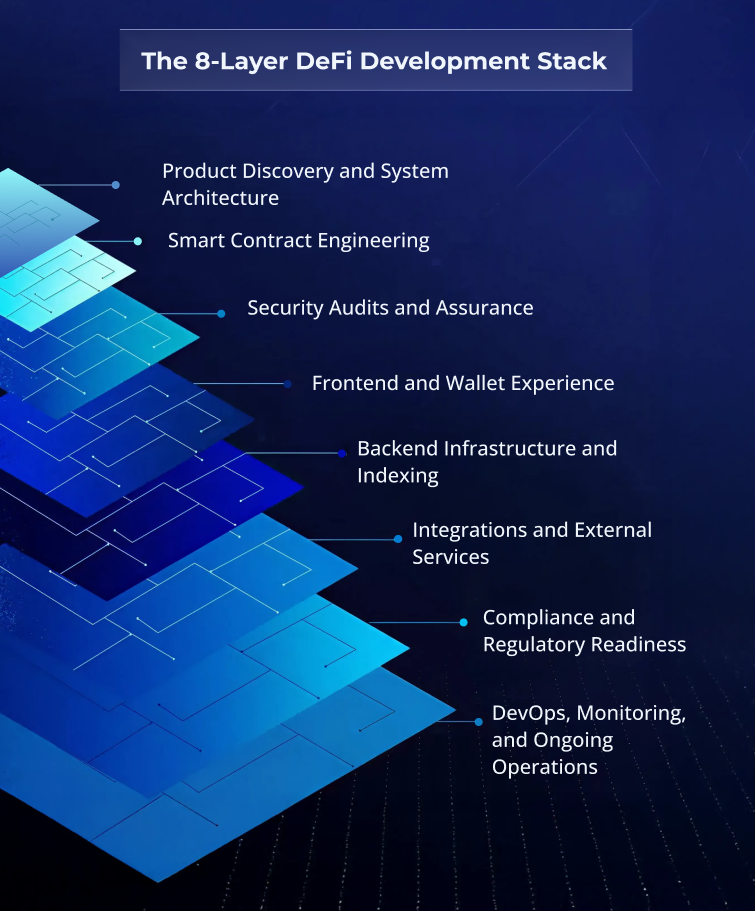
1. Product Discovery and System Architecture (5 to 12%)
This phase establishes the foundation for everything that follows. It determines:
- Which logic executes on-chain, and which runs off-chain
- Upgrade paths and contract lifecycle management
- Risk surfaces and security threat models
- Token flow, incentives, and economic constraints
Why does this phase matter?
Architectural missteps compound over time. Once capital and users are involved, correcting foundational mistakes often requires redeployment, liquidity migration, or governance intervention. These risks are precisely why high-value projects invest early in expert-led architecture design.
2. Smart Contract Engineering (20 to 35%)
Smart contracts define how value moves through the system. Core components typically include:
- Automated market makers
- Lending and borrowing pools
- Staking mechanisms
- Reward distribution logic
- Governance permissions
- Timelocks and multisignature controls
MVP builds focus on minimal logic tied to a single outcome. Enterprise builds require modular, upgrade-safe contracts that can evolve without disrupting capital. Higher composability increases testing scope and audit depth. This is a non-negotiable cost for robust DeFi development solutions.
3. Security Audits and Assurance (10 to 30%)
In 2026, security is an ongoing discipline rather than a one-time task. Costs increase with:
- Contract complexity
- Number of interacting modules
- Remediation cycles and re-audits
- Formal verification for high-risk logic
Rule of thumb!
If your protocol holds user funds, security should rank among your largest budget items. High ticket platforms treat audit readiness as a core product requirement, not an external validation step.
4. Frontend and Wallet Experience (10 to 20%)
User confidence is shaped at the interface layer. This scope includes:
- Wallet connections and transaction approvals
- Error handling and transaction state visibility
- Performance dashboards and analytics
- Mobile responsive design
Enterprise platforms often extend this with:
- Hardware wallet compatibility
- Institutional user workflows
- Consent records and audit visibility
These expectations significantly expand frontend investment within premium DeFi development services.
5. Backend Infrastructure and Indexing (10 to 25% )
Reliable DeFi platforms depend on unseen infrastructure. This includes:
- Blockchain indexers and data pipelines
- Event processing systems
- Application programming interfaces
- Monitoring and alerting systems
- Redundancy and failover planning
MVPs remain intentionally lean at this layer. Enterprise platforms invest deeply to ensure uptime, accuracy, and operational resilience.
6. Integrations and External Services (5 to 15% )
Modern DeFi platforms integrate with established ecosystems. Typical integrations include:
- Price oracles
- Cross-chain bridges
- Liquidity aggregators
- Custody providers
- Fiat on and off ramps
Using proven providers reduces risk but introduces ongoing operational costs. High ticket buyers plan these expenses from the beginning rather than treating them as add-ons.
See What Your DeFi Roadmap Really Costs
7. Compliance and Regulatory Readiness (Enterprise Scope)
If your platform interacts with:
- Fiat systems
- Institutional capital
- Payment flows
- Regulated jurisdictions
You will require:
- KYC and AML workflows
- Legal structuring and policy frameworks
- Reporting and audit trail systems
For enterprise-grade platforms, compliance can match or exceed core development costs, making it a critical pillar of professional DeFi development services. This layer ultimately determines whether a product can scale globally or remain confined to niche use cases.
8. DevOps, Monitoring, and Ongoing Operations
Operational readiness determines long-term success. This includes:
- Uptime monitoring and alerting
- Incident response procedures
- Key management and access controls
- Upgrade coordination
- Governance execution support
Institutional users expect continuous availability and predictable operations, a standard that only an experienced DeFi development company can reliably deliver. Best effort reliability is not acceptable at this level.
How to Design a Cost-Efficient DeFi Development Roadmap
- Define core responsibility: Clearly identify what your protocol must do on day one. Swaps, lending, staking, or settlements each carry different risk and cost profiles. A focused scope prevents unnecessary early spending and allows a DeFi development company to align architecture with real financial responsibility.
- Lock architecture early: Invest upfront in system design, threat modeling, and upgrade planning before building features. Strong architectural decisions reduce future rework, failed audits, and expensive migrations. This foundation is critical for sustainable DeFi development services.
- Keep the MVP disciplined: An MVP should validate demand, not replicate enterprise complexity. Avoid multi-chain support, advanced governance, or deep integrations unless they are essential to validation. Controlled scope keeps early costs predictable and defensible.
- Deliver in clear phases: Use a phased roadmap. Phase one validates the core use case. Phase two expands features and integrations. Phase three focuses on enterprise readiness, such as compliance, monitoring, and governance. Each phase should unlock a measurable business outcome.
- Integrate before custom builds: For non-differentiating components like oracles, analytics, custody, or indexing, integrating proven infrastructure is often more cost-effective and secure than building from scratch. This approach strengthens long-term DeFi development solutions.
- Plan operations and audits early: Budget for monitoring, incident response, upgrades, and recurring audits from the start. Operational readiness is not optional at scale and becomes significantly more expensive when treated as an afterthought.
A cost-efficient DeFi roadmap balances speed with responsibility, ensuring capital is invested where it creates lasting value rather than technical debt. Teams that plan architecture, security, and operations upfront are the ones that scale confidently, attract serious capital, and build DeFi platforms meant to last.
A Simple Decision Test for Founders
Choosing between an MVP-first or enterprise-first approach comes down to the level of responsibility your product must handle from the outset. This is where experienced teams and a credible DeFi development company apply a clear decision framework rather than relying on intuition.
You should think enterprise-first if:
- You will have custody of user funds at a meaningful scale, and cannot afford security shortcuts
- Institutional users or partners are part of your target market from day one
- Regulatory and compliance requirements are unavoidable due to jurisdiction or use case
- Downtime, exploits, or fund mismanagement would permanently damage trust
In these scenarios, enterprise-grade architecture, security, and operations are not optional. They are foundational requirements that shape how professional DeFi development solutions are designed, implemented, and supported to handle real capital and sustained scrutiny.
If these conditions do not apply, a strategic MVP is often the fastest and most capital-efficient path to validate demand, demonstrate traction, and raise funding. When designed by professional DeFi development services, an MVP can prove value quickly while laying the groundwork for a controlled transition to enterprise readiness.
Final Takeaway for Decision Makers
DeFi development costs in 2026 go far beyond writing smart contracts. They reflect the level of financial, technical, and legal responsibility your product is designed to handle from the start. This is why experienced teams evaluate cost through the lens of risk, scalability, and long-term operational readiness. The projects that succeed are not the ones that aim to build at the lowest possible cost. They are the ones who plan budgets realistically, make sound architectural decisions early, and scale their platforms in a controlled and deliberate manner. This disciplined approach is what separates short-lived launches from production-ready platforms delivered by a capable DeFi development company.
If your objective is to launch a DeFi product that clears audits, attracts serious capital, and scales without repeated rewrites, cost clarity becomes a strategic advantage. When supported by professional DeFi development services, cost clarity evolves into predictable performance, institutional trust, and scalable growth. This is where teams turn to Antier as a reliable partner for building DeFi platforms designed to perform at scale.
Frequently Asked Questions
01. What is the primary goal of a DeFi MVP compared to an enterprise DeFi solution?
The primary goal of a DeFi MVP is to validate a single product or market hypothesis, while an enterprise DeFi solution is designed to operate as long-term financial infrastructure.
02. How do the security approaches differ between DeFi MVPs and enterprise DeFi solutions?
DeFi MVPs typically undergo one audit with limited threat modeling, whereas enterprise DeFi solutions require multiple audits, formal verification, and continuous monitoring for enhanced security.
03. What are the typical timelines for developing a DeFi MVP versus an enterprise DeFi solution?
Developing a DeFi MVP usually takes 4 to 8 weeks, while an enterprise DeFi solution typically requires 2 to 3 months or more.



