
CryptoCurrency
Is Uniswap’s Fee Switch Already Failing?


Uniswap’s long-anticipated fee switch has gone live. However, it has failed to deliver immediate clarity on UNI’s long-term value capture.
Early on-chain data has sparked a sharp debate over whether the market is drawing conclusions far too soon or uncovering structural limitations in the protocol’s burn mechanics.
Sponsored
Sponsored
Is Uniswap’s Fee Switch Already Failing—or Is the Market Reading It Wrong?
Initial estimates from on-chain analysts suggest that Uniswap’s newly activated protocol fees may be generating as little as $30,000 per day in hard assets. This figure falls well short of the incentive levels proposed under recent governance plans.
That early reading has raised uncomfortable questions about whether UNI emissions could outweigh fee-driven burns, at least in the short term.
“Analyzing current levels, UNI incentives are expected to exceed burns from the fee switch,” wrote one user, adding that the data invites reflection on how different the picture might look had fees been active historically.
The warning followed a detailed breakdown by on-chain research, which initially estimated roughly $95,000 in daily Ethereum-only protocol revenue under an optimistic scenario.
After drilling down into individual pools, however, that estimate was repeatedly revised lower. The analyst found that many of the top fee-generating pools were either illiquid, newly deployed, whitelisted, or exposed to rug risk. This means much of the apparent revenue could not realistically be cashed out.
After discounting questionable sources, the analyst concluded that only about $30,000 per day might represent hard, realizable assets. Annualized generously, that implies roughly $22 million in yearly protocol revenue. This is even after assuming weekday volume strength and some Layer-2 expansion.
Against a proposed $125 million in UNI incentives, the resulting fees-to-emissions ratio appeared deeply unfavorable.
Sponsored
Sponsored
“Early data is not promising that the fee switch will come anywhere close to offsetting the proposed incentives,” Memelord wrote, arguing that asset diversity, liquidity constraints, and arbitrage risk could cause value leakage during the early phases of deployment.
“Overeager and Misleading”: Hayden Adams Pushes Back on Early Fee Switch Criticism
That conclusion drew a swift and forceful rebuttal from Uniswap founder Hayden Adams. Calling the analysis “wrong, overeager and misleading,” Adams argued that critics were extrapolating from an incomplete rollout.
“Only a subset of fee sources have turned on so far,” he said, emphasizing that several parameters remain adjustable through future governance proposals.
Adams also pushed back on interpretations of early UNI burns. He noted that the protocol’s token jar mechanism is not yet being efficiently arbitraged.
Fees are accumulated across thousands of tokens. Meanwhile, burns occur in small batches, making early burn data a poor proxy for steady-state behavior.
Sponsored
Sponsored
“The first burn doesn’t say much about what the steady state will be,” he said.
More broadly, Adams rejected comparisons between the growth budget outlined in the UNIfication proposal and traditional liquidity mining incentives.
The Uniswap executive stressed that Uniswap is structurally less dependent on liquidity subsidies. He also indicated that the growth budget is intended to fund long-term expansion, not compensate LPs for surrendered fees.
“If Labs and the growth budget went away, current fee burn would continue pretty much as is,” he added.
Other community members sided with that view, marking a sharp contrast with the market optimism just weeks earlier.
Sponsored
Sponsored
In November, Uniswap’s UNIfication proposal, introducing protocol fees, a 100 million UNI retroactive burn, and structural consolidation between Labs and the Foundation, helped push UNI to a two-month high.
At the time, analysts such as CryptoQuant CEO Ki Young Ju speculated that fee activation could result in up to $500 million in annual burns if volume remained high.
For now, the gap between that bullish thesis and early on-chain reality remains wide. Whether the fee switch matures into a sustainable UNI burn engine, or proves structurally overstated, may depend less on its first days than on how quickly Uniswap can scale activation, tune parameters, and convert partial deployment into durable protocol revenue.
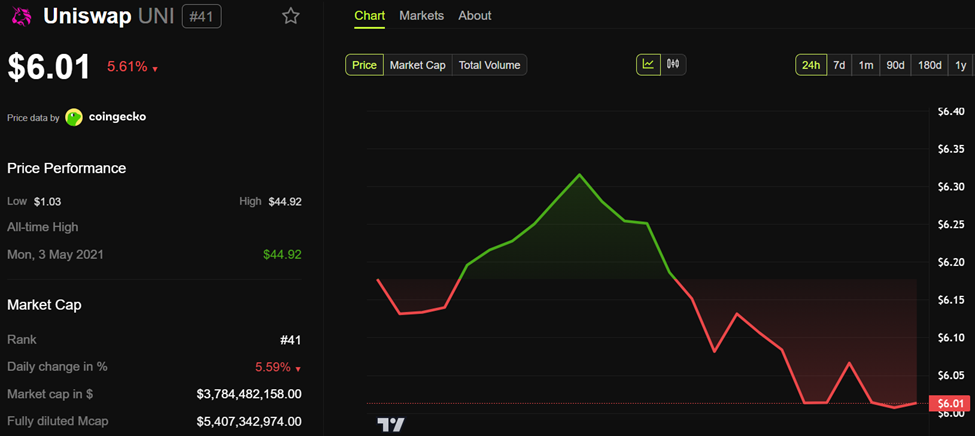
UNI, the powering token for the Uniswap ecosystem, was trading for $6.01, down by almost 6% in the last 24 hours.



