
Crypto World
Japan’s $6.5B Stablecoin Push: How Cosmos Powers 200 Banks in Tokenized Deposit Revolution


TLDR:
- Progmat Coin consortium unites 200+ Japanese banks for ¥1 trillion three-year stablecoin issuance plan.
- Project Pax integrates Swift API with IBC protocol to preserve banking workflows while modernizing settlement.
- Cosmos architecture enables ledger-level compliance controls and permissioned issuance for regulated assets.
- IBC interoperability protocol maintains zero security exploits since 2021 launch across 200+ blockchains.
Tokenized deposits and stablecoins continue to reshape institutional settlement systems as major financial players adopt blockchain infrastructure.
Japan’s banking consortium, backed by over 200 institutions, plans to issue approximately ¥1 trillion in stablecoins over three years using Cosmos technology.
The initiative demonstrates how traditional finance integrates programmable money while maintaining regulatory compliance and operational control.
Banking Consortium Leverages Cosmos for Cross-Border Settlement
Progmat Coin represents a significant development in institutional blockchain adoption. The platform, co-developed by Datachain, brings together Japan’s largest banks and financial institutions. The consortium selected Cosmos infrastructure to address persistent inefficiencies in cross-border payments.
Project Pax, launched by Progmat and Datachain, uses the Inter-Blockchain Communication Protocol as its core interoperability layer.
The architecture preserves existing banking workflows while modernizing settlement infrastructure. Banks initiate payments through Swift’s API, maintaining familiar compliance controls throughout the process.
The settlement layer operates across both public and private blockchains. Progmat issues regulated stablecoins that move via IBC connections. Datachain’s multi-prover security model meets Japanese regulatory requirements while enabling cross-chain transfers.
This design targets the G20’s identified weaknesses in cross-border payments. The system eliminates correspondent banking chains and enables real-time settlement.
It decouples payment reach from correspondent relationships and provides immutable records for regulatory reporting.
Compliance Controls and Network Connectivity Drive Institutional Adoption
Cosmos-based chains allow institutions to embed compliance logic at the ledger level. Issuers configure permissioned issuance, whitelisted participants, and transaction limits directly into chain architecture. This approach shifts enforcement closer to the point of issuance rather than relying on external controls.
The technology stack powers over 200 independent blockchains. The interoperability protocol has remained free of security exploits since launching in 2021.
This track record addresses threshold concerns about whether underlying technology can operate at scale.
Institutions retain control over validator selection and governance processes. Compliance logic, redemption workflows, and access controls embed at the ledger level.
Issuers can restrict IBC connections to approved counterparty chains that implement compatible compliance standards.
Cosmos supports EVM compatibility through its framework, enabling interaction with existing treasury and payment applications.
Institutions can restrict connectivity to approved networks while maintaining access to broader liquidity ecosystems.
This connectivity allows tokenized deposits to operate within purpose-built chains without sacrificing interoperability.
The Progmat initiative illustrates how regulated stablecoin infrastructure can scale while preserving predictability. Financial institutions require control, compliance, and integration with existing banking systems.
Tokenized deposits extend bank money into programmable environments without replacing central bank-issued currencies or disrupting core banking operations.


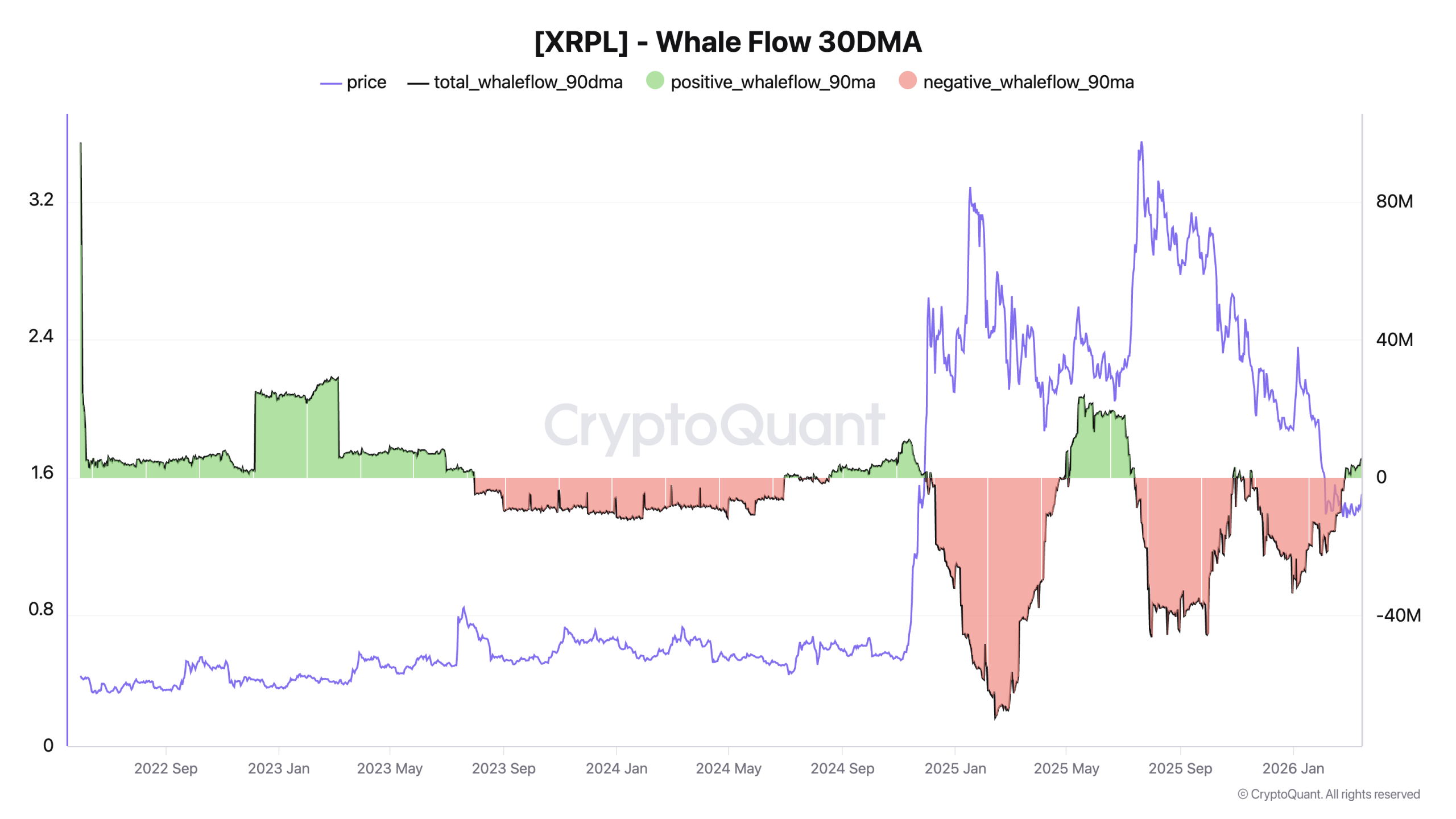
XRP price hit a multi-week high of $1.6 on March 17 before settling around $1.5. Can it hold the key support level as whale demand is back?
Summary
- XRP price climbed to a four-week high near $1.60 as the broader crypto market rallied following Bitcoin’s breakout above $75,000.
- On-chain data shows whales have shifted back into accumulation mode, while Binance reserves have risen to 2.78 billion XRP.
- Growing network activity and strong technical indicators suggest bulls remain in control as traders watch support near $1.50.
According to data from crypto.news, XRP (XRP) price hit $1.60 on Tuesday, March 17, its highest level over the past 4 weeks. Trading at $1.52 at the time of writing, the asset has rallied 11% from its weekly lows and 19% from its lowest point over the past month.
While a market-wide rebound following Bitcoin’s surge past the $75,000 psychological resistance provided a strong tailwind, several specific catalysts have supported these recent gains.
First, whales have officially entered accumulation mode after months of remaining in a distribution phase. Data from CryptoQuant shows that the XRP Whale Flow 30-day moving average, a metric that tracks the movement of coins into large holder wallets, has switched to positive after nearly four months of red. This shift is significant because whale accumulation often sparks retail interest in the asset as smaller investors look to follow the lead of influential market participants.
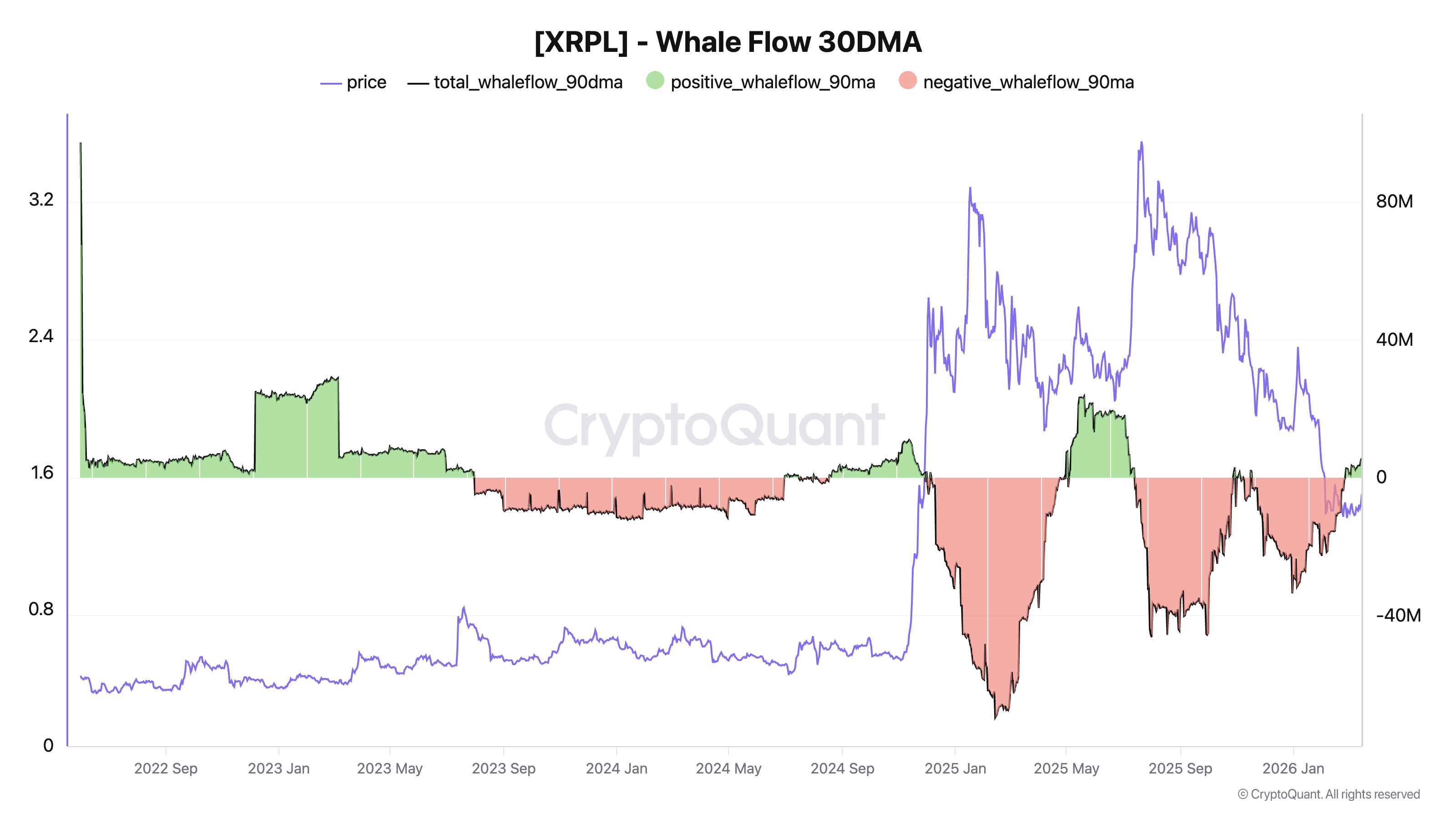
Second, reports indicate that XRP reserves on Binance have soared to 2.78 billion tokens, their highest levels since late 2025. As whales remain in an accumulation phase, they could gobble up most of these available tokens, which could lead to a supply crunch that drives prices even higher.
Third, investors are showing increased engagement with the underlying technology. Per data from Santiment, the total number of active addresses on the XRPL network climbed to a five-week high. A surge in active addresses indicates growing network utility and a rise in unique user participation, which typically serves as a bullish signal for long-term price stability.
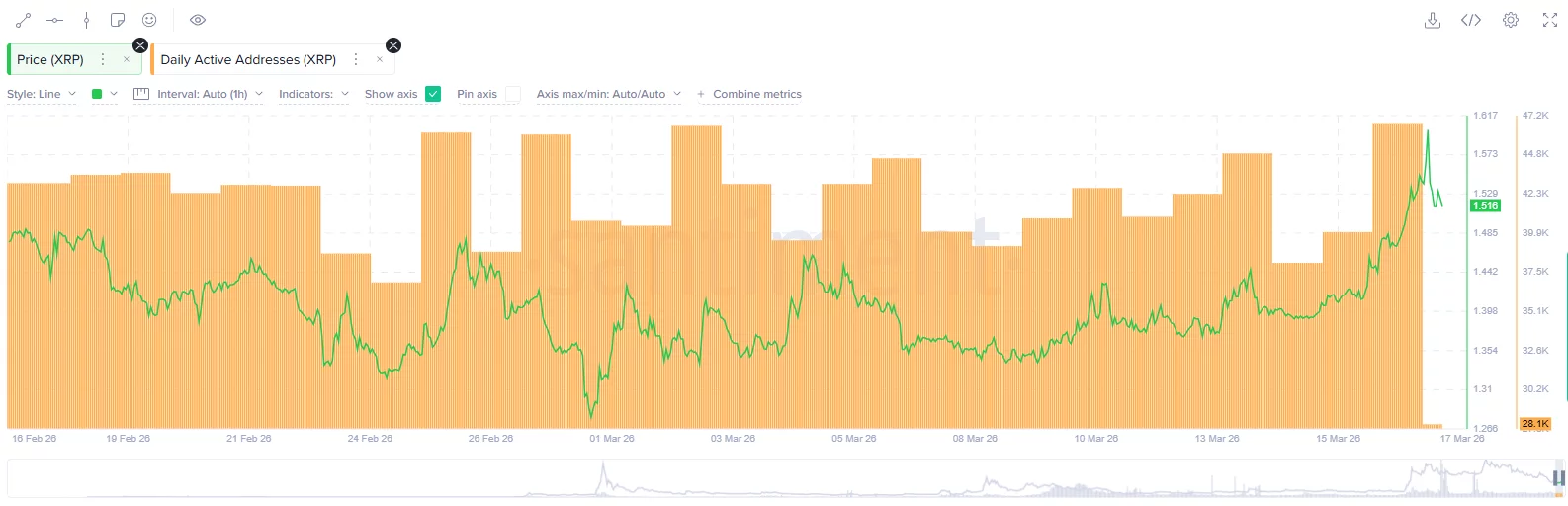
Should these trends continue, the current support level may act as a solid foundation for the next leg up.
Technical indicators suggest that bulls hold the upper ground at press time. On the daily chart, the Aroon Up reading currently stands at 100% while the Aroon Down is at 35.71%. When the Aroon Up is significantly higher than the down, it means that the market is in a strong uptrend and that the most recent price highs were achieved very recently.
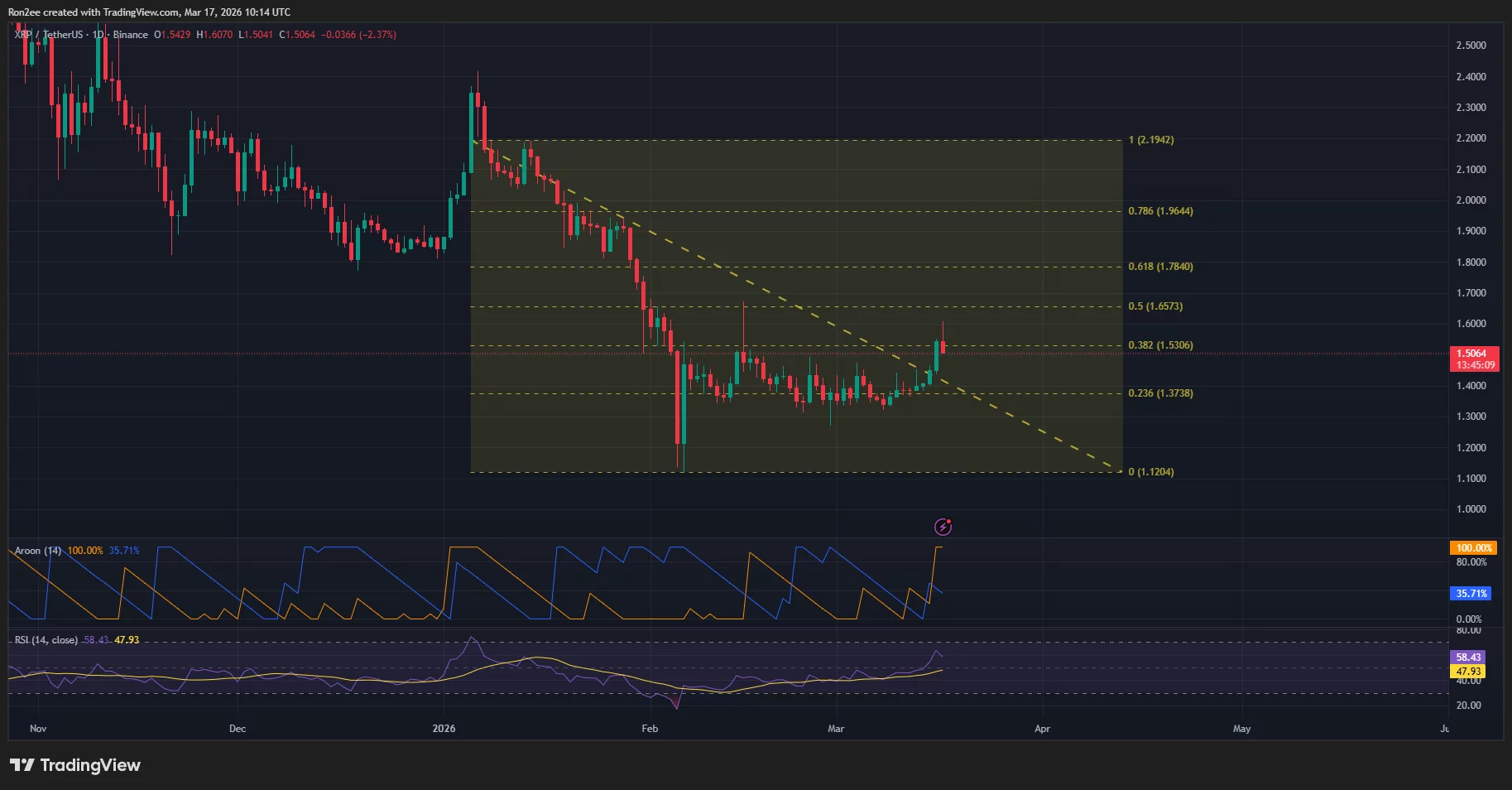
The relative strength index remains above 59 after slipping from 63 since yesterday. This is a sign that while the immediate buying momentum seems to have waned a bit, the bullish trend is not completely exhausted, and there is still plenty of room for further upside before the asset becomes overbought.
Hence, the XRP price will likely hold the $1.50 support with a potential rally to $1.65 if it manages to rebound and sustain above the $1.53 level, which aligns with the 38.2% Fibonacci retracement level, a key area that traders often watch for signs of trend continuation.
Meanwhile, failure to hold the $1.40 support would likely lead to a deeper correction toward the $1.37 zone.
Disclosure: This article does not represent investment advice. The content and materials featured on this page are for educational purposes only.

XRP price just flipped BNB to become the fourth largest crypto by market cap. Price pushed past $1.50 on a 125% volume spike. Total market cap hit $93.4 billion.
Futures open interest on Binance has climbed 59% since October. Traders are re-leveraging aggressively. OI is rebuilding toward the same danger zone that preceded the last major crash.

XRP is still 58% below its 2025 highs. But the speed of this open interest rebuild suggests smart money is positioning for a sustained move, not just a quick scalp.
Open Interest Surge Signals Leveraged Conviction
Coinglass data puts XRP open interest on Binance at 353.49 million XRP as of March 17. Back in October it was sitting at 222.79 million. That is a significant rebuild.
Here is what makes it interesting. Price has not reclaimed its October highs yet. But OI is already surging. That divergence points to net new long positioning entering the market. Traders are not chasing a recovery. They are front-running one.

XRP trading hit $3.22 billion during the BNB flip, significantly outpacing its rival.
Large wallets are accumulating across major assets right now. The positioning looks less like a dead cat bounce and more like a bet on sustained momentum.
Can XRP Price Hold the $1.50 Breakout? Key Levels to Watch
XRP is trading at $1.53, having broken through $1.40 on high volume. Now it is testing the $1.50 to $1.60 zone. A range that has killed previous rallies multiple times.
Bull case: hold above $1.53 on a daily close and the breakout is confirmed. Next target is $1.90 if volume stays elevated enough to absorb profit taking.
Bear case: lose $1.50 and the price retraces to $1.35. RSI is heating up fast. A rejection here flushes the late longs who chased the breakout.
Now the structural concern.
Open interest is at 353 million XRP and climbing toward 400 million. That exact level was the ceiling in September 2025 right before XRP collapsed from $3.65 to under $2. The difference this time is price is still 58% below those highs. More leverage per dollar of market cap. That is a powder keg setup.
A small spot correction could trigger cascading liquidations. Institutional ETF demand provides some floor. But the leverage density makes the market fragile.
Watch Binance funding rates over the next 48 hours. Rates spike while price stalls at $1.55 and a flush is coming. Price grinds higher with stable OI and $1.80 opens up.
The setup is explosive in both directions.
The post XRP Price Flips BNB as Open Interest Rebuilds Toward Pre-Crash Levels appeared first on Cryptonews.

TLDR
- T. Rowe Price submitted an amended S-1 filing to the SEC for its upcoming actively managed cryptocurrency ETF
- The investment vehicle will maintain between 5 and 15 digital currencies simultaneously, selected through quantitative analysis
- Anchorage Digital Bank has been designated as the custodian for cryptocurrency assets in the revised documentation
- The eligible token roster expanded to 15 assets with the addition of Sui, alongside Bitcoin, Ether, Dogecoin, and Shiba Inu
- The investment product seeks to exceed the performance of the FTSE US Listed Crypto Index and may incorporate staking operations
T. Rowe Price, a major asset management company overseeing $1.8 trillion in assets, has submitted a revised registration document to the US Securities and Exchange Commission for its planned Price Active Crypto ETF.
The updated S-1 filing was delivered on Monday, expanding upon the initial documentation submitted in October 2025. The investment vehicle is structured to provide investors with professional management of digital currency exposure through conventional brokerage platforms.
The submission identifies 15 digital currencies eligible for inclusion, featuring Bitcoin, Ether, Solana, XRP, Dogecoin, Shiba Inu, Chainlink, and Sui. The latter represents a fresh addition absent from the October proposal.
The investment fund will not simultaneously hold all 15 cryptocurrency assets. During typical market conditions, the portfolio will contain between five and fifteen digital tokens.
Investment selections will be determined through quantitative algorithms analyzing fundamental metrics, asset valuation, and market trends. The objective is to surpass the benchmark performance of the FTSE US Listed Crypto Index.
The revised documentation designates Anchorage Digital Bank as the custodial institution for the fund’s digital assets. This financial institution will handle security and storage of the cryptocurrencies within the ETF.
How the Fund Would Work
Initially, participants would establish or liquidate positions using fiat currency rather than direct cryptocurrency transfers. The documentation indicates this framework may evolve to accommodate in-kind exchanges.
The submission also mentions the potential for staking activities, wherein tokens are committed to support blockchain network operations in exchange for yield generation. T. Rowe Price indicated staking decisions would depend on tax implications and regulatory clarity.
T. Rowe Price has provided investment management services for approximately 87 years and ranks among the top 25 global asset management firms. The organization is primarily recognized for its mutual fund offerings and retirement planning services rather than cryptocurrency investments.
The initial October submission caught many market analysts off guard. Nate Geraci, president of NovaDius Wealth Management, commented that the filing appeared out of “left field” considering T. Rowe Price’s conventional investment approach.
Major Asset Managers Moving Into Crypto
T. Rowe Price is among several established financial institutions entering the cryptocurrency ETF marketplace. BlackRock, Fidelity, Franklin Templeton, VanEck, and Invesco have previously introduced digital asset investment vehicles.
The initial submission occurred near what was then considered a market peak, following Bitcoin’s surge past $120,000. The filing coincided with a significant liquidation episode affecting leveraged cryptocurrency derivatives.
Subsequently, digital asset valuations declined and crypto ETFs experienced sustained capital withdrawals spanning multiple months. However, cryptocurrency ETF flows have recently shifted back to positive territory, based on CoinGlass tracking data.
The revised filing incorporates current information regarding the FTSE Crypto US Listed Index, including component weightings updated through January 2026.
Additional risk disclosures have been incorporated addressing portfolio turnover rates and the fund’s active management approach.
The SEC has not yet announced a timeline for potential approval.



Ripple’s token also surpassed BNB in terms of market cap today.
Alongside the rest of the market, XRP jumped earlier today to over $1.60, a level not seen in just over a month.
Although it was rejected there and now trades at around $1.50, the asset could be primed for more gains ahead, and Ali Martinez outlined the next possible target.
XRP to Aim at $1.85?
In the days leading up to today’s surge, Martinez also reported that the Bollinger Bands on XRP’s chart had squeezed as the asset spent most of the previous few weeks trading sideways in a relatively tight range between $1.33 and $1.47. Consequently, the analyst suggested that a bigger move is on its way, without providing any clear indication of the direction.
However, the cross-border token finally broke out of that range yesterday, surging past $1.50. It climbed to over $1.60 earlier this morning, and even though it was stopped there, it’s still above the upper boundary of its previous trading range. Consequently, Ali Martinez noted that the aforementioned big move might take the asset to its next notable target at $1.85.
$XRP is breaking out of this triangle!
Target: $1.85. https://t.co/3dirkMNDwF pic.twitter.com/H2D56F5zyZ
— Ali Charts (@alicharts) March 17, 2026
Interestingly, the impressive price resurgence over the past few days comes even as the spot XRP ETFs continue to underperform. After registering a highly negative 7-day streak, the funds were in the red once again on Monday, with almost $6 million in net outflows.
However, the company behind the token has made some major moves lately, including announcing plans to secure an Australian Financial Services License, as well as a partnership focused on the US and Canadian markets.
You may also like:
Strongly Bullish
CryptoWZRD also weighed in on the token’s recent performance, noting that it closed “strongly bullish,” especially against BTC. The analyst expects “more bullish moves from XRP/BTC,” which will help the cross-border asset in the near future.
Fellow market observer CW outlined a chart showing that XRP has touched the lower line of the ascending channel, which represents its cycle bottom. They added that “an uptrend has now begun” after a Heikin Ashi green candle appeared following the successful retest of the bottom level.
The lower line of the ascending channel is the bottom of $XRP.
And a Heikin Ashi green candle appeared.
After touching the bottom, the trend reversed. An uptrend has now begun. pic.twitter.com/i5H5nDFKZH
— CW (@CW8900) March 17, 2026
Binance Free $600 (CryptoPotato Exclusive): Use this link to register a new account and receive $600 exclusive welcome offer on Binance (full details).
LIMITED OFFER for CryptoPotato readers at Bybit: Use this link to register and open a $500 FREE position on any coin!
The bitcoin price has remained relatively unscathed during the two‑week war with Iran. What’s more impressive is that its key volatility metrics have also held steady, a sign that crypto traders are less fearful than those in traditional markets such as equities, oil and bonds.
Tensions between Iran, the U.S., and Israel broke into open conflict on Feb. 28, damaging oil infrastructure across the Middle East and disrupting tanker flows. Analysts warned that the turmoil could trigger massive price volatility and fear-driven hedging across asset classes.
So far, they have been partially wrong.
Bitcoin’s 30-day implied volatility index, BVIV, has remained remarkably steady, holding between 55% and 60%, according to TradingView data. Implied volatility reflects the demand for options, so the stability suggests traders have not been aggressively buying put options, which hedge against price declines.
Traders in traditional markets, however, have freaked out and been chasing those options, as evidenced by spikes in their respective volatility indexes.
The equities gauge, the VIX — which measures the expected 30-day volatility of the S&P 500 based on options prices — averaged just above 20% before the conflict. It jumped to over 32% on March 6 and remained elevated near 26% on Monday.
Cboe’s crude oil volatility index, OVX, surged to more than 100% from 64%. MOVE, which tracks volatility in U.S. Treasury notes, rose to 85% from 73%, hitting a high of 95% at one point, reflecting broad-based market uncertainty. The volatility index for gold, traditionally seen as a haven during troubled times, held steady above 30%.
The divergence between the bitcoin and traditional market indexes matters. Asset prices can be noisy and affected by erratic flows, but volatility indicators often provide a clear picture of investor sentiment, especially the demand for hedging against downside risks. By that measure, BTC traders appear calm.
One possible explanation is that the crypto sentiment was already unsettled before the Iran conflict. Bitcoin’s price plunged from an all‑time high above $126,000 in October 2025 to the low $60,000s in subsequent months, a drawdown that shook out many bulls and forced others to hedge against further declines.
In that context, the Iran war has been less of a shock to the crypto market than to stocks and other markets, which traded near record highs or were calm in the weeks leading up to the conflict.
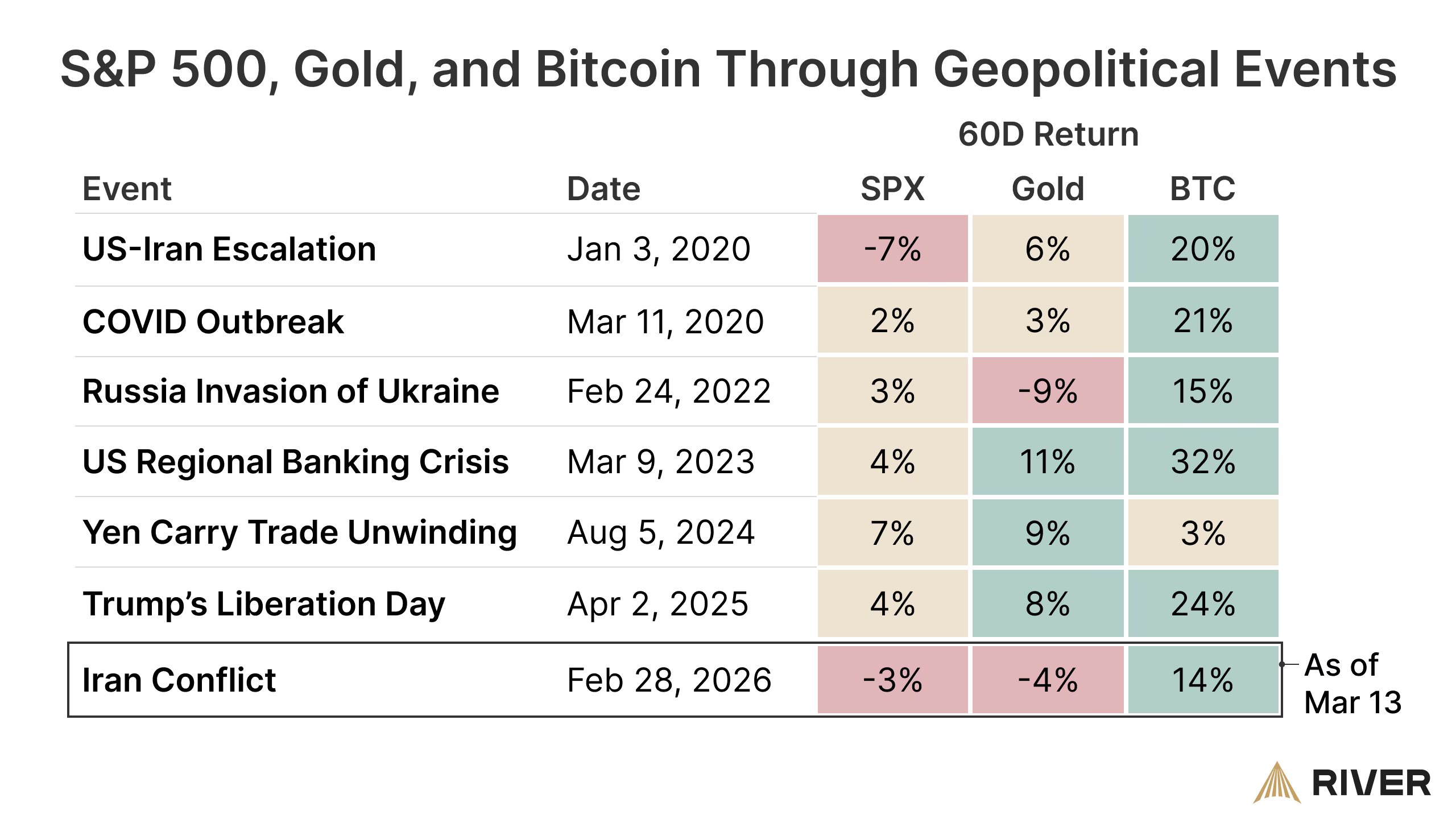
According to an analysis by bitcoin-focused financial firm River, the cryptocurrency has averaged double-digit returns over 60-day periods during multiple geopolitical events since 2020.

History is repeating itself. Bitcoin has rallied more than 10% to $74,000 in two weeks, according to CoinDesk data.
All things considered, the message is clear: BTC has held steady when it mattered the most. It remains to be seen if the stability persists.
Key Highlights
- HYPE surged approximately 10% to reach the $40 price level, establishing itself as the top gainer among the 20 largest cryptocurrencies by market capitalization
- Open Interest increased to $1.67 billion, marking the highest reading since early February and indicating significant new capital inflows
- Funding rates shifted into positive territory at 0.008%, demonstrating that long position holders are compensating short sellers
- The 4-hour RSI indicator stands at 70, approaching overbought levels, while the MACD displays a bullish crossover pattern
- Tokenized assets accounted for 33% of Hyperliquid’s weekly trading volume, establishing a new platform record
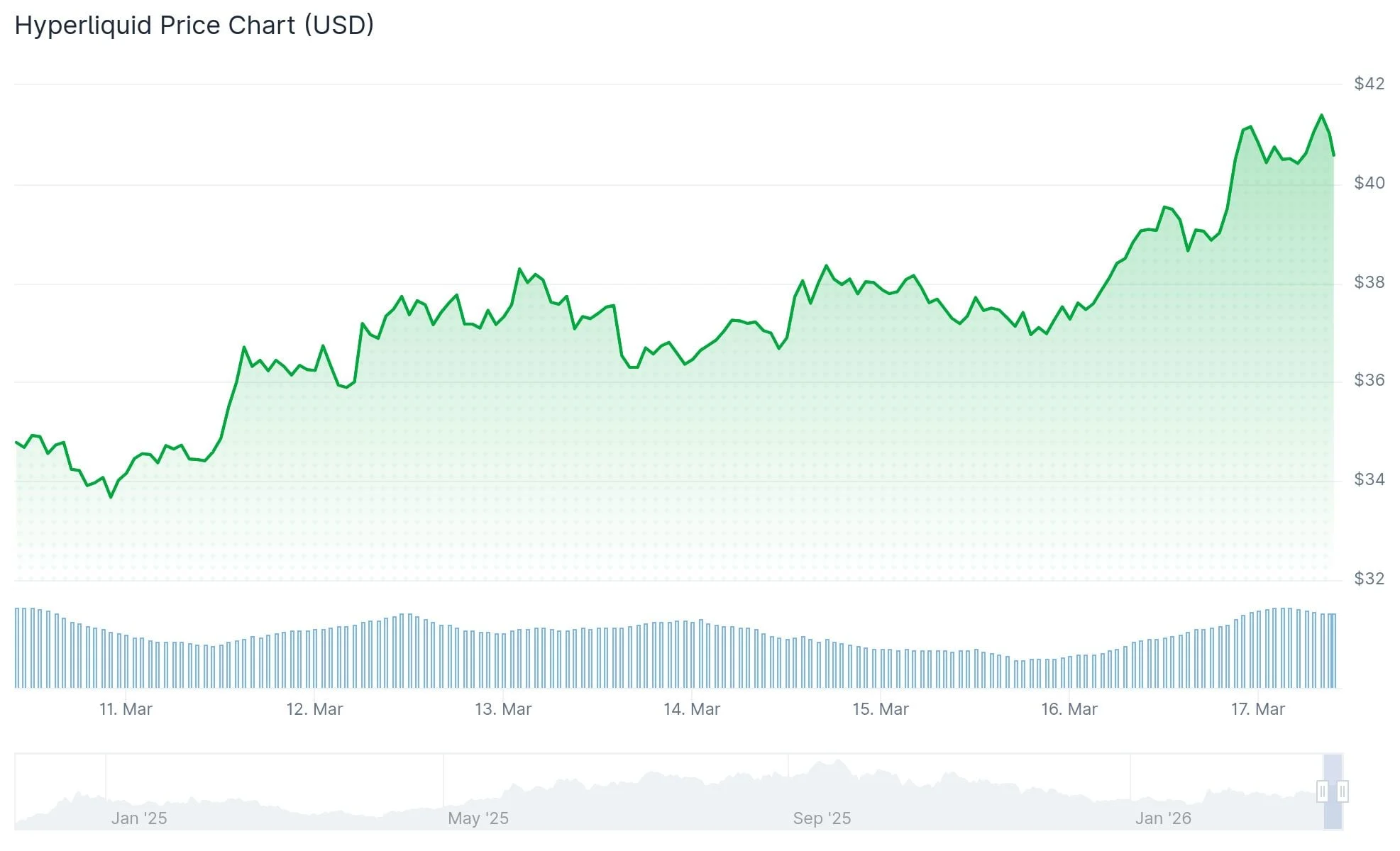
Hyperliquid (HYPE) has climbed to $40 following a nearly 10% price increase on Monday. This upward movement enabled HYPE to surpass Cardano’s ADA, securing the position as the tenth-largest cryptocurrency by market capitalization.
The price surge is supported by robust on-chain metrics and derivatives market indicators. According to CryptoQuant analytics, significant whale transactions, buy-side pressure dominance, and stabilizing conditions across both spot and futures markets are evident.
In the derivatives markets, Open Interest (OI) expanded to $1.67 billion on Tuesday. This represents the highest measurement recorded since the beginning of February, with consistent growth observed throughout March.

An increase in OI generally indicates that fresh capital is flowing into the market. This additional liquidity could provide support for the current upward price trajectory.
Hyperliquid’s funding rates transitioned to positive territory on Sunday and climbed to 0.008% by Tuesday. This shift from negative to positive funding rates indicates that traders with long positions are compensating those with short positions — a clear indication of robust bullish sentiment.
Chart Analysis Suggests Further Upside Potential
Examining the 4-hour timeframe, HYPE successfully breached a daily resistance barrier at $36.51 last Thursday. The token established support around that threshold the next day before climbing roughly 10% through Monday’s trading session.
The 4-hour RSI reading stands at 70, positioned just beneath overbought conditions. Additionally, the MACD indicator has generated a bullish crossover signal, accompanied by expanding green histogram bars that reinforce the positive technical outlook.
Should HYPE maintain its upward momentum, the primary target remains the $50 psychological threshold. Nevertheless, the October 29 peak of $49.88 could serve as resistance due to concentrated sell-order activity in that price zone.
A brief retracement within the overall uptrend remains possible. In such a scenario, the initial support level to monitor would be $36.51, with secondary support at $33.60, which was most recently tested on March 10.
Record-Breaking Tokenized Asset Trading Activity
Beyond price movements, tokenized assets represented 33% of Hyperliquid’s total weekly trading volume. This marks an unprecedented all-time high proportion for this asset category on the platform, based on Blockworks data.
Tokenized assets also constitute approximately 21% of the total open interest on Hyperliquid. Open interest represents the aggregate value of all active derivative contracts.
The expanding proportion of tokenized assets indicates that an increasing number of traders are maintaining positions in these instruments over extended timeframes.
Tokenized assets represent conventional financial instruments or tangible real-world assets that have been digitized on blockchain networks, enabling them to be exchanged within decentralized trading environments.
As of Tuesday’s trading session, HYPE is valued at $40 with bullish traders eyeing $50 as the subsequent critical resistance level.
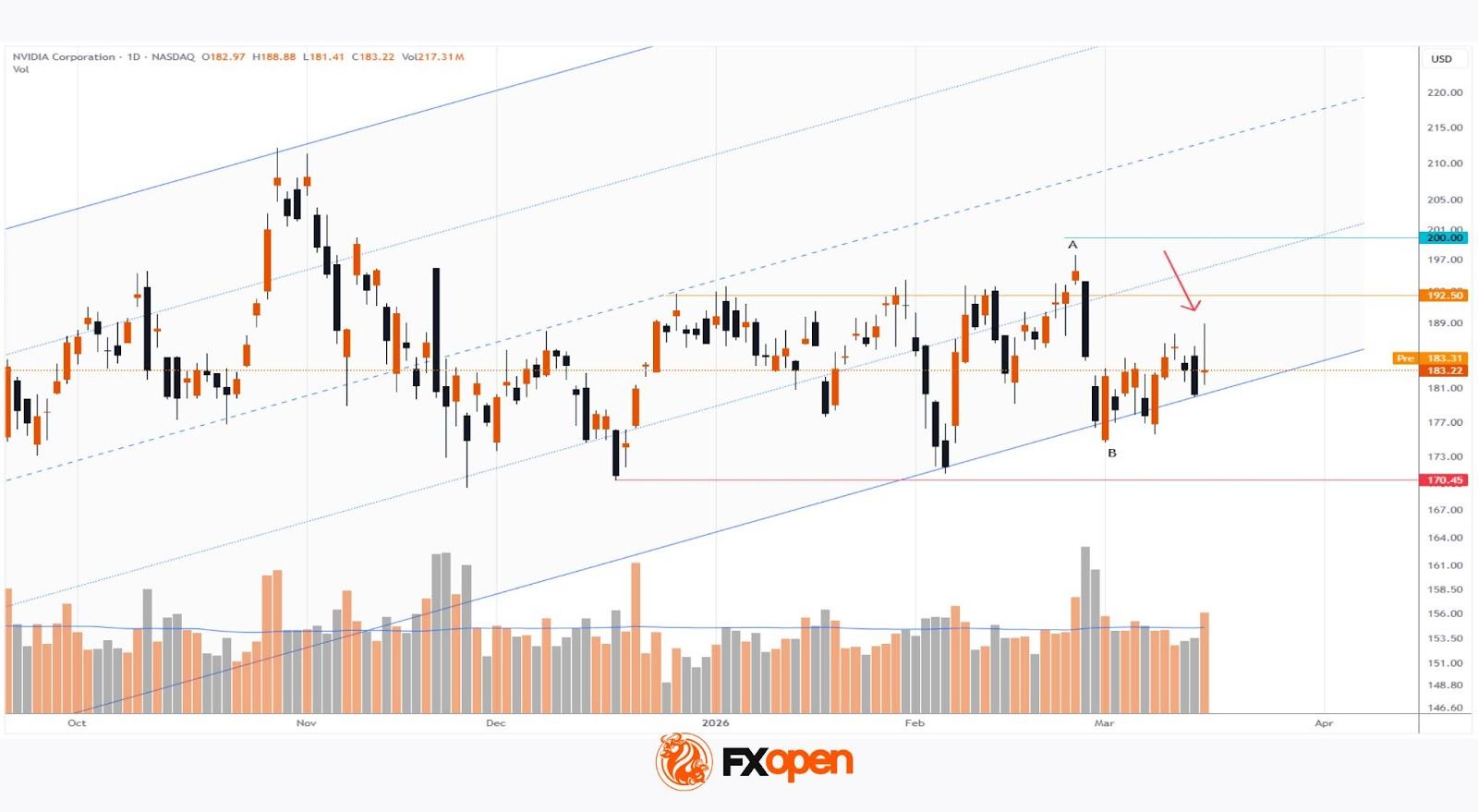
Nvidia shares experienced heightened volatility yesterday, with the price jumping to a March high during the Nvidia GTC 2026 conference, where Jensen Huang made several major announcements. According to media reports:
→ Nvidia unveiled a next-generation platform named after the astronomer Vera Rubin. The new chips are designed for “agentic AI” (AI agents).
→ The company expects total orders for current-generation AI systems (Blackwell) and next-generation systems (Vera Rubin) to reach $1 trillion by 2027. This is double the company’s previous $500 billion forecast announced earlier.
→ Huang also noted that market demand is shifting. While chips were previously purchased mainly for training AI models, demand is now increasingly driven by companies such as OpenAI, Meta and Anthropic, which must serve hundreds of millions of users in real time.
As the NVDA chart shows, the share price rose above the $188.50 level, but later pulled back, which may suggest excessive optimism among buyers and aggressive selling pressure.
Technical Analysis of Nvidia (NVDA)
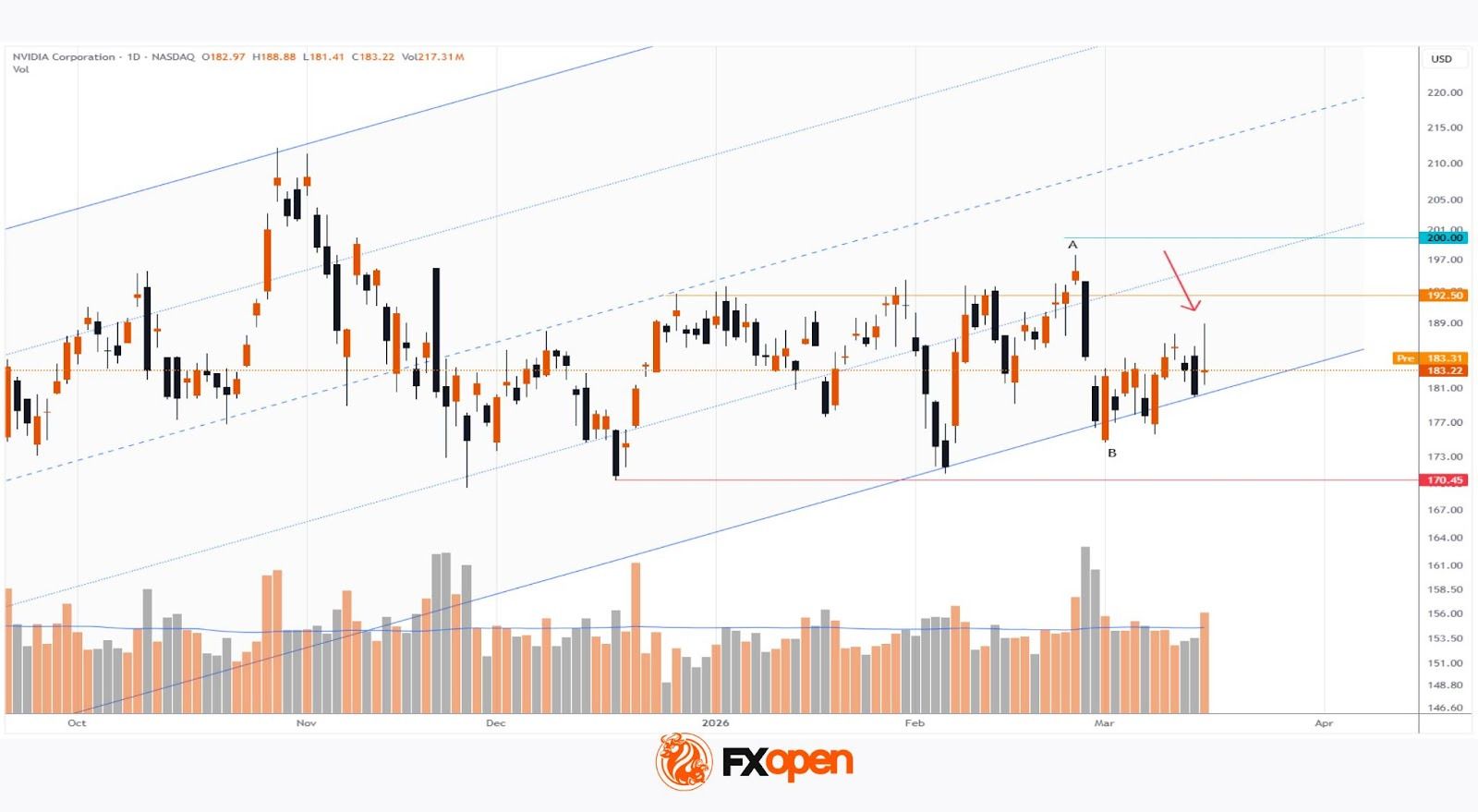
On the morning of 26 February, while analysing NVDA price movements following the quarterly earnings release, we:
→ updated the long-term ascending channel (which remains intact);
→ pointed to the negative experience of other tech giants earlier in 2026, whose shares rallied briefly after earnings before turning lower (for example, Meta);
→ suggested that if bulls wanted to confirm control of NVDA, it would be important to keep the price above the $192.50 level.
During the main trading session that same day, the $192.50 level was broken by bears on a wide candle accompanied by rising volumes, confirming these concerns. Moreover, the downward momentum continued the following day, eventually leading to the A→B swing.
Overall, bulls still have reasons to remain calm, as:
→ the fundamental backdrop remains optimistic;
→ the lower boundary of the ascending channel continues to act as strong support.
However, the NVDA price chart also presents some warning signs:
→ peak A may represent a bull trap;
→ yesterday’s candle with a long upper shadow could also signal a similar trap.
If this proves to be the case, a test of the lower boundary of the channel would be a logical next step. Such a scenario could significantly alter sentiment in the NVDA stock market.
Buy and sell stocks of the world’s biggest publicly-listed companies with CFDs on FXOpen’s trading platform. Open your FXOpen account now or learn more about trading share CFDs with FXOpen.
This article represents the opinion of the Companies operating under the FXOpen brand only. It is not to be construed as an offer, solicitation, or recommendation with respect to products and services provided by the Companies operating under the FXOpen brand, nor is it to be considered financial advice.
TLDR
- Ping Fai Yuen alleges his estranged spouse Fun Yung Li accessed 2,323 Bitcoin from his Trezor wallet in August 2023 by recording his seed phrase via household surveillance cameras
- The cryptocurrency held a value near $60 million when allegedly stolen but has since appreciated to approximately $172 million
- The digital assets were distributed across 71 different blockchain addresses with no transaction activity recorded after December 21, 2023
- While dismissing the primary conversion claim, a UK High Court judge permitted the case to advance on alternative legal grounds
- Justice Cotter determined the husband possesses “a very high probability of success” and advised scheduling an expedited trial
Ping Fai Yuen, a British man, alleges that his estranged spouse Fun Yung Li covertly captured the 24-word seed phrase for his Trezor hardware wallet through domestic surveillance equipment. According to his claims, she subsequently utilized this information to authorize the unauthorized transfer of 2,323 Bitcoin in August 2023.
The Bitcoin held an estimated value approaching $60 million during the alleged incident. Based on current market prices hovering around $74,000 per token, the holdings are now worth approximately $172 million.
The disputed cryptocurrency moved through multiple transactions before settling into 71 distinct blockchain addresses. Court filings indicate these addresses have remained dormant with zero recorded movements since December 21, 2023.
According to Yuen’s testimony, his daughter alerted him to his wife’s alleged intentions to appropriate the Bitcoin. Following this warning, he deployed audio surveillance technology throughout their residence. He asserts these recordings document his wife deliberating about the theft and strategizing methods to transfer substantial funds while avoiding scrutiny from financial institutions and law enforcement.
Law enforcement officials arrested Li and confiscated multiple cold storage wallets and timepieces during a residence search. She was subsequently released under bail conditions. Authorities eventually determined no additional action would be pursued unless fresh evidence emerged.
Legal Battle Over Crypto Property Rights
This case presents a fundamental legal question: can Bitcoin be classified as property under current English legal frameworks?
Li’s legal representatives petitioned for case dismissal. They contended that Yuen’s primary allegation centered on conversion, a legal doctrine in England historically applicable exclusively to tangible property and incompatible with digital assets such as Bitcoin.
The presiding judge concurred that conversion was inapplicable. Nevertheless, Justice Cotter determined the proceedings could advance to trial based on alternative legal theories that might enable Yuen to reclaim the Bitcoin should his accusations be substantiated.
In an unrelated September 2024 incident, a physical altercation occurred between Ping and Li. Yuen subsequently entered guilty pleas to assault occasioning actual bodily harm plus two counts of common assault.
Yuen has additionally informed the court of his suspicion that the 71 Bitcoin addresses have been subjected to a dusting attack. These attacks involve transmitting minimal cryptocurrency amounts to wallets for tracking purposes and potentially identifying valuable holders for phishing schemes and additional fraudulent activities.
Judge: Evidence Is “Damning”
In November 2024, Yuen filed for an asset preservation injunction requesting the court freeze the cryptocurrency, formally recognize his ownership rights, and either restore the Bitcoin or compensate him with equivalent cash value.
Justice Cotter documented that Yuen possesses “a very high probability of success,” citing the audio documentation and the hardware discovered during Li’s residence search.
“The transcripts are damning,” Cotter stated, noting that Li provided no justification for the Bitcoin transfers.
Justice Cotter further advocated for an accelerated trial, characterizing it as “necessary given the security threats to, and volatility of value of, the Bitcoin.”


Bitcoin’s price climbed to a six-week peak earlier this morning, touching $76,000 after it broke above $70,000 last week. Despite retracing by nearly two grand since then, the asset is still up by $11,000 since its February 28 low when it plummeted immediately after the strikes in the Middle East began.
Now, though, there are more bullish hints ahead, as popular analyst Ali Martinez brought up a key signal that has led to all major BTC rallies in the past three years.
Funding Rates Turn Negative
The funding rates are periodic, small fee payments exchanged between traders holding short and long positions in perpetual futures contracts, keeping those prices aligned with the actual spot BTC price. When the rates are positive, this means that longs are paying shorts, and vice versa.
Although some consider positive rates to be bullish since BTC’s perp price is higher than the spot one as long positions dominate, Ali Martinez actually believes in the opposite and outlined historical examples to prove his theory. The analyst with almost 165,000 followers on X noted that BTC funding rates turning negative is “a signal that has preceded every major relief rally of the last 3 years.”
“Market sentiment is currently at a ‘peak fear’ reset. History shows that when the crowd pays to short, the local bottom is usually in. We’ve seen this script play out with surgical precision:
-
Dec 2022: from $17,800 to $24.8k (+39%)
-
Mar 2023: from $20,000 to $30,700 (+53%)
-
Aug 2023: from $26,400 to $73,000 (+176%)
-
Sept 2024: from $58,000 to $104,500 (+80%)
-
Apr 2025: from $94,700 to $111,600 (+18%)
-
June 2025: from $107,000 to $124,700 (+17%)”
After bitcoin’s breakout past $70,000, the funding rates have reset to -0.004%. The analyst believes smart money is “watching for the inevitable short squeeze” and if history is to keep that 100% strike rate on this indicator, the current dip is “the coiled spring for the next leg up.”
Did the Rally Take Place Already?
Martinez’s original post came as bitcoin’s price traded around $71,000. In the following 24 hours, though, the asset climbed to $76,000, hitting its highest price tag since early February. That’s a 7% gain in a day. The question is whether this was already the rally that he talked about, a claim that could have some substance given the fact that the relief pumps after the funding rates turned negative in the past couple of examples have declined in terms of percentages.
In addition, BTC’s latest moves are mostly impacted by the developments in the Middle East, so if something big is to occur there, more volatility could ensue almost immediately. Nevertheless, the cryptocurrency has outperformed all other asset classes, including gold, since the war began, which could be another positive sign for its short-term price moves.
The post The Metric That Preceded Every Bitcoin Rally Just Flashed Green: Is a BTC Surge Next? appeared first on CryptoPotato.
TLDR
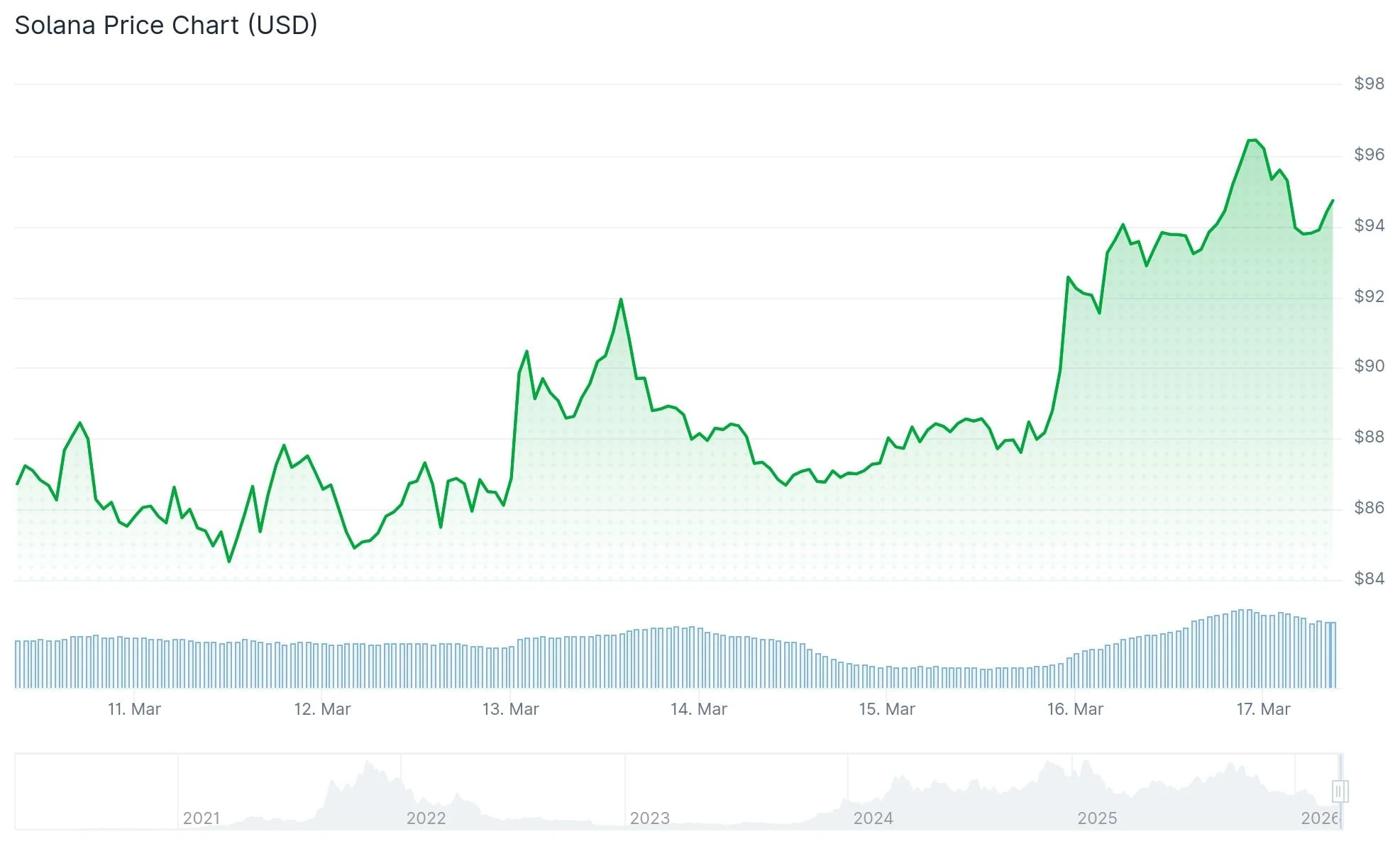
- Solana experienced a 7%+ rally within 24 hours, touching $97.67 while the overall crypto market gained approximately 3.6%.
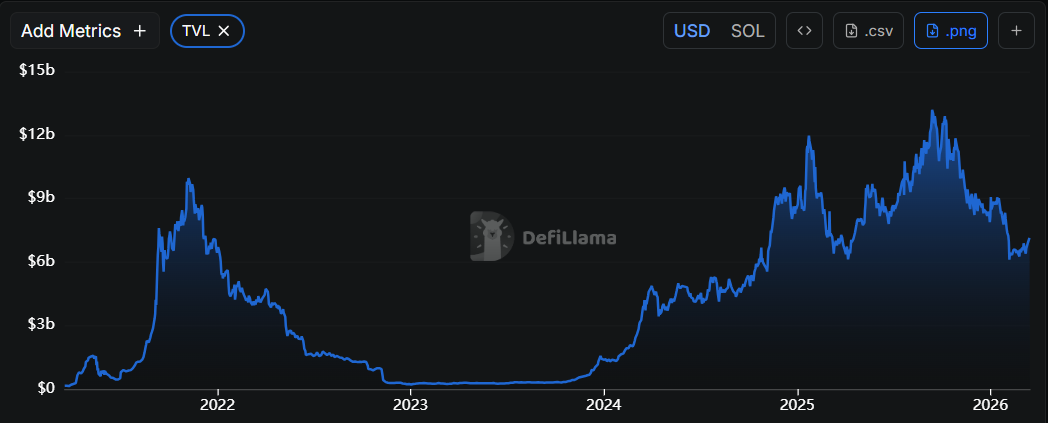
- The network’s total value locked increased by 25% throughout the past 30 days, demonstrating renewed investor confidence.
- SOL maintains trading above the $92 mark and its 100-hour simple moving average, with bullish support establishing at $94.
- Critical resistance points are positioned at $98 and $100, while downside support exists at $92 and $88.
- The token has appreciated over 40% since hitting its February bottom, as the RSI indicator advances toward 60 from previously oversold territory.
Solana has delivered an impressive 24-hour performance, rallying more than 7% to peak at $97.67 before experiencing a modest retracement to settle around the $95 zone. This upward movement coincides with a broader cryptocurrency market recovery that saw gains of approximately 3.6% during the identical timeframe.
Currently, SOL maintains its position above the $92 threshold and trades above its 100-hour simple moving average. Technical analysis reveals a bullish trend line forming with critical support established at $94 on the hourly timeframe, according to data sourced from Kraken.
Critical Resistance Zones Emerge
The cryptocurrency now encounters resistance around the $95 level, with the subsequent barrier positioned at $98. The psychologically significant $100 threshold represents the primary challenge ahead. Successfully breaking and closing above $100 could pave the way toward $105, with potential extension to $112.
Conversely, should SOL fail to maintain support above $92, the next cushion sits at $88. Breaking beneath $88 would likely bring the $82 level into play.
While the recent upswing correlates with broader market stabilization, Solana has notably outpaced the majority of alternative top-10 cryptocurrencies during this same period.
On-Chain Metrics Validate Price Action
The total value locked within Solana’s ecosystem expanded by 25% over the preceding 30-day period. This metric, which quantifies the amount of capital deployed within a blockchain’s infrastructure, indicates accelerating platform utilization when showing this magnitude of growth.
Continuous developer engagement and consistent decentralized application deployments across the network have persisted. These fundamental on-chain indicators have contributed to supporting the current bullish price trajectory.
Solana has appreciated more than 40% from its February trough. The Relative Strength Index has recovered toward the 60 threshold after rebounding from oversold conditions experienced earlier this year.
Price action has been oscillating within a range bounded by $80 support and $95 resistance throughout recent weeks, creating a consolidation formation that market participants frequently monitor for potential breakout opportunities.
The 200-day moving average continues to reside above present price levels, suggesting the long-term directional bias hasn’t completely reversed yet.
SOL is currently valued at approximately $94.62, commanding a market capitalization near $54 billion, with a 52-week trading range spanning from $70.61 to $252.78.

Can XRP price hold $1.50 support as whales accumulate and active wallets surge?
Who has won the most Oscars? See the record-holders in major categories

The Global Story – How does war affect a child’s brain?

Smart energy pays enters the US market, targeting scalable financial infrastructure

Why Israel is blocking foreign journalists from entering

Bitcoin: We’re Entering The Most Dangerous Phase

2 of the BEST financial tips that’ve helped me understand money young! financialliteracy #moneytips

They’re Keeping XRP Down Until THIS Happens

Qatar’s Airspace Is Closed. 140 Emergency Flights. The Gulf’s Financial Capital Is Emptying Out.
-
 Tech6 days ago
A 1,300-Pound NASA Spacecraft To Re-Enter Earth’s Atmosphere
-
Crypto World3 days ago
HYPE Token Enters Net Deflation as HyperCore Buybacks Outpace Staking Rewards
-

 Business7 days ago
ExxonMobil seeks to move corporate registration from New Jersey to Texas
-

 Fashion4 days ago
Weekend Open Thread: Addict Lip Glow
-

 Tech7 days ago
ChatGPT will now generate interactive visuals to help you with math and science concepts
-
Sports3 days ago
Why Duke and Michigan Are Dead Even Entering Selection Sunday
-

 NewsBeat6 days ago
Residents reaction as Shildon murder probe enters second day
-

 Business2 days ago
Search for Savannah Guthrie’s Mother Enters Seventh Week with No Arrests
-

 Business6 days ago
Search Enters Sixth Week With New Leads in Tucson Abduction Case
-

 Business3 days ago
US Airports Launch Donation Drives for Unpaid TSA Workers as Partial Government Shutdown Enters Fifth Week
-
Crypto World3 days ago
Coinbase and Bybit in Investment Talks: Could Bybit Finally Enter the US Crypto Market?
-

 NewsBeat6 days ago
I Entered The Manosphere. Nothing Could Prepare Me For What I Found.
-

 Sports6 days ago
PWHL, Senators discussing plan to keep Charge in Ottawa
-

 Business3 days ago
Country star Brantley Gilbert enters growing non-alcoholic beer market
-

 Business24 hours ago
Australian shares drop as Iran war enters third week
-

 Sports4 days ago
College Basketball Best Bets: Conference Tournament Semifinal Picks
-

 Crypto World24 hours ago
Crypto Lender BlockFills Enters Chapter 11 with Up to $500M in Liabilities
-

 Crypto World7 days ago
Will Chainlink price reclaim $10 amid volatility squeeze?
-

 Tech6 days ago
Clarity as strategy
-

 Politics6 days ago
Trump Says Middle East Is ‘Very Lucky’ That He’s President


You must be logged in to post a comment Login