
Crypto World
JPMorgan taps Dwyane Wade, Tom Brady in athlete wealth management push


Tom Brady looks on prior to an NFL game between the Baltimore Ravens and the Dallas Cowboys at AT&T Stadium in Arlington, Texas, Sept. 22, 2024.
Cooper Neill | Getty Images Sport | Getty Images
JPMorgan Chase has recruited some of the biggest names in American sports to help tackle a persistent problem: professional athletes going broke.
The bank on Wednesday announced an initiative called the JPMorgan Chase Athlete Council, led by two-time NBA Hall of Famer Dwyane Wade and featuring other high-profile athletes including Tom Brady, Sue Bird, Alex Morgan, Megan Rapinoe, A’ja Wilson and Jalen Brunson.
The stars will meet with JPMorgan executives to help the bank craft programs designed to serve athletes from college to professional life and retirement, JPMorgan said in a release.
The move reflects growing competition among banks and wealth managers to serve athletes, the most prominent of whom are increasingly becoming entrepreneurs, investors and media personalities.
Most athletes don’t receive personal finance education in school, and their relatively short careers leave a narrow earning window that requires careful planning, according to JPMorgan, the biggest U.S. bank by assets. About one in six NFL players declare bankruptcy within 12 years of retiring, the bank said.
“An athlete’s career and earning power are unique,” said Kristin Lemkau, head of JPMorgan Wealth Management. “Careers can be short and retirement unexpected. We want to develop a program by athletes for athletes.”
Wade said in the release that the initiative gives athletes a chance to share hard-won experiences with the next generation.
“Having the right educational resources and guidance is critical to making smart decisions about money as your career evolves,” he said.
The bank is also standing up an Athlete Center of Excellence staffed by financial professionals with sports experience and launching a content hub with checklists for athletes navigating the name, image and likeness, or NIL, system and guides for assembling a roster of advisors.


This release summarizes new findings from SAS and IDC regarding how banks deploy AI. It notes that rising AI spend has not yet translated into robust governance or guardrails, undermining trust in AI systems. The study finds that only 11% of banks achieve both high internal confidence in AI and demonstrable trust, while 47% sit in a trust dilemma between underuse and overreliance. With regional digital transformation advancing in the UAE and beyond, the report underscores the need for governance, transparency, and solid data foundations as banks scale AI. The rest of this article highlights key takeaways and near-term watchpoints.
Key points
- Only 11% of banks achieve both high internal confidence in AI and demonstrably trustworthy AI.
- 47% fall into the trust dilemma between underusing reliable AI and overrelying on unvalidated AI.
- 19% operate with siloed data infrastructure, the worst rate among the study’s focus industries.
- 45% lack effective data governance and 41% lack centralized or optimized data infrastructure.
- 60% expect AI spending growth between 4% and 20%.
Why it matters
These findings have practical implications for banks, regulators, and technology teams. Without strong data foundations, governance, and explainability, AI investments may fail to deliver reliable results or earn customer and regulator trust. The emphasis on responsible innovation indicates that meaningful ROI depends on aligning AI ambition with governance and transparent decision-making before scaling. For readers, the report signals where weaknesses exist and what foundational work should be prioritized as AI initiatives move from pilots to production.
What to watch
- 52% plan to expand their AI architecture; 43% plan to form or grow dedicated AI teams.
- 31% plan to focus on developing and tuning AI models themselves.
- Nearly one-third plan increases in trustworthy AI investment to support more autonomous systems.
- 60% expect AI spending growth between 4% and 20%.
Disclosure: The content below is a press release provided by the company or its PR representative. It is published for informational purposes.
Study: Only 11% of banks have cracked the code on trustworthy AI
Even as AI spending surges, few banks have established the necessary governance and guardrails – and nearly half misjudge their own AI readiness
Dubai, United Arab Emirates, 7 April 2026 – In banking, trust isn’t optional – it’s everything. Yet, even as banks accelerate AI investment faster than other sectors, most are deploying AI without the oversight and infrastructure needed to earn that trust. That’s the central tension revealed in new banking insights from SAS’ Data and AI Impact Report: The Trust Imperative, with research insights by IDC.
Among the four sectors examined in the study, banking outpaces government, insurance and life sciences both in AI spending and adoption of trustworthy AI practices. In fact, about one-quarter (23%) of banks operate at the highest level of IDC’s Trustworthy AI Index. But even with these advantages, most banking institutions fall far short of the report’s “ideal state,” which combines high trust with high trustworthiness. According to the report:
- Only 11% of banks have achieved both high internal confidence in AI and AI systems that are demonstrably trustworthy.
- Nearly half (47%) fall into what IDC calls the “trust dilemma” – either underusing reliable AI because they don’t sufficiently trust it or overrelying on AI systems that haven’t been adequately validated.
“On trustworthy AI, banking leads every sector in this study – and even so, most banks’ foundational readiness is nowhere near where it needs to be,” said Stu Bradley, Senior Vice President of Risk, Fraud and Compliance Solutions at SAS. “Roughly nine in 10 banks have yet to fully align trust with proof, and about one in five are still running on siloed data. Closing the gap between AI ambition and AI readiness should be a top-down priority for all banks.”
As the UAE’s Vision 2031 and wider digital transformation efforts continue to gain momentum, banks across the Middle East are increasingly adopting advanced technologies to improve efficiency, strengthen resilience, and deliver better customer experiences.
Michel Ghorayeb, Managing Director at SAS UAE, said: “Banks in the Middle East are well-positioned to build on strong foundations, with robust data, clear governance, and effective oversight enabling AI investments to scale and deliver reliable results. At the same time, prioritizing transparency and making AI decisions easier to understand will play a key role in strengthening confidence. Banks that place responsible AI at the heart of their strategy will be best positioned to drive innovation, earn trust, and create sustainable long-term value.”
Investment is rising, but foundations remain fragile
The report, based on a global, cross-industry survey of 2,375 IT and business leaders, reveals a troubling pattern: Investment in AI capabilities is not being matched by investment in the responsible innovation pillars that make AI dependable. In an industry where a single model failure can trigger regulatory penalties or erode consumer confidence overnight, that’s a dangerous disconnect.
And the problem isn’t a lack of investment: Banks’ AI spending trajectory exceeds all other sectors in the study, with most banks (60%) expecting growth between 4% and 20%. A smaller subset (12%) anticipates even steeper increases. Despite this momentum, the study found significant foundational weaknesses remain, including:
- Data silos. Nearly one in five banks (19%) still operate with a siloed data infrastructure – the worst rate among the study’s focus industries.
- Insufficient data foundations. A significant portion of banks lack effective data governance (45%) and/or a centralized or optimized data infrastructure (41%).
- Talent gaps. Many banks (42%) also face shortages of specialized AI skills.
To address these issues, more than half (52%) of banks plan to expand their AI architecture; another 43% plan to form or grow dedicated AI teams. But fewer than one-third (31%) plan to focus on developing and tuning AI models themselves. The takeaway: These aren’t abstract or theoretical barriers; they’re structural.
“The banking sector clearly understands AI’s potential, but understanding and execution are not the same,” said Kathy Lange, Research Director of the AI and Automation Practice at IDC. “Without strong data architectures, governance frameworks and talent pipelines, banks risk pouring money into AI initiatives that can’t deliver ROI – or worse, that undermine the very trust they depend on.”
Responsible innovation, not cost savings, drives AI ROI
The report also challenges the assumption that AI’s primary value in banking is cost cutting. To the contrary, banking stands alone in ranking product and service innovation above process efficiency as the leading source of AI-driven value.
Cross-industry ROI figures show banks are onto something. Organizations using AI to improve customer experience reported the highest return – $1.83 for every dollar invested – followed closely by those centered on expanding market share ($1.74). Those focused on cost savings reported the lowest – $1.54 per dollar. Moreover, organizations that prioritized trustworthy AI were 60% more likely to report doubling overall return on their AI initiatives. That’s solid proof that responsible innovation is a growth accelerator that more than pays for itself.
Banks are also moving more decisively than other sectors toward agentic AI, with nearly one-third planning increases in trustworthy AI investment to support more autonomous systems. But as AI systems gain greater decision-making authority, the consequences of weak governance grow more significant.
“Regulators are watching. Customers are watching. And right now, nearly half of banks are using unproven AI – or hesitating to tap AI they’ve validated,” said Alex Kwiatkowski, Director of Global Financial Services at SAS. “No bank wants to become an ‘also-ran’ in this highly competitive race, and cost savings alone won’t keep them in it.
“The banks that win will be ones that invest in governance, explainability, transparency and strong data foundations before they scale, not after something breaks.”
To learn more and access the full Data and AI Impact Report, published in September 2025, visit SAS.com/ai-impact.
SAS is a global leader in data and AI. With SAS software and industry-specific solutions, organizations transform data into trusted decisions. SAS gives you THE POWER TO KNOW®.
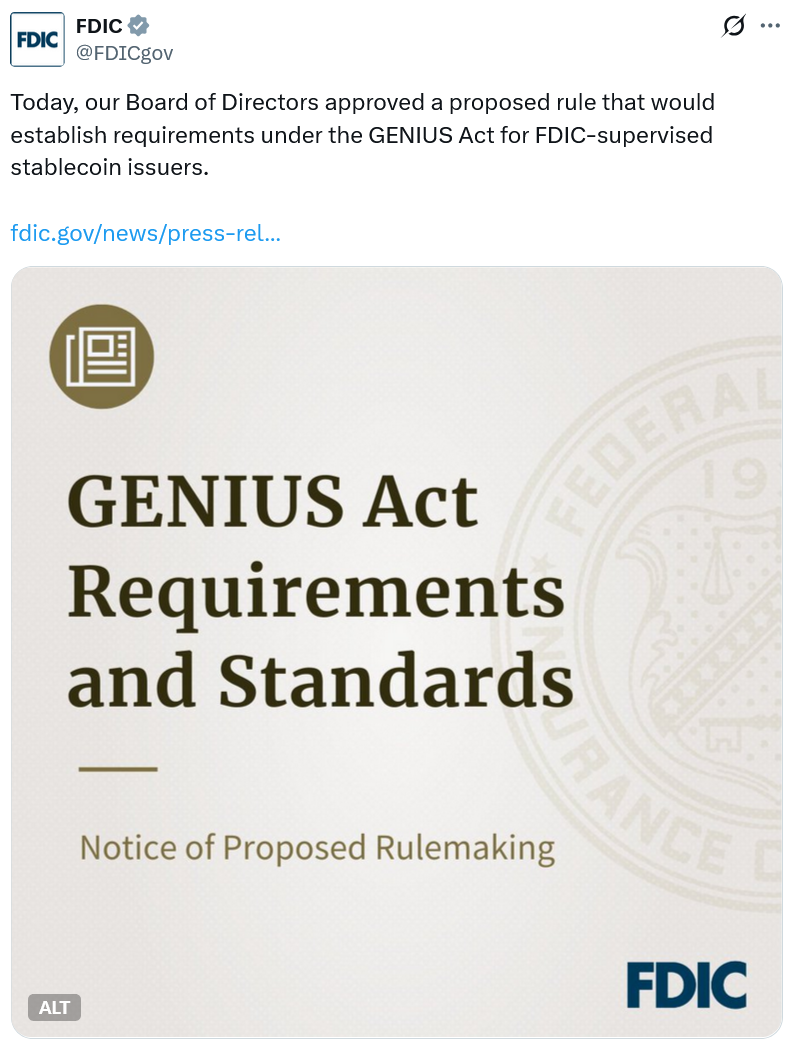
The US Federal Deposit Insurance Corporation (FDIC) has proposed new rules to regulate FDIC-supervised stablecoin issuers in accordance with the Guiding and Establishing National Innovation for US Stablecoins (GENIUS) Act, which was signed into law nine months ago.
In a statement on Tuesday, the FDIC said its board of directors voted to issue a proposal that would set reserve, redemption, capital, risk management and custody standards for stablecoin issuers and insured depository institutions under its supervision.

The FDIC insures deposits at more than 4,000 financial institutions and supervises over 2,700 banks and savings associations to maintain stability in the US financial system.
The GENIUS Act granted the FDIC authority to oversee stablecoin activity within the banks and institutions that it supervises when it was signed into law in July, though it is scheduled to take effect on Jan. 18, 2027, if not earlier.
FDIC insurance won’t directly protect token holders
While reserve deposits backing a payment stablecoin would be insured under the FDIC’s proposed rules, that protection won’t extend to stablecoin holders, the FDIC said.
The FDIC argued that treating stablecoin holders as the insured depositors “seems inconsistent” with the GENIUS Act’s prohibition on payment stablecoins being subject to Federal deposit insurance.
Related: Stablecoins flip automated clearing house volume in February
However, the FDIC said its rules would still provide a more “secure environment” for stablecoin holders by offering them “increased assurance that their payment stablecoins are subject to elevated regulatory and supervisory standards.”
FDIC welcomes feedback
The FDIC invited the public to offer feedback on 144 questions related to how it should regulate stablecoin issuers. Comments will be accepted for the next 60 days.
It marks the FDIC’s second proposal for implementing the GENIUS Act, following a Dec. 19 plan to establish an application procedure for IDIs seeking approval to issue payment stablecoins through subsidiaries.
The Office of the Comptroller is also working to implement the GENIUS Act. The OCC would cover a broader scope of stablecoin activity than the FDIC, as it oversees national bank subsidiaries and certain nonbank issuers.
Magazine: Would Bitcoin really be at $200K if not for Jane Street? Trade Secrets


The crypto market update oil prices Iran war bitcoin impact news today is being written by an energy market in freefall: US crude surged above $115 per barrel and Brent crossed $111 after Tuesday’s Kharg Island strikes, the IEA’s head declared the Hormuz oil shock worse than the crises of 1973, 1979, and 2022 combined, and the chain connecting oil prices to Bitcoin has never been tighter or more punishing.
Summary
- US crude oil surged above $115 per barrel following Tuesday’s Kharg Island strikes, with Brent crude above $111; gas prices in Los Angeles crossed $6 per gallon, and the national US average has reached $4.14, up from $2.98 before the war began
- IEA Executive Director Fatih Birol told French newspaper Le Figaro: “The world has never experienced a disruption to energy supply of such magnitude,” calling the current crisis “more serious than the ones in 1973, 1979 and 2022 together” — and warned that April would be worse than March because the last pre-war cargo ships are now clearing ports
- The oil-to-crypto transmission mechanism is mechanical: higher oil drives inflation, inflation keeps the Federal Reserve from cutting rates, higher rates suppress liquidity, and tighter liquidity is the dominant headwind for risk assets including Bitcoin and Ethereum
The crypto market update oil prices Iran war bitcoin impact news today is as direct as it gets. US crude surged above $115 per barrel within minutes of the first Kharg Island strike reports on Tuesday, with Brent crude crossing $111. Gas prices in Los Angeles have already crossed $6 per gallon. The national average stands at $4.14, up from $2.98 the day before the war began on February 28.
This is the price of a closed strait. The Hormuz chokepoint normally handles roughly 20% of global oil and gas flows. Since Iran imposed its de facto blockade, global supply has lost approximately 12 million barrels per day, more than the combined shortfalls of 1973 and 1979, according to IEA data. “When you look at the 1973 and 1979 crises, in both of them we lost each about 5 million barrels per day. These oil crises led to global recession in many countries,” IEA Executive Director Fatih Birol told the Norges Bank Investment Management podcast. “Today, we lost 12 million barrels per day — more than two of these oil crises put together.”
Birol also warned specifically about the month ahead. March was partially buffered by cargo ships that had entered the strait before the war began and were still arriving at port. “In April, there is nothing,” he said in the same interview. The full impact of the supply disruption is only now reaching energy markets in real terms.
His conclusion to Le Figaro was unambiguous: the current crisis is “more serious than the ones in 1973, 1979 and 2022 together” — combining the oil shocks of both 1970s energy crises with the gas market dislocation that followed Russia’s 2022 invasion of Ukraine.
How This Reaches Bitcoin
The mechanism is not subtle. As crypto.news reported, the Federal Reserve has no room to cut rates while oil is pricing in a prolonged supply shock. The market currently prices in minimal near-term Fed movement. Bitcoin performs best in easing liquidity conditions — rate cuts, falling dollar, growing money supply. It performs worst in exactly the conditions the Iran war has created: oil-driven inflation, a Fed on hold, and investors rotating into traditional safe-haven assets.
As crypto.news noted, $65,000 has been identified as Bitcoin’s key near-term support. A sustained oil price above $115 keeps the macro headwind in place and leaves BTC vulnerable to a break below that level if tonight’s escalation materializes.
“The single most important solution to this problem is opening up the Hormuz Strait,” Birol said. Until that happens, crypto investors are effectively long on diplomacy whether they intend to be or not.

TLDR
- The Solana Foundation launched the STRIDE program to enhance security for DeFi protocols after the $285 million Drift hack.
- STRIDE provides 24/7 threat monitoring for protocols with over $10 million in total value locked and formal verification for those over $100 million.
- The program aims to protect DeFi protocols by using mathematical proofs to ensure the correctness of smart contracts.
- Solana partnered with cybersecurity firms to form the Solana Incident Response Network, which will provide rapid ecosystem defense.
- The Drift Protocol hack highlighted the need for stronger security measures as North Korean hackers infiltrated the system for months before executing the attack.
The Solana Foundation has announced a new initiative to enhance the security of decentralized finance (DeFi) protocols following the high-profile $285 million hack of Drift Protocol. The hack, which occurred on April 1, 2026, was attributed to North Korean hackers who infiltrated the platform over several months. This breach highlights the increasing threats facing Solana-based DeFi protocols, prompting the foundation to act swiftly to prevent similar incidents in the future.
STRIDE Program Launched for Enhanced Protection
In response to the growing concerns, the Solana Foundation has launched a new security initiative called STRIDE. STRIDE stands for Solana Trust, Resilience, and Infrastructure for DeFi Enterprises, and it aims to offer comprehensive protection to the network’s largest DeFi protocols. This program targets protocols with a total value locked (TVL) of over $10 million and includes round-the-clock threat monitoring services. For larger protocols with over $100 million TVL, the foundation will offer advanced “formal verification” services.
Formal verification uses mathematical proofs to check the correctness of smart contracts by exhaustively evaluating all possible states and execution paths. This method guarantees the reliability of the smart contracts, providing a higher level of security for protocols dealing with substantial funds. The initiative aims to ensure that DeFi protocols on Solana are protected against potential exploits and vulnerabilities, especially as the platform’s financial ecosystem continues to expand.
Solana Foundation Teams Up with Security Firms
To bolster the STRIDE program, the Solana Foundation has also partnered with a group of cybersecurity firms. This collaboration led to the formation of the Solana Incident Response Network (SIRN), a collective focused on swift ecosystem defense. Among the founding members of SIRN are OtterSec, Neodyme, Squads, and ZeroShadow, who will provide rapid response capabilities in the event of a security breach.
SIRN aims to offer a unified defense system for the entire Solana ecosystem, addressing vulnerabilities before they are exploited. As part of the program, these firms will help improve the resilience of the network’s infrastructure and contribute to the evolving security standards of STRIDE. This collective effort underscores the importance of proactive, collaborative defense mechanisms to safeguard against increasingly sophisticated threats targeting DeFi protocols.
Drift Protocol Exploit Triggers Urgency for Stronger Security
The urgency of this security push was made clear after the exploit of Drift Protocol. The attack, which drained $285 million in under 12 minutes, was one of the largest and fastest attacks in DeFi history. Drift confirmed that the attackers had been infiltrating their system for six months before executing the hack. This methodical infiltration process highlighted how vulnerable DeFi protocols can be to advanced persistent threats.
With the launch of STRIDE, the Solana Foundation is taking a more hands-on approach to securing its DeFi ecosystem. The foundation’s focus on high-value protocols reflects an understanding that different protocols face varying levels of risk depending on their TVL. As Solana’s DeFi ecosystem grows, ensuring robust security measures will be essential to preventing future attacks and maintaining user confidence.

TLDR
- Morgan Stanley’s Bitcoin ETF, MSBT, is set to begin trading tomorrow on NYSE Arca.
- The trust will track the CoinDesk Bitcoin Benchmark 4 PM NY Settlement Rate.
- MSBT will hold Bitcoin directly and will not use leverage or active trading.
- The ETF has an annual sponsor fee of 0.14%, which is lower than most competitors.
- Coinbase and BNY will serve as the trusted custodians for the Bitcoin holdings.
Morgan Stanley’s Bitcoin ETF is set to begin trading tomorrow on the NYSE Arca under the ticker MSBT. The U.S. Securities and Exchange Commission (SEC) declared the Morgan Stanley Bitcoin Trust effective after the bank filed its final prospectus. This launch marks Morgan Stanley’s entrance into the competitive U.S. spot Bitcoin ETF market.
MSBT ETF Structure and Trading Details
The Morgan Stanley Bitcoin Trust is designed as a physical Bitcoin product, meaning it will hold Bitcoin directly. The trust will track the CoinDesk Bitcoin Benchmark 4 PM NY Settlement Rate, reflecting the value of Bitcoin in the market. The trust will not engage in any active trading, leverage, or derivatives, ensuring it mirrors Bitcoin’s performance without attempting to outperform it.
With this approach, the ETF offers a straightforward product for investors seeking exposure to Bitcoin. The trust’s low-cost structure includes an annual delegated sponsor fee of just 0.14%. This fee is lower than the 0.25% fee charged by other major Bitcoin ETFs, such as BlackRock’s IBIT.
Custody and Seed Creation Details
Morgan Stanley’s Bitcoin ETF will rely on BNY and Coinbase Custody Trust Company for the safe storage of Bitcoin. These trusted custodians are responsible for holding the Bitcoin assets in the trust, ensuring security and transparency for investors. The initial creation baskets for the trust are expected to total $1 million, with 50,000 shares to be issued ahead of the listing.
This structure and the pricing model demonstrate Morgan Stanley’s competitive positioning in the growing Bitcoin ETF market. As the first major U.S. bank to file for spot Bitcoin ETFs, the firm has made a clear commitment to expanding its crypto offerings. It continues to explore further opportunities, including offering Bitcoin, Ether, and Solana trading through E*Trade by 2026.
The launch of MSBT underlines Morgan Stanley’s confidence in the future of crypto investments, providing retail and institutional investors an additional option in the evolving Bitcoin ETF space.

Iran’s Supreme National Security Council on Wednesday accepted a two-week ceasefire in its war against the US, but emphasized this did not mean an end to the war.
The price of Bitcoin pushed past $72,000 for the first time in 20 days after the US and Iran agreed to a two-week ceasefire.
“I agree to suspend the bombing and attack of Iran for a period of two weeks,” Trump said in a Truth Social post on Tuesday, hours before his deadline for Iran to reopen the Strait of Hormuz or face military attacks on key infrastructure.
Iran’s Supreme National Security Council also said it accepted the ceasefire.
Bitcoin (BTC) climbed 2.6% in the hour following the announcement, reaching $72,339 at the time of publication, according to CoinMarketCap.
Crypto traders have historically seen geopolitical tensions as a headwind for prices, with any hints of easing often triggering quick relief rallies.

The deal also came hours after Trump renewed threats against Iran.
“A whole civilization will die tonight, never to be brought back again. I don’t want that to happen, but it probably will,” Trump said in a post on Monday.
Related: Bitcoin wallets absorb 4.37M BTC as network activity flips to ‘bull phase’
The last time Bitcoin traded above $72,000 was March 18, as sentiment continues to drag in the crypto market.
The Crypto Fear & Greed Index, which measures overall crypto market sentiment, posted an “Extreme Fear” score of 11 on Tuesday, signaling that investors are taking a cautious approach to the crypto market.
On April 1, Trump said the US could wrap up its military campaign in Iran within weeks, claiming the goal of eliminating Iran’s nuclear capabilities had been achieved.
Magazine: ‘Phantom Bitcoin’ checks, Drift hack linked to North Korea: Asia Express

Split Capital, the digital asset hedge fund founded by investor Zaheer Ebtikar, is winding down after a profitable run, with Ebtikar revealing in an X post that the firm delivered more than 100% returns and was profitable in both 2024 and 2025. He attributed the decision to wind down to a belief that the crypto market has shifted away from the hedge-fund strategies the firm once pursued.
Ebtikar said the hedge fund model “did not make sense for crypto, in perpetuity,” signaling a broader re-evaluation among venture-like capital approaches in a sector that has matured since its earlier, more momentum-driven phases. The announcement comes amid ongoing scrutiny of crypto hedge funds, which have faced tougher market conditions in the wake of the 2022 downturn, according to industry coverage.
Key takeaways
- Split Capital will shut down after a period of profitability, reporting over 100% returns across 2024 and 2025.
- Zaheer Ebtikar is transitioning to a leadership role at Plasma, a stablecoin-focused startup backed by notable investors, including Peter Thiel and Tether’s Paolo Ardoino.
- Plasma aims to build infrastructure for stablecoin settlement and broader global financial access; the company raised $24 million in February of the previous year.
- The move illustrates a broader shift in crypto funding—from traditional hedge-fund structures toward capitalizing on infrastructure and foundational technology that underpins practical crypto and fiat interoperability.
- Industry context suggests hedge funds have faced structural headwinds as market dynamics evolve, underscoring evolving investor preferences for durable, value-driven opportunities.
Split Capital’s winding down and Ebtikar’s rationale
In outlining the decision, Ebtikar framed Split Capital’s trajectory as part of a larger evolution within crypto markets. He described his early years in the space as “PvP button-clicking”—a reference to traders attempting to capitalize on momentum and narrative-driven surges. After nearly a decade, he argues, the market’s incentives have shifted. “The industry no longer rewards traders chasing momentum; it has matured into a space where the only real question is ‘What does the future look like and where is the value?’” he said.
He acknowledged that some observers were correct to question the sustainability of funds modeled after traditional hedge funds in a rapidly changing crypto landscape. The decision to wind down, he suggested, reflects a conviction narrowing toward a smaller set of founders and verticals that he believes will shape the next phase of the industry.
Plasma’s stablecoin infrastructure ambitions and Ebtikar’s new role
The move to Plasma follows a close, ongoing collaboration with its founding team throughout 2024 and 2025. Plasma positions itself as a builder of infrastructure for stablecoin settlement and broader access to global finance, touting a mission to unlock more efficient, widely accessible digital settlement rails. The company previously disclosed that it raised $24 million in February of the prior year from notable backers, including Framework Ventures, Bitfinex, Peter Thiel, and Paolo Ardoino, the CEO of Tether.
As Plasma’s chief strategy officer, Ebtikar will shepherd partnerships, growth initiatives, and go-to-market efforts, while also engaging with investors and policymakers ahead of the rollout of Plasma One and ongoing ecosystem expansion. In his view, the crypto sector is entering a new phase defined less by speculative trading and more by the creation of foundational financial infrastructure that can operate at a global scale.
“The last dance of crypto’s old era and the hope and deep belief that our work at Plasma can get us to a new golden age for our space,” Ebtikar said, framing his move as part of a broader industry shift toward sustainable, value-oriented development rather than perpetual momentum plays.
Industry backdrop: pressure on crypto hedge funds and a pivot toward infrastructure
The crosscurrents in the hedge-fund portion of crypto were underscored by industry coverage noting a tougher operating environment for crypto-centric funds in the wake of the latest market stresses. While some managers have argued that high correlation and liquidity constraints have muted alpha opportunities, others are recalibrating toward ventures that build durable protocols, settlement capabilities, and on-ramps to mainstream finance. In this context, Split Capital’s wind-down and Plasma’s expanded focus on infrastructure can be read as a signal of where capital is increasingly flowing: toward platforms and rails that enable broader participation in a crypto-enabled financial system, rather than toward boutique trading strategies alone.
The ecosystem’s evolution seems to be accompanied by a shift in how firms measure value. Where once a top-tier hedge fund might have boasted performance metrics across aggressive bid-ask dynamics, the current landscape emphasizes sustainable, long-horizon development—particularly in areas like stablecoins, on-chain settlement, and cross-border access to digital finance. This transition aligns with a growing consensus that crypto’s real utility will emerge from interoperable infrastructure and governance-enabled platforms that can scale beyond speculative narratives.
As Plasma moves to scale its platform and expand its network of partners and policymakers, observers will be watching closely how the company’s roadmap intersects with evolving regulatory expectations and the broader push to bring stablecoins into more robust, widely accessible financial rails. The pairing of a wind-down with a strategic shift toward infrastructure underscores the industry’s ongoing maturation—and the ways in which seasoned investors are recalibrating to a landscape where building durable capabilities may ultimately offer more enduring value than chasing short-term momentum.
At the same time, Split Capital’s leadership has signaled that its decision does not diminish the potential for strong performance in crypto strategies, but rather reflects a belief that capital should be deployed to areas with enduring impact. The firm’s reported profitability in 2024 and 2025, coupled with a strategic pivot to Plasma, illustrates how investors are balancing track records with a forward-looking assessment of where value is likely to emerge in a transforming market.
The evolution also raises questions about what investors should monitor next. Key indicators include Plasma’s progress toward its planned platform deployments, the pace of ecosystem expansion, and how the regulatory landscape shapes the feasibility and profitability of stablecoin-based settlement infrastructures. For participants across the crypto spectrum—traders, builders, and institutional backers—the next chapters will hinge on whether the infrastructure-centric approach can meet demand for speed, security, and cross-border accessibility in a growing digital-finance economy.
Readers should watch Plasma’s rollout cadence, strategic partnerships, and any statements from the funding community about the roadmap for Plasma One. As the sector tests new models of value creation, the tension between traditional hedge-fund structures and infrastructure-led growth will likely continue to inform where capital flows next and which ventures prove resilient in a maturing market.
Starting next week, taker orders on Binance that breach dynamic price corridors will be automatically canceled.
Binance on Tuesday announced a Spot Price Range Execution Rule (PRER) that will restrict order execution to dynamic price bands and automatically expire all taker orders with execution prices outside a specified range. The rule takes effect on April 14 with a gradual rollout across spot trading pairs.
The mechanism allows orders to execute only within dynamic price bands set around a reference price derived from recent trades, the exchange said. Unlike stop-loss or limit orders set by individual users, PRER is an exchange-level market protection mechanism applied during order matching — functionally analogous to circuit breakers on traditional stock exchanges.
The rule comes six months after the 10/10 crash, when crypto markets suffered their largest single-day liquidation event on record. The event wiped out over $19 billion in leveraged positions within 24 hours, impacting more than 1.6 million traders, triggered by President Trump’s threat of a 100% tariff on Chinese tech imports.
The crash exposed execution vulnerabilities on Binance specifically. USDe plunged to roughly $0.65 on the exchange while trading near $1 on Curve Finance, and long-dormant limit orders filled at extreme prices for assets including BNSOL and WBETH. Binance paid $283 million in compensation to affected users, followed by an additional $300 million in stablecoins and $100 million in low-interest loans under its “Together Initiative.”
A BitMEX report later characterized the episode as a microstructure failure that left order books at their thinnest since 2022.
Low liquidity conditions and the execution of long-standing limit orders contributed to trades occurring at unexpected price levels, Binance acknowledged in its PRER documentation.
PRER is the second major post-crash policy change. On January 7, Binance updated its Proof of Reserves (PoR) methodology. Previously, the reported net account balances did not include Binance’s own assets, which resulted in an inflated reserve ratio. The revised approach folds platform-held assets into the calculation, producing more conservative but more accurate ratios.
Binance’s PoR page claims that the exchange holds user assets 1:1, maintains zero debt in its capital structure, and keeps a separate SAFU emergency fund. The system uses Merkle Tree and zk-SNARK cryptographic verification, allowing individual users to confirm their balances are included without exposing personal data.
This article was written with the assistance of AI workflows. All our stories are curated, edited and fact-checked by a human.
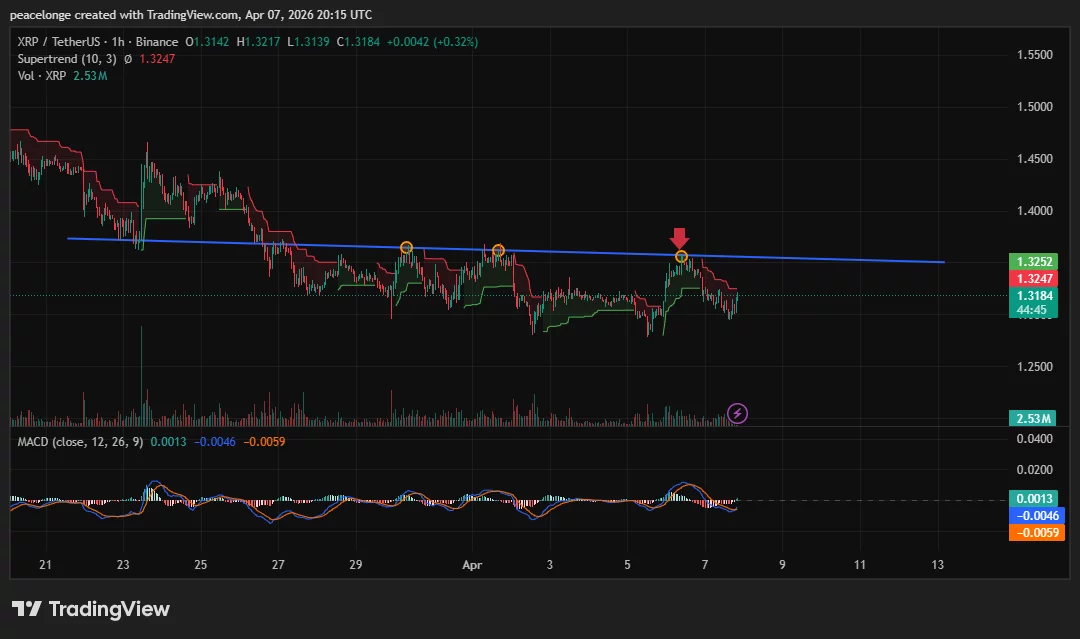
XRP price has now rejected the descending trendline resistance at least three times since late March, and the most recent failure on April 6 to 7 arrived on rising volume, a signal analysts associate with bearish continuation rather than consolidation.
Summary
- XRP price is at $1.3184 on April 7 after being rejected at the descending trendline near $1.35 for the third time since late March, with the 1H Supertrend at $1.3247 acting as immediate resistance above current price.
- The 1H MACD line sits at -0.0046 with the signal at -0.0059 and a barely positive histogram of 0.0013, with both lines in negative territory confirming the absence of bullish momentum despite the marginal uptick.
- A break below the $1.30 to $1.28 support zone exposes the 23.6% Fibonacci retracement at $1.28, below which holder support thins toward $1.15, while a confirmed daily close above $1.35 is required to shift the near-term bias.
XRP (XRP) price is trading at $1.3184 on April 7, down 1.9% from the session’s high after failing to close above the descending trendline resistance near $1.35 on April 6. The rejection is visible on the 1H chart as a red arrow marking where price touched the diagonal trendline and reversed, the third such failure since late March with prior rejections marked at lower trendline contacts. The 1H Supertrend at $1.3247 is now sitting just above current price, providing an additional near-term ceiling that compounds the trendline rejection signal.
On the 1H chart, XRP is trading within a structure defined by a descending trendline that has produced at least three confirmed rejections since March 21, visible as orange circles at prior high points where price touched and reversed from the diagonal resistance. The red arrow marks the most recent rejection, the most significant because it followed a recovery from the $1.27 zone that briefly raised expectations of a breakout attempt.
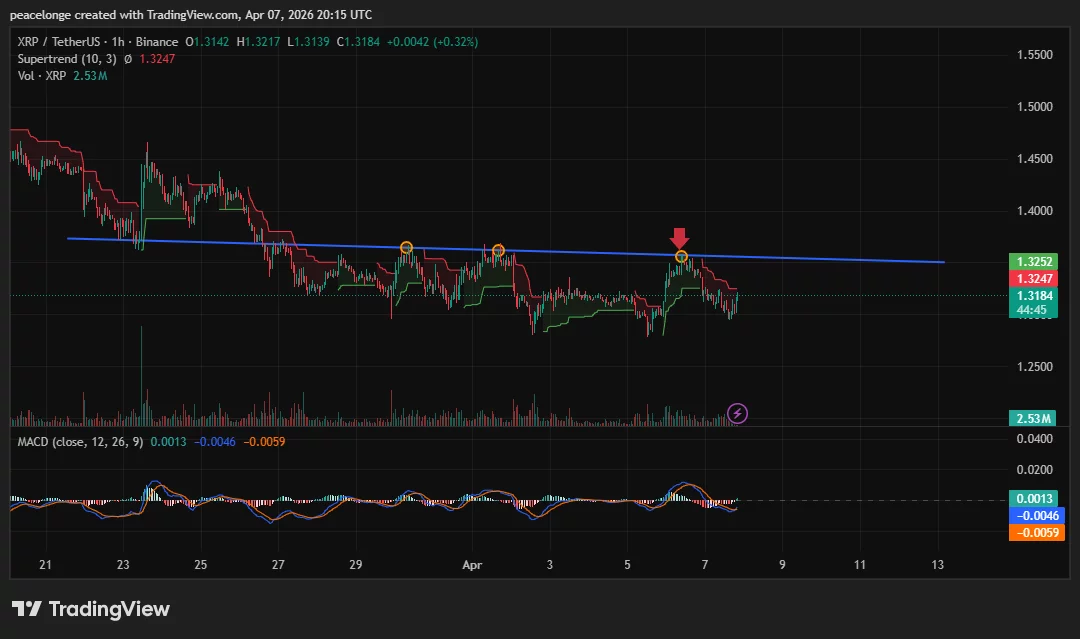
The 1H MACD line sits at -0.0046, with the signal at -0.0059 and a histogram reading of 0.0013. Although the MACD line is fractionally above the signal, both lines remain in negative territory and the histogram reading of 0.0013 is too small to constitute a meaningful bullish cross. Per market data published April 7, the daily RSI stands at 38, described as “weak momentum, but not yet in oversold territory,” meaning there is no technical floor from that indicator alone. The same analysis noted that open interest is rising alongside falling price, a sign traders are adding short positions rather than accumulating, which tends to amplify downside moves if support gives way.
Key Levels: $1.28 Fibonacci and $1.15 Bear Target
The $1.30 to $1.31 zone is the immediate structural support. A closing break below it exposes $1.28, which has held since February and aligns with the 23.6% Fibonacci retracement of XRP’s prior rally. Below $1.28, holder support thins materially toward $1.15 as the next significant structural level. On the upside, a confirmed daily close above the descending trendline at $1.35 is the minimum requirement to shift the near-term bias, and would also need to clear the 50-day EMA at $1.38 to open a path toward $1.40 to $1.45. The CLARITY Act, with a late April Senate markup targeted, is a binary catalyst that could shift the structural picture if passed, but a failure extends the current setup lower.
Derivatives and ETF Flow Context
Spot XRP ETFs recorded $3.56 million in net outflows in the week ending April 6, per CoinMarketCap data, reflecting reduced demand at a point where fresh capital is needed to challenge trendline resistance. The combination of ETF outflows, rising futures open interest consistent with short positioning, and thinning order book depth on Binance leaves XRP exposed to larger moves once either level breaks.
If $1.30 holds on a daily close, the range between $1.28 and $1.35 remains the decision zone. A close below $1.28 targets $1.15 as the next significant support.


The latest crypto news US CLARITY Act Senate 2026 bitcoin regulation battle has reached a pivotal moment: the bill that would define US crypto law for a generation is deadlocked between four factions in the Senate Banking Committee, and Senator Bernie Moreno has warned plainly that missing the May window risks pushing comprehensive crypto legislation off the calendar until after the 2026 midterms — and potentially beyond.
Summary
- The CLARITY Act faces a four-way standoff among crypto firms, banks, the SEC, and structural critics over whether stablecoin platforms can pay yield to users; Senators Tillis and Alsobrooks reached a compromise in principle on March 20 banning passive yield but permitting activity-based rewards, though key industry players including Coinbase and Stripe have still not fully accepted the text
- The Senate Banking Committee markup is targeted for the second half of April after Easter recess ends April 13; the bill then faces five sequential hurdles before reaching the president’s desk, leaving almost no margin for further delay
- Polymarket places 2026 signing odds at 63 to 66%; Ripple CEO Brad Garlinghouse has said 80 to 90%, though he recently pushed his expected passage timeline from April to May; JPMorgan analysts called passage by midyear a “positive catalyst for digital assets”
The latest crypto news US CLARITY Act Senate 2026 bitcoin regulation standoff is less about what the bill says and increasingly about whether the political calendar will allow it to move at all. As crypto.news reported, the core stablecoin yield dispute — the fight that paralyzed the January markup and dominated the past three months — has a framework in place: the Tillis-Alsobrooks compromise from March 20 bans passive yield on stablecoin balances while permitting activity-based rewards tied to payments and platform use. Senators Lummis and Alsobrooks have described the deal as 99% resolved.
The obstacle now is not the bill’s content. It is the five-step process that remains: a Senate Banking Committee markup, a full Senate floor vote requiring 60 votes, reconciliation with the Agriculture Committee version, reconciliation with the House-passed version from July 2025, and a presidential signature. Senator Bernie Moreno stated explicitly: “If the bill does not reach the full Senate floor by May, digital asset legislation may not receive serious consideration again for years.”
The four factions each have veto power over different parts of the bill. Crypto firms, led publicly by Coinbase, want the flexibility to offer yield-bearing stablecoins and clear DeFi protections. Banks, led by the American Bankers Association, are opposed to any stablecoin economics that could pull deposits away from the insured banking system — Standard Chartered estimated an open-ended yield provision could redirect up to $500 billion in deposits. Democratic senators are pushing for ethics language barring government officials and their families from personally profiting from crypto — language directed explicitly at Trump family holdings. And structural critics within both parties want stronger anti-fraud and DeFi oversight provisions the current draft does not contain.
What Passes or Fails Means for Bitcoin
As crypto.news noted, the CLARITY Act’s outcome is a critical variable for the entire institutional crypto pipeline. If it passes, the SEC/CFTC jurisdictional line becomes federal law rather than a reversible guidance document — giving large asset managers a permanent legal rationale for Bitcoin commodity custody and product approval. If it stalls past May, regulatory guidance from the current administration could be reversed after the midterms, putting institutional capital currently on the sidelines back into waiting mode.
Peter Van Valkenburgh, executive director of Coin Center, framed the bill’s purpose precisely: the aim of passing the CLARITY Act is not to trust the current administration, but to “bind the next one.”
The Senate returns from Easter recess on April 13. The Banking Committee markup window is the second half of April. That window is the entire ballgame.
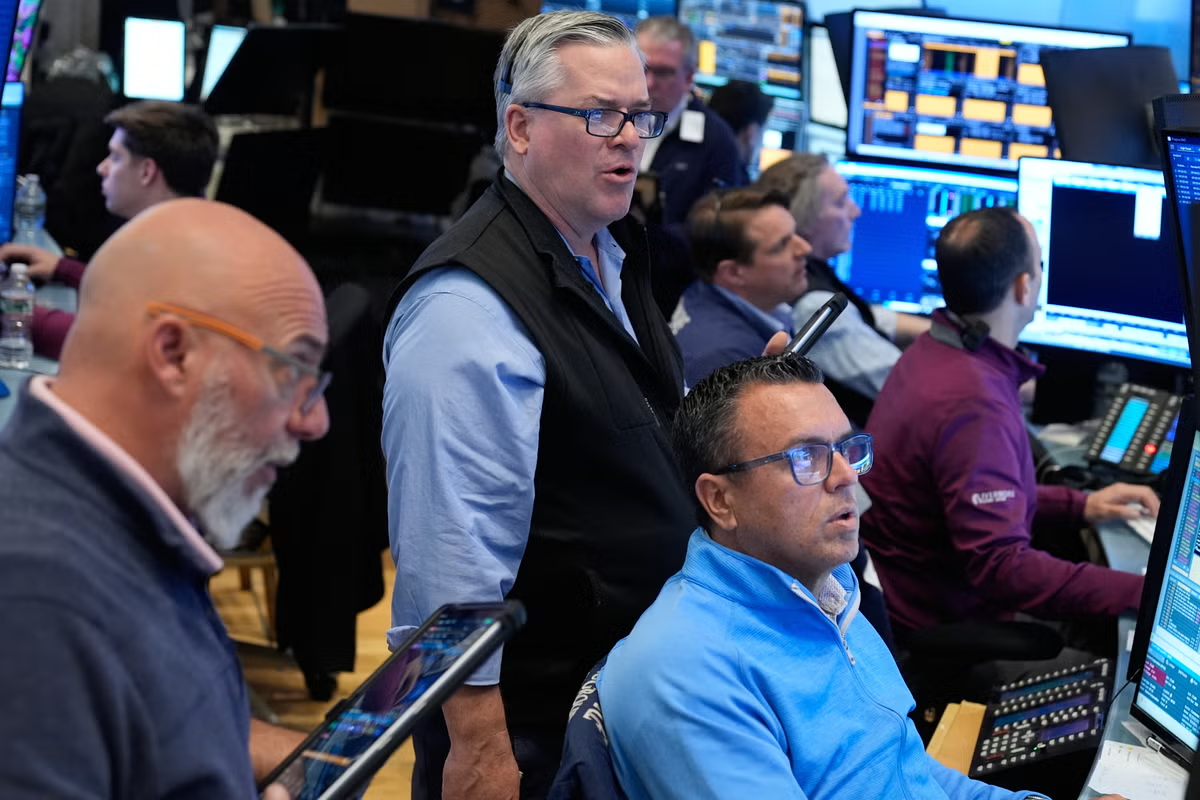
Oil prices plummet and stocks surge after Trump suspends attacks on Iran
RBC Capital lowers Pharvaris stock price target on model adjustments

Only 11% of banks have cracked the code on trustworthy AI


-

 NewsBeat5 days ago
Steven Gerrard disagrees with Gary Neville over ‘shock’ Chelsea and Arsenal claim | Football
-

 Business5 days ago
No Jackpot Winner and $194 Million Prize Rolls Over
-

 Fashion4 days ago
Weekend Open Thread: Spanx – Corporette.com
-

 Crypto World6 days ago
Gold Price Prediction: Worst Month in 17 Years fo Save Haven Rock
-

 Business2 days ago
Three Gulf funds agree to back Paramount’s $81 billion takeover of Warner, WSJ reports
-

 Business4 days ago
Expert Picks for Every Need
-

 Sports3 days ago
India men’s 4x400m and mixed 4x100m relay teams register big progress | Other Sports News
-

 Business6 days ago
Login and Checkout Issues Spark Merchant Frustration
-

 Tech4 hours ago
How Long Can You Drive With Expired Registration? What Florida Law Says
-
Business3 days ago
No Jackpot Winner, Prize to Climb to $231 Million
-

 Tech5 days ago
Commonwealth Fusion Systems leans on magnets for near-term revenue
-

 Tech6 days ago
Drawing Tablet Controls Laser In Real-Time
-

 Crypto World6 days ago
Ripple rolls out enterprise crypto treasury platform for corporates
-

 Fashion2 days ago
Massimo Dutti Offers Inspiration for Your Summer Mood Board
-

 Crypto World6 days ago
Why It’s Partnering, Not Issuing
-

 Business3 days ago
Akebia Therapeutics, Inc. (AKBA) Discusses Pipeline Progress and Strategic Focus on Kidney Disease Treatments at R&D Day – Slideshow
-

 Fashion7 days ago
Debenhams Occasion Dresses for Girls 2026 Collection
-
 Sports6 days ago
Steal Gary Woodland’s subtle power move for longer drives
-
 Tech6 days ago
Battery Tester Outperforms Cheaper Options
-
Politics5 days ago
Wings Over Scotland | The quality of mercy
You must be logged in to post a comment Login