
CryptoCurrency
Key Market Trends, Inner Working, Benefits, and Use Cases

Building high-accuracy cryptocurrency payment gateway solutions that integrate biometric modules is no longer an experimental idea. It is a practical requirement for enterprises that want secure, fast, and user-friendly Web3 commerce. In a market where payment experience determines conversion and security determines trust, combining biometric authentication with blockchain-native settlement removes both friction and ambiguity. Biometric verification replaces weak passwords and multi-page authorizations with human-centric approval tied to cryptographic keys. That mix delivers smoother checkout, stronger non-repudiation, and clarity in settlement. This blog walks through the end-to-end transaction flow, maps current market drivers, explains biometric modules in simple technical terms, and breaks down key advantages, highlights features, and practical use cases that are important to enterprise teams and payment architects.
Market Trends Around Crypto Payment Gateway Development
Enterprise interest in accepting crypto payments has matured from curiosity into production planning. Stablecoins and tokenized cash rails are driving merchant pilots and merchant-focused settlement products. Several large payment and fintech firms announced stablecoin settlement and bank-issued digital currencies as alternatives to slow banking rails. At the same time, biometric payments are moving from novelty to scale, driven by device-level secure enclaves, FIDO2 passkeys, and improved liveness detection. The combined trend is clear: merchants seek payment flows that reduce chargebacks, speed settlement, and deliver a checkout experience comparable to card swiping. These forces create a runway for biometric-enabled crypto gateways that support stablecoin and multi-chain settlement while offering enterprise-grade reporting and reconciliation.
What are Biometric Modules?
Biometric modules are integrated hardware and software stacks that capture, preprocess, verify, and protect biometric traits. Typical modalities include fingerprint, facial recognition, iris, palm vein, and voice. A module performs three fundamental tasks. It captures raw input and extracts a compact template. It performs liveness checks and anti-spoofing analysis to ensure the sample is from a living person. It stores and matches templates in a secure environment, such as a secure enclave or hardware security module. Modern modules expose SDKs and standardized APIs so applications can request authentication without ever receiving raw biometric data. For payments, biometric modules are paired with cryptographic key stores so that a successful biometric match can unlock a private key or authorize a signing operation instead of revealing the key itself. This structure preserves privacy while enabling cryptographic proof of consent.
How Does a Crypto Payment Gateway With Biometric Modules Work?
A biometric-enabled crypto payment gateway platform combines device-level verification with a modular settlement and custody layer. Here is the typical sequence. First, the customer enrolls their biometric on-device. The biometric module captures the trait, performs preprocessing, runs a liveness check, and stores a hashed template inside a secure enclave. At checkout, the gateway requests biometric authorization via an SDK call. The module again validates liveness and matches the template. On successful matching, the module either unlocks a device-held signing key or triggers a signing operation using a key stored in a secure hardware module. The gateway receives a signed payment authorization payload, which it converts into an on-chain transaction for noncustodial flows or forwards as an instruction to a custody layer for custodial flows. The gateway tracks on-chain confirmations, performs merchant reconciliation, and optionally routes conversion to stablecoins or fiat rails through liquidity partners.
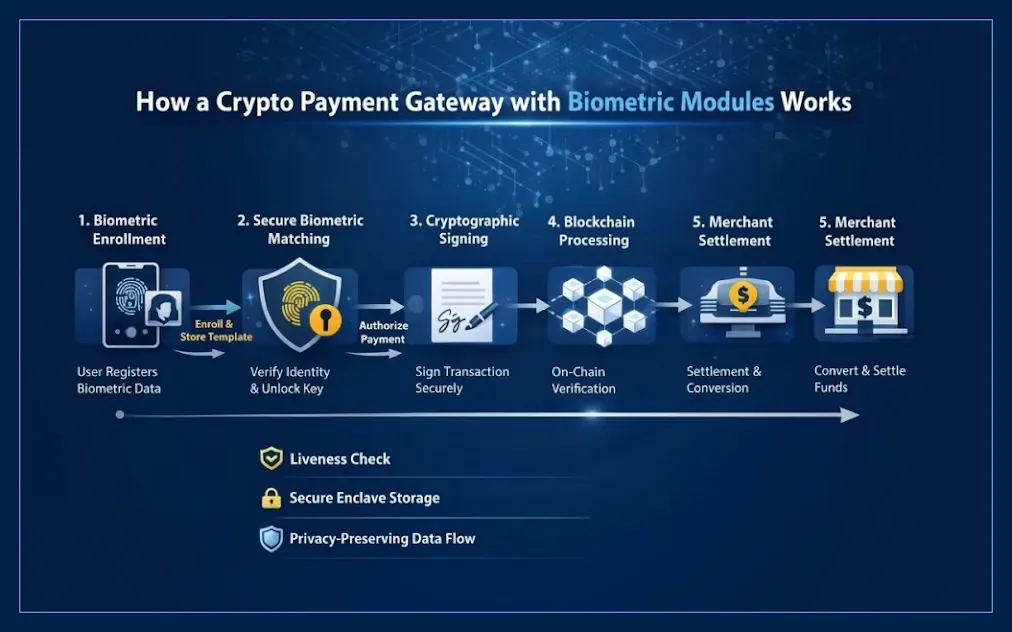
Throughout this flow, the raw biometric never leaves the secure enclave. Only cryptographic assertions and signatures are transmitted, enabling privacy-preserving non-repudiation and enterprise auditability. This architecture maps cleanly to mobile, web, POS, and kiosk environments and scales across blockchains by abstracting chain-specific signing logic into a pluggable cryptographic adapter.
Benefits of Crypto Payment Gateway Development With Biometric Modules
1. Improved fraud resilience – Biometric verification reduces attacks that rely on stolen credentials and social engineering.
2. Higher conversion rates – One-touch biometric approval reduces friction and lowers cart abandonment.
3. Clear proof of customer intent – Signed biometric-backed authorizations strengthen dispute resolution and reduce chargeback risk.
4. Lower operational cost – Faster resolution of disputes and fewer manual interventions reduce support overhead.
5 Privacy-first design – When templates are stored on-device, user privacy and regulatory compliance are easier to maintain.
6. Stronger merchant trust – Enterprises gain predictable settlement and auditable signing logs for internal and external compliance.
7. Broader acceptance – Biometric-enabled flows make crypto payments viable for in-person retail, travel, and high-value commerce where card-present security is expected.
They explain the commercial and operational value that enterprises will realize when biometric modules are thoughtfully integrated with payments and settlement rails. If you also wish to acquire the time and speed advantage while development, it is recommended that you opt for white label cryptocurrency payment gateway creation. It helps you in numerous ways >>>>>>>>>>>>>
Here, you can also surf about the best crypto payment gateway companies that are leading the current market. >>>>>>>>>>>>
Features of a Crypto Payment Gateway Solution With Biometric Module
Once you plan to build the best crypto payment gateway solution for your business, you must also know what features must be included in the platform:
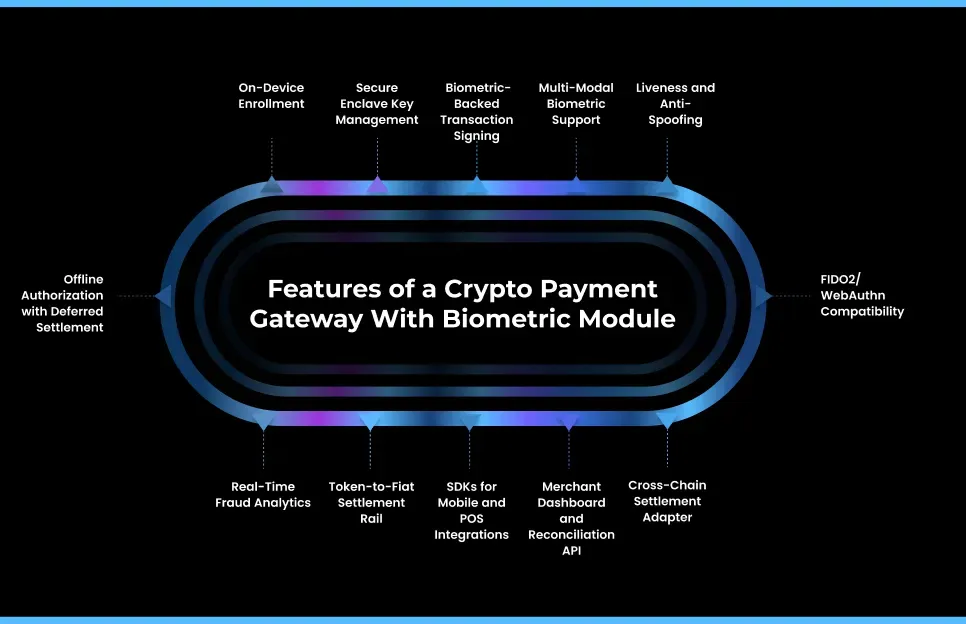
- On-device enrollment – Capture the user’s biometric, create an irreversible template, and store it locally in the device’s secure enclave during a verified enrollment flow.
- Secure enclave key management – Store and manage signing keys in hardware-backed enclaves or HSMs with policies for rotation and emergency revocation.
- Biometric-backed transaction signing – A successful biometric match unlocks or authorizes a cryptographic signing operation so the user can approve payments without exposing private keys.
- Multi-modal biometric support – Support fingerprint, face, iris, voice, or palm modalities to improve accessibility and reduce rejection rates across devices.
- Liveness and anti-spoofing layer – Real-time checks and challenge-response methods detect presentation attacks and block synthetic or replayed biometric inputs.
- FIDO2 and passkey compatibility – Use industry standards to enable interoperable, phishing-resistant authentication that leverages device biometrics as passkeys.
Launch a Biometric-Ready Crypto Payment Gateway Today!
- Cross-chain settlement adapter – Abstract chain-specific signing and submission logic so the gateway can route, batch, and confirm transactions across multiple blockchains.
- Merchant dashboard and reconciliation APIs – Provide merchant-facing reporting, exportable ledgers, refund tools, and APIs for automated reconciliation and finance systems integration.
- Mobile and POS SDKs – Native SDKs for mobile apps and point-of-sale terminals with attestation, error handling, and sample UI flows for seamless integration.
- Token-to-fiat conversion rail – Integrated liquidity and on/off ramps that convert token receipts to stablecoins or fiat and settle to merchant bank accounts.
- Real-time fraud analytics and alerts – Behavioral models, risk scoring, and rule engines surface anomalies and trigger automated alerts, holds, or challenge flows.
- Offline authorization with deferred settlement – Allow devices to generate signed approvals while offline and submit them later for on-chain or custodial settlement with expiry and nonce protections.
Use Cases of a Crypto Payment Gateway With Biometric Modules
- Retail point-of-sale : quick fingerprint or face-based authorization at checkout terminals.
- E-commerce one-touch checkout : logged-in users approve payment with a biometric prompt.
- Cross-border micropayments : reduce onboarding friction for small-value remittances.
- Crypto payroll: employees authenticate token disbursements with biometrics for secure payouts.
- Crypto ATMs and kiosks : biometric authorization reduces identity fraud at cash-out points.
- Gaming and metaverse marketplaces : frictionless purchases for in-game items and experiences.
- Hospitality and travel : contactless guest checkout for incidentals and extras.
- High-ticket B2B trade : additional biometric-backed confirmation for large settlements.
Why Does This Matter for Enterprise Adoption?
Enterprises need predictable settlement, lower fraud losses, a simple merchant experience, and clear compliance. Biometric-enabled crypto gateways combine the clarity of on-chain settlement with the usability of biometric authentication. The result is an enterprise-ready payments stack that reduces dispute costs and enables acceptance of tokenized rails at scale. Recent industry moves toward bank-issued and merchant-friendly stablecoins reinforce that the plumbing for large-scale adoption is being put in place. Any serious investor who is willing or planning to launch an impeccable and impactful solution must tie up with a renowned and global-level cryptocurrency payment gateway development company that designs and delivers apt solutions as per business needs.
Conclusion
Biometric-enabled crypto payment gateway solutions are a practical way to make Web3 payments usable, auditable, and enterprise-friendly. If you want a partner who understands key management, cross-chain settlement, POS integrations, and enterprise compliance, Antier is ready. Our team includes blockchain architects, AI and security engineers, cryptocurrency wallet specialists, and payments product experts. We build end-to-end solutions from biometric-enabled SDKs and device-integrated POS terminals to merchant dashboards and fiat settlement rails. We focus on accuracy, privacy, and scale so enterprises can accept crypto confidently and convert it into real revenue.
Frequently Asked Questions
01. What are the benefits of integrating biometric modules into cryptocurrency payment gateways?
Integrating biometric modules enhances security by replacing weak passwords with human-centric approval, streamlines the checkout process, and improves non-repudiation and clarity in settlement.
02. How are market trends influencing the development of crypto payment gateways?
Market trends show a growing enterprise interest in crypto payments, driven by the adoption of stablecoins and biometric payments, which aim to reduce chargebacks, speed up settlements, and enhance the overall checkout experience.
03. What functions do biometric modules perform in payment systems?
Biometric modules capture and preprocess biometric traits, conduct liveness checks to prevent spoofing, and securely store and match biometric templates, ensuring secure and reliable authentication.



