
CryptoCurrency
Opportunists Pushing BTC Changes Are Bitcoin’s Biggest Threat

Introduction
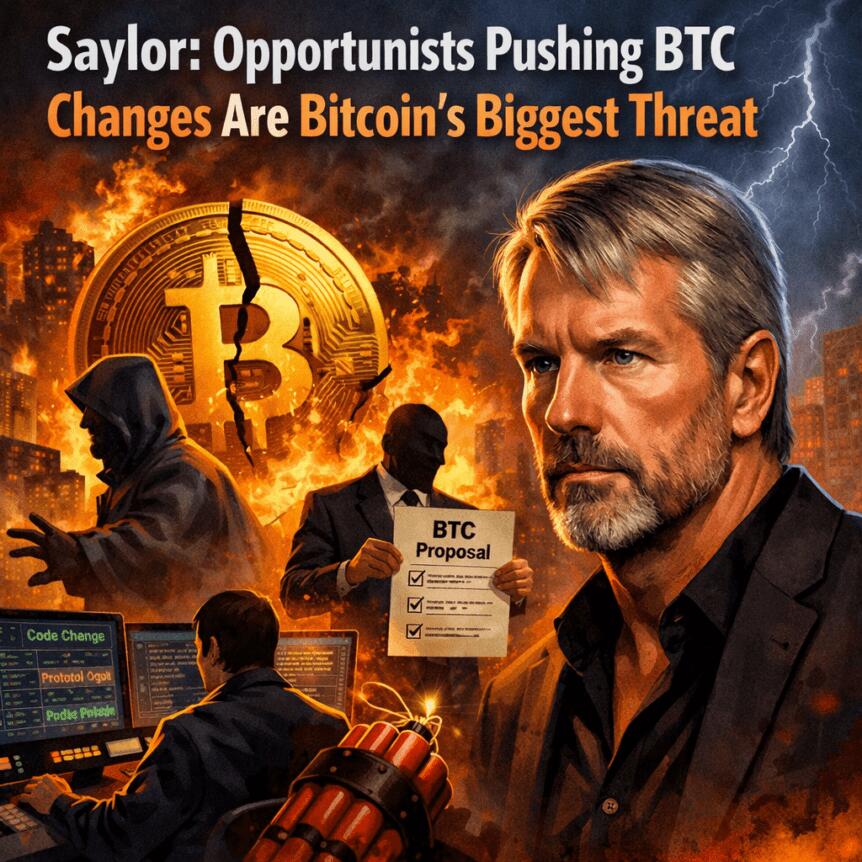
Bitcoin (CRYPTO: BTC) has long been defended as a rules-based monetary system, insulated from the whim of developers. In a recent online post, Michael Saylor, co-founder of Strategy, a Bitcoin treasury firm, argued that the network’s greatest risk lies not in external threats but in “ambitious opportunists” pressing for protocol changes. The exchange spurred a broader debate about how far the core protocol should evolve, pitting proponents of a rock-solid, ossified ledger against developers who want to expand Bitcoin’s features without compromising its security guarantees. The discussion comes amid ongoing conversations about non-monetary data on the chain—ranging from NFTs to on-chain images—that some see as potential use cases and others view as a distraction from Bitcoin’s primary purpose. The dialogue underscores a fundamental tension within the ecosystem: should Bitcoin remain narrowly focused, or should it evolve to address new realities without sacrificing its core properties?
Key Takeaways
- The debate centers on whether Bitcoin should ossify to preserve sound money or gradually incorporate features that enable non-monetary data and on-chain storage.
- Several prominent figures have weighed in, including Saylor, Bechler, and Mert Mumtaz, highlighting a spectrum of views on how to balance security with innovation.
- Quantum risk remains a point of contention, with some warning of future threats and others arguing that the network’s price and security dynamics are not yet driven by such concerns.
- Bitcoin Improvement Proposal 110 (BIP-110) is referenced as a temporary mechanism to filter non-monetary data, illustrating the ongoing spam wars and data management challenges on the network.
- The discourse reflects broader questions about governance, developer incentives, and the pace at which the protocol should adapt to emerging technologies.
Tickers mentioned: Bitcoin (CRYPTO: BTC)
Sentiment: Neutral
Price impact: Neutral. The conversation signals theoretical risk discussions rather than immediate market moves.
Trading idea (Not Financial Advice): Hold. The debate centers on governance and security trade-offs rather than near-term catalysts.
Market context: The exchange-trade between hardening the protocol and enabling new capabilities sits within ongoing debates about crypto governance, scalability, and risk management as macro and regulatory developments shape risk appetite for digital assets.
Why it matters
The core of the discussion is governance—how Bitcoin should evolve without compromising its foundational properties. Michael Saylor’s framing positions the risk as a governance and philosophy issue: are “ambitious opportunists” pushing for changes that could alter Bitcoin’s monetary characteristics, or can the network absorb selective upgrades that expand functionality while preserving decentralization and censorship resistance? This line of thought has long circulated among Bitcoiners who fear that rapid feature creep could open doors to unintended consequences, including new attack vectors or shifts in the network’s incentive structure.
On the other side, developers and proponents for extended capabilities argue that carefully designed enhancements can make Bitcoin more resilient and useful in a broader ecosystem. The debate touches on topics such as quantum-resistant wallet addresses and on-chain file storage, which some see as practical extensions of Bitcoin’s resilience and uptime. The discussion is not merely theoretical; it has real-world implications for how miners, node operators, and developers allocate time and resources. The tension was underscored by references to Bitcoin Improvement Proposal 110 (BIP-110), a tool discussed as a means to filter out non-monetary data and reduce spam in the legacy ledger. While BIP-110 represents a targeted compromise, it also highlights the broader concern about data management and the potential impact of non-monetary data on block space and security assumptions.
The quantum angle adds another layer of complexity. Some observers believe the emergence of quantum computing could threaten cryptographic foundations, while others insist that the community is already conducting defensive research and that notable price moves are not driven by these fears. The mixed opinions reflect a crypto ecosystem that values both robust cryptography and practical, incremental improvements. The discourse also shows the influence of prominent voices in the space, from investors to developers, each offering different prioritizations for Bitcoin’s trajectory. The debate is ongoing, with no consensus in sight about the optimal balance between a hardened base protocol and strategic feature additions.
Related: Michael Saylor pushes back on criticism of Bitcoin treasury companies
The Bitcoin community continues to debate the quantum threat
Quantum computing remains a provocative topic within the Bitcoin community. Nic Carter, a partner at Castle Island Ventures, has repeatedly warned that Bitcoin must move toward post-quantum standards sooner rather than later. His position underscores a broader concern: future cryptanalytic capabilities could undermine the security of current key types if not addressed proactively. Yet not all voices share this level of urgency. Adam Back, the CEO of Blockstream, has publicly disputed Carter’s assertions, describing them as uninformed while noting that researchers are quietly advancing protective measures. He emphasizes that the community is not denying the risk but is prioritizing a careful, evidence-driven approach to defense rather than alarmist rhetoric.
Market observers have noted that such debates rarely translate into immediate price movements. Bitcoin analyst James Check suggested that concerns about quantum threats have not materially influenced BTC’s market price, pointing instead to long-term holders’ behavior as a more decisive factor in recent price dynamics. The broader takeaway is that the Bitcoin network remains in a phase of introspection about its future development path, with some advocates pushing for more aggressive upgrades and others urging deeper conservatism to preserve the protocol’s core monetary properties.
The path forward for Bitcoin governance
At this juncture, the community appears to be navigating a fault line that runs through Bitcoin’s governance framework. On one side are voices urging a form of protocol ossification—maintaining a certifiably scarce, predictable rule set that prioritizes security and monetary integrity. On the other side are developers and researchers who argue for prudent, well-vetted evolutions that can harden the network against future threats and broaden its functional envelope—without compromising decentralization or trustless security. The conversation is not about rejecting enhancements outright; it is about attaining a shared understanding of risk, trade-offs, and the conditions under which upgrades should be pursued.
As this debate unfolds, observers emphasize the importance of transparent research, documented proposals, and clear governance signals. The Bitcoin network operates through a distributed consensus model, and any meaningful change requires broad participation across developers, node operators, and miners. The outcome of these discussions will influence everything from on-chain data practices to potential upgrades that address security and scalability. In the meantime, the ongoing dialogue serves as a barometer for how the community weighs new technologies against a proven, austere monetary system that has operated for over a decade without a centralized authority.
What to watch next
- Progress on BIP-110 and any subsequent data-management proposals within the Bitcoin community.
- Public statements from Saylor, other Bitcoin proponents, and key developers regarding the balance between protocol rigidity and feature expansion.
- Advances in research related to post-quantum cryptography and any practical implementations considered for Bitcoin’s stack.
- On-chain data discussions around spam, non-monetary data, and the potential impact on block space and fees.
- Regulatory and market responses to the broader debate on Bitcoin governance and future upgrades.
Sources & verification
- Michael Saylor’s X post invoking concerns about “ambitious opportunists” and protocol changes.
- Statements from Mert Mumtaz on the Bitcoin evolution debate.
- Adam Back’s response to the quantum threat debate and his comments on ongoing defensive research.
- References to Bitcoin Improvement Proposal 110 (BIP-110) and discussions about spam filtering.
- Coverage of quantum-related concerns and the macro context surrounding Bitcoin’s governance discussions, including related Cointelegraph reporting and on-chain discourse.
Key figures and next steps
The conversation is likely to continue as stakeholders weigh the potential benefits of upgrades against the axioms of Bitcoin’s monetary policy. As the community pushes for clarity on governance processes and the timing of any changes, users should monitor official discussions, developer notes, and consensus signals from major participants. The coming months may reveal a more defined stance on whether Bitcoin should embrace broader data usage, how to address the looming quantum threat, and what kinds of upgrades, if any, will be deemed acceptable without eroding trust in the network’s monetary characteristics.
What it means for users and developers
For users and builders, the debate highlights the practical implications of protocol choices. Security remains a primary concern, but the possibility of enhanced features—if implemented with rigorous testing and broad consensus—could expand the ecosystem’s capabilities without sacrificing the properties that have driven Bitcoin’s growth. The path forward will require ongoing dialogue, transparent governance, and a commitment to keeping Bitcoin resilient against both present and future threats.



