
Crypto World
Prediction Markets Are Becoming Smarter Financial Infrastructure

Prediction markets were once dismissed as niche betting platforms—interesting experiments, but peripheral to serious finance. That perception is rapidly changing. As crypto-native markets mature, prediction markets are evolving into powerful financial infrastructure for information discovery, capital allocation, and decision-making.
By aggregating incentives, capital, and belief into transparent price signals, prediction markets are becoming one of the most efficient tools for forecasting complex outcomes. This article explores how prediction markets are moving beyond betting, why liquidity depth increasingly signals truth, and why institutions are beginning to pay close attention.
Prediction Markets Beyond Betting
At their core, prediction markets allow participants to trade on the likelihood of future events. Prices emerge from collective belief, weighted by capital at risk. While early use cases focused on elections or sports, modern prediction markets have expanded far beyond simple wagers.
Today, prediction markets are increasingly applied to:
-
Economic indicators and macro outcomes
-
Protocol upgrades and network risks
-
Governance proposals and DAO decisions
-
Market events, defaults, and systemic stress
In these contexts, prediction markets function less like casinos and more like decentralized forecasting engines. Participants are incentivized to surface information early, challenge consensus views, and express conviction through capital—producing signals that often outperform polls, surveys, or expert opinion.
Capital Allocation, Governance, and Forecasting
One of the most powerful features of prediction markets is their ability to influence where capital flows.
Capital Allocation
Markets that price future outcomes allow investors, protocols, and organizations to allocate capital more efficiently. If a prediction market signals elevated risk or low probability of success, capital can be redirected before losses materialize.
Governance
In decentralized systems, governance often suffers from low participation and poor information quality. Prediction markets offer an alternative: instead of voting on preferences, participants trade on expected outcomes. This aligns incentives toward accuracy rather than ideology.
Forecasting Under Uncertainty
Traditional forecasting relies on static models and lagging data. Prediction markets, by contrast, update continuously as new information enters the system. This makes them particularly well-suited for fast-moving, complex environments such as crypto markets and digital economies.
Liquidity Depth as a Signal of Truth
Not all prediction markets are equally informative. The depth and quality of liquidity play a central role in determining signal reliability.
Deep, competitive liquidity:
-
Reduces the influence of noise and manipulation
-
Rewards informed participants
-
Produces tighter, more accurate pricing
In this sense, liquidity acts as a filter. Markets with meaningful capital at risk tend to converge on more accurate probabilities over time. Thin markets, by contrast, are easily distorted.
For smart liquidity, this distinction is critical. Where capital concentrates, information quality improves. As a result, well-capitalized prediction markets increasingly function as real-time truth-discovery mechanisms rather than speculative games.
Why Institutions Are Starting to Pay Attention
Institutions are drawn to tools that improve decision-making under uncertainty. Prediction markets offer several attributes that align with institutional needs:
-
Transparent, market-based probability signals
-
Continuous updating as new data emerges
-
Incentive-aligned forecasting rather than opinion polling
-
Potential integration with risk management and strategy
Use cases are expanding across:
-
Macro research and scenario planning
-
Policy and regulatory impact analysis
-
Corporate strategy and product decisions
-
Risk assessment in volatile or opaque markets
As regulatory clarity improves and infrastructure matures, prediction markets are increasingly viewed not as novelty products, but as decision-support systems embedded within broader financial and organizational frameworks.
Table: Prediction Markets as Financial Infrastructure
| Dimension | Key Insight |
|---|---|
| Primary Function | Aggregation of information through market incentives |
| Beyond Betting | Used for governance, risk analysis, and forecasting |
| Capital Role | Aligns belief with financial commitment |
| Liquidity Signal | Depth improves accuracy and truth discovery |
| Institutional Value | Enhances decision-making under uncertainty |
| Long-Term Potential | Core infrastructure for data-driven markets |
Future Outlook
As digital economies grow more complex, the demand for accurate, real-time forecasting will intensify. Prediction markets are well positioned to meet this demand—particularly in environments where traditional data sources are incomplete, biased, or slow.
The next generation of prediction markets will likely feature:
-
Deeper institutional liquidity
-
Integration with governance and treasury systems
-
Broader coverage of economic and technological outcomes
-
Improved market design to resist manipulation
In this evolution, prediction markets are not replacing analysts or models—they are augmenting them with incentive-aligned truth discovery.
Conclusion
Prediction markets are undergoing a quiet transformation. What began as speculative betting is evolving into smart financial infrastructure—capable of guiding capital, improving governance, and forecasting outcomes in uncertain environments.
As liquidity deepens and use cases expand, prediction markets may become one of the most powerful tools for navigating complexity in crypto and beyond. For institutions and smart liquidity alike, ignoring them is becoming increasingly difficult.

The US Securities and Exchange Commission has cleared up longstanding ambiguity about how crypto assets should be treated.
The SEC issued an interpretation on Tuesday clarifying how federal securities laws apply to certain crypto assets and transactions involving cryptocurrencies.
This is a “major step in the Commission’s efforts to provide greater clarity regarding the treatment of crypto assets,” it stated. The guidance also “complements Congressional endeavors to codify a comprehensive market structure framework into statute.”
The Commodity Futures Trading Commission (CFTC) also joined the interpretation, confirming that it will apply the Commodity Exchange Act to crypto assets.
SEC: Cryptos Are Not Securities
The interpretation establishes a token taxonomy covering five categories: digital commodities, digital collectibles, digital tools, stablecoins, and digital securities.
The key takeaway is that most crypto assets are not classified as securities, which is the opposite of the previous Administration’s stance on them. SEC Chairman Paul Atkins stated:
“It also acknowledges what the former administration refused to recognize – that most crypto assets are not themselves securities.”
“After more than a decade of uncertainty, this interpretation will provide market participants with a clear understanding of how the Commission treats crypto assets under federal securities laws,” he added.
After more than a decade of uncertainty, this interpretation will provide market participants with a clear understanding of how the SEC treats crypto assets under federal securities laws.
This is what regulatory agencies are supposed to do: draw clear lines in clear terms. https://t.co/wij5cA7N2i
— Paul Atkins (@SECPaulSAtkins) March 17, 2026
You may also like:
“For far too long, American builders, innovators, and entrepreneurs have awaited clear guidance on the status of crypto assets under the federal securities and commodity laws,” said CFTC Chairman Michael Selig.
“With today’s interpretation, the wait is over. Chairman Atkins and I are committed to fostering a regulatory environment that allows the crypto industry to flourish in the United States with clear and rational rules of the road.”
It also provides guidance on common crypto activities that have long existed in a legal gray zone, including airdrops, mining, staking, and asset wrapping.
Both Atkins and Selig framed this as a “bridge for entrepreneurs and investors” while Congress works on broader bipartisan market structure legislation.
“This is the biggest move toward legitimacy I’ve seen in all my time in crypto. Maybe bigger than the genius act since it covers all crypto assets,” commented crypto investor Ryan Sean Adams.
No Crypto Market Reaction
It seems that positive regulatory developments fail to move markets these days, as spot markets actually retreated by 1% over the past 24 hours.
Bitcoin tapped $74,800 three times over the past 12 hours or so but failed to break through, falling back to $74,350 at the time of writing.
Ether prices were tightly rangebound over the past 24 hours, trading at $2,333 on Wednesday morning in Asia.
The altcoins were a mixed bag, with gains for Tron and Hyperliquid, and losses for XRP, Stellar, and Canton.
Binance Free $600 (CryptoPotato Exclusive): Use this link to register a new account and receive $600 exclusive welcome offer on Binance (full details).
LIMITED OFFER for CryptoPotato readers at Bybit: Use this link to register and open a $500 FREE position on any coin!


US Securities and Exchange Commission Chair Paul Atkins has proposed a “safe harbor” framework aimed at easing regulatory pressure on crypto firms while keeping them within the federal oversight structure.
Summary
- SEC Chair Paul Atkins proposes safe harbor exemptions to allow crypto firms to raise capital under defined regulatory pathways.
- Framework includes startup and fundraising exemptions, along with conditions for when tokens may fall outside securities laws.
Speaking at the DC Blockchain Summit in Washington, Atkins said, “such a safe harbor would provide crypto innovators bespoke pathways to raise capital in the US, while providing appropriate investor protections.”
Calls for similar safe harbor measures have previously been put forward by SEC commissioner Hester Peirce, who has long advocated for a tailored approach that gives crypto projects time to develop before being subject to full securities regulation.
Atkins proposed a “fit-for-purpose startup exemption” targeting early-stage projects, which would allow developers to raise limited capital without full securities registration before they are subject to standard compliance requirements.
He said the provision would give projects a “regulatory runway” to develop their networks before facing the full weight of compliance requirements.
To qualify, firms would need to provide “principles-based disclosures” through public channels, a model that aligns with the industry’s practice of publishing white papers and technical updates.
His proposal also outlines a “fundraising exemption” for more established projects.
This way, issuers would be able to raise up to $75 million within a 12-month period, while meeting more structured disclosure requirements, including financial documentation.
Further, Atkins introduced an “investment contract safe harbor,” aimed at addressing when a token should no longer be treated as a security.
“This safe harbor could apply once the issuer has completed or otherwise permanently ceased all essential managerial efforts that the issuer represented or promised that it would engage in under the investment contract,” Atkins said.
The provision looks to bring more certainty to how tokens are assessed as projects move toward decentralised structures.
According to Atkins, the SEC will soon put forward draft rules for public consultation, though he added that “only Congress can ensure that regulation in this area is future-proofed through comprehensive market structure legislation.”
The SEC chair’s comments came as the SEC and the Commodity Futures Trading Commission issued a joint interpretation outlining how crypto assets should be classified under federal law.
Atkins has clarified that “only one crypto asset class remains subject to the securities laws,” identifying it as “traditional securities that are tokenized.”
As covered by crypto.news, the SEC is also seeking public feedback on proposed changes to Rule 15c2-11, which would limit broker-dealer reporting requirements in over-the-counter markets to equity securities, easing concerns that the rule could extend to crypto assets.
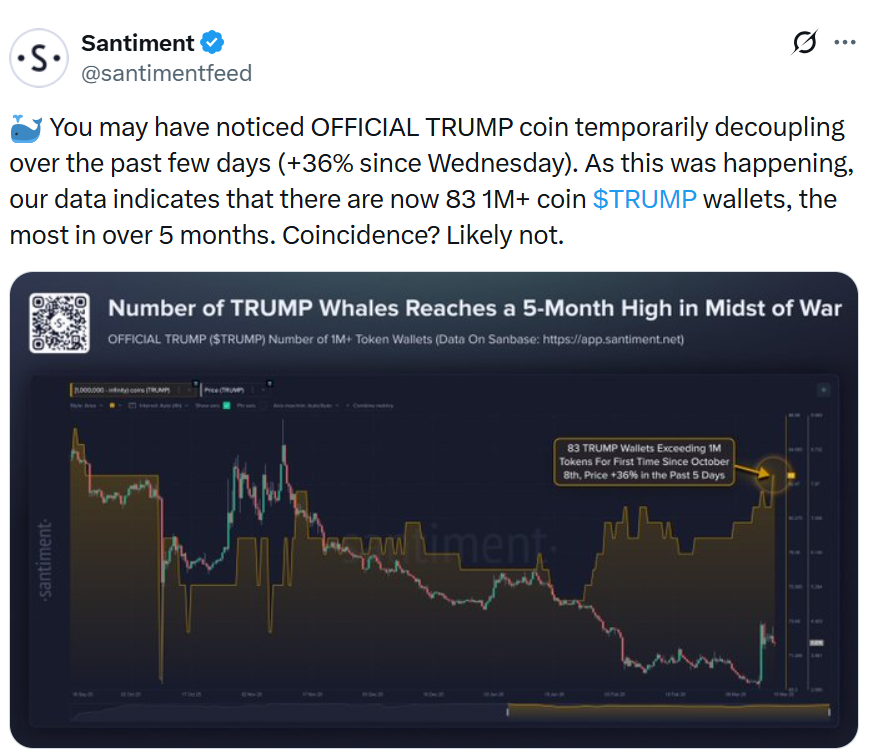
The number of whale wallets holding more than one million of US President Donald Trump’s memecoin has surged to a five-month high after announcing a luncheon at his Florida home for top holders last week.
There are now 83 wallets holding more than 1 million TRUMP (TRUMP) (equating to $3.7 million), making it the highest showing for the memecoin since Oct. 8 last year, Santiment said in an X post on Monday.
The luncheon with Trump is set for April 25 at his Mar-a-Lago residence in Florida, according to the Trump team. The top 297 token holders are invited, with the top 29 eligible for a private reception with the president, subject to passing background checks.
In the days following the luncheon announcement, TRUMP rose by more than 50% to hit a peak of $4.35. As of Wednesday, TRUMP is up 27% over the last seven days and trading at $3.71.

Dominick John, an analyst with Zeus Research, told Cointelegraph the Mar-a-Lago event, which offers access to the US president, is acting as a powerful catalyst for accumulation.
Crypto data analytics platform CoinCarp lists 642,882 TRUMP holders, with over 91% of the supply concentrated among the top 10 and over 97% among the top 100. At the first event for TRUMP token holders last year, Tron founder Justin Sun was the largest tokenholder.

John also points to other guests, such as Tether CEO Paolo Ardoino, who is scheduled to speak and attend the luncheon, as potential drivers of user interest.
“Momentum is driven by narrative-led flows and whale positioning,” he said.
“The presence of Paolo Ardoino from Tether at this event hints at potential ecosystem announcements, providing a real catalyst. His appearance could transform the gala into a progress showcase for the TRUMP token,” John added.
TRUMP spiked in lead up to last year’s gala
Trump held his first “crypto gala” dinner last year in May 2025, a few months after his Jan. 20 inauguration as US president.
It was limited to the top 220 TRUMP token holders and included crypto executives such as Hyperithm CEO Sangrok Oh, as well as anonymous and pseudonymous crypto traders like Cryptoo Bear, and sports stars like NBA champion Lamar Odom.
The event’s announcement a month earlier, on April 23, saw the token peak at $15.59 on April 25. However, the token began to gradually fall from that point. It fell to $14.51 on May 22, the day of the dinner, then gradually dropped to $12.46 a week later and $8.90 a month later.
John said it’s likely the coin would follow a similar trajectory after the upcoming luncheon concludes in April.
“Historically, Trump events show an announcement-driven hype phase followed by a gradual post-event downtrend. This event will follow a similar trajectory, unless new developments are unveiled around this event.”
US lawmakers look to limit memecoin profits by politicians
US senators and former staffers protested outside the event last year, while Democratic lawmakers have also introduced bills to limit political influence and profits from memecoins.
Related: SEC will consider most crypto assets not securities under federal law
The Modern Emoluments and Malfeasance Enforcement (MEME) Act was introduced in February 2025 to prevent federal officials from using their positions to profit from memecoins. It’s currently in the Committee stage and hasn’t progressed to a vote in either the House or Senate.
Meanwhile, the Stop Presidential Profiteering from Digital Assets Act aims to make it illegal for federal officials to issue, promote, or sell digital assets, such as memecoins. The similar Curbing Officials’ Income and Nondisclosure (COIN) Act has also failed to advance since its introduction last year.
Magazine: Clarity Act risks repeat of Europe’s mistakes, crypto lawyer warns

For years, decentralized finance has promised a future where anyone can access powerful financial tools without intermediaries. But let’s be honest—actually using DeFi still feels like piloting a spaceship with a blindfold on.
Multiple tabs. Endless approvals. Slippage anxiety. Gas fees lurking like jump scares.
Now imagine this instead:
“Swap my ETH for the best possible yield strategy with low risk.”
And… that’s it.
No charts. No routing decisions. No manual execution.
Welcome to the world of Intent-Based DeFi—where you define what you want, and the protocol figures out how to get it done.
What Is Intent-Based DeFi?
Intent-Based DeFi flips the traditional model on its head.
Instead of manually executing transactions step-by-step, users simply declare their intent—a desired outcome. Behind the scenes, a network of solvers, bots, or protocols competes to fulfill that intent in the most efficient way possible.
Think of it like this:
-
Old DeFi: You drive the car (and probably crash a few times)
-
Intent-Based DeFi: You set the destination, and an expert driver handles the route
How It Works (Without the Headache)
At its core, intent-based systems rely on three key components:
1. User Intent
You specify a goal:
-
“Swap 1 ETH to USDC at the best rate.”
-
“Earn yield with minimal impermanent loss.”
-
“Bridge funds to another chain cheaply and fast.”
2. Solvers (Execution Engines)
These are sophisticated actors—bots, market makers, or protocols—that compete to fulfill your request.
They:
-
Search across liquidity sources
-
Optimize routing
-
Minimize fees and slippage
-
Bundle transactions efficiently
3. Settlement Layer
Once the best solution is found, the transaction is executed trustlessly on-chain.
You get the result. No micromanagement required.
Why This Is a Big Deal
Let’s not sugarcoat it—manual DeFi is inefficient.
Intent-based systems fix some of the biggest pain points:
🧠 Less Complexity
No more juggling between DEXs, bridges, and yield farms.
⚡ Better Execution
Solvers optimize trades better than most humans ever could.
💸 Lower Costs
Bundled execution reduces gas fees and slippage.
🔒 Reduced Risk
Fewer manual steps = fewer chances to mess up (we’ve all been there).
Real-World Use Cases
This isn’t just theory—it’s already happening.
🔄 Smart Swaps
Instead of choosing between Uniswap, Curve, or aggregators, you simply request the best swap—and let the system handle routing.
🌉 Cross-Chain Transactions
Say goodbye to manually bridging assets. Just specify where you want your funds, and the protocol handles the journey.
📈 Automated Yield Strategies
Users can express goals like:
“Maximize yield on stablecoins with low volatility”
The system allocates funds dynamically across strategies.
The Hidden Power: MEV Optimization
Intent-based DeFi also has a surprising advantage—it can reduce the damage from MEV (Maximal Extractable Value).
Instead of exposing your transaction to bots that exploit it, solvers compete to give you the best outcome. That flips MEV from a tax into a potential benefit.
In other words:
The predators become service providers.
Challenges (Because Nothing Is Perfect)
Before we declare the death of manual trading, there are still hurdles:
⚠️ Trust in Solvers
Even with decentralized systems, users rely on third parties to execute intents correctly.
🔍 Transparency
Complex routing and execution can feel like a black box.
🧩 Standardization
Different protocols are building their own intent systems—interoperability is still evolving.
So… Is Manual Trading Dead?
Not quite.
Power users, arbitrageurs, and degens who love tweaking every parameter will still want full control.
But for the vast majority?
Manual trading is starting to look like:
-
Dial-up internet
-
Flip phones
-
Or sending faxes in 2026
Intent-based DeFi isn’t just an upgrade—it’s a paradigm shift.
Final Thoughts
The real promise of DeFi was never about complexity—it was about access.
Intent-based systems bring us closer to that vision by abstracting away the technical friction and letting users focus on outcomes, not processes.
Soon, interacting with DeFi might feel less like coding…
and more like making a request.
“Grow my portfolio safely.”
And the system simply replies:
“Done.”
REQUEST AN ARTICLE

Meta Platforms will shut down its Horizon Worlds metaverse for virtual reality users in June, pivoting to a mobile-only experience as it retreats from the aggressive metaverse push it championed just five years ago.
Consumers will no longer be able to build, publish, or update virtual reality worlds, or access the Horizon Worlds metaverse on Meta Quest headsets, from June 15, the company said in a Tuesday blog post.
Horizon Worlds launched in late 2021 as a VR-only, online multiplayer platform where users can build and publish virtual environments and games, and interact with others as avatars.

However, Meta reportedly started to experiment with Horizon Worlds as a mobile platform in 2025, according to Samantha Ryan, the VP of content at Reality Labs, who said in February it would be “shifting the focus of Worlds to be almost exclusively mobile.”
Horizon Worlds’ competitors, such as Fortnite and Roblox, which attract 1.3 million and 144 million daily active users, respectively, operate on PC, console, and mobile platforms. Fortnite has never officially developed its game for VR, while Roblox has offered a VR app since July 2023, though not all worlds are VR-compatible.
Meta’s decision to refocus Horizon Worlds comes just five years after Meta CEO Mark Zuckerberg pivoted the company towards the metaverse, even changing its name from Facebook to Meta. Those ambitions, however, have not translated into profits for the firm.
Reality Labs racks up $80 billion in losses since 2020
Meta’s Reality Labs division racked up a record $6 billion in losses for the fourth quarter of 2025, and cumulative losses for its metaverse division total almost $80 billion since 2020.
In January, Meta eliminated 1,000 jobs from Reality Labs while shuttering some of its virtual-reality game and content studios.
At the time, Reality Labs chief technology officer Andrew Bosworth said the company would primarily focus on mobile experiences instead of fully immersive virtual worlds accessed via headsets.
Related: Big Tech signs Trump pledge to cover their own AI energy costs
Meanwhile, Meta stock jumped 3% on Monday following a speculative Reuters report on Friday claiming that the company is “planning sweeping layoffs” that could affect 20% or more of its workforce. The move would reportedly offset spending on AI infrastructure and augmented-reality wearables.
A Meta spokesperson told CNBC that this was a “speculative report about theoretical approaches.”
It would, however, play into a broader trend of tech firms axing staff to focus on AI.
Metaverse tokens have melted
The blockchain-based metaverse was once also a talking point in the crypto industry in 2021, but has since faded into obscurity along with many other trends that have been eclipsed by the latest AI hype.
Major blockchain-based players such as Axie Infinity (AXS), The Sandbox (SAND), and Decentraland (MANA) have all seen their respective tokens tank between 98% and 99% from their all-time highs in November 2021, according to CoinGecko.
Magazine: Human brain cell wetware plays Doom, fly’s mind uploaded: AI Eye
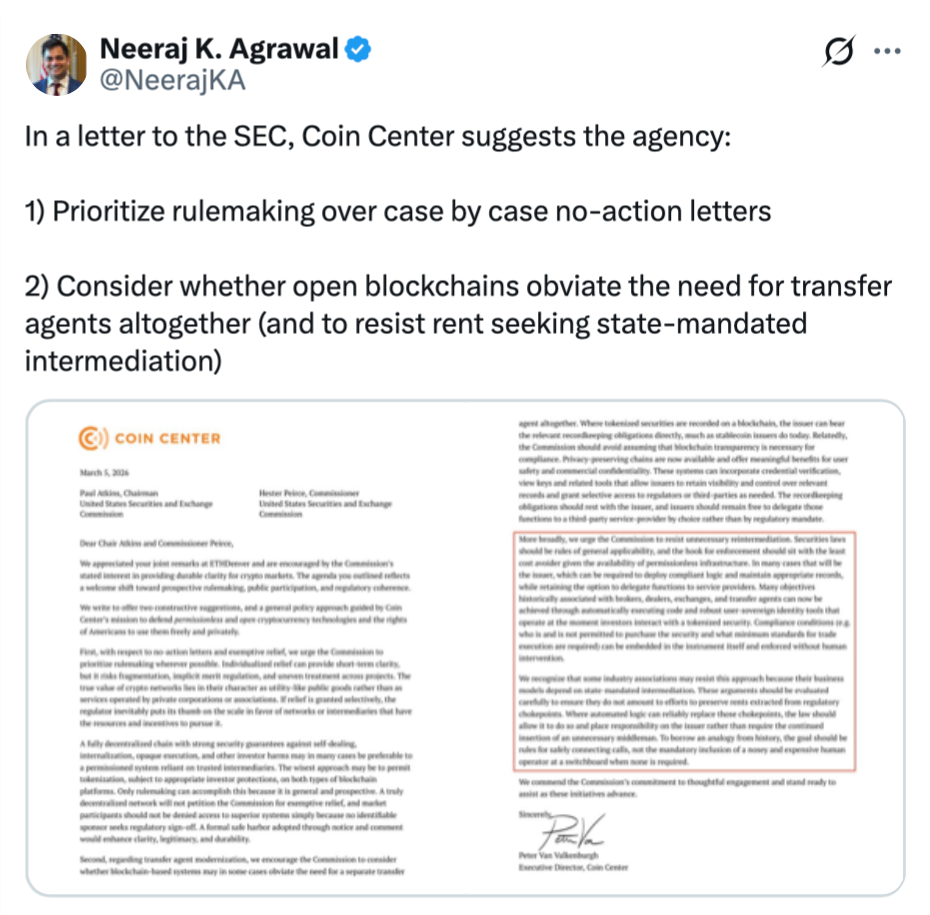
Crypto lobby group Coin Center has urged the US Securities and Exchange Commission to stop addressing individual crypto cases reactively and instead start setting clear rules.
“Individualized relief can provide short-term clarity, but it risks fragmentation, implicit merit regulation, and uneven treatment across projects,” Coin Center said in a letter to the SEC, urging the regulator to “prioritize rulemaking wherever possible.”
“The true value of crypto networks lies in their character as utility-like public goods rather than as services operated by private corporations or associations,” the letter read.
The letter, which was made public on Tuesday, was dated March 5.

Since then, the SEC has released a notice that interprets how “non-security crypto assets” fall under federal securities laws and provides a “coherent token taxonomy for digital commodities, digital collectibles, digital tools, stablecoins, and digital securities.”
The SEC and CFTC also signed a memorandum of understanding on Mar. 12 to better coordinate oversight of the financial markets, ending decades of “regulatory turf wars” between them.
Selective relief creates an unfair environment: Coin Center
Crypto-focused no-action letters have continued to trickle in, with the latest being a no-action letter addressed to crypto wallet provider Phantom Technologies by the Commodity Futures and Trading Commission’s Market Participants Division.
The CFTC notice, which was shared on Tuesday, said that the no-action letter would, under certain circumstances, stop the division from recommending that the regulator take an enforcement action against Phantom or its staff for failure to register as a broker.
The past few months have also seen the SEC hand out two no-action letters to decentralized physical infrastructure network (DePIN) crypto projects.
In late September, the SEC also issued a no-action letter that cleared the way for investment advisers to use state trust companies as crypto custodians.
However, Coin Center argued that relying on these case-by-case rulings creates uncertainty for the wider crypto market.
“If relief is granted selectively, the regulator inevitably puts its thumb on the scale in favor of networks or intermediaries that have the resources and incentives to pursue it,” it said.
Related: SEC will consider most crypto assets not securities under federal law
Meanwhile, US lawmakers are approaching the problem their own way.
The CLARITY Act, which aims to provide clearer regulatory oversight for the crypto industry, is moving through Congress.
The bill, if passed, would give the SEC and CFTC clearer guidance on which digital assets fall under their jurisdiction, helping reduce ambiguity and ensure more consistent treatment across the crypto industry.
Magazine: All 21 million Bitcoin is at risk from quantum computers

Washington, DC — The regulatory landscape for digital assets continues to evolve as policymakers explore a regulatory runway intended to unlock capital for crypto ventures while preserving investor protections. In remarks at a crypto lobby event, SEC Chair Paul Atkins laid out a concrete concept: a safe harbor framework built around three pillars designed to give crypto issuers a bespoke path through the U.S. regulatory maze. The agenda arrives as the agency and the Commodity Futures Trading Commission simultaneously issued interpretive guidance aimed at clarifying when crypto assets are securities and how non-security tokens could fall under securities laws. The moment underscores a shift from diagnostic debates to concrete regulatory mechanisms that could shape how projects fund themselves in the near term.
Our interpretation on crypto assets—grounded in existing law and informed by extensive public input—acknowledges what the former administration refused to recognize…
Most crypto assets are not themselves securities.
— Paul Atkins (@SECPaulSAtkins) March 17, 2026
Key takeaways
- The core proposal centers on a “safe harbor” that comprises a startup exemption, a fundraising exemption, and an investment contract safe harbor, aiming to provide a tailored regulatory runway for crypto projects to mature without surrendering investor protections.
- A startup exemption would permit crypto firms to raise a defined amount or operate for a set period, granting regulatory latitude to reach maturity while maintaining guardrails.
- The fundraising exemption would allow investment contracts involving crypto to raise capital up to a defined threshold within a 12-month window while remaining exempt from certain registration requirements under securities laws.
- The investment contract safe harbor would offer issuers and buyers clarity about when a given asset falls under securities laws, with conditions tied to the issuer’s ongoing commitments and the asset’s lifecycle.
- The idea relies on a trigger related to “permanently ceased all essential managerial efforts” behind an asset, signaling when protections and securities obligations would apply or end.
Market context: The discussion comes amid broader regulatory debates about how to harmonize investor protection with crypto innovation, all while lawmakers weigh market-structure legislation. As talks on a comprehensive framework progress, the industry watches how these proposed exemptions could interact with enforcement policies and evolving guidance on token classifications.
Why it matters
The proposal signals a potential shift toward regulatory clarity that could reduce ambiguity for issuers and investors alike. By outlining concrete exemptions, the plan aims to supply a predictable pathway for raising capital in the United States, which could encourage domestic projects to scale without provoking unintended securities-law exposure. For crypto builders, a defined startup timeline or a capped fundraising window could translate into more confident planning and strategic fundraising rounds, potentially accelerating product development and deployment.
However, the approach also raises questions about what constitutes sufficient “managerial effort” and how the safeguards would be enforced as projects evolve. Critics may worry that a patchwork of exemptions could create inconsistent standards across token types or trigger uneven treatment for similar offerings. The balance hinges on careful calibration of thresholds and sunset provisions that preserve investor protections while preventing regulatory uncertainty from stifling innovation.
From a broader perspective, the move illustrates regulators’ intent to move beyond abstract classification toward actionable scaffolding. The adoption of a safe harbor framework could influence how other jurisdictions view crypto fundraising, potentially shaping international comparability and cross-border fundraising strategies. As the public comment process unfolds, market participants will be watching for details on eligibility, disclosure requirements, and how the exemptions would interface with existing exemptions or exemptions under state law.
What to watch next
- Proposed rules for the exemptions are expected to be released for public comment in the coming weeks, providing a concrete blueprint to assess implementation challenges.
- Congress continues negotiations around market-structure legislation; observers will monitor whether the Clarity Act or related bills advance, given the current stall in the Senate.
- Regulators may issue additional guidance clarifying the boundaries between securities and non-securities in practice, potentially refining the scope of the safe harbor framework as real-world applications emerge.
- Industry groups and lawmakers will assess how the safe harbor interacts with enforcement actions, investor protections, and international regulatory developments that could affect competitiveness and innovation.
Sources & verification
- Paul Atkins, remarks at a Washington, DC crypto lobby event and the proposed three-part safe harbor framework: https://www.sec.gov/newsroom/speeches-statements/atkins-remarks-regulation-crypto-assets-031726
- Joint SEC-CFTC interpretation on crypto assets not securities: https://cointelegraph.com/news/sec-interpretation-crypto-assets-not-securities
- Clarity Act and related legislative context referenced by industry coverage: https://cointelegraph.com/news/clarity-act-crypto-united-states-congress-galaxy-digital
- Industry context on evolving crypto regulation and 2025 changes: https://magazine.cointelegraph.com/how-crypto-laws-changed-2025-further-2026/
- Public stance and timing noted in the accompanying tweet: https://twitter.com/SECPaulSAtkins/status/2034012012460556526?ref_src=twsrc%5Etfw
Regulatory safe harbors and the path forward for crypto exemptions
The conversations surrounding a safe harbor framework crystallize a broader theme in U.S. regulatory policy: the desire to foster a constructive environment where startups can raise capital without facing indefinite regulatory ambiguity, while ensuring that investors are adequately protected from risk. Atkins framed the proposed exemptions as a way to tailor regulation to the realities of crypto markets, acknowledging the need for bespoke pathways in an industry with unique funding dynamics and rapid product lifecycles.
The startup exemption envisions a defined early phase during which projects can attract capital or operate with a clear regulatory runway, offering a predictable timeline as teams build products, recruit communities, and develop governance mechanisms. The fundraising exemption would target investment contracts that involve crypto—allowing issuers to raise up to a specified amount within a year without triggering full securities registration. The investment contract safe harbor, meanwhile, would articulate a threshold beyond which token issuers and buyers would be subject to securities laws, potentially offering certainty about when protections apply as the asset matures or as project commitments change.
Crucially, Atkins emphasized that the safe harbor would be triggered by a specific condition: when an issuer has “permanently ceased all essential managerial efforts” promised for the asset. This condition is intended to prevent perpetual ambiguity around the status of a token and to provide a clear point at which securities obligations become applicable. The approach seeks to balance entrepreneurial flexibility with the safeguards designed to protect investors in complex, evolving markets.
In parallel, regulators clarified that most crypto assets are not themselves securities, while still outlining circumstances under which securities rules may apply to non-security assets. The interpretive action reflects an attempt to harmonize traditional securities law with the realities of a diverse digital-asset landscape, where token models range from payments rails to governance tokens and beyond. Industry observers note that the framework could affect fundraising strategies, disclosure practices, and how projects structure token distributions. The designation of a safe harbor would be a practical step toward reducing regulatory friction for compliant offerings, even as broader questions about market structure, transparency, and enforcement persist.
As the public comment period looms, the crypto sector will be watching for precise definitions, numerical thresholds, and procedural steps that will determine how readily these exemptions can be deployed. While the regulatory impulse is to create a more navigable route for compliant issuances, the ultimate success of such a framework will hinge on its ability to scale with innovation, deter fraud or misrepresentation, and mesh with international standards. The interplay between this proposed framework and ongoing legislative efforts—such as the stalled Clarity Act—will matter for how quickly and comprehensively the U.S. market can align with evolving global norms.


Opinion by: Leo Fan, founder of Cysic
Decentralized compute has failed. Not because it can’t find you a cheap GPU; it’s actually quite good at that. The problem is that every major network today still forces you to trust the node operator with your data and results.
We have replaced Amazon’s login page with a wallet connection and called it Web3.
A staggering $2 billion to $3 billion was poured into “decentralized cloud” tokens from 2023 to 2025. Yet none of the top players can give a smart contract mathematical certainty that the work was done correctly. Zero-knowledge rollups, onchain AI agents and fully trustless apps remain impossible at scale.
The entire sector has decentralized supply and payments. Trust is still centralized. Until verification is cryptographic, “decentralized compute” is just Airbnb for GPUs.
The marketplace mirage
Current leaders are sophisticated spot markets, nothing more. Akash pulled in about $11 million in Q3 2025 revenue. Render managed about $18 million. Impressive for coordination layers, sure, but trivial next to AWS’s $100 billion-plus annual run rate.
These networks solved the easy part, idle GPU discovery and crypto payments, and declared victory. Their proof-of-work done? Usually, just “the node streamed the result plus some reputation score.”
That’s not verification. That’s a pinky promise with extra steps.
Real-world failures are already happening. In 2025, bad actors returned corrupted Blender renders through Render’s network. No onchain way to detect it. Io.net caught a Sybil cluster gaming reputation scores in May and further failures in November with aPriori’s mysterious Sybil cluster that claimed 60% of the airdrop across 14,000 wallets. Gensyn’s own whitepaper admits their “learning game” tolerates less than 49% malicious tolerance in practice.
These are the predictable outcomes when you replace mathematical proofs with social enforcement.
Think about what this means for actual use cases. A Layer 2 rollup outsourcing STARK proofs to any current decloud still needs a trusted multisig or single honest prover. The centralization risk remains unchanged. An autonomous agent doing inference on io.net? The on-chain contract can’t tell if the LLM output was correct or backdoored. We’ve recreated the oracle problem with more steps.
Breaking Web3’s core promise
Bitcoin never asked you to trust miners. Ethereum doesn’t require faith in validators. They gave you ways to verify. Today’s compute networks do the opposite:
“Here’s your result. Trust me, bro, and we’ll slash if someone complains.”
This philosophical mismatch kills the entire value proposition. The Total Addressable Market (TAM) for “decentralized GPU” gets capped at rendering and basic training because nobody will run sensitive workloads on networks where nodes see your plaintext data, such as DeFi bots, medical inference, and proprietary models.
Vitalik nailed it at Devcon 2024:
“If your scaling solution reintroduces trusted parties, you haven’t scaled. You’ve just outsourced.”
That’s exactly what we’ve done. We outsourced AWS to a thousand smaller AWS nodes and patted ourselves on the back.
The market size illusion becomes clear when you do the math. Without verifiable execution, you can’t serve. Financial institutions need provable compliance. Healthcare systems require an auditable inference. Rollups demand trustless proof generation. AI agents must execute high-value transactions.
Related: Institutions must stake Ether on decentralized infrastructure
You’re left competing for Stable Diffusion hobbyists and Blender farms. Good luck building a trillion-dollar market on that.
The only path forward
Real decentralized compute requires cryptographic proof accompanying every result, including zkSNARKs, STARKs or optimistic fraud proofs, that are verifiable in under a second by any smart contract.
This isn’t theoretical anymore. Hardware-accelerated proving stacks using FPGAs and custom ASICs make this economically viable at GPU-scale bandwidth. The 2024-2025 ZPrize winners showed STARKs over cycle-accurate circuits running in under eight seconds on the latest FPGA clusters, heading toward sub-second on next-gen silicon.
When this verification layer exists, everything changes. A $10,000 DeFi agent can run private AlphaTensor-level reasoning onchain. Rollups can outsource proofs to 10,000 untrusted nodes with zero risk. Inference becomes as trustless as checking an Ethereum balance.
Open, permissionless networks of specialized provers will compete on latency and cost. But the key difference is that dishonesty becomes mathematically impossible, not just expensive. No reputation systems. No slashing games. Just math.
The real revolution
We didn’t decentralize compute by turning GPUs into an open market. That’s like saying we decentralized money by letting people trade dollars on DEXs.
We’ll deserve the name when computational results become as unforgeable as Bitcoin transactions are unspendable without the private key. It’s impossible to fake, trivial to check.
The breakthrough Web3 needs isn’t another 5% cheaper GPU hour. It’s the first network that can attach an unbreakable proof of correctness to every teraflop. That’s the infrastructure we were promised. Everything else is just a centralized cloud with extra steps.
Opinion by: Leo Fan, founder of Cysic
This opinion article presents the author’s expert view, and it may not reflect the views of Cointelegraph.com. This content has undergone editorial review to ensure clarity and relevance. Cointelegraph remains committed to transparent reporting and upholding the highest standards of journalism. Readers are encouraged to conduct their own research before taking any actions related to the company.
Five Vietnamese companies are reportedly competing to launch the country’s first licensed crypto exchanges as authorities move to bring trading onshore and ban overseas platforms.
Five companies have passed an initial qualification round, Reuters reported on Tuesday, citing a March 12 finance ministry document. The group reportedly includes affiliates of private banks Techcombank, VPBank and LPBank, alongside stockbroker VIX Securities and conglomerate Sun Group. VPBank and Sun Group reportedly confirmed their licence applications to Reuters.
Vietnam opened applications for licenses to operate crypto exchanges in January. The move came after new procedures issued by the finance ministry and a law that, for the first time, defines crypto assets as property while still banning their use as legal tender or for payments.
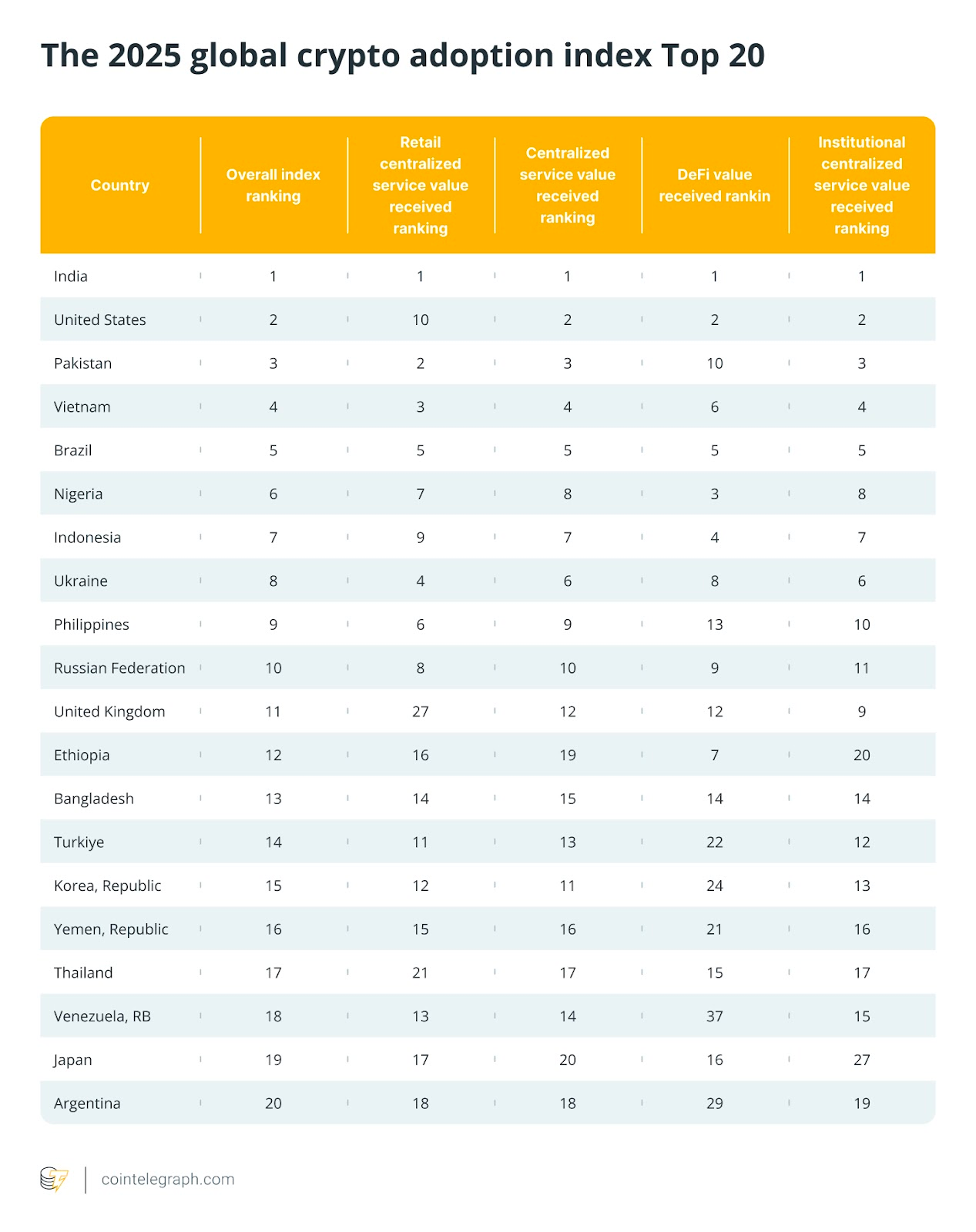
Vietnam has emerged as a major hub for crypto trading, ranking fourth globally in Chainalysis’ latest Global Crypto Adoption Index with $200 billion in estimated transactions over the 12 months to June. However, despite the significant activity, most traders still rely on offshore exchanges such as Binance, OKX and Bybit to access the market.
Related: Crypto’s real boom is happening in Argentina, Nigeria, and the Philippines
Vietnam to ban overseas crypto platforms
Authorities are also reportedly drafting rules that could prohibit Vietnamese nationals from using overseas platforms. According to Reuters, officials have raised concerns about the growing use of crypto and stablecoins, particularly in relation to capital moving out of the country.
In September 2025, Vietnam launched a five-year crypto pilot with strict rules requiring all transactions to be conducted in Vietnamese dong and limiting issuance to locally registered companies. The framework also bans fiat-backed assets like stablecoins, allowing only crypto backed by real, non-financial assets.

As a result of the strict entry conditions, including high capital requirements of around $379 million, the country’s Ministry of Finance said no companies had applied for its digital asset trading pilot by October.
Cointelegraph reached out to Techcombank, VPBank and LPBank, VIX Securities and Sun Group for comment, but had not received a response by publication.
Related: Vietnam central bank expects credit growth amid rapid crypto adoption
Vietnam to tax crypto similar to stocks
In February, Vietnam drafted a tax framework for crypto transactions that would treat digital assets similarly to securities trading. Under the proposal, individuals would pay a 0.1% tax on each crypto transaction processed through licensed providers, while such transfers would remain exempt from value-added tax.
For companies, the rules would differ, with institutional investors facing a 20% corporate income tax on profits from crypto trading after costs and expenses.
Magazine: Bitcoin may take 7 years to upgrade to post-quantum — BIP-360 co-author
Decentralized autonomous organizations (DAOs) were built on an ideological premise that is now running up against the realities of running a business, where decentralization collides with the need for legal ownership and control.
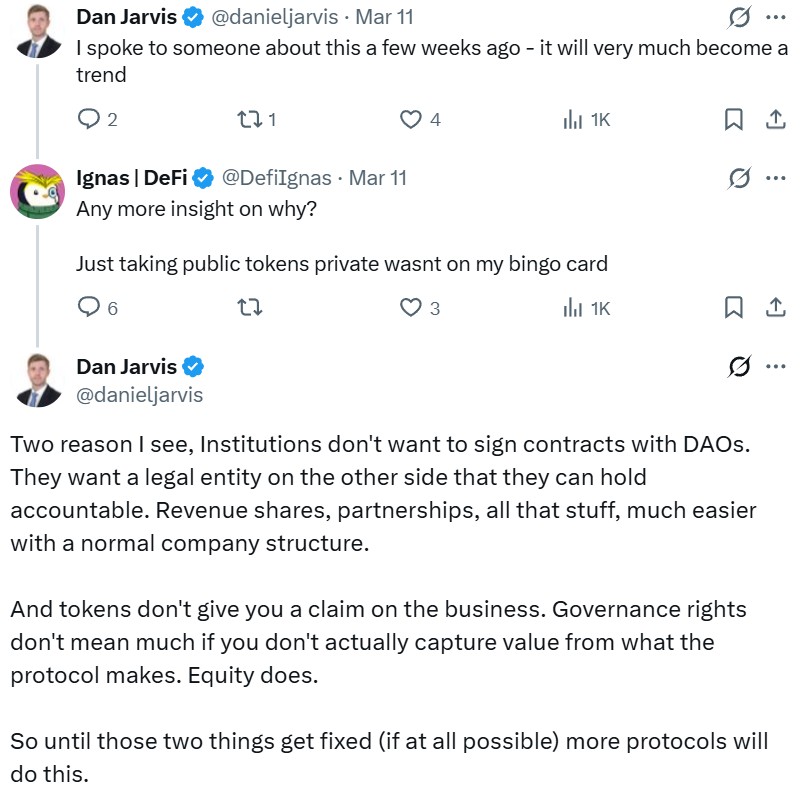
On March 11, DAO Across Protocol made a controversial proposal to transition to a private company through a token-to-equity exchange buyout. Risk Labs, the team behind Across (ACX), said that the token and DAO structure “materially” impacted its ability to close deals with enterprises and institutions.
The industry reaction has been split. Decentralized finance (DeFi) researcher Ignas called it a “huge failure of crypto.”
“It feels like a betrayal of the crypto spirit: investment access for everyone, anywhere, globally,” Ignas said on X. “I hope other DAOs don’t follow them.”

The DAO structure is holding back Across’ stablecoin business
Crosschain Bridge Across Protocol currently operates under a token and DAO structure, with Risk Labs overseeing development through a foundation model.
Risk Labs’ proposal outlines a transition to a newly formed US C-corporation that would take over protocol development and commercialization. ACX holders could exchange their tokens for equity in the new entity or opt into a buyout.
“[DAOs] were supposed to replace the archaic organizational infrastructure that is marked by greed and a lack of trust,” Matthew Pinnock, founder of DeFi project Altura, told Cointelegraph.
“However, as the industry increasingly moves toward real-world assets and institutional capital, protocols are running into structural limitations. Institutions typically need a clear legal counterparty that can sign contracts and undergo due diligence, something a decentralized collective cannot easily provide,” Pinnock added.
Related: Perp DEXs become the latest battleground for blockchains
Across co-founder Hart Lambur said that in Across’ case, having a token “generally hurts more than it helps.”
“We launched the Across token very early, at a very low valuation, and with a very broad airdrop. We picked this strategy so that we could build value in public with our community,” Lambur said on X. “Today, the macro environment has changed. Tokens are undervalued and underappreciated.”

Across is positioned around stablecoin infrastructure, which partly explains its transition. The goal is to enable fund movements across stablecoins at parity, with fees absorbed by issuers or partners rather than end users. Lambur said that securing related agreements requires contracts and offchain payment arrangements that are not well suited to DAO structures.
ShapeShift dissolved its corporate entity to become a DAO
As protocols rethink DAO structures, ShapeShift offers a counterpoint. The crypto trading platform transitioned into a DAO in 2021, dissolving its corporate entity in favor of tokenholder governance.
Tim Black, product lead at ShapeShift DAO, said many teams adopted DAO structures during the last cycle as part of a broader narrative, without fully accounting for the operational complexity involved.
Related: Banks will run RWAs on two blockchain rails, says RedStone co-founder
“What Across is proposing is essentially admitting that. They’re saying the DAO experiment helped bootstrap the network, but a company structure is better suited to the next phase,” Black told Cointelegraph.
“Many teams quietly operate like companies already,” he added. “Shapeshift was innovative in using workstreams, mirroring departments, but they still create more friction than collaboration over time.”

Social media debates shifted toward tokenized equity as the way to go over the traditional corporate structure, with Ignas claiming that it would be progress for the industry. But Black thinks that says more about token designs than the concept, as many governance tokens already function as pseudo equity.
“The original idea behind governance tokens was coordination, not ownership… If they just become equity substitutes, then the experiment has basically collapsed back into the corporate model it was supposed to challenge,” he said.
Across’ corporate structure isn’t finalized
If transitions like Across’ become more common, the outcome may not be a single direction for DeFi, but a split in how protocols are structured and operated.
“One side becomes corporate crypto, protocols run like fintech companies with tokens functioning more like shares. The other side stays genuinely decentralized and accepts the operational friction that comes with that,” said Black.
That shift is already being shaped by the influx of institutional capital and RWAs, which impose requirements that DAO structures often struggle to meet.
“That is why we are seeing DAOs taking the regulatory black pill and dropping the D that made them decentralized autonomous organisations,” Pinnock said.
As protocols adapt, some are moving toward clearer legal frameworks and centralized execution layers, while others continue to prioritize open participation and community governance.
Though Across is eyeing a corporate structure, it still operates as a DAO today. It framed its proposal as a “temperature check” to signal that no final decision has been made. It still needs to pass a governance vote and get the blessing of its token holders.

Magazine: Metaplanet’s Japan Bitcoin bet, Bithumb ordered suspension: Asia Express

Bodo/Glimt’s fairytale Champions League run comes to end against Sporting

Gloucestershire Airport sale collapse sparks fears over council’s financial recovery plan

Netflix’s 8-Part Sci-Fi Thriller Is One of the Best Shows on Any Streaming Platform

Smart energy pays enters the US market, targeting scalable financial infrastructure

Why Israel is blocking foreign journalists from entering

Bitcoin: We’re Entering The Most Dangerous Phase

Australian Bombshell! Wellness Retreat Markled! Suspicious Financial Activity!

How Much You NEED To Invest Every Month to RETIRE in 10 Years? (So FEW)

XRP RALLYING! IS THIS THE BEGINNING OF AN XRP BULL RUN?! BREAKING XRP NEWS!
-
 Tech7 days ago
A 1,300-Pound NASA Spacecraft To Re-Enter Earth’s Atmosphere
-
 Crypto World4 days ago
HYPE Token Enters Net Deflation as HyperCore Buybacks Outpace Staking Rewards
-

 Fashion4 days ago
Weekend Open Thread: Addict Lip Glow
-

 Tech2 days ago
Your Legally Registered ‘Motorcycle’ Might Not Count Under Proposed US Law
-
Sports4 days ago
Why Duke and Michigan Are Dead Even Entering Selection Sunday
-

 NewsBeat6 days ago
Residents reaction as Shildon murder probe enters second day
-

 Business2 days ago
Search for Savannah Guthrie’s Mother Enters Seventh Week with No Arrests
-

 Business7 days ago
Search Enters Sixth Week With New Leads in Tucson Abduction Case
-

 Sports6 days ago
PWHL, Senators discussing plan to keep Charge in Ottawa
-

 Business4 days ago
US Airports Launch Donation Drives for Unpaid TSA Workers as Partial Government Shutdown Enters Fifth Week
-
 Tech12 hours ago
Are Split Spacebars the Next Big Gaming Keyboard Trend?
-
Crypto World3 days ago
Coinbase and Bybit in Investment Talks: Could Bybit Finally Enter the US Crypto Market?
-

 NewsBeat7 days ago
I Entered The Manosphere. Nothing Could Prepare Me For What I Found.
-

 Business4 days ago
Country star Brantley Gilbert enters growing non-alcoholic beer market
-

 Business2 days ago
Australian shares drop as Iran war enters third week
-

 Crypto World2 days ago
Crypto Lender BlockFills Enters Chapter 11 with Up to $500M in Liabilities
-

 Sports4 days ago
College Basketball Best Bets: Conference Tournament Semifinal Picks
-

 Politics7 days ago
Trump Says Middle East Is ‘Very Lucky’ That He’s President
-
 Crypto World6 days ago
Three Binance Charts May Be Hinting at Bitcoin’s Next Move
-
 Business5 days ago
Trump demands Powell cut rates as Iran conflict raises energy prices


You must be logged in to post a comment Login