According to Dalio, there are important differentiating characteristics between bitcoin and gold, and these traits are pushing institutions to the latter.
The billionaire investor and founder of the leading hedge fund, Bridgewater Associates, Ray Dalio, has once again criticized bitcoin (BTC). This time, Dalio rejected comparisons between the cryptocurrency and gold, stripping the digital asset of its safe-haven narrative.
During an interview with the All-In Podcast, the Bridgewater founder insisted that BTC has not played the role of a safe-haven like gold. He accepted that bitcoin has been receiving a lot of attention as a form of money but faces long-term threats. Dalio’s comments come as financial assets react to geopolitical tensions amid the ongoing U.S.-Iran crisis.
Advertisement
Dalio Rejects BTC Comparisons to Gold
According to Dalio, there are important differentiating characteristics between bitcoin and gold. The former lacks privacy; transactions can be monitored and indirectly controlled by entities. Such qualities, in the billionaire’s opinion, would make central banks and large institutions reluctant to buy and hold it.
On the other hand, these institutions are consistently buying and holding gold because the precious metal is widely considered a store of value and an inflation hedge. Dalio highlighted that the precious metal is not an asset that is speculated on, contrary to what most people have come to believe. In fact, he mentioned that gold is the most established form of money and the second-largest reserve currency held by central banks.
Moreover, gold does not face the same threats as Bitcoin. Dalio mentioned growing concerns about the possible effects of quantum computing on the Bitcoin network. So, despite getting a lot of attention, especially from individuals, and being considered as alternative money, bitcoin still has a relatively small and controlled market in comparison to gold.
It is worth noting that Dalio has developed some kind of love-hate relationship with BTC over the years. Once a critic, the investor began to embrace the cryptocurrency in 2021 and even gained exposure to it. Still, he believes gold is the ultimate financial asset, and BTC does not come close.
Advertisement
Gold Hit Heavier By U.S.-Iran Conflict
Despite Dalio dismissing bitcoin’s safe-haven narrative, the digital asset has performed relatively well since the U.S.-Iran conflict began. On March 3, the day Dalio made these remarks, gold lost 6% during trading hours, falling from $5,377 to $5,039, according to TradingView data. BTC, on the other hand, fell by a mere 3.7% over the same timeframe.
You may also like:
Comparing the price movements of both assets on that day directly challenges Dalio’s statements, as gold was more affected by the very crisis it is supposed to shield investors from.
SPECIAL OFFER (Exclusive)
Binance Free $600 (CryptoPotato Exclusive): Use this link to register a new account and receive $600 exclusive welcome offer on Binance (full details).
LIMITED OFFER for CryptoPotato readers at Bybit: Use this link to register and open a $500 FREE position on any coin!
A Thane magistrate court in India has granted bail to CoinDCX co-founders Sumit Gupta and Niraj Khandelwal after a 71 lakh rupee cheating complaint tied to a fake trading platform impersonating the Indian crypto exchange. The March 23 common order found no prima facie case against the founders, who were questioned and remanded over the weekend amid allegations they defrauded an investor. The court noted that the informant had admitted in court that another person, not the applicants, was involved in the fraudulent scheme and that an amicable settlement had been reached in the matter.
In a move that underscores the ongoing risk of impersonation in the crypto space, CoinDCX responded on March 24 via X (formerly Twitter), saying the proceedings reinforced a third‑party impersonation scenario. The firm emphasized that the fraud occurred on a counterfeit site, coindcx.pro, which has no connection to CoinDCX. The company urged users to verify domains and interact only with the exchange’s official platform and social profiles.
Key takeaways
The Thane court granted bail to CoinDCX co-founders Sumit Gupta and Niraj Khandelwal after ruling there was no prima facie case, based on the information available at the initial stage of the investigation.
The alleged fraud involved a lookalike site, coindcx.pro, described by CoinDCX as unaffiliated with the company, illustrating a broader impersonation risk facing Indian crypto platforms.
Judges noted that the informant had filed an affidavit stating another accused, Rana, had repaid the cheated amount, and that the founders were not present at the café in Mumbra where the deal occurred. The matter was described as amicably settled, reducing the likelihood of evidence tampering claims.
CoinDCX publicly framed the incident as a case of third‑party impersonation, reinforcing the need for users to verify domains and interact only with official channels to curb phishing and scam risk.
The case highlights the ongoing tension between fast‑moving crypto‑sector growth in India and the persistent risk of brand impersonation, phishing, and counterfeit platforms targeting investors and users.
Legal framing: What the bail order reveals
The court’s order indicates that the investigation officer had “no objection” to releasing Gupta and Khandelwal on bail, a procedural signal often used when authorities see insufficient immediate evidence to justify continued detention. The magistrate also observed that the accused were not present at the location of the alleged offense and that the informant acknowledged in court that another individual could have represented themselves as the accused to defraud the investor. The “amicable settlement” between the informant and the principal accused further complicated the prosecution’s case, suggesting a potential resolution that could limit the scope of trial proceedings.
Both founders were released on bail upon a bond of 50,000 Indian rupees (about $530) with conditions to cooperate with the investigation and stand trial if required. While bail offers temporary relief from detention, it does not conclude the merits of the underlying allegations, and the case could proceed if prosecutors pursue further charges or uncover new evidence.
Impersonation, phishing, and the risk to users
The broader context of this episode is the rising incidence of impersonation and phishing aimed at India’s crypto ecosystem. CoinDCX’s statement frames the incident as part of a pattern in which fraudsters mimic well-known brands and create lookalike platforms to deceive investors. The company urged users to validate domain names, avoid responding to offers from unverified sources, and rely on the exchange’s official channels for trading and communications. For readers watching regulatory developments, this case underscores why incident‑response and security best practices are increasingly central to crypto firms’ operating models.
Advertisement
The incident also resonates with a wider industry concern: how to differentiate legitimate platforms from counterfeit sites, especially when the lookalikes copy branding and user interfaces with alarming fidelity. For investors and traders, the episode reinforces the practical need to scrutinize URLs, bookmark official sites, and remain vigilant against phishing attempts that can surface even when a high‑profile exchange is involved. CoinDCX’s emphasis on third‑party impersonation will likely feed into ongoing industry conversations about brand protection and user education as structural responses to fraud risk.
For those seeking more background on security best practices in crypto, industry observers often highlight the importance of confirming site authenticity and using hardware wallets for large holdings, in addition to platform‑level protections and verifications. As fraud schemes evolve, platforms may increasingly adopt stricter identity checks, domain monitoring, and rapid takedown processes to reduce exposure to impersonation. Readers can follow updates through official exchange communications and regulatory disclosures as the case unfolds.
Impact on CoinDCX and market trust
From a market trust perspective, the bail decision points to the complexity of policing a fast‑growing crypto landscape in which legitimate ventures are sometimes entangled with opportunistic fraud. While the court’s ruling removes a layer of immediate personal risk for the founders, the broader case keeps investors’ attention on the structural challenges of brand protection and consumer safety in crypto. CoinDCX’s public response—framing the incident as impersonation—seeks to reassure users while spotlighting the need for robust checks beyond a single exchange’s controls.
The case also intersects with ongoing regulatory discourse in India about crypto activity, consumer protection, and enforcement. As authorities sharpen their focus on compliant operations and risk controls, exchanges may face increased expectations to demonstrate transparent incident handling, rigorous verification processes, and proactive user education. For now,CoinDCX’s stance emphasizes that users should treat only official nodes of communication as authoritative and stay vigilant against lookalikes and spoofed platforms.
Advertisement
Readers should monitor subsequent updates from the court regarding the status of the investigation and any further filings. While the bail order provides temporary clarity on the personal risk to the founders, it does not close the door on potential civil or criminal follow‑ups, nor does it diminish the ongoing need for improved security protocols across the sector. The event serves as a reminder that, in crypto’s rapid expansion, legitimacy and trust hinge as much on governance and consumer safeguards as on product innovation.
CoinDCX’s March statements and the court’s March order together illustrate a broader narrative: as crypto platforms scale in India, the risk environment for users grows more complex, demanding heightened scrutiny of websites, vigilant due diligence, and continuous investor education. The industry will likely watch closely how enforcement bodies evolve their investigations and what technical and regulatory measures exchanges adopt to prevent impersonation and safeguard user funds.
What remains uncertain is how the case will proceed beyond the bail stage—whether prosecutors will pursue further charges or whether the amicable settlement will influence future proceedings. Investors and users should stay tuned for continued coverage of the investigation’s trajectory and any policy developments that could shape brand protection standards across India’s crypto landscape.
Risk & affiliate notice: Crypto assets are volatile and capital is at risk. This article may contain affiliate links. Read full disclosure
Bhutan moved more Bitcoin from its state-linked wallet on Wednesday, extending a March drawdown in its sovereign holdings.
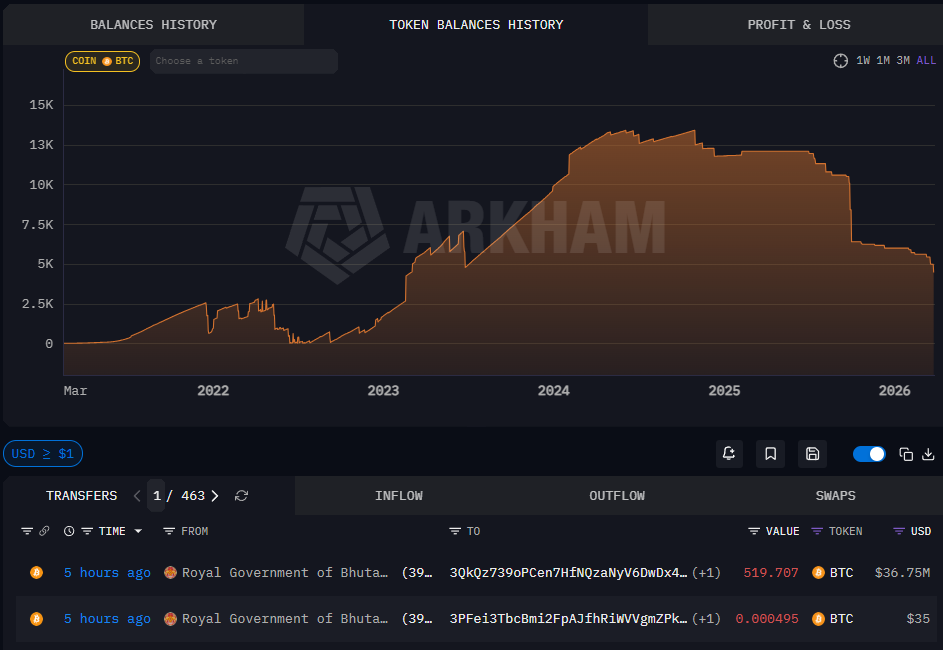
Arkham data showed a Bhutan government-linked wallet transferred about 519.7 BTC, worth roughly $36.7 million, to two wallets on Wednesday. Onchain Lens said one of the destination wallets was linked to trading firm QCP Capital.
The move marked the Bhutan-tagged wallet’s third large Bitcoin transfer in March, following the $72 million moved in six separate transactions in the 24 hours leading up to March 18, and the $11.8 million moved on March 9.
The latest transfer adds to a heavier March outflow pattern after Bhutan moved just over 284 BTC in February. The wallet still holds 4,453 BTC worth around $315 million, down from over 13,000 BTC in October 2024, according to Arkham.
Advertisement
Royal Government of Bhutan (Druk Holdings) wallet. Source: Arkham
As of March 12, Bhutan was the fifth-largest country by Bitcoin holdings, behind the US government, the United Kingdom’s government, El Salvador, and the United Arab Emirates Royal Group, according to a report by Arkham.
Bhutan leverages Bitcoin mining to support its economic growth
Bhutan was among the earliest countries to adopt Bitcoin mining in 2019 and has since constructed multiple hydroelectric power plants along its glacial rivers to harness cheap hydroelectric power.
In May 2023, Bhutan’s sovereign wealth fund, Druk Holding and Investments, announced a $500 million partnership with Bitdeer to expand its Bitcoin mining operations.
In December 2025, Bhutan said it will tap into BTC from its stash to help build its special administrative region, the Gelephu Mindfulness City (GMC). The initiative is part of the wider national Bitcoin Development Pledge, which aims to support Bhutan’s long-term economic development through its Bitcoin holdings and mining operations.
Advertisement
On Jan. 8, 2026, Bhutan’s GMC revealed plans to set up a strategic cryptocurrency reserve comprising major tokens, including Bitcoin, Ether (ETH) and BNB (BNB).
Cointelegraph is committed to independent, transparent journalism. This news article is produced in accordance with Cointelegraph’s Editorial Policy and aims to provide accurate and timely information. Readers are encouraged to verify information independently. Read our Editorial Policy https://cointelegraph.com/editorial-policy
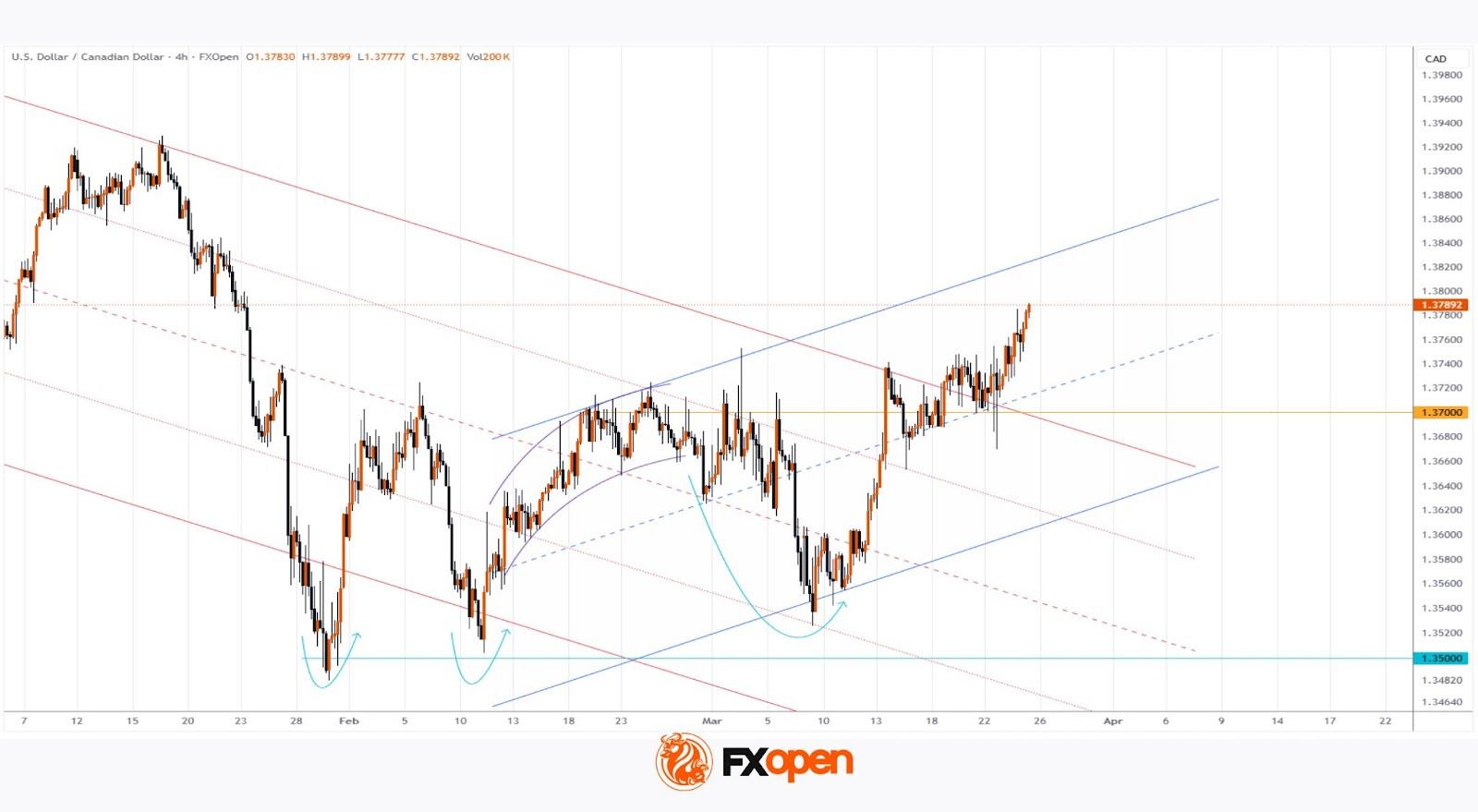
Today, the USD/CAD currency pair climbed above the 1.3787 level for the first time since late January.
→ Demand for the US dollar is being supported by concerns over escalating tensions in the Middle East. Market participants are favouring the USD as a safe-haven asset.
→ The Canadian dollar is under pressure due to domestic economic concerns. According to media reports, recent data point to weak GDP growth and a soft labour market. This increases the likelihood that the Bank of Canada will cut interest rates, while the Federal Reserve is expected to keep them unchanged.
Technical Analysis of USD/CAD
On 23 February, when the pair was trading around the 1.3700 level, we:
→ highlighted the ongoing long-term descending channel and the key support at 1.3500; → noted similarities with a rounding top pattern; → suggested a scenario in which bears might attempt to regain control and resume the longer-term downtrend.
Advertisement
Indeed, in the following sessions, USD/CAD showed signs of strong selling pressure, with the most pronounced move occurring on 9 March, when the pair dropped below 1.3530.
However, the onset of the Middle East conflict and other factors have significantly shifted market sentiment. The long-term descending channel has now been broken, suggesting that:
→ bulls have regained control of the market; → the pair may continue to develop within a newly formed ascending channel (shown in blue); → the 1.3700 level, which previously acted as resistance, may now serve as support going forward.
Trade over 50 forex markets 24 hours a day with FXOpen. Take advantage of low commissions, deep liquidity, and spreads from 0.0 pips (additional fees may apply). Open your FXOpen account now or learn more about trading forex with FXOpen.
Advertisement
This article represents the opinion of the Companies operating under the FXOpen brand only. It is not to be construed as an offer, solicitation, or recommendation with respect to products and services provided by the Companies operating under the FXOpen brand, nor is it to be considered financial advice.
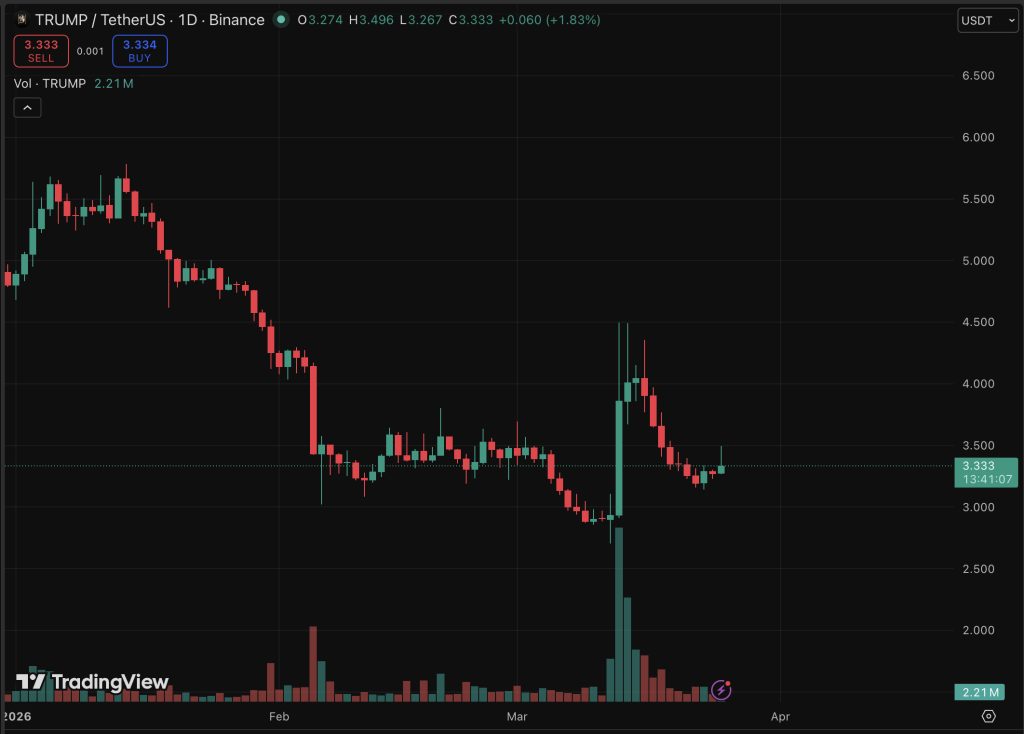
TRUMP crypto hangs precariously around the $3.34 mark, posting a deceptive 3.11% gain over the last 24 hours while trading volume plummeted by 8.84% to $145.36 million. The asset has shed 10% of its value in the past week, consolidating after a series of sharp corrections that have shaken holder confidence.
This divergence, rising price on falling volume, often signals a lack of conviction with the coin itself, occurring as the broader market navigates geopolitical tensions and extreme volatility. With technical indicators flashing conflicting signals, the immediate path remains ambiguous.
Can TRUMP Crypto Recover or Is a Breakdown Imminent?
The technical structure for TRUMP is currently fragile. The asset is trading just above a critical support level at $3.30. A failure to hold this line could be catastrophic, potentially triggering a “death cross” scenario if the price slips below the $3.20 threshold. This bearish formation typically invites aggressive short-selling, which would deepen the correction significantly.
However, the data offers a glimmer of hope. The Relative Strength Index (RSI) sits at 56.44, indicating a mild bullish bias (some room to run), and the Bull Bear Power (BBP) reading of 0.133 suggests buyers retain a slight edge.
Yet, the broader money flow tells a different story. The Technical outlook is clouded by a Chaikin Money Flow (CMF) of -0.15, revealing that capital is actively exiting the asset despite the minor price bump. Additionally, the MACD and signal lines remain submerged below the zero line, confirming that bearish momentum still dominates the trend.
For a reversal to stick, bulls must push past the $3.37 resistance. A sustained close above this level could initiate a golden cross, driving the price toward $3.40. Without a surge in volume to back this move, however, any rally is likely to be sold into.
LiquidChain Targets Early Mover Upside as TRUMP Stagnates
While TRUMP holders anxiously watch the $3.31 support, smart money is increasingly rotating into utility-dense infrastructure plays that solve fundamental market fragmentation. Traders fatigued by meme coin volatility are pivoting toward projects like LiquidChain ($LIQUID), a Layer 3 protocol designed to unify the scattered liquidity of the crypto ecosystem.
Unlike speculative assets reliant on sentiment, LiquidChain fuses Bitcoin, Ethereum, and Solana liquidity into a single execution environment. The presale data confirms this demand: LiquidChain has already raised $600K as of right now.
Currently priced at $0.0143, the entry point offers a huge 1700% APY staking rewards. With features like verifiable settlement and a unified liquidity layer, $LIQUID aims to be the connective tissue of the multi-chain future. The contract itself has been audited by Certik, the benchmark of crypto safety.
Financial technology company Ripple said Wednesday it had joined the Monetary Authority of Singapore’s (MAS) BLOOM initiative with supply chain finance technology firm Unloq to test programmable cross-border trade settlement using the XRP Ledger and Ripple USD.
The pilot will use Unloq’s SC+ smart-contract-driven trade finance infrastructure, which integrates trade obligations, settlement conditions and financing workflow into a single execution layer. The pilot will also utilize Ripple’s XRP Ledger (XRPL) and its stablecoin designed for enterprise use cases, Ripple USD (RLUSD), the announcement states.
MAS launched BLOOM, short for Borderless, Liquid, Open, Online, Multi-currency, in October 2025 to extend settlement capabilities using tokenized bank liabilities and regulated stablecoins.
The pilot comes a little under four months after Ripple said MAS had approved an expanded scope of payment activities for the major payment institution license held by its Singapore subsidiary, Ripple Markets APAC, in December 2025.
Advertisement
Ripple and Unloq said the pilot will use digital settlement assets, including stablecoins and tokenized bank liabilities, with RLUSD payments released when predefined commercial conditions are met. The companies said the model is intended to improve visibility into settlement risk and support trade-finance access for smaller businesses.
Cointelegraph reached out to Ripple for comment on the timeline and details of the pilot initiative.
Singapore has continued to expand its tokenization agenda across payments, settlement and capital markets.
Advertisement
On Nov. 13, 2025, MAS announced plans to issue tokenized MAS bills to primary dealers, which will be settled using its wholesale central bank digital currency. The central bank said it will share more details about this future trial in 2026.
A day later, on Nov. 14, MAS updated its Guide on Digital Token Offerings to clarify how Singapore’s Securities and Futures Act (SFA) applies to tokenized capital market products and issuing entities. The new guide included case studies, disclosure expectations, and pilot program criteria for the responsible development of tokenization initiatives.
Cointelegraph is committed to independent, transparent journalism. This news article is produced in accordance with Cointelegraph’s Editorial Policy and aims to provide accurate and timely information. Readers are encouraged to verify information independently. Read our Editorial Policy https://cointelegraph.com/editorial-policy
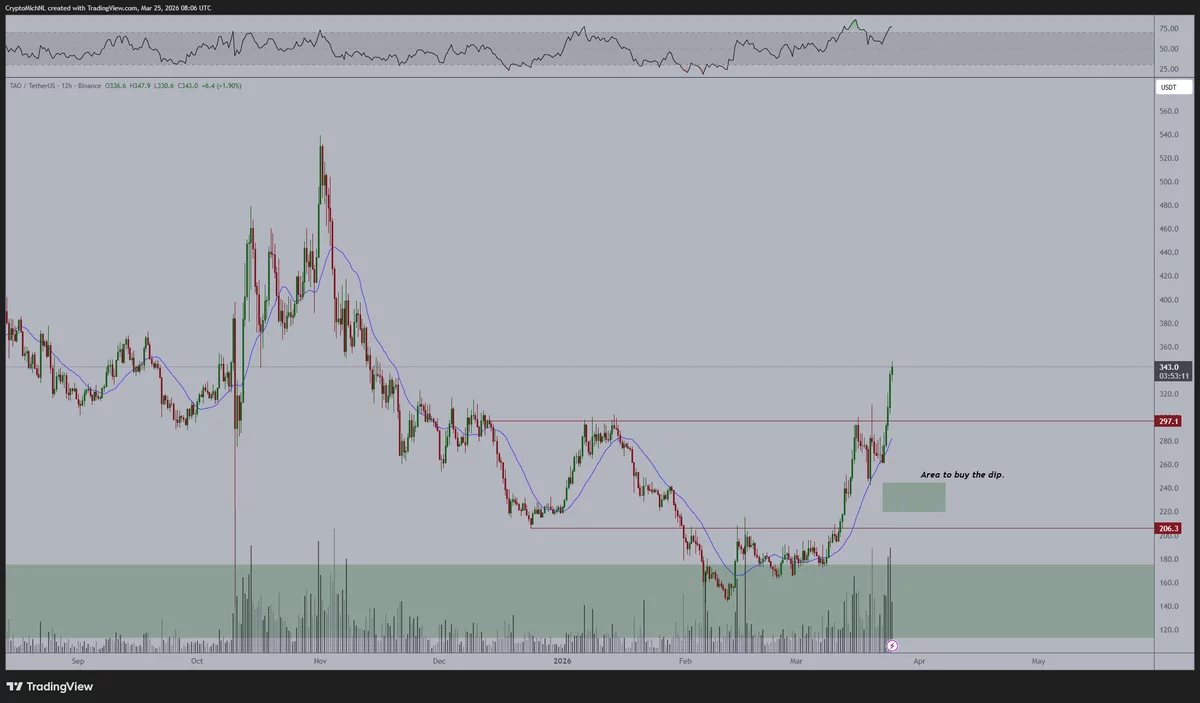
Bittensor’s native token TAO (TAO) moved higher on March 25 as traders tracked rising subnet activity, fresh staking data, and the network’s first halving event.
Summary
AO rose to $350 as traders tracked subnet growth, halving effects, and stronger market activity.
TAO staked across Bittensor subnets jumped past $620 million as the ecosystem expanded over months.
Only part of TAO sits in subnets, leaving room for more rotation from Root staking.
Consequently, the token traded at $350 at press time, with a 24-hour trading volume of $887.8 million, a daily gain of 12%, and a seven-day increase of 25%.
The move came as Bittensor’s subnet ecosystem posted rapid growth over the past year. Market participants also watched new comments from analysts and ecosystem figures as TAO reached its highest level since November 2025.
Advertisement
Moreover, Bittensor held a market capitalization of $3.35 billion, based on a circulating supply of 9.6 million TAO. The token ranked among the better-performing digital assets in the top 100 by market value over the past 24 hours.
Recent gains followed a broader move that started earlier in March. TAO had already moved above $300 after Nvidia CEO Jensen Huang referred to the Covenant-72B model during an appearance on the All-In Podcast, while market data also pointed to buying pressure and a short squeeze during the run-up.
CryptoRank data showed that the total TAO staked across subnets rose from about $74,400 to more than $620 million over the past 12 months. The increase came as more users moved into subnet participation, which plays a central role in Bittensor’s decentralized AI network.
Advertisement
Network activity also grew through the number of subnets. The count rose from about 80 to more than 120 over the same period, while several subnet projects posted monthly gains, including Templar at 171%, Quasar at 146%, NOVA at 66%, Targon at 36%, and iota at 29%.
Most TAO still sits outside subnets
Despite the rise in subnet staking, a large share of TAO remains outside subnet allocations. Mark Jeffrey, partner at Bittensor Fund and Stillcore Capital, said only 19% of TAO is staked in subnets, while about 48% remains in Root. He said,
“Once the first subnet zooms to $1B+, I expect Root stakers will start rushing into Subnets. Even if NO NEW TAO is bought, Subnets could 3x or 4x just because of that alone.”
His comment pointed to the scale of capital that could rotate within the ecosystem without fresh buying.
In addition, CoinGecko said TAO gains came after the network completed its first halving event, which cut token emissions by half. The reduced issuance added a new catalyst as traders assessed supply dynamics alongside ecosystem growth.
Advertisement
Crypto analyst Michaël van de Poppe also commented on the move. He wrote,
“What an absolutely wonderful morning with the strength of $TAO. Again; it’s in a new bull run, higher lows, higher highs. Next area of resistance: $500.”
Bittensor (TAO) price chart | Source: Michaël van de Poppe/X
Disclosure: This article does not represent investment advice. The content and materials featured on this page are for educational purposes only.
Gold price staged a defiant recovery on Wednesday, climbing 1.6% to settle at $4,550 even as geopolitical narratives shifted the analysis rapidly. The rebound was fueled by declining oil prices and reports of a potential Washington-brokered proposal to end the conflict in the Middle East.
While President Trump suggested negotiations with Tehran are active, Iranian officials have issued a stern denial, creating a volatile backdrop for safe-haven assets.
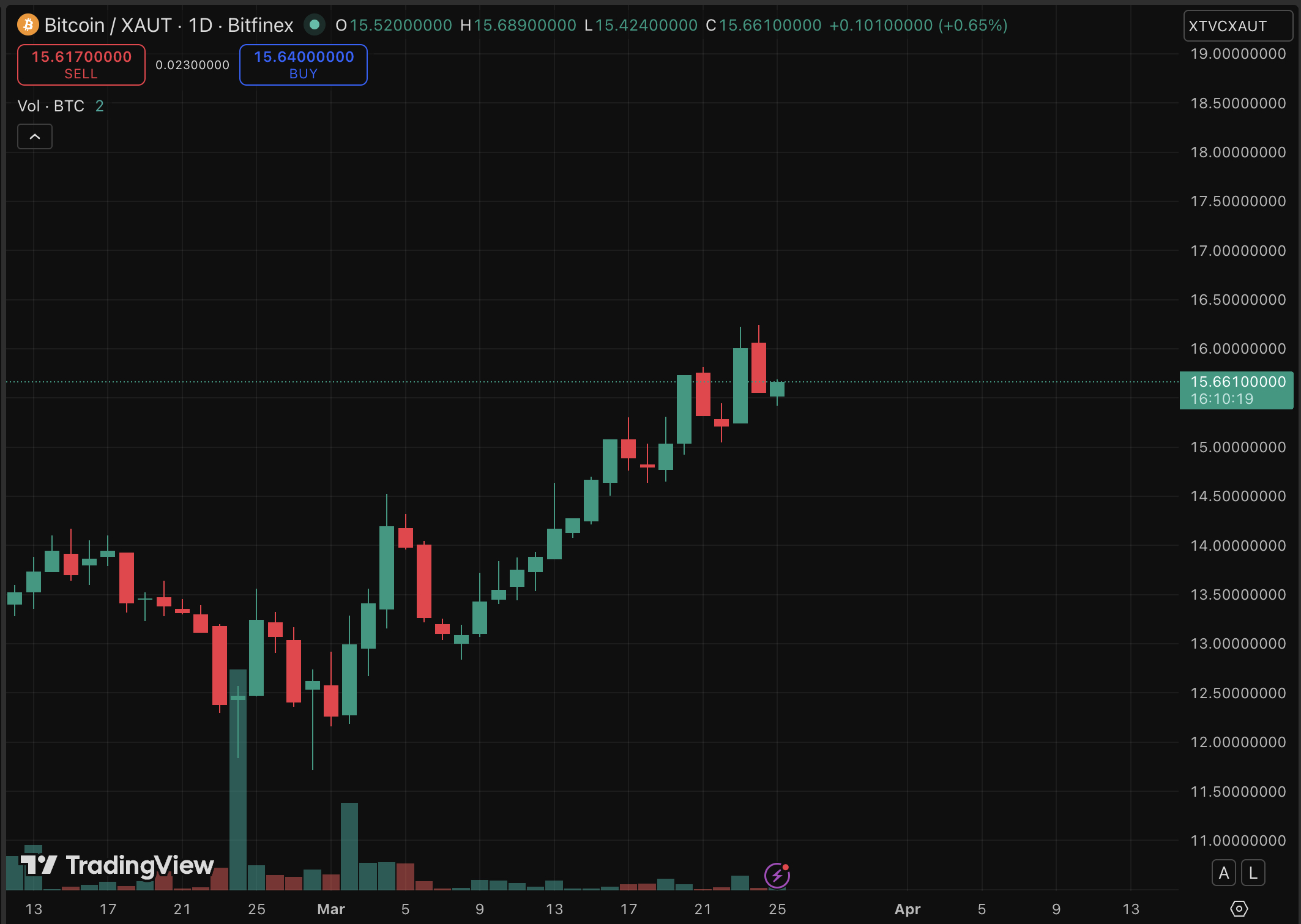
Spot markets reacted swiftly. Gold futures delivery surged over 3%, last seen at $4,545.50 per ounce. However, the broader trend remains concerning for bulls. Since March 4, the metal has suffered a 10% drop, significantly underperforming digital assets like Bitcoin, which has retraced only 4.5% in the same period. This divergence suggests that while headlines move prices momentarily, the underlying capital rotation favors digital scarcity.
BREAKING: Gold futures surge above $4,550/oz, now up +4% on the day, as optimism grows over US-Iran peace talks. pic.twitter.com/nUZfmY9uyb
Gold Price Analysis: Can XAU Sustain Gains Above $4,550?
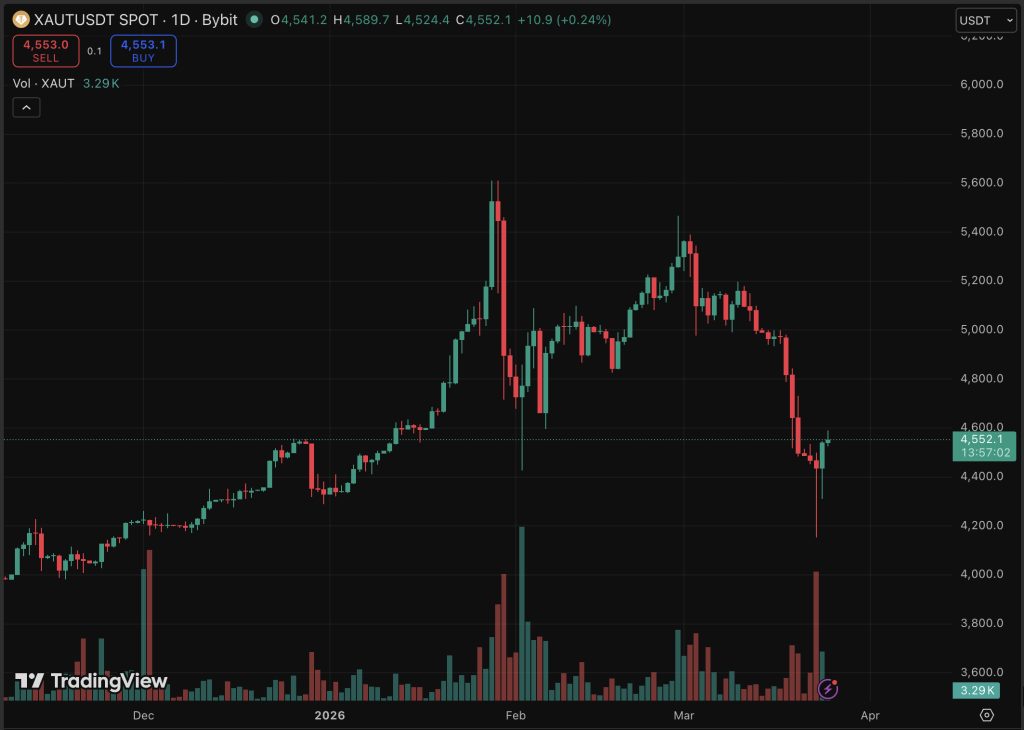
Tether Gold (XAUT), the crypto-native proxy for the metal, mirrors the spot recovery, trading at $4,553. This bounce, while welcome, does not erase the technical damage inflicted earlier in the month. The asset is currently trading in a noise vacuum, lacking the clearly defined support levels visible in the crypto market.
Analysts are watching the correlation between gold’s recovery and the digital asset market’s resilience. Bitcoin currently holds a critical floor above $70,000, with resistance stacking up near $74,500. If the safe-haven narrative flips decisively back to digital assets, driven by the “remarkable relative strength” noted by institutional researchers, gold’s current rally could prove to be a localized bull trap.
Recent data indicate a similar volatility pattern in silver markets, suggesting this is a sector-wide liquidity test rather than a gold-specific breakout. Unless gold can reclaim the structural highs lost in early March, the path of least resistance remains sideways to down.
LiquidChain Targets Cross-Chain Upside as Commodities Stall
Gold’s volatility, driven by contradictory war reports rather than fundamental demand, has pushed growth-focused traders toward high-beta infrastructure protocols. Metals may preserve wealth (sometimes), but they rarely multiply it overnight. As the macro landscape remains murky, smart money is rotating into Layer 3 solutions that solve liquidity fragmentation.
Enter LiquidChain ($LIQUID). This emerging Layer 3 protocol is building a unified execution environment that fuses Bitcoin, Ethereum, and Solana ecosystems into a single liquidity layer. The project has demonstrated significant early traction, raising $600K right now, from early backers.
The token is currently priced at $0.0143, with more than 1700% APY in staking rewards.
While early-stage tokens carry valid vesting risks, the LiquidChain presale presents a rare opportunity to enter a critical infrastructure play before mainnet valuation.
Disclaimer: This is not financial advice. Crypto assets are highly volatile. Do your own research.
Investors fled major gold funds as geopolitical tensions escalated, marking a distinct shift in capital allocation strategies. While gold spot ETFs bled, Bitcoin price has demonstrated resilience, holding the $70,000 level amid prediction of market whipsaws. This divergence suggests a potential changing of the guard, according to Bloomberg analyst.
The latest data paints a stark picture of this rotation. In the last week alone, top gold ETFs like GLD and IAU saw approximately $3.8 billion in exits. Conversely, Bitcoin investment products absorbed roughly $2 billion over the past few weeks, signaling that institutional appetite is shifting toward digital scarcity.
“Since the Iran strike, Bitcoin, surprisingly, has looked like a good safe haven and gold hasn’t,” noted Eric Balchunas, senior ETF analyst at Bloomberg Intelligence.
BTC XAUT, TradingView
Currently, Bitcoin trades above $71,000, noting a fractional bounce by 0.3% in the last 24 hours.
This decoupling challenges the traditional narrative that crypto assets are purely risk-on vehicles. With Bitcoin behaving as a store of value while gold falters, we are closely watching the $70,000 support zone for the next directional cue.
Bitcoin Price Prediction: Can BTC Hold $70,500 Support Amid Volatility?
Bitcoin’s price action over the last 48 hours has been defined by tight consolidation, oscillating between a high of $72,000 and a low of $69,000. While the asset remains down 18% year-to-date, the immediate short-term structure shows buyers stepping in aggressively near the $68,000 mark.
Volume data indicates a standoff and cautious optimism. However, overhead resistance at $71,800 remains a formidable barrier. If bulls fail to reclaim this level, a retest of the monthly low at $65,000 becomes a viable bearish scenario. Conversely, a breakout above $72,500 could open the path toward this year’s high.
BTC USD, TradingView
The technical setup suggests a market in waiting. Geopolitical catalysts are currently priced in, but the lack of a clear breakout keeps margin traders largely sidelined. For those seeking aggressive multiples, Bitcoin’s maturity into a “safe haven” may limit short-term explosive upside compared to emerging ecosystem plays.
Bitcoin Hyper Targets Early Mover Upside as L2 Narrative Heats Up
While Bitcoin stabilizes as a macro asset, the race to scale its network is accelerating. Capital is rotating into infrastructure layer-2 solutions that promise to unlock programmability for the world’s largest digital asset. Leading this charge is Bitcoin Hyper ($HYPER), the first-ever Bitcoin Layer 2 to integrate the Solana Virtual Machine (SVM).
The project is capitalizing on the demand for high-speed, low-cost execution on Bitcoin. By utilizing the SVM, Bitcoin Hyper delivers transaction finality faster than Solana itself, addressing Bitcoin’s core limitations—slow transactions and high fees—while maintaining a decentralized canonical bridge to the main chain. The market response has been quantifiable: the presale has already raised more than $32Million.
Early participants can enter at a price of $0.0136 per token with 36% APY on staking rewards. Beyond the technology, the protocol offers high APY staking incentives to secure the network early. As Bitcoin continues to trade sideways in the $70k range, the risk-reward ratio for pre-market infrastructure plays like $HYPER is drawing attention from traders looking to front-run the L2 ecosystem boom.
Ethereum price entered a pivotal stretch this week, trading at $2,170, a subtle +0.73% in the last 24 hours, as the network confronts deep existential questions regarding its roadmap prediction.
Following critical remarks from co-founder Vitalik Buterin regarding the ecosystem’s fragmented scaling approach, markets are reacting with caution. Data from prediction markets currently imply downside risks.
[X] I affirm the direction set out in the mandate, will help translate it into thoroughly reasoned strategies for my domain, and will maintain an exclusive and energetic focus on the mission-critical tasks necessary for its implementation, from today until my last day at the EF. https://t.co/D3puYiQzhB
The technical landscape has shifted violently in early 2026. While developers previously assumed applications would absorb complexity, Buterin argues that current Layer-2 (L2) proliferation may not fully deliver on Ethereum’s original design goals. This introspection arrives as the network attempts to secure itself against quantum threats and integrate AI capabilities.
Advertisement
This uncertainty regarding scaling architecture often leads capital to rotate. As established networks grapple with legacy cohesion, the market is pricing in the next generation of infrastructure plays.
Ethereum Price Prediction: Can ETH Hold Support This Week?
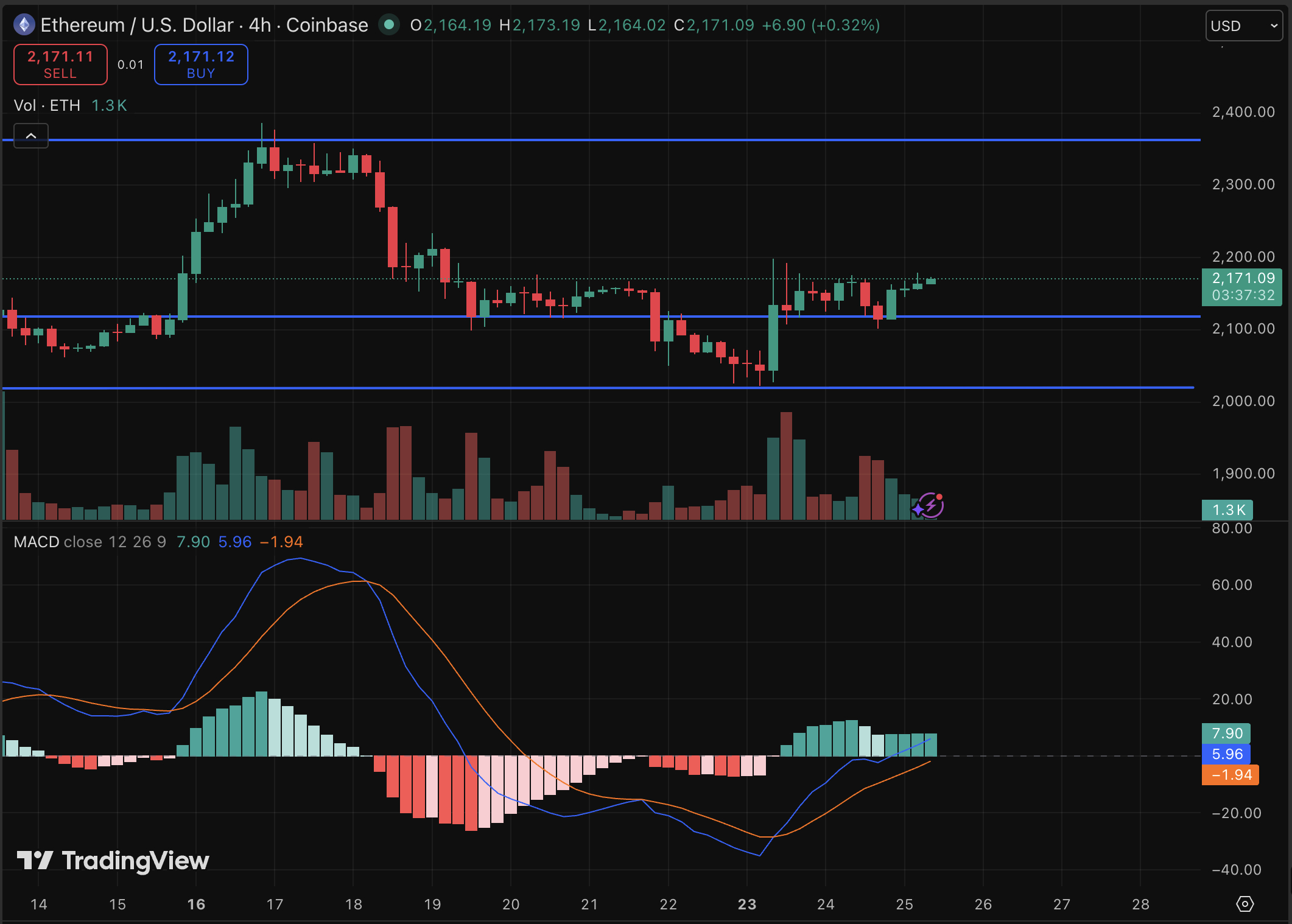
Ethereum’s price action suggests a battle for directional control. Currently changing hands at $2,170, ETH remains pinned between a critical support floor at $2,100 and overhead resistance at $2,350. Recent data reveals seller-skewed order books (47/43), indicating that bears are attempting to force a retest of the psychological $2,050 zone.
Advertisement
Technical indicators flash warning signs. While the MACD remains positive at 6, the histogram has turned red (-1.93), signaling that the bullish momentum seen during recent L2 testnet expansions is fading. A break below the 9-day DEMA at $2,300 has already occurred, forcing bulls to defend the lower range.
ETH USD, TradingView
The 24-hour trading range ($2,150-$2,180) reflects tight consolidation. If ETH can reclaim $2,300 and close above $2,400, analyst targets suggest a breakout toward the 200-EMA at $3,260 is possible.
LiquidChain Targets Unified Liquidity as Ethereum Segments
While Ethereum struggles with the fragmentation caused by disconnected Layer-2s—a concern highlighted explicitly by Buterin—investors are looking toward protocols that solve the liquidity fracture. This narrative shift has directed significant volume toward LiquidChain ($LIQUID), a Layer-3 infrastructure project designed to unify execution across chains.
Advertisement
Unlike current scaling solutions that isolate liquidity, LiquidChain fuses Bitcoin, Ethereum, and Solana into a single execution environment. The project’s presale has already raised more than $600K, with more than 1700% APY rewards.
Priced at $0.0143 during the current tranche, the project offers a verifiable settlement layer that appeals to traders fatigued by bridging risks. While high-cap assets like ETH face resistance in established price channels, early-stage infrastructure plays like LiquidChain are capturing the “solution utility” premium.
Investors holding silver positions opened in early this year are staring at significant unrealized losses today. Silver price finished yesterday’s session down to $68 per ounce, a sharp retraction from the $120 highs seen in late January following a turbulent market analysis.
Following a volatile trading window where prices collapsed as low as $61 during the Asian session, market participants are scrambling to reassess the geopolitical premiums previously baked into the commodity. This 40% drawback highlights the dangers of chasing assets that climb “like fireworks.”
Silver Price Analysis: Can The Metal Stabilize After Double-Digit Drop?
$69 is the number currently defining traders’ screens. The session low of $61, printed at 3 a.m. ET, now serves as the critical support floor. The volatility stems directly from macro-geopolitical developments involving the United States and Iran, specifically regarding the Strait of Hormuz. While the threat of immediate escalation has been postponed by five days to allow for talks, the market reaction suggests the risk premium is eroding faster than bulls anticipated.
Technical indicators scream caution. The swift drop from $120 suggests the parabolic phase has fractured. Volume on the downdraft was significant, indicating institutional liquidation rather than mere retail panic.
XAG USD, TradingView
If the $61 level fails to hold during the next testing of liquidity, analysts suggest further downside is probable. Conversely, a stabilization here requires a distinct shift in sentiment, perhaps fueled by safe-haven narratives reversing back to precious metals. Capital seems to be rotating, and fast.
Bitcoin Hyper Targets Early Mover Upside as Commodities Stumble
While silver investors lick their wounds from an 18.5% correction, smart capital is actively hunting for infrastructure plays that offer yield rather than just a volatile store of value. The heavy volatility in traditional commodities is driving a rotation into programmable assets—specifically Bitcoin Layer 2s.
Enter Bitcoin Hyper ($HYPER), the first-ever Bitcoin Layer 2 solution integrating the Solana Virtual Machine (SVM).
This project is not relying on geopolitical fear; it is building structural utility. Bitcoin Hyper has already raised an exact $32 million in its presale, signaling massive demand for high-speed Bitcoin infrastructure.
By bridging Bitcoin’s trust with Solana’s speed, $HYPER offers low-latency transaction execution and high APY staking with 36% rewards. The token is currently priced at $0.0136.
Investors tired of commodity whiplash are increasingly looking to research Bitcoin Hyper as the next growth frontier.
Disclaimer: This article is for informational purposes only and does not constitute financial advice. Cryptocurrency and commodity investments are highly volatile. Please do your own research.








⟁https://t.co/vqvBcdSj94 pic.twitter.com/R7ZeZ0NPGl







 pic.twitter.com/bnGCAFJmRa


 https://t.co/VNG0P4GuDo pic.twitter.com/XHI9QxT4Tv






 Fashion5 days ago
 Politics5 days ago
 Crypto World3 days ago
 News Videos7 days ago
 Crypto World4 days ago
 Tech5 days ago
 Crypto World7 days ago
 Sports2 days ago

 News Videos7 days ago
 Politics6 days ago
 Business3 days ago
 Business7 days ago
 Sports2 days ago
 Tech3 days ago

 Tech7 days ago
 Sports5 days ago
You must be logged in to post a comment Login