
Crypto World
Reset ahead as 90D open interest falls

XRP price outlook leans towards a market reset amid falling open interest and a spike in realized losses.
Summary
- XRP has seen a sharp decline in recent sessions, pulling back over 60% from its 2025 high.
- Open interest has dropped across Binance, Bybit and Kraken, reflecting broad leverage reduction.
- A major realized loss spike and tightening volatility place price near a key technical inflection zone.
XRP (XRP) was trading at $1.39 at press time, down 5.4% over the past 24 hours, as the broader crypto market extended its February pullback.
The token has fallen 27% over the past week and is now down 38% year-over-year, marking a steep 62% retracement from its July 2025 all-time high of $3.65.
Price action throughout the month has been volatile. XRP saw brief upside bursts, including a roughly 6% rally tied to renewed institutional spot interest and ETF-related developments. Those gains were short-lived.
Selling pressure returned quickly, supporting the downtrend that has been in place since the $2.60–$2.80 region.
Lower highs and lower lows have defined the structure, and recent candles show the market attempting to stabilize after a sharp capitulation wick toward the $1.30 area.
Open interest drops as leverage unwinds
A Feb. 26 report from CryptoQuant contributor Arab Chain pointed to a steady contraction in XRP derivatives positioning. The 90-day open interest change metric shows that traders have reduced exposure across major venues.
Platforms such as Binance, Bybit, and Kraken have all recorded declines in open contracts over the past three months.
When open interest falls across several exchanges at once, it usually means leverage is being taken off the table. Positions are closed, risk is trimmed, and speculative liquidity leaves the market.
That type of contraction does not automatically point to another leg lower. In many cycles, the price first needs to flush excess leverage before it can form a more stable base.
On-chain data adds context. According to Santiment, XRP recently logged its largest realized loss spike since 2022. The last time weekly realized losses approached $1.93 billion, the asset rallied more than 100% in the months that followed.
Fear often drives investors to sell below their entry price, resulting in significant losses. Selling pressure may go down as fewer weak hands are left after a lot of holders leave.
There is no guarantee that the market will bounce back right away, but historically, these points happen close to major market turns.
XRP price technical analysis
On the daily chart, XRP remains in a downtrend, with lower highs forming consistently since late 2025. Recently, however, price behavior has changed. Instead of sharp red candles, the market is now consolidating within a tight range.
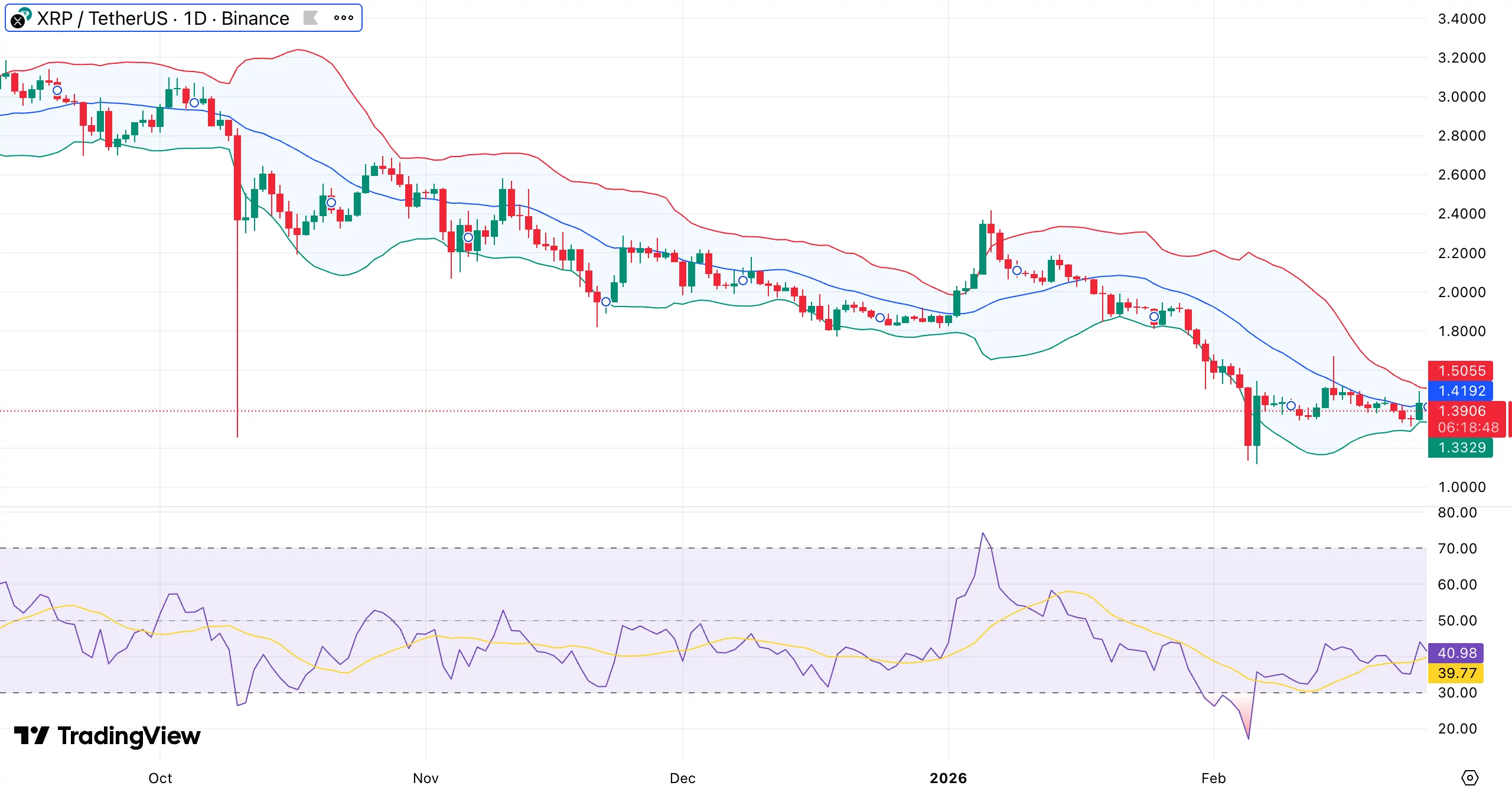
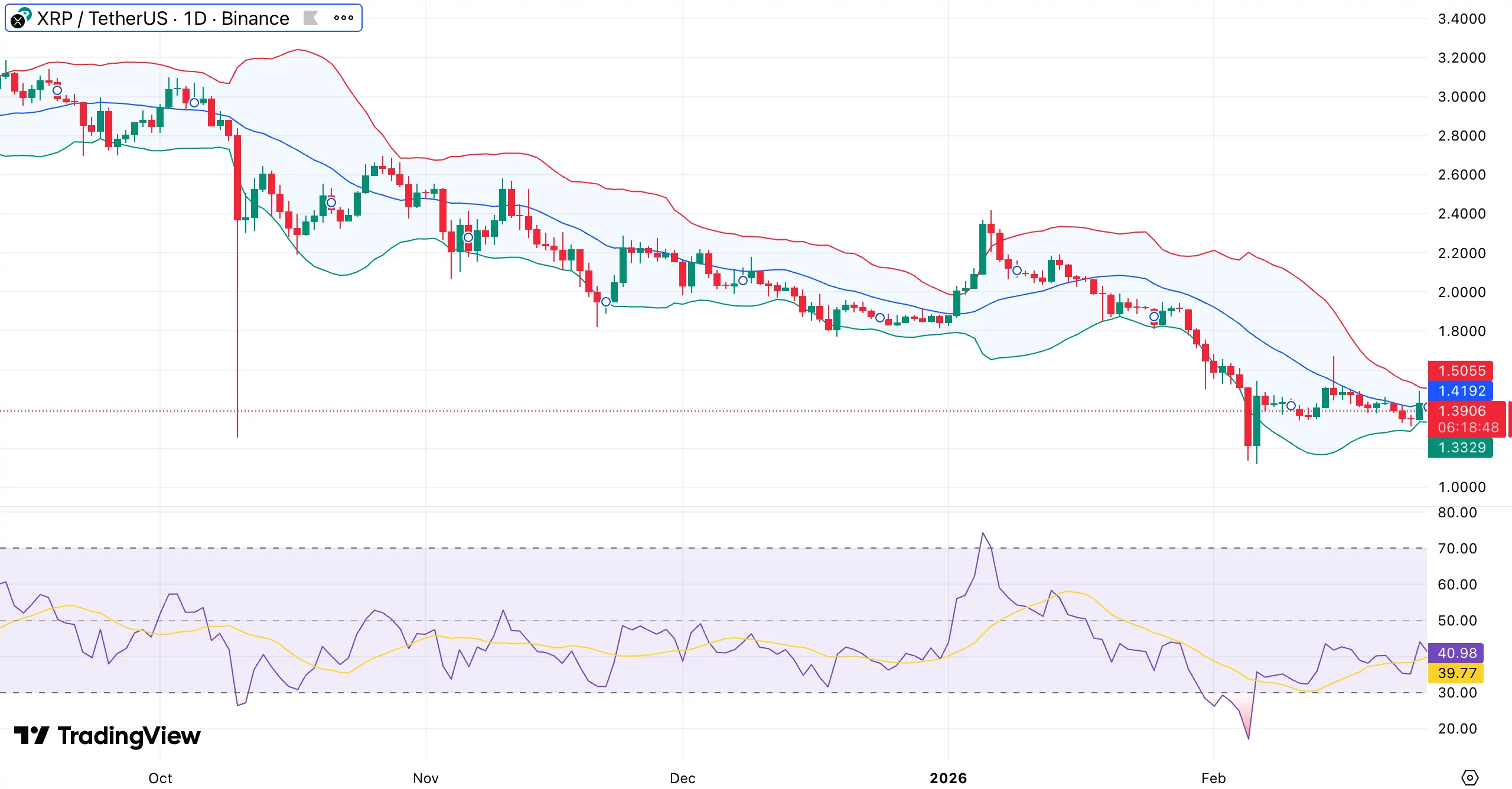
Bollinger Bands, which expanded during the selloff, have begun to contract. The price hovers near the 20-day moving average at $1.41, indicating a balance between buyers and sellers.
Momentum is starting to show signs of strain. The relative strength index has bounced back from oversold, but it is still below 50, which means that bulls haven’t fully taken over. A push above 50 would change the momentum in favor of buyers.
A volatility squeeze appears to be developing, and expansion is likely to follow. The $1.50–$1.55 area stands as the key resistance zone. A clean break and daily close above it would invalidate the most recent lower high and open room toward $1.65 and potentially $1.80.
On the downside, $1.33 remains immediate support, with $1.28–$1.30 acting as the structural floor from the recent liquidity sweep.


Key Takeaways
- Bank of America data reveals Kalshi controls 89% of U.S. prediction market trading volume
- Overall prediction market activity increased 4% weekly, though Polymarket experienced a 16% decline
- Federal agencies filed lawsuits against Arizona, Connecticut, and Illinois on April 2, 2026 regarding state-level gambling regulation
- A federal appeals court sided with Kalshi in New Jersey on April 6, 2026
- The resolution of these federal-state disputes will shape the industry’s regulatory landscape
The U.S. prediction market sector continues expanding, yet a jurisdictional conflict between federal authorities and state governments is reshaping regulatory control over the industry.
Recent Bank of America analysis indicates aggregate weekly trading activity climbed 4% compared to the previous week. Kalshi experienced 6% growth during this timeframe. Polymarket recorded a 16% decrease in trading volume during the identical period.
Kalshi currently commands approximately 89% of tracked U.S. prediction market activity. Polymarket accounts for 7% while Crypto.com represents 4%, based on Bank of America’s calculations.
The disparity between platforms stems from their regulatory approaches. Kalshi maintains registration with the Commodity Futures Trading Commission (CFTC) and positions its offerings as federally supervised derivatives. Polymarket operates through blockchain technology and has traditionally functioned beyond U.S. regulatory frameworks.
State governments have mounted resistance. Nevada and Massachusetts secured preliminary injunctions targeting Kalshi. Arizona escalated matters in March 2026 by pursuing criminal charges against the platform — marking the first criminal prosecution ever directed at a CFTC-registered entity.
Federal Agencies Launch Legal Action Against Three States
On April 2, 2026, the CFTC and Department of Justice initiated three distinct federal lawsuits targeting Arizona, Connecticut, and Illinois. The legal actions directly name state governors and regulatory officials.
The CFTC characterized this action as “unprecedented” and justified it as essential for defending its exclusive authority over event contracts under the Commodity Exchange Act.
Connecticut distributed cease-and-desist notices regarding sports-focused contracts. Illinois followed with similar enforcement actions. Arizona advanced to criminal prosecution.
CFTC Chairman Michael Selig stated: “The CFTC will continue to safeguard its exclusive regulatory authority over these markets and defend market participants against overzealous state regulators.”
State authorities remain defiant. Connecticut Attorney General William Tong characterized the contracts as “plainly unlicensed illegal gambling.” An Illinois representative argued these firms expose citizens to products lacking “basic consumer protections.”
Federal Appeals Court Rules for Kalshi
On April 6, 2026, the U.S. Court of Appeals for the Third Circuit issued a 2-1 decision favoring Kalshi. The ruling prevented New Jersey gaming authorities from enforcing state gambling regulations on Kalshi’s operations.
The court determined that Kalshi’s event contracts qualify as “swaps” under the Commodity Exchange Act, establishing the CFTC’s exclusive regulatory authority. This represents the first federal appellate decision addressing this jurisdictional question.
Kalshi CEO Tarek Mansour described it as “a big win for the industry.”
Should federal regulators succeed in pending litigation, platforms such as Kalshi could function under unified national regulations. Conversely, defeats could fragment the industry into a state-specific regulatory structure resembling online sports wagering.
Binance revealed on April 10, 2026 that it integrated a prediction markets capability into Binance Wallet, demonstrating sustained engagement from prominent cryptocurrency platforms in this sector.
The CFTC maintains an active public feedback window through the end of April concerning an Advanced Notice of Proposed Rulemaking for prediction markets.

The March Consumer Price Index (CPI) data, a measure of the cost of goods and services, lands today with a hot print expected amid Iran war-driven energy costs. A fragile ceasefire has offered reprieve, but uncertainty lingers. Crypto whales are already positioning.
BeInCrypto analysts tracking on-chain whale activity have identified three tokens showing sharp accumulation or selling ahead of the release.
Ethereum (ETH)
Among the tokens seeing heavy whale accumulation ahead of the April CPI print, Ethereum (ETH) stands out. Its positioning dwarfs all others.
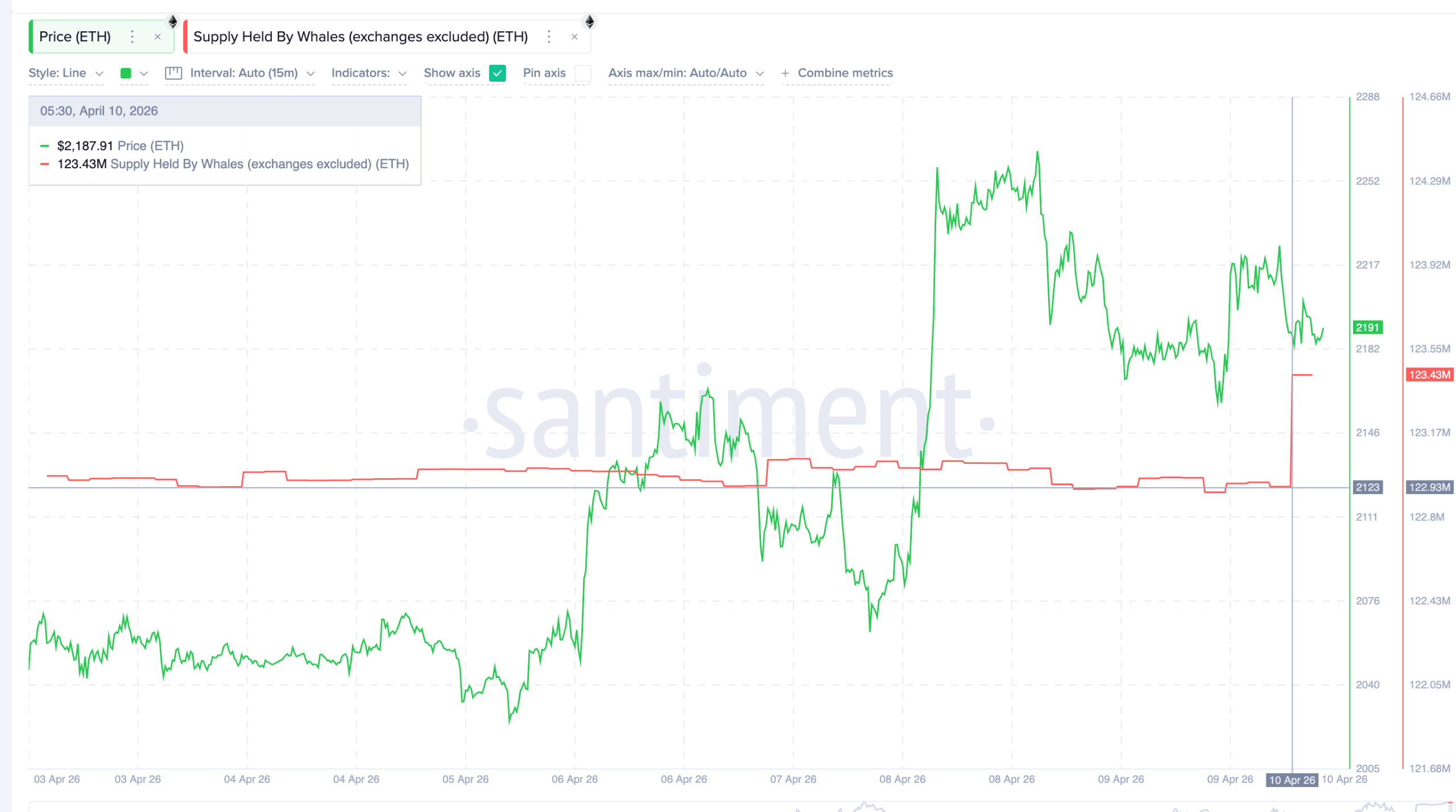
Santiment data shows ETH crypto whale wallets surged from 122.93 million to 123.43 million tokens in hours. That 500,000 ETH increase translates to roughly $1.09 billion in fresh buying.
Want more token insights like this? Sign up for Editor Harsh Notariya’s Daily Crypto Newsletter here.
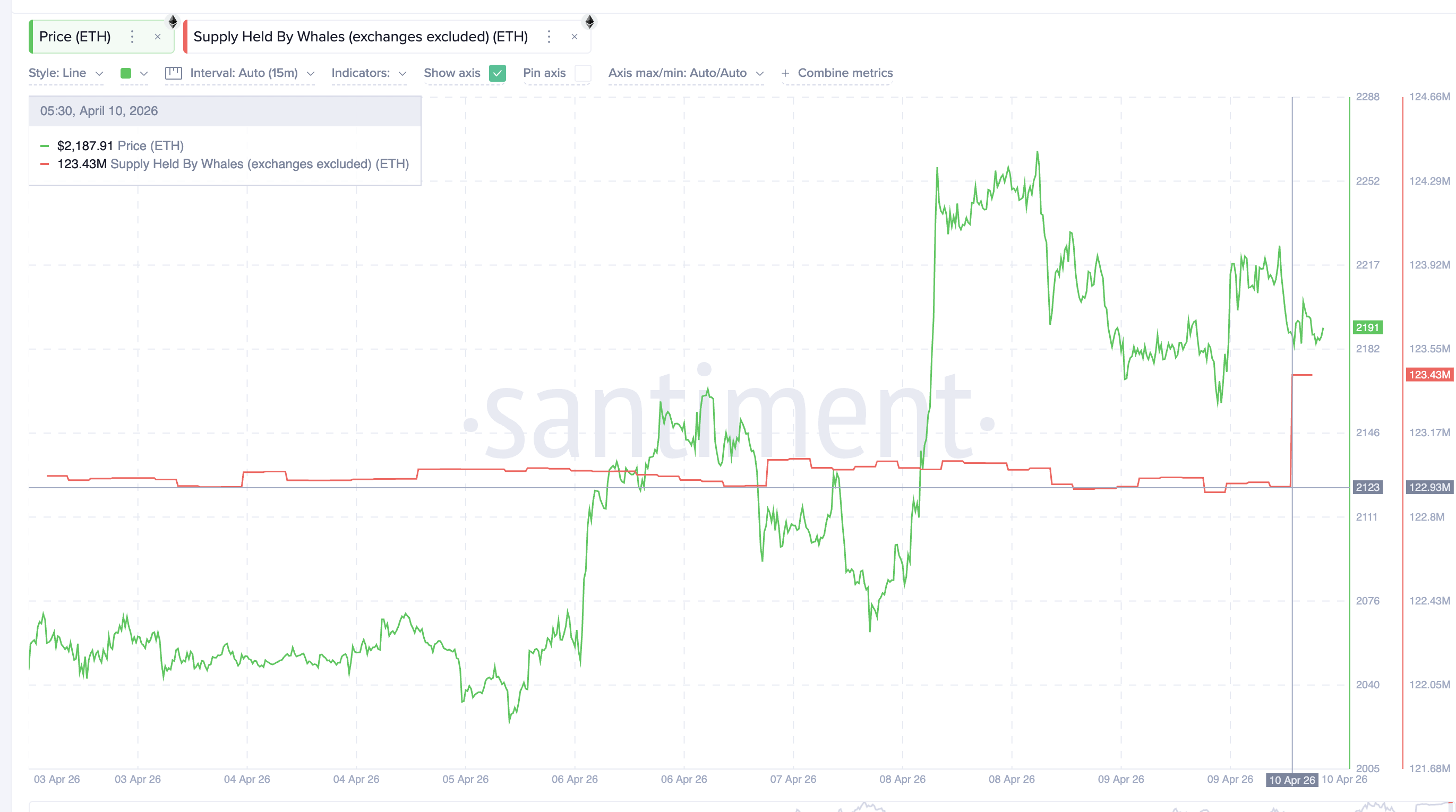
Headline CPI is expected to spike due to a 10.6% month-over-month jump in energy costs. However, core CPI inflation data is forecast at a softer 0.3% month over month. Large holders appear to be betting on that softer undertone sparking a relief rally.
Meanwhile, the Ethereum Foundation recently staked roughly 45,000 ETH to generate yield rather than sell. That structural shift reduces ongoing sell-side pressure from a major network entity and reinforces the bullish thesis.
On the daily chart, ETH is forming a cup-and-handle pattern inside a descending channel. The cup bottomed near $1,938 before curving higher. The handle’s upper boundary aligns with the channel neckline near $2,270. A single breakout could therefore confirm both structures simultaneously. A daily close above $2,231 would signal early strength.
A move through $2,270 followed by a clean reclaim of $2,300 would validate the pattern. That level aligns with the 0.618 Fibonacci level and would confirm renewed momentum.
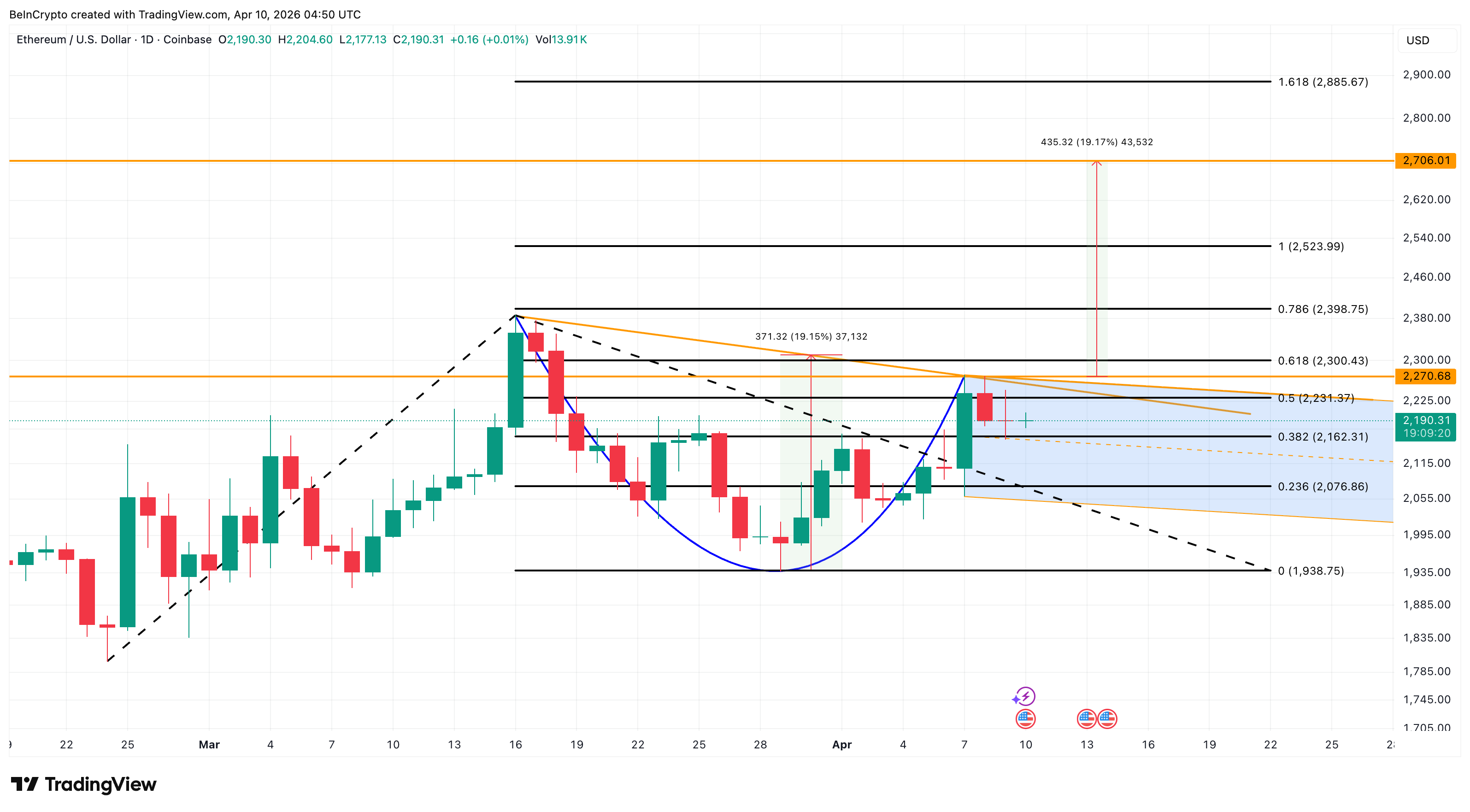
The projected upside sits near 19.15%, which could push ETH toward $2,706. However, a drop below $2,162 would weaken the setup. The pattern gets fully invalidated with a close under $1,938.
Uniswap (UNI)
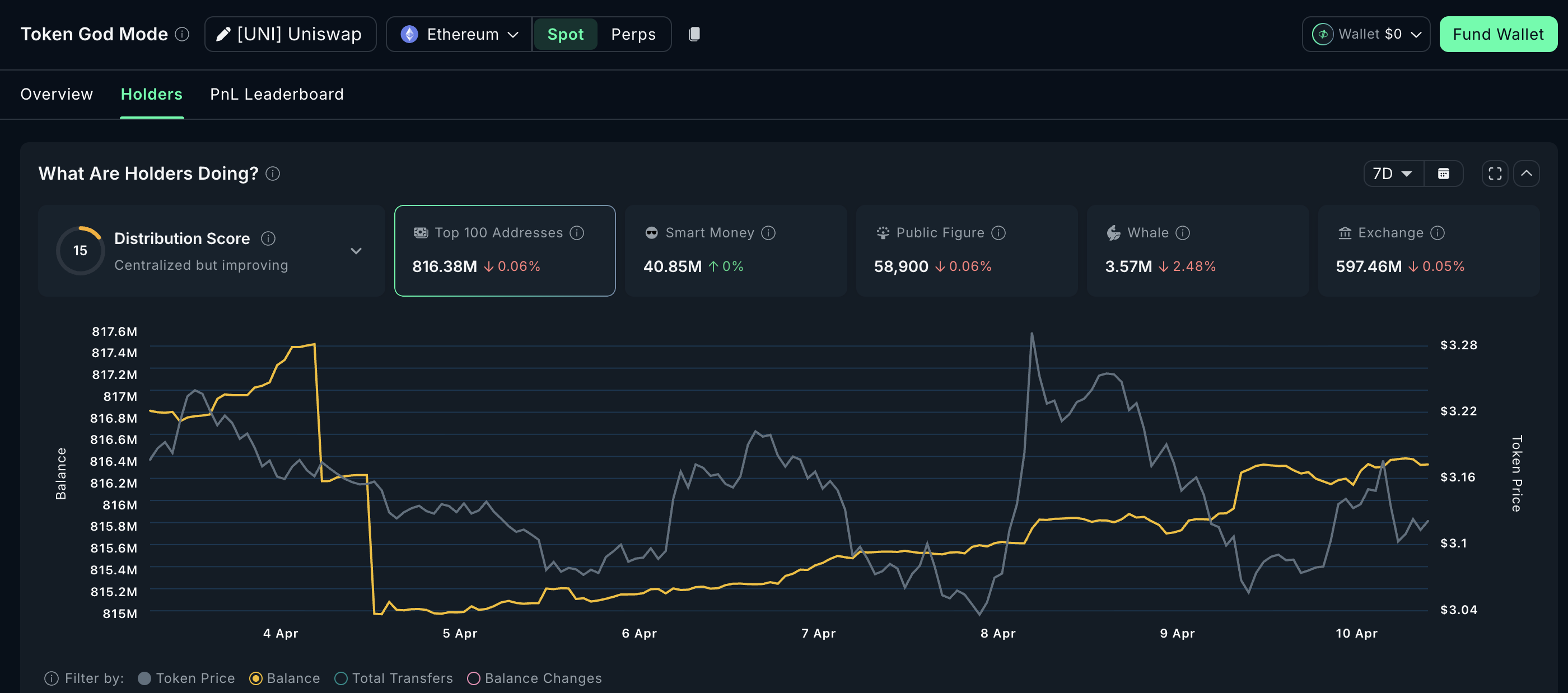
While some crypto whales are loading up ahead of the CPI print, others are trimming DeFi exposure. In contrast to Ethereum’s $1.09 billion inflow, Uniswap (UNI) has seen consistent whale selling pressure over the past seven days.
Nansen data shows UNI whale wallets cut holdings by 2.48% over the past week. The stash now sits at 3.57 million tokens. That amounts to roughly 90,000 UNI sold, worth approximately $283,000 at the current price near $3.14. The selling aligns with broader DeFi profit taking as the sector trades mostly flat in the 7-day timeframe. Large holders appear to be de-risking ahead of a volatile CPI print rather than reacting to any UNI-specific catalyst.
The daily chart supports the bearish tone. UNI has been trading inside a bear flag pattern since its March 13 high of $4.21. The flag’s lower boundary was tested near $3.01. UNI has since rebounded without reclaiming meaningful resistance. The 7-day whale distribution aligns with this bearish structure.
If that lower trendline breaks, the projected drop stands at roughly 28%. A daily close below $3.08, the 0.618 Fibonacci level, would start the trigger. Support levels at $2.92 and $2.72 could slow the decline. Yet the measured target sits near $2.20 if buyers fail to step in.
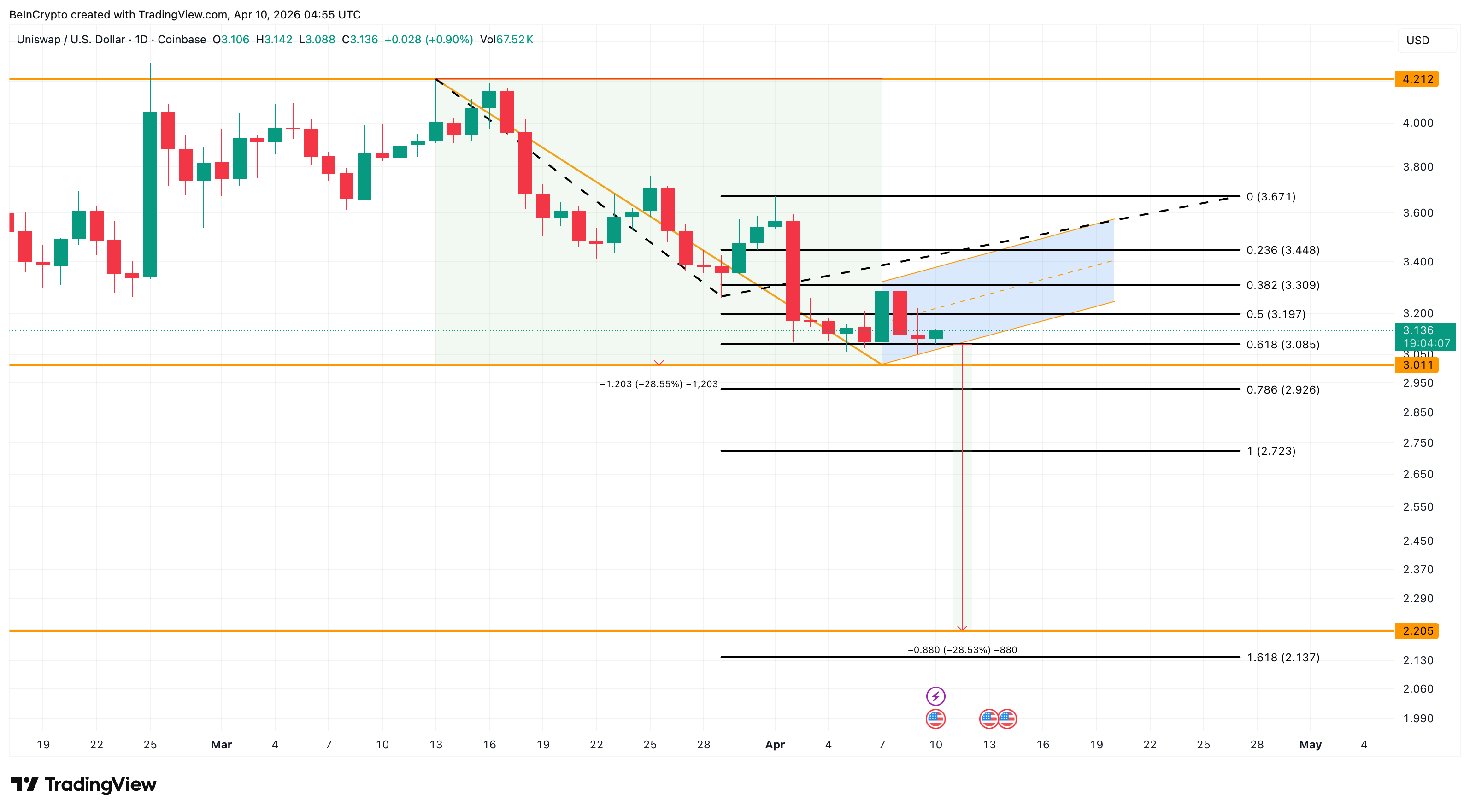
However, a push above $3.44 would challenge the bearish structure. A move beyond $3.67 would likely invalidate the bear flag entirely.
Chainlink (LINK)
Chainlink (LINK) rounds out the altcoin whale buying picture with a sudden surge in accumulation over the past few hours. Its oracle infrastructure feeds price data to DeFi protocols, positioning it to benefit from any activity uptick.
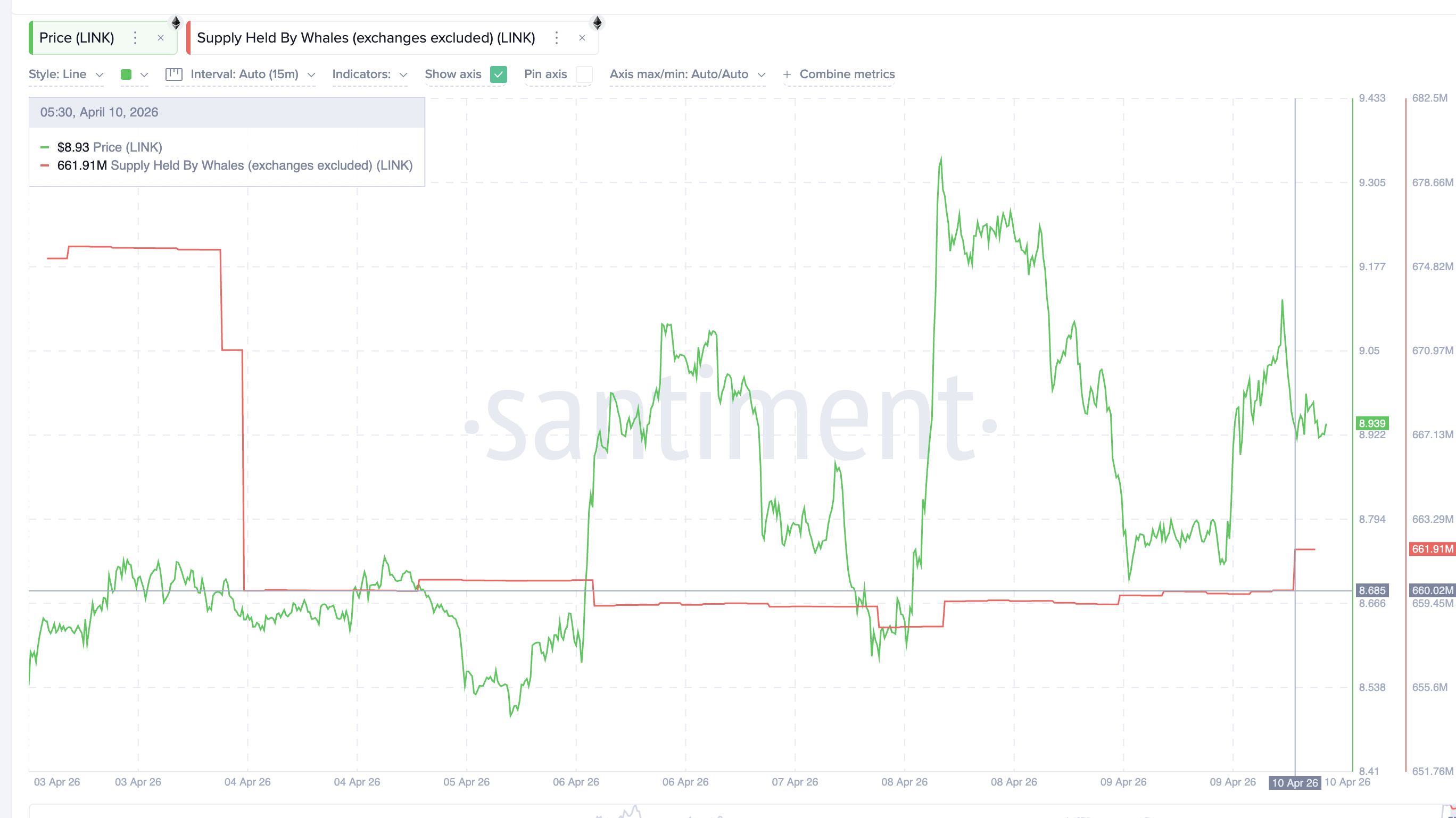
Santiment data shows LINK whale wallets climbed from 660.02 million to 661.91 million tokens. That 1.89 million LINK pickup translates to approximately $16.93 million in fresh buying. The accumulation mirrors the ETH whale pattern. Large holders appear to see the CPI print as a potential macro catalyst, provided a softer core reading surfaces.
On the daily chart, LINK is trading inside an inverse head-and-shoulders pattern. The right shoulder has locked into place, and the neckline sits near $9.43. From the head to the neckline, the measured target implies a 15.40% move higher. That could push LINK toward $10.82, above the psychological $10 mark.
A daily reclaim of $9.43 would confirm the breakout. From there, $9.63 and $9.89 serve as the first set of intermediate targets. However, $8.96 acts as the immediate floor. A slip below $8.68 would put the right shoulder under threat.
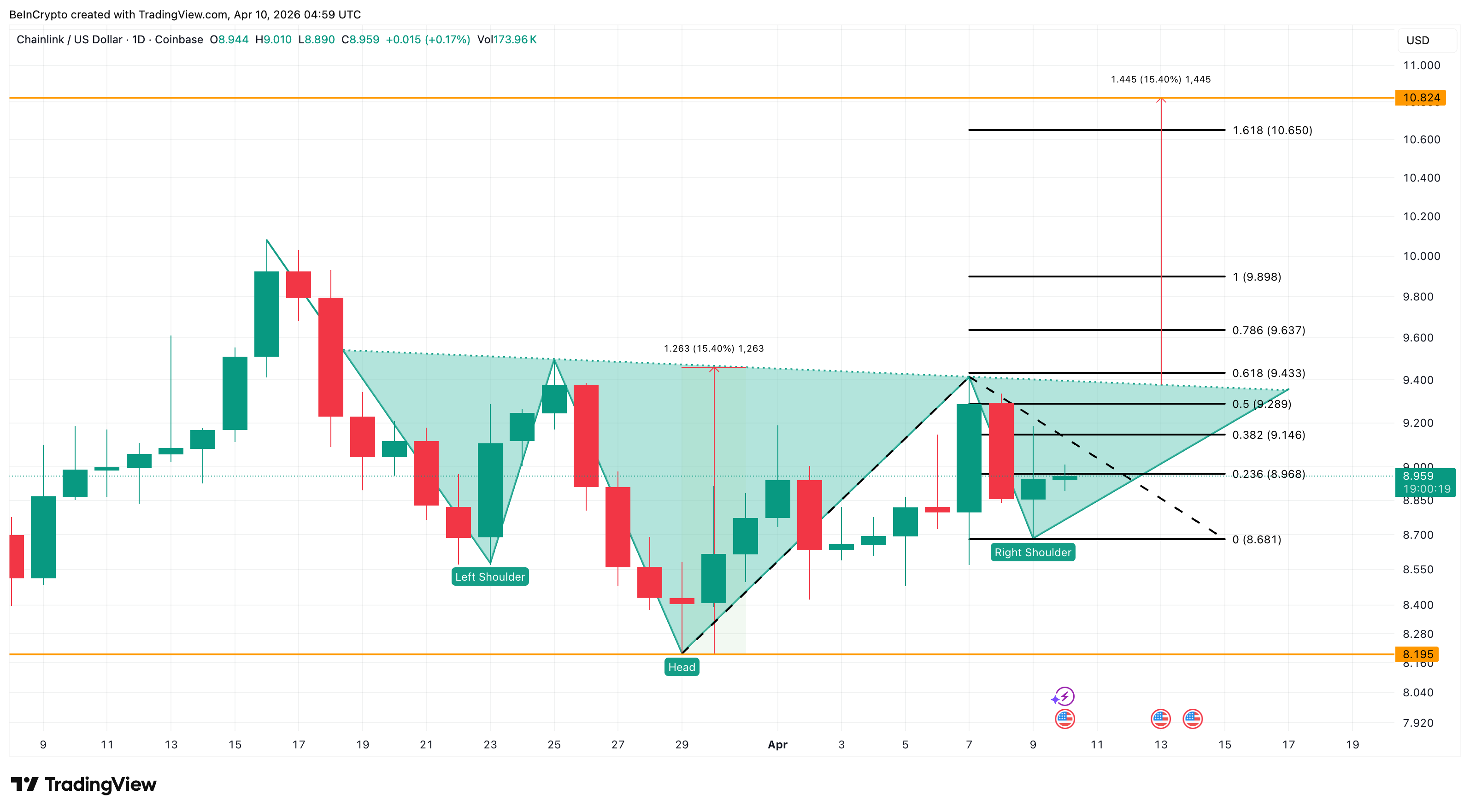
Yet the pattern retains its validity as long as LINK holds above $8.19, the head of the formation. Only a daily close below that level would fully invalidate the setup. Despite the macro uncertainty, that gives bulls a relatively wide margin of safety heading into the CPI release.
The post What Crypto Whales Are Buying and Selling Ahead Of The April US CPI Print appeared first on BeInCrypto.
Crypto World
Solana (SOL) Price Analysis: Critical Levels Emerge as ETF Outflows Accelerate in April
Key Takeaways
- Solana is currently positioned around $83, facing pressure from a downward trendline and multiple exponential moving averages
- ETF withdrawals totaled $17.08 million this week, with Tuesday recording an unprecedented single-day exit of $15.40 million
- Liquidation activity reached $7.99 million in the past day, with short positions accounting for the majority
- The crucial resistance barrier sits at the 50-day EMA zone between $87 and $88
- Technical analyst Ali Martinez identified a recurring pattern where SOL temporarily breaks above the 50-day MA before retreating
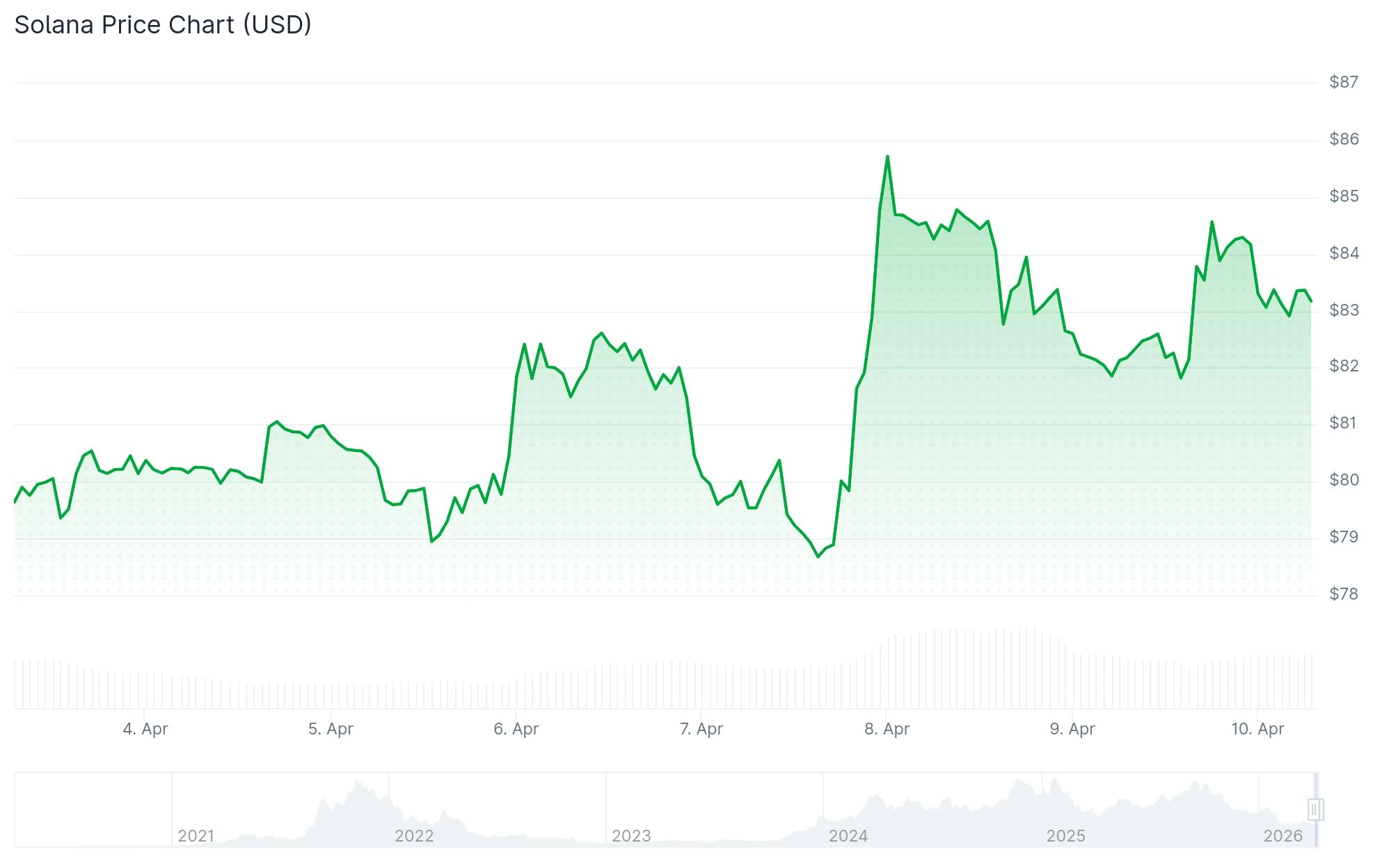
As of Friday, April 10, Solana maintains a position near $83, successfully defending the $80 floor but unable to generate upward momentum. The cryptocurrency remains constrained beneath its 50-day, 100-day, and 200-day Exponential Moving Averages, creating a neutral to bearish technical setup.
A declining trendline drawn from the peaks on January 14 and April 7 continues to cap upside movement, intersecting with the 50-day EMA in the $87–$88 range. Multiple attempts to breach this technical ceiling have failed to produce sustained closes above it.
Momentum indicators present a subdued picture. The Relative Strength Index currently registers 47, indicating neutral territory without directional conviction. Meanwhile, the Moving Average Convergence Divergence displays marginally positive values, though insufficient to signal an imminent trend reversal.
Institutional Capital Exits Accelerate
Institutional sentiment toward Solana has deteriorated noticeably throughout the week. United States-based spot SOL exchange-traded funds have experienced cumulative withdrawals of $17.08 million, headlined by Tuesday’s historic single-session outflow of $15.40 million.

Prolonged ETF redemptions generally signal institutional reallocation strategies and often contribute to downward price momentum in the underlying asset.
In derivatives markets, CoinGlass tracking reveals $7.99 million in liquidations across the last 24-hour period. Short positions comprised $5.97 million of these forced closures, indicating bears faced the brunt of volatility. Open Interest contracted by 1.48% to $4.78 billion, signaling diminished trader engagement.
The Open Interest-weighted funding rate maintains a marginal positive stance at 0.0038%, while the long-short ratio stands at 1.0141, indicating a slight tilt toward bullish positioning among active traders.
Technical Expert Identifies Cyclical Breakdown Behavior
Cryptocurrency analyst Ali Martinez shared observations on X documenting a pattern that has materialized three separate times since November 2025. In each instance, SOL momentarily recovered the 50-day Moving Average before failing to sustain elevation, followed by sideways movement and subsequent price deterioration.
Martinez emphasized that extended periods trading beneath the 50-day MA historically precede additional downside moves, based on recent price behavior.
Solana has predominantly oscillated within a $78–$92 corridor since March 5, when volatile trading drove prices from $92 down to $78 within a single session.
For bulls, a decisive daily close above $88 would establish a path toward the 100-day EMA positioned near $99.86. Conversely, if SOL breaks decisively below $80, attention shifts to support zones at $76.50 and potentially $47.90, a longer-term downside objective AMBCrypto outlined in February using weekly chart analysis.
Immediate resistance confronts SOL at $85, followed by the critical $88 level. Downside protection exists at $82.50, $81.40, and $80.
US stock markets are staging a recovery from the March selloff, with three key signals aligning to signal renewed confidence.
The rebound follows a volatile first quarter shaped by the US-Iran conflict, surging oil prices, and broad risk-off sentiment across equities and crypto markets.
Stock Market Flashes Recovery Signals
The Kobeissi Letter reported that the S&P 500 has posted its longest winning streak since October 2025. It has rallied 8% from its March 30 low.
Follow us on X to get the latest news as it happens
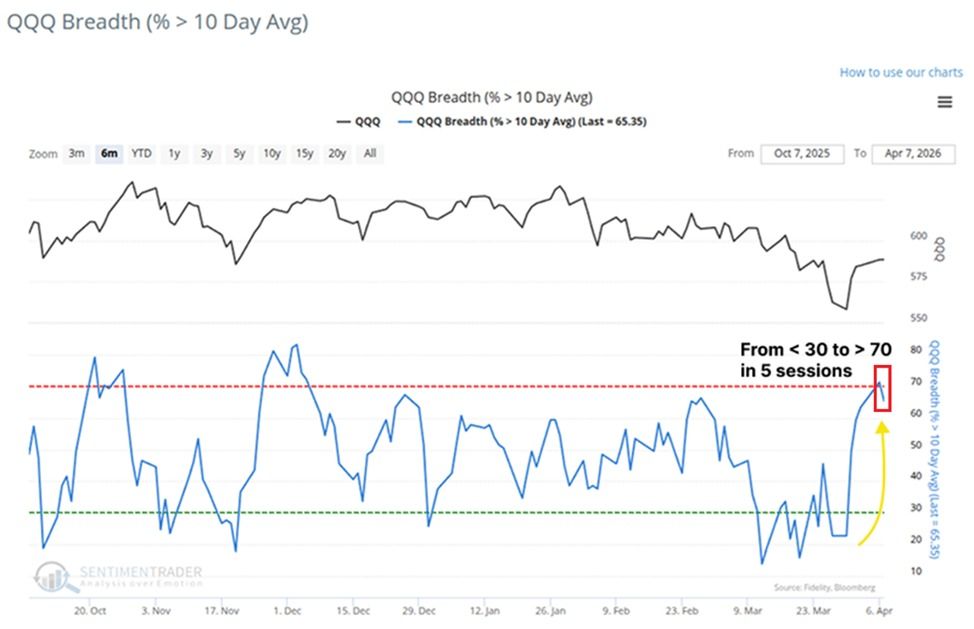
In a separate post, the analysts noted that roughly 65% of the stocks in the Invesco QQQ Trust (QQQ), which tracks the Nasdaq 100, are now trading above their 10-day moving averages.
That figure has jumped 40 points in just five sessions, the sharpest increase since November. In March’s second week, only 12% of stocks traded above that same average. That was the lowest reading in at least six months.
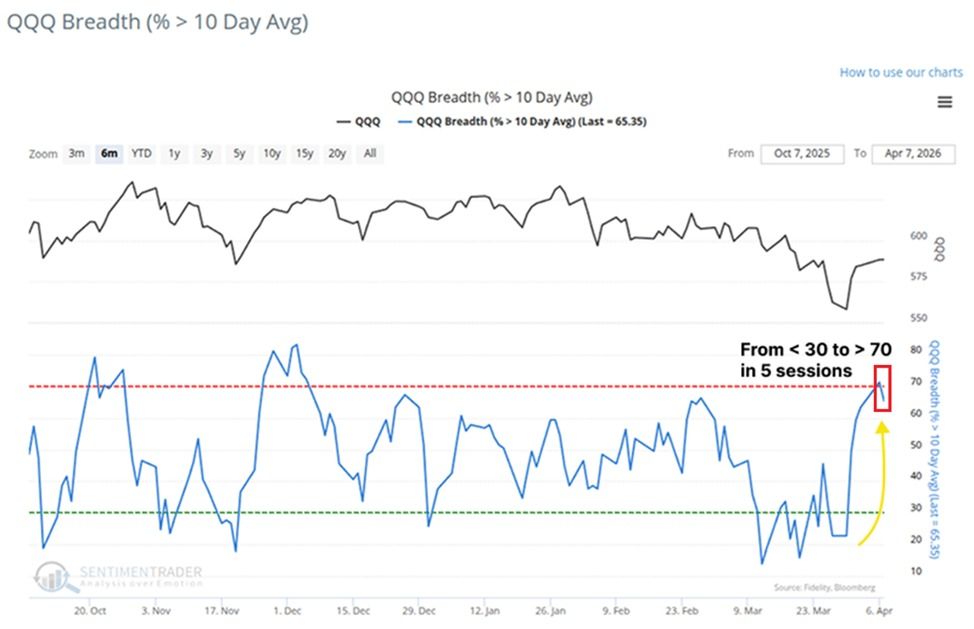
The improvement extends beyond tech. More than 70% of stocks in the S&P 500 and the Dow Jones Industrial Average (DJIA) have also reclaimed their 10-day moving averages. This suggests the rally is broad-based rather than driven by a handful of mega-cap names.
Historically, the Nasdaq 100 has traded higher 80% of the time over the following 12 months after reversals of this magnitude. That pattern adds a statistical backdrop to the current momentum.
“The market is setting up for a historic recovery,” the post read.
Insiders Remain Optimistic
Corporate executives also signaled confidence. In March, 26.4% of US publicly traded companies saw net insider purchases, the highest proportion in five months.
The reading rose from 20.9% in February and exceeded the 10-year average of 23.5%. This marked the second consecutive monthly increase in insider buying.
“This is also above the 10-year average of 23.5%. Corporate executives stepped in to purchase their own stock after the market pullback last month, a sign of confidence in a recovery,” The Kobeissi Letter wrote.
However, not all sectors reflected the same optimism. In energy, the share of companies with net insider purchases fell 1.6 percentage points to 17.5%. This decline suggests executives in that sector do not expect oil prices, elevated by the Iran conflict, to remain high for long.
Fundstrat’s Tom Lee added to the bullish case. He believes the market has bottomed and that the S&P 500 could reach 7,300 this year, implying notable upside from current levels. Lee noted that stocks demonstrated resilience during the worst of the geopolitical escalation, rising even as oil prices surged.
Whether the rally extends into a sustained recovery will depend on the durability of the ceasefire and how quickly oil-related inflation pressures ease. For now, the recent recovery, breadth, and insider conviction are aligned, painting a positive picture.
Subscribe to our YouTube channel to watch leaders and journalists provide expert insights
The post 3 Key Signals Paint a Bullish Picture for US Stocks appeared first on BeInCrypto.
TLDR
- An emergency gathering was convened by Treasury Secretary Scott Bessent and Federal Reserve Chair Jerome Powell with major banking executives regarding Anthropic’s Mythos AI system
- The AI model possesses capabilities to discover and leverage security flaws in all prominent operating systems and web browsers
- Senior executives from major institutions including Citigroup, Morgan Stanley, Bank of America, Wells Fargo, and Goldman Sachs participated; JPMorgan’s Jamie Dimon was absent
- Distribution of Mythos has been restricted to approximately 40 technology firms such as Microsoft and Google through an initiative named “Project Glasswing”
- Cryptocurrency and decentralized finance specialists warn about potential threats Mythos poses to previously unknown weaknesses in blockchain systems
In an unprecedented move this week, U.S. Treasury Secretary Scott Bessent and Federal Reserve Chair Jerome Powell convened an emergency session with leading Wall Street banking executives to address cybersecurity threats associated with Anthropic’s recently launched AI system, Mythos.
Anthropic Model Scare Sparks Urgent Bessent, Powell Warning to Bank CEOs
US Treasury Secretary Scott Bessent and Federal Reserve Chair Jerome Powell held an urgent meeting with Wall Street leaders to address cybersecurity risks linked to Anthropic’s Mythos AI model. Bank CEOs… pic.twitter.com/1ojYAJOztU— CN Wire (@Sino_Market) April 10, 2026
The critical gathering occurred on Tuesday at the Treasury Department’s Washington headquarters. Officials organized the meeting to ensure financial institutions fully comprehended the potential dangers Mythos presents and were implementing adequate protective measures for their infrastructure.
Present at the session were chief executives from Citigroup, Morgan Stanley, Bank of America, Wells Fargo, and Goldman Sachs. Notably absent was JPMorgan CEO Jamie Dimon, who was unable to participate, according to an individual with knowledge of the proceedings.
Federal officials dispatched invitations while several banking leaders were coincidentally in Washington for unrelated engagements, facilitating the rapid organization of the emergency session.
Each of the five participating financial institutions holds systemically important status. This designation indicates that any operational disruption affecting these banks could trigger cascading effects throughout the worldwide financial ecosystem.
Developed by Anthropic, Mythos represents an AI system engineered to detect and capitalize on security weaknesses within software infrastructure. Unlike typical consumer AI applications, Mythos specializes in cybersecurity analysis and advanced software engineering operations.
What Makes Mythos Different
According to Anthropic, Mythos demonstrates the ability to recognize and leverage security vulnerabilities present in all mainstream operating systems and popular web browsing platforms.
The system can pinpoint zero-day vulnerabilities — previously undiscovered security gaps in software that remain unpatched. Following detection, it possesses the capacity to develop functional exploits utilizing these discoveries.
While Anthropic introduced Mythos this week, the company deliberately avoided a broad public rollout. Company officials explained that access limitations were necessary given the model’s capacity to reveal undisclosed cybersecurity weaknesses.
Current availability remains confined to roughly 40 technology corporations, among them Microsoft and Google, participating in an exclusive arrangement designated as “Project Glasswing.”
Anthropic representatives stated they took the initiative to inform high-ranking U.S. government authorities and critical industry participants about Mythos’s functionalities prior to any public announcement.
Concerns Extend to Crypto and DeFi
Traditional banking institutions aren’t the only entities facing potential exposure. Cryptocurrency and decentralized finance professionals have raised alarms that Mythos could be weaponized against vulnerabilities within DeFi systems.
Specific concerns center on the model’s ability to identify and exploit zero-day security flaws instantaneously and economically, presenting significant risks to decentralized platforms dependent on smart contract integrity.
Separately, Anthropic is engaged in ongoing litigation with the Pentagon. The Defense Department has classified the organization as a supply-chain security concern, a determination Anthropic is actively challenging through legal channels.
Representatives from Goldman Sachs, Wells Fargo, and the Federal Reserve refused to provide statements. Neither the Treasury Department, the financial institutions that attended, nor Anthropic responded to inquiries seeking comment.
Key Highlights
- Bitcoin surged past $72,000 following Israeli PM Netanyahu’s announcement of Lebanon ceasefire discussions
- BTC has gained 9% in the last 30 days, contrasting sharply with the iShares Tech-Software ETF’s 12% decline
- February PCE inflation registered at 2.8% YoY, matching market expectations
- Q4 GDP for the US was adjusted downward to 0.5% annualized, intensifying recession worries
- March CPI report — the inaugural reading since US-Iran conflict escalation — releases tomorrow with higher projections
Bitcoin climbed beyond the $72,000 threshold on Thursday, buoyed by encouraging developments in Middle Eastern diplomatic relations. Israeli Prime Minister Benjamin Netanyahu directed his cabinet to initiate ceasefire discussions with Lebanon focused on Hezbollah disarmament. This announcement transformed what had been a declining session for cryptocurrency markets.
The flagship cryptocurrency surged approximately 3% following the announcement, touching $72,300. American equities also rebounded, with the Nasdaq advancing 0.65%. WTI crude oil retreated from nearly $103 per barrel to approximately $98.60 in response to the diplomatic development.
Bitcoin demonstrated superior performance compared to other leading digital assets throughout the trading session. Ethereum (ETH), Solana (SOL), and XRP each posted gains below 1%, while BTC maintained its dominant position.
Earlier during the session, February PCE inflation figures aligned with analyst predictions. The Bureau of Economic Analysis disclosed that PCE increased 2.8% year-over-year, while core PCE moderated to 3%, declining from January’s 3.1%.
BREAKING: February PCE inflation, the Fed’s preferred inflation measure, was unchanged at 2.8%, in-line expectations of 2.8%.
Core PCE inflation falls to 3.0%, in-line with expectations of 3.0%.
This marks the final pre-Iran War PCE inflation datapoint.
— The Kobeissi Letter (@KobeissiLetter) April 9, 2026
Bitcoin had begun its recovery trajectory before the ceasefire announcement, climbing from an intraday trough of $70,500 to approximately $71,200 subsequent to the inflation data publication.
Notably, the February PCE statistics reflect the timeframe preceding the late-February commencement of US-Iran military tensions. Market analysts and investors are anticipating more recent economic indicators to gauge how the conflict has influenced pricing dynamics.
Bitcoin Diverges From Software Equity Performance
Bitcoin and software sector equities have exhibited contrasting trajectories throughout the past 30 days. The iShares Expanded Tech-Software ETF (IGV) has declined 12% over this period, whereas BTC has appreciated 9% during the same timeframe.
The 20-day correlation coefficient between Bitcoin and IGV has fallen to 0.34, indicating a pronounced divergence in the performance characteristics of these two asset classes.
Federal Reserve Maintains Position as Recession Indicators Emerge
The fourth quarter US GDP underwent a downward revision to a 0.5% annualized growth rate, signaling economic deceleration. Nevertheless, market participants displayed reduced risk aversion, partially attributable to expectations that weakening growth increases the likelihood of governmental liquidity interventions.
FOMC meeting minutes disclosed Wednesday revealed Federal Reserve officials maintain receptivity to rate reductions this year, although a majority indicated they would contemplate rate increases should inflation persist substantially above the 2% objective. CME FedWatch probabilities indicate a 98.4% likelihood that the Fed maintains its current rate stance at the April 29 policy meeting.
A weakening US dollar has provided tailwinds for Bitcoin, as diminished confidence in the Federal Reserve’s inflation control capabilities typically favors assets with limited supply.
March CPI data is slated for Friday’s release. Wall Street consensus forecasts project 3.3% YoY, representing an increase from February’s 2.4%, constituting the initial inflation measurement since the onset of US-Iran hostilities.


Quantum computing has become one of the hottest topics lately, thanks to Google saying that a sufficiently powerful machine could exploit legacy blockchains with less firepower than initially estimated.
For XRP holders, a nuanced answer, based on expert takes, is that XRP’s architecture is better positioned than Bitcoin’s. XRP is the digital token operating on the XRP Ledger (XRPL), which is a open-source, decentralized blockchain. Ripple is a fintech company that co-founder this ledge.
Let’s discuss in detail, one step at a time.
The threat
Every major blockchain shares the same fundamental cryptographic features that include a private key, which is the secret password that you never share but use to sign and execute transactions on the distributed ledger.
For this, a public key is mathematically derived, and from that, your wallet address is generated, which you share with others to receive funds.
The quantum vulnerability that everyone is talking about is that a sufficiently powerful machine running the so-called Shor’s algorithm could theoretically reverse-engineer your private key from the exposed public key, draining your funds.
Typically, your public key is exposed to the network when you send a transaction, and when you receive funds, only your address is on-chain. This is why your account activity, whether you have sent funds, makes you quantum vulnerable, not your balance or how long you have held the address.
XRP’s exposure
This week, XRP Ledger’s validator Vet, ran a quantum vulnerability audit of the entire ledger and found that around 300,000 XRP accounts holding 2.4 billion XRP have never sent any funds. They have so far received only funds, meaning their public keys have never been exposed to the network.
These accounts are therefore quantum-safe by default.
However, there are dormant whale accounts that have transacted before and exposed their public keys, but this happened at least 5 years ago. They are essentially exposed and not active. If a quantum computer comes into existence tomorrow, these whales would be in trouble.
Vet found two such accounts on the entire XRP Ledger, and together they hold 21 million XRP. While that sounds a lot, it’s just 0.03% of the circulating supply.
Note that the vulnerability is based on the assumption that they are dormant and not around for “key rotation” – an XRPL feature that lets you swap your signing key without moving funds at all. Think of it this way: You can change the lock on your house (account) without having to move house. This way, your funds stay safe, no send transaction occurs, and anyone holding your old key is locked out of your account.
“The XRP Ledger is account based and allows for signing key rotation. so you can rotate keys that sign on behalf of an account without switching the account. this is obviously not a perfect solution at all and actual quantum resistant algorithms will eventuell be adopted,” Vet said on X.
Technically, this feature is available for everyone, but the problem arises when people are not around to use it – the so-called long dormant accounts, who may have lost keys, passed away, or simply aren’t paying attention. That is what makes them vulnerable.
Mayukha Vadari, staff software engineer at Ripple, pointed to the “escrow feature” as another defense against quantum risk.
He said that funds locked in escrow with a time lock are safe not because of cryptography, but because of logic — a time lock simply prevents withdrawal until a specified time has passed.
“Time locks aren’t hash based either, you just can’t get in until that time has passed (at least not via quantum – you’d need some other bug for that). Yeah that’s true, can’t stop a blackholing – but the attacker is less incentivized to do that because they don’t get the funds,” Vadari said.
How Bitcoin compares
The quantum threat to Bitcoin appears worse than that to XRP for two reasons.
First, the sheer scale. A significant portion of early bitcoin was mined using a format called P2PK, which exposed public keys directly in the transaction output – no spend transaction required. This includes Satoshi Nakamoto’s 1 million BTC, which has never moved. Broadly speaking, estimates of quantum-vulnerable dormant bitcoin range from 2.3 million BTC to as high as 7.8 million BTC. This represents between 11% and 37% of bitcoin’s circulating supply.
All of these are sitting ducks for a potential quantum attacker.
Even holders who recognize the threat and want to protect face a structural problem that XRP holders do not. That’s because Bitcoin’s blockchain lacks a key rotation feature, leaving holders with only one option: move funds to a new address whose public key has never been seen. Funds at that new address are quantum-safe.
However, when you move funds from old to new, the transaction sits in the memory pool (a temporary waiting room) for about 10 minutes. During this time, the public key of the old address is exposed. A sufficiently strong quantum machine can exploit this public key within ten minutes. This risk is still largely theoretical, but it points to bitcoin holders’ relative structural vulnerability.
That said, note that Bitcoin developers have already initiated several proposals to develop quantum resistance.

SEC chair Paul Atkins says “Project Crypto” means the SEC and CFTC are ready to implement the CLARITY Act as soon as Congress passes comprehensive market‑structure reforms.
Summary
- SEC chair Paul Atkins says “Project Crypto” is designed so SEC and CFTC can implement the CLARITY Act as soon as Congress moves.
- Treasury Secretary Basant has urged lawmakers to advance comprehensive market‑structure safeguards to President Trump’s desk.
- The comments signal regulators are aligning around a post‑CLARITY operating framework, putting pressure back on Congress.
U.S. Securities and Exchange Commission (SEC) chairman Paul Atkins has signaled that the agency considers itself operationally ready to implement the long‑discussed CLARITY Act, once Congress passes the underlying legislation. In a post on social media, Atkins said “the design goal of Project Crypto is that once Congress takes action, the SEC and CFTC will be ready to implement the CLARITY Act,” describing the work as a joint preparedness effort rather than a theoretical exercise. The comment suggests regulatory staff have already mapped out rulemaking, supervision, and enforcement workflows for a future in which digital assets sit under a clearer statutory framework.
Atkins explicitly aligned his remarks with Treasury, backing recent comments by Treasury Secretary Basant that “it’s time for Congress to plan for future regulatory safeguards and advance comprehensive market structure legislation to President Trump’s desk.” Framed together, the statements amount to a coordinated nudge from market regulators and Treasury: the bottleneck is now legislative, not administrative. The reference to “comprehensive market structure legislation” implies that CLARITY is being treated less as a narrow crypto bill and more as a broader rewrite of how digital assets, intermediaries, and trading venues are slotted into U.S. securities and commodities law.
CLARITY Act heading to Congress
For the crypto industry, the message cuts in two directions. On one side, a prepared SEC‑CFTC “Project Crypto” environment could bring long‑sought certainty on when tokens are treated as securities, which venues qualify as exchanges, and how custodians, brokers, and stablecoin issuers are supervised. On the other, a ready‑to‑deploy framework also means that once Congress acts, the implementation phase could move faster than some market participants expect, leaving less room to adjust business models mid‑stream. With both the SEC and Treasury now publicly stressing readiness and urging Congress to “plan for future regulatory safeguards,” the next move belongs to lawmakers – and the eventual shape of the CLARITY Act will determine whether this regulatory preparedness feels like relief or whiplash.
The crypto market rose by over 1.4% over the past day. However, Bittensor (TAO) missed the market-wide recovery.
The token dropped over 9% over the past 24 hours. The decline made TAO the worst-performing top-100 cryptocurrency by market cap. At press time, it traded at $292.
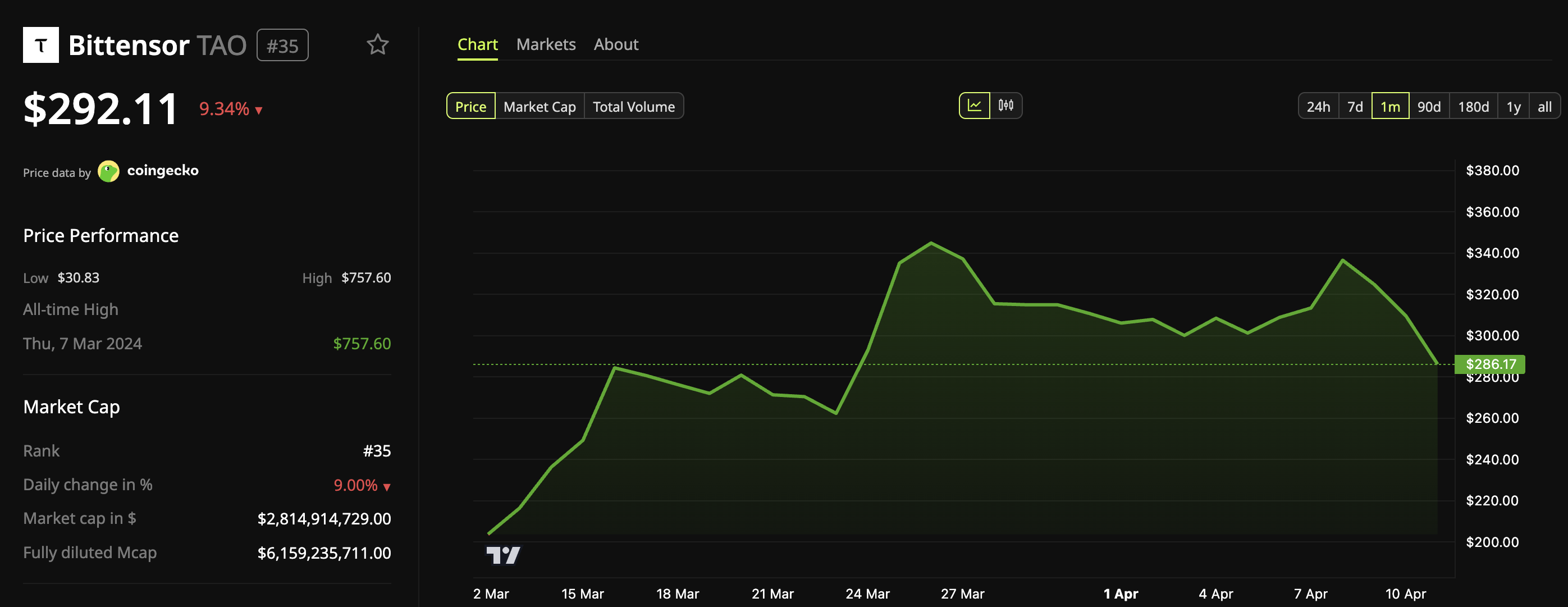
The selloff followed Covenant AI’s announcement that it is leaving the Bittensor network. The team operated three subnets, Templar (SN3), Basilica (SN39), and Grail (SN81), making it one of the protocol’s most prominent contributors.
Sam Dare, the founder of Covenant AI, cited concerns about decentralization as the reason for the departure. In a public statement, Dare accused Bittensor co-founder Jacob Steeves of exercising centralized control over what is marketed as a decentralized network.
Specifically, Covenant AI alleges that Steeves suspended emissions to its subnets, stripped its moderation access over its own community channels, unilaterally deprecated its subnet infrastructure, and applied economic pressure through strategically timed token sales.
“We cannot in good conscience continue to build on a network where the foundational claim we make to our investors, that this infrastructure is decentralized and permissionless, is contradicted by the reality of how the network is actually governed,” Dare wrote. “Bittensor operates a triumvirate structure, three individuals who manage the multisig for network upgrades, presented to the community as distributed governance. It is not. It is decentralization theatre.”
Follow us on X to get the latest news as it happens
The exit marks a dramatic shift in sentiment. Covenant AI’s Covenant-72B model was previously a key trigger for a significant TAO rally. The altcoin appreciated after NVIDIA CEO Jensen Huang referenced the model during an appearance on the All-In Podcast.
Despite leaving Bittensor, Covenant AI said it will retain its research team, existing work, and the models. The company indicated that new project announcements are expected soon.
“Covenant AI’s mission has not changed. Decentralized, permissionless AI training is not a Bittensor feature. It is a technological capability that our team is eager to advance,” the post added.
Whether the departure triggers further governance debate within the Bittensor community remains to be seen in the days ahead.
Subscribe to our YouTube channel to watch leaders and journalists provide expert insights
The post Bittensor’s TAO Leads Crypto Losers After Key Subnet Operator Departs appeared first on BeInCrypto.


Elon Musk’s xAI is taking Colorado to court over a new set of regulations designed to govern artificial intelligence.
Summary
- xAI has filed a lawsuit against Colorado to block Senate Bill 24-205 which would mandate rules against discrimination in AI systems used for jobs and housing.
- The company argues that the state is attempting to force its own political views onto the Grok chatbot and is interfering with its goal to be a truth-seeking platform.
The lawsuit, filed in a US district court on Thursday, seeks to stop Senate Bill 24-205 from taking effect. This law was created to prevent “algorithmic discrimination” by AI in sensitive sectors such as housing, finance, and employment.
The legal challenge centers on the idea that the state is overstepping its bounds by influencing how AI models communicate.
In the court filing, xAI claimed that “Colorado cannot alter xAI’s message simply because it wants to amplify its own views on the highly politicized subjects of fairness and equity.” The company also noted that the mandate would hinder its mission for Grok to be “maximally truth seeking.”
Legal representatives for xAI pointed out what they see as a contradiction in the bill, which is scheduled to start on June 30. They argued that the law actually encourages “differential treatment” under the guise of trying to “increase diversity or redress historical discrimination.”
Last December, xAI sued California over the Generative AI Training Data Transparency Act. In that case, the company argued that being forced to disclose data sources violates the First and Fifth Amendments by revealing trade secrets and compelling specific types of speech.
Amidst these state-level fights, some federal officials are calling for a change in how the industry is managed.
David Sacks, the White House AI czar and co-chair of the President’s Council of Advisors on Science and Technology, has been vocal about the need for a national standard.
“The problem that we’re seeing right now is that you’ve got 50 different states regulating this in 50 different ways, and it’s creating a patchwork of regulation that’s difficult for innovators to comply with,” Sacks stated in late March.
President Donald Trump appointed Sacks as co-chair of the newly established President’s Council of Advisors on Science and Technology to help streamline these rules and prevent a fragmented legal landscape across the country.
Trump recently signed an executive order aimed at centralizing these policies, with the goal of “nationalizing AI policy in place of the current patchwork of state laws.”
The administration has signaled that state-level mandates requiring AI to alter its output could be viewed as an obstruction to national interests and American leadership in the sector.

Boy, 5, screams ‘Dad don’t leave me!’ after being ‘abandoned’ on street in distressing CCTV

TCS deal wins signal stability despite AI concerns: Sandip Agarwal
Kalshi Dominates 89% of U.S. Prediction Markets Amid Federal-State Legal Clash


-

 Fashion7 days ago
Weekend Open Thread: Spanx – Corporette.com
-

 Business4 days ago
Three Gulf funds agree to back Paramount’s $81 billion takeover of Warner, WSJ reports
-

 Sports5 days ago
India men’s 4x400m and mixed 4x100m relay teams register big progress | Other Sports News
-

 Business6 days ago
Expert Picks for Every Need
-

 Tech2 days ago
How Long Can You Drive With Expired Registration? What Florida Law Says
-

 Business5 days ago
No Jackpot Winner, Prize to Climb to $231 Million
-

 Fashion4 days ago
Massimo Dutti Offers Inspiration for Your Summer Mood Board
-

 Fashion3 days ago
Let’s Discuss: DEI in 2026
-
Politics7 days ago
Wings Over Scotland | The quality of mercy
-

 Crypto World2 days ago
Bitcoin recovers as US and Iran Agree a Ceasefire Deal
-

 Business5 days ago
Akebia Therapeutics, Inc. (AKBA) Discusses Pipeline Progress and Strategic Focus on Kidney Disease Treatments at R&D Day – Slideshow
-

 Crypto World19 hours ago
Canary Capital Files SEC Registration for PEPE ETF
-

 Fashion7 days ago
Frugal Friday’s Workwear Report: Hammered Metallic Button Sweater Vest
-

 Politics6 days ago
The UK should not pay a penny in slavery reparations
-

 Tech4 days ago
Haier is betting big that your next TV purchase will be one of these
-

 Fashion7 days ago
Tory Burch’s Spring 2026 Campaign Goes on a Getaway
-

 Fashion7 days ago
Weekly News Update, 4.3.26 – Corporette.com
-

 NewsBeat6 days ago
Kemi Badenoch talks ‘spring cleaning’ Reform defections
-

 Tech4 days ago
Samsung just gave up on its own Messages app
-
 NewsBeat7 days ago
Rory McIlroy hopes to emulate greats as he aims to make more history
You must be logged in to post a comment Login