
Crypto World
Solana risks repeating 95% crash seen in 2022 while funding in Mutuum Finance nears $21m

Disclosure: This article does not represent investment advice. The content and materials featured on this page are for educational purposes only.
As Solana shows technical signals reminiscent of its 2022 downturn, investors are increasingly watching emerging DeFi projects like Mutuum Finance.
Summary
- Despite strong network metrics and growing on-chain activity, Solana remains in a long-term descending channel with indicators such as the monthly SuperTrend flashing a sell signal similar to conditions preceding its 2022 crash.
- Mutuum Finance is developing a non-custodial lending protocol on Ethereum that supports both Peer-to-Contract and Peer-to-Peer lending models.
- The project has raised over $20.7 million from more than 19,000 holders, with smart contracts audited by Halborn Security and the token reviewed by CertiK, while its V1 protocol is live on the Sepolia testnet.
Solana (SOL) is trading at levels that have prompted comparisons to its 2022 cycle, when the token declined roughly 95%. The current price structure has shown signs of weakness, with resistance zones capping upside attempts and momentum remaining fragile. Meanwhile, Mutuum Finance (MUTM) has seen funding approach the $21 million mark. The project operates a non-custodial lending and borrowing protocol within the decentralized finance sector, and the capital inflow reflects continued investor participation during a period of uncertainty for larger-cap assets.
Solana bearish trend persists
Solana’s real-world asset ecosystem reached $1.66 billion in tokenized value, reflecting increased on-chain capital movement and institutional participation. The network ranked among the leading Layer 1 chains in dApp revenue and recorded a rise in app revenue capture ratio from 262% to 375%, supported by strong network activity and spot ETF inflows.
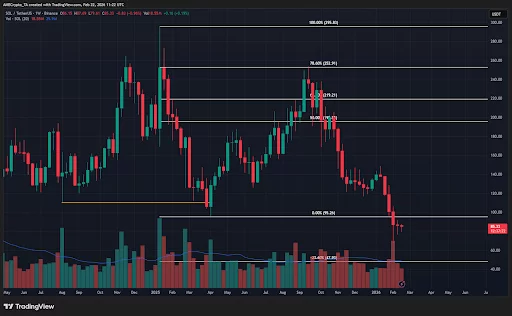
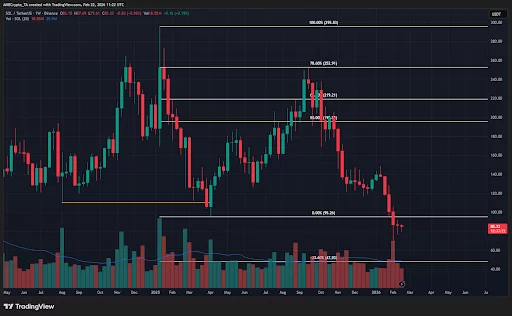
Despite these metrics, SOL remains in a long-term descending channel on the weekly chart. Analysts identify price imbalances up to $140 that could be filled before a potential test of the $47.9 extension level. The monthly SuperTrend indicator has flipped to a “sell” signal, a condition last seen in 2022 before a 95% decline. While network fundamentals show growth, the prevailing technical structure remains bearish. Meanwhile, Mutuum Finance sees strong growth.
Mutuum Finance lending
Built on the Ethereum network, Mutuum Finance is a new decentralized lending and borrowing protocol. It is a non-custodial platform, allowing users complete control over their funds. The project offers flexibility through its dual lending model, supporting both Peer-to-Contract (P2C) and Peer-to-Peer (P2P) lending. In the P2C system, users can deposit widely used assets like USDT or ETH into shared liquidity pools and earn interest automatically; for example, a $50,000 USDT deposit at 8% APY would grow to $54,000 over a year without additional action, while borrowers provide overcollateralized assets at dynamic rates based on pool demand.
The P2P model, on the other hand, caters to high-volatility tokens, allowing direct negotiations between borrowers and lenders; for instance, an investor holding $25,000 in a meme coin like PEPE could obtain a $13,800 USDC loan at 14% APY with 180% overcollateralization, preserving exposure to potential gains in PEPE while providing the lender $966 in interest in 6 months.
Security and community engagement
Mutuum Finance’s lending and borrowing smart contracts recently underwent a full audit by Halborn Security. The project team incorporated all recommendations highlighted by the security firm before the protocol’s testnet debut. The MUTM token itself has also been audited by CertiK, achieving a token scan score of 90/100. MUTM is priced at $0.04, with more than 19,070 holders and over $20.72 million committed to the project.
Solana is currently down 73% from its $294 ATH, following sharp downturns since Q4 2025. Frequent whale selling and profit-taking have further eroded confidence in the token. Meanwhile, Mutuum Finance shows steady development. Its V1 Protocol is live on the Sepolia testnet, allowing users to test the protocol’s core features, including staking, borrowing, and lending. Users can borrow and lend ETH, USDT, LINK, and WBTC, which are the supported test tokens. The testnet also includes an automated liquidator bot, which maintains protocol health.
As Solana risks repeating its 95% crash from 2022, with bearish technical signals and a sell signal on the monthly SuperTrend, investors are cutting their losses to seek alternative market plays. Meanwhile, strong capital inflows are being reported for Mutuum Finance (MUTM), whose funding is approaching $21 million. Built on Ethereum, MUTM offers a non‑custodial lending protocol with a dual‑market structure, live on Sepolia testnet, audited by Halborn and CertiK.
Disclosure: This content is provided by a third party. Neither crypto.news nor the author of this article endorses any product mentioned on this page. Users should conduct their own research before taking any action related to the company.


Arbitrum Sepolia, the primary testnet for the leading Ethereum Layer-2, has stopped block production. The network suffered a critical consensus failure at block 204606366, causing a chain split between node operators using different CPU architectures.
Developers relying on the testnet for pre-deployment validation are currently stalled as Offchain Labs engineers deploy emergency fixes.
- Consensus Failure: The chain halted at block 204606366, triggering a major outage that disrupted the network from 6:44 AM to 9:02 PM.
- Hardware Split: The breakdown was caused by a rare execution deviation where ARM and x86 processors produced conflicting block results.
- Operator Action: Node runners must currently restart with safety verification flags disabled or migrate entirely to x86 hardware to sync.
Why Did the Arbitrum Sepolia Nodes Split?
The outage is technical, specific, and severe. At block 204606366, the Arbitrum Sepolia sequencer produced a batch that processed differently depending on the validating node’s hardware. Nodes running on ARM architecture calculated a different state root than those on x86 chips, effectively splitting the network’s brain. This deviation forced a halt to block production, as the chain could not reach consensus on a valid path forward.
Offchain Labs identified the issue as a major outage. While mainnet operations remain unaffected, this incident highlights the fragility of heterogeneous hardware environments in decentralized networks. To resume syncing, node operators on version 3.8.0 must restart with the flag --node.feed.input.verify.dangerous.accept-missing, a command that explicitly bypasses standard input verification protocols. This is a stopgap, not a solution.
Testnets are designed to break so mainnets do not, but reliability on Arbitrum Sepolia has become a recurring friction point. Since the deprecation of the Goerli testnet in March 2024, Sepolia has served as the critical staging ground for dApps before they launch on the main Ethereum Layer-2 network. Frequent downtime here translates directly to delayed mainnet deployments and stalled audit timelines.
DeFi Exploits over the past year… — Emperor Osmo
1/ Moby Trade/Arbitrum (Jan 2025) $2.5M
Leaked private key. $1.5M recovered by whitehat.
2/ Hyperliquid bridge (Mar 2025) $17M
Smart contract exploit.
3/ UPCX (Apr 2025) $70M
Compromised private key. Token crashed 70%.
4/ GMX V1 (May 2025)…

 (@Flowslikeosmo) March 22, 2026
This is not an isolated event. The network faced similar stability challenges in August. While other protocols execute smooth, planned infrastructure updates—such as the recent Tellor Palmito testnet upgrade—Arbitrum’s unexpected halts force developers into reactive maintenance.
For institutional players building on Arbitrum, the requirement to swap hardware architectures mid-development to maintain a sync is a red flag for infrastructure maturity. The ecosystem needs stability, not just throughput.
What to Watch: The Path to Resolution
Offchain Labs has not yet released a permanent patch for the ARM/x86 deviation. At press time, the recommended fix requires manual intervention from every node operator. The team has announced plans for a new Nitro version update and a fresh database snapshot to resolve the compatibility issues fully.
Traders and developers should monitor the official status page for the release of the new snapshot. Until a verified patch confirms cross-architecture consistency, the testnet remains in a fragile state. If the fix lags, deployment schedules across the Arbitrum Orbit ecosystem will slide.
Discover: The best new crypto in the world
The post Arbitrum Sepolia Testnet Halts Block Production in Partial Outage appeared first on Cryptonews.
Crypto World
BMO launches tokenized cash and deposits on CME’s 24/7 settlement network: Bank of Montreal


Bank of Montreal enables clients to convert dollars into tokenized cash on CME and Google Cloud’s Universal Ledger for round-the-clock margin, collateral and B2B payments.
Bank of Montreal announced it will allow clients to convert dollars into tokenized cash and deposits on CME and Google Cloud’s Universal Ledger infrastructure, enabling 24/7 settlement for margin, collateral and business-to-business payments. The move integrates one of North America’s largest banks by assets into the CME’s continuous settlement rails, expanding institutional access to tokenized financial services beyond traditional trading hours.
The Universal Ledger platform, operated jointly by CME and Google Cloud, supports real-time asset movement and settlement outside conventional market windows. BMO’s integration represents a major adoption milestone for institutional tokenization infrastructure, allowing the bank’s client base direct access to around-the-clock digital asset settlement capabilities.
Sources: BMO
This article was generated automatically by The Defiant’s AI news system from publicly available sources.

Circle is pushing back on Europe. The stablecoin issuer has formally petitioned the European Commission to lower the capitalization thresholds in its proposed Market Integration Package. The argument is direct: the current rules create a regulatory paradox where a stablecoin must already be massive before it is legally permitted to operate at an institutional scale.
For euro-denominated stablecoins like EURC, the framework creates friction. It effectively bans them from institutional settlement before they ever get the chance to grow.
- The Ask: Lower the market cap threshold for e-money tokens (EMTs) to qualify as collateral under the Central Securities Depositories Regulation.
- The Framework: The EU’s Market Integration Package, designed to unify capital markets and expand the DLT Pilot Regime.
- Market Impact: Removing these barriers would allow EURC and other euro stablecoins to function as liquidity layers in formal securities settlement.
The Mechanics of the ‘Chicken-and-Egg’ Problem
The complaint comes down to one mechanical flaw.
Under the current draft of the Central Securities Depositories Regulation, only e-money tokens that already meet a high market capitalization threshold can be used in settlement systems. Circle’s problem with that is straightforward. No euro-denominated EMT currently meets that threshold.
The regulation creates a chicken-and-egg scenario. Tokens need a settlement utility to grow. Settlement utility requires a scale that they cannot achieve without it. Circle is calling it a structural barrier to entry and they are right.
The firm is requesting amendments to the DLT Pilot Regime to break the cycle. Excluding non-significant EMTs from settlement does not protect the market. It stalls the EU’s entire tokenization ambition before it starts.
— BSCN (@BSCNews) March 24, 2026
 BULLISH: CIRCLE AND COINBASE TO WIN BIG FROM STABLECOIN SURGE
According to analysts at Bernstein, both @Circle and @Coinbase can help investors gain exposure to the fast-growing stablecoin sector.
The firms have formed a partnership around the $USDC stablecoin and stand to… pic.twitter.com/CisztMTGZL
The stakes are direct. If the European Commission adopts Circle’s recommendation, EURC moves from a niche trading pair to a recognized settlement instrument for traditional finance. Banks and asset managers can settle trades on-chain. Euro stablecoins become functional collateral under CSDR rules.
If nothing changes, institutional participation stays theoretical. The vast majority of stablecoin liquidity sits in USD-denominated assets like USDC. For the EU to build a functioning DLT-based economy it needs a euro equivalent that moves frictionlessly between crypto exchanges and regulated securities venues.
The current framework does the opposite. It locks euro stablecoins out of the infrastructure they need to scale. Circle’s March 20 submission is an attempt to preempt a liquidity freeze in a market that has not even launched yet.
Regulatory Context: MiCA and the Integration Gap
Circle’s lobbying effort comes just months after the Markets in Crypto-Assets (MiCA) regulation took full effect in December 2024. While MiCA provided the licensing framework for issuers, the Market Integration Package is intended to build the rails for those assets to move across borders.
The friction underscores a broader disconnect. While MiCA is law, its implementation has been criticized by legal experts for varying wildly from country to country. Yuriy Brisov, a partner at Digital & Analogue Partners, has argued that the rules remain difficult to interpret, leaving issuers in a gray zone regarding compliance.
The Commission’s proposals are intended to fix this fragmentation, but Circle warns that without specific tweaks to the DLT regime, the “integration” will be in name only. As negotiations on the package continue—potentially through 2027—the gap between regulatory intent and market reality is widening.
If the Commission adjusts the thresholds, Europe opens the door to on-chain capital markets. If they hold the line, euro stablecoins remain stuck in the sandbox. Until the final text is agreed upon, institutional adoption is waiting on a definition.
Discover: The best new crypto in the world
The post Circle Urges EU to Ease Crypto Thresholds in Proposed Markets Framework appeared first on Cryptonews.

Ethereum-based DeFi lending protocol Fira has kicked off its fixed-rate on-chain credit market with roughly $450 million in deposits, signaling strong appetite for predictable borrowing costs in a sector long dominated by floating-rate dynamics. The new model centers on locking in borrowing costs and lending yields over defined maturities, rather than letting rates drift with utilization.
Fira’s approach reimagines on-chain lending by organizing markets around fixed timeframes and using supply-and-demand dynamics to set interest rates. In practice, this creates yield curves and defined maturities that mirror traditional fixed-income markets, a rarity in DeFi where long-hold lending can be opaque and rates volatile. A Fira spokesperson described the mechanism as a shift from fluctuating utilization-based pricing to a more predictable credit market architecture.
Key takeaways
- Fira launches with about $450 million in deposits, highlighting demand for fixed-rate, on-chain credit models in DeFi.
- The deposits were initially seeded by users migrating from Euler Finance during a pre-launch phase that began on January 8.
- DefiLlama currently lists Fira at roughly $451.6 million in total value locked on Ethereum, compared with the sector leader Aave at around $25.3 billion.
- Security and incentives are central to the rollout: six independent audits and a bug bounty program offering up to $500,000 in rewards for critical vulnerabilities.
- Fira is not alone in pursuing fixed-rate lending; peers include Notional Finance, IPOR, and Term Finance, indicating a growing niche within DeFi lending.
From Euler migration to early traction
Fira reported that its initial deposits were recaptured from Euler Finance’s ecosystem during the pre-launch phase. Pete Siegel, Fira’s chief financial officer, told Cointelegraph that the early rollout began with a market called UZR, designed to help Euler users migrate assets at a fixed rate within a product already available on Euler’s platform. “Fira was pre-launched in January. It opened with a first market called UZR, which enabled roughly a thousand users who were already on Euler, in a product available on Euler to migrate their assets at a fixed rate,” Siegel explained.
The liquidity influx underscores investors’ appetite for instruments that offer certainty over duration and payoff, rather than exposure to ever-shifting borrowing costs. As the project moves from pre-launch to a formal mainnet phase, observers will be watching whether the fixed-rate framework delivers on its promise of stability across longer-term on-chain lending cycles.
Security, governance, and incentives
Security is a central pillar of Fira’s launch strategy. The protocol’s smart contracts have undergone six independent security audits conducted by Sherlock, Spearbit via Cantina, Hexens, and yAudit between late 2025 and early 2026. In addition, Fira has activated a robust bug bounty program through Sherlock, offering rewards up to $500,000 for critical vulnerabilities in the protocol’s open-source Ethereum contracts.
Beyond security, Fira’s governance and risk controls will be closely watched as fixed-rate lending becomes more common in DeFi. The model’s reliance on fixed maturities invites questions about liquidity resilience, deployment risk, and the ability to quickly adapt to shifting market conditions. While fixed-rate structures can reduce volatility for lenders and borrowers, they also concentrate risk into defined windows that could be exposed to systemic shifts if a large portion of the curve moves in parallel or if external macro factors abruptly alter funding costs.
In the broader landscape, Fira sits alongside peers such as Notional Finance, IPOR, and Term Finance, all pursuing variations of fixed-rate credit in DeFi. These projects collectively suggest a shift in the industry’s thinking about risk management and yield formation on-chain, moving beyond the traditional, flexible DeFi lending paradigm toward more structured, instrument-like offerings.
What this means for investors and builders
The emergence of fixed-rate DeFi credit markets could matter in several ways. For lenders, the ability to lock in funding costs over a defined horizon helps stabilize cash-flow expectations and reduce the risk of sudden repricing. For borrowers, fixed rates can provide clarity for long-duration financing—an appealing feature for users building over multi-month horizons or hedging exposure to interest-rate shifts in volatile markets.
For developers and infrastructure teams, the arrival of yield curves on-chain invites a broader set of financial primitives to be built atop DeFi pools. It raises the prospect of more sophisticated risk analytics, more precise liquidity provisioning, and potential cross-platform integrations with other fixed-income-like instruments. However, it also increases the importance of robust risk management, given the complexity of pricing across multiple maturities and the possibility of liquidity thinness in certain segments of the curve during stressed market periods.
Context and next steps
The initial liquidity is a favorable sign, but the trajectory for fixed-rate DeFi lending will hinge on sustained user engagement, ongoing security assurances, and the ability of the market to scale across different maturities and assets. Fira’s early liquidity came from Euler participants, but growing beyond a single migration pool will be crucial to proving the model’s resilience and appeal to a broader user base.
As the sector tracks this experiment, market participants will also weigh the lessons from early fixed-rate experiments such as Notional Finance, IPOR, and Term Finance. The key question remains: can fixed-rate on-chain credit evolve from a niche product into a reliable, widely used instrument that complements variable-rate lending and more traditional on-chain debt markets?
Looking ahead, readers should watch for Fira’s expansion plans, new maturities, and cross-asset deployments that could broaden the fixed-rate landscape. Analysts will be paying attention to liquidity depth across the curve, the rate-setting mechanics under varying market conditions, and how the ecosystem integrates with existing DeFi rails to ensure a robust, secure, and transparent fixed-income experience on-chain.
In the near term, the emphasis will be on governance updates, additional audits, and the resilience of the UZR market as it matures. As with any new financial primitive in crypto, the next few quarters will reveal how capital allocators adapt to a world of fixed horizons and predictable yields in DeFi’s evolving credit market.

Tether Crypto just put $1.5 billion on human biology. The USDT issuer has taken a strategic stake in Eight Sleep, the AI-powered sleep technology company, at a $1.5 billion post-money valuation. This is not a passive financial play. It confirms what has been building for months: Tether is no longer just a stablecoin issuer. It is one of the most aggressive venture capital forces in tech.
The fuel behind the move is straightforward. Tether generated over $13 billion in profit in 2024, mostly from yield on its massive US Treasury holdings. That money is now being redirected into health tech, neurotech, robotics, and AI at a pace without precedent in crypto-native capital deployment.
- Valuation Signal: Eight Sleep’s post-money valuation hits $1.5 billion, tripling from approximately $500 million at its Series C in August 2021.
- Treasury Pivot: Tether’s $6.3 billion in excess reserves are being actively deployed into venture capital across four divisions — Data, Finance, Power, and Education.
- Strategic Context: Eight Sleep achieved free cash flow positivity in 2025, a rare milestone for consumer hardware companies, validating the investment thesis before Tether committed capital.
How Tether Crypto Profit Machine Funds Real-World Bets
The mechanics are simple and brutally effective.
Tether issues USDT, backs it with US Treasury bills, and collects yield on the float. The company manages over $100 billion in assets. At that scale, even modest T-bill yields generate billions annually with near-zero operating overhead.
— BSCN (@BSCNews) March 4, 2026
 LATEST: TETHER MAKES STRATEGIC INVESTMENT IN AI HEALTH TECH AT $1.5B VALUATION@Tether Investments has made a strategic investment in Eight Sleep at a $1.5 billion valuation to accelerate AI-powered, privacy-first health intelligence.
Eight Sleep, known for its AI-driven… pic.twitter.com/ev7Py06oFy
That machine has produced $6.3 billion in excess reserves, capital sitting above and beyond what is needed to back USDT 1:1. CEO Paolo Ardoino has been systematically redeploying that surplus into what he calls a thesis around individual sovereignty and long-term human potential.
Eight Sleep fits that thesis directly. The company uses embedded sensors and AI to track biometric data in real time, adjusting mattress temperature to optimize sleep architecture. Health intelligence as infrastructure.
The entry timing was clean. Eight Sleep hit free cash flow positivity in 2025, rare for consumer hardware, and launched 3 new products that year: Pod 5, Pod Pillow Cover, and Thermal Blanket. Founders Fund and Y Combinator led an August 2025 round at a $1 billion valuation. Tether is stepping in 6 months later at $1.5 billion with a strategic check that goes beyond passive financial exposure.
Can Tether’s Venture Capital Strategy Scale Beyond Stablecoins?
Eight Sleep is not Tether’s first move outside crypto.
In 2024 the company took a majority stake in Blackrock Neurotech, a brain-computer interface developer, for $200 million. In December 2025 it joined an $81 million round for Generative Bionics, an Italian humanoid robotics startup. Eight Sleep is the largest single investment in this portfolio and the clearest signal yet that Tether is building a diversified technology conglomerate funded by stablecoin economics.
The closest analogue in crypto history is MicroStrategy. Same scale of profit deployment. Same level of conviction. The difference is direction. MicroStrategy concentrates into Bitcoin. Tether diversifies across the biological edge of technology.
The market Tether is entering is pricing up fast. Oura raised $900 million at an $11 billion valuation in October 2025. Longevity and biosensing infrastructure are being treated as high-growth, defensible assets. Ardoino has said publicly that is exactly what Tether wants to own.
2 scenarios from here.
Eight Sleep’s free cash flow positivity, expanding product line, and international addressable market justify the $1.5 billion entry. Tether’s capital accelerates that roadmap materially. Or consumer hardware multiples compress in a tighter macro environment, health tech regulatory risk in Europe and the US stalls the push into clinical features, and Tether’s growing exposure to illiquid venture positions creates concentration risk if USDT redemption pressure spikes.
Ardoino frames Eight Sleep as a tool that enhances human autonomy rather than creates dependency. That positioning is deliberate. It makes the investment look mission-driven, not just financial.
Tether made $13 billion last year running the world’s largest on-chain money market fund. It is spending those profits to own the infrastructure of human performance. The stablecoin was always just the entry point.
Discover: The best new crypto in the world
The post Tether Crypto $13Bn Profit Engine Fuels $1.5Bn Bet on Health Intelligence appeared first on Cryptonews.
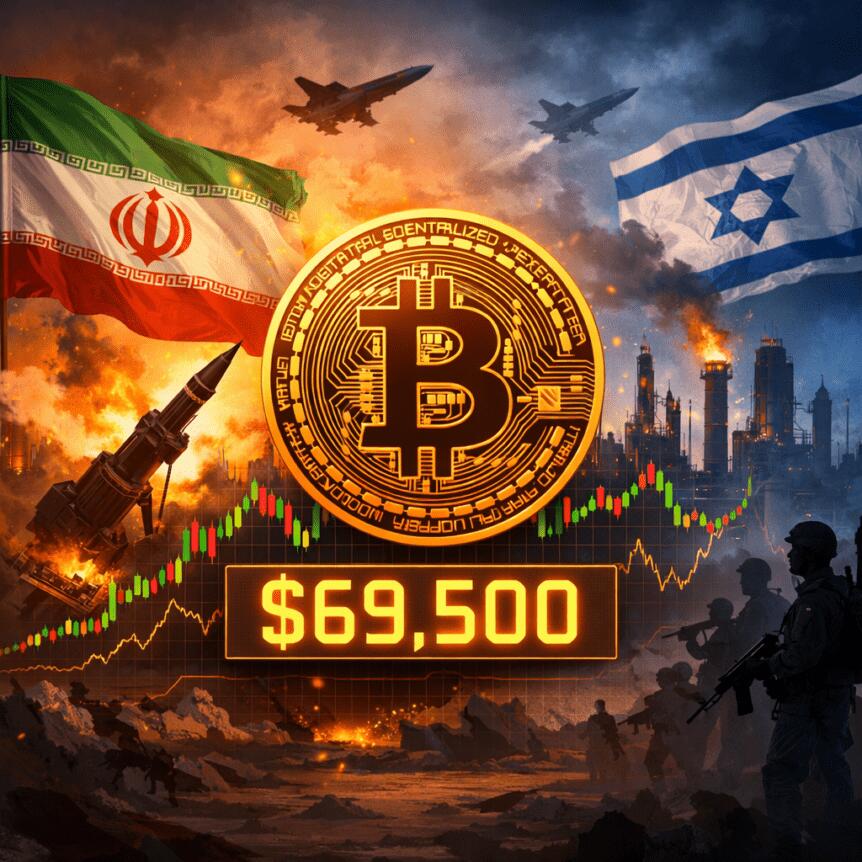
Bitcoin slipped below the $70,000 mark as macro risk assets came under pressure amid renewed Middle East tensions, renewing questions about BTC’s sensitivity to broader markets. The September session saw BTC pull back after a brief sprint to around $71,800 earlier in the week, with traders watching how the next move would unfold in an environment where oil, equities, and geopolitical risk remain intertwined.
Analysts described the scene as a palpable test for Bitcoin’s resilience in a risk-off backdrop, with some arguing that a potential regime shift—where BTC behaves less like traditional risk assets—could be forming, even as others warn that volatility and downside risk persist until macro momentum cools.
Key takeaways
- Bitcoin briefly fell through the $70,000 level as macro selling pressure hit risk assets, with intraday moves signaling continued volatility.
- Oil hovered near $95 per barrel, and U.S. stock indices opened lower as tensions in the Middle East and related supply concerns weighed on sentiment.
- Market color from QCP Capital framed the price action as a balancing act by policymakers, suggesting authorities are aiming to maintain stability even as geopolitical risks linger.
- Some observers saw early signs of a Bitcoin regime shift, with higher-lows patterns suggesting emerging strength that could challenge traditional risk asset correlations if sustained.
- Technical readings pointed to a contested footing around the 200-week average, with the metric around $68,300 acting as a ambiguous boundary and keeping the near-term outlook nuanced.
Macro backdrop and price dynamics
As U.S. markets opened, BTC traded on the back foot, losing roughly 1.5% on the day and retreating from an early-week push toward the $72,000 area. In traditional markets, the Nasdaq Composite slipped, while gold struggled to push decisively past $4,450. Oil’s oscillation—tending toward $95 per barrel after an initial retreat—reflected ongoing concerns about energy flow. The broader geopolitical backdrop, including tensions in the Strait of Hormuz and regional developments, kept risk sentiment on edge and complicated the path for a clear risk-on/risk-off regime for crypto assets.
Analysts pointed to the interplay between oil prices, sanctions headlines, and macro liquidity as a frequent driver of short-term Bitcoin moves. In such a climate, a single headline can shift correlations as traders reassess leverage, hedging needs, and the role of BTC within diversified portfolios.
Resilience, regime shift, and what it could mean for BTC
Market observers have debated whether Bitcoin’s current action signals a broader shift in how it behaves relative to traditional risk assets. QCP Capital, in its Market Color briefing, argued that President Trump’s handling of geopolitical risk and market stability creates a difficult balancing act: equities sit near key support, inflation pressures continue to influence expectations for rate hikes, and policymakers cannot afford to spur additional volatility. In this view, BTC’s relative steadiness in the face of rising tensions could reflect structural factors such as lower systemic leverage or, more intriguingly, the early stages of a regime shift where BTC does not track risk assets in the same way as before.
Indeed, several traders highlighted constructive technical signs, even as the overall backdrop remains fragile. Michaël van de Poppe pointed to a pattern of higher lows forming since the February crash, suggesting increasing strength if support holds. He cautioned, however, that the picture isn’t “out of the woods” yet, noting that higher lows can still trigger liquidity waves if markets move toward those levels. For a potential bullish runway, he pointed to a target in the high range around $77,000 to $80,000 if Bitcoin sustains the current support area.
On the other side of the spectrum, some analysts warned that weakness could reemerge. A well-known trader warned about a possible Bart Simpson-style pattern playing out on lower timeframes, underscoring the risk that a relief rally could falter without broader macro improvement. Such viewpoints reflect the ongoing tug-of-war between short-term momentum and longer-term structural factors shaping BTC’s trajectory.
Technical reading and near-term implications
The technical picture remains nuanced. The 200-week exponential moving average (EMA), around $68,300, has not delivered a definitive answer on support or resistance, allowing for continued choppiness in the near term. Some market participants suggest that BTC could trade within a broader range until macro catalysts clarify the directional bias, while others argue that strength in the form of higher-lows could precede a renewed upside leg if key levels hold through resistance tests.
In this environment, near-term risk management becomes paramount. Traders are watching whether Bitcoin can maintain the recent higher-lows trajectory, how it behaves around the critical $70,000 level, and how external factors such as oil prices and geopolitical headlines influence liquidity and collateral dynamics in the crypto market.
What readers should watch next
jolts in macro sentiment, particularly around Middle East developments and oil supply expectations, will be crucial in shaping Bitcoin’s path over the coming sessions. A sustained hold above the $70,000 threshold, coupled with a clear push beyond the mid-$70,000s, could renew optimism for the next leg higher. Conversely, renewed downside pressure—especially if macro risk appetite deteriorates—could see BTC retest lower supports in the near term.
Market participants will also be parsing the evolving relationship between Bitcoin and traditional risk assets, as crypto traders increasingly weigh whether a regime shift is underway or if current moves are simply a pause within a longer, volatile cycle.
This article synthesizes market observations and analysis from the period, reflecting published commentary and price action without asserting new claims beyond the cited material.
Crypto World
Bitcoin advances to $71,000 while derivatives signal cautious bullishness: Crypto Markets Today


Bitcoin is currently trading at around $71,000 having risen by 0.25% since midnight UTC, adding to a broader 24 hour rally of 4%.
Asian hours were favorable to AI tokens, with bittensor (TAO) and adding 5.8% and 4.1% apiece. The rise followed comments from Nvidia CEO Jensen Huang, who claimed that artificial general intelligence (AGI) — a term for AI that matches the cognitive abilities of human beings — has already been achieved.
Still, the main market driver continues to be the war in the Middle East following fresh strikes in Tel Aviv and Lebanon on Tuesday. On Monday, U.S. President Donald Trump said a 48-hour ultimatum over the Strait of Hormuz had been put on hold following “good and productive” peace talks with Iran, although Iranian officials called it “fake news.”
Oil remains at around $100 per barrel while U.S. equities are in the red, with Nasdaq 100 futures and S&P 500 futures both down by around 0.1% since midnight.
The crypto market has remained relatively resilient during the conflict, with bitcoin outperforming gold, a traditional haven asset, since the start of the war.
Derivatives positioning
- Over $550 million in leveraged crypto futures bets have been liquidated in 24 hours, with shorts or bearish bets taking most of the hit.
- Bitcon’s 4%, 24-hour price gain isn’t backed by increased participation in futures, as open interest (OI) in major USD- and USDT-denominated futures has declined to 228,000 BTC from 229,000 BTC.
- A similar pattern is seen in ETH, XRP and SOL markets.
- DOGE, ADA, SUI, AVAX, LINK, and PAXG futures have seen open interest decline by as much as 10%.
- Most tokens have seen aggressive bidding, as evidenced by their positive 24-hour cumulative volume deltas. CRO, XMR and TON stand out with negative CVDs.
- Perpetual funding rates for majors also paint a bullish picture, with values between 5% to 10%.
- On Deribit, BTC and ETH puts continue to show a net bias for protective put options across all time frames. However, they now trade at 5 to 6 volatility point premium to calls versus 8 to 10 early Monday.
- Block flows featured demand for the BTC put condor, a directionally neutral strategy designed to profit from low volatility. In ETH’s case, risk reversals dominated flows.
Token talk
- Several altcoins have outperformed bitcoin since midnight, with HYPE, OP and CRV all gaining around 3% as traders rotated into more speculative assets in anticipation of a wider market breakout.
- The bitcoin-dominant CoinDesk 20 (CD20) Index is up by 0.3% on Tuesday, while the altcoin-heavy CoinDesk 80 (CD80) has risen by more than 1%, indicating improving sentiment among the altcoin sector.
- The caveat to the improving sentiment is the state of the DeFi industry. One market watcher described the current landscape as a “really dark” period after Balancer Labs shut down operations and the Resolv stablecoin project was hacked Another criticized the lack of yield opportunities coupled the inherent risk that comes with using DeFi protocols.
- The memecoin sector is another feeling the strain. The CoinDesk Memecoin Index (CDMEME) is the worst performing benchmark on Tuesday, rising just 0.1% with several of the index components losing 3%-5%.

U.S. spot Bitcoin ETFs added fresh capital on March 23, reversing earlier weakness and restoring momentum across the category. The rebound followed several weeks of withdrawals in 2026, and it narrowed the funds’ year-to-date deficit. Bloomberg ETF analyst Eric Balchunas linked the trend to persistent demand, even as Bitcoin stayed well below recent highs.
Bitcoin ETF Flows Regain Traction
Spot Bitcoin ETFs recorded $167.2 million in net inflows on Monday, extending a broader recovery in March. Moreover, recent inflows lifted March totals near $2.5 billion after heavy withdrawals earlier in 2026. That reversal left year-to-date flows near flat, and one more strong session could push totals back above zero.
Balchunas said the category showed unusual staying power during six months marked by a sharp Bitcoin decline. Bitcoin lost about 40% over that span, yet the funds kept drawing demand instead of broad liquidation. As a result, the rebound strengthened the argument that these products now attract more durable holders.
BlackRock’s iShares Bitcoin Trust led the group, and it recovered its own year-to-date flow losses. The fund also ranked within the top 2% of U.S. exchange-traded funds by 2026 inflows. Therefore, IBIT continued to separate itself from peers through scale, steady demand, and faster recovery.
Gold Comparison Returns to Focus
Balchunas revived the Bitcoin versus gold debate by comparing current ETF behavior with gold funds trading a decade ago. When gold prices fell sharply around 2013, many gold-backed funds lost substantial assets within months. That episode reflected typical market behavior because large drawdowns often trigger faster selling across commodity products.
By contrast, spot Bitcoin ETFs absorbed the price shock and then regained momentum more quickly. Balchunas used that divergence to argue that Bitcoin fund holders behaved differently from traditional gold fund holders. In turn, the comparison widened discussion about whether Bitcoin now commands stronger long-term conviction than gold.
The debate also expanded because Bitcoin ETFs remain relatively new, while gold funds have operated for many years. Even so, the latest flow pattern suggested that Bitcoin products handled stress better than many expected. That backdrop provided fresh context for current ETF demand and Bitcoin’s competition with gold.
Wall Street Activity Adds Context
Separate corporate filings added context to the ETF rebound because major financial firms announced new Bitcoin plans. Strategy filed documents that would support up to $42 billion in additional Bitcoin purchases over time. Meanwhile, Morgan Stanley submitted paperwork tied to its own spot Bitcoin ETF effort.
Those moves indicated that traditional finance still sees commercial value in Bitcoin products despite recent volatility. They also supported the view that institutional participation in the sector continues to broaden. Consequently, ETF flows and corporate filings reinforced the same message about sustained market engagement.
Shaun Edmondson highlighted Monday’s ETF inflows alongside those filings and framed both developments as mutually supportive. His view added momentum to the broader narrative around tightening supply and expanding institutional demand. For now, the latest ETF data and related filings have reset the Bitcoin versus gold discussion.


High Stakes Capital has fully exited a 602,421 HYPE position for $22.9m around $38, extending a broader wave of profit‑taking among Hyperliquid whales near record highs.
Summary
- HYPE is trading around $38.86 after whale High Stakes Capital fully exited a position worth nearly $22.94 million over 24 hours.
- The address offloaded 602,421 HYPE at an average price of $38.08, following earlier sales of 300,000 HYPE for $11.45 million at $38.17 each.
- The unwind extends a broader pattern of profit-taking among large Hyperliquid whales after the derivatives-focused token hit record highs near $40.
A major Hyperliquid (HYPE) whale known as High Stakes Capital has liquidated more than 600,000 HYPE in the past 24 hours, cashing out close to $22.94 million and putting short-term pressure on the flagship Hyperliquid token. ChainCatcher, citing Onchain Lens data, reported that the address sold a total of 602,421 HYPE for approximately 22.938 million USDC, at an average price of $38.08, with the final tranche of 152,421 HYPE netting around $5.82 million and completing the exit. The sell-off comes as HYPE, the native token of Hyperliquid’s decentralized perpetuals and derivatives ecosystem, trades just below recent peaks at about $38.86, up 2.72% on the day.
PANews, also quoting Onchain Lens, noted that in the previous 12 hours the same whale had already sold 450,000 HYPE for $17.12 million USDC, at an average price of $38.05, while still holding 152,421 HYPE worth $5.68 million before the final leg. Earlier, Phemex News reported that High Stakes Capital offloaded 300,000 HYPE for $11.45 million at an average of $38.17, while still sitting on 302,421 HYPE valued at about $11.54 million and a cumulative profit exceeding $33.2 million. This staggered exit pattern shows the whale systematically selling into strength around the $38–$39 range rather than dumping in a single transaction, a strategy that tends to limit slippage but can cap upside while the orders clear.
HYPE is part of the derivatives and DeFi sector, functioning as the core token of the Hyperliquid network, where traders use the platform for decentralized perpetual futures and leveraged speculation. Hyperliquid’s token previously touched an all-time high near $39.93 as 24‑hour trading volume surged to roughly $496 million and open interest climbed to $10.1 billion, according to DailyCoin’s earlier reporting on HYPE’s breakout. At the same time, total value locked in the protocol jumped more than 369% in a matter of weeks, from about $311.55 million to $1.462 billion, underscoring the scale of capital rotating into derivatives-focused DeFi.
Recent data suggests that large HYPE holders are actively managing exposure around the $35–$40 band. KuCoin Flash reported that another genesis whale, linked to the address known as tummy.hl, began selling 498,000 HYPE via TWAP orders for more than $20 million, with the sale expected to complete within 21 hours. Coingabbar’s price analysis noted that HYPE was trading near $34.73 in early February, up 30.53% over the preceding month, with open interest at $1.65 billion even as trading volumes fell 18% to about $805.7 million, suggesting a structurally bullish but increasingly crowded trade. Against that backdrop, High Stakes Capital’s exit looks less like capitulation and more like a textbook profit realization into a stretched market, as derivatives tokens and exchange-linked assets continue to outperform much of the broader crypto complex.

Key Highlights
- Meta shares decline 1.86% to $593.11 following AI processor collaboration announcement
- Company partners with Arm to create specialized CPUs for artificial intelligence operations
- Arm AGI CPU designed for AI model training, inference operations, and general computing
- Custom processor aims for enhanced data center efficiency and performance metrics
- Collaboration marks strategic pivot toward proprietary silicon and AI-focused infrastructure
Meta Platforms (META) shares traded down to $593.11, representing a 1.86% decline, after the social media giant announced a strategic CPU partnership with Arm. The stock experienced consistent downward movement throughout the trading session with sustained seller activity. The announcement underscored Meta’s evolving approach to building specialized infrastructure for enterprise-scale artificial intelligence operations.
Strategic CPU Collaboration Advances Meta’s Hardware Vision
Meta announced a strategic alliance with Arm to engineer a novel category of processors dedicated to artificial intelligence workloads. The initiative addresses escalating computational requirements throughout Meta’s expanding infrastructure footprint. This collaboration represents a significant step in the company’s ongoing commitment to proprietary hardware development.
The inaugural chip, designated as the Arm AGI CPU, specifically addresses AI model training and inference operations. The processor simultaneously handles general-purpose computational tasks throughout Meta’s technology stack. This dual capability enhances Meta’s capacity to deploy sophisticated AI systems at scale.
Meta actively expands its hardware portfolio through both internal innovation and collaborative partnerships. The Arm AGI CPU complements Meta’s existing MTIA silicon architecture for enhanced operational synergy. This multi-pronged strategy creates a more versatile and resource-efficient computing infrastructure.
Arm AGI CPU Delivers Advanced Performance Metrics
The Arm AGI CPU represents a novel architecture for data center computing optimized for artificial intelligence applications. The design prioritizes maximizing performance density per rack while minimizing power consumption. This engineering focus enables large-scale AI implementations with superior resource efficiency.
Arm engineered the processor to coordinate distributed AI operations across memory hierarchies, storage arrays, and network fabrics. Reference implementations demonstrate rack configurations delivering thousands of processing cores in space-efficient designs. Furthermore, liquid cooling implementations enable substantial scaling for computation-intensive applications.
The processor architecture targets superior performance compared to conventional x86 platforms in both density and operational efficiency metrics. Arm projects substantial cost reductions for enterprise-scale data center implementations. This value proposition addresses industry requirements for economically viable AI infrastructure expansion.
Industry Implications and Future Development Roadmap
Meta has substantially increased infrastructure capital allocation to enable sustained AI innovation. The company recently expanded GPU procurement through strategic agreements with leading chip manufacturers. Furthermore, internal roadmaps detail multiple proprietary AI processors currently under development.
Arm’s transition into direct data center processor manufacturing represents a departure from its historical licensing business model. The company now establishes itself as a primary contributor in AI-optimized silicon innovation. This strategic repositioning reflects transforming competitive dynamics within semiconductor architecture and commercial deployment.
Meta intends to distribute board specifications and rack blueprints via the Open Compute Project within the current calendar year. This open-source strategy may expedite implementation throughout data center infrastructure providers and technology enterprises. Expanded ecosystem engagement demonstrates increasing industry momentum toward AI-specialized computing platforms.


Ripple XRP OH MY GOD!

‘Not good enough’: Sonia Bompastor fumes over VAR controversy in Chelsea FC loss as Veerle Buurman goal ruled out

Agree Realty Won’t Disappoint You, But It’s Also Not A Buy (NYSE:ADC)


-
 Crypto World4 days ago
NIO (NIO) Stock Plunges 6.5% as Shelf Registration Sparks Dilution Worries
-

 Fashion4 days ago
Weekend Open Thread: Adidas – Corporette.com
-

 Politics4 days ago
Jenni Murray, Long-Serving Woman’s Hour Presenter, Dies Aged 75
-

 Crypto World3 days ago
Best Crypto to Buy Now: Strategy Just Spent $1.57 Billion on Bitcoin During Fear While Early Investors Quietly Enter Pepeto for 150x Potential
-

 News Videos6 days ago
RBA board divided on rate cut, unusually buoyant share market | Finance Report | ABC NEWS
-

 Crypto World3 days ago
Bitcoin Price News: Bhutan Sells $72 Million in BTC Under Fiscal Pressure, but the Smart Money Entering Pepeto Sees What the Market Does Not
-

 Politics7 days ago
The House | The new register to protect children from their abusers shows Parliament at its best
-

 Tech5 days ago
inKONBINI Lets You Spend Summer Days Behind the Register
-

 Crypto World6 days ago
Canada’s FINTRAC revokes registrations of 23 crypto MSBs in AML crackdown
-

 Sports1 day ago
Remo Stars and Kano Pillars Strengthen Survival Hopes in NPFL
-
 NewsBeat6 days ago
Residents in North Lanarkshire reminded to register to vote in Scottish Parliament Election
-

 News Videos6 days ago
PARLIAMENT OF MALAWI – PAC MEETING WITH REGISTRAR OF FINANCIAL ON AMARYLLIS HOTEL – INQUIRY LIVE
-

 Politics5 days ago
Gender equality discussions at UN face pushbacks and US resistance
-

 Business2 days ago
No Winner in March 21 Drawing as Prize Rolls to $133 Million for Next
-

 Business6 days ago
Who Was Alex Pretti? 5 Key Facts About the ICU Nurse Killed by Federal Agents in Minneapolis
-

 Sports1 day ago
Gary Kirsten Accuses Pakistan Cricket Board Of ‘Interference’, Mohsin Naqvi Responds
-

 Tech2 days ago
Give Your Phone a Huge (and Free) Upgrade by Switching to Another Keyboard
-

 Sports4 days ago
2026 Kentucky Derby horses, odds, futures, preview, date: Expert who nailed 12 Derby-Oaks Doubles enters picks
-
Sports6 days ago
Vikings Free Agency Enters Phase 2 with Key Questions
-

 Tech7 days ago
Subnautica 2 might finally be entering early access in May
You must be logged in to post a comment Login