
Crypto World
Strategy Eyes More Bitcoin as Saylor Teases Bigger Bag


TLDR
- Michael Saylor hinted at more Bitcoin purchases as the asset traded near $67000.
- Strategy currently holds 718722 BTC valued at about $48 billion.
- The company bought its Bitcoin at an average price of around $76000.
- Strategy faces an unrealized loss of about 12% on its holdings.
- Saylor said Bitcoin allows $1 billion to move globally with ease.
Bitcoin traded near $67,000 as Michael Saylor signaled continued accumulation through a new social media post. He shared an image showing himself carrying a large orange bag covered with Bitcoin logos. He added the caption, “Maybe I need a bigger one,” and implied further purchases.
Bitcoin Holdings and Accumulation Strategy
Saylor posted the image on X as Bitcoin attempted to stabilize around $67,000. He used the visual to reinforce the strategy’s ongoing acquisition plan. The caption suggested that the company may expand its holdings further.
Strategy currently holds 718,722 BTC worth about $48 billion at current prices. The company acquired its holdings at an average price of $76,000. Therefore, Strategy holds an unrealized loss of roughly 12% on its position.
Despite the paper loss, Strategy reports an mNAV ratio near 1. The company also lists an adjusted enterprise value multiple of 1.256. These figures reflect the firm’s market valuation relative to its Bitcoin reserves.
Saylor has maintained a consistent position on long-term holding periods. He has stated that investors should prepare to hold Bitcoin for seven to ten years. He continues to frame corrections as part of the asset’s normal cycle.
Strategy reports its Bitcoin transactions weekly when activity occurs. Market participants expect the next update in the coming days. The company has not disclosed any new purchases this week.
Strategy World 2026 and Market Performance
Strategy hosted Strategy World 2026 earlier this week. During the event, Saylor repeated his view that Bitcoin represents digital capital. He said, “Bitcoin’s value lies in its ability to move one billion dollars anywhere in the world.”
He contrasted Bitcoin transfers with traditional asset transfers. He said moving large sums in traditional systems involves greater complexity. He emphasized practical capital mobility rather than abstract narratives.
Saylor also addressed Bitcoin’s price volatility during the event. He stated that volatility limits large capital inflows. He argued that fluctuations, not structural flaws, remain the main challenge.
Meanwhile, Strategy’s stock MSTR trades at $132.8. The shares have fallen 12.6% year-to-date in 2026. The stock remains 75.8% below its all-time high of $542.
Goldman Sachs has identified MSTR as the most shorted stock in the market. The company continues to tie its equity performance closely to Bitcoin holdings. Strategy plans to release further updates on Bitcoin activity next week.

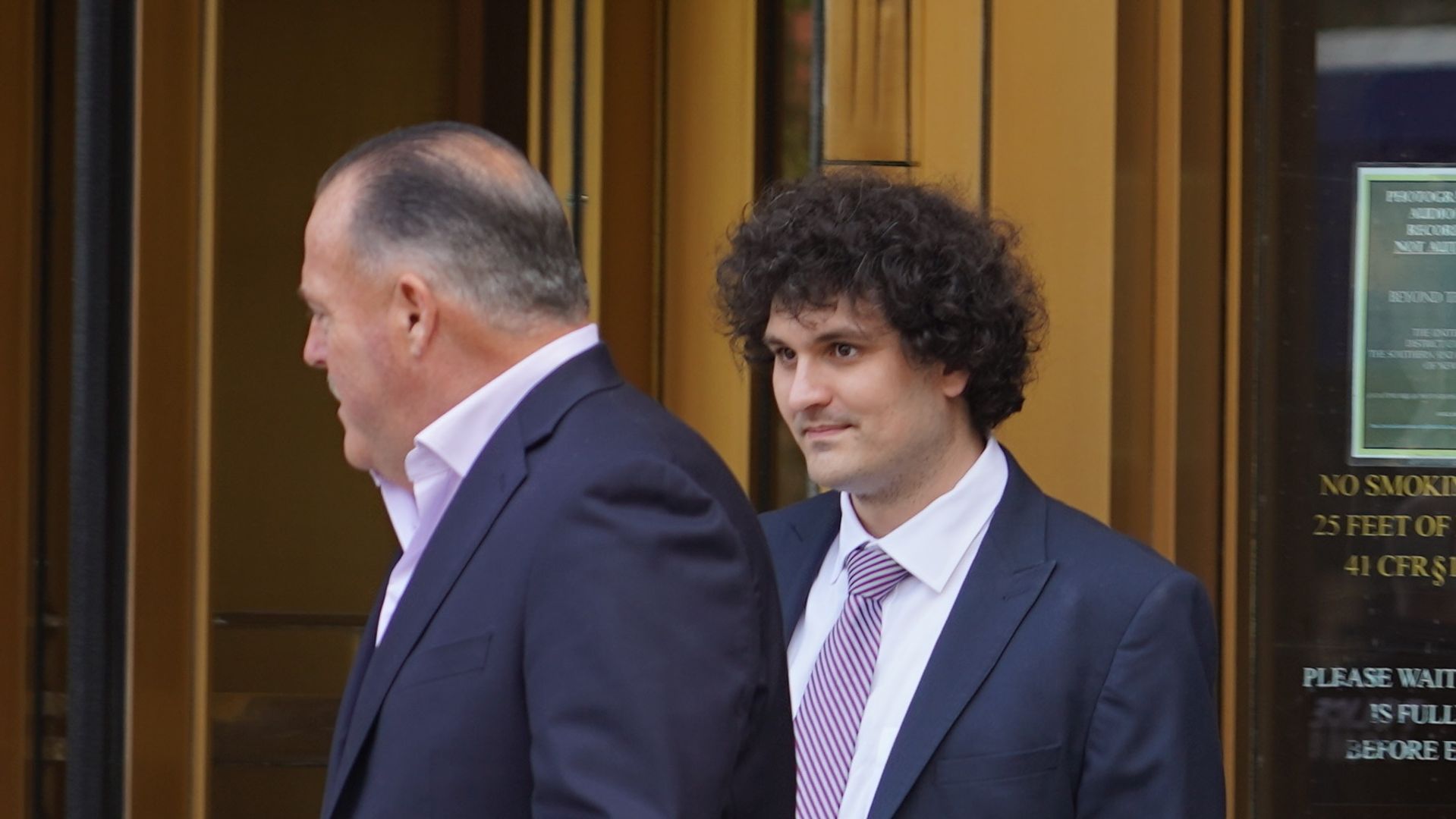
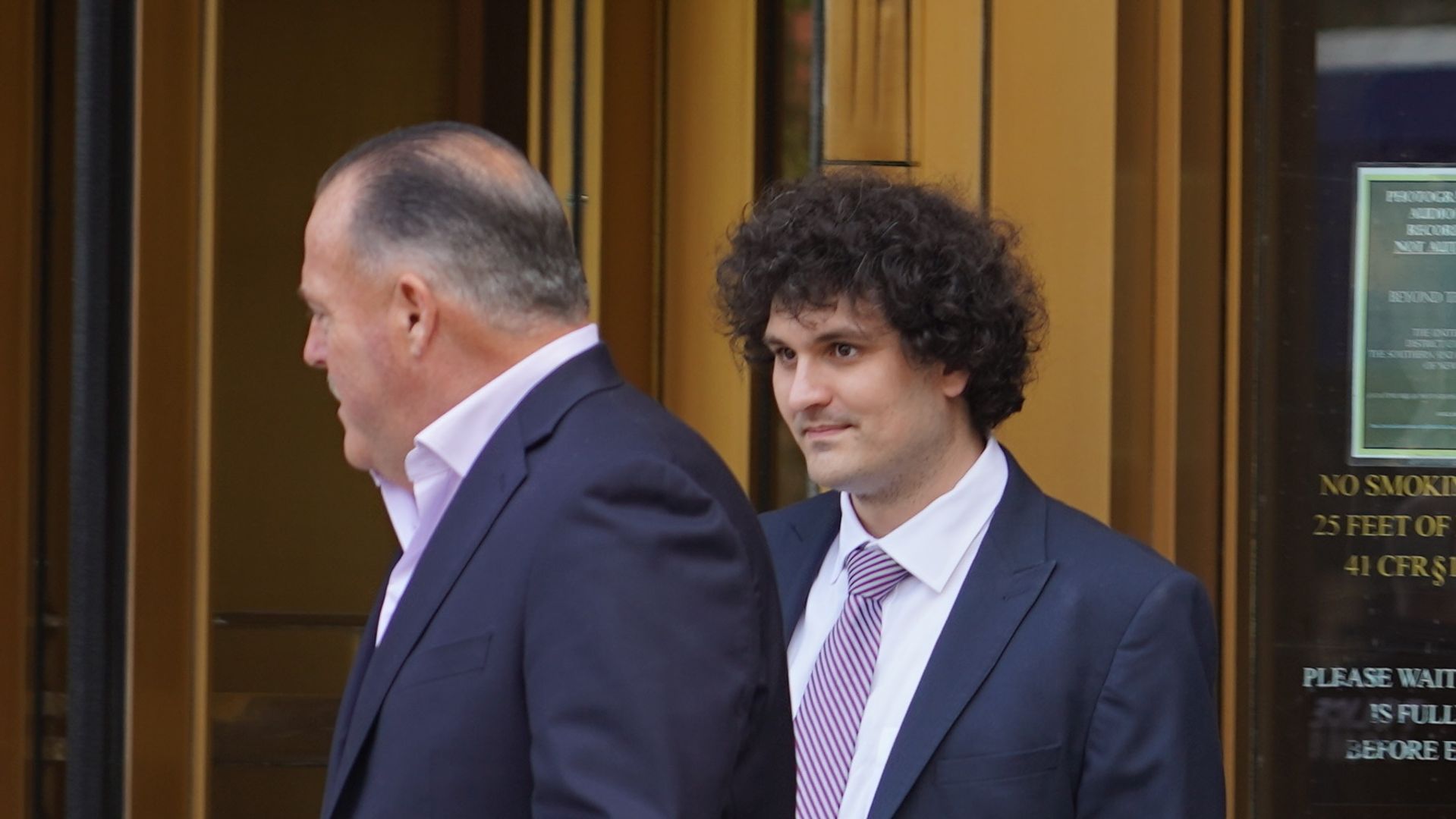
Federal prosecutors told a judge that a letter purportedly sent by Sam Bankman-Fried from prison was actually shipped via FedEx from somewhere else entirely, suggesting someone outside impersonated him.
The filing adds an unusual wrinkle to Bankman-Fried’s post-conviction fight. The FTX founder, sentenced to 25 years for fraud and conspiracy, has been pursuing a new trial from Federal Correctional Institution Terminal Island in San Pedro, California.
Prosecutors say the suspect letter was docketed March 16 but shipped from Palo Alto or Menlo Park, mislabeled the prison as a state facility, and carried a typed “/s/” instead of an actual signature.
Bureau of Prisons regulations bar inmates from sending mail through private carriers like FedEx, prosecutors noted.
Taken together, prosecutors said these discrepancies provide “reason to doubt” the letter was sent by Bankman-Fried.
The government did not accuse the defendant or his associates of fabricating the document, but the filing signals a willingness to challenge the reliability of materials submitted as part of his effort to secure a new trial.
Bankman-Fried has repeatedly argued that he did not receive a fair trial and has pointed to what he claims is new evidence, including the later recovery of customer funds through the FTX bankruptcy process.
Appellate judges have signaled skepticism toward that argument, stressing that the case turned on how customer funds were used and represented at the time, not whether creditors were later made whole.
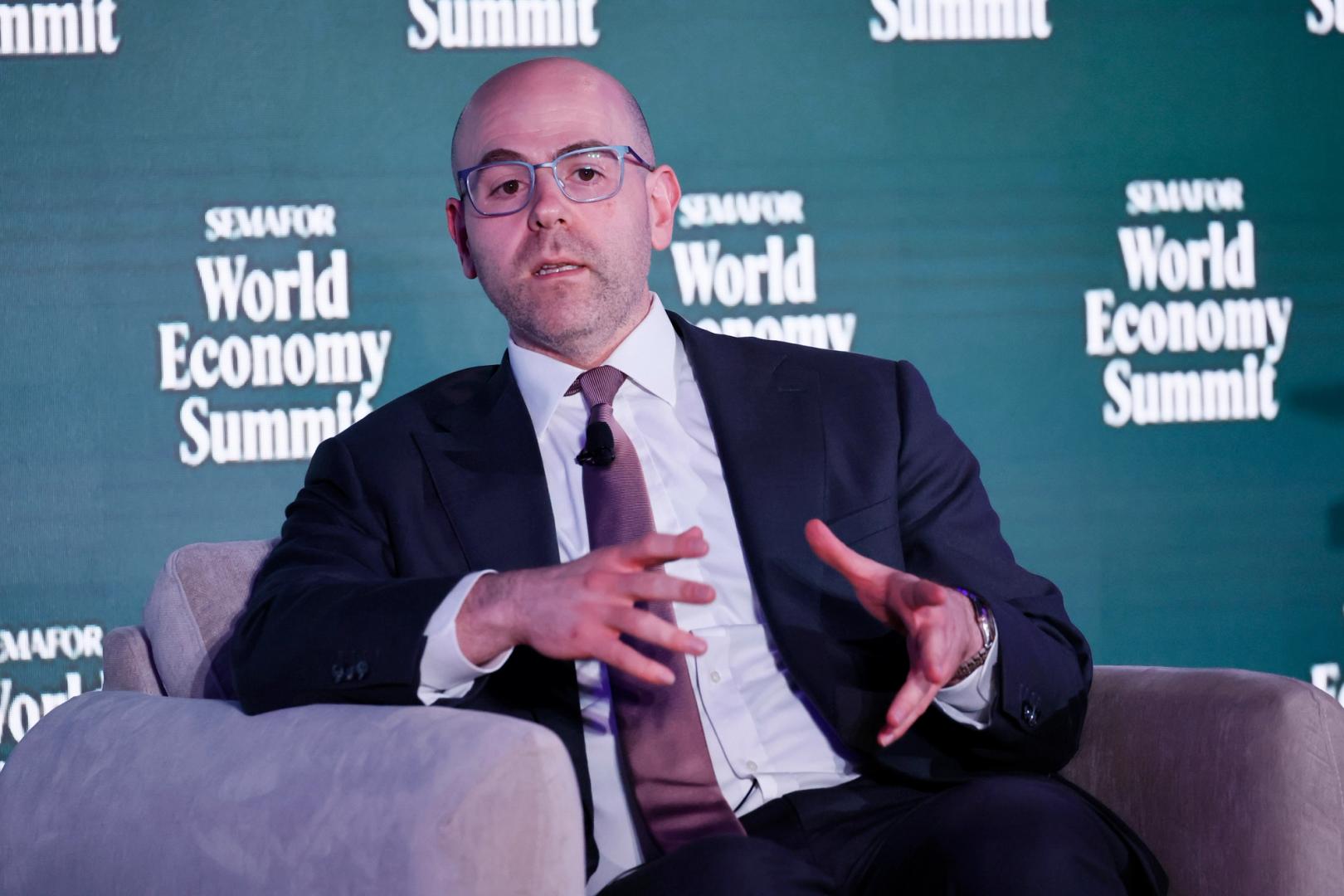
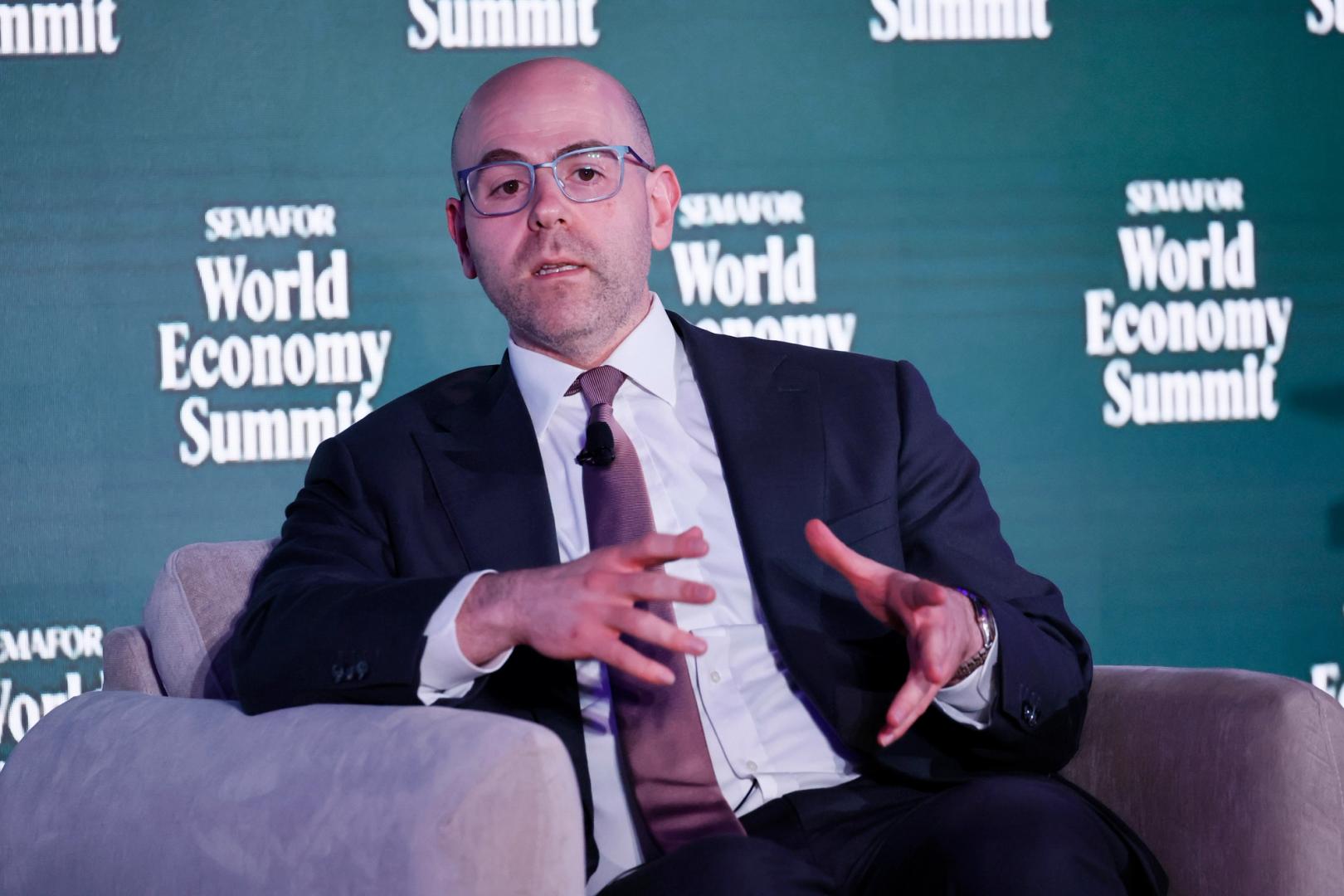
As the war with Iran enters its fourth week, crypto markets will be dominated by macro events.
Off the global stage, however, traders will be navigating a number of supply events while Aave prepares for the deployment of its v4 platform and hard forks loom for both the Akash and Casper networks.
A number of Fed speakers also make an appearance, with Governor Stephen Miran’s scheduled appearance at the Digital Asset Summit in New York being a highlight.
On the earnings front, Wall Street will get a fresh look at not-so-meme stock firm GameStop (GME), which has a bitcoin treasury of 4,710 BTC, alongside reports from companies including BitGo, a provider of crypto services to institutions.
What to Watch
(All times ET)
- Crypto
- Macro
- March 23, 10:00 a.m.: U.S. Construction Spending MoM for January est. 0.1% (Prev. 0.3%)
- March 23, 11:00 a.m.: Euro Area Consumer Confidence Flash for March est. -16 (Prev. -12.2)
- March 23, 7:30 p.m.: Japan CPI YoY for February (Prev. 1.5%); Core CPI est. 1.7% (Prev. 2%)
- March 24, 8:15 a.m.: U.S. ADP Employment Change Weekly (Prev. 9K)
- March 24, 8:30 a.m.: U.S. Nonfarm Productivity QoQ Final Q4 est. 2.5 % (Prev. 5.2%)
- March 24, 9:45 a.m.: U.S. S&P Global Composite PMI Flash for March (Prev. 51.9); Manufacturing PMI (Prev. 51.6); Services PMI (Prev. 51.7)
- March 24, 6:30 p.m.: Fed Gov. Michael Barr Speech on “Economic Outlook and Community Development” at National Community Investment Conference, Phoenix
- March 25, 3:00 a.m.: U.K. Inflation Rate YoY for February est. 3% (Prev. 3%); Core est. 3.1% (Prev. 3.1%)
- March 25, 8:30 a.m.: U.S. Import Prices MoM for February est. 0.2% (Prev. 0.2%); Export Prices MoM (Prev. 0.6%)
- March 26, 8:30 a.m.: U.S. Initial Jobless Claims for week ending March 21 est. 210K (Prev. 205K)
- March 26, 8:30 a.m.: U.S. Continuing Jobless Claims for week ending March 14 (Prev. 1,857K)
- March 26, 4:00 p.m.: Fed Gov. Lisa Cook speech on “Reflections on Financial Stability” at Yale
- March 26, 4:30 p.m.: Fed Balance Sheet for week ending March 25 (Prev. $6.66T)
- March 26, 7:00 p.m.: Fed Vice Chair Philip Jefferson speech on “Economic Outlook and Energy Effects” at Global Perspectives Speaker Series, Dallas
- March 26, 7:10 p.m.: Fed Gov. Michael Barr speech on “Economy”, Washington, D.C.
- March 27, 10:00 a.m.: U.S. Michigan Consumer Sentiment Final for March est. 55.5 (Prev. 56.6)
- Earnings (Estimates based on FactSet data)
- March 23: BTCS Inc. (BTCS), post-market, $0.01
- March 24: GameStop (GME), post-market, $0.31
- March 26: BitGo Holdings (BTGO), post-market, -$0.41
- March 26: Hyperion DeFi (HYPD), pre-market, -$4.62
- March 27: Sphere 3D (ANY), post-market, -$4.68
- March 27: Bonk Inc (BNKK), post-market
- March 27: Mawson Infrastructure Group (MIGI), post-market, -$10.40
- March 27: ZeroStack (ZSTK), post-market, -$1.97
Token Events
- Governance votes & calls
- Aave DAO is voting on deploying Aave V4 with a security-first initial setup, conservative risk parameters, and a modular hub and spoke architecture. Voting ends March 23.
- Floki DAO is voting to rank entries from Floki’s third guerrilla marketing competition. Voting ends March 23.
- StakeDAO’s sdSPECTRA is voting on the Spectra gauge weight allocation for the period of March 26 to April 1, 2026. Voting ends March 24.
- Gitcoin DAO is voting on a request from the treasury to fund DAO operations for 2026, covering governance, builder engagement and ecosystem growth. Voting ends March 25.
- Decentraland is voting to add a new location to Decentraland’s Points of Interest list. Voting ends March 25.
- ENS DAO is voting on an update to the Endowment Manager’s permissions that removes deprecated permissions and upgrades the Roles instance. Voting ends March 26.
- Unlocks
- March 25: Humanity (H) to unlock 4.19% of its circulating supply worth $10.1 million.
- Token Launches
Conferences

TLDR:
- Musk proposes lunar mass drivers to achieve petawatt-scale AI power, 1,000 times current terawatt capacity.
- The Moon’s low gravity and vacuum environment eliminate the need for traditional chemical rocket launches.
- Solar-powered AI satellites launched from the Moon could build a distributed orbital computing network.
- SpaceX Starship will deliver mass driver hardware to the Moon, supporting a long-term lunar city vision.
Lunar mass drivers could transform the future of artificial intelligence infrastructure, according to Elon Musk. The tech billionaire recently outlined a plan to build electromagnetic launch systems on the Moon.
These structures would use the Moon’s low gravity, vacuum environment, and solar energy. The goal is to achieve petawatt-scale computing — roughly 1,000 times the output of current terawatt systems. SpaceX’s Starship rocket would deliver all necessary equipment to the lunar surface.
The Moon’s Environment as a Strategic Advantage
The Moon’s lack of atmosphere removes a core barrier to orbital hardware launches. Without air resistance, electromagnetic mass drivers can accelerate payloads directly to escape velocity.
This eliminates the ongoing need for traditional chemical rockets in the launch process. Consequently, the cost of sending AI computing hardware into orbit from the Moon falls sharply.
Earth’s energy grids currently cap how fast AI infrastructure can grow. Data centers already compete with cities and industries for available power.
Moving AI operations off-planet bypasses those constraints entirely. The Moon provides room to build energy systems at a far greater scale than Earth currently permits.
Solar energy on the lunar surface runs largely uninterrupted compared to Earth conditions. Without a thick atmosphere reducing solar intensity, panels can maintain consistently high efficiency.
This makes solar power a natural and reliable energy source for mass driver systems. Low launch costs combined with plentiful solar energy present a strong economic foundation for the project.
Musk has previously discussed plans for a self-sustaining lunar city through SpaceX. The mass driver proposal builds on earlier announcements he made in February this year.
Both projects fit within a broader vision for permanent lunar industrial development. Moving AI computing to the Moon aligns directly with that long-term roadmap.
Scaling AI Computation Beyond Earth’s Physical Limits
Current terawatt-level AI systems are already pushing Earth-based energy infrastructure to capacity. Reaching petawatt scale demands a fundamentally different approach to power and logistics.
Lunar mass drivers offer a pathway to that scale without overburdening global power grids. The Moon could function, in effect, as a dedicated AI computing and orbital launch platform.
Musk has proposed building an AI satellite factory as part of this broader initiative. Solar-powered satellites carrying compute hardware would be launched into orbit via mass drivers.
This would establish a distributed network of AI processing power circling the Earth. Each satellite would draw energy from the Sun and operate on a continuous basis.
Robotics and optimization systems would manage much of the construction and operational phases. Human involvement would still be needed, particularly during early development on the lunar surface.
Over time, automation would allow the lunar mass driver to scale with fewer labor requirements. Musk has expressed hope of seeing this project realized within his lifetime.


Meta CEO Mark Zuckerberg is reportedly testing an internal AI agent to assist with his daily work. The move reflects a wider shift within the company as it pushes to integrate AI tools across its operations and workforce.
Summary
- Zuckerberg tests AI agent to speed up decisions and reduce internal communication layers at Meta.
- Meta expands AI tools like MyClaw and Second Brain to improve workforce productivity.
- Reports suggest possible layoffs as Meta shifts toward AI-driven efficiency and flatter team structures.
Reports indicate that Zuckerberg is already using an AI agent to retrieve information more efficiently. Instead of relying on internal teams, the system gathers data directly, reducing delays in decision-making. The tool remains under development but is already part of the CEO’s workflow.
This effort aligns with Meta’s broader strategy to improve productivity across its workforce. The company is exploring ways to simplify internal processes and reduce dependency on layered communication structures.
Meta has been expanding its use of AI tools among employees. Internal systems such as MyClaw allow staff to access files, review chat logs, and interact with both colleagues and AI systems. These tools aim to streamline collaboration and reduce time spent searching for information.
Another tool, known as Second Brain, supports employees in managing tasks and projects. Built on Anthropic’s Claude infrastructure, it has been described internally as an “AI chief of staff.” These tools reflect Meta’s goal of increasing efficiency within its workforce of around 78,000 employees.
In addition, Zuckerberg has previously outlined plans to reshape how Meta operates. During a recent earnings call, he said that 2026 would mark a shift in how AI influences the company’s structure and productivity. He stated,
“AI starts to dramatically change the way” Meta works.
He also noted that Meta is focusing on building an environment where individuals can contribute more directly. He said the company is “investing in AI-native tooling” and “flattening teams,” signaling a move toward fewer management layers and more independent contributors.
Layoff reports and industry trends
Separate reports suggest that Meta may consider additional layoffs as part of its AI strategy. Sources cited in recent coverage indicated that up to 20% of the workforce could be affected, though no timeline has been confirmed. Meta responded by describing such reports as “speculative.”
The move toward AI-driven efficiency is not limited to Meta. Several firms across the tech and crypto sectors have announced layoffs while increasing investment in AI tools. Companies such as Messari and Crypto.com have also reduced staff as they shift toward AI-focused operations.
Crypto World
Iran’s Foreign Minister Says Insurance Markets, Not Missiles, Closed the Strait of Hormuz
TLDR:
- Iran’s FM Araghchi says insurance cancellations, not military action, are stalling Persian Gulf tankers.
- Marine war risk insurers scrapped Gulf coverage, trapping an estimated 15 million barrels daily.
- Bearish investor sentiment hit 52%, the highest since spring 2025, as the conflict feeds risk models.
- Energy stocks gained 29% year-to-date in 2026 while Bitcoin dropped below $68,000 amid uncertainty.
The Strait of Hormuz remains physically open, yet global oil shipments have effectively stalled. Iran’s Foreign Minister Abbas Araghchi attributed the disruption not to military force but to marine war risk insurers.
Major providers have cancelled coverage for vessels operating in the Persian Gulf. Without active insurance policies, tankers cannot sail legally.
Roughly 15 million barrels of crude sit trapped daily. The standoff has rattled financial markets, pushing investor sentiment to its most bearish reading since spring 2025.
Insurance Cancellations, Not Mines, Grounded Persian Gulf Tankers
Araghchi took to X to address the shipping slowdown directly. He wrote: “Strait of Hormuz is not closed. Ships hesitate because insurers fear the war of choice you initiated—not Iran.”
He added that no insurer or Iranian would respond to further threats. His post pointed to an overlooked mechanism behind the disruption.
Marine war risk insurers pulled coverage after regional hostilities intensified. Without a valid policy, no commercial tanker can legally complete its voyage.
Mines and drone threats acted as triggers, but the underwriter’s spreadsheet became the real barrier. That dynamic has made military escorts largely ineffective.
Twenty-two countries coordinating with NATO face the same obstacle. Clearing mines or neutralising coastal batteries does not reopen shipping lanes when underwriters refuse to issue policies.
Providers like Lloyd’s of London base their decisions on actuarial models. Those models account for ongoing conflict, missile activity, and sustained military uncertainty.
Iran’s position, therefore, rests on the risk premium rather than a direct military blockade. As long as hostilities continue, insurers maintain their cancellations.
The 48-hour ultimatum issued by US leadership added further pressure to those calculations. Each new escalation feeds the risk model rather than easing it.
Bearish Investor Sentiment Rises as Energy and Housing Data Diverge
The American Association of Individual Investors survey from March 19 recorded 52 percent of investors as bearish. That reading is the highest since spring 2025.
Bullish sentiment fell to 30.4 percent, leaving a negative bull-bear spread of 21.6 percentage points. These numbers reflect the same insurance-driven mechanism Araghchi described.
Energy stocks recorded 20 all-time highs in 2026, the most since 2013. The sector gained 29 percent year-to-date and 367 percent since the 2020 pandemic low.
Traders are pricing a prolonged period of trapped supply. Meanwhile, Bitcoin fell below $68,000 amid broader market uncertainty.
New US home sales dropped 17.6 percent month-on-month to 587,000 units, the lowest since 2022. The median home price declined 6.8 percent year-over-year. Those figures point to stress in rate-sensitive sectors while the conflict continues.
The market has effectively split into two camps. One segment prices sustained high oil revenue. The other prices broad economic weakness.
Iran has warned that any strike on its power grid would permanently close the Strait of Hormuz. Insurers continue processing that statement the same way they process every other risk factor, by keeping policies cancelled.
Key Takeaways
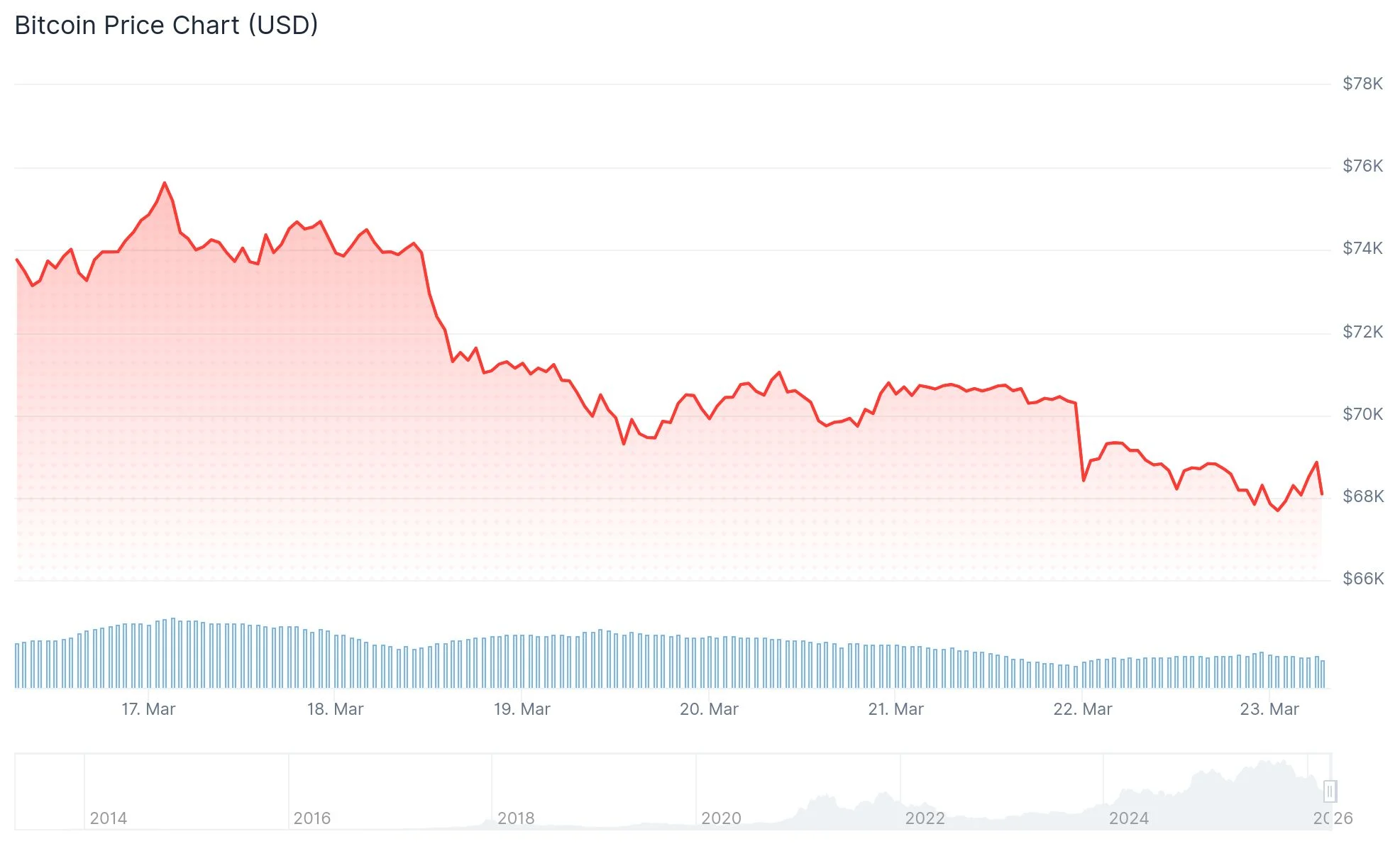
- Bitcoin (BTC) plunged from approximately $90,000 to close to $60,000 in early 2026, while equities remained resilient — but that’s changing.
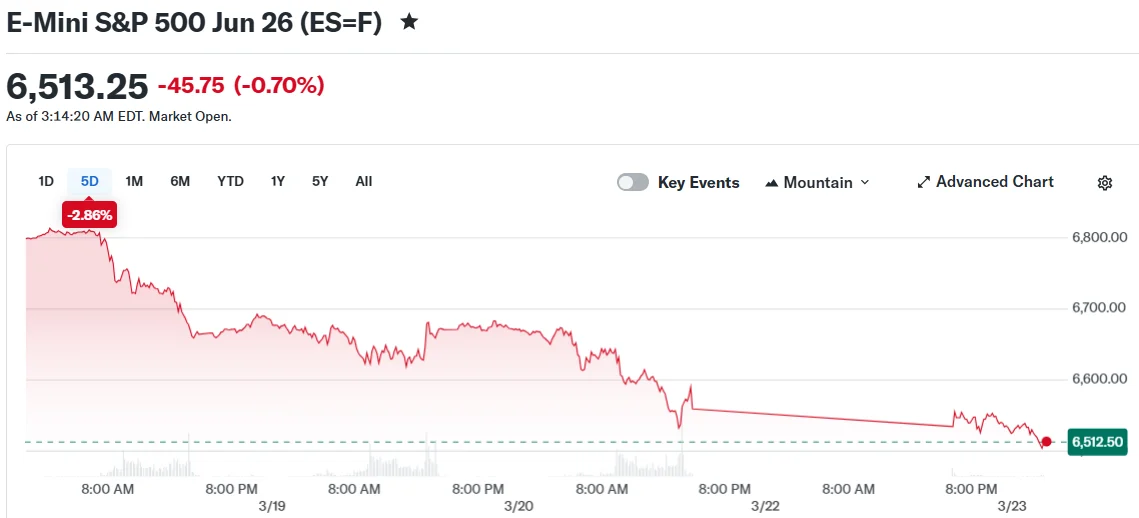
- Following the outbreak of conflict with Iran on Feb. 28, Treasury yields have surged, pushing Nasdaq and S&P 500 futures down to September levels.
- The 10-year Treasury yield reached 4.41%, marking its highest point since August 1, climbing 48 basis points since hostilities began.
- Both cryptocurrency and stock market sentiment indicators have plunged into “extreme fear” zones during late March.
- Retail investor pessimism has reached 52% for the next six-month outlook — the most negative reading since May 2025.
Digital asset markets experienced severe turbulence at the beginning of 2026, with Bitcoin plummeting from approximately $90,000 to near $60,000 within a five-week period. During that same timeframe, U.S. equity markets showed remarkable resilience, hovering close to all-time peaks.
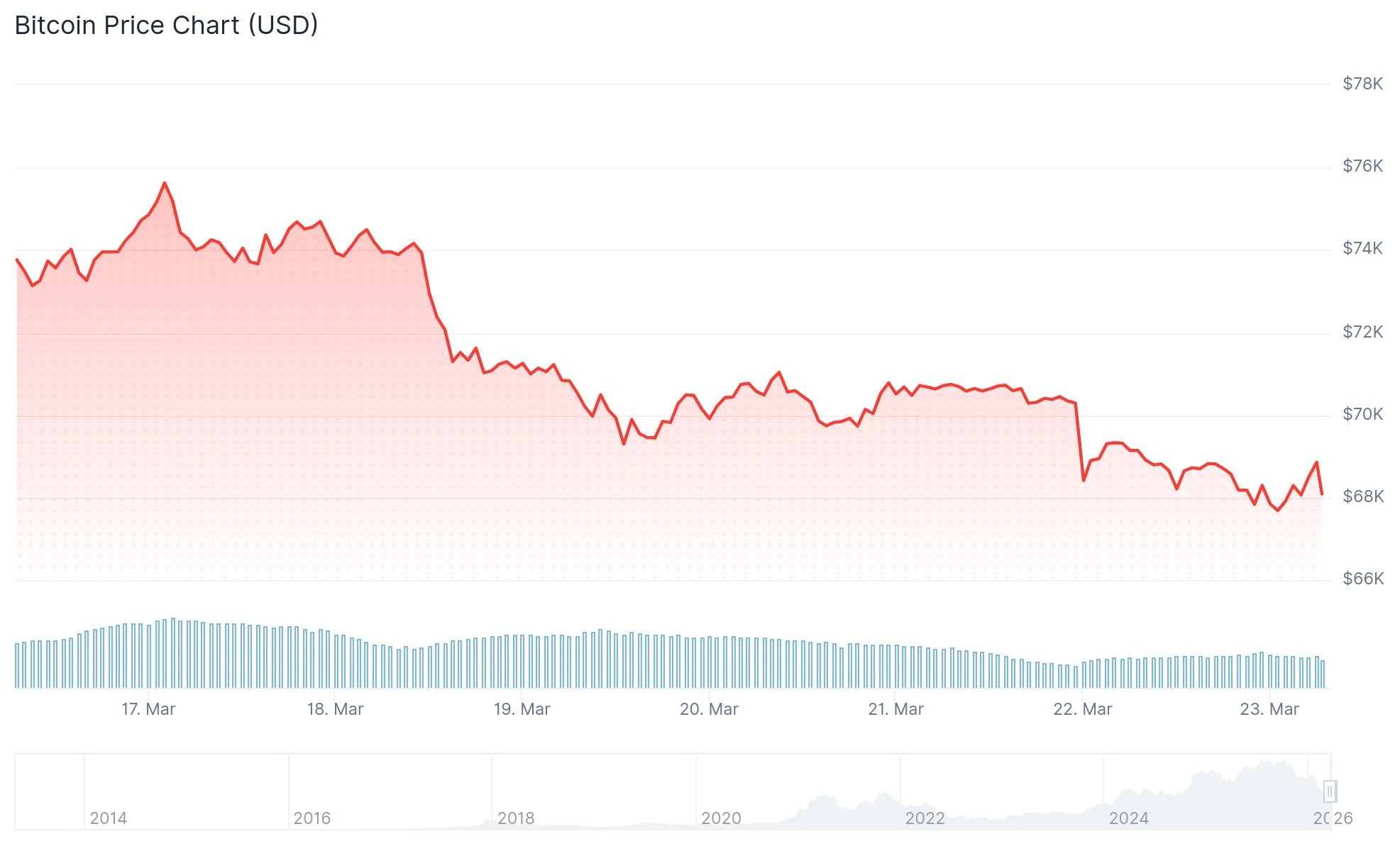
That divergence is rapidly disappearing — and not for positive reasons.
Since military operations involving Iran commenced on February 28, concerns about inflationary pressures and diminishing prospects for Federal Reserve interest rate reductions have driven U.S. Treasury yields significantly higher. This shift has started dragging equities downward, mirroring the weakness that bitcoin telegraphed several weeks ahead.
The benchmark 10-year U.S. Treasury note yield advanced to 4.41% during early Monday trading, marking its strongest level since the beginning of August. The yield has increased by 48 basis points from when the Iranian conflict initiated. Meanwhile, the two-year Treasury yield has surged 57 basis points to reach 3.94%.
Elevating yields carry significant implications because they increase borrowing expenses throughout the broader economy — affecting everything from home mortgages to business financing. This dynamic typically dampens enthusiasm for riskier assets in equity markets.
Nasdaq futures declined to 23,890 points during Monday’s early session, representing the weakest level since September 11. S&P 500 e-mini futures tumbled to 6,505 points, similarly marking their lowest position since September.
Bitcoin Functions as an Early Warning System
Market observers have consistently monitored bitcoin as a forward-looking gauge for overall risk sentiment. Its sharp decline during early 2026 may have served as an advance warning of the turbulence equities are currently facing.
In a recent analysis, Bloomberg Senior Commodity Strategist Mike McGlone highlighted that bitcoin occupies a position “at the top of the risk-assets iceberg,” suggesting its deteriorating price action could represent the initial phase of a broader market correction — especially if volatility in commodities spills over into stock indices.
Bitcoin has traded within a relatively narrow range in recent weeks, oscillating between $65,000 and $75,000. Monday morning prices hovered around $68,790. However, derivatives market indicators reveal profound anxiety, with an unprecedented skew toward put options — financial instruments designed to protect against additional price declines.
Anxiety Permeates Both Asset Classes
Measures of market sentiment indicate that fear has become pervasive. The Crypto Fear & Greed Index has retreated to “extreme fear” status. A comparable gauge tracking stock market sentiment has likewise experienced a sharp deterioration.
Blockchain analytics provider Alphractal characterizes this simultaneous emergence of fear across both markets as an uncommon occurrence, advising investors to maintain heightened vigilance.
Data from the American Association of Individual Investors reveals that 52% of retail market participants maintain a pessimistic view for the upcoming six months. This represents the most bearish sentiment registered since May 2025.
Donald Trump’s 48-hour deadline concerning the Strait of Hormuz continues ticking down, contributing additional uncertainty to market psychology.
Market analyst Tony Severino highlights a recurring historical phenomenon where bitcoin’s correlation with the S&P 500 declines to -0.5 before experiencing a dramatic reversal upward — a configuration he suggests frequently precedes significant equity market declines. That correlation metric has recently shifted back into positive territory.
“Typically there’s an initial rally that amplifies the subsequent pain,” Severino noted.
Current market pricing reflects a modest probability that the Federal Reserve might actually increase interest rates instead of implementing the anticipated cuts.
Key Takeaways
- SkyBridge Capital’s Anthony Scaramucci maintains that Bitcoin’s traditional four-year market cycle continues operating despite growing institutional participation
- Significant profit-taking occurred around the $100,000 price milestone, creating substantial sell-side pressure that pushed BTC from $126,000 down to $60,000
- While institutional capital and exchange-traded funds have dampened price swings, they haven’t fundamentally altered the cyclical nature of Bitcoin markets
- Scaramucci anticipates volatile, sideways price action throughout most of 2026 before a fresh uptrend emerges in the fourth quarter
- The S&P 500 declined 1.3% and breached its 200-day moving average, prompting warnings that Bitcoin might decline 50% if correlation with equities persists
Anthony Scaramucci, the managing partner at SkyBridge Capital, maintains that Bitcoin is experiencing a typical four-year cycle pullback and anticipates price recovery beginning in Q4 2026.
Scaramucci offered these insights during an appearance on Scott Melker’s “The Wolf of All Streets” podcast. He identified selling activity around the $100,000 price level as a primary catalyst behind the ongoing downturn.
Early adopters and long-term Bitcoin holders viewed the $100,000 mark as a significant profit-taking opportunity. This selling wave created downward momentum despite simultaneous institutional capital entering the market.
Bitcoin reached a peak near $126,000 before experiencing a steep decline to $60,000. This correction shattered widespread market predictions that BTC would reach $150,000 during 2025.
According to Scaramucci, those bullish projections were driven by Donald Trump’s cryptocurrency-friendly policies and improved regulatory conditions in the United States. However, he emphasized that markets typically defy consensus expectations.
He referenced early 2023 as a perfect illustration. Bitcoin began its recovery in January 2023 during a period of extreme bearish sentiment following FTX’s November 2022 collapse.
“It was at a period of great disinterest and great apathy that the bull market started again,” Scaramucci noted.
Institutional Participation Has Modified But Not Eliminated the Cycle
Scaramucci explained that Bitcoin exchange-traded funds and institutional capital have moderated volatility without destroying the cyclical framework. While price fluctuations have become less dramatic, the fundamental pattern persists.
He characterized the cycle as somewhat self-reinforcing. Market participants who recognize and trade based on the four-year rhythm effectively perpetuate the pattern through their collective behavior.
U.S. spot Bitcoin ETFs have attracted approximately $2 billion in net inflows during the last four weeks, representing the most extended period of positive flows seen in 2026.
Bitcoin’s Correlation With Traditional Equity Markets Strengthens
Bitcoin dropped beneath $69,000 on Saturday as escalating Middle East geopolitical tensions continued pressuring risk-sensitive assets. The Iran situation has now stretched into its third week, creating headwinds for global financial markets.
The S&P 500 fell 1.3% on Friday, closing below its 200-day moving average for the first occurrence in ten months. This technical level serves as a critical indicator for assessing long-term equity market trends.
Several market analysts now suggest Bitcoin could experience an additional 50% decline in 2026 if its correlation with the S&P 500 remains elevated.
Scaramucci characterized the present correction as an ordinary downturn consistent with historical cycles. He projects continued volatility and range-bound trading for the majority of the year before a new bullish phase initiates in Q4 2026.
U.S. spot Bitcoin ETFs have accumulated approximately $2 billion in total inflows during the previous four-week period.


Bithumb is moving to retain CEO Lee Jae-won as the South Korean crypto exchange faces regulatory pressure and fresh scrutiny over compliance controls. Shareholders are expected to vote on his reappointment at the company’s regular meeting on March 31.
Summary
- Bithumb seeks CEO Lee’s reappointment despite AML penalties and ongoing regulatory investigations in South Korea.
- Exchange faces transfer restrictions, fines, and scrutiny over a major Bitcoin promotion error.
- South Korea’s growing crypto market adds pressure as Bithumb prepares for license renewal.
Bithumb will reportedly ask shareholders to approve another two-year term for Lee Jae-won. His current term ends at the close of March. If shareholders approve the proposal, Lee will continue leading the exchange during a period of regulatory pressure.
The reported move comes as Bithumb remains the second-largest crypto exchange in South Korea by trading volume, per CoinGecko data. The company continues to hold a strong market position behind Upbit, while Korbit remains smaller by comparison.
Regulatory action adds pressure
Bithumb has recently faced action from South Korea’s Financial Intelligence Unit. In March, the regulator reportedly imposed a six-month partial suspension and a 36.8 billion won fine over alleged anti-money laundering failures.
Under the reported measures, new customers will not be allowed to make external crypto transfers from March 27 through Sept. 26. The case has added pressure on the exchange as it manages compliance and prepares for future licensing requirements.
Moreover, the exchange also drew attention in February after it reportedly credited users with 2,000 Bitcoin instead of 2,000 won during a promotional campaign. That error led to the distribution of 620,000 coins that the exchange could not support.
Bithumb is also waiting for the outcome of another probe linked to alleged order book sharing with an overseas platform. According to the Korea Times, an industry official said,
”Bithumb will be on edge awaiting the results of ongoing regulatory probes, as the company still needs to renew its virtual asset service provider license.”
South Korea’s crypto market keeps growing
The leadership decision comes as South Korea’s crypto market continues to expand. The sector has seen stronger policy support since President Lee Jae-myung took office and advanced crypto-related measures, including a bill tied to stablecoins.
Crypto ownership has also risen sharply in the country. Earlier data showed South Korean crypto exchange users had surpassed 16 million, equal to more than 30% of the population. Market estimates also project the country’s crypto sector could generate $1.3 billion in revenue in 2026.
Key Highlights
- A sophisticated attacker leveraged a vulnerability in Resolv’s USR minting mechanism, generating approximately 80 million unbacked tokens from an initial deposit of just $200,000 in USDC
- The hacker successfully extracted 11,409 ETH, valued at approximately $25 million
- USR’s value plummeted to $0.025 on Curve Finance before staging a partial recovery to roughly $0.85
- Resolv has suspended all protocol operations; while the team claims the collateral pool remains secure, USR token holders sustained significant losses due to supply inflation
- Major DeFi platforms including Morpho, Lido, and Aave quickly responded to assess and mitigate their exposure
A critical security breach struck Resolv’s USR stablecoin on Sunday, with an attacker exploiting vulnerabilities in the minting infrastructure to generate approximately 80 million unbacked tokens, ultimately draining roughly $25 million worth of Ether from the protocol.
The malicious activity commenced around 2:21 a.m. UTC. The perpetrator initiated the attack by depositing 100,000 USDC into Resolv’s USR Counter contract, receiving an astronomical 50 million USR in return — approximately 500 times the legitimate amount. A follow-up transaction produced an additional 30 million tokens.
Following the unauthorized minting, the attacker systematically exchanged the fraudulent USR for USDC and USDT through various decentralized exchanges, subsequently consolidating the proceeds into ETH. The attacker’s wallet currently contains 11,409 ETH, representing approximately $23.7 million in current market value.
USR, engineered to maintain a $1 price peg, catastrophically collapsed to $0.025 on Curve Finance merely 17 minutes after the initial minting transaction. While the token experienced a partial rebound to approximately $0.85, it remained significantly depegged as of Sunday morning.
Resolv Labs announced on X that all protocol operations had been temporarily suspended. The development team emphasized that the collateral pool “remains fully intact” with “no underlying assets” compromised. They characterized the vulnerability as “isolated to USR issuance mechanics.”
Despite these assurances, blockchain analysts highlighted that existing USR holders suffered substantial damage. The massive influx of 80 million newly minted tokens severely diluted the circulating supply, while the attacker’s aggressive selling depleted available pool liquidity. Any investors holding USR during the incident experienced immediate portfolio losses.
Security Flaws Traced to Inadequate Access Management
Blockchain security analyst Andrew Hong identified the breach’s origin as a privileged account designated as the SERVICE_ROLE. This critical account was controlled by a single externally owned account rather than a more secure multisignature wallet. The minting contract lacked essential safeguards including oracle verification, amount validation protocols, and maximum minting thresholds.
Pashov, a security firm that previously audited Resolv’s staking module in July 2025, informed Cointelegraph that the fundamental issue appears to stem from a private key compromise rather than inherent weaknesses in the protocol’s architectural design.
Cyvers CEO Deddy Lavid emphasized: “Audits alone are not enough. If you’re not monitoring minting and supply in real time, you’re blind when it matters most.”
Resolv’s official website documents 14 separate audit engagements conducted by five distinct security firms, a $500,000 bug bounty program hosted on Immunefi, and ongoing smart contract surveillance systems.
DeFi Ecosystem Responds to Contain Fallout
Numerous DeFi platforms implemented rapid response measures following the exploit. Lido confirmed that user funds deposited in Lido Earn remained secure. Aave founder Stani Kulechov stated the platform maintained no direct USR exposure and confirmed Resolv was actively repaying outstanding debt. Morpho co-founder Merlin Egalite clarified that only specific vaults had USR exposure.
Contagion Effects Spread Through Lending Ecosystems
Both USR and its staked derivative wstUSR were approved as collateral assets on platforms such as Morpho and Gauntlet. Market analysts observed that opportunistic traders may have acquired USR at its severely discounted price and leveraged it to borrow USDC at the full $1 valuation, effectively draining liquidity reserves from affected vaults.
Resolv’s junior insurance tranche, RLP, also faces potential capital impairment. Stream Finance, holding a substantial 13.6 million RLP position valued at approximately $17 million, could transmit additional losses to its depositor base. Stream previously disclosed a $93 million loss in November 2025.
The RESOLV governance token declined approximately 8.5% in the 24-hour period following the security breach.
This Resolv incident exemplifies a broader industry pattern. According to a recent Immunefi report, the average cryptocurrency hack now inflicts damages of approximately $25 million, with the five largest exploits during 2024–2025 representing 62% of total stolen funds.
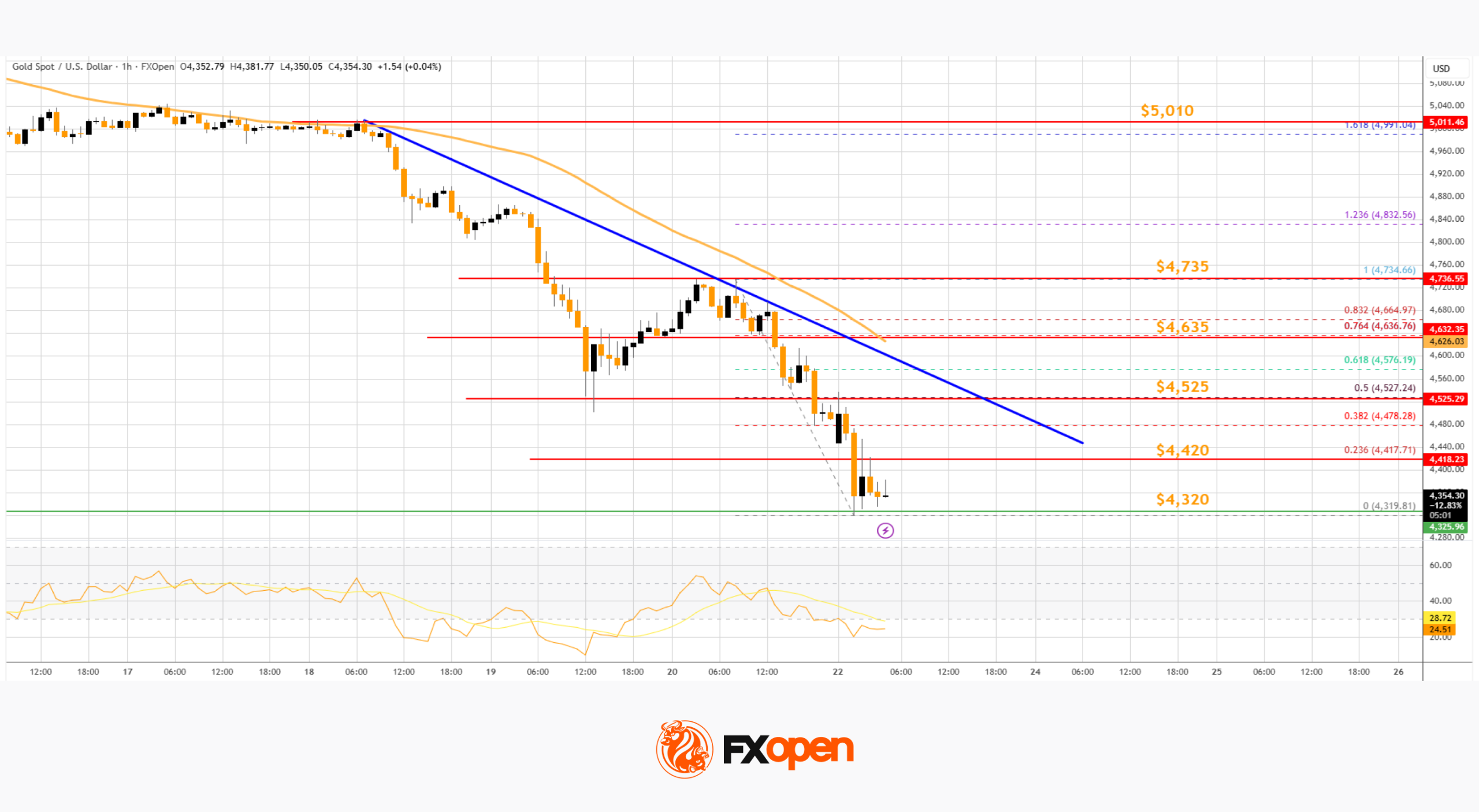
Gold price extended losses below $4,500 before the bulls appeared. WTI Crude oil prices are rising and could climb further higher toward $105.00.
Important Takeaways for Gold and WTI Crude Oil Prices Analysis Today
· Gold price failed to clear $5,000 and declined heavily against the US Dollar.
· There is a key bearish trend line forming with resistance at $4,525 on the hourly chart of gold at FXOpen.
· WTI Crude oil prices are moving higher above the $95.00 resistance zone.
· There was a break above a connecting bearish trend line at $97.00 on the hourly chart of XTI/USD at FXOpen.
Gold Price Technical Analysis
On the hourly chart of Gold at FXOpen, the price failed to settle above $5,000 and reacted to the downside, as discussed in the previous analysis. The price traded below $4,800 and $4,650 to enter a bearish zone.
There was a sharp drop below $4,500. The price settled below the 50-hour simple moving average, and RSI dipped below 30. Finally, it tested the $4,320 zone. A low was formed at $4,319, and the price is now consolidating losses.
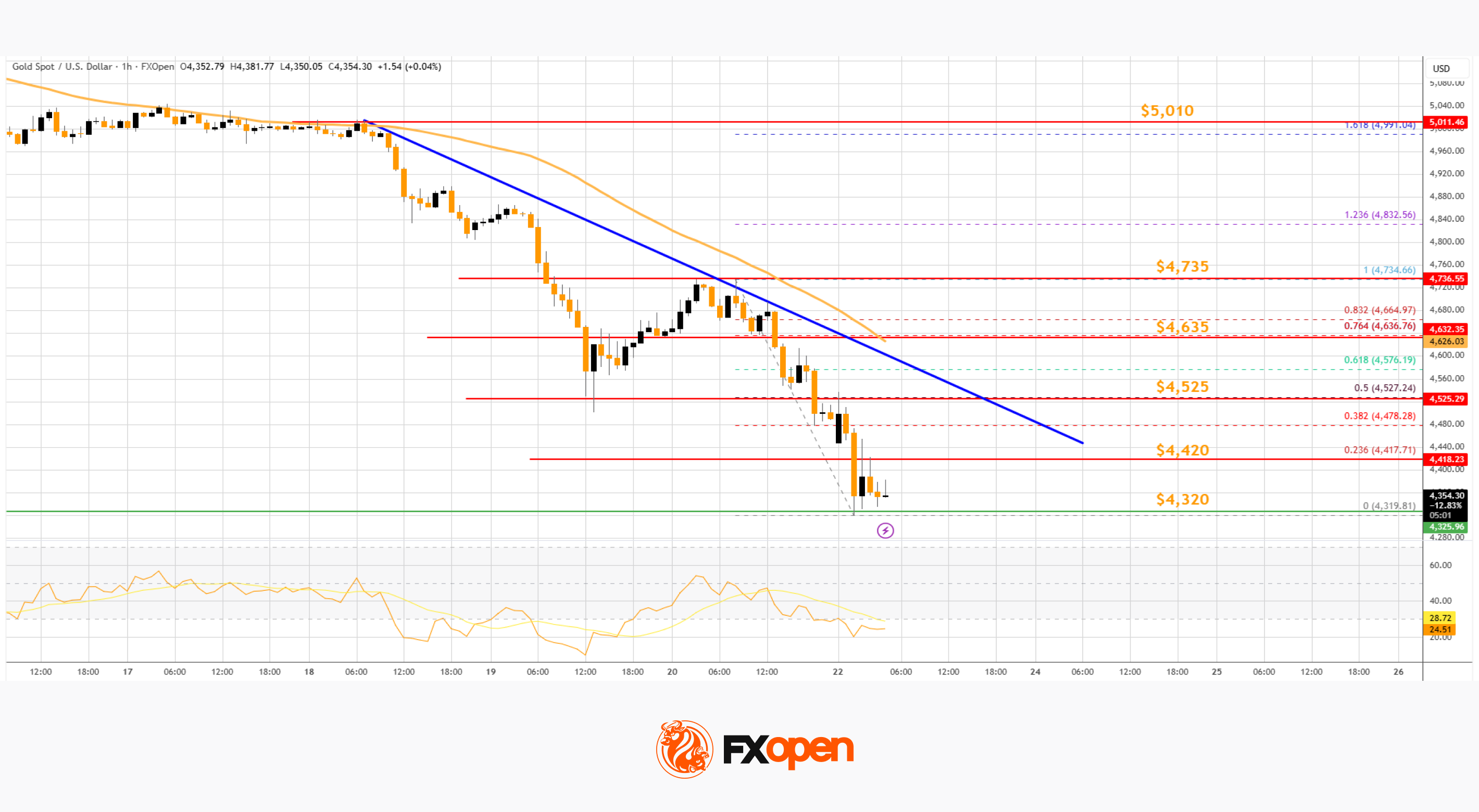
Immediate resistance on the upside is $4,420 or the 23.6% Fib retracement level of the downward move from the $4,734 swing high to the $4,319 low.
The first major hurdle sits at $4,525. There is also a key bearish trend line forming with resistance at $4,525 and the 50% Fib retracement. A close above $4,525 could initiate a recovery wave to $4,635. An upside break above $4,635 could send Gold price toward $4,735. Any more gains may perhaps set the pace for an increase toward $5,010.
If there is no fresh increase, the price could continue to move down. Initial support on the downside is near the $4,320 level. The first key area of interest might be $4,300. If there is a downside break below $4,300, the price might decline further. In the stated case, the price might drop to $4,200.
WTI Crude Oil Price Technical Analysis
On the hourly chart of WTI Crude Oil at FXOpen, the price started a strong increase from $91.80 against the US Dollar. The price gained bullish momentum after it broke $95.00.
There was a sustained upward movement above $95.50 and $98.00. More importantly, there was a break above a connecting bearish trend line at $97.00. The bulls pushed the price above the 50-hour simple moving average, and the RSI climbed toward 60.
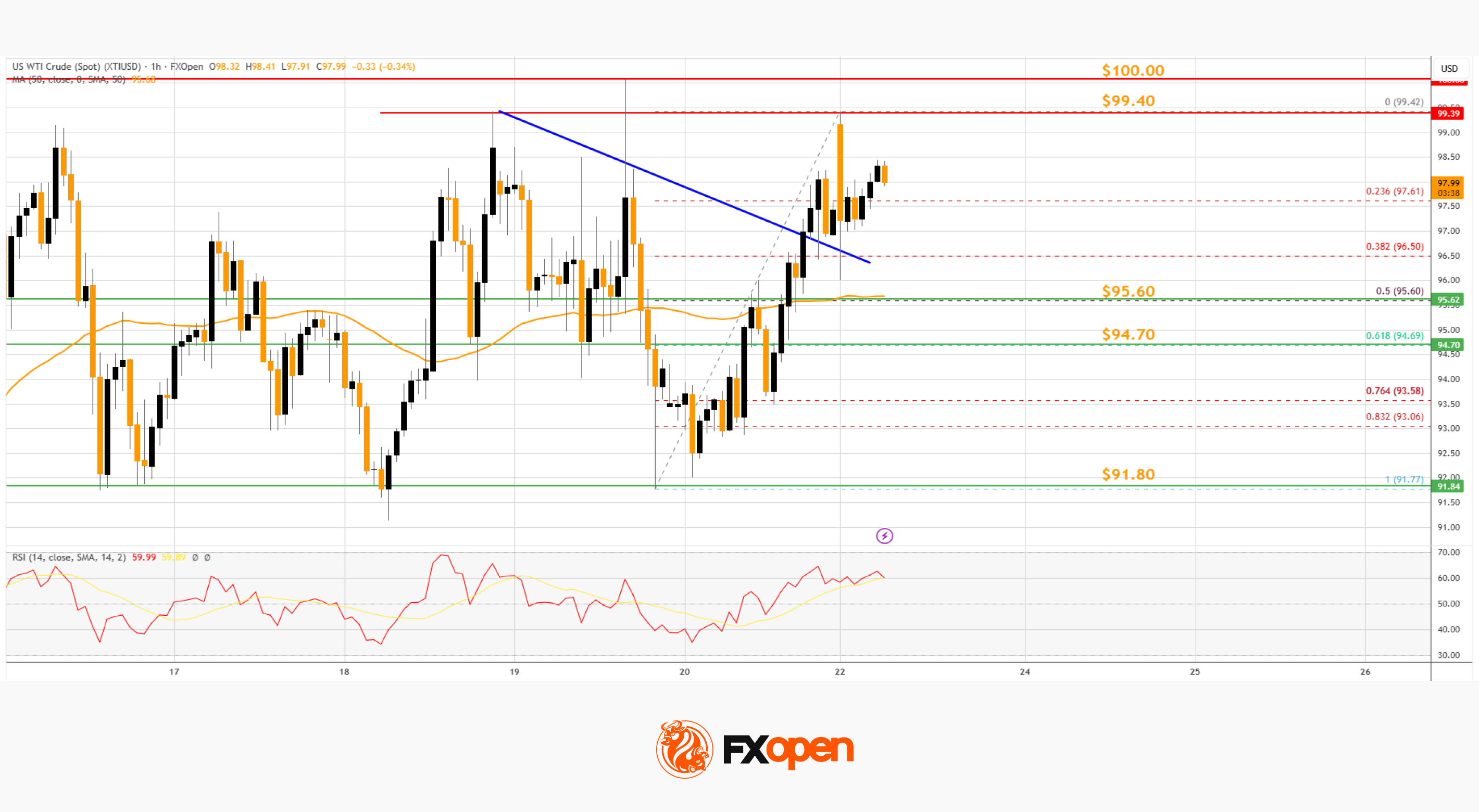
A high was formed near $99.42 before there was a minor pullback. The price declined below the 23.6% Fib retracement level of the upward move from the $91.77 swing low to the $99.42 high.
However, the bulls are active above $95.00. Immediate resistance is $99.40. If the price climbs further, it could face hurdles near $100.00. The next major stop for the bulls might be $102.00. Any more gain might send the price toward $105.00.
Conversely, the price might correct gains and retest the 50-hour simple moving average at $95.60 and the 50% Fib retracement. The next area of interest on the WTI crude oil chart could be $94.70.
If there is a downside break, the price might decline to $91.80. Any more losses may perhaps open the doors for a move toward $85.00.
Start trading commodity CFDs with tight spreads (additional fees may apply). Open your trading account now or learn more about trading commodity CFDs with FXOpen.
This article represents the opinion of the Companies operating under the FXOpen brand only. It is not to be construed as an offer, solicitation, or recommendation with respect to products and services provided by the Companies operating under the FXOpen brand, nor is it to be considered financial advice.

Plans unveiled for huge new town near Bristol

Prosecutors flag SBF letter sent from the Bay Area, not prison

Eagles most underrated player entering the 2026 NFL season


![Why Bitcoin Is Going Higher Than You Think! [6 Data Points]](https://wordupnews.com/wp-content/uploads/2026/03/1774255687_maxresdefault-80x80.jpg)

-

 Fashion3 days ago
Weekend Open Thread: Adidas – Corporette.com
-
 Crypto World2 days ago
NIO (NIO) Stock Plunges 6.5% as Shelf Registration Sparks Dilution Worries
-

 Politics3 days ago
Jenni Murray, Long-Serving Woman’s Hour Presenter, Dies Aged 75
-
 Tech6 days ago
Are Split Spacebars the Next Big Gaming Keyboard Trend?
-

 Crypto World1 day ago
Best Crypto to Buy Now: Strategy Just Spent $1.57 Billion on Bitcoin During Fear While Early Investors Quietly Enter Pepeto for 150x Potential
-

 News Videos5 days ago
RBA board divided on rate cut, unusually buoyant share market | Finance Report | ABC NEWS
-

 Crypto World1 day ago
Bitcoin Price News: Bhutan Sells $72 Million in BTC Under Fiscal Pressure, but the Smart Money Entering Pepeto Sees What the Market Does Not
-

 Business7 days ago
Australian shares drop as Iran war enters third week
-

 Crypto World7 days ago
Crypto Lender BlockFills Enters Chapter 11 with Up to $500M in Liabilities
-

 Politics5 days ago
The House | The new register to protect children from their abusers shows Parliament at its best
-

 Fashion7 days ago
25 Celebrities with Curly Hair That Are Naturally Beautiful
-

 Tech3 days ago
inKONBINI Lets You Spend Summer Days Behind the Register
-
 Politics6 days ago
Real-time pollution monitoring calls after boy nearly dies
-

 Crypto World5 days ago
Canada’s FINTRAC revokes registrations of 23 crypto MSBs in AML crackdown
-
 NewsBeat5 days ago
Residents in North Lanarkshire reminded to register to vote in Scottish Parliament Election
-

 Business7 days ago
Meta planning major layoffs as AI spending and automation reshape workforce
-

 News Videos5 days ago
PARLIAMENT OF MALAWI – PAC MEETING WITH REGISTRAR OF FINANCIAL ON AMARYLLIS HOTEL – INQUIRY LIVE
-

 Politics4 days ago
Gender equality discussions at UN face pushbacks and US resistance
-

 Business17 hours ago
No Winner in March 21 Drawing as Prize Rolls to $133 Million for Next
-
Entertainment7 days ago
Oscars reunite Rob Reiner supergroup of 17 stars for emotional tribute: Here's who appeared on stage
You must be logged in to post a comment Login