

Crypto World
Tether Mints $1 Billion USDT as Global Economic Uncertainty Persists


For the first time in over a month, Tether mints $1 billion USDT on the Tron network.
Tether, the world’s largest stablecoin issuer, just minted $1 billion worth of USDT on the Tron network. This is the first time the company has issued such a large amount in over a month, and it pushes the total circulating supply to about $183 billion, which is over $100 billion more than its closest competitor, USDC.
According to its official transparency page, over $96 billion of the total supply sits on Ethereum, while Tron is a close second with $86 billion.
Tether minted another 1B $USDT on #Tron 6 hours ago.
The circulating supply of $USDT on #Tron has reached 85.3B, far more than on #Ethereum.https://t.co/2wFo2DEvz3 pic.twitter.com/YPmRZ7nFHM
— Lookonchain (@lookonchain) March 12, 2026
While moves of this kind don’t usually cause significant volatility in the markets immediately, the firm may be anticipating increased demand for USDT amid ongoing military tensions worldwide.
The war in Iran has sent massive ripples across the global economy. Just last week, the price of crude oil exploded by more than 30% daily, reaching a high above $120, before plummeting during the same day (and the ones to follow) on subsequent announcements. This had an immediate impact on Bitcoin’s price, which followed suit and also went through extreme volatility.
It’s inevitable that global geopolitical turmoil impacts crypto markets, and while the current move to mint $1 billion USDT might not lead to an immediate change in pricing, increased liquidity across the board can help the market absorb potential shocks.
Binance Free $600 (CryptoPotato Exclusive): Use this link to register a new account and receive $600 exclusive welcome offer on Binance (full details).
LIMITED OFFER for CryptoPotato readers at Bybit: Use this link to register and open a $500 FREE position on any coin!



Bitcoin remains pinned around $70,000, showing impressive price stability even as market sentiment remains deeply pessimistic amid the Iran war and oil price volatility.
Crypto’s fear and greed index, a widely tracked sentiment indicator, has persistently signaled extreme fear in recent weeks, suggesting traders remain cautious despite the lack of a major price breakdown.
Market positioning also paints a dour picture. Annualized funding rates for bitcoin perpetual futures have been negative since early March, reflecting a growing bias for bearish short bets. The current stretch marks the longest period of negative funding since April 2025, when bitcoin ultimately formed a market bottom, around $76,000.
This is consistent with fear on Wall Street, where the VIX index jumped to 25 this week, its highest in over a year.
Yet bitcoin’s price action has been notably resilient. Since the escalation of the Middle East conflict on Feb. 28, the largest cryptocurrency has gained roughly 7%. That compares favorably with other major assets over the same period. The Nasdaq 100 has been largely steady while the S&P 500 has dropped about 1%, gold has slipped roughly 3% and silver has fallen nearly 9%.
This is in addition, to brent crude briefly pushing back above $100 per barrel earlier today amid ongoing tensions in the region.
The contrast was also visible during Wednesday’s U.S. trading session. BlackRock’s iShares Bitcoin Trust (IBIT) traded 1% higher. While major equity benchmarks were in the red, including the S&P 500 (SPX), the Nasdaq 100 (QQQ), the Russell 2000 (IWM) and the Dow Jones Industrial Average (DJI), highlighting bitcoin’s relative resilience during U.S. market hours.
The outperformance likely stems from big traders and institutions snapping up coins in privately negotiated transactions, keeping demand steady.
For now, bitcoin appears to be performing better than the market mood surrounding it, holding steady despite persistent fear across the broader financial landscape.
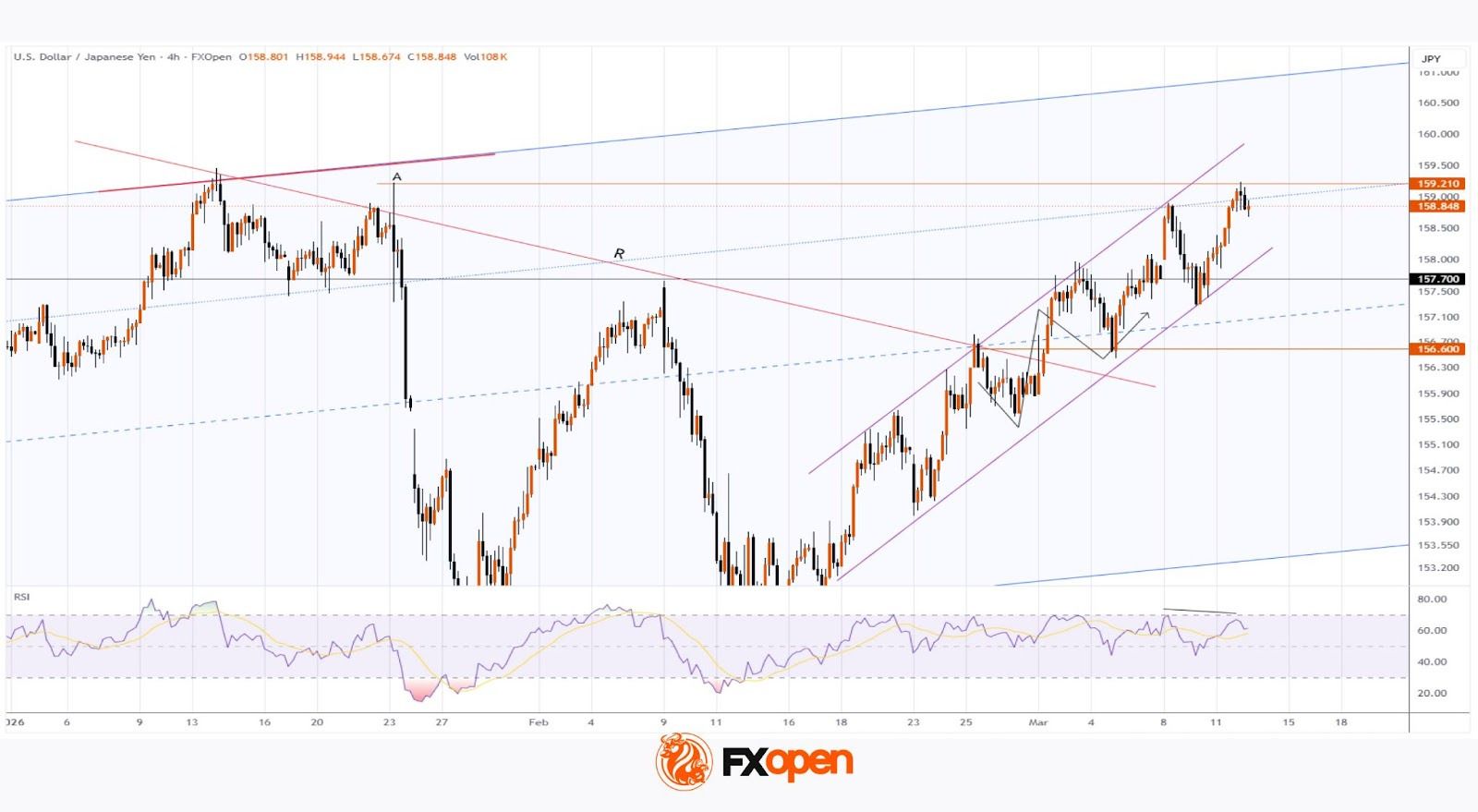
The USD/JPY chart shows a bullish trend at the start of March, influenced by the escalation of military activity in the Middle East.
On one hand, the US dollar is strengthening due to increased demand for safe-haven assets. On the other, the Japanese economy is under pressure because of its heavy reliance on oil imports from the Middle East.
These factors have pushed the pair above 159.20 JPY per USD this week, surpassing the January high (point A). The 2026 peak lies nearby; however, technical analysis suggests that bullish momentum may be fading.
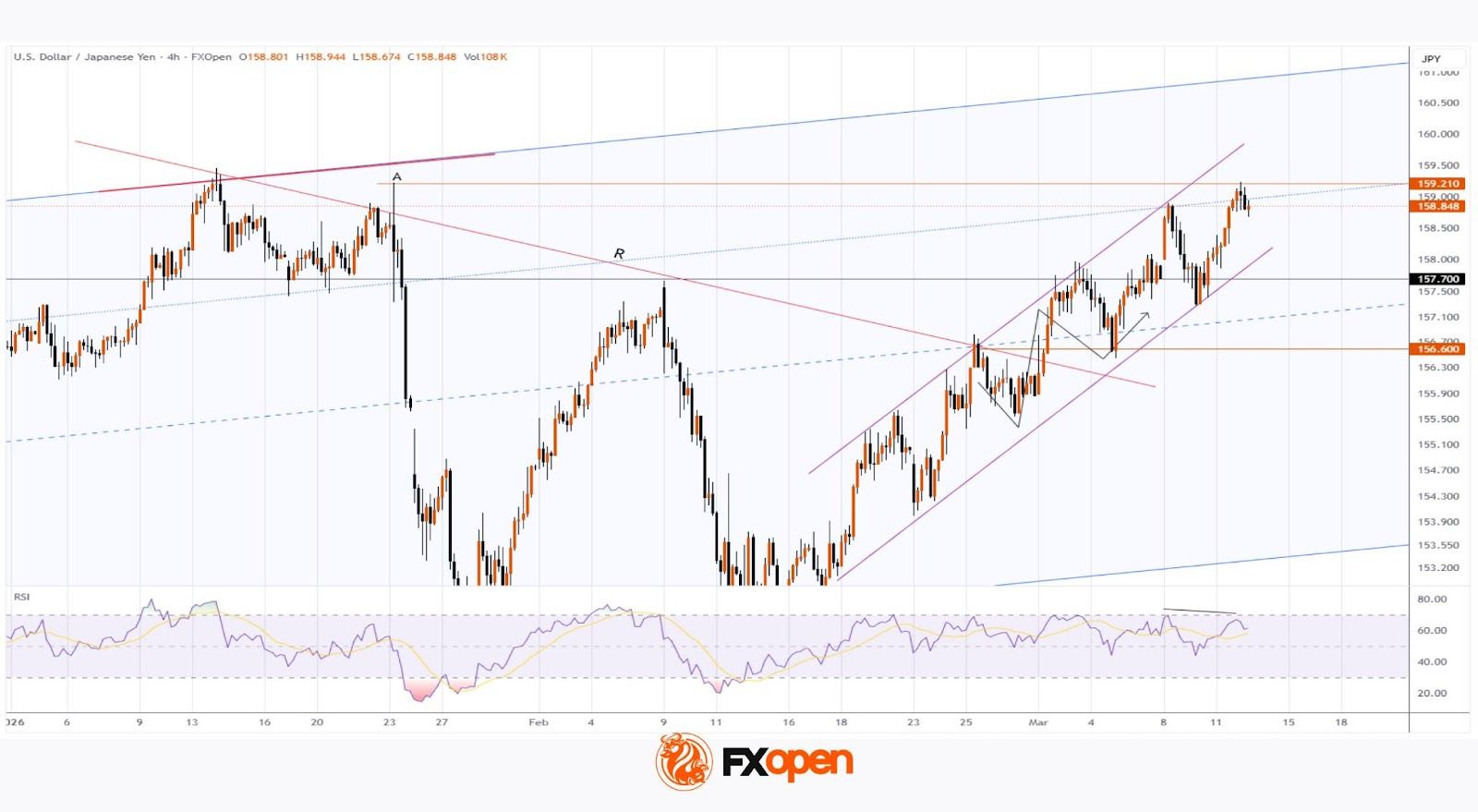
In our note of 26 February, we:
→ updated the wide ascending channel along with the intermediate growth trajectory (shown in purple);
→ highlighted signs of seller activity near 156.600.
As indicated by the arrow on the USD/JPY chart, after a small pullback to the lower purple line, buyers resumed their efforts, with the 156.600 level now acting as support.
Currently, we can observe that:
→ the RSI indicator is forming a bearish divergence;
→ it is becoming increasingly difficult for the price to reach the upper boundary of the purple channel;
→ the brief breach of point A resembles a bearish Liquidity Grab.
Additional bearish factors include:
→ the line dividing the upper half of the long-term channel into two parts;
→ proximity to the psychological 160 JPY per USD level.
It is worth recalling that in 2024, 1 USD briefly exceeded 160 JPY, but this level did not hold, as the Bank of Japan intervened. This context adds significance to the upcoming BOJ announcements, scheduled for next Thursday. Ahead of this event, USD/JPY may consolidate around current levels.
Trade over 50 forex markets 24 hours a day with FXOpen. Take advantage of low commissions, deep liquidity, and spreads from 0.0 pips (additional fees may apply). Open your FXOpen account now or learn more about trading forex with FXOpen.
This article represents the opinion of the Companies operating under the FXOpen brand only. It is not to be construed as an offer, solicitation, or recommendation with respect to products and services provided by the Companies operating under the FXOpen brand, nor is it to be considered financial advice.

Geopolitical frictions and a shifting macro backdrop are sharpening focus on what could emerge as a tipping point for crypto and broader risk assets: the US midterm elections. In a March 11, 2026 market commentary, Binance Research surveys how election cycles historically fed rebounds in equities and Bitcoin, suggesting the upcoming vote might unlock a constructive window for risk-on assets. The report flags that the 12 months after past midterms have seen the S&P 500 rise by about 19% on average, while Bitcoin delivered roughly a 54% gain across the three post-midterm years on record. With the midterms slated for November 3, 2026, the study frames the coming year as a potentially pivotal phase for markets trading around political uncertainty.
Key takeaways
- Historical post-midterm performance shows a potential upside for risk assets, with the S&P 500 up ~19% on average and Bitcoin up ~54% over the three post-midterm years in prior cycles.
- Bitcoin has experienced negative returns during several midterm years (example declines: 2014, 2018, 2022), but the pattern in subsequent years has generally been a rebound.
- The near-term direction hinges on geopolitics, notably US-Israel-Iran tensions, with oil prices a potential pressure point if energy supply is disrupted.
- The energy market narrative was reinforced by an emergency energy stock release of 400 million barrels, the largest coordinated drawdown on record.
- Market participants appear to be in a wait-and-see phase, awaiting clearer directional signals once election outcomes are known.
Tickers mentioned: $BTC
Sentiment: Neutral
Price impact: Positive. The historical pattern of post-midterm rebounds in both equities and Bitcoin suggests a potential uplift in risk assets once political uncertainty subsides.
Trading idea (Not Financial Advice): Hold. Investors may want to wait for clearer post-election directional cues and macro signals before taking sizable new positions.
Market context: The narrative arcs around the midterms intersect with macro risk sentiment, regulatory discourse, and energy-market dynamics, all of which can shape liquidity and appetite for crypto assets in the near term.
Why it matters
The Binance Research framework emphasizes that the political risk hurdle commonly cleared after election outcomes has historically unlocked a more robust risk-on regime. In practical terms, if the 2026 midterms resolve with a clearer policy outlook, traders could see renewed bid activity across both traditional markets and crypto. The historical lens does not guarantee future moves, but it provides a reference for how sentiment has tended to shift when political ambiguity diminishes.
From a trader’s vantage point, the divergence between headline risk and market mechanics is notable. Even as Bitcoin (CRYPTO: BTC) has flirted with key levels and traded within ranges shaped by liquidity flows, the broader message of the Binance analysis is that the cycle often accelerates once electoral uncertainty recedes. In prior midterm years, Bitcoin’s trajectory has been punctuated by sharp corrections during the year itself, followed by significant recoveries in the ensuing periods. That pattern could inform risk budgeting and timing considerations for funds that aim to participate in the rebound without overexposure to interim volatility.
Oil and energy markets add another layer of complexity. As geopolitical tensions intensify, crude prices have shown sensitivity to supply expectations. Recent data suggest the market could spike further if disruptions endure, a scenario that tends to weigh on risk assets in the short run even as longer-term cycles remain dependent on policy clarity and liquidity dynamics. A one-day spike to the vicinity of $95 per barrel framed the current stress, underscoring how energy risk can spill over into equities and crypto markets.
In parallel, market infrastructure signals have pointed to a broader risk-off posture in the near term. The energy-release maneuver by international authorities, described as the largest-ever coordinated drawdown, adds a layer of supply-side management that could temper volatility in the energy complex—but it does not eliminate the risk of further macro shocks. Analysts cautioned that continued geopolitical escalation could keep risk assets under pressure, at least until a clearer post-election framework emerges. For readers interested in the on-the-ground links to these developments, recent reporting from Reuters outlined the energy dynamics and the rhetoric around price stability amid the conflict.
Despite the near-term headwinds, the longer historical arc highlighted by Binance Research remains relevant: the period after the election and the associated resolution of political uncertainty has historically produced meaningful rallies. The message is not to extrapolate a foolproof blueprint, but to recognize that policy clarity can reframe risk appetite. Bitcoin’s own history of midterm-year drawdowns, followed by rebounds, adds a layer of complexity but also a potential pathway for investors who can weather the interim noise. To see a related compilation of market context including the energy shock and its ripple effects, readers can review the linked analyses and the energy market data sources cited in the coverage, including the market commentary that anchors these observations.
For a quick snapshot of the broader narrative in motion, a concise explainer video on market dynamics related to this cycle can be found here: Video discussion.
The analysis arrives as markets enter a period of heightened attention ahead of the November 3, 2026 vote, when the 120th Congress will take shape and set the tone for policy and regulatory signals in the year ahead. While the near term may ride a roller-coaster of headlines, the data from prior cycles provides a reference point for investors assessing whether a recovery window could be opening for equities and digital assets alike. The key takeaway: the post-election horizon could be the most constructive phase of the cycle, provided geopolitical tensions do not diverge into a sustained risk-off regime before the dust settles.
The crosscurrents at play—geopolitics, energy stability, and the timing of policy clarification—mean that market moves could be as much about risk sentiment and liquidity flows as about fundamentals. In the coming months, traders will be watching for progress in diplomatic channels, oil market signals, and any regulatory developments that could influence market structure or capital flows into crypto. The interplay of these factors will help determine whether the long-hoped-for recovery accelerates or remains restrained by ongoing uncertainty.
As with all such analyses, the caveat remains: past performance is not a guarantee of future results. However, the framework outlined by Binance Research provides a structured lens to interpret how the upcoming midterms might align with broader macro and crypto-market rhythms. The next few quarters will be telling as investors weigh the odds of a meaningful reset against continued geopolitical volatility and policy debates that will shape the market landscape for the remainder of the year.
What to watch next
- November 3, 2026 — US midterm elections determine the composition of the 120th Congress and influence policy signals for the year ahead.
- Post-election period — watch for any substantive shifts in regulatory discourse that could affect crypto market structure and liquidity.
- Geopolitical developments in the Middle East — escalation or de-escalation can impact energy prices and risk sentiment.
- Official energy-market actions — monitor further commentary on energy security and any additional emergency stock management outcomes.
- Market commentary updates — ongoing analyses that correlate election outcomes with volatility and liquidity in crypto markets.
Sources & verification
- Binance Research, Weekly Market Commentary (March 11, 2026) — historical post-midterm performance data and interpretation.
- Reuters reporting on energy disruptions and price implications related to Middle East tensions.
- Trading Economics data on crude oil price movements and daily price spikes.
- International Energy Agency announcements on emergency stock releases (largest coordinated drawdown).
- Election date and political timeline for the November 3, 2026 midterms.
Post-midterm dynamics could reshape crypto and risk assets
The central premise is that the political fog surrounding election outcomes has historically been a wind at the back of risk assets once it lifts. Binance Research’s synthesis shows a pattern of strength following periods of uncertainty, with the S&P 500 and Bitcoin delivering memorable advances in the year or years after midterm cycles. That pattern does not imply a guaranteed rally, but it offers a framework for considering how a calmer political horizon might influence price action across markets that have become increasingly interlinked in recent years.
In practice, the near-term trajectory will be colored by geopolitics and macro data arrivals. The immediate risk premiums tied to the US-Israel-Iran dynamic could push energy prices higher, which tends to compress risk appetite in the short run. Yet if the election outcomes resolve in a way that reduces political risk, liquidity could improve and traders may reallocate toward risk assets, including digital currencies. Bitcoin’s own history in midterm years—marked by episodic declines followed by longer-term recoveries—adds nuance to how investors should position themselves during this transition window. The historical signal is not a guarantee, but it is a lens for weighing potential outcomes as the cycle evolves.
Market participants will also be watching for any policy shifts or legislative milestones that could affect the crypto market structure, such as regulatory proposals or framework updates that impact market access and capital flows. The energy-market backdrop, with its flashpoints and emergency stock actions, will continue to feed volatility but also to shape the tempo of risk-taking. In a landscape where liquidity and risk sentiment are closely tethered to macro and geopolitical developments, the post-midterm period could offer a clearer directional signal for traders, investors, and builders navigating the crypto ecosystem.
Cryptio, a developer of accounting software for digital assets, raised $45 million in a Series B funding round as financial institutions and corporations expand their use of blockchain-based assets.
The round closed about three weeks ago and was led by BlackFin Capital Partners and Sentinel Global. Existing investors 1kx, BlueYard Capital and Ledger Cathay Capital also participated, Fortune reported, citing a company announcement. The company’s valuation wasn’t disclosed.
Cryptio’s platform helps companies track the digital assets they hold and where those assets are stored across wallets, custodians and exchanges. In January last year, the firm raised $15 million in an extension to its Series A funding round from mid-2022.
The software also helps firms manage crypto loans and monitor other blockchain-based assets. The system organizes this data so companies can produce accounting records and financial reports.
Cryptio was founded eight years ago by Antoine Scalia, after he graduated from business school in Paris. Early customers were startups and smaller crypto companies.
The firm now employs about 110 people and serves more than 450 clients. Those clients include stablecoin issuer Circle Internet (CRCL) and the blockchain subsidiary of French bank Société Générale (GLE).
Cryptio operates in a growing market for crypto accounting tools. In January, crypto infrastructure firm Fireblocks acquired competing platform TRES Finance for $130 million.
Sentinel Global managing partner Jeremy Kranz said Cryptio has gained traction by working closely with large financial institutions and explaining how its system integrates with their existing accounting processes.
The fundraise comes as U.S. corporate adoption of the crypto space has accelerated, with the Trump administration pushing policies meant to strengthen the industry in the U.S. His cyber strategy has vowed to “support the security” of cryptocurrencies and blockchain.
Regulatory and accounting changes have also lowered barriers for institutions. Regulators replaced the SEC’s SAB 121 guidance with SAB 122, easing custody rules for banks, while new Financial Accounting Standards Board rules that took effect in 2025 require companies to report crypto assets at fair value.


After the first wave of spot ether (ETH) exchange-traded funds launched without staking, BlackRock’s iShares Staked Ethereum Trust ETF (ETHB), one of the industry’s most anticipated versions, begins trading on Nasdaq on Thursday.
The fund marks the asset manager’s third crypto ETF and the first from BlackRock to incorporate staking. ETHB will hold spot ether and stake a portion of those holdings on the Ethereum network, allowing investors to potentially earn rewards while benefiting from price movements.
The new vehicle expands BlackRock’s existing digital asset lineup, which includes the iShares Bitcoin Trust (IBIT) and the iShares Ethereum Trust (ETHA). Those funds have grown rapidly since their launches, with IBIT today managing more than $55 billion in assets and ETHA about $6.5 billion.
“This is really about investor choice,” Jay Jacobs, BlackRock’s U.S. head of equity ETFs, told CoinDesk in an interview. “While ETHA has developed liquidity and a growing derivatives market, some investors are focused on maximizing total returns by combining ether price exposure with staking rewards, he added.”
Ethereum uses a proof-of-stake system that allows holders of its native token to lock up coins to help validate transactions and secure the network. In return, participants receive rewards, which many investors view as a yield-like feature of the asset.
Until now, most ether ETFs have offered only price exposure without staking, although some asset managers, including Grayscale, have recently launched ETFs with staking capabilities. Jacobs said that gap may have discouraged some crypto-native investors from moving assets into exchange-traded funds.
“Some investors who already hold ether directly were staking it and weren’t ready to move into an exchange-traded product because they would lose that feature,” he said. “By incorporating staking, the ETF allows investors to keep the benefits of staking while gaining the operational advantages of an ETF structure.”
Those advantages include institutional-grade custody, the ability to trade through traditional brokerage accounts and integration with standard portfolio allocations alongside stocks and bonds.
The product may also appeal to certain institutional investors who prefer assets that generate income or cash flow.
“For some institutions, when they evaluate an investment, they want to think about it from a cash flow perspective,” Jacobs said. Staking rewards may help make ether more comparable to other assets in portfolio models.
Read more: Crypto ETFs with staking can supercharge returns but they may not be for everyone
BlackRock expects interest in the product to come from a wide range of investors, including individual traders, financial advisors and institutional allocators such as hedge funds and family offices.
The fund carries a 0.25% sponsor fee, though BlackRock is waiving part of the cost for the first year, reducing it to 0.12% on the first $2.5 billion in assets. Jacobs said the temporary discount is intended to help the product gain traction in its early months.
Despite the growth of crypto investment products, allocations to digital assets remain relatively small in traditional portfolios. Institutions are typically allocating in the “low single digits,” often around 1% to 2%, according to Jacobs. At those levels, he said, the risk contribution of bitcoin or other digital assets can be comparable to the exposure investors already accept from large technology stocks within diversified portfolios.
BlackRock has rapidly become one of the largest players in crypto investment products. The firm oversees roughly $130 billion across crypto-related exchange-traded products, tokenized liquidity funds and stablecoin reserve management. According to the company, iShares captured about 95% of flows into digital asset ETPs in 2025.
For now, Jacobs said the firm remains focused on expanding adoption of its existing crypto products, particularly bitcoin and ether, as many investors are still learning about the asset class.
“We’re still in the early days of digital asset ETF adoption,” he said. “For many investors, this is the first step.”

Key Takeaways
- Ofgem has approved Tesla Energy Ventures’ application for a UK electricity supply license, now in effect.
- The licensing procedure spanned from July 2025 through March 2026 before final authorization.
- Tesla is now authorized to retail electricity to residential and commercial properties throughout Great Britain.
- The company enters competition with major British energy providers including Octopus Energy, British Gas, and EDF.
- A different Tesla entity, Tesla Motors Limited, previously obtained an electricity generation license in the UK.
Tesla Energy Ventures Limited has received authorization from Ofgem to retail electricity throughout Great Britain. The regulatory approval became effective Wednesday following a review process that commenced in July 2025.
The authorization encompasses both residential and commercial customer segments, enabling Tesla to distribute electricity directly to British households and enterprises.
This positions Tesla as a new competitor against Britain’s established energy retailers, including Octopus Energy, British Gas, and EDF.
Tesla has existing operations within the UK energy sector. Through Tesla Motors Limited, the company maintains an electricity generation license, and customers with Powerwall batteries can already monetize surplus solar generation through grid feed-in.
The newly granted supply license represents a logical progression — enabling Tesla to manage the entire cycle and distribute electricity directly as a retail provider.
Market Entry During Price Volatility
The authorization arrives during a challenging period for British consumers. Energy costs across Britain have increased following conflict in Iran, creating widespread concern about escalating utility expenses.
Most British households currently enjoy temporary protection from volatile gas prices through July under regulated pricing structures. However, this safeguard is temporary.
Tesla’s entrance into the market provides consumers with an additional choice among retail energy providers, although competitive pricing details have not been disclosed.
The automaker brings international energy market experience. Tesla Energy currently maintains operations in Australian and American energy markets.
Tesla’s British Market Standing
Tesla’s automotive sales in the UK have faced headwinds. Vehicle deliveries declined 8.9% year-over-year during 2025, impacted by competitive pressure from budget-friendly Chinese electric vehicle manufacturers.
Additionally, some markets have experienced consumer resistance connected to Elon Musk’s involvement in political discourse.
The energy sector provides Tesla an alternative growth channel in Britain — one independent of automotive performance.
Tesla has yet to reveal pricing structures, rate plans, or an official launch timeline for its electricity retail services in Great Britain.
Ofgem confirmed the license approval through an official regulatory announcement released this week.

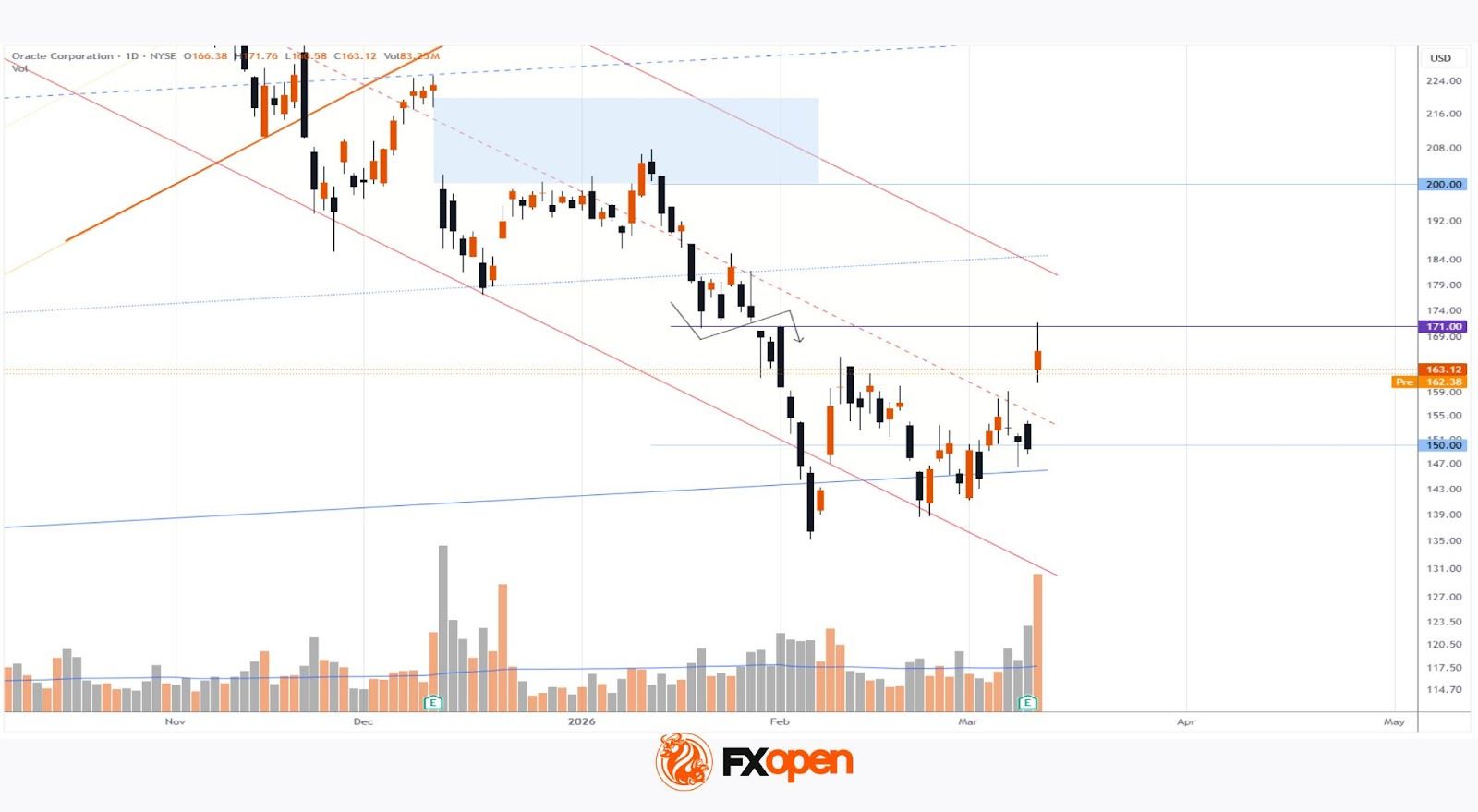
Following a strong earnings report, Oracle shares surged above $160, marking roughly a 1.5-month high:
→ Earnings per share: expected $1.70, actual $1.79;
→ Revenue: expected $16.7bn, actual $17.2bn.
This is the first quarter in 15 years in which both revenue and earnings rose by more than 20%. Additional optimism came from:
→ Cloud infrastructure revenue, which jumped 84% to $4.9bn;
→ Oracle confirming a five-year, $300bn deal with OpenAI (Project Stargate);
→ Total backlog (future revenue) surpassing $553bn.
These developments have the potential to significantly ease downward pressure on ORCL shares, which had been in a downtrend following a record high last autumn.
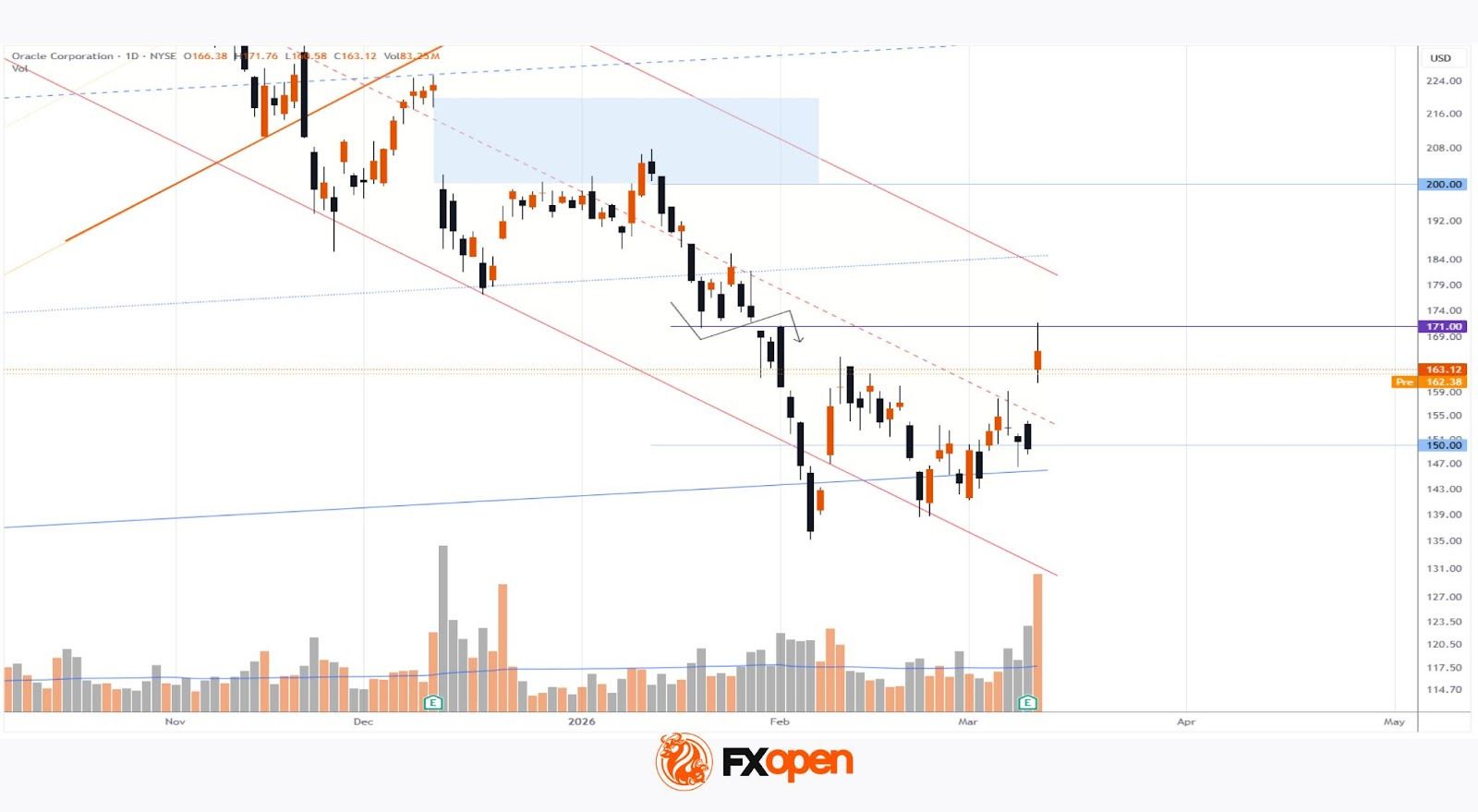
In our technical note of 5 February, the stock fell below $150, and we:
→ highlighted support levels that could halt further declines;
→ suggested that “smart money” might view prices below $150 as attractive.
That same day, ORCL shares formed a low from which they did not fall further.
Recent price action, including a bullish gap above $160, indicates that buyers are regaining control. However, they may need to exert substantial effort to confirm their strength, given that:
→ the $170 level, formerly support, now acts as resistance (indicated by an arrow);
→ the descending channel (shown in red) remains relevant.
Buy and sell stocks of the world’s biggest publicly-listed companies with CFDs on FXOpen’s trading platform. Open your FXOpen account now or learn more about trading share CFDs with FXOpen.
This article represents the opinion of the Companies operating under the FXOpen brand only. It is not to be construed as an offer, solicitation, or recommendation with respect to products and services provided by the Companies operating under the FXOpen brand, nor is it to be considered financial advice.
The global financial markets saw a notable shift as President Donald Trump declared the U.S. has effectively “won” the conflict with Iran, signaling a potential end to the 10-day military engagement known as Operation Epic Fury.
Summary
- The crypto market rebounded after President Donald Trump declared the U.S. had effectively “won” the conflict with Iran.
- Bitcoin surged over 5% to reclaim the $70,000 level as investors rotated back into risk assets.
- Analysts say a break above $72,500 could signal a broader crypto market rally if geopolitical tensions continue to cool.
The Geopolitical pivot: From “excursion” to victory
In a series of rapid-fire statements from Kentucky and Florida, President Trump characterized the war as a “short-term excursion” that achieved its primary objectives within the “first hour.” He claimed that roughly 80% of Iran’s missile launchers and much of its naval power have been neutralized.
For crypto markets, the rhetoric marks a critical transition.
While the President noted that forces would remain to ensure stability, the shift from active escalation to a “victory” narrative has triggered a classic “risk-on” rally.
Investors, who had previously fled to safe havens like gold and the U.S. Dollar, are now rotating back into high-growth assets as the threat of a prolonged energy chokepoint in the Strait of Hormuz appears to recede.
Crypto market rebounds “Peace Trade”
The crypto market acted as a primary barometer for this shifting sentiment. After sliding into the mid-$60,000 range earlier in the week due to war-induced panic, Bitcoin (BTC) staged a powerful recovery, jumping over 5% to reclaim the $70,000 psychological barrier.
Ethereum and major altcoins followed suit, with total crypto market capitalization rebounding to $2.45 trillion.
If the de-escalation holds, the “uncertainty overhang” that has suppressed prices since late February could vanish, potentially setting the stage for a run toward new all-time highs.
What the BTC chart says next
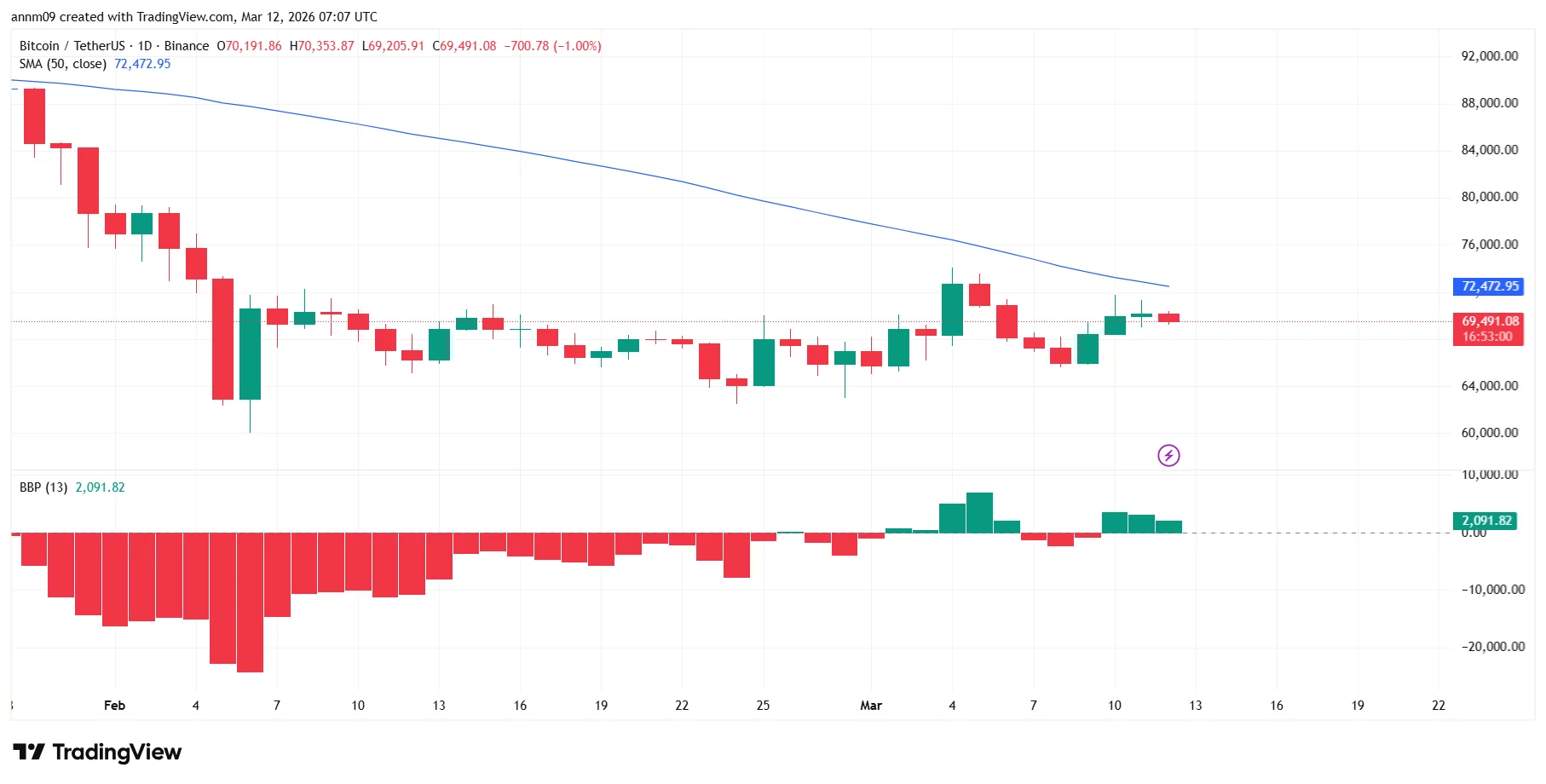
The BTC/USDT 1D chart highlights a significant technical tug-of-war. Despite the recent bounce, Bitcoin remains in a consolidation phase following its February peak.
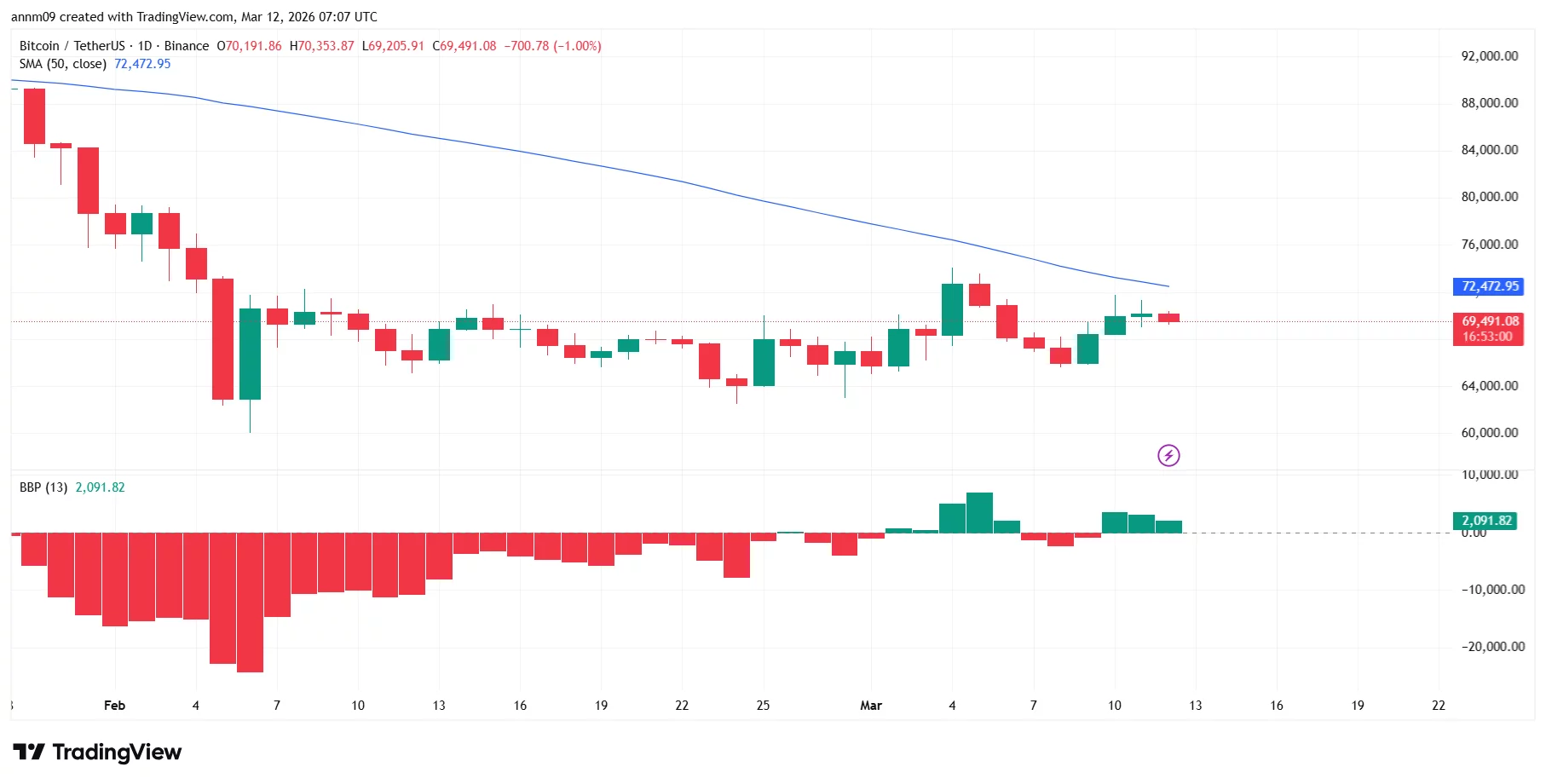
Immediate Resistance: The $72,500 level remains the “boss” of this range. A daily candle close above this mark, supported by high volume, would confirm a breakout.
Support Zones: The $67,500 to $68,000 zone has proven resilient. As long as BTC stays above this floor, the bullish structure remains intact.
The BBP Indicator: A close look at the BBP indicator at the bottom of the chart shows that the histogram has already flipped into green territory. This is a significant bullish signal, indicating that the “Bulls” have successfully overpowered the “Bears” for the time being.
While Trump’s declaration has provided the spark, the sustainability of this rally depends on whether the “victory” translates into a formal ceasefire and stabilized oil prices. If geopolitical tensions continue to cool, the “Trump Peace Trade” could be the catalyst that finally pushes Bitcoin into the elusive six-figure territory.
Analysis found that Bitcoin fell about 56% during midterm years on average, while moving closely with declines in US equities.
US midterm election cycles have historically been associated with increased volatility across financial markets, with the S&P 500 experiencing average peak-to-trough drawdowns of about 16%, according to a new report published by Binance Research.
It stated that midterm years have typically produced the weakest performance within the four-year US presidential cycle, as political uncertainty surrounding elections weighs on investor sentiment. In seven of the past ten midterm cycles, equity markets recorded corrections of more than 10% as political risk continued to influence market behavior.
Political Uncertainty Shakes Markets
Digital assets have shown a similar pattern during these periods. According to the analysis, Bitcoin has historically moved in close correlation with equities during midterm cycles. Since 2014, which the report considers the first meaningful cycle due to earlier liquidity limitations in crypto markets, BTC has recorded an average decline of about 56% during midterm election years across the three completed cycles.
Despite this historical weakness during such years, the research revealed that there is a consistent pattern of strong market performance once political uncertainty clears. Data cited in the report show that the 12 months following US midterm elections have produced positive returns for the S&P 500 in every instance since 1939. Over that period, the index has delivered an average gain of about 19% in the year following the vote.
Bitcoin has also recorded gains in all three post-midterm years on record, and the cryptocurrency delivered an average return of roughly 54% during those periods. The findings reveal that markets often recover once election outcomes become clear and investors gain greater visibility into the political and policy landscape.
The report frames the pattern as a recurring cycle in which election-year volatility is followed by a period of stronger performance for risk assets as uncertainty fades and capital returns to the market.
The analysis comes at a time when global markets are already facing major volatility driven by geopolitical tensions and macroeconomic concerns. Escalating developments in the Middle East, including disruptions linked to the Strait of Hormuz, have raised fears of supply shocks in global energy markets and contributed to sharp swings in oil prices.
You may also like:
Next Catalyst
At the same time, all eyes are on the upcoming US inflation indicators, including Consumer Price Index and Personal Consumption Expenditures data, which could influence expectations around future monetary policy decisions.
Binance Research said that the current market conditions are also shaped by elevated leverage among investors and negative gamma positioning among market makers in both equity and cryptocurrency markets. These factors can amplify price movements when markets react to geopolitical or macroeconomic developments.
While the near-term risks remain, periods of heightened political and macro uncertainty have often been followed by stronger performance once major sources of uncertainty are resolved.
Binance Free $600 (CryptoPotato Exclusive): Use this link to register a new account and receive $600 exclusive welcome offer on Binance (full details).
LIMITED OFFER for CryptoPotato readers at Bybit: Use this link to register and open a $500 FREE position on any coin!

Victims of a Chinese investment fraud are challenging a United Kingdom proposal to compensate them through a Chinese redress scheme, arguing the plan could leave British authorities holding much of the upside from roughly 61,000 Bitcoin seized in a money-laundering investigation.
According to the Financial Times, citing court documents, the dispute has moved into the UK High Court as groups representing victims seek to recover funds linked to the cryptocurrency seized by police in London. The Bitcoin (BTC) haul is now worth about 3.2 billion pounds ($4.3 billion) after rising sharply in value since the assets were confiscated.
Law firm Candey, which represents about 5,700 victims, said the proposed compensation arrangement may not guarantee fair restitution. The fraud scheme itself reportedly affected more than 128,000 investors in China, according to court documents cited by the FT.
The case highlights growing legal questions around crypto seizures, where digital assets can appreciate significantly between confiscation and restitution. The dispute stems from a Chinese investment fraud scheme that ran between 2014 and 2017 and defrauded investors before proceeds were converted into BTC and moved abroad.
Prosecutors say claims could exceed losses
Prosecutors reportedly argued that some of the legal claims could allow a subset of victims and litigation funders to recover sums exceeding their actual losses.
Martin Evans KC, representing the Director of Public Prosecutions, said in court submissions that the claims risk benefiting “a small subset of victims and their litigation funders” while excluding other victims and the Crown, according to the FT.
Related: UK elections: How crypto donation risks are dividing MPs
Candey defended the legal action, saying court proceedings give victims the best chance of securing proper compensation and noting that its legal fees are capped at 18% of any recovered funds.
A preliminary hearing is scheduled for July to determine whether English or Chinese law should govern the claims to the seized Bitcoin. The High Court has also set a May 22 deadline for claimants seeking recovery under Section 281.
Bitcoin seizure linked to London mansion purchase attempt
British authorities seized more than 61,000 BTC during a 2018 raid on a London property linked to Jian Wen, who was later convicted of money laundering, and Zhimin Qian, the mastermind of the scheme, who was sentenced by a UK court to over 11 years in prison in November 2025.
Wen attracted attention after attempting to buy a luxury London mansion using Bitcoin and failing to explain the origin of the funds.

In 2024, victims of the scheme sought assistance from Chinese authorities to recover the seized Bitcoin.
The seized Bitcoin has also drawn policy attention in Britain, with reports in 2025 that officials were exploring how and when such holdings could be sold.
Magazine: UK’s Orwellian AI murder prediction system, will AI take your job? AI Eye

Remaining fire-wrecked Glasgow building Union Corner to be demolished

Aboriginal firms seek AUKUS shift as WA procurement leads nation

Bitcoin climbs the wall of worry amid escalating Iran war and oil volatility


-
Business6 days ago
Form 8K Entergy Mississippi LLC For: 6 March
-

 News Videos3 days ago
10th Algebra | Financial Planning | Question Bank Solution | Board Exam 2026
-

 Fashion6 days ago
Weekend Open Thread: Ann Taylor
-

 Crypto World3 days ago
Paradigm, a16z, Winklevoss Capital, Balaji Srinivasan among investors in ZODL
-
 Tech1 day ago
A 1,300-Pound NASA Spacecraft To Re-Enter Earth’s Atmosphere
-
 Sports7 days ago
499 runs and 34 sixes later, India beat England to enter T20 World Cup final | Cricket News
-

 Politics6 days ago
Top Mamdani aide takes progressive project to the UK
-

 Business2 days ago
ExxonMobil seeks to move corporate registration from New Jersey to Texas
-

 Sports5 days ago
Three share 2-shot lead entering final round in Hong Kong
-

 Sports4 days ago
Braveheart Lakshya downs Lai in epic battle to enter All England Open final | Other Sports News
-

 Tech2 days ago
ChatGPT will now generate interactive visuals to help you with math and science concepts
-

 NewsBeat19 hours ago
Residents reaction as Shildon murder probe enters second day
-

 NewsBeat7 days ago
Piccadilly Circus just unveiled ‘London’s newest tourist attraction’ and it only costs 80p to enter
-

 Entertainment5 days ago
Hailey Bieber Poses For Sexy Selfies In New Luscious Lip Thirst Traps
-

 Business4 days ago
Search for Nancy Guthrie Enters 37th Day as FBI Probes Wi-Fi Jammer Theory
-

 Business1 day ago
Search Enters Sixth Week With New Leads in Tucson Abduction Case
-
 NewsBeat3 days ago
Pagazzi Lighting enters administration as 70 jobs lost and 11 stores close across Scotland
-

 Tech3 days ago
Despite challenges, Ireland sixth in EU for board gender diversity
-

 Business3 days ago
Search Enters 39th Day with FBI Tip Line Developments and No Major Breakthroughs
-

 NewsBeat23 hours ago
I Entered The Manosphere. Nothing Could Prepare Me For What I Found.