
CryptoCurrency
The Old BTC Risk Explained

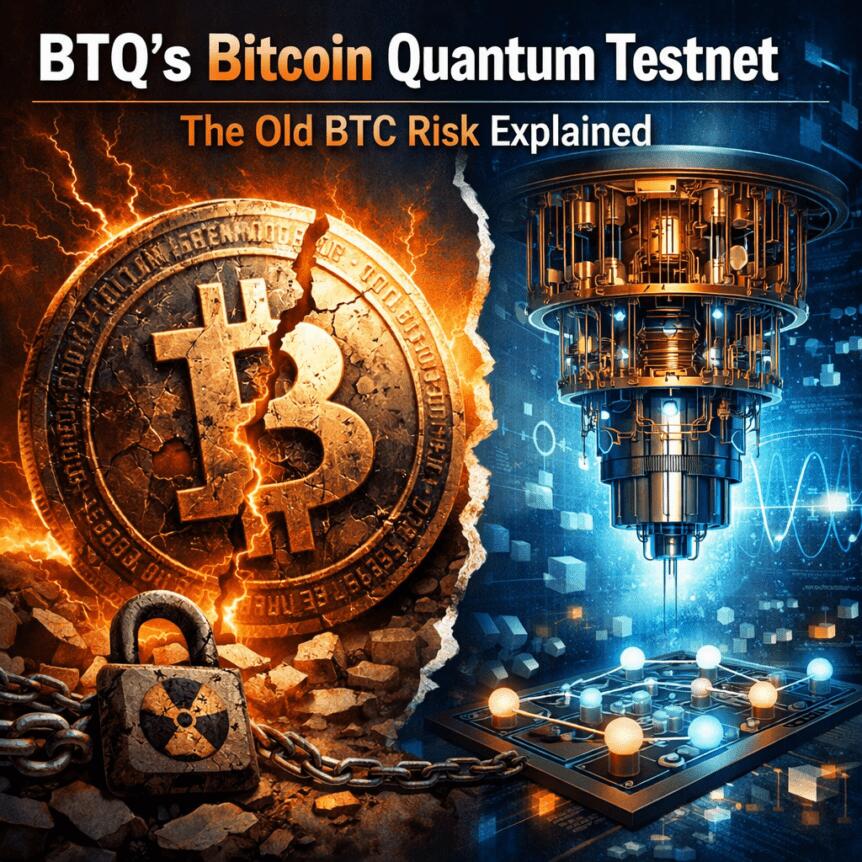
BTQ Technologies has announced a Bitcoin-like testnet designed to stress-test post-quantum signatures in a controlled environment. Launched on January 12, 2026, the Bitcoin Quantum testnet aims to evaluate how a quantum-resistant signing scheme would operate in a blockchain of this type, without altering Bitcoin’s mainnet governance. The effort focuses on practical engineering trade-offs, wallet operations, and network coordination—key questions as the crypto world weighs how to prepare for a future where quantum computers could challenge current cryptographic assumptions.
Key takeaways
-
Bitcoin’s quantum risk centers on exposed public keys and signature security.
-
BTQ’s testnet explores post-quantum signatures in a Bitcoin-like environment.
-
Post-quantum signatures significantly increase transaction size and block space demands.
-
“Old BTC risk” is concentrated in legacy output types and address reuse patterns.
Tickers mentioned: $BTC
Sentiment: Neutral
Price impact: Neutral. The focus is on testing and preparedness rather than immediate price movement.
Trading idea (Not Financial Advice): Hold. The project is exploratory and educational, not a call to action for traders.
Market context: The effort underscores ongoing concerns about quantum readiness amid broader market caution and the need for scalable, interoperable upgrades.
What quantum changes?
Most Bitcoin-quantum risk discussions center on cryptographic signatures rather than the coin supply or the notion of quantum computers guessing wallets outright. The core fear is that a cryptographically capable quantum computer could run Shor’s algorithm to solve the discrete logarithm problem efficiently enough to derive a private key from a known public key. That possibility would undermine the security guarantees of elliptic-curve and Schnorr-based signatures, potentially enabling unauthorized spending if the public key is publicly exposed on-chain. Some researchers frame this as a long-range risk—where public keys are already visible in older script types or due to address reuse—and a shorter, more immediate exposure window when a transaction is broadcast and awaiting confirmation.
It’s important to note that no quantum computer today poses an immediate threat to Bitcoin, and mining-related impacts remain a separate, more constrained discussion compared with signature breakage. Still, the field continues to explore what a future quantum-enabled attack might require and how to mitigate it without breaking existing ecosystems.
What BTQ built and why it’s interesting
BTQ’s Bitcoin Quantum testnet is effectively a Bitcoin Core-based fork designed to substitute the signature primitive. In its announcement, the firm stated that it replaces ECDSA with ML-DSA, a module-lattice signature standard formalized by the National Institute of Standards and Technology as FIPS 204 for post-quantum digital signatures. This change triggers substantial engineering trade-offs: ML-DSA signatures are markedly larger—roughly 38-72 times bigger than ECDSA—necessitating a larger block payload. To accommodate the growth, the testnet raises the block size limit to 64 mebibytes, enabling space for additional transaction data while researchers observe how network throughput and validation scale under post-quantum conditions.
Beyond signing, the project functions as a holistic lifecycle environment: wallet creation, signing and verification workflows, mining, a block explorer, and a mining pool. In effect, the testnet serves as a comprehensive platform to observe not just cryptography in isolation, but the broader operational strain and coordination costs that a quantum-resistant Bitcoin might incur.
Where old BTC risk concentrates
Analysts often talk about “old BTC risk” in the context of public keys that are already exposed on-chain. A quantum-capable adversary could theoretically derive the corresponding private keys and spend those outputs. The exposure varies by output type—three categories stand out because they place elliptic-curve public keys directly in on-chain scripts:
-
P2PK accounts for a tiny fraction of UTXOs—about 0.025%—yet it holds a disproportionately large share of value, roughly 8.68% or about 1,720,747 BTC, largely dormant Satoshi-era coins.
-
P2MS accounts for about 1.037% of UTXOs but is estimated to secure only a small amount of BTC, around 57 BTC.
-
P2TR is prevalent by count—around 32.5% of UTXOs—but represents a modest value share, about 0.74% or 146,715 BTC. Its exposure ties to Taproot’s key-path design, wherein a tweaked public key becomes visible on-chain.
Address reuse can amplify exposure, because a public key that appears on-chain remains visible thereafter. BTQ emphasizes that the pool of potentially affected coins is heterogeneous and substantial, reinforcing the argument for proactive testing in a Bitcoin-like environment rather than waiting for a universal protocol migration.
What’s next for Bitcoin?
In the near term, observability and preparedness take center stage. The signature threat model underscores the importance of wallet and scripting practices that limit early public-key exposure or that minimize reuse patterns. Proposals such as BIP 360—introducing a Pay-to-Tapscript-Hash style construct that bypasses key-path spending—illustrate the broader strategy for a gradual, risk-aware transition. Other hash-only or script-spend concepts, like Pay-to-Quantum-Resistant-Hash, surface in developer discussions as avenues to decouple quantum-vulnerable key spends from the core network flow.
None of these options are settled, and Bitcoin’s likely response remains an incremental, coordination-driven process. The BTQ testnet makes two points hard to ignore: first, the “old coin” exposure remains a practical driver of risk assessments; second, implementing post-quantum readiness is fundamentally an engineering and governance challenge—one that benefits from a sandbox like this testnet to quantify costs, trade-offs, and timelines without claiming imminent breakage.



