CryptoCurrency
Top Real Estate Tokenization 2026 Trends Set to Unlock New Opportunities

Digital infrastructure is transforming real estate into a way to own, invest in, and manage assets using new technologies. The world’s total value of all real estate is at least hundreds of trillions of dollars, and the transition to Digital Real Estate Ownership provides unprecedented levels of access and investment efficiency. Previously, investors had been limited by their geographical location, minimum capital investment requirements, and market restrictions. However, these investors can now gain easy access to high-quality property investment deals as a result of Digital Real Estate Ownership. The process of digitizing physical property is not only about digital conversion but also re-engineering how property value is stored, transferred, and increased using a programmable, secure storage method.
Participation in the development of a New Era of Real Estate Tokenization is occurring as Tokenized Real Estate Investments are created by converting physical property into digitally mapped assets on blockchain platforms. These digital assets represent legitimate ownership that is validated through immutability and transparency of the asset. Regulatory scrutiny continues to grow in parallel with the increase in institutional interest in Real Estate Tokenization, and 2026 is expected to be a key year in the evolution of the industry. The building of mature market environments, as well as the increasing focus on innovative and compliant design, will continue to push towards realizing the New Era of Real Estate Tokenization in 2026 where Tokenized Real Estate Investment will be a leading and globally accepted source of investment in high-quality properties by institutional investors.
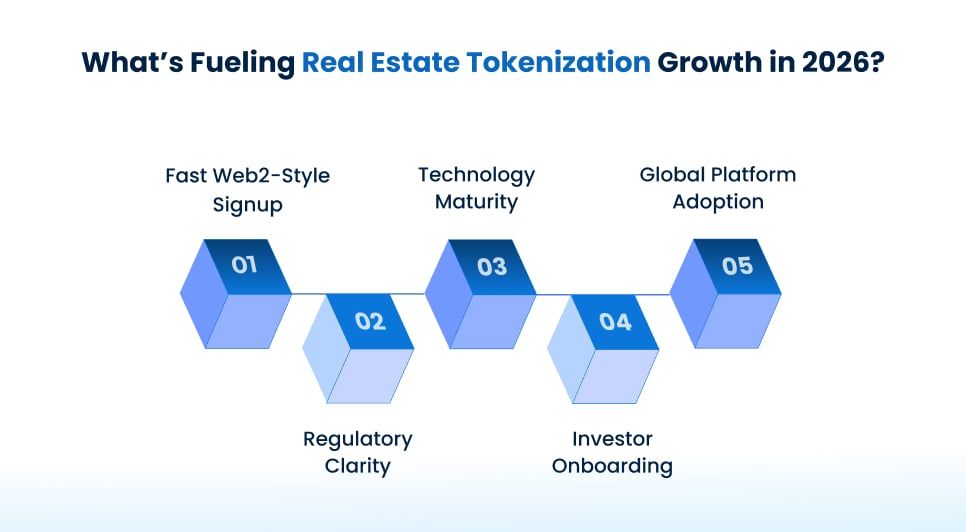
The real estate tokenization market will grow rapidly between now and 2026 as a result of multiple forces: market, regulatory & technological, all growing together.
1. Market Demand
Investors today want liquid (the ability to trade easily & quickly), transparency (the ability to see where their money is going & who is managing it), & flexible ownership (the ability to own portions of a property). Tokenized assets have all of those features. Investors can participate in global real estate without the traditional hurdles of ownership. The ability to trade their property-backed tokens instantaneously, invest fractionally, and widen their geographic investment base has created a lot of demand for tokenized real estate globally.
2. Regulatory Clarity
The major markets are formalizing their digital securities, digital property-backed tokens, & digital asset custody rules. As the regulatory frameworks for these assets mature, commercial enterprises will confidently create legal tokenized offerings. This creates regulatory clarity, leading to increased predictability and scalability of the future of real estate tokenization.
3. Technology Maturity
Blockchain networks continue to mature and support greater throughput, more secure transactions, more sophisticated smart contract logic, & greater integration with current banking systems. All of this technology maturity will support greater growth in real estate tokenization platforms (RTPS) and enable enterprises to adopt these technologies to realize maximum benefits.
4. Investor Onboarding
Tokenization reduces the entry point for investors to participate in premium real estate investment, resulting in global investors (retail, private equity & institutional) having access to diversified investment opportunities that were previously unachievable due to cost & geography.
Trends Redefining Real Estate Investor Strategies in 2026
With the emergence of new technologies such as blockchain and tokenization, a number of changes are being made to how businesses and individuals will invest in real estate. Real estate investors can now invest using cryptocurrency and purchase real estate using tokenized assets, which means that individuals who may have previously been excluded from investing in real estate will have the opportunity to be part of this new wave of technology.
Institutional investment firms and other large organizations have transitioned from requiring infrastructure that meets all requirements for tokenization within a national framework towards requiring a supported framework of interoperable, bank-compliant, and scalable infrastructure; thus, making the institutional-grade infrastructure one of the most crucial factors affecting Real Estate Tokenization by 2026.
A large number of investors are expected to actively invest in Tokenized Property based upon the presence of these institutional-level platforms, with the proper regulatory and governance requirements that banks, asset managers, and real estate funds require.
- Institutional platforms that support multi-jurisdictional compliance engines facilitate global investors to participate in the Tokenized Property market without incurring any legal obstacles.
- There is an increasing demand for major brands and corporations to provide robust enterprise-level custodial solutions in conjunction with multi-party computing wallets, regulated digital asset custody, and real-time monitoring of risk for regulated entities.
- Many institutional-grade platforms also have smart contracts that are audited and satisfy the standards for institutions by regulatory authorities in the finance and international property sectors.
- The use of interoperability between Wealth-Tech systems has increased, allowing Digital Real Estate Ownership data to flow seamlessly into the investor dashboards and tax reporting systems.
Growth in Tokenized Commercial Real Estate
As the flagship segment of tokenized real estate investments, commercial real estate (CRE) has predictable cash flows and stable valuation cycles that closely align with the uses of blockchain automation. Tokenized real estate assets (such as office buildings, logistics hubs, retail chains, and industrial parks) provide investors with fractional interests in a traditionally inaccessible market due to barriers such as high minimum investment amounts. This trend toward commercializing CRE assets is expected to become the dominant trend in the future of real estate tokenization 2026, especially for global investors diversifying into resilient real estate asset classes.
- Tokenization of CRE will improve liquidity by enabling secondary market trading of fractional units that have typically required extended holding periods prior to being able to sell.
- Corporate landlords will utilize tokenization in order to expedite capital-raising processes and simplify the capital-raising process through automated digital issuance vs. lengthy physical negotiation processes.
- Smart contracts will automate lease payment procedures, rental yields, and profit distribution, providing a transparent and predictable income stream.
- Institutional adoption of tokenization is increasing as companies/enterprises pursue digitally native structures for their investments in order to decrease administrative overhead and reduce settlement delay on transactions.
AI-Driven Real Estate Tokenization for Property Valuation and Analytics
The rapid growth of AI has impacted the real estate tokenization platform development space. These new platforms provide detailed information about each individual asset, as well as predictive analysis of how those assets will perform over time. Additionally, the comprehensive use of AI in today’s tokenization solutions provides the most comprehensive evaluation of an asset’s value. As a result, real estate tokenization allows for transparency and ease of access for investors to better understand their potential investments, thereby instilling confidence in the marketplace.
Here’s how AI is benefiting Real Estate Tokenization Platforms:
Using AI-based valuation models creates a more accurate method of valuing an asset by leveraging everyday market data, rather than relying solely upon historical data and subjective analysis.
Machine learning allows for the evaluation of the level of volatility, liquidity, and overall performance of the tokenized assets on the platform using AI models.
Through the use of automated intelligence, investors receive personalized investment recommendations that enhance their investment decision-making processes, no matter which location they live in.
AI-enhanced data visualization tools provide clearer insights into an asset’s fundamentals and allow for easier access to detailed information about digital real estate ownership.
Expansion of Fractional Ownership Models
The rise of Fractional Ownership Real Estate represents the largest market driver for global adoption of tokens. These platforms provide a way to break down barriers to traditional property investment by decreasing minimum entry prices of premium properties and offering investors the ability to purchase fractional ownership in a premium property as low as $50. In 2026, the adoption of fractional ownership is expected to continue growing, providing opportunities for investors to gain access to a broad range of residential, vacation rental, boutique hotel, and mixed-use property investments through fractional ownership.
- By reducing barriers to entry, fractional ownership provides a vehicle for μικρο investment opportunities for those individuals who may otherwise not have been able to invest in premium property.
- Fractional ownership provides international investors with the opportunity to diversify their investment portfolios across borders, thus providing a method for creating wealth on a global scale.
- Fractional units can be traded by anyone, anywhere in the world 24/7, which means that instead of being a non-liquid asset, real estate now has the ability to be highly liquid as a digital investment.
- Fractional ownership also allows for accelerated fundraising for developers, which means that developers can get construction started sooner and get to market sooner than they would if they relied solely on traditional financing methods.
Regulated Secondary Marketplaces for Liquidity
The rise of regulated secondary markets increases the liquidity profiles of tokenized real estate assets, and as more markets receive regulatory authority, the amount of liquidity available for digital real estate ownership tokens will significantly increase. By 2026, liquidity depth for such tokens will emerge as significant.
- The regulated exchanges offer greater investor protections because they integrate KYC and AML checks, Securities Regulation compliance, and Automation of Trade Settlement processes.
- The ability to sell tokens whenever investors wish allows for immediate and continuous exits from positions, eliminating the illiquidity associated with owning tangible property.
- Professional market makers will be deployed to increase the depth of the market by implementing pricing stability and liquidity control processes.
- Interoperability among blockchains will further enhance the ability of investors to trade across international borders with tokenized real estate assets.
Global Regulatory Alignment for Tokenized Assets
A significant factor driving the future of real estate tokenization will be regulatory convergence. All over the world, from North America to Europe to the Asia Pacific (APAC) and the Middle East, governments are establishing clear laws for issuing digital assets, holding digital assets, paying taxes on digital assets, and operating within a marketplace. With greater clarity regarding what constitutes a digital asset will help develop greater institutional confidence in this new type of investment product and speed up the process by which enterprises adopt them.
- A Unified Regulatory Framework helps eliminate legal uncertainty, allowing businesses to operate more effectively across many countries and be able to offer their products/services to more consumers in more areas.
- A New Token Standard that is “Compliance Ready” has been created, thereby allowing for a greater degree of interoperability between different global token markets.
- Legal Clarity About Token Classifications (i.e., Security vs Utility) Will Allow For Greater Participation From Institutional Investors.
- Regulatory Sandboxes and Other Pilot Programs Allow Businesses to Experiment with Tokenized Property Models Under a Controlled Environment.
Integration with Banking and Wealth Platforms
Tokenized assets increasingly feature with mainstream finance’s growth in connection to the development of platforms for the tokenization of real estate assets, facilitating the rising integration of APIs between banks, private wealth management firms, and FinTech companies / portfolios with a means for clients to purchase, manage and sell property tokens directly through traditional banking interfaces; therefore, such an integration represents the last significant point connecting traditional financial systems with tapeled property investment ecosystems.
- Wealth management platforms allow for the aggregation of all assets in one location, including equity securities and fixed income securities, which include tokenized real estate.
- Many custodial banks are in the process of building secure digital asset vaults specifically for institutional investor use.
- Traditional payment rails allow for instant funding and immediate withdrawal of money from an account used to purchase tokens.
- Banks are in the process of piloting token-backed loan programs, created to allow tokenized real estate to be pledged as collateral for credit lines.
Smart Contract Automation for Rental Yields
Investors now have the opportunity to earn passive income through tokenized real estate with smart contracts. These contracts automate the distribution of yield and provide a tempting option for investors looking for an easier way to manage their portfolio. In addition, smart contracts allow for programmed ownership, which provides a seamless, hassle-free experience when investing in real estate.
- Token holders receive rental income automatically, eliminating the need for manual accounting.
- Smart contracts provide real-time updates on asset performance, which increases transparency for investors.
- Token holders can vote on decisions made by the asset through on-chain governance.
- Automated yield distributions are appealing to investors around the world who want a steady, predictable, and decentralized source of income that is backed by physical properties.
1. The Verdict
To thrive in this current era of real estate quickly moving towards digital investment, businesses must find a partner who has extensive technical knowledge, understands the complexities of different jurisdictions’ regulatory requirements regarding real estate investments, and executes all work with excellence. Antier is well-positioned to take advantage of this digital transformation by being a Complete Tokenization Ecosystem Provider for institutions/developers/real estate investment firms looking to create and offer compliant/tokenized property-backed digital assets globally.
Antier is the leading real estate tokenization platform development company, through Advanced Digital Technologies, and provides developers, institutions, and real estate investment firms with a compliant/tokenized property-backed digital asset. Antier, with its certified team, enables real estate developers and institutional investors to create secure tokenized platforms, enable yield distributions automatically, create secondary trading marketplaces and create new liquidity channels for their real estate investments.
Frequently Asked Questions
01. What is Digital Real Estate Ownership?
Digital Real Estate Ownership refers to the use of new technologies to own, invest in, and manage real estate assets, allowing for unprecedented access and investment efficiency.
02. How does tokenization impact real estate investment?
Tokenization converts physical properties into digitally mapped assets on blockchain platforms, enabling legitimate ownership that is validated through transparency and immutability, thus making real estate investment more accessible.
03. What factors are driving the growth of the real estate tokenization market?
The growth is driven by market demand for liquidity, transparency, and flexible ownership, along with increasing regulatory clarity and technological advancements, all expected to converge by 2026.