
Crypto World
Trump Gives Hormuz Ultimatum in 48 Hours as Oil Surges


Strategic Waterway at Risk
The Strait of Hormuz is also one of the most important routes of oil transit in the world, and its interruption has already attracted international attention. The US stance has been supported by several nations such as the United Kingdom, France, and Germany, which have put pressure on Iran to allow normal shipping activities. Furthermore, the Gulf countries have also highlighted the necessity to maintain the energy routes steadily to avoid the broader economic impact in case the US attacks. Iran has replied that any assault by the US will be met with attacks on the infrastructure in the region that benefits the US. Energy plants, technology systems, and desalination plants may serve as targets in the case of further escalation, according to the officials. This was also in response to an alleged missile attack associated with Iran on the Haifa refinery in Israel that fueled more tension in the region.
Oil markets responded swiftly to the events, with oil prices rising to approximately 98 dollars per barrel, indicating the increasing supply fears. The traders considered the possibility of extended unrest in the Gulf region, which would constrict global supplies. In addition, analysts observed that strategic reserves might fail to counter lasting supply shocks in the event that the conflict spreads to international markets. The cryptocurrency market revealed a new vulnerability as geopolitical risks rose amidst global markets. Major digital assets suffered losses with investors moving to less risky assets due to uncertainty. The larger risk-off mood thus persisted to press crypto prices even though they have tried to recover in the recent past.
The situation in the financial markets is delicate to any additional update, with each group taking a strong stand. On another indicator, investors are keeping a close eye on any diplomatic happenings that will reduce tensions or avert escalation. Nevertheless, with additional uncertainty surrounding the Strait of Hormuz, volatility can be expected to continue in the near term in both oil and digital asset markets.

Crypto World
Bitcoin advances to $71,000 while derivatives signal cautious bullishness: Crypto Markets Today


Bitcoin is currently trading at around $71,000 having risen by 0.25% since midnight UTC, adding to a broader 24 hour rally of 4%.
Asian hours were favorable to AI tokens, with bittensor (TAO) and adding 5.8% and 4.1% apiece. The rise followed comments from Nvidia CEO Jensen Huang, who claimed that artificial general intelligence (AGI) — a term for AI that matches the cognitive abilities of human beings — has already been achieved.
Still, the main market driver continues to be the war in the Middle East following fresh strikes in Tel Aviv and Lebanon on Tuesday. On Monday, U.S. President Donald Trump said a 48-hour ultimatum over the Strait of Hormuz had been put on hold following “good and productive” peace talks with Iran, although Iranian officials called it “fake news.”
Oil remains at around $100 per barrel while U.S. equities are in the red, with Nasdaq 100 futures and S&P 500 futures both down by around 0.1% since midnight.
The crypto market has remained relatively resilient during the conflict, with bitcoin outperforming gold, a traditional haven asset, since the start of the war.
Derivatives positioning
- Over $550 million in leveraged crypto futures bets have been liquidated in 24 hours, with shorts or bearish bets taking most of the hit.
- Bitcon’s 4%, 24-hour price gain isn’t backed by increased participation in futures, as open interest (OI) in major USD- and USDT-denominated futures has declined to 228,000 BTC from 229,000 BTC.
- A similar pattern is seen in ETH, XRP and SOL markets.
- DOGE, ADA, SUI, AVAX, LINK, and PAXG futures have seen open interest decline by as much as 10%.
- Most tokens have seen aggressive bidding, as evidenced by their positive 24-hour cumulative volume deltas. CRO, XMR and TON stand out with negative CVDs.
- Perpetual funding rates for majors also paint a bullish picture, with values between 5% to 10%.
- On Deribit, BTC and ETH puts continue to show a net bias for protective put options across all time frames. However, they now trade at 5 to 6 volatility point premium to calls versus 8 to 10 early Monday.
- Block flows featured demand for the BTC put condor, a directionally neutral strategy designed to profit from low volatility. In ETH’s case, risk reversals dominated flows.
Token talk
- Several altcoins have outperformed bitcoin since midnight, with HYPE, OP and CRV all gaining around 3% as traders rotated into more speculative assets in anticipation of a wider market breakout.
- The bitcoin-dominant CoinDesk 20 (CD20) Index is up by 0.3% on Tuesday, while the altcoin-heavy CoinDesk 80 (CD80) has risen by more than 1%, indicating improving sentiment among the altcoin sector.
- The caveat to the improving sentiment is the state of the DeFi industry. One market watcher described the current landscape as a “really dark” period after Balancer Labs shut down operations and the Resolv stablecoin project was hacked Another criticized the lack of yield opportunities coupled the inherent risk that comes with using DeFi protocols.
- The memecoin sector is another feeling the strain. The CoinDesk Memecoin Index (CDMEME) is the worst performing benchmark on Tuesday, rising just 0.1% with several of the index components losing 3%-5%.

U.S. spot Bitcoin ETFs added fresh capital on March 23, reversing earlier weakness and restoring momentum across the category. The rebound followed several weeks of withdrawals in 2026, and it narrowed the funds’ year-to-date deficit. Bloomberg ETF analyst Eric Balchunas linked the trend to persistent demand, even as Bitcoin stayed well below recent highs.
Bitcoin ETF Flows Regain Traction
Spot Bitcoin ETFs recorded $167.2 million in net inflows on Monday, extending a broader recovery in March. Moreover, recent inflows lifted March totals near $2.5 billion after heavy withdrawals earlier in 2026. That reversal left year-to-date flows near flat, and one more strong session could push totals back above zero.
Balchunas said the category showed unusual staying power during six months marked by a sharp Bitcoin decline. Bitcoin lost about 40% over that span, yet the funds kept drawing demand instead of broad liquidation. As a result, the rebound strengthened the argument that these products now attract more durable holders.
BlackRock’s iShares Bitcoin Trust led the group, and it recovered its own year-to-date flow losses. The fund also ranked within the top 2% of U.S. exchange-traded funds by 2026 inflows. Therefore, IBIT continued to separate itself from peers through scale, steady demand, and faster recovery.
Gold Comparison Returns to Focus
Balchunas revived the Bitcoin versus gold debate by comparing current ETF behavior with gold funds trading a decade ago. When gold prices fell sharply around 2013, many gold-backed funds lost substantial assets within months. That episode reflected typical market behavior because large drawdowns often trigger faster selling across commodity products.
By contrast, spot Bitcoin ETFs absorbed the price shock and then regained momentum more quickly. Balchunas used that divergence to argue that Bitcoin fund holders behaved differently from traditional gold fund holders. In turn, the comparison widened discussion about whether Bitcoin now commands stronger long-term conviction than gold.
The debate also expanded because Bitcoin ETFs remain relatively new, while gold funds have operated for many years. Even so, the latest flow pattern suggested that Bitcoin products handled stress better than many expected. That backdrop provided fresh context for current ETF demand and Bitcoin’s competition with gold.
Wall Street Activity Adds Context
Separate corporate filings added context to the ETF rebound because major financial firms announced new Bitcoin plans. Strategy filed documents that would support up to $42 billion in additional Bitcoin purchases over time. Meanwhile, Morgan Stanley submitted paperwork tied to its own spot Bitcoin ETF effort.
Those moves indicated that traditional finance still sees commercial value in Bitcoin products despite recent volatility. They also supported the view that institutional participation in the sector continues to broaden. Consequently, ETF flows and corporate filings reinforced the same message about sustained market engagement.
Shaun Edmondson highlighted Monday’s ETF inflows alongside those filings and framed both developments as mutually supportive. His view added momentum to the broader narrative around tightening supply and expanding institutional demand. For now, the latest ETF data and related filings have reset the Bitcoin versus gold discussion.


High Stakes Capital has fully exited a 602,421 HYPE position for $22.9m around $38, extending a broader wave of profit‑taking among Hyperliquid whales near record highs.
Summary
- HYPE is trading around $38.86 after whale High Stakes Capital fully exited a position worth nearly $22.94 million over 24 hours.
- The address offloaded 602,421 HYPE at an average price of $38.08, following earlier sales of 300,000 HYPE for $11.45 million at $38.17 each.
- The unwind extends a broader pattern of profit-taking among large Hyperliquid whales after the derivatives-focused token hit record highs near $40.
A major Hyperliquid (HYPE) whale known as High Stakes Capital has liquidated more than 600,000 HYPE in the past 24 hours, cashing out close to $22.94 million and putting short-term pressure on the flagship Hyperliquid token. ChainCatcher, citing Onchain Lens data, reported that the address sold a total of 602,421 HYPE for approximately 22.938 million USDC, at an average price of $38.08, with the final tranche of 152,421 HYPE netting around $5.82 million and completing the exit. The sell-off comes as HYPE, the native token of Hyperliquid’s decentralized perpetuals and derivatives ecosystem, trades just below recent peaks at about $38.86, up 2.72% on the day.
PANews, also quoting Onchain Lens, noted that in the previous 12 hours the same whale had already sold 450,000 HYPE for $17.12 million USDC, at an average price of $38.05, while still holding 152,421 HYPE worth $5.68 million before the final leg. Earlier, Phemex News reported that High Stakes Capital offloaded 300,000 HYPE for $11.45 million at an average of $38.17, while still sitting on 302,421 HYPE valued at about $11.54 million and a cumulative profit exceeding $33.2 million. This staggered exit pattern shows the whale systematically selling into strength around the $38–$39 range rather than dumping in a single transaction, a strategy that tends to limit slippage but can cap upside while the orders clear.
HYPE is part of the derivatives and DeFi sector, functioning as the core token of the Hyperliquid network, where traders use the platform for decentralized perpetual futures and leveraged speculation. Hyperliquid’s token previously touched an all-time high near $39.93 as 24‑hour trading volume surged to roughly $496 million and open interest climbed to $10.1 billion, according to DailyCoin’s earlier reporting on HYPE’s breakout. At the same time, total value locked in the protocol jumped more than 369% in a matter of weeks, from about $311.55 million to $1.462 billion, underscoring the scale of capital rotating into derivatives-focused DeFi.
Recent data suggests that large HYPE holders are actively managing exposure around the $35–$40 band. KuCoin Flash reported that another genesis whale, linked to the address known as tummy.hl, began selling 498,000 HYPE via TWAP orders for more than $20 million, with the sale expected to complete within 21 hours. Coingabbar’s price analysis noted that HYPE was trading near $34.73 in early February, up 30.53% over the preceding month, with open interest at $1.65 billion even as trading volumes fell 18% to about $805.7 million, suggesting a structurally bullish but increasingly crowded trade. Against that backdrop, High Stakes Capital’s exit looks less like capitulation and more like a textbook profit realization into a stretched market, as derivatives tokens and exchange-linked assets continue to outperform much of the broader crypto complex.

Key Highlights
- Meta shares decline 1.86% to $593.11 following AI processor collaboration announcement
- Company partners with Arm to create specialized CPUs for artificial intelligence operations
- Arm AGI CPU designed for AI model training, inference operations, and general computing
- Custom processor aims for enhanced data center efficiency and performance metrics
- Collaboration marks strategic pivot toward proprietary silicon and AI-focused infrastructure
Meta Platforms (META) shares traded down to $593.11, representing a 1.86% decline, after the social media giant announced a strategic CPU partnership with Arm. The stock experienced consistent downward movement throughout the trading session with sustained seller activity. The announcement underscored Meta’s evolving approach to building specialized infrastructure for enterprise-scale artificial intelligence operations.
Strategic CPU Collaboration Advances Meta’s Hardware Vision
Meta announced a strategic alliance with Arm to engineer a novel category of processors dedicated to artificial intelligence workloads. The initiative addresses escalating computational requirements throughout Meta’s expanding infrastructure footprint. This collaboration represents a significant step in the company’s ongoing commitment to proprietary hardware development.
The inaugural chip, designated as the Arm AGI CPU, specifically addresses AI model training and inference operations. The processor simultaneously handles general-purpose computational tasks throughout Meta’s technology stack. This dual capability enhances Meta’s capacity to deploy sophisticated AI systems at scale.
Meta actively expands its hardware portfolio through both internal innovation and collaborative partnerships. The Arm AGI CPU complements Meta’s existing MTIA silicon architecture for enhanced operational synergy. This multi-pronged strategy creates a more versatile and resource-efficient computing infrastructure.
Arm AGI CPU Delivers Advanced Performance Metrics
The Arm AGI CPU represents a novel architecture for data center computing optimized for artificial intelligence applications. The design prioritizes maximizing performance density per rack while minimizing power consumption. This engineering focus enables large-scale AI implementations with superior resource efficiency.
Arm engineered the processor to coordinate distributed AI operations across memory hierarchies, storage arrays, and network fabrics. Reference implementations demonstrate rack configurations delivering thousands of processing cores in space-efficient designs. Furthermore, liquid cooling implementations enable substantial scaling for computation-intensive applications.
The processor architecture targets superior performance compared to conventional x86 platforms in both density and operational efficiency metrics. Arm projects substantial cost reductions for enterprise-scale data center implementations. This value proposition addresses industry requirements for economically viable AI infrastructure expansion.
Industry Implications and Future Development Roadmap
Meta has substantially increased infrastructure capital allocation to enable sustained AI innovation. The company recently expanded GPU procurement through strategic agreements with leading chip manufacturers. Furthermore, internal roadmaps detail multiple proprietary AI processors currently under development.
Arm’s transition into direct data center processor manufacturing represents a departure from its historical licensing business model. The company now establishes itself as a primary contributor in AI-optimized silicon innovation. This strategic repositioning reflects transforming competitive dynamics within semiconductor architecture and commercial deployment.
Meta intends to distribute board specifications and rack blueprints via the Open Compute Project within the current calendar year. This open-source strategy may expedite implementation throughout data center infrastructure providers and technology enterprises. Expanded ecosystem engagement demonstrates increasing industry momentum toward AI-specialized computing platforms.


Key Highlights
- GameStop stock declines despite exceeding earnings forecasts and building substantial cash holdings
- Company surpasses profit expectations while total revenue experiences significant year-over-year contraction
- Aggressive expense management elevates profit margins despite declining sales figures
- Collectibles division expansion counterbalances softness in gaming hardware and software categories
- Robust financial position enhanced by $9B in liquid assets and cryptocurrency investments
GameStop Corp.(GME) experienced a downturn to $22.81, representing a 0.96% decrease, even as the company delivered stronger-than-expected profitability and maintained a formidable cash position. Extended trading hours witnessed additional pressure, with shares declining to $22.68, marking another 0.58% retreat. This negative momentum emerged during the final trading session despite the retailer showcasing enhanced earnings performance and substantial liquidity improvements.
Profitability Surges While Top-Line Sales Contract
GameStop delivered fourth-quarter adjusted earnings of $0.49 per share, surpassing Wall Street consensus estimates of $0.37. Conversely, total revenue came in at $1.1 billion, falling short of projections and marking a 13.9% year-over-year decrease. This divergence highlighted the company’s ability to enhance bottom-line performance while grappling with persistent sales challenges.
Adjusted operating income climbed substantially to $147.7 million, up from $84.4 million recorded in the corresponding quarter last year. Net income totaled $127.9 million, marginally trailing the previous year’s comparable result. Consequently, disciplined expense management and enhanced operational performance bolstered earnings despite ongoing revenue headwinds.
For the complete fiscal year 2025, GameStop generated adjusted net income of $647.4 million, representing a dramatic increase from $131.2 million previously. Operating income reversed course, delivering a positive $232.1 million versus the prior year’s loss. The retailer achieved a remarkable transformation in overall profitability throughout the entire fiscal period.
Liquidity Expands With Cryptocurrency Holdings
GameStop dramatically bolstered its cash reserves, with liquid assets and equivalents surging to $9.0 billion from $4.8 billion. Additionally, the retailer disclosed Bitcoin holdings and associated receivables totaling $368.4 million as of quarter close. Accordingly, the financial position demonstrated enhanced strategic flexibility and meaningful digital currency involvement.
Selling, general, and administrative costs decreased to $241.5 million from $282.5 million year-over-year. Reduced overhead expenses facilitated margin expansion and elevated adjusted profitability metrics. This strategic cost management underpinned financial gains amid persistent revenue challenges.
Full-year SG&A expenditures similarly contracted to $910.2 million from $1.130 billion in the prior fiscal year. Concurrently, adjusted operating income advanced to $289.5 million, completely reversing the previous year’s deficit. Thus, operational efficiency initiatives remained central to overall financial achievement.
Product Category Performance Reveals Strategic Pivot
GameStop’s collectibles division demonstrated impressive momentum, generating $365.0 million and representing 33.1% of overall revenue. Conversely, hardware and accessories revenue contracted to $535.6 million from $725.8 million. Likewise, software category sales dropped to $203.7 million from $286.2 million.
This evolving revenue composition demonstrated a strategic reorientation toward higher-margin product categories including collectibles. Core gaming merchandise categories encountered persistent demand weakness and diminished revenue generation. Management strategically reallocated resources toward divisions demonstrating superior growth characteristics.
Total annual sales decreased to $3.630 billion from $3.823 billion in the preceding fiscal year. Enhanced profitability metrics and aggressive cost management mitigated the revenue decline’s financial impact. Therefore, overall results illustrated a deliberate evolution toward a streamlined and more profitable business framework.


London-based crypto-friendly fintech giant Revolut reported record earnings for 2025 as it scales across new markets.
Profit before tax rose 57% year over year to $2.3 billion, while revenue climbed 46% to $6 billion, according to its annual report. The company posted its fifth straight year of net profit, which stood at $1.7 billion for 2025, with margins improving to 38%.
Growth came from a wider mix of services. Card payments, subscriptions, foreign exchange and wealth products each contributed meaningful income. Eleven business lines generated more than $135 million each, the firm said.
Customer activity also surged. Total balances increased 66% to $67.5 billion, while transaction volume reached $1.7 trillion. Revolut added 16 million retail users, bringing its total to 68.3 million. Business accounts rose to 767,000.
Regulatory progress remains central to its strategy. The firm now operates as a licensed bank in more than 30 markets, which earlier this month started including the U.K., and has filed for a U.S. banking license.
Revolut plans to invest $13 billion over five years and aims to reach 100 million customers by 2027, it said. The firm lets users buy and sell crypto through its platform, including through a dedicated exchange called Revolut X.
Crypto World
Tether Engages Big Four Firm for Its First Full Independent Audit in Digital Asset History

TLDR:
- Tether engaged a Big Four accounting firm for its first full independent audit in digital asset market history.
- The audit covers over $184 billion in USD₮ market cap, making it the largest inaugural audit in financial markets.
- CFO Simon McWilliams confirmed Tether already meets Big Four audit standards ahead of the formal review process.
- The audit moves Tether beyond standard stablecoin attestations, raising the accountability bar for all digital asset issuers.
Tether has engaged a Big Four accounting firm to conduct its first full independent financial audit. The stablecoin issuer, managing over $184 billion in market capitalization, made the announcement on March 24, 2026.
This move positions the company beyond standard attestation practices common among stablecoin issuers. With more than 550 million users globally, the audit is expected to be the largest inaugural audit in financial market history.
Tether Sets a New Benchmark for Stablecoin Transparency
The engagement followed a competitive selection process involving several major accounting firms. Each firm conducted a thorough assessment of Tether’s systems, internal controls, and financial reporting.
Multiple stakeholders participated during the onboarding phase, which concluded weeks before the announcement. The level of interest from audit firms reflects how closely the industry is watching this development.
CEO Paolo Ardoino spoke directly to the weight of the decision. “Tether’s mission has always been to build trust through action, not promises,” he said.
He further noted that trust is built when institutions are willing to open themselves fully to scrutiny. For users and businesses relying on USD₮ daily, this process is about accountability, resilience, and long-term confidence in the infrastructure they depend on.
CFO Simon McWilliams, appointed in early 2025, has been central to preparing the company for this process. He stated clearly that “the organisation is already operating at Big Four audit standard; the audit will be delivered.”
His appointment marked a turning point in the company’s internal governance and financial architecture. His leadership helped build the systems needed for a fully independent review.
Tether has consistently retained earnings within its ecosystem rather than distributing profits externally. Capital remains available in affiliated proprietary holding companies to support USD₮ stability.
As part of the audit process, the company will move listed securities in the coming days. The ongoing audit will provide full visibility into how those reserves are positioned.
Currently, attestations remain the industry standard for stablecoin issuers. Tether is moving beyond that floor toward a full audit that carries far greater scrutiny.
This shift reflects a broader push for institutional-grade accountability across the digital asset sector. Other issuers are now likely to face increased pressure to follow suit.
What the Audit Means for USD₮ Users and the Broader Market
Ardoino described the audit as representing “years of work to strengthen our systems so that Tether can meet the highest standards applied in global finance.”
That preparation involved expanding governance structures, tightening financial controls, and aligning reporting processes with Big Four expectations. The result is a company that entered the audit engagement from a position of readiness rather than obligation.
The audit process covers a uniquely complex mix of digital assets, traditional reserves, and tokenized liabilities. Few institutions outside major sovereign entities operate at a comparable scale.
That complexity makes the review one of the most technically demanding audits ever attempted. Completing it successfully would mark a major milestone for digital asset infrastructure.
Tether has also worked with global law enforcement to identify illicit activity and freeze unlawful funds. These efforts have strengthened USD₮’s reputation as a reliable digital dollar.
Combined with robust compliance systems, the audit adds another layer of credibility to its reserve management practices.
Tether’s broader mission centers on financial access in regions where traditional banking systems are limited or fragile. Open digital dollars, in the company’s view, are essential to enabling economic opportunity.
The audit supports that mission by reinforcing the trustworthiness of the underlying infrastructure. Users in underserved markets stand to benefit directly from greater institutional confidence in USD₮.
The company has invested heavily in governance, risk management, and internal controls over recent years. Those investments laid the groundwork for meeting Big Four audit requirements.
Moving forward, Tether aims to use this audit as a foundation for continued transparency efforts. The result could reshape how the broader market evaluates stablecoin issuers going forward.
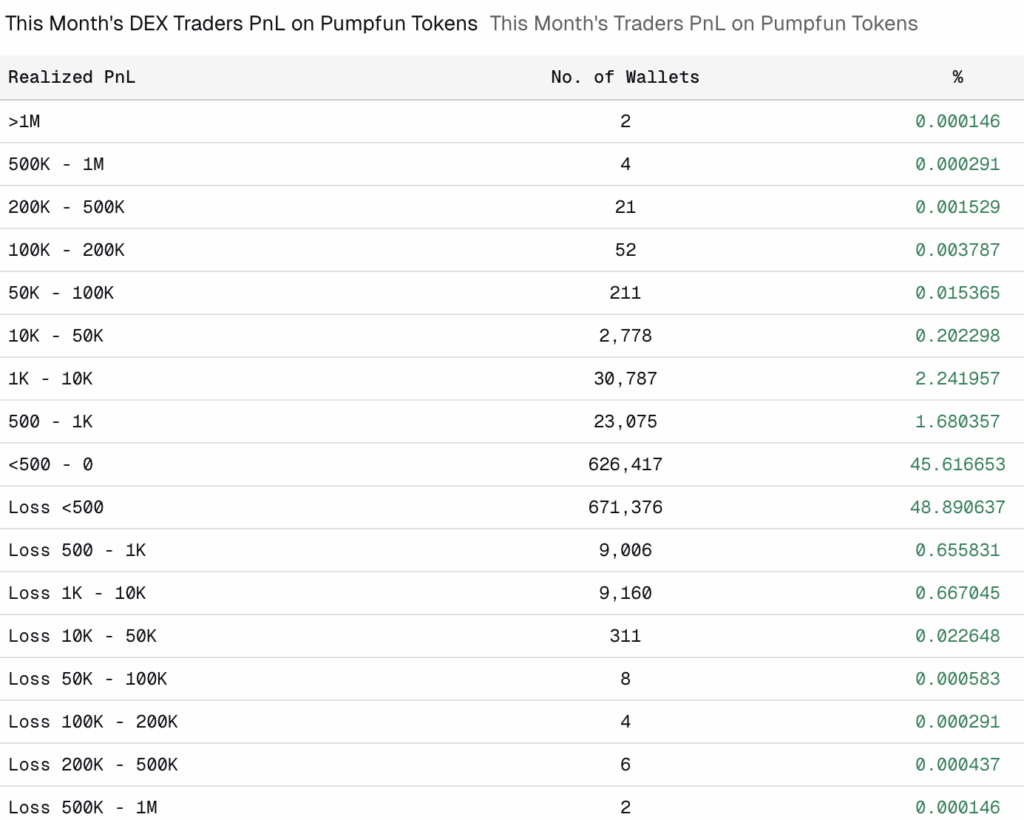
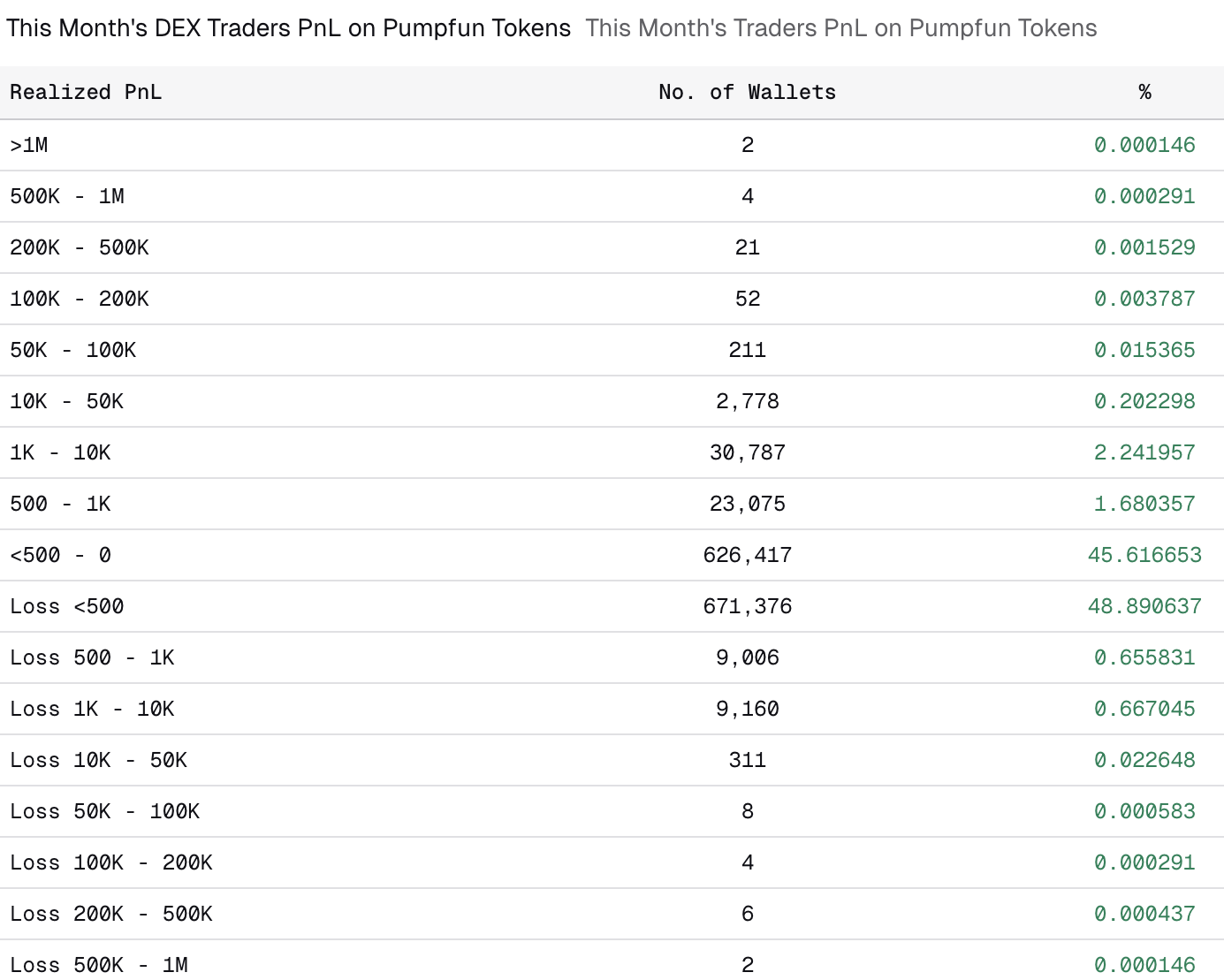
Around 96% of crypto wallets trading Pump Fun-launched tokens have made less than $500 in the past month, with over 50% posting a loss.
That’s according to Dune analytics compiled by analyst @oladee.
Oladee’s data shows that 45.6% of traders made profits up to $500, while 50.6% suffered losses.
The figures were apparently misreported by market analyst Ted Pillows who claimed that they showed 96% of Pump Fun token traders on decentralised exchanges had suffered PnL losses this month.
On the contrary, two wallets made over $1 million trading Pump Fun tokens this past month. On the other end of the scale, two lost anywhere between $500,000 and $1 million.
Read more: X Creators $1M prize winner exposed as memecoin pump-and-dumper
It’s worth noting that the data just shows the number of wallets, and that individual traders can create multiple wallets if they want to.
Pump Fun token launchers are making bank
While the majority of individuals trading these tokens aren’t making bank, the ones deploying them certainly are.
According to crypto analyst Dethective, the top 250 deployers of Pump Fun tokens have extracted $79 million from traders.
Dethective added that these 250 wallets only deployed around 10 tokens that managed to exceed a market cap of $5 million. The wallets also launched 194,000 tokens over the past six months.
Read more: Binance token listing no longer a ‘bullish’ event, research
Dethective notes that his findings don’t necessarily represent 250 different people, but are specifically 250 crypto wallets.
Pump Fun token down 80%, and there’s still no airdrop
Pump Fun has recently pivoted towards AI and the emerging sector of agentic trading that involves AI software trading on your behalf.
In this spirit, the memecoin platform announced a system of automated buyback options for third-party AI agents.
This feature wasn’t well received by Pump Fun traders on X who are still restless over the platform’s reluctance to roll out an airdrop that it said, 258 days ago, would be coming “soon.”
Read more: Crypto firms cut jobs as bear market and AI shift bite
Pump Fun hasn’t addressed its airdrop on X since then, and it’s unclear what its current status is. The price of its $PUMP token is down 80% from it’s all-time-high of $0.008819 in September last year.
One factor that might be delaying things is the ongoing crypto bear market and the wider economic fallout from the US-Israel war against Iran.
Indeed, last week, crypto exchange Kraken announced that it was delaying the launch of its initial public offering until “market conditions improve.”
NFT platform OpenSea also announced that it would delay launching its $SEA token due to the “challenging” market conditions across crypto.
Got a tip? Send us an email securely via Protos Leaks. For more informed news and investigations, follow us on X, Bluesky, and Google News, or subscribe to our YouTube channel.

Implied volatility indicators suggest peak fear has passed, with crypto markets leading traditional finance in pricing risk, even as BTC USD struggles to reclaim key support. Trading near $70,000 following a 2% corrective slide over the last 24 hours, the market leader is flashing conflicting signals.
While some traders worry BTC USD could see a deeper sell-off toward the mid-$50k region, one key metric suggests the bottom may already be behind us.
Currently, the Fear & Greed Index sits at a trepidatious 26 (Fear), yet prediction markets remain skeptical of immediate upside. As Bitcoin mirrors Wall Street structure post-ETF, savvy capital is beginning to rotate into high-beta infrastructure plays to outpace the grind.
JUST IN: $880 billion Bernstein says the Bitcoin bottom is likely in and BTC is set to go up from here — Bitcoin Magazine (@BitcoinMagazine) March 24, 2026

They're targeting $150,000  pic.twitter.com/Ng7KGMojQ8
Discover: The best crypto to diversify your portfolio with
Can BTC USD Reclaim $76,000 Before Month End?
Bitcoin is currently trapped in a corrective descending channel, and it is trading at the $70,000 level, down from recent attempts to breach resistance, signaling heavy overhead pressure.
However, the medium-term outlook retains bullish targets. Data projects a potential rebound to $76,000 by the end of this month, implying an 9% upside if bulls can defend immediate support levels. Conversely, failure to hold the $68,230 line could validate a steeper drop.

Sellers remain in control below $77,500. Their forecast warns that without a clean breakout, the price could revisit $55,500, or a brutal 21% haircut from current levels.
Discover: The best pre-launch token sales
Bitcoin Hyper Targets Early Mover Upside as Bitcoin Tests Key Levels
While Bitcoin navigates this choppy consolidation phase (often a prelude to violent moves), smart money is hedging against stagnation by targeting infrastructure scalability. The logic is simple: if Bitcoin is the gold, the rails moving it are the shovels. This shift has funneled massive volume into Bitcoin Hyper ($HYPER), the first-ever Bitcoin Layer 2 to integrate the Solana Virtual Machine (SVM).
The project has raised a staggering $32 million, capitalizing on the demand for high-speed programmability on Bitcoin. By utilizing the SVM, Bitcoin Hyper delivers transaction speeds faster than Solana itself, all while anchoring to Bitcoin’s security layer. It addresses the ecosystem’s “trilemma” by fixing slow transactions and high fees without sacrificing trust.
Priced at just $0.0136 on presale stage, $HYPER offers a distinct risk-reward profile compared to established caps.
Early backers are positioning for the high-staking 36% APY rewards and the Decentralized Canonical Bridge, which facilitates seamless BTC transfers.
Disclaimer: Crypto is a high-risk asset class. This article is provided for informational purposes and does not constitute investment advice.
The post BTC USD To Reserve: Is Now The Time to Buy? appeared first on Cryptonews.

BitMine pushed the corporate crypto race forward after it spent more on Ethereum than Strategy spent on Bitcoin last week. Arkham‑linked data put BitMine’s weekly ETH purchase at $140.74 million, while Strategy’s weekly Bitcoin buy reached $76.6 million. As a result, the week highlighted stronger balance-sheet demand from institutions across the two largest cryptocurrencies.
BitMine Drives Ethereum Treasury Higher
BitMine accelerated its Ethereum strategy and pushed its treasury closer to another major supply milestone in March. The company said it held 4,660,903 ETH on March 22, valued at about $10.03 billion. That stockpile represented 3.86% of Ethereum’s 120.7 million token supply and kept BitMine ahead in the treasury ranking.
Moreover, BitMine said its combined crypto, cash, and related holdings totaled $11 billion after the latest accumulation round. Those assets included $1.1 billion in cash, 196 Bitcoin, and several equity stakes outside its token reserves. Meanwhile, the company kept Ethereum as its primary treasury reserve asset and its main accumulation target.
TOM LEE JUST BOUGHT MORE CRYPTO THAN SAYLOR pic.twitter.com/1GSFLdvKdS
— Arkham (@arkham) March 24, 2026
BitMine also expanded staking, and that move strengthened its Ethereum exposure beyond simple token accumulation. As of March 23, the company had staked 3,142,643 ETH, worth about $6.5 billion at stated prices. That total equaled roughly 67% of BitMine’s ETH holdings and added another revenue stream from network validation.
Strategy Adds Bitcoin but Trails on Weekly Pace
Strategy still added Bitcoin last week, but its reported pace trailed BitMine’s Ethereum buying by a wide margin. Market reports said the company bought 1,031 BTC for about $76.6 million during the same period. Consequently, BitMine’s weekly purchase exceeded Strategy’s by more than $64 million and led the week’s treasury comparison.
Even so, Strategy remained the largest treasury holder across the public-company crypto market by overall asset size. BitMine’s latest company update valued Strategy’s Bitcoin holdings at about $52 billion, keeping Bitcoin ahead on scale. That position preserved Bitcoin’s lead in corporate reserves, while Ethereum gained ground through BitMine’s faster buildup.
The contrast reflected different treasury timelines, and it highlighted different methods of corporate crypto accumulation. Strategy built its Bitcoin position over the years, whereas BitMine scaled its Ethereum treasury within several recent months. Therefore, Ethereum treasury companies now command more attention in public-market coverage and treasury strategy discussions.
Institutional Adoption Broadens Across Both Assets
BitMine did not begin as an Ethereum treasury company, and that background adds context to its rapid expansion. The firm operated as a Bitcoin miner before it redirected excess capital into Ethereum reserves and staking activity. By August 2025, it had become the largest publicly disclosed Ethereum treasury, according to market reporting.
Now, BitMine aims to acquire 5% of Ethereum’s supply, and that target frames its current buying campaign. Arkham-linked reporting estimated another $359 million of ETH would take holdings to the 4% threshold. Accordingly, the latest purchase kept BitMine within reach of another symbolic marker in the Ethereum market.
Together, the latest moves showed institutional adoption through direct treasury allocation rather than passive market products. Ethereum gained a sharper corporate benchmark, and Bitcoin kept its established treasury leader in public markets. For now, public companies continue to widen crypto treasury competition across both assets and across balance sheets.

Bitcoin advances to $71,000 while derivatives signal cautious bullishness: Crypto Markets Today

Jay-Z Reveals How Blue Ivy Supported Him Amid Rape Case

Update on casualties after building crumbles to ground in Oldham

Smart energy pays enters the US market, targeting scalable financial infrastructure

Why Israel is blocking foreign journalists from entering

Bitcoin: We’re Entering The Most Dangerous Phase

Vile Cheater Exposed On Financial Audit | Caleb Hammer Clips

Financial Flex with SPEED #nfl #financialflex #ishowspeed #relatable #xyzbca #ronaldo

Nvidia’s one of the fastest growing companies with one of the lowest valuations, says Jim Cramer
-
 Crypto World4 days ago
NIO (NIO) Stock Plunges 6.5% as Shelf Registration Sparks Dilution Worries
-

 Fashion4 days ago
Weekend Open Thread: Adidas – Corporette.com
-

 Politics4 days ago
Jenni Murray, Long-Serving Woman’s Hour Presenter, Dies Aged 75
-

 Crypto World3 days ago
Best Crypto to Buy Now: Strategy Just Spent $1.57 Billion on Bitcoin During Fear While Early Investors Quietly Enter Pepeto for 150x Potential
-

 News Videos6 days ago
RBA board divided on rate cut, unusually buoyant share market | Finance Report | ABC NEWS
-

 Crypto World3 days ago
Bitcoin Price News: Bhutan Sells $72 Million in BTC Under Fiscal Pressure, but the Smart Money Entering Pepeto Sees What the Market Does Not
-

 Politics7 days ago
The House | The new register to protect children from their abusers shows Parliament at its best
-

 Tech5 days ago
inKONBINI Lets You Spend Summer Days Behind the Register
-

 Crypto World6 days ago
Canada’s FINTRAC revokes registrations of 23 crypto MSBs in AML crackdown
-

 Sports1 day ago
Remo Stars and Kano Pillars Strengthen Survival Hopes in NPFL
-
 NewsBeat6 days ago
Residents in North Lanarkshire reminded to register to vote in Scottish Parliament Election
-

 News Videos6 days ago
PARLIAMENT OF MALAWI – PAC MEETING WITH REGISTRAR OF FINANCIAL ON AMARYLLIS HOTEL – INQUIRY LIVE
-

 Politics5 days ago
Gender equality discussions at UN face pushbacks and US resistance
-

 Business2 days ago
No Winner in March 21 Drawing as Prize Rolls to $133 Million for Next
-

 Business6 days ago
Who Was Alex Pretti? 5 Key Facts About the ICU Nurse Killed by Federal Agents in Minneapolis
-

 Sports1 day ago
Gary Kirsten Accuses Pakistan Cricket Board Of ‘Interference’, Mohsin Naqvi Responds
-

 Tech2 days ago
Give Your Phone a Huge (and Free) Upgrade by Switching to Another Keyboard
-

 Sports4 days ago
2026 Kentucky Derby horses, odds, futures, preview, date: Expert who nailed 12 Derby-Oaks Doubles enters picks
-
Sports6 days ago
Vikings Free Agency Enters Phase 2 with Key Questions
-

 Tech7 days ago
Subnautica 2 might finally be entering early access in May
You must be logged in to post a comment Login