CryptoCurrency
UAE’s Layered Digital Asset Strategy

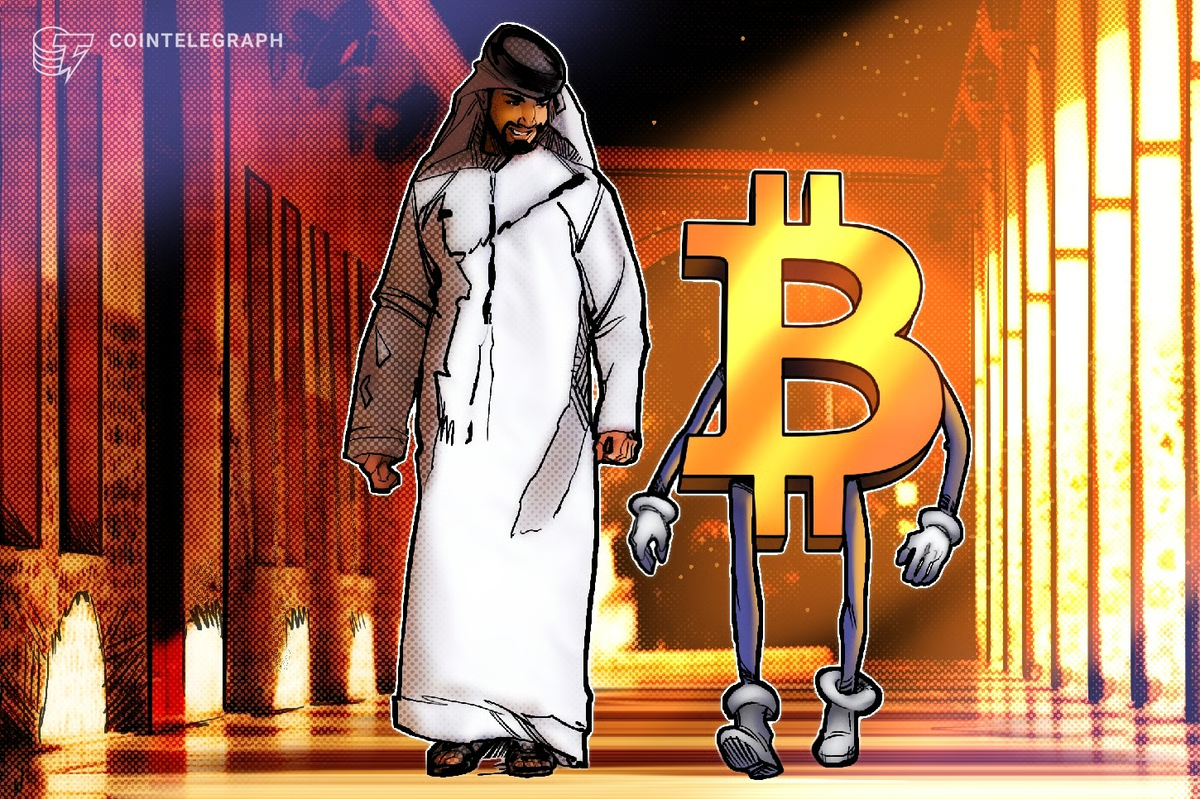
The United Arab Emirates is not trying to choose between Bitcoin and broader crypto. Instead, it is deliberately building both in different cities and for different stages of adoption.
Abu Dhabi, the capital of the UAE, has positioned itself as a hub for Bitcoin (BTC)-focused institutional infrastructure, emphasizing custody, over-the-counter (OTC) liquidity, mining and regulated capital markets. Dubai, by contrast, has built a broader crypto economy that spans payments, stablecoins, Web3 apps, gaming, tokenization and consumer-facing products.
While this shows a distinction, industry participants noted that it reflects a layered strategy and not fragmentation. “The two approaches are complementary,” said Gregg Davis, producer of Bitcoin MENA, the largest Bitcoin-focused event in the UAE.
“A broad digital-asset ecosystem naturally directs attention toward the most secure and time-tested asset — Bitcoin. Together, they create a diverse and dynamic market across the UAE,” Davis told Cointelegraph.
On the other hand, Dubai’s ecosystem maximizes participation and real-world usage, according to Matthias Mende, the co-founder of the Dubai Blockchain Center and the founder of the Web3 social verification platform Bonuz.
“In simple terms, Abu Dhabi is building ‘crypto Wall Street,’ while Dubai is building the place where people actually use this technology every day,” Mende said.

Abu Dhabi’s Bitcoin-first institutional thesis
Davis argued that Abu Dhabi’s strategy is rooted in a clear distinction between Bitcoin and the broader crypto landscape.
“Abu Dhabi has done the work to understand that Bitcoin stands apart from the broader digital-asset landscape,” Davis said. “Much of what falls under ‘Web3’ remains speculative or built around problems that may not need solving.”
According to Davis, the intent to position Abu Dhabi as a center for institutional Bitcoin is already visible.
“Major entities in Abu Dhabi gaining exposure to Bitcoin is a strong signal of long-term conviction,” he told Cointelegraph. He added that clearer regulatory pathways and public-sector support have made the emirate attractive for Bitcoin-native firms.
Recent developments back up this institutional Bitcoin thesis. Abu Dhabi has emerged as a focal point for large-scale, regulated Bitcoin activity, underscored by the launch of the Bitcoin MENA 2025 event, which brought institutional investors, miners and infrastructure providers in the emirate to discuss custody, mining and treasury strategies.
Global companies, such as Galaxy Digital, have expanded into Abu Dhabi under the ADGM framework, citing regulatory clarity and institutional demand. Meanwhile, crypto exchange Binance secured full regulatory approvals covering trading, clearing and custody.
Dubai builds the crypto economy layer
While Abu Dhabi focuses on institutional rails, Dubai has taken a broader approach, designing a regulatory environment intended to support entire industries built on top of digital assets.
“Dubai is trying to build the full crypto economy around that,” Mende told Cointelegraph. “Consumer apps, brands, payments, gaming, creators and tokenization.”
He told Cointelegraph that the convergence of stablecoins, tokenized real-world assets (RWAs) and consumer-facing apps created a new economic layer that goes beyond trading.
“Stablecoins will be the visible part — simple ‘scan, tap, pay’ flows — while RWAs bring serious institutional capital onchain,” Mende said, adding that blockchain-based digital IDs, non-fungible tokens (NFTs), vouchers and tickets make the whole system human-centric and “useful for daily life.”
Dubai’s regulatory clarity has been a major enabler of the crypto economy vision. “The biggest enabler is clarity,” Mende said. “Founders know which activities are regulated, what license they need and which rulebook they fall under, so they can design products and token models with a clear path.”
That clarity, however, does not eliminate all friction. Mende told Cointelegraph that challenges remain at the interface with traditional finance, particularly banking and fiat on- and off-ramps, and in more experimental areas such as decentralized finance and DAOs, where frameworks are still evolving.
Related: State Street, Galaxy and Ondo join tokenized cash race with 24/7 sweep fund
Stablecoins emerge as the first mass-use rail
As Dubai’s crypto economy develops, multiple industry leaders point to payments and stablecoins as the first area of durable, real-world adoption.
“Payments and stablecoin infrastructure will lead because they solve a universal and urgent problem: cross-border settlement that is slow, expensive and fragmented,” Patrick Ngan, the chief investment officer at Zeta Network Group, told Cointelegraph.
According to Ngan, regulatory clarity provides financial institutions with the confidence to integrate digital settlement rails directly into commerce. “Once those rails are in place, volume follows,” he said. “That is where the first durable, real-world adoption will appear.”
SingularityDAO founder Marcello Mari echoed the sentiment. He said that stablecoins are already more embedded in everyday activity than many outside the region realize.
“In Dubai, USDT and USDC are actually used more than you think — for rent, remittances, real estate and service payments,” Mari said. “Gaming and Web3 creators will follow, but stablecoins are the first bridge to real-world utility.”
Apart from crypto-native companies, stablecoins have caught the attention of mainstream companies in the UAE. On Thursday, state-owned telecom giant e& announced that it’s preparing to test a dirham-backed stablecoin for bill payments.
However, both Ngan and Mari expressed that while regulatory clarity exists, operational timelines and banking relationships remain the biggest bottlenecks. “The rules are clear, but the process requires patience and strong operational discipline,” Ngan said.
Magazine: Bitcoin $200K soon or 2029? Scott Bessent hangs at Bitcoin bar: Hodler’s Digest