
CryptoCurrency
Whales Move XRP to CEXs as Price Tests a Key Support Level


XRP’s price has fallen below $2, erasing nearly all of the recovery since the start of the year. At the same time, XRP balances on several major exchanges have increased. This trend has heightened concerns about further downside risk.
The pullback has coincided with broader market weakness, as geopolitical tensions pushed investors toward risk-off positioning. However, many analysts remain optimistic about XRP in 2026.
Sponsored
Sponsored
XRP Exchange Reserves and Whale-to-Exchange Activity Surge in January
Data from CryptoQuant shows that XRP reserves on major exchanges such as Binance and Upbit increased significantly in January 2026.
The chart indicates that investors have consistently transferred XRP to exchanges since the beginning of the year. As a result, balances on Binance reached 2.72 billion XRP, while Upbit held nearly 6.3 billion XRP. In total, exchange reserves now account for almost 10% of the circulating supply.
Notably, an inverse correlation between Upbit balances and the XRP price has become increasingly clear. Since Upbit reserves began rising in the first week of January, XRP has dropped from $2.40 to $1.83. This trend highlights the significant influence of Korean investors on XRP’s price action.
Another notable on-chain metric is Whale Exchange Transactions (on Binance), which measures the number of transfers between whales and exchanges. This indicator reflects how actively large holders move coins in and out of trading platforms.
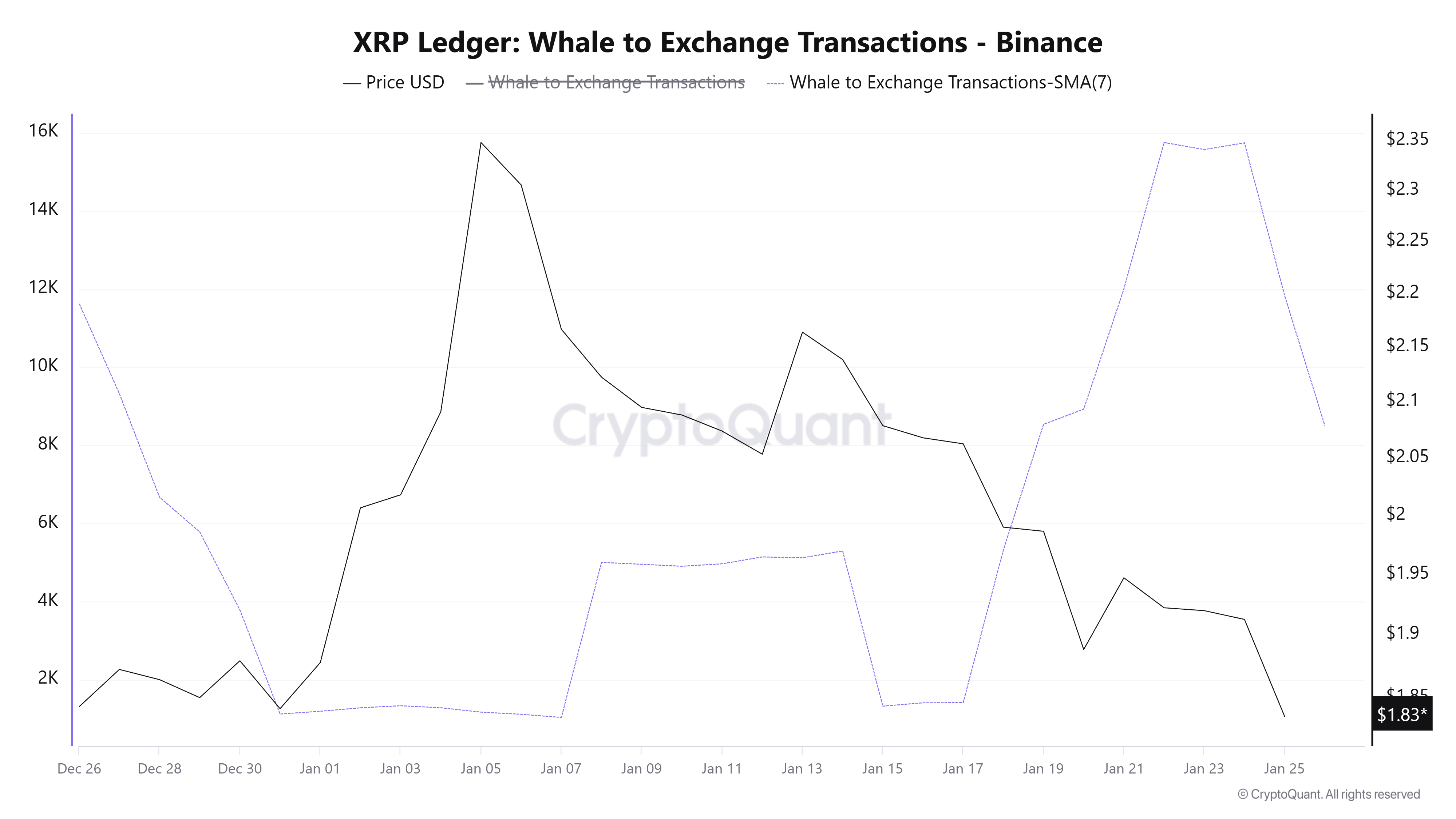
Rising exchange reserves combined with increased whale transactions could intensify selling pressure. The data suggests that more whales may be moving XRP onto exchanges.
Sponsored
Sponsored
In addition, XRP ETFs have recorded only two days of outflows since their November 2025 launch. The first came on January 7, when $40.80 million was withdrawn from the funds. The second—and largest ever—occurred on January 20, with $53.32 million in outflows primarily from Grayscale’s GXRP. The January 20 selloff was largely driven by President Trump’s tariff threats against European NATO members, which triggered a broad risk-off move across US markets.
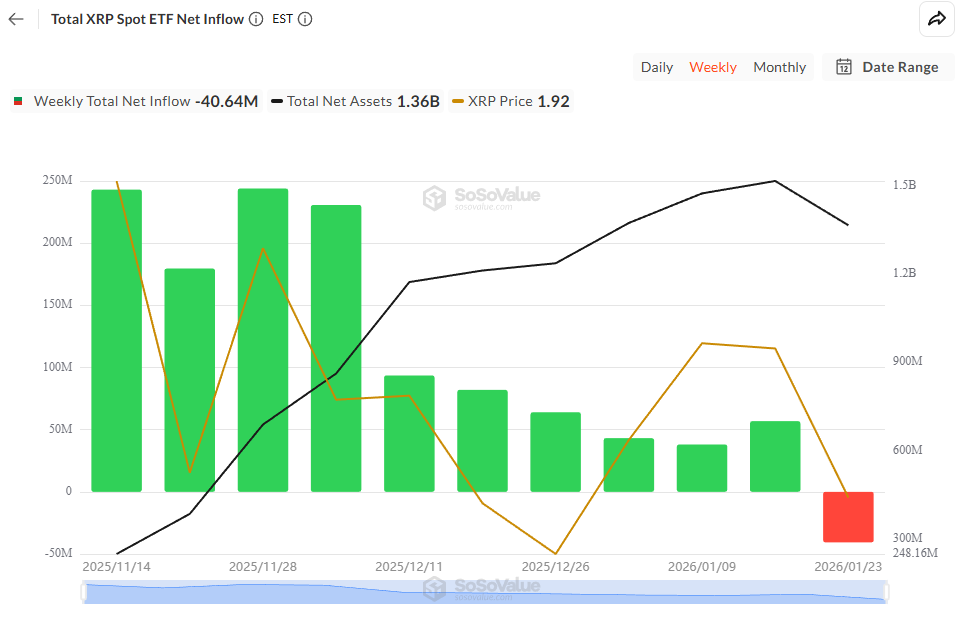
A recent BeInCrypto analysis notes that when capital inflows stall and turn negative, it often signals a pause or pullback in institutional demand.
Meanwhile, XRP has erased most of its early-year rebound and is now trading near the critical $1.88 support level. Previous analyses warned that a breakdown below this level could trigger a further 45% decline, potentially pushing the price below $1.
Despite these risks, several positive factors may help XRP absorb selling pressure. A recent report from Token Relations highlights a notable improvement in XRP ETF trading volumes in January. The report also points to rising demand for DeFi products on the XRP Ledger (XRPL).
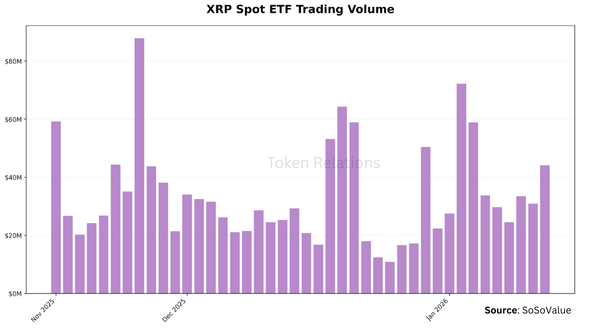
“December 2025 saw $483 million in XRP ETF inflows, while Bitcoin ETFs recorded $1.09 billion in outflows during the tax-loss harvesting season. This trend suggests institutional rotation from Bitcoin to XRP ahead of 2026. Trading liquidity remained robust, consistently processing between $20 million and $80 million in daily value. Adoption exceeded expectations for altcoin ETF launches, with steady daily inflows indicating systematic allocation strategies rather than speculative trading,” Token Relations reported.
Despite these two outflow days, cumulative net inflows remain at $1.23 billion as of January 23, with total net assets of $1.36 billion. Analysts note that the outflows appear to be macro-driven rather than a fundamental shift in sentiment toward XRP.
Recently, Ripple has continued expanding RLUSD’s use cases, a stablecoin on the XRP Ledger, through partnerships with multiple countries and institutions. These positive developments could provide meaningful support for XRP’s price. If the token holds above $1.88 and ETF inflows continue, a retest of $2.40 remains possible. However, a break below support would shift focus to $1.25.



