
Crypto World
Whop Treasury launches with Aave, Plasma, and Veda integrations: Whop



E-commerce platform Whop has launched its Treasury feature, enabling creators to earn yield directly on balances through integrations with Aave, Plasma, and Veda.
Whop has launched Whop Treasury, an on-chain earning feature for its e-commerce platform powered by Aave, Plasma, and Veda. The feature allows creators to generate yield directly on their account balances. According to the announcement, millions of users can now access on-chain earning capabilities through the platform.
The launch represents an integration of DeFi infrastructure into a mainstream fintech platform. Aave founder Stani Kulechov highlighted the development as a milestone for bringing Aave into broader fintech adoption, with the Treasury feature giving creators direct yield-generation capabilities on their platform balances.
Sources: Stani Kulechov on X | Stani Kulechov on X
This article was generated automatically by The Defiant’s AI news system from publicly available sources.

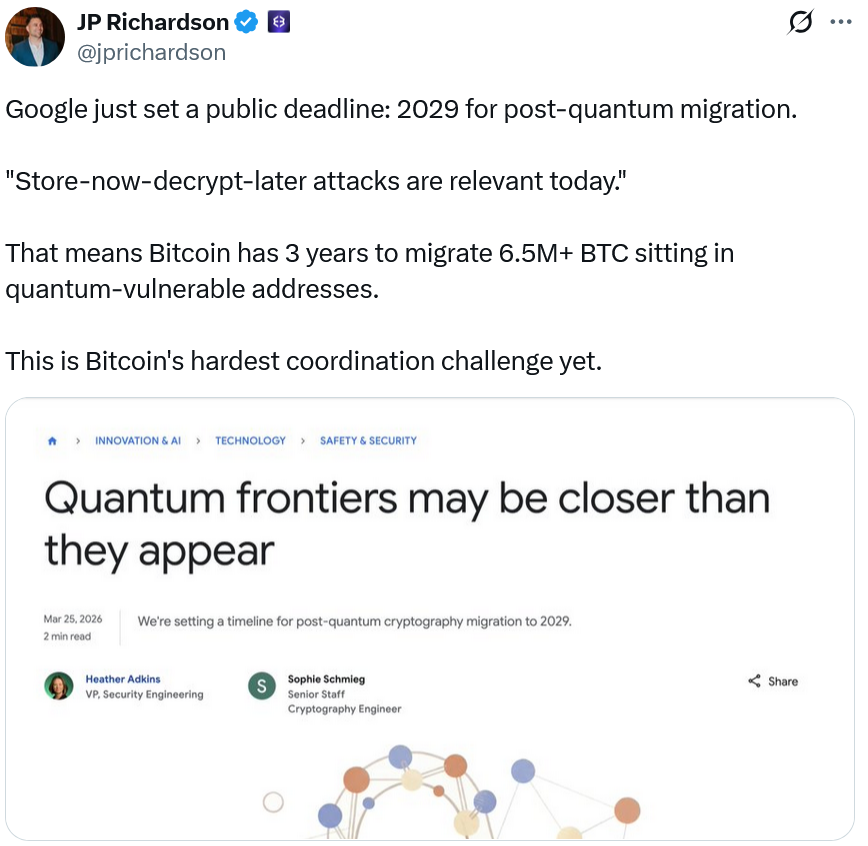
Google has set a 2029 deadline for its post-quantum cryptography (PQC) migration, warning that “quantum frontiers” could be closer than they appear.
On Wednesday, Google said rapid progress in quantum computing hardware and quantum error correction, along with updated estimates of how quickly a quantum machine could break today’s encryption standards, has heightened the urgency to act sooner rather than later.
“Quantum computers will pose a significant threat to current cryptographic standards, and specifically to encryption and digital signatures,” Google said, while also noting that PQC migration is needed for users to use authentication services securely.
This is the first time Google has set a timeline to roll out post-quantum capabilities across its products. The 2029 timeline is earlier than some industry estimates for Q-Day — the point at which quantum computers become powerful enough to break current public-key encryption.
“It’s our responsibility to lead by example and share an ambitious timeline. By doing this, we hope to provide the clarity and urgency needed to accelerate digital transitions not only for Google, but also across the industry.”

Google’s call for urgency comes as it continues to develop its quantum chip, Willow, which has a computing capacity of 105 qubits, making it one of the most powerful in the industry.
There are also rising concerns that quantum computers could severely disrupt the crypto industry by breaking the cryptographic algorithms used to secure digital assets. However, there is still debate over whether only crypto wallets with exposed public keys are vulnerable or whether all coins are at risk.
Crypto networks also eye post-quantum upgrades
The Ethereum Foundation launched a “Post-Quantum Ethereum” resource hub on Tuesday, focused on protecting the blockchain from future quantum computing threats and securing the billions of dollars in value on the network.
The post-quantum team plans to implement quantum-resistant solutions in Ethereum at the protocol level by 2029, with solutions targeting the execution layer to follow.
In January 2025, Solana developers created a quantum-resistant vault on the Solana blockchain to protect user funds from quantum threats by implementing a complex hash-based signature system that generates new keys each time a transaction is made.
Related: Google uncovers iOS exploit kit used in crypto phishing attacks
However, to access the feature, Solana users need to store their funds in Winternitz vaults rather than regular Solana wallets, as it isn’t a network-wide security upgrade.
Meanwhile, there has been increasing division in the Bitcoin ecosystem on what action developers should take, if any at all.
One of the Bitcoin ecosystem’s strongest voices, Blockstream CEO Adam Back, says quantum risks are widely overstated and that no action is needed for decades.
On the other hand, security researcher Ethan Heilman and others have proposed a new output type for Bitcoin, called Pay-to-Merkle-Root, through Bitcoin Improvement Proposal 360 (BIP-360), which seeks to protect Bitcoin addresses from potential short-exposure quantum attacks.
However, that implementation may take seven years, Heilman told Cointelegraph in February.
Magazine: Nobody knows if quantum secure cryptography will even work
Key takeaways:
-
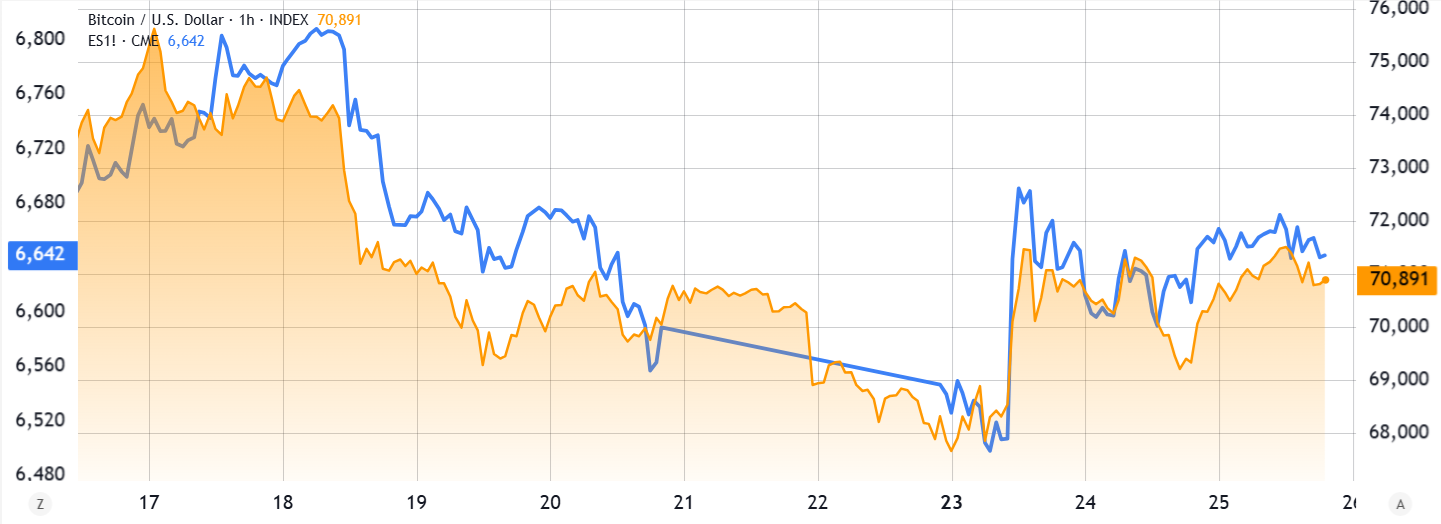
Over 90% of Bitcoin call options may expire worthless if the price fails to break above $71,000 by Friday.
-
Traders fear rising inflation and worsening credit conditions as the US and Israel-Iran war continues.
Bitcoin (BTC) has been stuck in a narrow range between $67,700 and $71,600 over the past week, closely following how the US stock markets reacted to the US and Israel-Iran war. Traders have high hopes that the upcoming $18.6 billion Bitcoin monthly options expiry on Friday could provide the bullish momentum needed to break above the $75,000 level for good.

The Bitcoin call (buy) options dominate March’s total open interest, totaling $11.2 billion, while put (sell) instruments stood 34% lower at $7.4 billion. However, this advantage means little given that Bitcoin has failed to sustain levels above $74,000 for the past seven weeks. Investors fear that inflation will remain a concern as WTI oil prices sustained levels above $90.
Economic uncertainty helps bears dominate the quarterly Bitcoin options expiry
Initial signs of cracks in the US economy emerged after private credit funds limited redemptions amid concerns of deteriorating loan quality. The $3 trillion sector has been under scrutiny after asset managers Ares Management, Apollo Global Management, Blue Owl Capital, and Cliffwater were forced to halt or restrict withdrawals in recent weeks, according to CNBC.
The uncertainty in the socio-economic scenario might be precisely what bears needed for Bitcoin’s quarterly expiry. To better assess the forces driving Bitcoin’s price ahead of Friday’s event at 8:00 am UTC, analysts are looking at what prices the call and put options were placed.
Deribit holds a clear lead with a 76% market share with $14.1 billion in open interest, followed by OKX with 7.1% and CME at 6.6%. Despite the greater demand for call options, Bitcoin bulls at Deribit were overconfident, placing the majority of their bets on $90,000 and higher levels.

Only $2 billion of the call options at Deribit were placed below $78,000, meaning 77% of those instruments will likely become worthless on Friday. It’s clear that Bitcoin bulls did not anticipate a quarterly expiry at $71,000, a price that would invalidate 92% of the call options open interest.
Related: Bitcoin’s battle for $70K continues as data shows traders avoiding bullish positioning
Part of those positions might have been placed before February, when Bitcoin was trading above $86,000, which explains the heavy positions far above current price levels.

The put options open interest at $66,000 or higher stood at $2.2 billion at Deribit, meaning 40% of those instruments remain in play for Friday’s expiry. Therefore, at first sight, there is a slight advantage for the put options, but a more granular view is required to understand at what level the situation might change.
Below are four probable outcomes for Friday’s BTC options expiry at Deribit based on current price trends:
-
Between $65,000 and $69,000: The net result favors the put (sell) instruments by $1.8 billion.
-
Between $69,001 and $72,000: The net result favors the put (sell) instruments by $950 million.
-
Between $72,001 and $75,000: The net result favors the put (sell) instruments by $430 million.
-
Between $75,001 and $78,000: The net result favors the call (buy) instruments by $790 million.
Ultimately, Bitcoin bulls need a 6% rally from the present $70,900 level to shift the outcome of the March options expiry in their favor.
This article does not contain investment advice or recommendations. Every investment and trading move involves risk, and readers should conduct their own research when making a decision. While we strive to provide accurate and timely information, Cointelegraph does not guarantee the accuracy, completeness, or reliability of any information in this article. This article may contain forward-looking statements that are subject to risks and uncertainties. Cointelegraph will not be liable for any loss or damage arising from your reliance on this information.
Stellar’s XLM price jumps toward the top of its range as traders rotate into payment and remittance tokens amid rising volumes, stablecoin pilots, and CBDC tests.
Summary
- Stellar’s XLM price trades near $0.18 after rising about 7.5% in 24 hours and more than 6% over the past week, outpacing the broader crypto market.
- The token’s market cap stands around $5.92 billion with roughly $216 million in daily trading volume, underscoring renewed interest in payment-focused layer-1 networks.
- A broader rotation into real-world payment and remittance assets, alongside ongoing stablecoin and CBDC experiments on Stellar, appears to be reinforcing XLM’s latest breakout.
Stellar’s native token XLM (XLM) is trading at about $0.1792, up 1.22% over the last hour, 7.45% in the past 24 hours, and 6.06% over the past seven days, with a market capitalization of roughly $5.92 billion and 24-hour trading volume of about $215.79 million.
XLM price climbs on strong daily gains
The move has pushed XLM toward the upper end of its recent range, following several sessions where daily closes clustered between roughly $0.1569 and $0.1671 in late March, according to historical price data. This rally is taking place as the global crypto market cap sits near $2.45 trillion, up about 1.31% on the day, meaning Stellar is outperforming the market-wide benchmark and many similarly sized layer-1 assets.
Stellar is a layer-1 payments and remittance-focused blockchain designed to facilitate low-cost, near-instant cross-border transfers, with XLM serving as the native asset used for fees, liquidity, and bridging between currencies. The network was created to connect financial institutions, money transfer operators, and fintech platforms, enabling issuers to tokenize fiat or other assets and route them through Stellar’s consensus network. With a circulating supply reported above 50 billion XLM and a live price around the mid-$0.16 to $0.18 band, Stellar’s on-chain design positions it as a high-liquidity medium of exchange rather than a strictly scarce store-of-value asset.
In terms of broader context, XLM is part of a cohort of payment and settlement tokens that includes assets like XRP and other cross-border networks, segments that often see renewed interest when regulatory narratives or bank integration stories return to the foreground. Recent coverage of Stellar’s ecosystem has highlighted expanding smart contract functionality through Soroban, pilots related to central bank digital currencies (CBDCs), and partnerships with remittance players such as MoneyGram, all of which reinforce the token’s live usage beyond pure speculation.
While Stellar’s ledger does not expose a simple “whale” dashboard, its recent advance has come alongside elevated volumes and strong relative performance compared to peers. XLM’s daily trading volume around $215–216 million, against a sub-$6 billion market cap, implies a relatively high turnover ratio that often accompanies phases of accumulation by larger actors and active trading by short-term speculators. Historical data shows several recent days with price gains above 3–7% and modest pullbacks, creating a staircase pattern higher rather than a single blow-off spike.
At the sector level, interest in payment and remittance chains has been supported by ongoing debates around bank-grade stablecoins, ISO 20022 messaging integration, and real-world asset rails, where Stellar is frequently cited as one of the infrastructures used or tested for cross-border flows. This positions XLM within a broader pattern: as financial institutions and fintechs probe compliant, high-uptime networks to move fiat-linked assets, tokens like XLM benefit from narrative and usage tailwinds that can sustain rallies longer than purely meme-driven cycles.
Pi Network’s (PI) token stayed under $0.20 on Wednesday after several days of sideways trading, while the broader crypto market remained under pressure.
Summary
- PI stayed below $0.20 as weak market sentiment and fading momentum limited short-term recovery efforts.
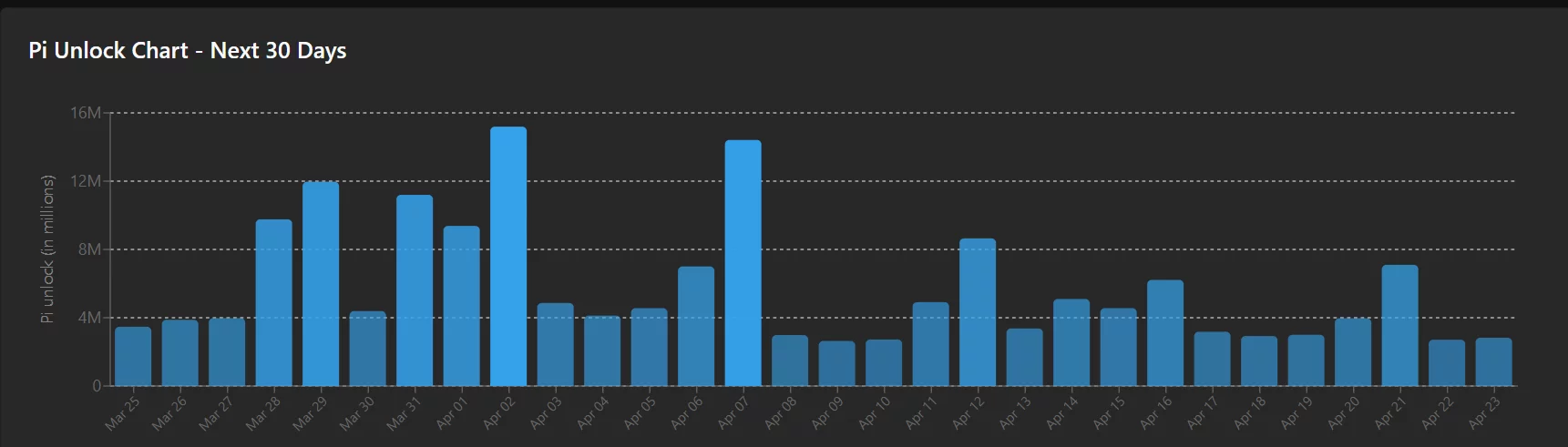
- About 154.2 million PI tokens may enter circulation in 30 days, adding fresh supply pressure.
- Consensus 2026 exposure boosted visibility, but traders stayed focused on unlocks, momentum, and broader weakness.
PI has dropped about 37% from its recent peak near $0.29 to around $0.18, even as the project continued to post updates around its ecosystem and future events. The current setup shows that price pressure may continue in the coming weeks if supply rises faster than demand and market sentiment stays weak.
The wider crypto market has entered a cautious phase, and that has limited support for many altcoins. Bitcoin has fallen about 4% over the past seven days after failing to hold levels above $72,000, while Ether, Solana, and XRP have also moved in a narrow range.
That backdrop has affected Pi Coin as well. Tension between the United States and Iran has added another layer of uncertainty, and traders have remained careful even as reports pointed to possible diplomatic talks. In such conditions, risk assets often struggle to attract strong buying interest.
Another factor that may weigh on PI is the upcoming token release schedule. Around 154.2 million tokens are expected to enter circulation over the next 30 days, which equals about 5.1 million tokens per day.
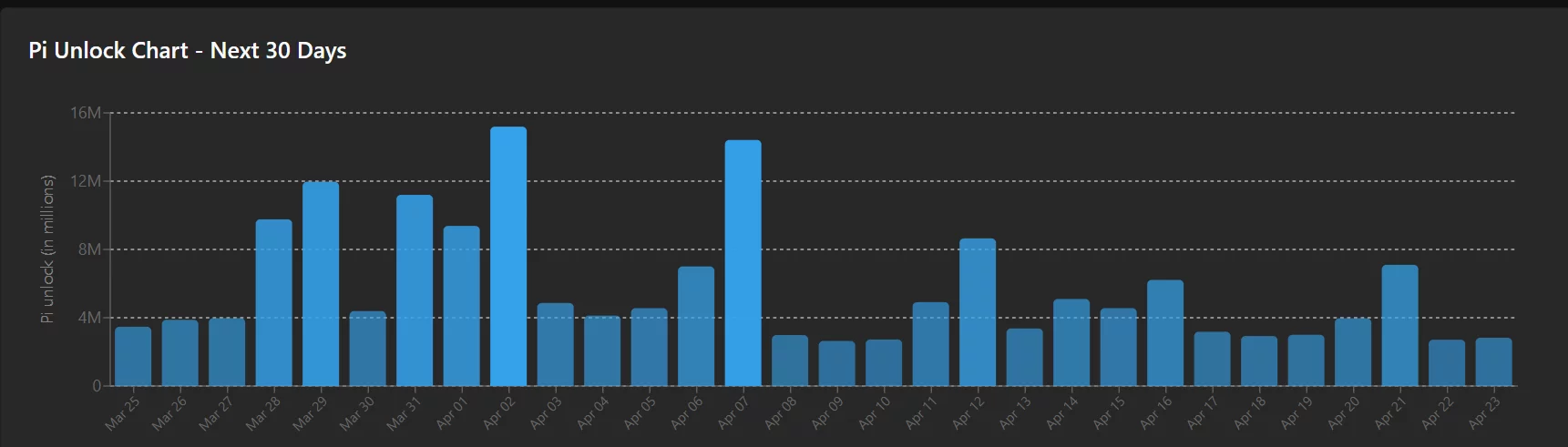
A rise in circulating supply can pressure price when buyer demand does not grow at the same pace. Large unlock events have often triggered short-term volatility in other crypto projects, and PI may face the same risk if holders decide to sell part of the newly available supply.
In addition, PI posted a strong move in mid-March, but that rally lost pace quickly. Since then, the token has traded sideways and remained below the $0.20 mark, which shows that buyers have not fully regained control.
The pullback from $0.29 to about $0.18 also points to weaker short-term momentum. Mainnet-related optimism has not been enough to reverse that trend so far, and that may keep traders focused on downside risks instead of recovery.
Conference Exposure May Not Change Near-Term Price Action
Pi Network has also drawn attention after securing a sponsorship role at Consensus 2026 in Miami, which will run from May 5 to May 7. Supporters of the project viewed the development as a positive step, and one X user said the event includes a 20-minute main-stage session focused on PI and artificial intelligence.
Still, event visibility does not always lead to immediate price support. Last year, Pi Network also appeared as a Gold Sponsor at TOKEN2049 in Singapore, yet sponsorship activity alone did not remove market pressure. For now, traders appear more focused on supply, momentum, and market conditions than on conference exposure.
Disclosure: This article does not represent investment advice. The content and materials featured on this page are for educational purposes only.
FET price rebounds toward key resistance as AI token rotation, exchange outflows, and progress on the Artificial Superintelligence Alliance roadmap drive renewed demand for the ASI-linked token.
Summary
- Artificial Superintelligence Alliance’s FET price trades around $0.23–$0.25 after rising roughly 3–5% in the last 24 hours, reversing part of its recent weekly drawdown.
- The token’s market cap sits between about $520 million and $650 million, with 24-hour trading volumes ranging from $150 million to over $260 million, underscoring active speculative and directional interest in AI-linked assets.
- An evolving roadmap toward the ASI merger, new AI agent tools, and a dedicated ASI:Chain blockchain continues to frame FET as a core bet on decentralized artificial intelligence infrastructure.
Artificial Superintelligence Alliance’s FET (FET) price is trading near $0.23–$0.25 on March 25, 2026, with live dashboards placing it around $0.2499 at the latest update and showing a 24-hour range between roughly $0.2251 and $0.2538. Over the past day, FET’s price has risen by approximately 3.8% on one major tracker, while another source records a 15.5% daily surge to about $0.238 in a recent session, highlighting a sharp short-term reversal from a 7-day drawdown of around 6–7%.
FET price rebounds as AI rotation returns
That move has come alongside 24-hour trading volumes between roughly $150 million and $262 million, with circulating supply estimates between about 2.26 billion and 2.6 billion FET, implying a market capitalization in the $520–$650 million range at current prices.
FET functions as the native token of the Artificial Superintelligence Alliance, a decentralized AI ecosystem formed around Fetch.ai that aims to support autonomous agents, AI services and a dedicated AI-focused blockchain. In this role, FET is used for transaction fees, staking, and coordination of AI workloads, placing it firmly in the AI token category rather than pure DeFi, L1, or RWA. The alliance’s roadmap and token economics have been reshaped by a merger plan to combine FET with SingularityNET’s AGIX and Ocean Protocol’s OCEAN into a single ASI token, with a total supply targeted at 2,630,547,141 units following upgrades.
Market structure data points to significant positioning changes around FET’s latest bounce. A recent update notes that FET’s 15.5% daily surge to about $0.238 coincided with a net outflow of 1.5 million tokens from centralized exchanges, pushing exchange reserves to a new low for the cycle and signaling reduced immediate sell-side liquidity. At the same time, that report highlights that spot whale activity between roughly $0.20 and $0.22 remained predominantly on the sell side, creating a band of resistance where larger holders have been taking profit into strength. This combination of outflows and whale selling suggests the rally is being driven by broader AI inflows and on-chain scarcity, but still faces overhead supply that could cap upside if demand fades.
FET’s price action is also unfolding against a wider backdrop of renewed interest in AI-linked tokens such as Bittensor’s TAO and Render, with sector dashboards flagging parallel gains across AI infrastructure and compute assets. The alliance’s own development cadence reinforces that narrative: recent milestones include the ASI:Create closed alpha, a platform for building and deploying AI agents, and the ASI:Chain DevNet beta, a blockDAG-based layer-1 tailored to high-concurrency AI workloads. Looking further ahead, the roadmap calls for an ASI:Chain TestNet in 2026 and a mainnet launch by late 2026 or early 2027, alongside an open beta for ASI:Create, which collectively aim to convert the AI token narrative into concrete developer and user traction.
The merger mechanics underpinning this push are also critical: documentation and external analyses confirm that FET will be rebranded to ASI, with AGIX and OCEAN migrating into the new asset via fixed conversion ratios, bringing the unified supply to 2.63 billion tokens and tying three previously separate AI ecosystems into one economic base. As that process advances, FET sits at the center of a structural consolidation in the AI token space, leaving its price increasingly sensitive to both sector-wide risk appetite and the execution of the ASI roadmap.
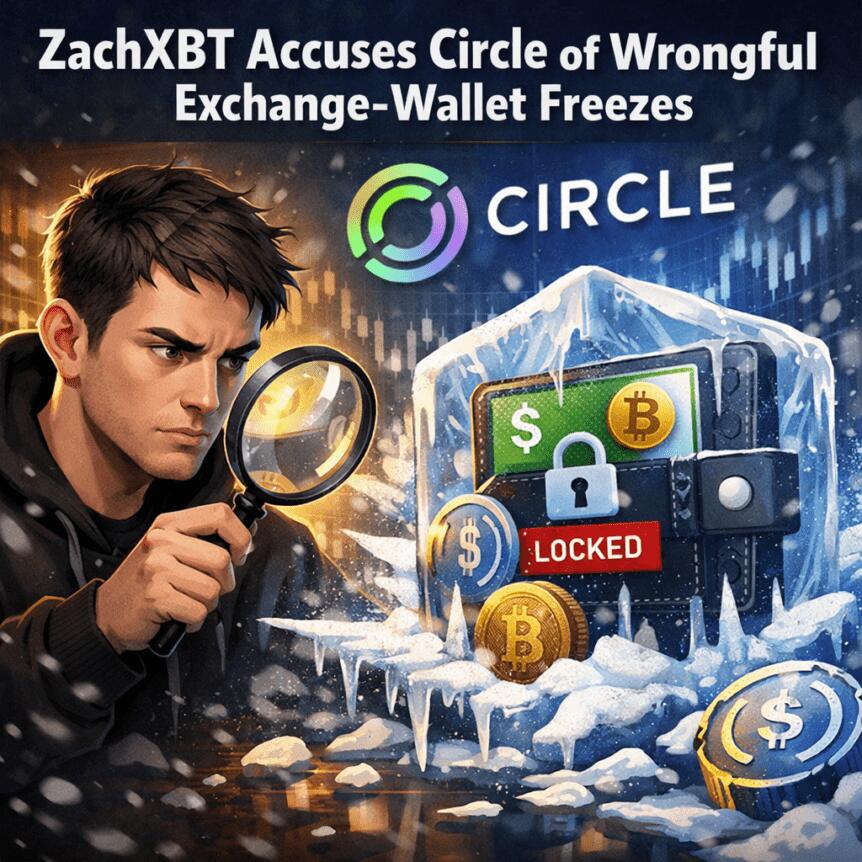
Circle, the issuer behind the USD Coin (USDC), drew scrutiny after reportedly freezing 16 wallets tied to a civil case in the United States. On-chain investigator ZachXBT characterized the move as inappropriate, arguing the wallets belonged to legitimate business operations and were not connected to the case in any apparent way.
The wallets, ZachXBT noted, were used by a mix of crypto exchanges, online casinos, and foreign exchange businesses. He added that an analyst armed with basic on-chain tools could have recognized the wallets as ordinary business addresses from among the vast number of transactions Circle processes each day.
In a separate social post, the investigator asserted that the case appears sealed and that Circle had “zero basis” to freeze fiat-pegged USDC wallets. He described the freeze as potentially the most incompetent he has observed in years of investigations, suggesting the action reflected a governance process outsource to a default judicial mechanism rather than a defined, auditable internal procedure.
Cointelegraph approached Circle for comment on these claims, but the company did not provide a response by publication time.
Centralized stablecoins like USDC—where the issuer maintains reserves and has the ability to intervene—have long been debated for their contrast with the permissionless ethos of many crypto assets. Critics point out that, unlike cash, centrally issued stablecoins can be frozen, a point echoed by several industry figures.
“This is your 10th reminder that centrally issued stablecoins are not actually yours; they can be frozen, unlike cash,”
Mert Mumtaz, founder of RPC node provider Helius, reacted to the freezes by underscoring the governance risk inherent in centralized stablecoins. He framed the episode as a reminder that control rests with the issuer, with potential implications for user rights and privacy.
Jean Rausis, co-founder of the Smardex decentralized trading platform, linked Circle’s action to broader regulatory designs under discussion in the GENIUS stablecoin framework. He suggested that provisions within GENIUS could enable a privately managed central bank digital currency (CBDC) pathway, highlighting ongoing debates about how much visibility, oversight, and control such tokens might concede to authorities.
The discussion extends to broader concerns about the relationship between regulated stablecoins and the future cryptocurrency regulatory landscape. Critics have warned that frameworks like GENIUS may inadvertently normalize a centralized, surveilled form of money under the guise of stability and compliance, potentially steering markets toward a CBDC-like model. In May 2025, commentator and former lawmaker Marjorie Taylor Greene also raised alarms that regulated stablecoins could act as a “CBDC Trojan Horse.”
Key takeaways
- Circle reportedly froze 16 USDC-related wallets tied to exchanges, gaming, and FX businesses, a move disputed by crypto researchers as misaligned with the civil case context.
- On-chain investigator ZachXBT contends the wallets were clearly business instruments, not entities implicated in the ongoing case, and questions the governance process used to authorize the freezes.
- Industry voices stress that centralized stablecoins can be frozen by issuers, underscoring tensions between censorship-resistance ideals and regulatory compliance.
- Discussion around GENIUS signals concern that centralized infrastructure could nudge regulated stablecoins toward privately managed CBDC-like models, fueling ongoing CBDC debates.
- Circle did not provide a public comment at the time of reporting, leaving questions about internal processes and future safeguards unresolved.
Rethinking stablecoins in a regulatory era
The episode situates Circle’s actions within a broader discourse about the balance between stability, governance, and user sovereignty. Proponents of decentralized finance have long argued that censorship resistance and non-custodial control are core benefits of crypto. The ability of a stablecoin issuer to freeze funds—whether due to legal pressures, compliance programs, or other governance mechanisms—poses a direct challenge to that ideal.
Industry executives frame this moment as a test of how future stablecoins will operate under increasing scrutiny. The GENIUS framework, which aims to shape stablecoin regulation in the United States, is cited by several stakeholders as a potential pathway for more tightly controlled, centrally managed assets. Critics warn that such measures could drift toward CBDC-like systems, with implications for transparency, user consent, and financial privacy.
For investors and users, the key question is where risk management ends and user autonomy begins. If stablecoins remain fully centralized, ownership and access could hinge on issuer discretion rather than user rights. By contrast, a move toward more decentralized, algorithmic, or opt-in governance mechanisms might preserve censorship resistance but come with different liquidity and compliance trade-offs. The current situation with USDC highlights the practical tensions between these design choices and the real-world friction points that users and institutions must navigate.
What to watch next
Observers will be looking for any clarifications from Circle regarding the freeze process, internal governance criteria, and the safeguards—if any—that govern such actions. Regulators may also seek greater transparency around how stablecoins are managed, when freezes can be invoked, and how affected users can contest actions. The broader market will likewise assess how this incident influences confidence in centralized stablecoins and whether it accelerates calls for more robust, auditable frameworks that align with the industry’s long-standing push for transparency and resilience.
As the dialogue around stablecoins and CBDCs evolves, readers should stay tuned for updates on Circle’s official stance, forthcoming regulatory guidance under GENIUS, and any shifts in industry practices designed to prevent ambiguous, arbitrary freezes in the future.
Crypto World
LINK price consolidates above $9 while CCIP adoption cements Chainlink’s tokenization role
Summary
- Chainlink’s LINK price is trading near $9.42 today, up 3.64% in the last 24 hours and about 1.19% over the past week, with a market cap around $6.67 billion.
- Daily trading volume stands near $659.4 million, underscoring solid liquidity and active positioning in a market that is increasingly using Chainlink for tokenization and cross-chain infrastructure.
- New integrations for Chainlink’s Cross-Chain Interoperability Protocol (CCIP), including ADIChain and broader bank and asset manager pilots, are helping to frame LINK as core middleware for tokenized assets.
Chainlink’s (LINK) price is changing hands around $9.42 today, with 1-hour gains of 0.13%, a 24-hour rise of 3.64% and a 7-day increase of 1.19%, putting its market capitalization at roughly $6.67 billion on a circulating supply of about 708.09 million tokens.
LINK price hovers near 3-month low
Over the last 24 hours, LINK’s spot trading volume has reached about $659,390,868 across tracked exchanges, giving the asset a volume-to-market-cap ratio close to 10%, a level consistent with heavy but orderly trading in a liquid large-cap altcoin. In earlier snapshots, the token traded near $14.28 with a market cap of $9.94 billion and daily volume of $687.78 million, showing how LINK has compressed in price from its late-2025 range while maintaining deep liquidity.
Historical data from market dashboards shows that LINK remains far below its all-time high near $52.70, leaving it down roughly 70–73% from peak even after the latest bounce, but with its full 696–708 million token circulating supply actively traded across major venues. That combination of long-term drawdown and persistent liquidity has made LINK a structural component of many portfolios that want oracle and interoperability exposure, rather than purely momentum-driven flows.
Chainlink is a decentralized oracle and interoperability network that connects smart contracts to off-chain data, computation and other blockchains, positioning LINK as a core infrastructure token rather than a pure DeFi coin, AI asset or layer-1. Its nodes deliver price feeds, proof-of-reserve data, random number generation and, increasingly, cross-chain messaging via the Cross-Chain Interoperability Protocol (CCIP). In this model, LINK is used to pay for oracle services and secure the network, making demand for tokenized assets, DeFi and institutional connectivity directly relevant to the token’s long-term economics.
Recent technical and ecosystem updates have reinforced this role. Chainlink’s own communication describes CCIP as an “end-to-end interoperability standard” that allows tokenized funds to keep their share register on one chain while using CCIP to process subscriptions and redemptions across others, including private bank networks and public blockchains like Ethereum and Solana. A January 2026 deep dive outlines plans for CCIP v1.5 on mainnet, which will enable self-serve token integrations, customizable rate limits and support for EVM-compatible zk-rollups, expanding the protocol’s reach.
Adoption data around CCIP and related services helps explain why LINK continues to attract directional interest despite its long consolidation. Research cited in a March 2026 price outlook estimates that CCIP has been averaging around $90 million in weekly token transfers, hinting at steady cross-chain volume already moving through the protocol. Chainlink itself reports that its oracle infrastructure has enabled over $28 trillion in cumulative transaction value across DeFi, tokenized assets and other use cases, providing a track record that appeals to institutional users.
New partnerships add regional and sector depth. In early March 2026, the ADI Foundation announced that it would integrate Chainlink and use CCIP as the canonical bridge for ADIChain, a network focused on tokenization across the Middle East, Africa and Asia and reportedly backed by over $240 billion in assets through its institutional partners. Under that collaboration, Chainlink also becomes ADIChain’s official oracle provider for price feeds, reserve verification and NAV calculations for stablecoins and tokenized real-world assets, making LINK central to the network’s RWA and stablecoin stack.
More broadly, coverage of CCIP in banking and asset management circles highlights pilot projects in which major banks and asset managers use Chainlink to move tokenized fund shares and stablecoins across public and private chains, including experiments by ANZ and SBI Digital Markets to settle cross-border payments and manage subscriptions. In that environment, LINK’s current price level around $9–$10, coupled with hundreds of millions of dollars in daily volume and a multi-year consolidation structure around the $14 support region, positions it as a liquid, infrastructure-linked bet on the scaling of tokenization and cross-chain activity rather than a short-lived momentum trade.


Update (March 25 8:22PM UTC): This article has been updated to clarify the role of M1X Global in the first paragraph.
The technology provider building the infrastructure for the Republic of the Marshall Islands’ universal basic income (UBI) program which will use a US dollar-pegged sovereign financial instrument has attracted some significant crypto-tied backers.
In a Tuesday notice shared exclusively with Cointelegraph, M1X Global announced that it had launched following a $3 million angel investment round by current and former executives connected to crypto and financial services companies.
Backers for the M1X Global angel round included former Coinbase chief technology officer Balaji Srinivasan and Cumberland Labs CEO Tama Churchouse.
According to the company, the funding will support the development and adoption of the USDM1 digital sovereign bond which allows citizens of the Republic of the Marshall Islands to access the UBI program.
While the Marshall Islands debuted USDM1 on the Stellar blockchain in December, M1X Global said it intended to expand the digital instrument’s use cases into institutional markets. According to M1X co-founder and COO Jordan Goldman, the expanded access to the instrument will allow it to “serve as high-quality collateral.”
Many countries have introduced similar programs furthering the adoption of digital assets, from the Bahamas launching the first central bank digital currency in 2021 to Palau backing blockchain savings bonds in 2024. The Bank of Canada said earlier this month that a pilot program had resulted in the issuance of the country’s first tokenized bond.
Related: What happens to Bitcoin if US bond yields soar above 5%?
IMF cautioned against Marshall Islands launching digital sovereign bond
Although the launch of the UBI program using USDM1 kicked off in December, the International Monetary Fund (IMF) had warned the government of the Marshall Islands not to launch the digital sovereign bond “given the lack of pre-requisite capacity and ability to effectively mitigate associated risks.” The IMF said that the instrument’s ability to improve financial inclusion was “limited in the near term, given the lack of adequate digital infrastructure.”
“The risks posed by a global launch of USDM1 appear to be disproportionally higher than the perceived gains and cannot be mitigated given lack of prerequisite capacity,” said the IMF in a December report on the Marshall Islands, adding:
“USDM1 may entail fiscal risks in the event of redemption pressures due to loss of investor confidence. The latter could be triggered by price volatility of T-Bills or more likely by operational and cybersecurity vulnerabilities, possibly amplified by inadequate legal and regulatory framework for USDM1.”
A representative of the Marshall Islands government told Cointelegraph in November that it was “in active dialogue with the IMF regarding the UBI programme and USDM1” and the digital bond was “intentionally designed to mirror the Brady-style framework historically supported by the IMF.”
Regarding the M1X Global launch, a spokesperson for the Marshall Islands’ government told Cointelegraph that the IMF warning was based on the fact that USDM1 was untested at the time.
Magazine: What’s a ‘Network State’ and are there real-life examples? Big Questions
Dune and Visa released research showing non-USD stablecoins growing dramatically, with holder addresses jumping 30x and monthly transfer volume hitting $10B.
Dune Analytics and Visa published research titled “Beyond Dollarization” on March 25 revealing significant growth in non-USD stablecoin adoption. Non-USD stablecoin supply grew 3x, while holder addresses increased from 40,000 to 1.2 million (a 30x jump) and monthly transfer volume expanded from $600 million to $10 billion.
The research found that approximately 80% of non-USD stablecoin activity is driven by payments and treasury flows rather than DeFi activity. Transfer patterns show weekend drops that mirror payroll cycles, indicating use of local currency stablecoins as functional money rather than speculative assets.
Sources: Dune Analytics | The Block
This article was generated automatically by The Defiant’s AI news system from publicly available sources.
Crypto World
Pump.fun locks creator fees after “vamping” drains trust on Solana, industry reaction snowballs
Pump.fun now lets creators change fee wallets only once after launch, moving to curb “vamping” on Solana as platform revenue falls and industry figures call for coordinated reform.
Summary
- Pump.fun co-founder Alon Cohen announced a protocol update on March 24 that limits token creators to one post-launch change of their fee recipient wallet.
- The move came in direct response to widespread “vamping” — a practice where creators redirected fees to their own wallets after tokens gained traction, undercutting buyers.
- The update drew over 396,000 views on X and sparked a public industry call to action from prominent Solana figures to collectively eliminate the behavior.
Pump.fun, the dominant Solana (SOL)-based memecoin launchpad, announced a significant protocol change on March 24 that caps creator fee modifications to a single post-launch edit — a direct response to rampant fee manipulation that has eroded user trust across the platform. The update was announced by co-founder Alon Cohen, known on X as @a1lon9, in a thread that has since accumulated over 396,200 views, 2,600 likes, and 479 retweets.
Pump.fun reacts to curb ‘vamping’
The problem, as Cohen explained it, had been structural. Every token deployed on pump.fun carries an assigned Coin Admin who controls the creator fee setup — who receives the fees, how they are distributed, and in what proportions. Until now, those Coin Admins faced no limits on how many times they could alter those settings. “Coin Admins had free reign to change fee recipients and distribution as much as they desire, which ultimately led to manipulation,” Cohen wrote. The pattern was predictable: a creator would deploy a token with fees directed toward a third-party wallet to build community trust, allow the token to gain traction and generate meaningful fee revenue, then quietly redirect those fees back to themselves. “People realize, get frustrated, the coin loses traction and narrative is ruined,” Cohen added.
The fix is relatively simple in mechanism but significant in impact. Under the new rules, every token launches with standard creator fees by default, and the creator is granted exactly one opportunity to redirect those fees to a different wallet. After that single reassignment, the configuration becomes permanent and cannot be altered. “The result: if the creator redirects fees to another wallet, those settings are locked. If they don’t redirect fees, their one chance to do so can be used later,” Cohen said. All existing coins with active fee distributions have had their settings locked retroactively under the update.
The announcement triggered a wave of responses from across the Solana ecosystem, with one post in particular hitting 215,300 views within hours. Tom, a well-known Solana trader who goes by @SolportTom on X, directly called out major trading platforms to join the effort. “We can all agree that vamps suck ass. Need to work together to solve it,” he wrote, tagging @a1lon9, @AxiomExchange, @TradingTerminal, and others. His argument cut against short-term financial incentive: “Yes there’ll be less money in fees but a better space = this will last longer.”
The response illustrated a broader sentiment that has been building on pump.fun for months. The platform, which allows virtually anyone to create and trade memecoins on Solana in seconds, has faced recurring criticism over how its fee structure rewards deployers at the expense of traders. In January, pump.fun overhauled its creator-fee model after acknowledging that its Dynamic Fees V1 system had inadvertently incentivized coin creation over actual trading activity — the lifeblood of the platform.
The update arrives at a difficult moment for the platform commercially. Despite pump.fun expanding beyond memecoins in March with support for assets including WBTC, USDC, and Ethereum via Wormhole — and surpassing 1.5 million app downloads — its fee revenue and monthly trading volume remain well below 2025 levels. At its January 2025 peak, the platform generated $15.38 million in a single day in protocol fees; that figure has fallen sharply since. Cohen himself acknowledged the limits of the current fix. “It’s important to note that this is one small step towards overcoming a much larger problem,” he wrote, thanking “hundreds of traders who have given myself or pump.fun affiliates meaningful feedback over recent months.”
Solana (SOL) is currently trading at $92.17, up 3.29% over the past 24 hours, according to crypto.news data.

Bangladesh’s New Selection Committee Chief Habibul Bashar Wants Long-Term Return Of Shakib Al Hasan

Study: Delaying Kindergarten Has Few Longterm Benefits

Google to Make Quantum Migration by 2029


-
 Crypto World5 days ago
NIO (NIO) Stock Plunges 6.5% as Shelf Registration Sparks Dilution Worries
-

 Fashion5 days ago
Weekend Open Thread: Adidas – Corporette.com
-

 Politics5 days ago
Jenni Murray, Long-Serving Woman’s Hour Presenter, Dies Aged 75
-
 NewsBeat16 hours ago
Manchester United reach agreement with Casemiro over contract clause amid transfer speculation
-

 Crypto World4 days ago
Best Crypto to Buy Now: Strategy Just Spent $1.57 Billion on Bitcoin During Fear While Early Investors Quietly Enter Pepeto for 150x Potential
-

 Crypto World4 days ago
Bitcoin Price News: Bhutan Sells $72 Million in BTC Under Fiscal Pressure, but the Smart Money Entering Pepeto Sees What the Market Does Not
-

 Tech6 days ago
inKONBINI Lets You Spend Summer Days Behind the Register
-

 Sports3 days ago
Remo Stars and Kano Pillars Strengthen Survival Hopes in NPFL
-

 Politics6 days ago
Gender equality discussions at UN face pushbacks and US resistance
-

 Business3 days ago
No Winner in March 21 Drawing as Prize Rolls to $133 Million for Next
-

 Sports3 days ago
Gary Kirsten Accuses Pakistan Cricket Board Of ‘Interference’, Mohsin Naqvi Responds
-

 Tech3 days ago
Give Your Phone a Huge (and Free) Upgrade by Switching to Another Keyboard
-

 Sports5 days ago
2026 Kentucky Derby horses, odds, futures, preview, date: Expert who nailed 12 Derby-Oaks Doubles enters picks
-
Sports7 days ago
Vikings Free Agency Enters Phase 2 with Key Questions
-

 Tech3 days ago
AI enters the chat: New Seattle dating app relies on tech to facilitate meaningful human connections
-

 Politics6 days ago
Scotland’s rejection of assisted dying is a victory for humanity
-

 NewsBeat6 days ago
Missile lands next to presenter during live report
-

 Business6 days ago
DLocal: Entering 2026 At Escape Velocity
-
Business5 days ago
Columbia Sportswear enters $500 million credit agreement with JPMorgan Chase
-
 NewsBeat7 days ago
Val Kilmer to appear posthumously in new film using generative AI
You must be logged in to post a comment Login