
Crypto World
Why your offshore crypto is no longer safe from the taxman

David Klasing, a tax attorney from California, recalls meeting a client whose early cryptocurrency holdings had grown to $700 million in eight years and, having never reported a dime of it, was losing sleep they’d be jailed for tax fraud.
Klasing says he recommended the client complete a voluntary disclosure, a penalty-reducing program for taxpayers who wilfully fail to report foreign assets. By coming forward proactively, they would avoid a criminal prosecution.
“That’s the fix for anybody that has large amounts of unreported crypto,” Klasing said in an interview. “I have people coming to me on a daily basis who are now reading about new reporting requirements the government’s trying to put in place with foreign exchanges, and who haven’t reported anything going back eons.”
There’s no doubt that if you’ve accumulated significant unreported gains on cryptocurrency held off-shore, tax authorities in the U.S., Europe and many other jurisdictions are now on your trail. The Crypto Asset Reporting Framework (CARF), which went into operation in various jurisdictions this month, was designed to align global reporting standards and, basically, compels foreign brokerages and exchanges to open their kimonos to tax authorities.
“I expect to see a lot of countries taking the CARF as an inspiration to establish their own domestic reporting requirements,” said Colby Mangels, head of government solutions at crypto tax compliance firm Taxbit, “We will also see a lot more people educate themselves about crypto tax compliance. Because if you don’t report it, the authorities will find out what’s going on and that’ll be worse.”
The taxman cometh
It was already the case that U.S. taxpayers with cryptocurrency in foreign accounts had to report their holdings to the IRS over certain thresholds. The Foreign Bank Account Reporting (FBAR) requirements apply to accounts over $10,000, while a Foreign Account Tax Compliance Act (FATCA) form must be filled out for foreign assets varying between $50,000 and $100,000-plus.
Of course, crypto was designed to stay out of sight of governments, which means it’s taken some time — bitcoin first appeared in 2009 — for tax authorities to get to grips with the asset class, not to mention the global patchwork of exchanges and trading platforms. But it’s a process that has steadily advanced, Klasing said, going all the way back to when the IRS challenged Swiss banking secrecy back in the mid-noughties.
Back then, the agency issued a John Doe summons to Swiss wealth management powerhouse UBS for the names of U.S. taxpayers with undeclared accounts between 2002 and 2007. It’s possible to see similarities between numbered bank accounts and cryptocurrency-controlling alphanumeric keys, with the obvious exception that anyone can be issued with the latter.
‘Money in a suitcase’
While crypto exchanges and brokerages are now being asked to provide authorities with account information in a way that doesn’t hurt investors, Klasing says he comes across people who are using techniques like decentralized finance (DeFi) to cover their tracks.
“They believe the paper trail behind DeFi is harder for the government to follow or is untraceable. A lot of them are using mixers, and doing everything they can not to report cryptocurrency,” Klasing said.
Taxbit’s Mangels remembers working on the early version of the U.S. foreign account tax rules common reporting standard (FATCA CRS), which was enabled in 2010 and focused on “old school money laundering and tax evasion,” he said.
“The original framework is from the days when you had to put your money in a suitcase and get on an airplane to some foreign country and open a bank account there,” Mangels said in an interview. “Today, I can use my laptop to transact in crypto from my living room, using platforms located anywhere in the world, which is a huge risk for governments.”
Mangels went on to join the Organisation for Economic Co-operation and Development (OECD) in Paris where he became one of the main architects of CARF.
Like crypto’s anti-money laundering (AML) procedures and standards, CARF requires crypto service providers such as exchanges and wallet providers to collect private and sensitive information about their customers. In this case, customers’ transactions are reported to local tax authorities, who then share the information with the customers’ home countries, just as they do with traditional bank account data.
While sophisticated blockchain analytics firms such as Chainalysis, Elliptic, TRM and Crystal can track and trace wallet transactions onchain, the trail goes dark when transactions take place within a crypto exchange or other private trading platform, which is where the vast majority occur, Mangels pointed out.
The new rules provide authorities with the light they need. Tax examiners and law enforcement will become privy to a three-fold combination of information including fiat on- and off-ramp data, onchain analytics of wallets on the public blockchains and CARF’s hitherto unseen ledger book data from inside exchanges.
Wallet tracking, tax IDs, subpoenas
“It’s going to trigger a lot of investigations and a lot of interest from governments who have wanted this data and find it’s very complementary to onchain analytics,” Mangels said. “Let’s say the government gets some CARF data and realizes someone didn’t declare some taxes, they’ll then subpoena the crypto asset service provider that they’ve identified as holding the relevant information.”
Over 70 countries have now committed to CARF, and over 50 saw the legislation go live at the beginning of 2026, Mangels said. This means many crypto firms will begin collecting self-certification information on their customers such as their tax ID and tax residency.
Transactions will be tracked during 2026, and the first bout of reporting will take place in 2027, when each tax authority will have gathered the necessary information from its exchange partners.
As for Klasing’s client, since they were prepared to turn themself in, the terms they face, which include six years of amended returns, penalties and interest, might seem a little egregious, Klasing said. But they’re being given a pass for something that’s almost like money laundering, he added.
“This is the only crime in America where it can be a completed crime and if you handle it right, you get absolved for your sins and you don’t go to jail,” Klasing said. “Why? Because you’re voluntarily fixing the problem.”


TLDR:
- Analyst Aaron Dishner warns April’s BTC rally is a deceptive move within a larger bear market.
- Historical bottom-year patterns show April relief rallies precede sharper May and June corrections.
- On-Balance Volume and TBO divergence signals suggest Bitcoin’s April recovery lacks real conviction.
- Dishner targets $49,000 as Bitcoin’s key support if the $60,000 price floor breaks down in Q2.
Bitcoin bull trap fears are mounting as analyst Aaron Dishner warns that April’s price recovery is not a sign of bear market reversal.
Drawing on historical bottom-year patterns and technical indicators, Dishner argues that a deceptive relief rally is forming ahead of a sharper May and June correction.
He cautions retail investors against mistaking short-term green candles for a sustained trend shift, noting that the broader bearish structure for Bitcoin remains firmly in place.
April’s Rally Could Be Setting Up Retail Investors for a Fall
Bitcoin has shown sharp price swings this week, drawing fresh attention from traders across the market. Analyst Aaron Dishner urges caution against reading too deeply into recent gains.
He argues the bear market structure remains intact despite the short-term price uptick. Dishner’s analysis draws on the Better Crypto Calendar, tracking monthly returns for BTC, ETH, and the broader crypto market.
The data reveals a recurring pattern in bottom years, where relief rallies appear but stay contained within a larger bearish structure. He believes 2026 is following that same path.
He previously flagged a 4.3% price pump triggered by unverified geopolitical news, which reversed quickly. He sees that kind of move as a textbook example of low-liquidity manipulation. Similar fake-outs, he warns, are likely to repeat through April.
On X, Dishner wrote: “The data is pointing to a mini rally in April that could fool a lot of people before things get uglier in May and June.”
Potential tests of the $70,000 to $80,000 range are part of what he describes as a relief rally phase. Those levels could pull in retail buyers expecting a full trend reversal.
That enthusiasm, he notes, is exactly what makes a bull trap effective. The TradFi phrase “sell in May and walk away” lines up well with his broader outlook this year.
Bottom years, he explains, often include an April bounce, followed by further pain in May and June. A secondary bounce around July is also possible, but only after a more significant drawdown has already occurred.
Technical Signals and Downside Targets Reinforce the Bearish Case
Dishner tracks On-Balance Volume alongside his TBO Indicator to assess the conviction behind any rally. Both metrics are currently weak, despite the recent price move higher.
He reads this as a clear sign that genuine buying pressure is missing from the market. Fresh Trending Breakout divergence warnings have appeared on higher timeframes as well.
These signals, in his view, point toward lower price lows ahead in May and June. His primary downside target for Bitcoin sits at $49,000, should the $60,000 support level fail to hold.
Dishner advises traders to stay patient and avoid chasing short-term green candles in this environment. He recommends waiting for bearish confirmation before entering heavy positions.
Bottom years do create long-term accumulation opportunities, but only for those who remain disciplined through the volatility and false signals along the way.

Crypto World
Europe Moves to Place Crypto-Asset Providers Under Centralized EU Supervision Through ESMA
TLDR:
- The ECB fully endorsed the EU Commission’s plan to transfer crypto-asset supervision to ESMA in Paris.
- Crypto-asset service providers would move from national regulators to a single EU-wide supervisory framework.
- The ECB warned that ESMA must be adequately staffed and funded before taking on expanded crypto oversight.
- The proposal now enters EU government and Parliament negotiations, a process expected to take several months.
Europe is moving toward centralized oversight for crypto-asset service providers across the bloc. The European Central Bank endorsed the European Commission’s proposal on Friday.
The plan shifts supervision of key financial entities, including crypto firms, to EU level. The European Securities and Markets Authority in Paris would take on this expanded role.
France and Germany have championed this regulatory integration effort. The move aims to strengthen Europe’s position against the US and China.
Crypto-Asset Providers Face Direct EU Supervision Under New Proposal
Crypto-asset service providers are now formally included in the EU’s centralized oversight push. The ECB confirmed its full support for transferring supervision of these entities to ESMA.
This marks a clear shift in how Europe intends to regulate the crypto sector. Crypto firms operating across EU borders would fall under a single supervisory framework.
Currently, crypto-asset service providers answer to national regulators in each member state. The Commission’s proposal would move that authority directly to ESMA in Paris.
This change would create a unified approach to crypto oversight across the entire EU. The goal is to remove fragmentation and close regulatory gaps between member states.
The ECB made its position clear in a formal opinion required under EU legislative procedures. “The ECB fully supports the Commission proposals, which constitute an ambitious step towards deeper integration of capital markets and financial market supervision within the Union,” the central bank stated
. While the opinion is not binding on lawmakers, it carries considerable weight in the ongoing debate. It signals institutional alignment behind the push for centralized crypto supervision.
Smaller EU states such as Ireland and Luxembourg have shown hesitation toward the plan. Both countries currently host a significant number of crypto and financial firms.
However, the ECB’s backing may gradually ease resistance from these governments. Centralized oversight could also bring greater legal certainty for crypto businesses operating in those markets.
ESMA Must Be Ready to Handle Crypto Supervision at Scale
The ECB warned that ESMA must be properly staffed and funded before taking on crypto oversight. Expanding supervision to include crypto-asset service providers adds significant operational demands.
Without adequate resources, effective enforcement of crypto regulations could fall short. The central bank stressed that resourcing must be addressed before the transition begins.
A sequenced transition from national to EU-level supervision was also recommended by the ECB. For crypto firms, an abrupt regulatory handover could create compliance uncertainty in the short term.
A phased approach would give both ESMA and crypto providers time to adjust. This measured rollout is seen as key to maintaining stability during the changeover.
The ECB also requested a non-voting seat on the ESMA board as part of this process. It wants its expertise reflected in technical standards, guidelines, and recommendations that will govern crypto supervision.
These standards will shape how crypto-asset service providers are monitored going forward. Getting this framework right matters for both investor protection and market confidence.
The Commission’s proposal now heads into negotiations between EU governments and the European Parliament. This legislative process is expected to span several months before becoming law.
For the crypto sector, the outcome of these talks will define the regulatory landscape ahead. Industry participants across Europe will be watching each stage of the negotiations closely.
TLDR:
- Dynamix Corporation and The Ether Reserve LLC mutually terminated their Business Combination Agreement on April 8, 2026.
- Unfavorable market conditions were cited as the primary reason behind the immediate termination of the planned merger deal.
- The Payor is required to pay Dynamix $50,000,000 within 15 days of the April 8, 2026 termination effective date.
- Dynamix has until November 22, 2026 to close a new business combination or face mandatory liquidation of public shares.
Dynamix Corporation business combination termination has sent ripples through the SPAC landscape, closing the door on what was once a promising path to bringing The Ether Reserve LLC to public markets.
On April 8, 2026, both parties pulled the plug on their July 2025 merger agreement, with unfavorable market conditions bearing the blame.
The exit comes with a hefty price tag — a $50 million termination payment now due within 15 days, leaving Dynamix racing against its November 2026 deadline to find a new deal or face liquidation.
Ether Machine Cites Market Conditions in Merger Exit
The Ether Machine, a planned public company, confirmed the mutual termination of its business combination with Dynamix Corporation and The Ether Reserve LLC effective immediately.
The deal was originally signed on July 21, 2025, and was widely seen as a path to taking the company public via Nasdaq. Market conditions, however, shifted that trajectory.
The termination dissolved the Sponsor Support Agreement between DynamixCore Holdings, LLC, Dynamix, and The Ether Machine, Inc. alongside it. The ETHM Subscription Agreements and the Contribution Agreement also ended in accordance with their own terms.
These agreements were all structurally tied to the original business combination. Multiple entities were party to the Termination Agreement, including ETH SPAC Merger Sub Ltd. and ETH Partners LLC.
Three Delaware-incorporated SPAC subsidiaries were also signatories to the deal. Each played a defined role within the originally planned transaction structure.
The termination filing was submitted to the U.S. Securities and Exchange Commission as a Current Report on Form 8-K.
Dynamix, trading on Nasdaq under ticker ETHM, disclosed the full details within that report. The document is publicly available through the SEC’s filing system.
$50M Payout and a November 2026 Deadline Set the Next Clock
Under the Termination Agreement, the Payor named in Annex A must pay Dynamix $50,000,000 within 15 days of April 8, 2026. The agreement includes mutual releases for all known and unknown claims tied to the original Business Combination Agreement.
A covenant not to sue and a mutual non-disparagement clause also form part of the terms. Dynamix still has until November 22, 2026, to complete a new initial business combination.
This window was established in its final prospectus filed on November 21, 2024. Should no deal close by that date, the company must begin winding down operations and redeem public shares from its trust account.
The Sponsor and Dynamix officers have waived their rights to liquidating distributions from the trust account on founder shares. They remain entitled to distributions from assets held outside the trust account.
That pool could include portions of the $50 million termination payment remaining after company expenses are settled.
Crypto World
Justin Sun Accuses World Liberty Financial of Hidden Token Freeze Backdoor Amid $175M Dispute
TLDR:
- Justin Sun invested roughly $175 million across WLFI and TRUMP memecoin before the public fallout began.
- WLFI froze 595 million of Sun’s unlocked tokens worth $107 million, citing a breach of his investor agreement.
- WLFI borrowed $75 million in stablecoins on Dolomite against its own token, sending $40 million to Coinbase Prime.
- The WLFI token has dropped 76% from its all-time high, now trading near $0.079 amid ongoing legal threats.
World Liberty Financial and Justin Sun are locked in a public dispute over frozen tokens, alleged misconduct, and a contract backdoor claim.
Sun, the project’s largest investor with roughly $175 million in Trump-linked crypto exposure, accused WLFI of hiding a wallet freeze function from investors. WLFI denied the claims and threatened legal action.
On-chain data has made portions of both sides’ activities visible to the public, raising questions across the crypto community.
Justin Sun Alleges Hidden Freeze Function in WLFI Token Contract
Sun first invested $30 million in WLFI in late 2024. By January 2025, he scaled that position to $75 million and was named a project advisor. He also committed $100 million to the TRUMP memecoin, bringing his total exposure to roughly $175 million.
The WLFI token launched on September 1, 2025, at around $0.25 and reached a high near $0.33. Only 20% of presale tokens were unlocked at launch.
Three days after launch, Sun moved approximately 50 million WLFI tokens to HTX, an exchange where he holds an advisory role.
Around that same time, HTX began offering WLFI presale investors high yields for depositing and locking their newly unlocked tokens.
WLFI alleges that Sun was selling tokens on the back end of his own exchange, including tokens tied to locked user balances.
According to WLFI, the plan was to exit early using retail users’ locked tokens as liquidity. Sun would then use future token vestings to refill HTX user balances. WLFI says it obtained logs supporting this claim and froze his wallet on breach-of-agreement grounds.
The freeze locked approximately 595 million unlocked tokens worth $107 million, along with billions more in vesting tokens. On-chain data from Nansen showed Sun’s wallet transfer occurred after the price dropped that day, not before.
Sun publicly described himself as “the first and single largest victim” of what he called a hidden backdoor blacklisting function.
He added that governance votes used to justify the freeze had key information hidden from voters and predetermined outcomes.
WLFI’s Dolomite Loan and Coinbase Prime Transfers Draw Further Scrutiny
Starting in February 2026, WLFI’s treasury began borrowing on Dolomite, a DeFi lending platform. It deposited its own stablecoin and governance token as collateral, then borrowed real stablecoins against them.
By April 9, 2026, WLFI had deposited 5 billion tokens as collateral and borrowed around $75 million in stablecoins. Over $40 million of those funds were sent to Coinbase Prime, a platform commonly used for institutional fiat conversion.
Dolomite was co-founded by Corey Caplan, who also serves as a WLFI advisor and has been described as acting in a CTO capacity. WLFI’s own token made up roughly 55% of Dolomite’s total liquidity at that point.
The USD1 stablecoin pool on Dolomite reached 93 to 100% utilization during this period, making it difficult for regular depositors to withdraw their funds. The $40 million transfer to Coinbase Prime took place hours before Trump’s US-Iran ceasefire announcement.
WLFI responded to the criticism by calling it FUD. The project stated the position was far from liquidation and described itself as an “anchor borrower” generating yield for other lenders on the platform.
WLFI’s official account addressed Sun directly on X, stating: “See you in court pal.” Sun responded by demanding the team identify themselves publicly rather than operating behind an anonymous account. The Dolomite loan remains open, and the WLFI token was trading near $0.079 at the time of writing, down 76% from its all-time high.
Crypto World
Morpho Borrowers Generate $170M in Interest as DeFi Lending Competition With Aave Heats Up
TLDR:
- Morpho borrowers paid $170M in interest over the past year, reflecting strong borrower demand on the protocol.
- At a 10% take rate, Morpho DAO earns roughly $17M annually against a $1.7B valuation, a 1:100 revenue multiple.
- Aave generated $140M in annualized revenue against a $1.5B valuation, giving it a far stronger revenue-to-valuation ratio.
- Morpho’s modular lending structure limits DAO revenue capture, making its take rate model a key factor for token pricing.
Morpho borrowers have paid approximately $170 million in interest over the past year, new data from Token Terminal shows.
This figure places the lending protocol in direct comparison with Aave, one of the longest-standing decentralized finance platforms.
The numbers have drawn attention from analysts tracking on-chain revenue metrics. Both protocols are now being evaluated side by side, giving investors a clearer picture of where value is being generated in DeFi lending.
Morpho’s Revenue Math at a 10% Take Rate
Token Terminal recently shared data showing Morpho’s borrower interest payments over a 12-month period. Based on a 10% take rate assumption, the Morpho DAO would have generated around $17 million in annualized revenue. That revenue figure sits against a current protocol valuation of approximately $1.7 billion.
Token Terminal posted on X, noting that “borrowers on Morpho have paid ~$170M in interest during the past year.”
The post further stated that at a 10% take rate, the DAO would have generated roughly $17M in annual revenue. That framing gave markets a concrete way to assess the protocol’s earnings relative to its size.
The revenue-to-valuation ratio for Morpho currently stands at roughly 1:100. For context, that means the protocol is valued at about 100 times its estimated annual revenue.
This kind of multiple is common in early-stage crypto protocols but remains a key figure for fundamental investors watching the space.
How Aave Stacks Up Against Morpho
Aave, by contrast, has generated approximately $140 million in annualized revenue. Its current valuation sits at around $1.5 billion, which places it at a revenue-to-valuation ratio closer to 1:11.
That gap between the two protocols is notable for anyone comparing lending platforms on a fundamentals basis.
Token Terminal’s post drew a direct comparison between the two, stating that “Aave has generated ~$140M in annual revenue against a ~$1.5B valuation.”
The contrast makes clear that Aave is generating far more revenue relative to its market cap than Morpho. However, Morpho’s total interest paid by borrowers is higher at $170M, showing strong borrower activity on the platform.
The difference in take rates between the two protocols drives much of the revenue gap. Morpho’s modular lending structure means the DAO captures a smaller portion of total interest paid.
As the protocol matures, its revenue capture model will likely be a key factor in how the market continues to price MORPHO tokens going forward.
TLDR:
- Sei Network daily active users dropped from over 2M to between 1M and 1.2M in April 2026.
- Sei Network TVL fell sharply to $41.6M from a peak of $626M recorded in July 2025.
- Sei Network DEX and perpetuals volumes hit $6.55M and $12.25M respectively in 24 hours.
- Sei Network FDV of $549M exceeds its $369M market cap, signaling more token supply ahead.
Sei Network is currently navigating a consolidation phase marked by steady user retention but softening capital inflows.
On-chain data from April 2026 shows the network maintaining a functional base of activity while key growth metrics trend downward.
Trading volumes remain active across decentralized exchanges and perpetuals markets. However, liquidity and new user acquisition have slowed, painting a picture of a network in pause rather than decline.
User Engagement Holds Steady as New Growth Loses Steam
Daily active users on Sei Network have pulled back from over 2 million earlier in April to between 1 million and 1.2 million. That decline, while notable, does not point to a collapse in network participation.
Returning users continue to make up the bulk of on-chain activity, which shows the existing community remains engaged.
New user growth, on the other hand, has softened considerably over the same period. This pattern often appears when a network exhausts its initial wave of adoption and enters a slower, more organic phase. It does not signal failure, but it does mean fresh momentum has cooled for now.
As noted by crypto analyst Kingjaz on X, Sei is “showing a mix of resilience and weakness,” with user activity holding but capital inflows clearly slowing.
That balance defines where the network stands today. The core community is present, but expansion is not happening at the pace seen earlier this year.
Trading activity across the network tells a similar story. DEX volume reached $6.55 million in 24 hours, while perpetuals volume hit $12.25 million over the same window.
App fees and revenue remain thin at $11,155 and $2,872 respectively, showing usage without meaningful protocol-level earnings.
TVL Decline and Capital Rotation Raise Questions for Sei
The sharper concern within current data is the drop in total value locked. TVL on Sei sits at roughly $41.6 million, down from a peak near $626 million recorded in July 2025. That gap represents a substantial outflow of capital from the ecosystem over a relatively short time.
Bridged liquidity remains higher at approximately $251 million, and stablecoin market cap stands near $179 million.
These figures suggest capital has not entirely exited the ecosystem. Rather, it may be waiting on clearer market conditions or rotating into other opportunities.
Sei’s current price ranges between $0.055 and $0.057, with a market cap of around $369 million. The fully diluted valuation sits at approximately $549 million, meaning a portion of the total token supply has yet to enter circulation. That gap could add selling pressure down the line.
The network, therefore, sits at a crossroads between holding its ground and rebuilding momentum. Consistent trading and a loyal user base offer a stable floor, while weak inflows and limited revenue remain the metrics to watch going forward.
TLDR:
- TAO is trading at $261, below the critical 200-day moving average resistance level near $281.
- A lower high at $390 after November’s $475 peak signals a potential bearish distribution phase.
- The $143 Fibonacci support held earlier in 2025, producing a near tripling of TAO’s price value.
- Real subnet usage and institutional interest in Bittensor keep the bullish fundamental case alive.
Bittensor’s TAO token is navigating a pivotal technical crossroads at $261, drawing sharp attention from traders and analysts.
The asset sits below its 200-day moving average while red volume spikes signal rising selling pressure. A lower high at $390 following November’s $475 peak adds to growing concern.
Yet strong subnet fundamentals continue to challenge the purely bearish reading of the chart.
TAO Bears Point to Distribution Pattern After Lower High
The March lower high has become the central talking point among TAO watchers. Price ran from the $143 Fibonacci floor to $390, a move that nearly tripled in value.
However, that rally failed to reclaim the 200-day moving average sitting near $281. That failure now stands as a textbook warning signal for trend traders.
Analyst @2xnmore laid out the concern plainly, stating that “a lower high after a failed 200 MA reclaim is one of the cleanest bearish signals in technical analysis.”
That pattern, combined with today’s volume spike to the downside, raises valid questions about who is actually selling. Distribution phases often look exactly like this before price rolls over completely.
Below the current $261 level, the next visible support sits between $200 and $220. A breakdown through that zone opens the door to a retest of the $143 lows.
That would represent a near 45% drop from current prices, a scenario that would reset the entire 2025 narrative around TAO.
Smart money often exits into retail momentum. The dTAO narrative and subnet expansion attracted fresh buyers in Q1.
If institutions used that interest to offload positions, the lower high becomes more than just a technical signal. It becomes evidence of a completed distribution cycle.
Fundamentals Offer a Counter Case for TAO Bulls
On the other side of the argument, TAO’s underlying ecosystem has not deteriorated. Real usage on Chutes, growing subnet activity, and institutional interest in Bittensor infrastructure remain active. These are not paper narratives. They reflect building utility across the network.
@2xnmore acknowledged this tension directly, noting that “the fundamentals on this subnet ecosystem are unlike anything else in crypto right now.”
That kind of divergence between price and utility has historically preceded strong recoveries in emerging crypto sectors. The 0.618 Fibonacci level at $143 held earlier in the year and produced a near tripling of price.
A clean reclaim of the $281 moving average, supported by above-average volume, would structurally shift the chart back to bullish.
That level now acts as both resistance and a defining line for trend direction. Bulls need that reclaim to invalidate the lower high pattern.
Until that happens, TAO trades in a zone where both outcomes remain technically valid. The chart and the fundamentals are currently pointing in opposite directions.
Crypto World
WLFI Token Controversy: $5B Collateral Move, Withdrawal Crisis, and Justin Sun Blacklist Claim
TLDR:
- WLFI deposited $5B of its own token on Dolomite, borrowing $75M and sending $40M to Coinbase Prime.
- Dolomite’s utilization hit 100%, blocking ordinary depositors from withdrawing their stablecoins on the platform.
- Justin Sun alleged WLFI used a smart contract backdoor to blacklist his wallet, freezing $107M of his funds.
- Investor losses reached $3.87B across 600,000 wallets while related entities collected $350M in fees total.
World Liberty Financial (WLFI) is back at the center of crypto controversy following a series of financial moves that have raised serious questions about governance, transparency, and conflict of interest.
The token, currently trading at $0.07, has seen social activity surge sharply even as its price falls 18% this week and 67% from September highs.
With 600,000 wallets holding the token, losses now stand at $3.87B while related entities have collected $350M in fees.
Conflict of Interest Raises Questions Over WLFI’s Dolomite Transaction
WLFI deposited $5 billion worth of its own token as collateral on Dolomite, a DeFi lending protocol. Against that collateral, it borrowed $75 million in stablecoins. Shortly after, $40 million of those funds moved directly to Coinbase Prime.
The transaction structure drew immediate scrutiny due to the relationships involved. Dolomite was co-founded by Corey Caplan, who also holds an advisory role at World Liberty Financial. Essentially, the borrower had direct ties to the lender, the collateral, and the protocol itself.
When WLFI deposited the $5B in tokens, Dolomite’s utilization rate hit 100% almost immediately. That spike left ordinary depositors unable to withdraw their stablecoins, even though their balances appeared intact on paper.
This kind of arrangement has led many in the crypto community to question whether the transaction served the broader user base.
LunarCrush reported that social mentions, engagements, and crypto market share for WLFI are all climbing sharply, driven largely by these controversies.
Justin Sun Blacklist Claim Adds Another Layer to WLFI’s Growing Troubles
Beyond the Dolomite situation, WLFI now faces a separate and equally serious allegation. Justin Sun, founder of TRON, publicly claimed that WLFI blacklisted his wallet using a backdoor function embedded in the project’s smart contract.
According to Sun, this action froze approximately $107 million of his holdings without notice or recourse. The claim raised immediate concerns about centralized control within what was marketed as a decentralized finance project.
A backdoor function capable of freezing wallets runs counter to core DeFi principles. It suggests that specific parties may hold override authority over the protocol, which is not a standard feature in genuinely decentralized systems.
Meanwhile, WLFI’s circulating supply has reached 31.7 billion tokens. That growth in supply, combined with a price drop of 67% from its September peak, points to ongoing pressure on token value.
The Trump family and associated business entities have reportedly collected $350M in fees throughout this period, while investor losses have reached $3.87 billion across 600,000 wallets.
Crypto World
Could the XRP Price Prediction Break $2 After Leading ETF Inflows With $120M While Pepeto Might Offer Much More Returns
The xrp price prediction just got a new catalyst. XRP led all crypto assets in weekly ETF inflows with $120 million while whale wallets hit a 10-month accumulation high, adding over 11 million XRP per day, according to Yahoo Finance. But XRP still sits at $1.35 after six straight monthly losses.
The xrp price prediction benefits from whale buying and ETF flows, but the wallets building real wealth this cycle have already moved past large caps. They are in the presale where over $8.9 million raised, a SolidProof audit, and a Binance listing ahead mean the 100x math works before the first trade opens.
XRP led all crypto assets in weekly ETF inflows with $120 million, according to Yahoo Finance. CryptoQuant data from April 6 shows whale accumulation at a 10-month high with large wallets adding 11 million XRP per day on a 30-day average.
The CLARITY Act markup targeting late April could permanently classify XRP as a digital commodity under federal law, and Polymarket gives 72% odds of the bill passing in 2026. The xrp price prediction now sits in a better regulatory setup than any point in XRP’s history, and the presale entries positioned before institutional capital fully arrives will capture the strongest returns.
XRP, Pepeto, and the Exchange Presale Where the Listing Math Delivers
Pepeto
Institutional money is flowing into XRP ETFs at record pace. That is the Wall Street playbook, and it produces returns measured in percentages on assets with $82 billion market caps. Pepeto was designed for the investors who know what comes after that headline: the early-stage exchange where the triple-digit multiples sit before the advisory networks even know it exists.
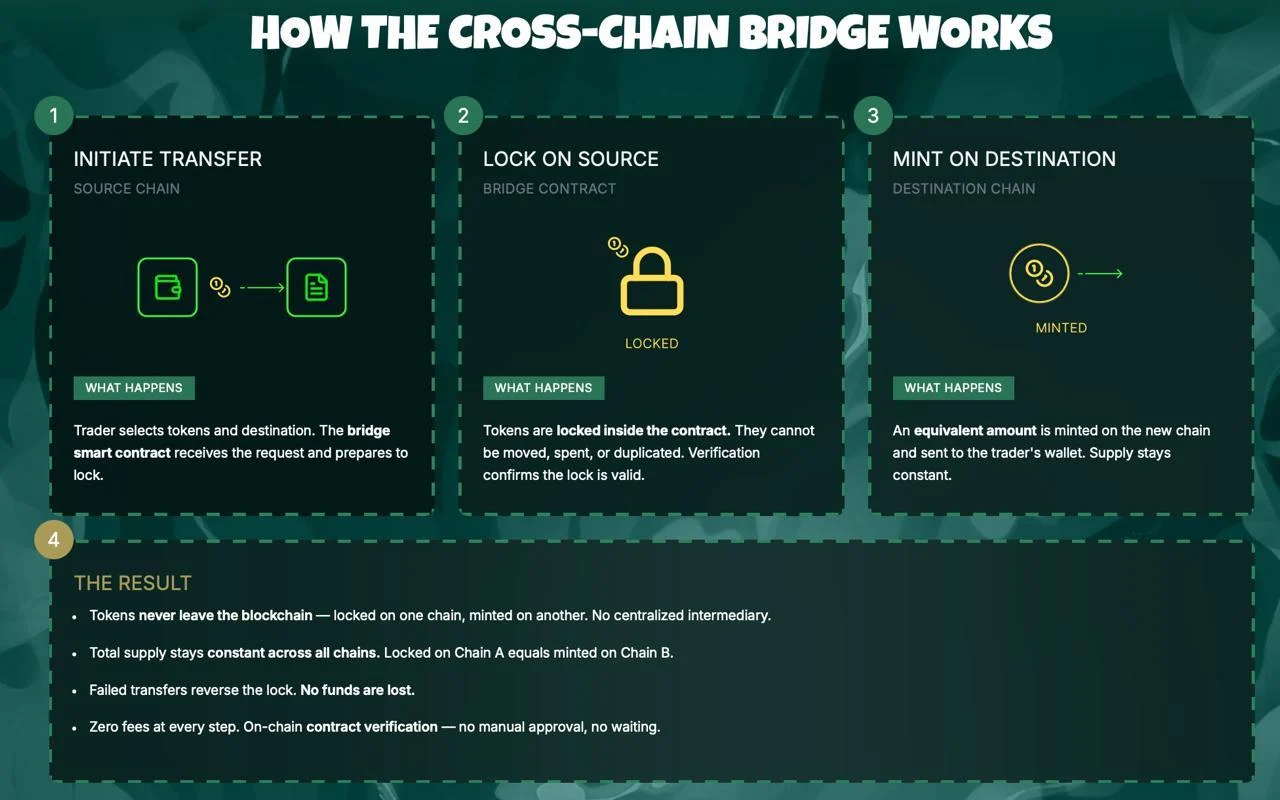
PepetoSwap settles every order without a fee so your capital stops getting chipped away. The risk tool reviews contracts before your money goes near them. The bridge sends tokens across chains at full value. The creator who turned Pepe into an $11 billion token with no utility is behind Pepeto, and a Binance veteran on the dev team steers the exchange toward its listing date.
SolidProof finished a full code review before the first dollar entered. Over $8,920,333 raised because the wallets entering verified everything first. Staking at 185% APY builds daily for holders inside. The institutional wave is here, and it raises every position, including the early-stage ones that got in before the crowd notices.
The presale sits at $0.000000186 with 420 trillion supply. Pepe hit $11 billion on the same supply and the same creator but had no exchange tools at all, and reaching that level from here is 100x. The Binance listing will blow open the price, and Pepeto holders will be the breakout stories of this cycle. The xrp price prediction targets $2 to $3 over months. Pepeto targets 100x on one listing day, and it is close.
XRP Price Prediction at $1.35 as Whales Stack 11M XRP Per Day and CLARITY Act Nears
XRP trades at $1.35 with commodity status confirmed, according to CoinMarketCap. Whale wallets are adding 11 million XRP daily while ETF inflows hit $120 million in one week. Resistance sits at $1.40 with $1.65 as the next target.
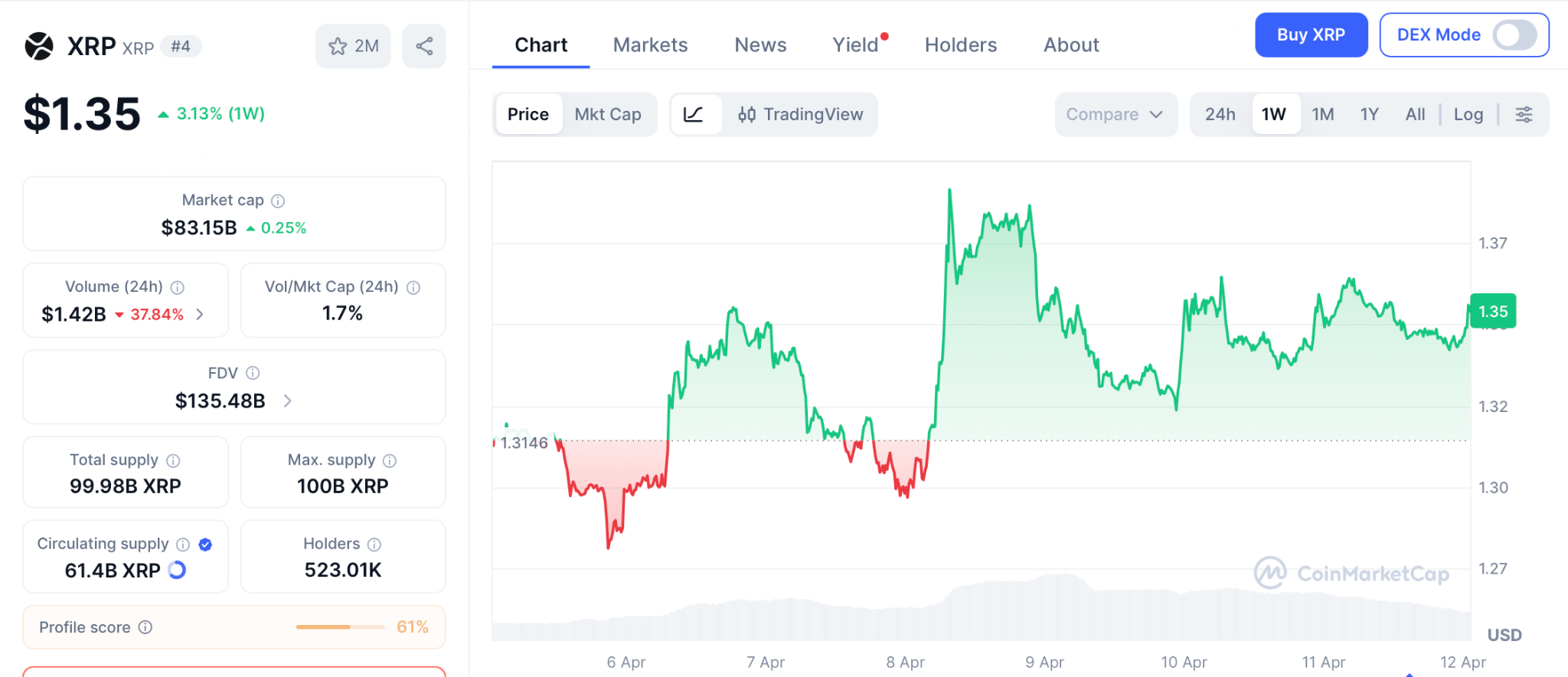
A break above $1.65 opens $2.00, a 48% move from here. Wall Street targets range from $2 to $3, with aggressive calls reaching $8 if banks scale settlement. If $1.28 breaks, $1.10 is the floor. Even the all-time high of $3.84 is only 2.8x from current levels.
The xrp price prediction is bullish, but 2.8x over months does not change a life the way one presale listing does.
Conclusion
The institutional wave that $120 million in weekly XRP ETF inflows represents is arriving in full force, and the early-stage presale entries positioned ahead of it are where the biggest returns sit. The xrp price prediction is bullish with commodity clarity, whale accumulation at a 10-month high, and the CLARITY Act markup weeks away.
But the wallets building real wealth this cycle are inside Pepeto at presale pricing. Visit Pepeto’s official site because the entry is still open, and the ones who act now will hold the positions this entire cycle talks about while everyone who waited watches from the outside wondering what their life would look like if they had moved.
Click To Visit Pepeto Website To Enter The Presale

FAQs
What is the xrp price prediction after leading $120M in weekly ETF inflows?
XRP targets $1.65 near term with $2 to $3 for 2026 as whale accumulation hits a 10-month high and the CLARITY Act markup approaches in late April.
How does the xrp price prediction compare to Pepeto’s listing return?
XRP at $1.35 targets 2.8x to the all-time high over months. Pepeto at presale pricing offers 100x from a single Binance listing that is approaching fast.
Disclaimer: This is a Press Release provided by a third party who is responsible for the content. Please conduct your own research before taking any action based on the content.
TLDR:
- Ethereum posted a -3.19% daily move, rejecting near $2,300 and closing lower within the range
- Price remains range-bound between $2,000 and $2,300 after exiting a prolonged downtrend phase
- Momentum indicators show weakening strength as MACD histogram shrinks and lines converge
- Key support at $2,110 faces pressure, while resistance near $2,300 continues limiting upside attempts
Ethereum began the second quarter with mild gains, yet recent price action shows hesitation near key resistance levels.
A daily chart shared by analyst Daan Crypto Trades points to weakening momentum, as ETH struggles to sustain upward movement within a defined consolidation range.
What Does Current Price Action Reveal About Ethereum’s Market Structure?
A tweet from Daan Crypto Trades outlines Ethereum’s current position on the ETH/USD 1D chart from Bitstamp. The latest candle opened at 2,285.1 and reached a high of 2,289.3.
The price later dropped to a low of 2,176.6 before closing at 2,212.8. This marks a decline of 72.8 points, representing a 3.19% loss on the day.
This daily candle reflects a strong rejection near the upper boundary of the range. The close near the lower half of the candle suggests that sellers regained control during the session. As a result, upward attempts faced resistance, limiting further gains in the short term.
Looking at the broader structure, Ethereum remains in a recovery phase after a prolonged decline. From November to February, the market formed consistent lower highs and lower lows. During that period, price dropped from above 4,000 to around 1,700.
Since March, the structure has shifted into sideways movement. Price has been trading between 2,000 and 2,300, forming a consolidation range.
This range reflects a balance between buyers and sellers after the earlier decline. While higher lows have formed since February, resistance continues to cap upward movement near 2,300 to 2,400.
How Do Indicators and Key Levels Shape Ethereum’s Next Move?
Volatility bands on the chart provide further context for current price action. The upper band sits near 2,295.8, while the middle band stands at 2,112.8.
The lower band is positioned around 1,941.7. Price recently tested the upper band but failed to break above it. This rejection pushed the price back toward the mid-band level.
The mid-band near 2,110 now acts as a short-term pivot zone. Holding above this level may support continued consolidation.
However, a break below could expose the lower range near 2,000. The lower band at 1,940 remains a deeper support level if selling pressure increases.
Momentum indicators also show a shift in strength. The MACD-style oscillator remains positive, with the histogram reading at +0.86%.
The fast line stands near 1.71%, while the signal line is around 0.86%. Although momentum turned positive recently, the histogram is shrinking, and the lines are converging.
This pattern often signals slowing upward momentum. As a result, buying pressure appears to be fading near resistance levels. This aligns with the recent rejection near 2,300, where sellers stepped in again.Source: TradingView
Resistance remains clearly defined between 2,295 and 2,320. A break above this zone would open the path toward 2,400 and beyond.
On the downside, immediate support lies between 2,110 and 2,120. Below that, the 2,000 to 2,050 range continues to act as a strong floor.
Current conditions suggest a market still searching for direction. Short-term movement leans toward the downside following the recent rejection. However, the broader structure remains range-bound, with no confirmed breakout yet.
If price drops below 2,110, a move toward 2,000 becomes more likely. On the other hand, reclaiming 2,300 could shift momentum back toward higher targets between 2,500 and 2,700.

EasyJet passengers ‘stranded in Milan’ after border control nightmare

Spanish premier Sanchez heads for fourth China visit, risks annoying Trump
Analyst Warns Bitcoin April Rally Could Precede May-June Crash


-

 Business7 days ago
Three Gulf funds agree to back Paramount’s $81 billion takeover of Warner, WSJ reports
-

 Politics2 days ago
US brings back mandatory military draft registration
-

 Fashion2 days ago
Weekend Open Thread: Veronica Beard
-

 Tech5 days ago
How Long Can You Drive With Expired Registration? What Florida Law Says
-

 Politics8 hours ago
World Cup exit makes Italy enter crisis mode
-
 Sports2 days ago
Man United discover Nico Schlotterbeck transfer fee as defender reaches Dortmund agreement
-

 Fashion7 days ago
Massimo Dutti Offers Inspiration for Your Summer Mood Board
-

 Crypto World3 days ago
Canary Capital Files SEC Registration for PEPE ETF
-

 Fashion5 days ago
Let’s Discuss: DEI in 2026
-

 Business2 days ago
Tesla Model Y Tops China Auto Sales in March 2026 With 39,827 Registrations, Beating Cheaper EVs and Gas Cars
-

 Crypto World4 days ago
Bitcoin recovers as US and Iran Agree a Ceasefire Deal
-

 Politics3 days ago
Malcolm In The Middle OG Turned Down ‘Buckets Of Money’ To Appear In Reboot
-

 Business2 days ago
OpenAI Halts Stargate UK Data Centre Project Over Energy Costs and Copyright Row
-

 Business1 day ago
Ireland Fuel Protests Enter Day 5 as Blockades Spark Shortages and Government Prepares Support Package
-

 Tech7 days ago
Italian court says Netflix must refund customers up to $576 over price hikes
-

 Tech7 days ago
Haier is betting big that your next TV purchase will be one of these
-

 Tech7 days ago
Gamer Restores the Original PlayStation Portal From Two Decades Ago
-

 Tech7 days ago
The Xiaomi 17 Ultra has some impressive add-ons that make snapping photos really fun
-

 Tech7 days ago
Samsung just gave up on its own Messages app
-

 Politics3 days ago
LBC Presenter Mocks Trump Over Iran War Failures
You must be logged in to post a comment Login