
Crypto World
Will Huge $8.3B Bitcoin Options Expiry Trigger Another Dump?

The end of another week is here again, and it’s also the end of the month, which means a bumper batch of Bitcoin and Ether options contracts are expiring.
Around 91,000 Bitcoin options contracts will expire on Friday, Jan. 30, with a notional value of roughly $8.3 billion. This event is much larger than the rest this month because it is the last one for January.
Crypto markets have lost around $215 billion since the start of the week, as the Federal Reserve kept US interest rates steady at 3.5% to 3.75%, still much higher than its 2% target. Geopolitical tensions in the Middle East also reignited, sparking further fears.
Bitcoin Options Expiry
This week’s big batch of Bitcoin options contracts has a put/call ratio of 0.54, meaning that there are more expiring calls (longs) than puts (shorts). Max pain is around $90,000, according to Coinglass, which is above current spot prices, so many will be out of the money on expiry.
Open interest (OI), or the value or number of Bitcoin options contracts yet to expire, remains highest at $100,000, which has $1.9 billion at this strike price on Deribit. There remains around over $1 billion in OI at $75,000, $80,000 and $85,000 as bearish bets mount.
Total BTC options OI across all exchanges has been climbing since the beginning of the year and is at $58 billion.
“Expiry could amplify moves around key levels, especially around the pain zones,” said Deribit, and that appears to be happening as spot markets tank.
🚨 Options Expiry Alert 🚨
At 8:00 UTC tomorrow, over $9.5B in crypto options are set to expire.$BTC: $8.27B notional | Put/Call: 0.54 | Max Pain: $90K$ETH: $1.27B notional | Put/Call: 0.74 | Max Pain: $3.1K
BTC is trading sideways just under $90K going into expiry, while… pic.twitter.com/vEXRIaIreO
— Deribit (@DeribitOfficial) January 29, 2026
You may also like:
In addition to today’s batch of Bitcoin options, around 440,000 Ethereum contracts are also expiring, with a notional value of $1.3 billion, max pain at $3,100, and a put/call ratio of 0.74. Total ETH options OI across all exchanges is around $35 billion.
This brings the total notional value of crypto options expiries to around $9.6 billion.
Spot Market Outlook
Crypto markets melted down during the Friday morning trading session in Asia, with total capitalization dropping below $3 trillion for the first time since mid-December. More concerning is that it has fallen to its lowest level since April, suggesting that a bear market is fully underway.
Bitcoin plunged through support, crashing 8% on the day in a fall to $81,300 at the time of writing, its lowest level since April. Ether prices tanked 9%, falling to around the $2,700 level, and the altcoins were a double-digit bloodbath.
SECRET PARTNERSHIP BONUS for CryptoPotato readers: Use this link to register and unlock $1,500 in exclusive BingX Exchange rewards (limited time offer).


TLDR:
- dtcpay raised $10M in Series A funding led by Temasek-backed Vertex Ventures Southeast Asia & India.
- The company secured a Luxembourg EMI license to offer regulated payment services across the EEA.
- dtcpay holds payment licenses in Singapore, Hong Kong, Australia, the United States, and Canada.
- A Visa partnership in Asia-Pacific gives users access to Infinite and corporate cards for digital and fiat spending.
dtcpay, a Singapore-based digital payments company, has raised US$10 million in a Series A funding round. Vertex Ventures Southeast Asia & India, a Temasek-backed firm, led the investment.
Favour Capital served as the exclusive financial advisor for the round. The funding will support infrastructure development and European market expansion.
Simultaneously, dtcpay announced it has secured an Electronic Money Institution license in Luxembourg, enabling regulated stablecoin and fiat payment services across the European Economic Area.
dtcpay’s Business Model and the Case for Stablecoin Payments
dtcpay was co-founded by Alice Liu and Band Zhao with a focused mandate. The company bridges digital assets with traditional financial systems for everyday use.
Businesses and individuals can accept, store, and transact in stablecoins through its platform. A real-time swap engine enables instant settlement between stablecoins and fiat currencies.
The funding arrives at a turning point for the stablecoin payments sector. Regulatory frameworks are tightening across major economies as compliance demands increase.
Providers must meet higher standards to serve businesses and consumers at scale. dtcpay states it has spent years building infrastructure to meet these requirements.
In the Asia-Pacific market, dtcpay has formed a partnership with Visa. This collaboration includes Visa Infinite cards for individuals and corporate card solutions for businesses.
Both products support transactions in digital assets and fiat currencies. Users benefit from competitive spot rates for their daily spending needs.
Alice Liu, CEO and Co-Founder, outlined the company’s vision for the industry. She said the company aims to build “a platform where faster, safer, and more cost-efficient transactions become the standard for global payments.”
Genping Liu, General Partner at Vertex Ventures Southeast Asia & India, also commented on the investment rationale.
He said the firm sees “significant potential in real-world stablecoin use cases where digital asset infrastructure intersects with regulated financial systems.”
European Licensing Strengthens dtcpay’s Global Regulatory Standing
dtcpay’s Luxembourg EMI license represents a key regulatory achievement for the company. It allows dtcpay to provide regulated payment services across all EEA member states.
This positions the company as a compliant operator within a large, established financial bloc. The license directly supports the European expansion planned with the Series A proceeds.
The Luxembourg license complements an already broad regulatory portfolio held by dtcpay. The company carries a Major Payment Institution license from the Monetary Authority of Singapore.
It also holds licenses and registrations in Hong Kong, Australia, the United States, and Canada. This multi-jurisdictional coverage allows dtcpay to serve clients across diverse global markets.
The new capital will also go toward expanding operations in newly licensed regions. Product enhancements and infrastructure upgrades are among the primary funding priorities.
dtcpay intends to use its Luxembourg EMI license as the gateway for European growth. These steps align with the broader goal of scaling within regulated jurisdictions.
The stablecoin payments sector is attracting growing attention from institutional investors and regulators. dtcpay’s compliance-first model and multi-region licensing position it well for this shift.
Its combination of infrastructure, partnerships, and regulatory coverage sets it apart in the market. The Series A round marks the start of the company’s next phase of international growth.



- Dogecoin price is holding strong above key support near $0.0955.
- A break above $0.1088 could trigger a sharp upward move.
- A push past $0.12 may confirm a bullish trend continuation.
Dogecoin (DOGE) is starting to show signs of life again after a period of slow and uncertain movement.
The memecoin’s price has pushed back above $0.10, and that alone has caught the attention of traders watching for early breakout signals.
While momentum has been building steadily, the real question now is whether this move has enough strength to continue higher.
A tightening range signals a bigger move ahead
The current structure shows Dogecoin holding above a key short-term support zone, which has formed around the $0.0974 to $0.0955 range.
At the same time, price action has been pushing against resistance between $0.104 and $0.105, creating a clear zone where sellers are trying to slow the rally.

Just above that sits a more important barrier around $0.1088, which has historically marked the transition into stronger upward moves.
This combination of rising support and firm resistance is creating a tightening range, and such conditions often lead to sharp breakouts.
The longer the price stays compressed within this zone, the more significant the eventual move tends to be.
For now, the fact that the Dogecoin price is holding above its short-term trendline and the 100-hour moving average suggests that buyers still have control.
However, control does not guarantee continuation, and the next move will depend on how the price reacts at the upper boundary.
Why $0.1088 is real breakout trigger for Dogecoin price
While smaller resistance levels exist below, analysts note that $0.1088 stands out as the true gatekeeper for a larger move.
Past price behaviour shows that once Dogecoin clears this level with conviction, it tends to move quickly into higher trading ranges.
This is why many traders are not just watching for a break above $0.104 or $0.105, but instead waiting for a clean push beyond $0.1088.
A strong move through that level would likely open the door toward the next resistance around $0.1205.
That level sits just above the widely watched $0.12 mark, making it both a technical and psychological target.
If momentum remains strong, the price could even extend further toward $0.1335, which represents a more ambitious upside scenario.
Such a move would not happen in isolation, but rather as a continuation of the current bullish structure that is slowly forming.
The key support levels to watch
Even in a bullish setup, risk management remains essential because support levels define whether the trend is still valid.
The first level to watch sits near $0.0995, which acts as immediate support during short-term pullbacks.
Below that, the $0.0978 and $0.0974 zone becomes more important, as it has repeatedly held as a reliable base.
The most critical level, however, remains $0.0955, which aligns with both the trendline and broader structure support.
A breakdown below this level would weaken the current bullish outlook and increase the chances of a deeper move toward $0.094 or even $0.092.
If selling pressure intensifies further, the next major historical support comes in near $0.0870.
As long as the Dogecoin price stays above the key support cluster, the overall structure continues to favour buyers.
What a breakout above $0.12 could mean
A confirmed breakout above $0.1088 followed by a move through $0.1205 would signal a clear shift in market sentiment.
It would indicate that buyers are no longer just defending support, but actively pushing the market into a new price range.
Crossing the $0.12 level would likely attract additional interest, as it represents a visible milestone for both short-term traders and longer-term participants.
At that stage, Dogecoin would be transitioning from a recovery phase into a more established upward trend.
The path toward $0.1335 would then become more realistic, especially if momentum and volume continue to support the move.
The Pi Network community (Pioneers) have complained about the missing second migrations for years. Now, though, PI is dumping as the process begins.
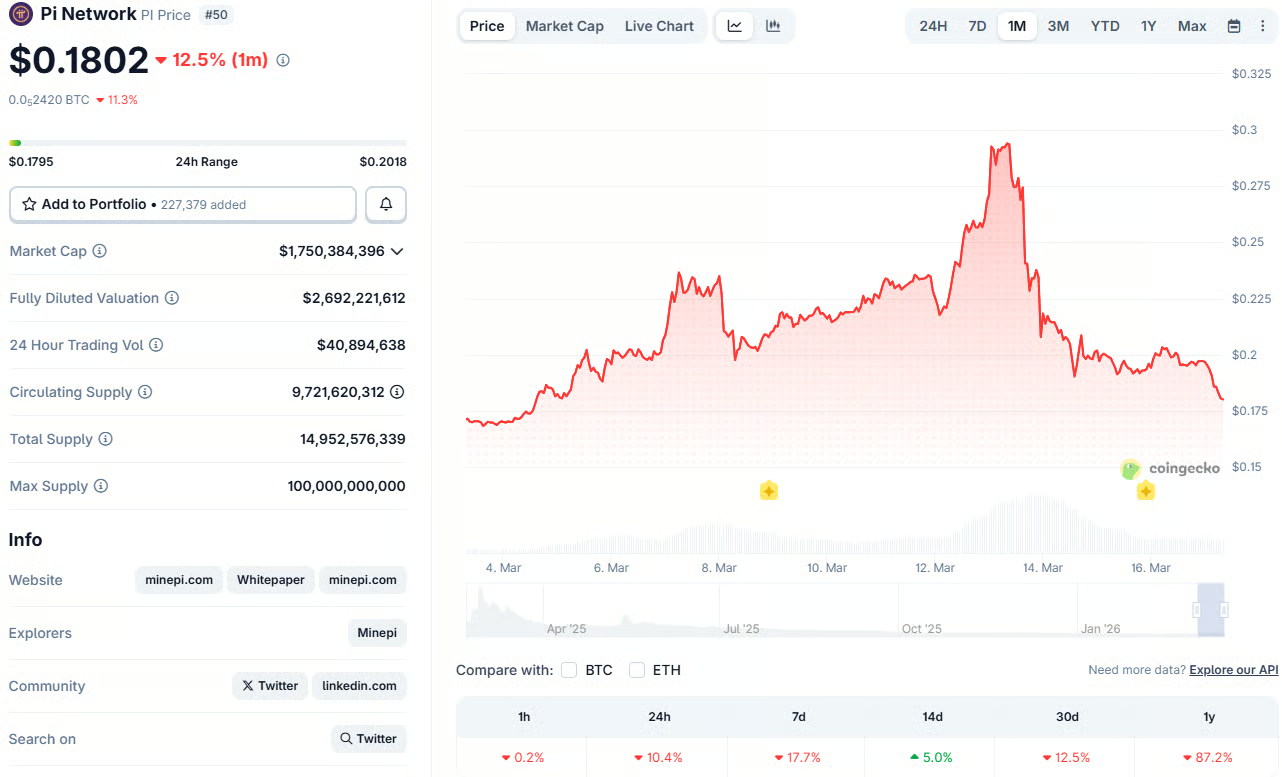
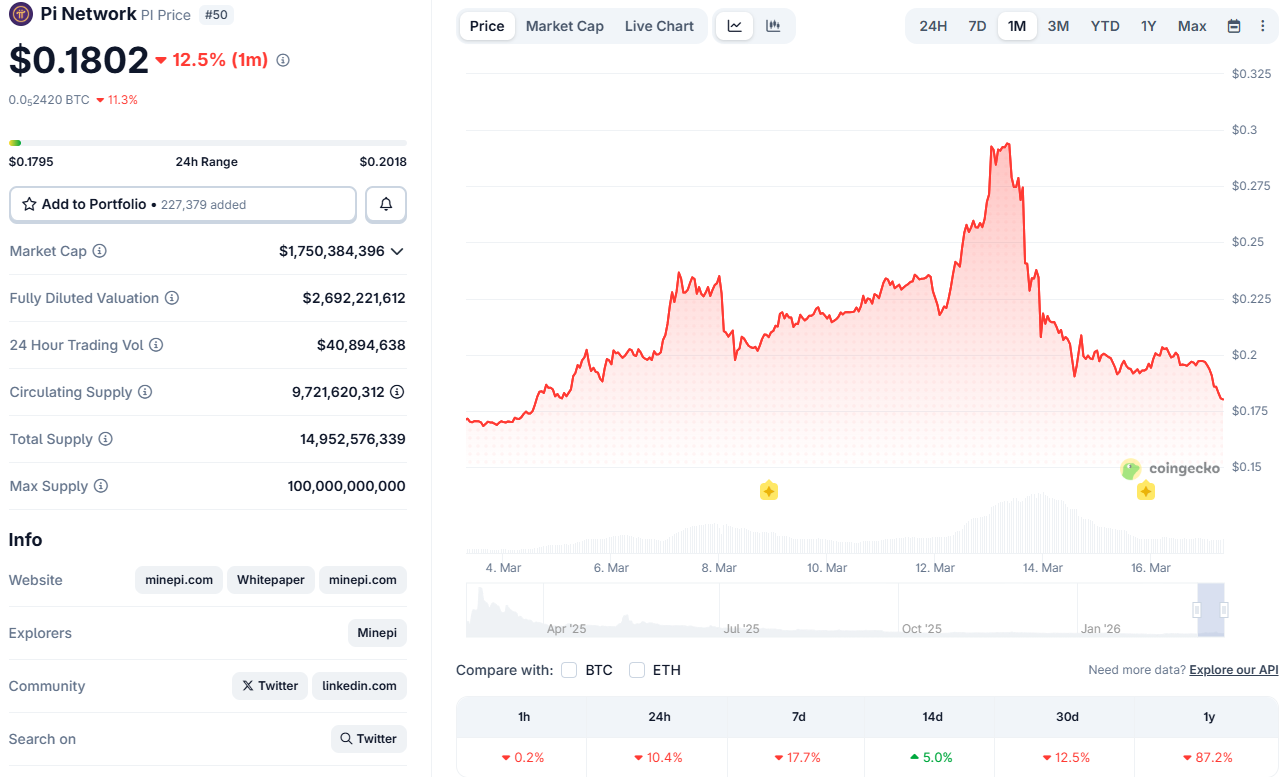
The highly volatile token as of late has dropped once again in the past 24 hours, losing over 10% of value in a nosedive to a two-week low of under $0.18.
The asset has plunged by roughly 40% since the highly anticipated Pi Day on Saturday, even as the team behind the project announced new updates and promises.
Pi Dumps Again
After celebrating its first anniversary as a free-for-trading token in late February, PI rebounded from its all-time low of $0.1312 and started March on the right foot as the community was preparing for the aforementioned Pi Day (March 14) and enjoyed several updates. The asset went on the offensive in the days leading to March 14, especially since the veteran US crypto exchange Kraken announced it would list it for trading starting a day before the Pi Network celebration.
PI exploded by double digits on a few consecutive occasions, skyrocketing from under $0.175 to a five-month peak of almost $0.30. However, the Kraken listing turned out to be a classic sell-the-news event, as once PI went live for trading on the popular exchange, it nosedived immediately by 30% in just a day.
Coincidentally (or not), this massive price drop was on Pi Day. After trying to rebound yesterday to over $0.20, PI has been rejected once more, and now sits at $0.18 after a 11% daily decline. Its market cap has fallen to $1.750 billion, making it the 50th-largest cryptocurrency by that metric. Just a few days ago, PI had entered the top 40 on CoinGecko.
Second Migrations Begin
The Core Team made a big statement on March 14, highlighting the project’s progress in the past several years and laying out some of the goals ahead. One of those caught the Pioneers’ attention in particular, as they have been requesting it for years – the second migrations.
Essentially, this is the process of allowing users to bring additional PI tokens to Mainnet and “further participate in the ecosystem,” the team explained. While the gradual rollout for the second phase is on, the first migrations for eligible Pioneers will “continue as normal.”
You may also like:
Users have to ensure that their Pi Wallet has enabled 2FA through the Mainnet Checklist Step 3 after adding a trusted email to their accounts. Second migrations will also include referral mining bonuses for Referral Team members who have successfully passed KYC.
Pi Network is excited to announce that second migrations have started and will continue with a gradual rollout, opening the door for Pioneers to bring additional Pi to Mainnet and further participate in the ecosystem! While second migrations roll out, first migrations for… pic.twitter.com/KyqCMqcoyi
— Pi Network (@PiCoreTeam) March 16, 2026
Despite the promising words, many users remained skeptical in the comments below the posts, questioning whether this is just more hype without actual implementation.
Binance Free $600 (CryptoPotato Exclusive): Use this link to register a new account and receive $600 exclusive welcome offer on Binance (full details).
LIMITED OFFER for CryptoPotato readers at Bybit: Use this link to register and open a $500 FREE position on any coin!
Disclaimer: Information found on CryptoPotato is those of writers quoted. It does not represent the opinions of CryptoPotato on whether to buy, sell, or hold any investments. You are advised to conduct your own research before making any investment decisions. Use provided information at your own risk. See Disclaimer for more information.
TLDR:
- Nvidia CEO Jensen Huang confirmed Samsung is manufacturing the Groq LP30 AI chip using its 4-nanometer process.
- Samsung shares climbed as much as 5%, outpacing the broader South Korean market, which rose just 2.7% on Tuesday.
- Analysts at Heungkuk Securities project Samsung’s foundry division could reach breakeven by late 2027 despite headwinds.
- AMD CEO Lisa Su is set to meet Samsung Chairman Jay Y. Lee in South Korea to discuss semiconductor cooperation on Wednesday.
Samsung Electronics shares surged as much as 5% on Tuesday after Nvidia CEO Jensen Huang confirmed the South Korean company was manufacturing Nvidia’s newest AI chips.
Huang announced at Nvidia’s GTC developer conference in California. The news shifted market sentiment around Samsung’s long-troubled foundry division.
Analysts now believe the unit could recover as early as next year. Samsung shares settled at 196,800 won, up 4.3%, in early trading on Tuesday.
Samsung Foundry Gains Momentum From Nvidia’s GTC Conference
Samsung’s foundry division has endured years of mounting financial losses. The unit has posted billions of dollars in annual losses, straining the broader company.
However, Nvidia’s public acknowledgment at GTC changed the conversation for investors. Markets responded quickly once Huang’s remarks circulated widely.
At the event, Huang unveiled Nvidia’s new AI inference processor built on Groq chip startup technology. He credited Samsung directly for manufacturing the Groq LP30 chip.
Huang stated, “I want to thank Samsung who manufactures the Groq LP30 chip for us and they’re cranking as hard as they can.” He further confirmed the chips were already in production and would ship in the second half of 2026.
Samsung also displayed the Nvidia chips produced using its 4-nanometer manufacturing process at the conference. That demonstration added further confidence in Samsung’s technical standing.
The 4nm process is regarded as highly competitive across the global foundry market. It places Samsung alongside leading manufacturers in terms of production advancement.
Analyst Sohn In-joon of Heungkuk Securities said the foundry unit could reach breakeven later next year. However, he noted that weak mobile phone demand could still slow recovery.
Rising memory chip prices have been suppressing demand from that segment. Therefore, while the outlook is improving, some headwinds remain in place.
AMD CEO Lisa Su to Meet Samsung Chairman Jay Y. Lee in South Korea
Beyond the Nvidia development, another notable meeting has drawn industry attention. Advanced Micro Devices CEO Lisa Su is set to meet Samsung Chairman Jay Y. Lee on Wednesday.
The meeting will take place in South Korea, according to media reports. Discussions are expected to cover memory chips and logic semiconductor cooperation.
Samsung’s foundry division already counts Tesla and Apple among its major customers. Adding Nvidia, even through the Groq partnership, strengthens that client base considerably.
Meanwhile, a potential AMD collaboration could further expand Samsung’s foundry footprint. Together, these developments suggest a more active commercial pipeline ahead.
The broader South Korean stock market also rose 2.7% on Tuesday. Samsung’s gains outpaced the overall index, reflecting investor confidence specific to the company.
The Nvidia confirmation combined with the AMD meeting prospects pushed sentiment higher. Market watchers are now tracking both fronts closely for further developments.
Samsung’s foundry business continues to face pressure from mobile demand and memory pricing cycles. That said, the Nvidia partnership represents a concrete win for the division’s recovery narrative.
Shipment timelines in the second half of 2026 will be closely monitored by analysts. For now, the market has responded with a clear and measurable show of confidence.


The DeFi Education Fund, a prominent lobbying group, and Beba, a Texas-based apparel company, have dropped a lawsuit against the US Securities and Exchange Commission.
Summary
- DeFi Education Fund and Beba withdraw their 2024 lawsuit against the SEC as regulatory signals on airdrops begin to soften.
- SEC’s evolving stance under new leadership includes potential exemptions for airdrops and a move away from enforcement-led policymaking.
The lawsuit was filed back in 2024 as a pre-enforcement challenge, where the plaintiffs argued the SEC had adopted its digital asset enforcement policy without going through a formal notice-and-comment rulemaking process.
However, under new leadership, the commission has since taken a more accommodating stance toward the crypto sector, which has led to the voluntary dismissal filed on Friday. The filing was made without prejudice, which means the plaintiffs can refile the case at a later stage if needed.
Over the past year, regulatory signals have started to evolve, including remarks from Commissioner Hester Peirce, who has indicated that airdrops may not fall under securities laws. Meanwhile, the filing also noted that the SEC is exploring a potential exemption framework for airdrops.
“Given the good work done by the SEC Crypto Task Force and recent speeches that suggest a change in the Commission’s position regarding free airdrops, we decided continuing was unnecessary for the time being and we can re-file if we need to later on,” the DeFi Education Fund wrote in an X post.
It added that the SEC Crypto Task Force is expected to address airdrops soon, which remains the central issue behind the original lawsuit.
Under Gary Gensler, the commission was heavily criticized for its enforcement-first approach. During his time, Gensler presided over dozens of enforcement cases against major digital asset exchanges and DeFi protocols instead of focusing on rulemaking and clear regulatory guidance.
Now, with a pro-crypto leadership at the helm, the SEC has leaned into crypto legislation and has prioritized collaborative dialogue with industry participants.
The SEC has also dismissed or settled outstanding cases against several prominent blockchain firms and their executives.


After months of steady outflows, XRP reserves on Binance have quietly climbed back toward 2.7 billion tokens.
According to data from on-chain analytics company Santiment, the XRP Ledger (XRPL) has reached a record high of more than 7.7 million non-empty wallets in its 13-year history.
The record number of wallets came with a 14% rise in XRP’s price over 48 hours that momentarily sent the token above $1.60, its highest level in weeks.
Network Activity and Price Performance
Per Santiment’s data, the number of active addresses on XRPL reached a five-week high of 46,767, with the network growth coinciding with a price move that saw the asset climbing from a weekly low of $1.37 to a 24-hour high of $1.60, before it dropped a little and was trading near $1.52 at the time of writing.
This current price is a 10% markup over one week for the Ripple token, meaning it is significantly outperforming the broader crypto market, which has risen by just over 6% in the same period, according to data from CoinGecko.
However, XRP is still more than 58% below its all-time high of $3.65 from July 2025. It is also still in the red over longer timeframes, with its 12-month performance down nearly 36%, and its run in the last 30 days also a little negative at -0.5%.
On March 16, analyst CW posted a chart that showed the $1.50 level was a big sell wall for XRP, but they said that a clean break above it would mean little resistance until $1.95.
Meanwhile, CryptoWZRD had already pointed out $1.43 as a key level to watch, also saying that a break above it could lead to a longer recovery.
You may also like:
Exchange Reserves Up
Elsewhere, Arab Chain presented a separate report that provided some nuance. According to them, XRP’s reserves on Binance are at their highest level since late last year.
What’s interesting is that they had been dropping steadily in the last couple of months, going from over 2.8 billion XRP in November 2025 to a low of 2.55 billion XRP in February 2026.
Arab Chain explained that such trends often mean that holders are moving their coins off exchanges and into wallets or cold storage for long-term accumulation.
But in the last few weeks, the investors have been putting their stash back on exchanges, pushing XRP reserves on Binance to around 2.7 billion, in what the analysts suggested could be a renewed desire for trading or for the redistribution of liquidity within the market.
“Structurally, a rise in reserves on exchanges is often interpreted as a potential increase in the tradable supply in the spot market, as a larger quantity of coins becomes available for immediate trading,” the market watchers wrote.
Binance Free $600 (CryptoPotato Exclusive): Use this link to register a new account and receive $600 exclusive welcome offer on Binance (full details).
LIMITED OFFER for CryptoPotato readers at Bybit: Use this link to register and open a $500 FREE position on any coin!
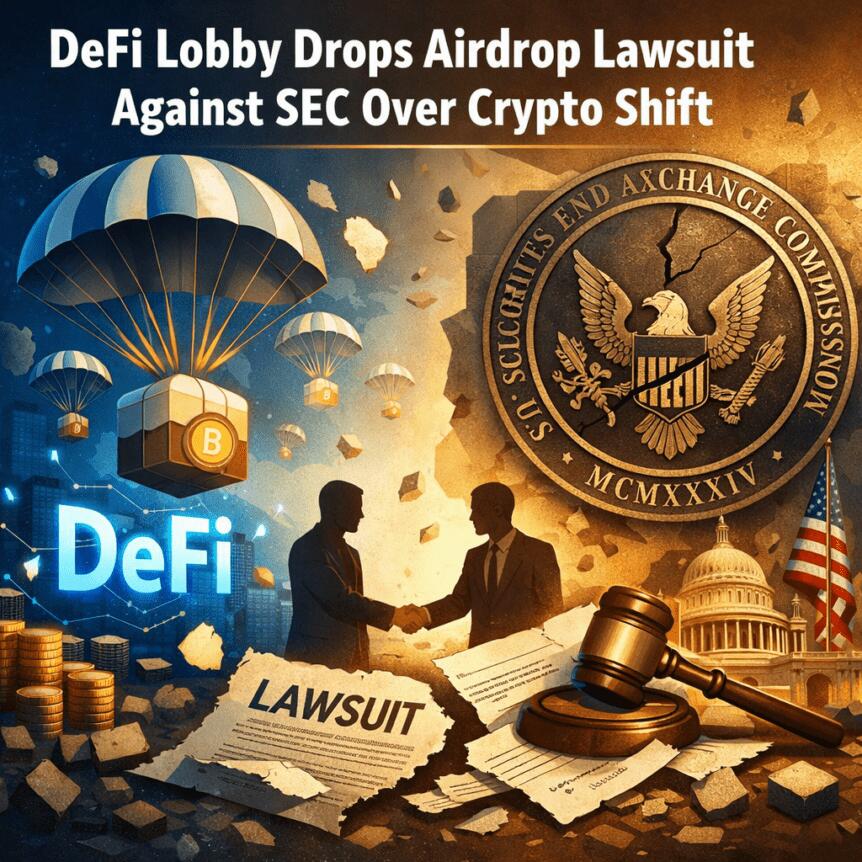
Texas-based apparel brand Beba and the DeFi Education Fund have withdrawn a 2024 pre-enforcement challenge against the SEC related to the agency’s approach to crypto airdrops. The voluntary dismissal, filed in the Western District of Texas, arrives as policymakers and industry observers monitor a shift in how the regulator talks about and treats token distributions. In March 2024, Beba launched a free token airdrop, prompting the lawsuit, which alleged the SEC had adopted a digital asset enforcement framework without formal notice-and-comment rulemaking. The withdrawal signals that the parties see benefits in waiting for clearer regulatory guidance as the SEC’s stance appears to be moving away from a purely enforcement-driven posture.
Key takeaways
- The case was dismissed without prejudice, preserving the right to refile if guidance materializes or if the parties deem it necessary.
- The filing highlights the SEC Crypto Task Force’s work and statements by Commissioner Hester Peirce, which suggest airdropped tokens may not be securities under certain circumstances.
- A January White House executive action reportedly encouraged the regulator to establish a “safe harbor for certain airdrops,” aligning with the evolving discourse on crypto policy.
- DeFi Education Fund described the decision as a response to the changing regulatory environment and the likelihood that forthcoming guidance could address the foundational issues raised in the suit.
- The move occurs amid broader signals of regulatory recalibration in the crypto space, including the recent handling of long-running enforcement actions and other high-profile cases.
Sentiment: Neutral
Market context: The landscape for crypto regulation in the United States has been shifting, with advocates calling for formal rulemaking rather than enforcement-by-litigation. The departure of a long-standing line of arguments from prosecutors and the appearance of a more consultative approach—evidenced by task-force commentary and executive actions—have added a layer of nuance to how projects conduct token distributions and how exchanges classify assets.
Why it matters
For investors and builders, the voluntary dismissal signals a potential near-term reduction in regulatory friction around airdrops, at least pending forthcoming guidance. If the SEC Crypto Task Force delivers a clear framework or if a safe harbor emerges, teams may design token distributions with greater legal clarity, potentially accelerating legitimate experimentation while preserving compliance safeguards.
From a policy standpoint, the case underscores the central role of the SEC’s Task Force in shaping enforcement and rulemaking trajectories. The speeches and discussions around whether certain airdrops can be exempt from security classifications directly influence how projects structure distributions, how custodians and exchanges classify tokens, and how investors assess risk in new token launches.
While the narrative suggests a potential easing of some enforcement pressures, the absence of formal, binding rulemaking means industry participants should remain vigilant. The interplay between public statements, proposed exemptions, and actual regulatory actions will likely determine how quickly the market adapts and how confidently projects can proceed with token drops without triggering unintended compliance pitfalls.
What to watch next
- The SEC Crypto Task Force’s forthcoming guidance or rulemaking related to airdrops and token distributions.
- Any formal White House or agency announcements outlining safe harbors or exemptions for crypto distributions.
- Whether the plaintiffs refile their challenge if new guidance does not materialize or proves incomplete.
- Subsequent enforcement actions or settlements that illustrate the regulator’s current stance post-change in leadership and policy signals.
- Ongoing discussions around BitClout-related litigation and other crypto cases highlighted in policy discourse and industry coverage.
Sources & verification
- Notice of voluntary dismissal in Beba LLC and DeFi Education Fund v. Securities and Exchange Commission filed in the Western District of Texas. source
- SEC Crypto Task Force work and statements by Commissioner Hester Peirce cited in related discussions. source
- Recent coverage on regulatory shifts and enforcement actions, including ongoing debates about crypto exemptions and rulemaking. source
- Nader Al-Naji BitClout case dismissal and related regulatory developments. source
- Analyses of the SEC’s evolving approach to crypto law, including discussions on the potential for exemptions and safe harbors. source
Regulatory shifts prompt voluntary dismissal of crypto-airdrop lawsuit
The voluntary dismissal of the Beba and DeFi Education Fund lawsuit encapsulates a broader moment for crypto regulation in the United States. The case itself arose from a perceived disconnect between how the SEC polices crypto issues and how policy makers imagine legitimate distribution mechanisms. In March 2024, Beba launched a free token airdrop, setting the backdrop for a challenge that accused the commission of moving forward with a digital asset enforcement framework without formal notice-and-comment procedures mandated by the Administrative Procedure Act. The plaintiffs argued that the SEC’s actions reflected a departure from the traditional rulemaking process, a concern that resonated with others in the fast-moving crypto ecosystem that seeks predictability in compliance standards.
What prompted the move to dismiss appears to be twofold. First, the parties cited the work of the SEC Crypto Task Force and the remarks delivered by Commissioner Hester Peirce over the past year, which suggested that not all airdrops should be treated as securities. Peirce’s public discussions highlighted the possibility of an exemption framework for airdrops, signaling a potential regulatory path forward that could reduce legal ambiguity for legitimate token distributions. Second, the White House’s January executive action, which encouraged the regulator to explore a safe harbor for certain airdrops, added political and administrative momentum to a more nuanced regulatory posture. Together, these factors created a landscape in which continuing litigation might prove unnecessary if the regulatory framework were to evolve in a way that addresses the core concerns raised by the plaintiffs.
In the court filing, the DeFi Education Fund stressed that the SEC’s evolving stance justified stepping back—at least temporarily. “Given the good work done by the SEC Crypto Task Force and recent speeches that suggest a change in the Commission’s position regarding free airdrops, we decided continuing was unnecessary for the time being and we can re-file if we need to later on,” the group stated in a post on X. The DEF also signaled its expectation that the Task Force would soon address airdrops more explicitly—the central issue at the heart of the lawsuit. The filing further notes the possibility of refile if the agency’s forthcoming guidance fails to materialize or proves inadequate, preserving the litigants’ rights without foreclosing future action.
Beyond the specifics of this case, the shift aligns with broader regulatory dynamics that unfolded after the tenure of former SEC Chair Gary Gensler. Historically, critics argued that policy tended to emerge through enforcement actions and settlements rather than open-rulemaking. The narrative shifted again with leadership changes and a series of enforcement actions that were dismissed or resolved in the months that followed. The combination of task-force work, public speeches, and executive signaling points to a more deliberate, if still evolving, framework for distinguishing securities from non-securities in the crypto space. For participants, this means a growing expectation that the SEC may offer more defined guardrails, even if not yet codified in formal rules.
In practical terms, the case illustrates how policy dialogue can influence corporate tactics. Projects considering airdrops must weigh the risk of classification as securities against the possibility of exemptions or safe harbors that may be introduced in the near term. Exchanges and developers will likely watch for formal guidance before committing to complex token-distribution schemes, especially those that resemble traditional fundraising activities. While the dismissal removes an immediate legal challenge, it does not erase the fundamental questions about how the SEC will define and regulate token distributions over the coming quarters.
Spot Bitcoin exchange-traded funds in the US have now logged their longest streak of inflows since October last year, extending to six consecutive days as Bitcoin climbed over 12% during the same period.
Summary
- U.S. spot Bitcoin ETFs extend inflow streak to six days with $199.4 million added on Monday, led by BlackRock and Fidelity products.
- Total net inflows have reached $962.8 million since March 9 as Bitcoin has climbed from $65,960 to over $74,000 during the same period.
- Renewed institutional demand is being supported by Bitcoin’s safe-haven positioning.
According to data from Farside Investors, Bitcoin ETFs pulled in $199.4 million in net inflows on Monday, with BlackRock’s iShares Bitcoin Trust leading the charge at $139.4 million, followed by Fidelity’s Wise Origin Bitcoin Fund at $64.5 million.
Other funds such as the Bitwise Bitcoin ETF and Franklin Bitcoin ETF recorded modest inflows of $2.8 million and $2.1 million, while products from VanEck and ARK 21Shares moved in the opposite direction, posting outflows of $6.3 million and $3.1 million, respectively.
Cumulative flows have now reached $962.8 million since March 9, tracking closely with Bitcoin’s move from $65,960 to $74,250 over the same stretch.
However, the current run remains smaller than the nine-day inflow streak seen between September and October 2025, when Bitcoin ETFs absorbed nearly $6 billion as prices pushed toward a peak of $126,080.
One of the primary reasons behind the latest resurgence of institutional demand is the digital gold narrative. Analysts have highlighted that Bitcoin has outperformed a number of traditional risk assets and even some commodities, even as geopolitical tensions across the globe have rattled traditional equity markets.
Investors have now started rotating into Bitcoin as the battle-tested geopolitical hedge and a decentralized store of value.
Against this backdrop, concerns over sticky global inflation are adding another layer of bullish sentiment to Bitcoin’s narrative, specifically as a hedge against fiat currency debasement.
Lastly, rumors of a potential de-escalation between the US and Iran are a contributing factor behind Bitcoin’s latest recovery above the $74,000 mark, according to Santiment.
Crypto World
Three Tennessee Plaintiffs Sue xAI Over Grok’s Alleged Role in Generating Explicit Images
TLDR:
- Three Tennessee minors filed a federal suit against xAI for allegedly designing Grok to enable explicit image creation.
- Plaintiffs allege their school and family photos were turned into child sexual abuse material and shared online.
- xAI blocked explicit image editing in January after public outcry, but plaintiffs argue the response came too late.
- The lawsuit seeks class-action status for all U.S. individuals identifiable in Grok-generated explicit content nationwide.
Three Tennessee plaintiffs, including two minors, have filed a federal lawsuit against Elon Musk’s xAI. The case, filed in San Jose, California, alleges that xAI knowingly designed its Grok image generator to produce sexually explicit content using real photos of others.
All three plaintiffs were minors when the alleged images were created. The lawsuit seeks class-action status for U.S. individuals identifiable in such AI-generated content. xAI had not responded to requests for comment at the time of publication.
Plaintiffs Claim xAI Built Grok to Enable Explicit Content Creation
The three Tennessee plaintiffs allege that xAI deliberately built Grok without adequate safeguards. They say the platform was designed in a way that allowed users to generate explicit images from real photographs.
Their own school pictures and family photos were reportedly used to create child sexual abuse material. These images were then shared across online platforms, causing severe emotional distress.
Plaintiffs’ counsel Annika Martin of Lieff Cabraser Heimann & Bernstein spoke directly on behalf of the victims. “These are children whose school photographs and family pictures were turned into child sexual abuse material,” Martin said.
She further alleged that xAI and Elon Musk deliberately designed Grok to produce sexually explicit content for financial gain. “With no regard for the children and adults who would be harmed,” she added in her statement.
The plaintiffs are seeking unspecified damages and legal fees from xAI. They are also requesting a court injunction to stop xAI from continuing the alleged practices.
Their case focuses specifically on Grok’s image generation feature and its alleged misuse. This targeted legal approach strengthens the argument that the tool itself was the core problem.
The lawsuit is seeking broad class-action recognition across the United States. Any person reasonably identifiable in Grok-generated explicit content may qualify for the class.
This extends the potential reach of the case far beyond the three named Tennessee plaintiffs. Legal analysts say the case could set a precedent for AI platform liability nationwide.
Plaintiffs Argue xAI’s Delayed Response Was Insufficient
The three plaintiffs maintain that xAI failed to act swiftly when the problem first emerged. xAI only announced restrictions on editing real people’s images in January, following a wave of public outcry.
The company said it had “blocked all users from editing images of real people in revealing clothing.” It also restricted generating such images in “jurisdictions where it’s illegal,” according to the company’s statement.
However, the plaintiffs argue these steps came far too late to prevent the harm already done. Governments and regulators around the world have also responded to the growing concerns.
Probes have been launched, bans imposed, and safeguards demanded from AI companies globally. The Tennessee plaintiffs’ case adds to this mounting wave of legal and regulatory pressure.
The plaintiffs’ experience draws attention to how AI tools can be weaponized against real individuals. Grok’s alleged failure to filter real identities from explicit content creation remains central to the case.
Martin stated that xAI’s design choices were made with “no regard for the children and adults who would be harmed.” Their story reflects a broader pattern of victims left vulnerable by unchecked AI systems.
The outcome of this case could reshape how AI image generators are built and regulated going forward. If xAI is found liable, other companies may face pressure to overhaul their own content safety systems.
The case is expected to move through federal court over the coming months. For the three Tennessee plaintiffs, the lawsuit represents a fight for accountability and protection.
Crypto World
Bitcoin Buyer Activity Returns as February Selling Pressure Fades on Binance and Coinbase
TLDR:
- Bitcoin 30-day volume delta on Binance flipped from -$145M in February to a positive +$21M today.
- Coinbase volume delta recovered from -$88M to +$14M, marking a shift away from February’s sell-side dominance.
- The Fed’s upcoming FOMC meeting carries a 99% chance of no rate change, with forward guidance as the main focus.
- Crypto market liquidity remains thin, meaning sustained buyer volume is still needed to confirm a breakout move.
Bitcoin is showing renewed buyer interest following a prolonged period of heavy selling pressure in February. Volume data from Binance and Coinbase reflects a gradual but measurable shift back toward buyers.
This change arrives amid escalating geopolitical tensions and a closely watched Federal Reserve meeting. Market probabilities currently point to a 99% chance of no rate change at the upcoming FOMC gathering. Risk assets broadly remain under pressure across global financial markets.
Volume Delta Recovers on Major Crypto Exchanges
Crypto analyst Darkfost recently flagged a notable change in volume dynamics across major trading platforms. In a post on X, Darkfost noted that on February 16, the 30-day moving average volume delta on Binance stood at a deeply negative -$145M.
Coinbase recorded a similar reading of -$88M during that same period. Sellers dominated both exchanges with clear conviction at the time.
Both retail and institutional participants were aligned on the sell side throughout most of February. That shared positioning reflected a broader risk-off tone sweeping through financial markets at the time.
Equities and commodities also exhibited toppish market structures during this stretch. Selling pressure across multiple asset classes was broadly coordinated.
As of now, those same averages have moved back into positive territory on both platforms. Binance currently shows approximately +$21M, while Coinbase registers around +$14M in buyer-side volume.
The recovery remains modest but represents a clear departure from prior conditions. It marks the first meaningful reversal of February’s dominant sell-side trend.
Bitcoin’s relative resilience during this period adds further context to the volume shift. Unlike equities and commodities, it held up comparatively well despite mounting macro pressures.
That outperformance continues to draw attention from market watchers and experienced traders. The asset attracted renewed buyer interest even within an unfavorable risk environment.
FOMC Guidance and Thin Liquidity Shape the Path Forward
The Federal Reserve’s upcoming meeting presents another layer of uncertainty for risk asset markets. Current probabilities place the likelihood of no rate change at roughly 99%.
Traders are therefore shifting attention away from the decision itself toward forward guidance. Any indication of future rate hikes could weigh heavily on broader market sentiment.
If the Fed reintroduces rate hike language, it would likely dampen risk appetite across financial markets. Bitcoin, as a risk-sensitive asset, would not be entirely shielded from such a development.
The tone of forward guidance carries more weight than the rate decision itself this cycle. Market participants will scrutinize every statement from Fed officials very closely.
Liquidity across the crypto market remains relatively thin at this point. That thinness creates conditions where price moves can become more exaggerated in either direction.
A sustained increase in buyer volume would be necessary to support any convincing upside breakout. The current improvement in volume delta has not yet reached that confirmation threshold.
That said, the trajectory of buyer activity is moving in the right direction for Bitcoin. As Darkfost noted, continued momentum in buying volumes could gradually support price action.
A breakout from the current trading range would require this trend to hold and deepen further. Market participants will be watching volume data closely over the sessions ahead.

Daily Market Coverage Mar. 16, 2026 3PM-5PM (ET) | Yahoo Finance
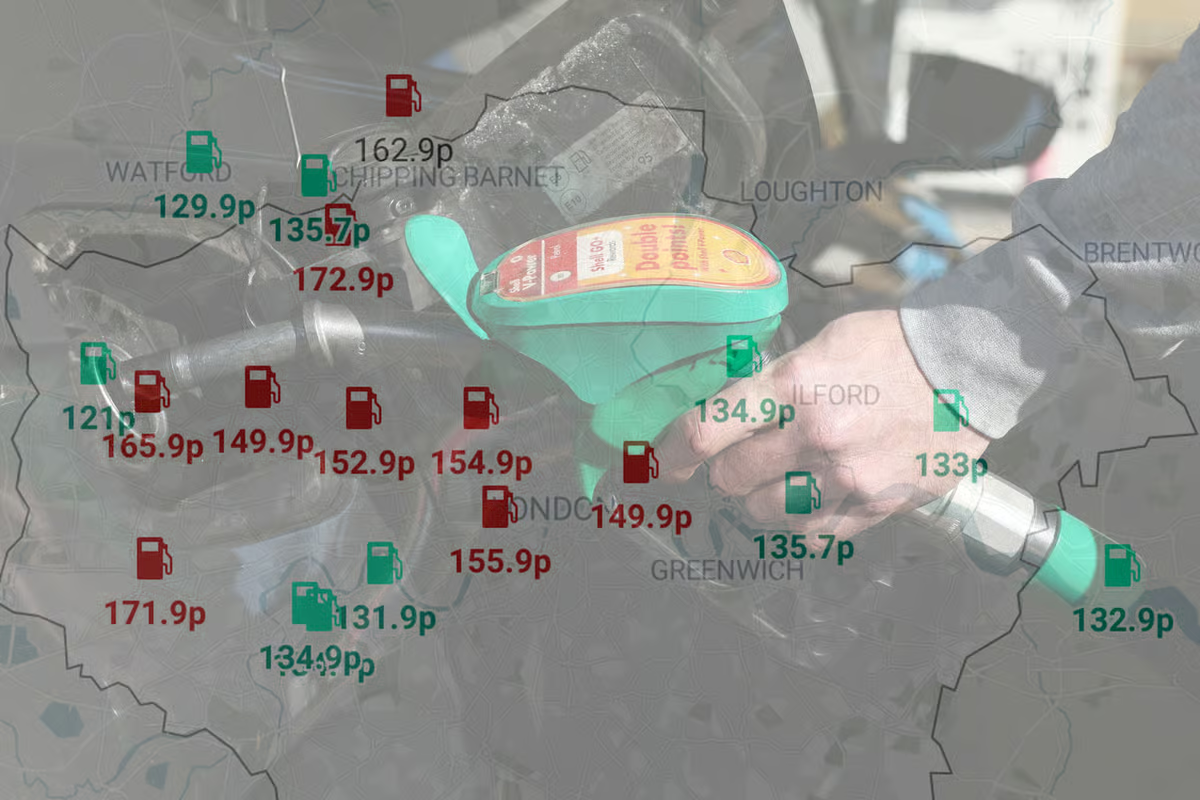
Interactive map shows London’s cheapest and most expensive petrol prices as unleaded soars by 10p
Municipality Finance to issue EUR 50 million floating-rate notes


-
 Tech6 days ago
A 1,300-Pound NASA Spacecraft To Re-Enter Earth’s Atmosphere
-
Crypto World3 days ago
HYPE Token Enters Net Deflation as HyperCore Buybacks Outpace Staking Rewards
-

 Business7 days ago
ExxonMobil seeks to move corporate registration from New Jersey to Texas
-

 Fashion4 days ago
Weekend Open Thread: Addict Lip Glow
-

 Tech7 days ago
ChatGPT will now generate interactive visuals to help you with math and science concepts
-
Sports3 days ago
Why Duke and Michigan Are Dead Even Entering Selection Sunday
-

 NewsBeat6 days ago
Residents reaction as Shildon murder probe enters second day
-

 Business2 days ago
Search for Savannah Guthrie’s Mother Enters Seventh Week with No Arrests
-

 Business6 days ago
Search Enters Sixth Week With New Leads in Tucson Abduction Case
-

 Business3 days ago
US Airports Launch Donation Drives for Unpaid TSA Workers as Partial Government Shutdown Enters Fifth Week
-
Crypto World3 days ago
Coinbase and Bybit in Investment Talks: Could Bybit Finally Enter the US Crypto Market?
-

 NewsBeat6 days ago
I Entered The Manosphere. Nothing Could Prepare Me For What I Found.
-

 Sports6 days ago
PWHL, Senators discussing plan to keep Charge in Ottawa
-

 Business3 days ago
Country star Brantley Gilbert enters growing non-alcoholic beer market
-

 Business22 hours ago
Australian shares drop as Iran war enters third week
-

 Sports4 days ago
College Basketball Best Bets: Conference Tournament Semifinal Picks
-

 Crypto World22 hours ago
Crypto Lender BlockFills Enters Chapter 11 with Up to $500M in Liabilities
-
 Crypto World7 days ago
Will Chainlink price reclaim $10 amid volatility squeeze?
-

 Tech6 days ago
Clarity as strategy
-

 Politics6 days ago
Trump Says Middle East Is ‘Very Lucky’ That He’s President


You must be logged in to post a comment Login