
Crypto World
World Liberty Financial to launch institutional RWA product



World Liberty Financial has unveiled plans to roll out an institutional-grade real-world asset product, starting with a tokenized investment linked to Trump International Hotel & Resort, Maldives.
Summary
- WLFI is partnering with Securitize and DarGlobal to tokenize loan revenue from a major Maldives resort.
- The offering targets accredited investors and will operate under strict regulatory and transfer rules.
- The project reflects WLFI’s ongoing strategy to link DeFi, traditional assets, and institutional finance.
The goal of the project, which is being developed in partnership with Securitize and DarGlobal PLC, is to tokenize loan revenue interests tied to the upscale resort.
According to WLFI’s Feb. 18 statement, the offering is designed for accredited and eligible investors, providing access to fixed yield and revenue streams within a regulated framework.
How the tokenized product is structured
The initial offering will provide investors with fixed returns and access to loan-related income generated by the resort. Revenue from interest payments will be distributed through the token structure, allowing holders to gain exposure to the asset’s performance without direct property ownership.
The company noted that the product will operate within a regulated securities framework under Regulation D and Regulation S. Tokens will not be registered for public sale in the United States and may only be offered through approved exemptions.
Eric Trump, co-founder of WLFI, said the initiative aims to bring tokenized real estate to decentralized finance in a compliant way. He described the Maldives project as a flagship example of how high-end property can move on-chain.
“We built World Liberty Financial to open up decentralized finance to the world. With today’s announcement, we are now extending that access to tokenized real estate.”
— Eric Trump, co-founder of World Liberty Financial.
Securitize chief executive officer Carlos Domingo said scalable and compliant real estate tokens could see strong global demand, while DarGlobal CEO Ziad El Chaar called the partnership a step toward improving liquidity in private real estate markets.
The announcement clarified that The Trump Organization is not directly involved in issuing or promoting the tokens, and that branding is used under a licensing agreement.
World Liberty Financial (WLFI) also noted that the tokens may later be supported on multiple public blockchains and could be used as collateral through its WLFI Markets platform, where permitted by law.
Broader expansion strategy
The real estate launch follows a series of recent efforts by WLFI to position itself in institutional digital finance. On the same day as the announcement, the company hosted the World Liberty Forum at Mar-a-Lago, bringing together executives from firms including Goldman Sachs, Nasdaq, and Franklin Templeton.
The private event focused on digital assets, stablecoins, artificial intelligence, and monetary policy, according to people familiar with the gathering.
WLFI also announced a separate partnership with Apex Group to pilot its USD1 stablecoin for settlements in tokenized fund operations. The agreement will help integrate blockchain-based payments into traditional fund administration.



Crypto has spent years obsessing over speed, fees and scalability. Now it may have to confront a more existential question: what happens when its core security breaks?
That question is moving from theory to urgency. Quantum computers, machines that use the principles of quantum physics to process information in fundamentally different ways than today’s computers, could eventually solve the kinds of mathematical problems that underpin modern encryption.
Discussions around post-quantum cryptography have intensified across the industry in recent weeks, especially after new research from Google and academic collaborators suggested that such systems could one day break widely used encryption, potentially cracking systems like Bitcoin’s in minutes rather than years.
While Bitcoin developers scramble to find a solution and Ethereum prepares for the event, Solana is trying to get ahead of that scenario.
Cryptography firm Project Eleven has teamed up with the Solana Foundation to experiment with post-quantum security, technology designed to withstand quantum attacks that could render today’s cryptography obsolete. The early work is already surfacing a difficult reality: making Solana quantum-safe may come at the expense of the performance that defines it.
In practice, that effort has meant moving beyond theory and into live testing. Project Eleven has worked with the Solana ecosystem to model how the network would behave if its current cryptography were replaced, including deploying a test environment using quantum-resistant signatures — the digital keys that authorize transactions. The goal is not just to prove the technology works, but to understand what breaks when it’s pushed to scale.
The early results show a clear tradeoff.
The new, quantum-safe “signatures” that approve transactions are much larger and heavier than those used today, roughly 20 to 40 times larger, Project Eleven CEO Alex Pruden, who founded the project, after years in crypto and venture capital, brings a mix of military and industry experience to the problem, told CoinDesk. That means the network can handle far fewer transactions at once. In testing, a version of Solana using this new cryptography ran about 90% slower than it does today, Pruden said.
That tradeoff cuts directly at the heart of Solana’s design. The blockchain has built its reputation on high throughput and low latency, positioning itself as one of the fastest networks in crypto. But post-quantum cryptography — while more secure against future threats — comes with heavier data and computational requirements, making it harder to maintain those speeds.
‘Pick any wallet’
Solana may also face a more immediate structural challenge than its peers.
Unlike Bitcoin and Ethereum, where wallet addresses are typically derived from hashed public keys, Solana exposes public keys directly. That difference matters in a quantum scenario. “In Solana, 100% of the network is vulnerable,” Pruden said.
“A quantum computer could pick any wallet and immediately start trying to recover the private key.”
Pruden, a former Army Green Beret, first became interested in Bitcoin while deployed in the Middle East, later worked at Coinbase and joined Andreessen Horowitz’s venture team on its first fund. He then became an early leader at privacy-focused blockchain Aleo before launching Project Eleven, a firm focused on preparing digital assets for what he calls “Q-day,” the moment quantum computers can break today’s cryptography.
Some developers in the Solana ecosystem, meanwhile, are looking at simpler, more immediate fixes. One example is something called ‘Winternitz Vaults’, which uses a different kind of cryptography that’s believed to be safer against quantum attacks. Instead of changing the entire network, these tools focus on protecting individual wallets, giving users a way to secure their funds now while bigger, system-wide upgrades are still being figured out.
Despite those hurdles, Solana has moved faster than much of the industry in at least one respect: experimentation. “There’s something tangible,” Pruden said. “We actually have a testnet with post-quantum signatures.” He added that the Solana Foundation “deserves credit for at least engaging and wanting to do the work.”
Across crypto, that level of engagement remains rare. While some ecosystems, most notably Ethereum, have begun discussing long-term migration paths, concrete implementation has been limited.
The broader challenge is not just technical, but social: upgrading cryptography in decentralized systems requires coordination across developers, validators, applications and users, all of whom must move in sequence.
For Pruden, the risk is that the industry waits too long to begin that process. “This is a tomorrow problem — until it’s today’s problem,” he said. “And then it takes four years to fix.”
Read more: Here’s how bitcoin, Ethereum and other networks are preparing for the looming quantum threat
Crypto World
Bitcoin whales are selling the most aggressively on record while ETFs and Strategy keep buying
The most visible bitcoin buyers in the world are buying at near-record pace. It is not enough.
A CryptoQuant weekly report showed overall 30-day apparent demand at negative 63,000 BTC as of late March, meaning the broader market is selling far faster than institutions can absorb. ETF purchases hit approximately 50,000 BTC in the rolling 30-day window, the highest since October 2025. Strategy’s accumulation held steady at roughly 44,000 BTC. Together, the two largest institutional channels absorbed about 94,000 BTC in March.
If institutions bought 94,000 BTC and net demand is still negative 63,000, the rest of the market — such as retail, older whales, miners, funds — sold approximately 157,000 BTC in the same period.
At least four other independent indicators are pointing in the same direction.
The whale reversal
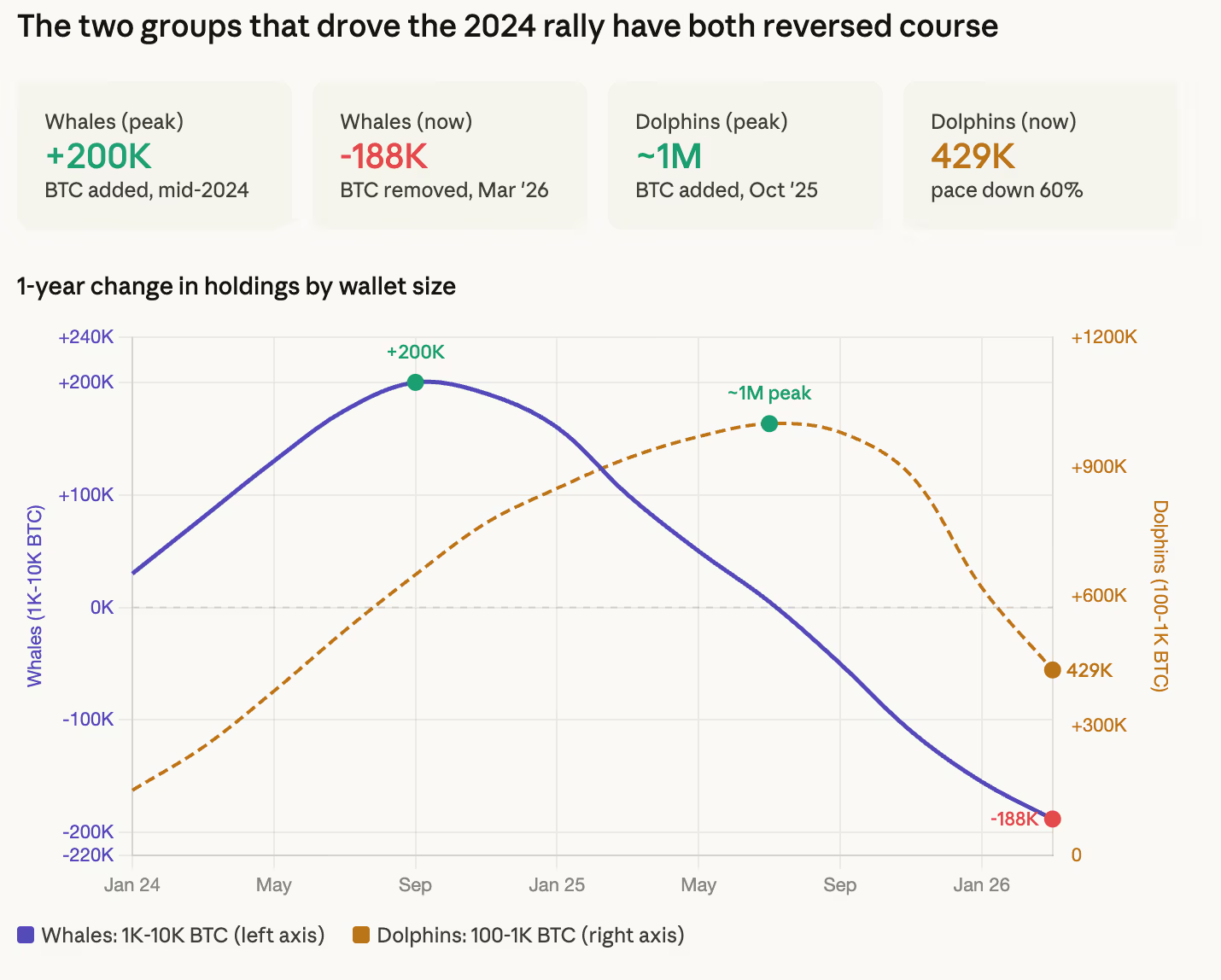
Large holders, wallets with 1,000 to 10,000 BTC, have turned from the market’s biggest buyers into its biggest sellers on a scale CryptoQuant describes as one of the most aggressive distribution cycles on record.
A year ago, these wallets were collectively adding 200,000 bitcoin to their holdings. Today they are collectively removing 188,000. That is a nearly 400,000 BTC swing from accumulation to distribution in roughly 18 months.
Mid-tier holders, wallets with 100 to 1,000 BTC, are still technically accumulating but the pace has collapsed more than 60% since October 2025, from nearly 1 million BTC in annual additions to 429,000. They haven’t stopped buying. They’ve dramatically slowed down.

The realized price compression
Bitcoin’s spot price at in the $67,000-$68000 range sits 21% above its realized price of $54,286, the average cost basis of every coin on the network weighted by its last transaction. That means the average holder is still in profit, which historically means the market has not bottomed, as CoinDesk noted earlier in the week.
In 2022, the signal that marked the actual cycle low was spot falling below realized price. Bitcoin traded under its aggregate cost basis from June through October of that year, and the deepest point, roughly 15% below realized, coincided almost exactly with the low near $15,500.
The current setup is not that. But the gap is closing fast. In late 2024, when bitcoin traded above $119,000, the premium to realized price was roughly 120%. That has compressed to 21% in about 15 months, one of the fastest approaches to the realized price line outside of outright crashes.
The sentiment disconnect
The Fear and Greed Index has been stuck between 8 and 14 for the past month, deep in extreme fear territory. Yet bitcoin ETFs drew over $1 billion in net inflows in March.
That combination of extreme fear alongside strong institutional buying is unusual. It means the flows are not translating into broader confidence, but that institutions are buying into a market that the rest of the participants do not want to be in.
The widely-followed Coinbase Premium Index reinforces this. The metric, which measures whether bitcoin trades at a premium or discount on Coinbase relative to other exchanges and serves as a proxy for U.S. institutional appetite, has been persistently negative since bitcoin’s all-time high above $126,000 in early October 2025. Even with prices in the $65,000 to $70,000 range, American buyers have not stepped back in at scale.

The war pattern
The behavioral explanation for the demand drain is visible in the price action of the past five weeks. Bitcoin has spent the entire Iran conflict grinding between $65,000 and $73,000, selling on every escalation headline, rallying on every de-escalation headline, and ending up roughly where it started. Monday’s 4% equity rally on ceasefire optimism gave back by Wednesday after Trump’s address promised to hit Iran “extremely hard.”
The pattern of hope, headline, reversal repeats with such regularity that the dominant strategy has become not to have a position at all. That shows up in the demand data as gradual withdrawal rather than panic selling.
The drawdown is compressing, not ending
The current drawdown from October’s all-time high above $126,000 is roughly 47%, significantly less severe than the 84% to 87% crashes that followed the 2013 and 2017 peaks. Fidelity Digital Assets analyst Zack Wainwright noted in late March that bitcoin’s growth is becoming “less impulsive,” with a reduced probability of extreme downside events as the asset matures.
“Bitcoin’s drawdowns compressing to about 50% is a sign of a maturing market structure,” said Jason Fernandes, co-founder and market analyst at AdLunam. “As liquidity deepens and institutional participation increases, volatility naturally compresses on both the upside and the downside.
The drawdown compression framing matters for the demand data. If bitcoin is maturing into an asset where 50% corrections replace 85% crashes, then the current contraction may not resolve with the violent capitulation flush that marked previous cycle bottoms.
What could change this
Two catalysts sit on the near-term horizon.
Morgan Stanley received approval this week for a bitcoin ETF charging just 14 basis points, 11 below the category average. The product opens access to 16,000 financial advisors managing $6.2 trillion, a channel that has not previously had direct bitcoin ETF exposure.
Strategy’s STRC preferred equity product saw hundreds of millions in inflows around its recent ex-dividend date, providing the funding mechanism for its 44,000 BTC monthly accumulation. If that repeats and accelerates each month, it adds a new source of sustained buying pressure.
However, it would remain a single company running a leveraged bitcoin strategy.
CryptoQuant’s own report identifies a potential short-term bounce toward $71,500 to $81,200 if the Iran conflict de-escalates, corresponding to the Lower Band and Trader On-chain Realized Price resistance zones.
These two metrics track the average cost basis of short-term and active traders respectively, and that have historically acted as ceilings during bear market rallies. Bitcoin currently trades below both.
The read across all five data sources is that bitcoin’s demand structure is thinning from the inside.
That does not mean the current range floor breaks, but that the floor depends entirely on whether ETFs, Strategy, and the new Morgan Stanley channel can continue absorbing what the rest of the market is trying to get rid of.


Cambodia has moved closer to tougher action against scam centers linked to crypto fraud and other online crimes.
Summary
- Cambodia’s Senate approved a draft bill targeting scam compounds tied to crypto and online fraud.
- The bill sets prison terms, fines, and tougher penalties for gangs or multiple victims involved.
- The measure now awaits royal approval as Cambodia faces pressure over regional scam centers globally.
The country’s Senate approved a draft law that would impose prison terms and fines on people involved, marking a new step in its response to scam compounds.
Cambodia’s Senate said it unanimously approved the draft law on Friday, with all 58 senators voting in favor. The bill now awaits the king’s approval before it can take effect.
Reports said the proposed law would impose prison terms of two to five years and fines of up to $125,000 for certain offenses. Those penalties could double if the crimes involve a gang or affect several victims.
The Senate said the draft law would create criminal rules to address gaps in current legislation. It described the measure as part of a wider effort to respond to fraud carried out through technology systems.
In its notice, the Senate said the law would help tackle risks to social security, the economy, and public order. The notice added that the measure aimed to improve cooperation in the fight against fraud and protect Cambodia’s reputation. It said the draft law would help “fill the gaps and deficiencies in the current law” and improve efforts against fraud.
In addition, the bill moved forward after criticism from foreign governments and international bodies over scam activity in Southeast Asia. A 2025 report from the US State Department said Cambodia’s government had often treated scam cases as labor disputes and had not prosecuted owners or operators of suspected scam compounds.
The timing also followed action from the United Kingdom, which sanctioned operators of a Cambodia-based scam center. Cambodia also extradited to China the leader of a criminal syndicate with reported links to scam compounds. Before the Senate vote, the National Assembly approved the bill on March 30 with all 112 members voting in support.
Scam centers remain under scrutiny
Reports from the region have described scam compounds as closed sites where workers may face control, threats, and abuse. A 2024 UN report on a compound in the Philippines said some workers were trafficked, held against their will, and exposed to violence.
The report said many of these sites operate like self-contained facilities. It stated that the people inside are “basically fenced off from the outside world,” with access to restaurants, dormitories, and other services that reduce the need to leave. Cambodia’s proposed law now places fresh attention on how the country plans to address such operations.


Bitcoin (BTC) traded near $67,000 over the weekend after a week of sharp swings. The broader crypto market also stayed steady, while Pi Network’s PI token held above $0.17 after days of losses.
Summary
- Bitcoin traded around $67,000 as weekend volatility faded and the broader crypto market stayed subdued.
- Pi Network’s PI token stabilized above $0.17 after recent losses, ending its sharp downward trend.
- VeChain climbed 9% daily while HASH dropped 10%, marking the strongest altcoin moves reported today.
Bitcoin showed limited movement over the past 24 hours and remained close to the $67,000 level. Its price action followed a volatile week in which the asset moved between $66,000 and $68,000 before rising to $69,200 on Wednesday.
That move reversed after fresh market pressure, sending Bitcoin down to $65,700 later the same day. Since then, the asset has traded in a narrow range. At press time, Bitcoin’s market capitalization stood at about $1.34 trillion, while its market dominance remained near 56.2%.
Most large-cap altcoins posted small changes during the same period. Ethereum held near $2,050 after a slight daily loss, while XRP remained above $1.30. BNB, Solana, TRX, and Cardano all recorded gains of less than 1%.
The biggest moves among larger altcoins came from a smaller group of assets. RAIN fell more than 6% and dropped below $0.0075. HBAR, PEPE, UNI, and SHIB also traded lower. In contrast, Ethereum Classic rose 3.5% to $8.30 and stood out from the broader market.
PI token steadies after recent drop
Pi Network’s PI token showed signs of stability after a recent downward move. The token traded above $0.17, marking a pause in the decline that had drawn attention across the altcoin market.
Elsewhere, HASH posted the sharpest daily loss among the mentioned tokens, falling 10% over the past 24 hours. VeChain moved in the opposite direction and gained 9% on the day, helping it return to the top 100 altcoins by market value.
Meanwhile, the total crypto market value changed little over the day and remained just below $2.4 trillion. That flat reading matched the quiet performance seen across Bitcoin and most major altcoins during the weekend session.
Market activity also stayed muted despite recent macro and geopolitical headlines that had raised expectations of stronger price swings earlier in the week.
Disclosure: This article does not represent investment advice. The content and materials featured on this page are for educational purposes only.


HypurrFi has warned users not to interact with its website or lending app after reporting a possible domain hijacking.
Summary
- HypurrFi warned users to avoid its app after reporting a possible domain compromise Friday.
- The team said user funds remain safe while it investigates the suspected hijacking incident.
- Frontend attacks remain a crypto risk because compromised domains can trick users into signing transactions.
The incident has raised fresh concern over frontend attacks in decentralized finance, even when onchain systems remain intact.
HypurrFi said it is investigating a possible compromise involving its domain. The team asked users to avoid the website and the lending protocol until it shares a new update.
Founder androolloyd posted on X, “Do NOT USE THE HYPURR .FI domain, it is compromised.” The team later repeated that warning and told users not to interact with the app until further notice.
HypurrFi also said there is no current sign of risk to user funds. It added that its social media accounts remain under team control during the investigation.
The warning focused on the website and user access point rather than the protocol’s core contracts. That distinction is common in cases where attackers target frontend systems instead of onchain code.
HypurrFi operates as a DeFi lending and borrowing protocol on HyperEVM. HyperEVM is the EVM-compatible network linked to Hyperliquid’s trading ecosystem.
The protocol has about $30 million in total value locked, based on DefiLlama data. That made the warning more urgent for users who may still try to access the platform through the compromised domain.
The team did not provide details on how the hijacking may have happened. It also did not say when the site would return to normal use.
For now, the main message from the project remains clear. Users should avoid the domain and wait for an official notice before reconnecting wallets or signing any transaction requests.
Domain hijacking remains a known crypto risk
Domain hijacking has become a recurring issue across the crypto sector. These attacks often target a project’s website and user interface instead of its smart contracts.
Once attackers control a domain, they can place wallet drainers or other malicious prompts on the site. This method can affect users even when the underlying protocol has passed security reviews.
A similar case affected the BONKfun domain last month. That incident added to a growing list of attacks that use fake or compromised frontends to reach users.


Bitcoin (BTC) stayed near $67,000 on April 4 as two CryptoQuant analysts pointed to a split market structure.
Summary
- Bitcoin spot volume dropped faster than open interest, showing derivatives still carried more market weight.
- Exchange reserves fell by 66,300 BTC as OTC flows pointed to continued institutional accumulation recently.
- Negative funding and nearby downside liquidity kept short-term liquidation risk elevated for Bitcoin traders.
CryptoQuant analyst Carmelo_Alemán said Bitcoin daily spot volume fell from 42,026 BTC on March 17 to 35,590 BTC on April 2. That marked a 15.31% drop in spot activity over the period. At the same time, open interest fell from $23.33 billion to $21.26 billion, a smaller 8.87% decline.
He also said the estimated leverage ratio rose from 0.2207 to about 0.225. In his view, Bitcoin is becoming “less dependent on real buying and selling” and more tied to leveraged positions. The same note said funding rates stayed mostly negative, showing stronger short positioning in perpetual futures.
Carmelo_Alemán said liquidity below the market sits closer than the larger liquidity zones above. That setup, according to his note, leaves Bitcoin open to a short-term move driven by long liquidations before any stronger recovery attempt.
CryptoQuant research published this week also said Bitcoin spot demand remains in deep contraction even as institutional buying continues through ETFs and Strategy purchases. That supports the view that price action has relied more on derivatives and large buyers than on broad spot demand.
Exchange reserves fall as institutions absorb supply
In a separate note, CryptoQuant analyst GugaOnChain said Bitcoin exchange reserves dropped by 66.3K BTC over the past 30 days. The post added that OTC absorption made up 92.1% of recent flow, compared with 7.9% on regular 24-hour market volume.
GugaOnChain said that pattern points to ongoing institutional accumulation. However, the analyst also warned that on-chain scarcity is facing a “cloudy macroeconomic scenario,” with geopolitical shocks still able to force fast moves back to exchange liquidity.
According to crypto.news data, Bitcoin traded around $67,150 at press time, with a market cap near $1.34 trillion.
Disclosure: This article does not represent investment advice. The content and materials featured on this page are for educational purposes only.
The Digital Asset Market Clarity Act’s compromise language on stablecoin yield has circulated among crypto and banking industry stakeholders in closed-door Capitol Hill sessions, with a Senate Banking Committee markup now targeted for the second half of April — though the text has drawn a mixed, and in some corners hostile, reception.
Summary
- Senators Thom Tillis and Angela Alsobrooks reached an agreement in principle on stablecoin yield on March 20; formal draft language was reviewed by crypto industry leaders on March 24 and banks on March 25
- The compromise bans passive yield on stablecoin balances but permits activity-based rewards tied to payments, transfers, or platform use
- Polymarket had the CLARITY Act priced at a 66% probability of becoming law in 2026 as of April 2
The Tillis-Alsobrooks deal draws a firm line: platforms cannot offer yield — directly or indirectly — for simply holding a stablecoin. Rewards remain permissible only when tied to user activity, not passive balances. The framework gives the SEC, CFTC, and Treasury twelve months to define what specific rewards programs are permissible.
“The compromise that myself and Senator Tillis have been working on is one that we believe will allow us to have the guardrails in place that will help us prevent deposit flight,” Senator Alsobrooks told an American Bankers Association summit.
The banking industry’s position reflects existential concern. Standard Chartered analysts estimated that an open-ended yield provision could redirect up to $500 billion in deposits from traditional banks into stablecoin products by 2028. Banks won the core argument they sought: passive yield is off the table.
Industry Reaction
The industry reception has been far from unified. As the deal first emerged, the market structure bill was framed as potentially unblocking one of the most consequential crypto legislative events of the cycle. But the actual text has landed closer to the bank position than the White House’s earlier compromise framing. Coinbase privately told Senate staff it could not accept the March 23 draft. Stripe has also objected. Broader institutional appetite for regulated crypto products — from ETFs to structured tokens — makes the CLARITY Act’s outcome a critical variable for the entire institutional crypto pipeline in 2026.
The stablecoin yield text is not the only outstanding issue. Senate Democrats are focused on ethics language barring government officials and their families from personally benefiting from crypto holdings. DeFi provisions and the potential attachment of community bank deregulation to the bill also remain unresolved.
The Calendar
The Senate was in pro forma session only through April 9 and returns to full session April 13. Senator Bernie Moreno has stated explicitly that if the bill does not reach the full Senate floor by May, digital asset legislation may not advance before the midterm election cycle. The CLARITY Act passed the House 294–134 in July 2025 and cleared the Senate Agriculture Committee in January 2026. It enters the banking panel with broad support — but a narrowing clock that leaves almost no room for further substantive revision.

The Ethereum Foundation (EF), the non-profit organization at the heart of the world’s most-used blockchain, has staked nearly $100 million in ETH during the last 24 hours.
The move signals a departure from the organization’s long-standing and often controversial practice of selling its native tokens to fund operations.
Ethereum Foundation Could Earn Up to $4 Million in Annual Yield
On-chain data confirms that on April 3, the Foundation deposited approximately 45,034 ETH—valued at roughly $93 million—into the Ethereum Beacon Deposit Contract.
The move, tracked via Arkham Intelligence, saw funds moved from the EF’s Treasury Multisig wallet in systematic batches of 2,047 ETH.
This follows a smaller deposit of 22,500 ETH earlier in the week. It brings the Foundation’s total staked balance to 69,500 ETH, or approximately $143 million.
For much of the last decade, the Foundation’s treasury management has been a flashpoint for market speculation. The organization historically relied on periodic ETH liquidations to cover its annual budget, research grants, and ecosystem development.
These ETH sales frequently occurred near market highs, leading some traders to view Foundation “dumps” as a reliable signal of a local price ceiling. Consequently, the practice fueled accusations that the protocol’s leaders lacked long-term conviction.
This pivot toward staking transforms the Foundation into a primary participant in its own economic system. By acting as a validator rather than a liquidator, the organization is converting its $430 million Ether treasury into a productive, yield-bearing endowment.
At current institutional staking yields of roughly 2.7%, the Foundation’s current staked holdings are projected to generate approximately $4 million in recurring annual revenue.
However, this move forces the Foundation to navigate the same operational risks and “slashing” frictions faced by ordinary network participants.
Meanwhile, the Foundation’s new strategy mirrors a broader trend among institutional holders.
Firms such as BitMine have staked millions of tokens over the last year, contributing to a global total of 38.5 million Ether—roughly 30% of the circulating supply—now committed to securing the network.
The post Ethereum Foundation is Staking Nearly $100 Million in ETH Again appeared first on BeInCrypto.
Chainlink (LINK) moved back into focus after a large amount of LINK reached Binance during weekend trading.
Summary
- Chainlink moved 19 million LINK, with most tokens sent to Binance during weekend trading hours.
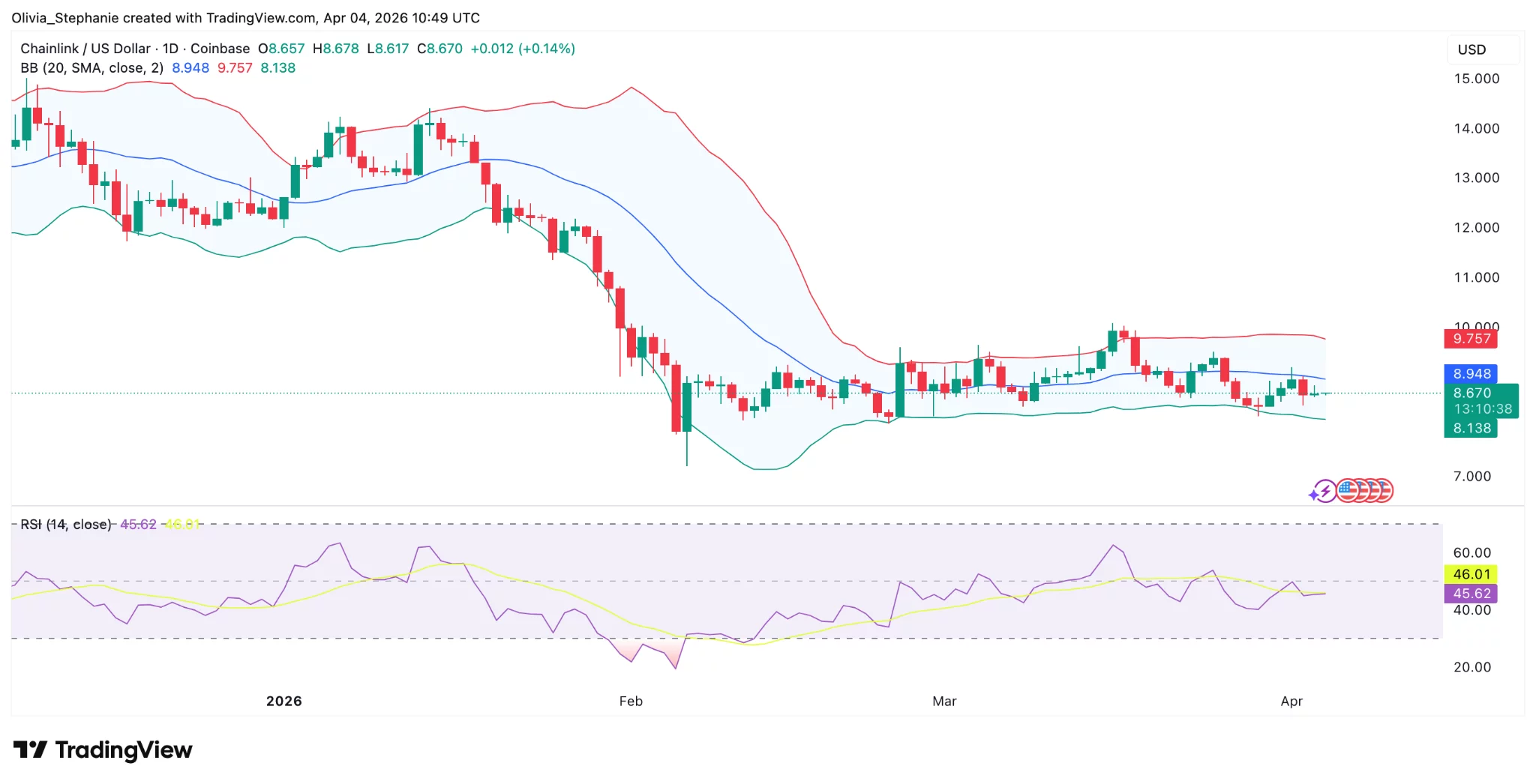
- LINK traded near $8.63 as RSI stayed below 50 and momentum remained weak overall today.
- The quarterly unlock renewed focus on Binance inflows, exchange supply, and possible selling pressure.
CryptoQuant analyst Darkfost pointed to a large LINK transfer during what he described as a “low-liquidity weekend.” Separate onchain reports later said Chainlink completed its regular quarterly unlock, moving 19 million LINK worth about $165 million from three non-circulating supply addresses.
Of that total, about 14.375 million LINK, valued near $125 million, went to Binance. Another 4.625 million LINK, worth about $40.1 million, moved to multisig address 0xD50…8Af. Reports said Chainlink has followed a similar pattern about every three months, with most tokens going to exchanges and a smaller share set aside for staking rewards.
Large exchange inflows often draw attention because they can increase tradable supply. In this case, the Binance transfer arrived during a period when weekend liquidity was thinner than usual, which can make large token movements stand out more in market activity.
Even so, the purpose of the transfer remains unclear. Market observers said the movement could reflect routine treasury management, custody changes, or preparation for distribution, but none of those explanations had been confirmed at the time of reporting.
LINK price and chart stay cautious
According to Crypto.News data, LINK traded at about $8.63 on April 4, with a market cap near $6.28 billion and 24-hour volume around $145.1 million, according to market data. That left the token little changed on the day and only modestly higher over the past week.
On the daily chart shared by the user, Bollinger Bands showed an upper band at 9.757, a middle band at 8.948, and a lower band at 8.138.
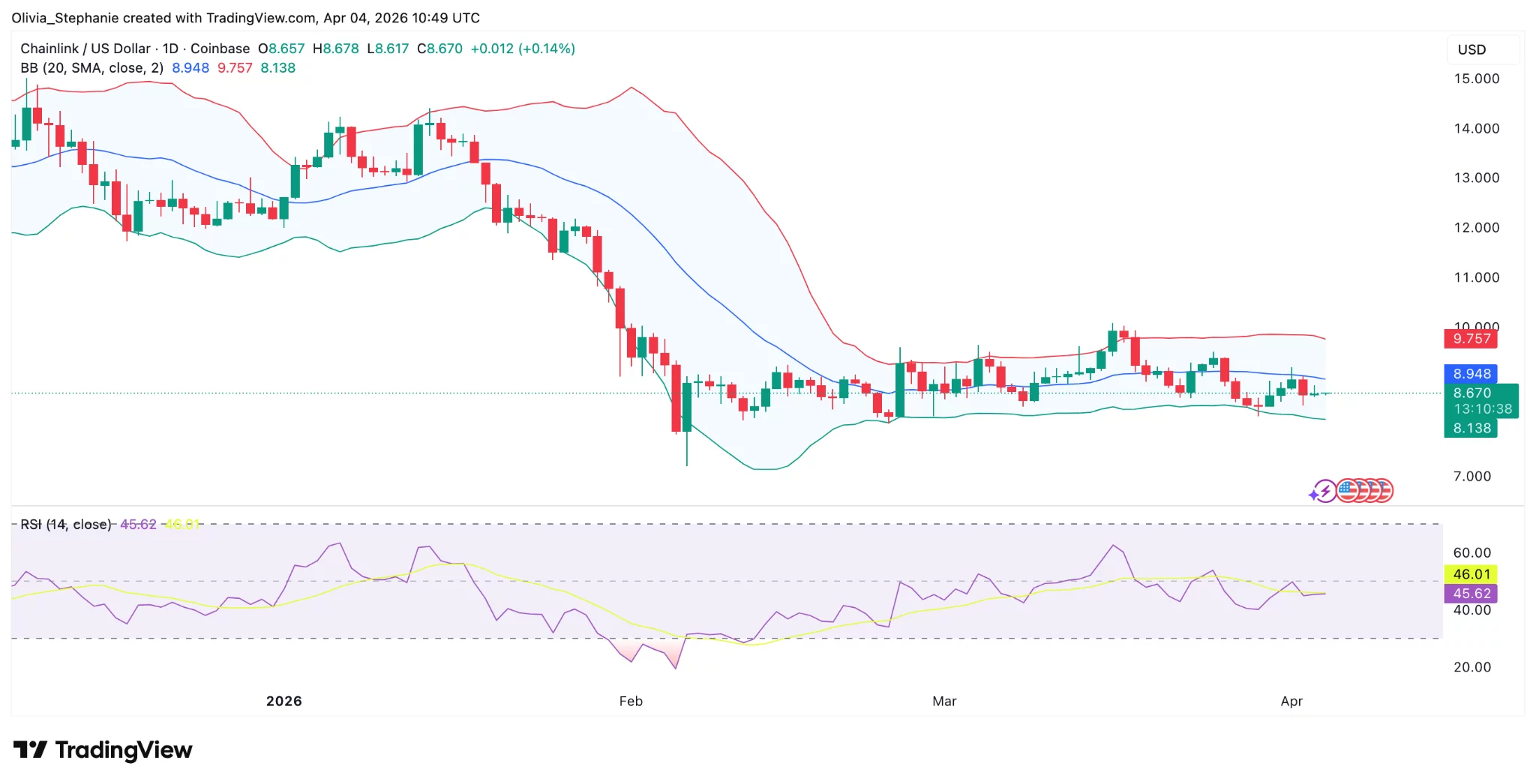
LINK traded below the 20-day average but above lower support, while the RSI sat near 45.48. That setup pointed to weak but stable momentum, with resistance near 8.95 and support around 8.14.
Disclosure: This article does not represent investment advice. The content and materials featured on this page are for educational purposes only.

Financial services giant Charles Schwab plans to launch direct trading for Bitcoin and Ethereum before the end of June.
This is a move that threatens to disrupt the dominance of crypto-native exchanges by leveraging the firm’s $12 trillion in client assets.
Schwab’s Crypto Launch Could Pull New Money Into Bitcoin and Ethereum
The firm is preparing to offer clients direct access to cryptocurrencies through a new platform called ‘Schwab Crypto.’
“Gain early access to the Schwab Crypto account, offered by Charles Schwab Premier Bank, SSB—your new gateway to buy and sell Bitcoin and Ethereum cryptocurrencies,” the firm’s website stated.
Notably, Schwab is structuring the service through Charles Schwab Premier Bank, SSB. This state savings bank charter indicates a conservative, compliance-driven approach to the new product.
The firm will also exclude residents of states with stringent crypto regulations, such as New York and Louisiana, during the initial rollout. This underscores its focus on regulatory safety over immediate national expansion.
Additionally, the firm’s deliberate choice to limit initial offerings to Bitcoin and Ethereum further highlights Schwab’s cautious strategy.
By excluding smaller, more volatile cryptocurrencies, the firm is validating the two largest digital assets while protecting its mainstream retail client base from the highly speculative fringes of the market.
Market observers anticipate that Schwab’s entry will inject significant capital into the cryptocurrency ecosystem and further legitimize the asset class.
Tome Dunleavy, the Head of Venture at Varys Capital, pointed out that the bank would be introducing “net new buyers” Into the market.
However, this move also signals a new era of intense competition against established cryptocurrency exchanges like Coinbase and Robinhood.
Meanwhile, the initiative marks a strategic pivot for the Westlake, Texas-based brokerage. Previously, Schwab offered clients exposure to digital assets indirectly through crypto-linked stocks, futures, and spot exchange-traded products.
By facilitating direct trading, Schwab aims to capture transaction spreads and fees currently lost to third-party ETF issuers. This move keeps lucrative revenue within its own ecosystem.
Schwab has a history of aggressive pricing, famously driving stock trading commissions to zero in 2019. If the firm applies a similar low-fee strategy to digital assets, it could force severe margin compression across the crypto exchange sector.
Furthermore, Schwab offers clients the convenience of managing traditional retirement accounts, equities, and digital assets on a single platform, eliminating the need for multiple financial applications.
The post Charles Schwab to Enter the Crypto Trading Space By June 2026 appeared first on BeInCrypto.

I did a boat trip around Wales’ largest island and couldn’t believe what I was seeing

Amazon converts failed Fresh stores to Whole Foods in new UK grocery push

Solana news: The network’s post-quantum push reveals harsh tradeoff: security vs speed

Smart energy pays enters the US market, targeting scalable financial infrastructure

Why Israel is blocking foreign journalists from entering

Bitcoin: We’re Entering The Most Dangerous Phase

Ripple XRP: “THE SHADOW ACCOUNTS LEAKED IT” Goldman Sachs $154M Secret Filing! (DECODING THE PLAN)

Everyday Motivation : Review your financial goals

3 Govt Schemes For Women Entrepreneurs? #finance #money #business #gkindia #basicgyaan
-

 NewsBeat2 days ago
Steven Gerrard disagrees with Gary Neville over ‘shock’ Chelsea and Arsenal claim | Football
-

 Business1 day ago
No Jackpot Winner and $194 Million Prize Rolls Over
-
Entertainment5 days ago
Fans slam 'heartbreaking' Barbie Dream Fest convention debacle with 'cardboard cutout' experience
-

 Fashion17 hours ago
Weekend Open Thread: Spanx – Corporette.com
-

 Crypto World3 days ago
Gold Price Prediction: Worst Month in 17 Years fo Save Haven Rock
-

 Tech5 days ago
The Pixel 10a doesn’t have a camera bump, and it’s great
-
Crypto World4 days ago
Dems press CFTC, ethics board on prediction-market insider trades
-
 Entertainment7 days ago
Lana Del Rey Celebrates Her Husband’s 51st Birthday In New Post
-

 Tech5 days ago
Avatar Legends: The Fighting Game comes out in July and it looks pretty slick
-

 Tech4 days ago
EE TV is using AI to help you find something to watch
-

 Sports4 days ago
Tallest college basketball player ever, standing at 7-foot-9, entering transfer portal
-

 Business2 days ago
Login and Checkout Issues Spark Merchant Frustration
-

 Fashion6 days ago
Amazon Sundays: Soft Spring Layers
-

 Tech6 days ago
Elon Musk’s last co-founder reportedly leaves xAI
-

 Fashion5 days ago
The Best Spring Trends of 2026
-

 Tech4 days ago
How to back up your iPhone & iPad to your Mac before something goes wrong
-

 Politics5 days ago
Should Trump Be Scared Strait?
-

 Tech5 days ago
Apple will hide your email address from apps and websites, but not cops
-

 Crypto World5 days ago
U.S. rule change may open trillions in 401(k) funds to crypto
-

 Tech4 days ago
Flipsnack and the shift toward motion-first business content with living visuals
You must be logged in to post a comment Login