
Entertainment
Clint Eastwood’s Most Powerful War Film Explored WWII From an Unexpected Angle

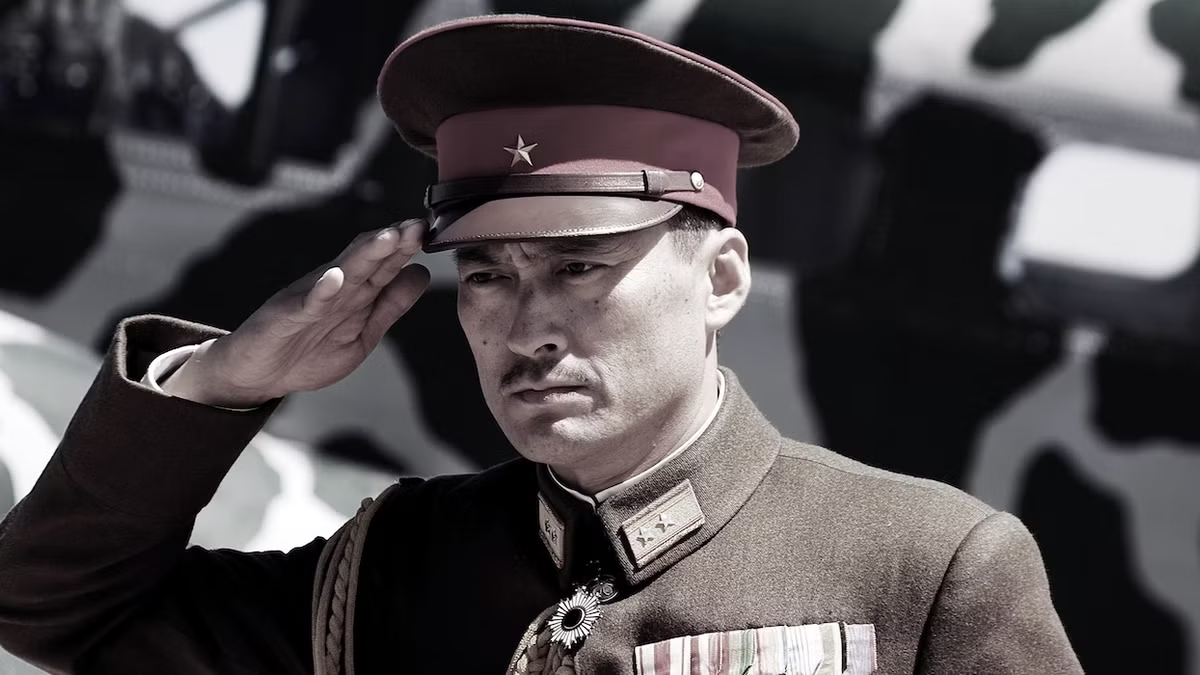
Clint Eastwood may be renowned for being one of the most iconic Western stars of all time, but he’s dedicated almost as much of his career to telling compelling stories about history. Eastwood clearly admires heroes who faced unimaginable odds, and has been drawn to underrepresented biographical pieces ever since the 1988 musician film Bird. Although he’s touched on different wars in many of his projects, Eastwood finally offered his take on World War II in 2006 with two films that told the same story from multiple perspectives. While Flags of Our Fathers followed the American soldiers who invaded the Pacific Islands during the last days of the war, Letters from Iwo Jima explored the perspective of the Japanese Army that was left to defend their home.
Eastwood has always been a filmmaker unafraid to take risks, but Letters from Iwo Jima was one of the most ambitious films of his career. Few films had attempted to explore the Japanese perspective of World War II, and Eastwood made the film authentically in the Japanese language, bringing together a cast that included many unknown stars. Although Flags of Our Fathers seemed to be the more commercial project on paper, Letters from Iwo Jima outgrossed it and earned four Academy Award nominations, including Best Picture and Best Director. Although he is often called out as being an old-fashioned filmmaker, Eastwood’s sensitive, respectful approach to this tale of chivalry made Letters from Iwo Jima one of his most powerful films.
Clint Eastwood Took a Two-Pronged Approach to the Pacific Theater
As with many of Eastwood’s best films, Letters from Iwo Jima explores a diversity of perspectives by showing characters who held different positions of power in the Japanese Army. It made sense for Eastwood to cast Ken Watanabe in the role of General Tadamichi Kuribayashi, the military leader who oversaw the defense of Iwo Jima from the oncoming Allied invasion. Not only was Watanabe the most famous actor in the cast, but he had recently proved that he could play an admirable warrior with his Oscar-nominated role in The Last Samurai. Watanabe retains a spirit of quiet, honorable resolve that bears a lot in common with many of the heroes that Eastwood played over the years. Despite having earned accolades for his experiences in combat, Kuribayashi was willing to endure the same burdens as the men under his command and believed in protecting the sanctity of human life. Eastwood is clear to point out the vast differences in ethics that existed between members of the army and those within the inner circle of Imperial Japan. Even though Kuribayashi may not agree with the tactics used by his nation, he would never question orders because of his unyielding patriotism.

45 Years Ago, Clint Eastwood Reteamed With the Director of ‘Dirty Harry’ for This Underrated Western
Clint Eastwood and Shirley MacLaine teamed up for a fresh Western adventure with terrific chemistry.
Since Flags of Our Fathers showed how young American men were shaped by the war, Letters from Iwo Jima was appropriately focused on the junior members of the Japanese infantry, such as Kazunari Ninomiya as Private First Class Saigo. Eastwood captured the aura of fear that existed within Japanese communities, showing how average civilians were forced to hide to follow the strict commands of the army. The desperate nature of the war effort meant that many of those defending Japan’s bases were inexperienced, as Saigo was a modest baker who had never previously fired a weapon. Eastwood crafts an empathetic portrayal of these civilians who were called upon to fight an unwinnable battle, but he also emphasizes how the spirit of camaraderie and brotherhood gave them a larger goal during their service.
‘Letters From Iwo Jima’ Offered a Sympathetic Take on the Japanese Army
Eastwood has occasionally attracted criticism for the length of his films, but Letters from Iwo Jima justifies its running time because of the steps it took to become completely immersed within Japanese culture. The film included flashbacks that explored the experiences of characters like Kuribayashi before the war, and also examined the torment that the Japanese soldiers faced when they were faced with disease and waning medical supplies as the invasion progressed. Perhaps the most moving aspect of the film’s construction is a framing device that Eastwood uses with scenes set in 2005, in which the letters and memoirs of characters like Saigo are rediscovered by contemporary archeologists. Although this could have easily felt like a saccharine way to evoke emotion, Eastwood uses it as a tool to show how many stories of sacrifice and heroism have been lost to time. It serves as a reminder that the film is a living text, as Eastwood was only able to depict a portion of the many stories that existed within the totality of this historical period.
It’s a bit odd that Eastwood is often pegged as a conservative filmmaker, as many of his best films seek to understand and respect those who come from a different cultural background. Letters from Iwo Jima was a necessary new take on the World War II epic, as the history of the genre is filled with depictions of the Japanese that are downright racist and xenophobic. Even if Flags of Our Fathers wasn’t nearly as excellent of a film, it worked as a companion piece to Letters from Iwo Jima because they showed how heroism, chivalry, and patriotism could exist within two sides of the conflict. Unforgiven will likely always be cited as Eastwood’s undisputed masterpiece, but Letters from Iwo Jima is an important piece of global cinema that helps to preserve a moment in time.
Letters from Iwo Jima is available to rent or buy on VOD services.

- Release Date
-
February 2, 2007
- Runtime
-
141 Minutes
- Writers
-
Iris Yamashita, Paul Haggis, Tadamichi Kuribayashi, Tsuyoko Yoshido
- Producers
-
Paul Haggis, Robert Lorenz
-

-

Kazunari Ninomiya
General Tadamichi Kuribayashi



