
Entertainment
He May Be Known for Major Franchises, but One of David Dastmalchian’s Best Performances Is in This Quietly Devastating Drama

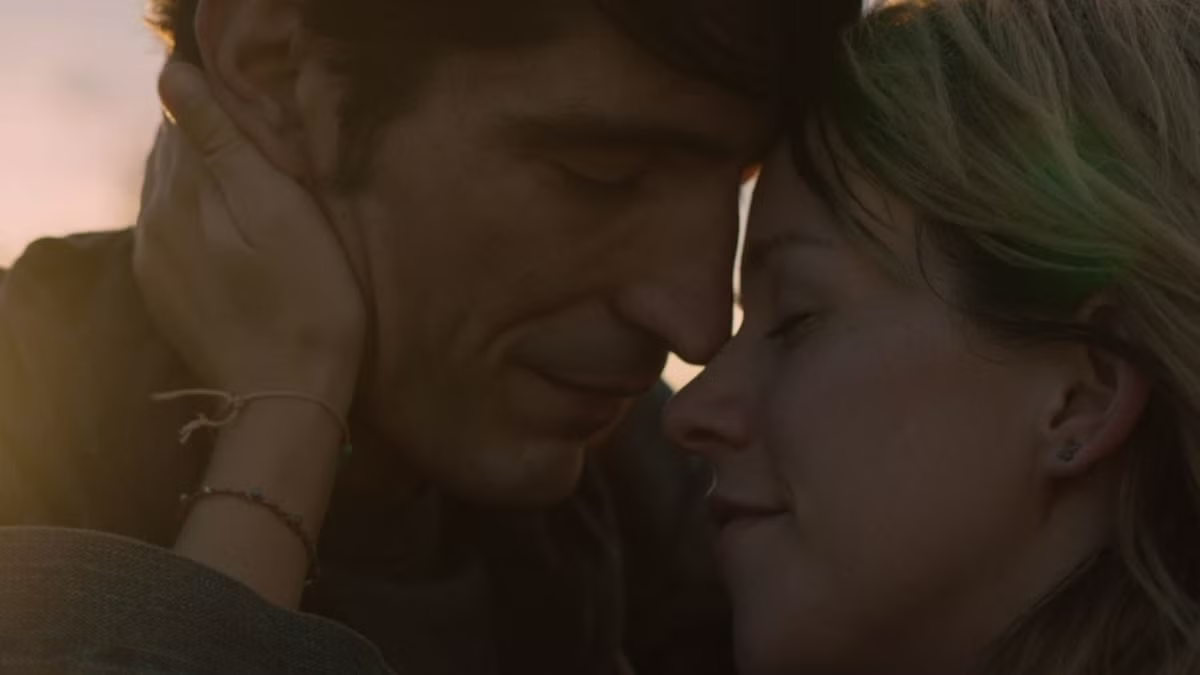
When most audiences think of David Dastmalchian, they picture him lurking on the fringes of blockbusters and comic book worlds — a familiar face in films like The Dark Knight, Ant-Man, and The Suicide Squad. Over the last decade, he’s built a reputation as a scene-stealer, providing performances for the unsettling presence in the corner, the oddball with a tragic undercurrent, the man who can make a five-minute appearance unforgettable, and more. But before he became a genre fixture, Dastmalchian gave one of the most personal, gutting performances of his career in Animals.
In Animals, which he also wrote the screenplay for, Dastmalchian plays Jude, a man living with addiction alongside his girlfriend in a downward spiral. The film isn’t concerned with grand redemption arcs or stylized portrayals of drug use; it’s brutally honest, uncomfortable, and achingly human. His performance embodies the quiet tragedies of dependency with a level of intimacy and interiority rarely afforded to actors in franchise work. The most striking thing about Animals is how it reframes Dastmalchian not as a character actor defined by quirks, but as a leading man capable of carrying a story with devastating nuance. It’s a testament to how much range can live beneath blockbuster typecasting — and proof that talent doesn’t need a billion-dollar franchise to shine.
‘Animals’ Turns David Dastmalchian From a Blockbuster Fixture to an Intimate Storyteller

By the time Animals arrived, Dastmalchian had already made a name for himself as the kind of actor audiences might not know by name, but always recognized on sight. His haunting turn as one of the Joker’s henchmen in The Dark Knight instantly marked him as someone who could embody menace with quiet intensity. Later roles — like the lovable, nervous Kurt in Ant-Man and the tragic, bizarre Polka-Dot Man in The Suicide Squad — cemented his reputation as a unique screen presence, capable of toggling between darkness and humor with ease. But Animals isn’t a performance that hides behind heightened genre trappings. There’s no mask, no powers, no outlandish comic book universe to absorb the weight of the story. There’s just Jude, a man who is both deeply in love and deeply broken, clinging to a life built on fragile illusions. It’s a raw, unvarnished showcase of Dastmalchian’s talent — one that exposes how good he is when he isn’t tasked with stealing scenes, but with anchoring an entire film.
Writing the screenplay gave him the chance to carve a space for himself as more than an ensemble player. The character of Jude is not a standard protagonist — he isn’t heroic, and he isn’t even particularly stable. He is, however, painfully real, and Dastmalchian leans into that reality with precision. Every twitch of his jaw, every forced smile, every sudden burst of desperation feels carved from lived experience. That’s because, in many ways, it is. Dastmalchian has spoken openly about his own struggles with addiction in his early life, and that honesty informs every frame of Animals.
‘Animals’ Confronts Addiction Without the Hollywood Gloss

What sets Animals apart from so many other films about addiction is its refusal to turn it into a spectacle. In mainstream dramas, addiction is often stylized — something that leads to cathartic climaxes and carefully crafted arcs of recovery or ruin. Dastmalchian and director Collin Schiffli strip all of that away. The story follows Jude and his girlfriend Bobbie (Kim Shaw) as they drift through a fragile, makeshift existence. They’re partners in love and in self-destruction, stealing, hustling, and numbing themselves in an endless loop. The film doesn’t offer grand turning points or preachy morals. Instead, it lives in the day-to-day ache of dependency — the ways it frays trust, erodes dignity, and blurs love into co-dependence.
For Dastmalchian, this isn’t a role designed to elicit Oscar-baiting breakdowns. His Jude doesn’t give big speeches. His pain isn’t theatrical. It’s in the small, invisible humiliations — the way he fumbles for excuses when their scams go wrong, the way he covers up fear with false bravado, the way he lingers on Bobbie like she’s the last piece of the world holding him up. His performance is all flickers and fractures, capturing what it feels like to live inside an unraveling mind. This commitment to realism gives Animals a distinct tone: quiet devastation. It isn’t loud, but it lingers. It shows addiction not as a climactic battle, but as a thousand small defeats. And in that quiet, Dastmalchian finds power.
‘Animals’ Is a Love Story That’s Also a Tragedy

At its core, Animals is not just a story about addiction; it’s a love story about two people caught in the undertow. Jude and Bobbie’s bond is intense, messy, and full of a desperate kind of hope. They dream of escape, but neither has the strength to truly break the cycle. Their love becomes both a refuge and a prison, something that sustains them even as it kills them. Dastmalchian and Shaw create a dynamic that feels lived-in and intimate. Their chemistry isn’t romantic in the traditional cinematic sense — it’s tethered by shared damage, mutual need, and fleeting joy in stolen moments. Watching Jude and Bobbie together feels like watching a pair of moths orbiting the same flame. They know it’s burning them alive, but the glow is all they have.
What makes Dastmalchian’s performance extraordinary is how he lets love and decay coexist in Jude. He loves Bobbie deeply, but he is also complicit in her destruction. There are moments where his affection turns gentle, and others where his desperation makes him cruel. It’s a deeply human portrayal — messy, contradictory, and tragically honest. In many ways, Animals operates like the anti-Hollywood romance. There are no grand gestures or clean resolutions. Love here isn’t salvation, it’s another drug, and Dastmalchian gives Jude the complexity to hold both tenderness and ruin in the same breath.
Dastmalchian’s Career Has Always Been More Than Typecasting
In the years since Animals, Dastmalchian’s profile has only grown. He’s popped up in some of the biggest franchises in modern pop culture — Marvel, DC, Dune, the horror genre with Late Night with the Devil, and even Oppenheimer. Audiences love him for his distinctive presence: the wiry frame, the slightly haunted eyes, and the ability to make the smallest roles unforgettable. He’s the kind of actor who elevates everything he’s in.
But Animals is a reminder that behind the “quirky character actor” label lies a performer with remarkable depth. There’s a tendency in Hollywood to keep actors in the boxes where they first succeed. For Dastmalchian, that box has often been “the weirdo in the corner,” the unsettling outsider. Yet, Animals proves he can be the center. He can carry a film not because he’s eccentric, but because he’s devastatingly human. His later performances — especially as Polka-Dot Man, perhaps his most emotionally resonant role within a blockbuster — echo the vulnerability he first bore in Animals. It’s clear that the emotional core of Jude is something Dastmalchian carries with him as an artist. He may have found a home in comic book universes, but he built his foundation in stories that cut close to the bone.
‘Animals’ Is Quietly Devastating, Thanks to Dastmalchian
Just over a decade later, Animals remains one of Dastmalchian’s most powerful performances precisely because it’s so unassuming. It doesn’t demand attention — it earns it. The film sits in the shadows of his higher-profile work, but for anyone who’s seen it, Jude is unforgettable. It’s also a deeply personal marker in his career. Dastmalchian’s openness about his past and his willingness to channel it into art has given his work a rare authenticity. Whether he’s playing a henchman in a billion-dollar blockbuster or a man clawing at survival in a dingy car, that authenticity shines through.
Animals is more than just a film — it’s a key to understanding the artist behind so many unforgettable supporting roles. It’s a testament to how much range can live beneath blockbuster typecasting, and how the most quietly devastating performances can echo louder than any explosion or superpowered showdown. Dastmalchian may be a staple of the genre world now, but in Animals, he gave us something rawer, smaller, and infinitely more human. And that might just be his best work to date.
Animals is available to stream on Tubi in the U.S.

- Release Date
-
May 15, 2014
- Runtime
-
90 minutes
- Director
-
Collin Schiffli
- Producers
-
Chris Smith



