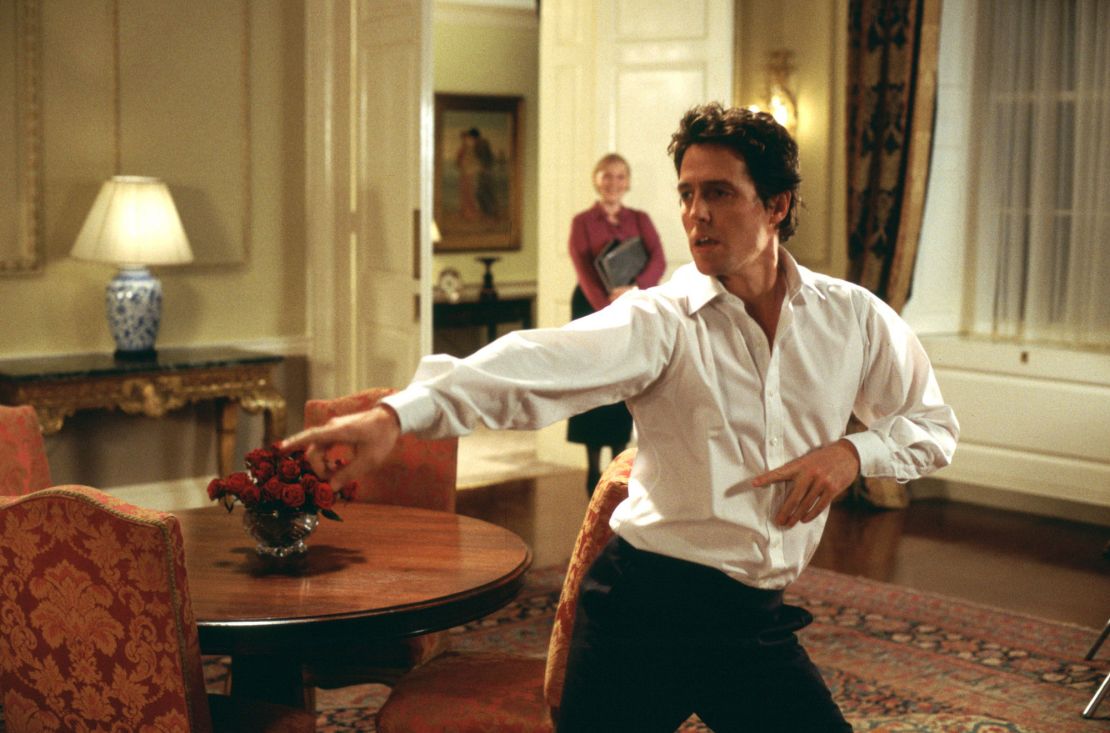
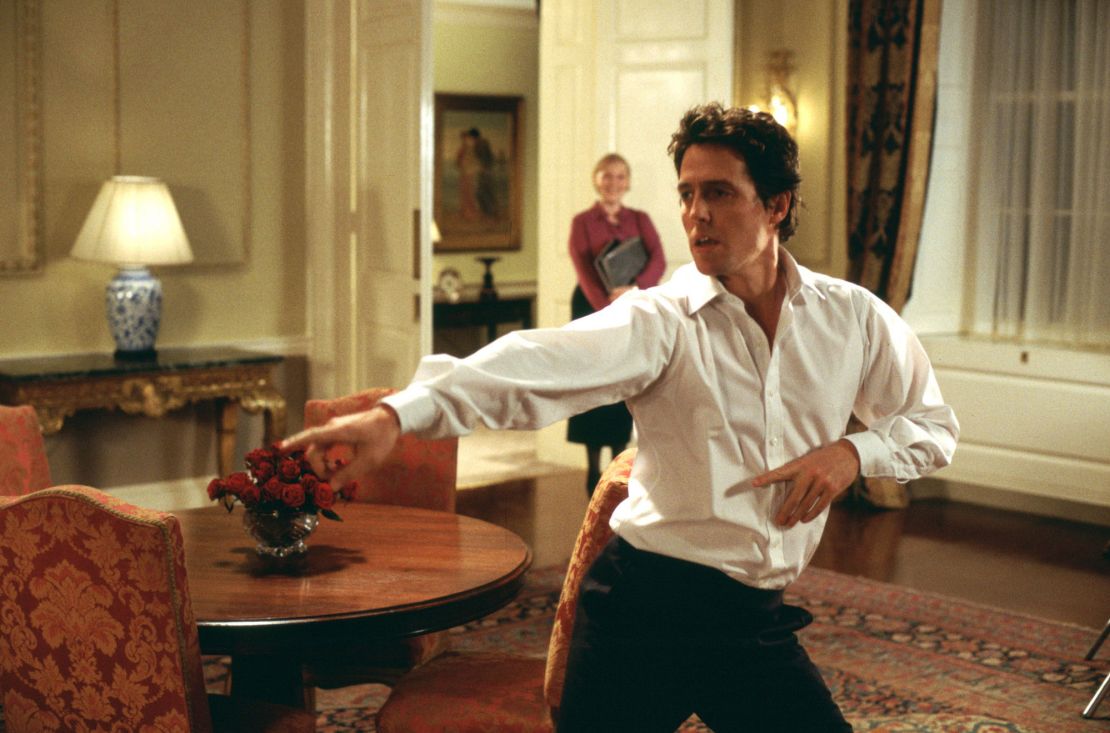
Every year, as the days grow colder and Christmas draws nearer, “Love Actually” quickly becomes a festive favorite on people’s television screens.
But nearly 20 years on from the release of the 2003 romantic comedy, the movie has faced scrutiny over its story lines and lack of diversity.
“There were things you’d change but thank god society is changing. So my film is bound, in some moments, to feel, you know, out of date,” the movie’s writer and director Richard Curtis said earlier this week.
Advertisement
He was speaking to Diane Sawyer as part of a documentary on ABC News titled: “The Laughter & Secrets of Love Actually: 20 Years Later.”
“Love Actually” features interweaving story lines, following several romantic relationships. However, most of the leading cast is White and all the relationships depicted are heterosexual.
Asked about any moments that might make him “wince,” Curtis said: “The lack of diversity makes me feel uncomfortable and a bit stupid.” He added: “I think there are three plots that have bosses and people who work for them.”
The movie features an impressive number of big names from the entertainment industry, with Alan Rickman, Emma Thompson, Hugh Grant, Chiwetel Ejiofor, Keira Knightley, Bill Nighy, Colin Firth, Liam Neeson, Martin Freeman, Laura Linney, Martine McCutcheon, Rowan Atkinson and Thomas Brodie-Sangster all appearing at some point.
Advertisement
Nearly 20 years on, “Love Actually” remains popular, becoming a staple of the holiday season.
“It’s amazing the way it’s entered the language,” Nighy said in the ABC News documentary.
“I’ve had people coming up to me saying ‘it got me through my chemotherapy,’ or ‘it got me through my divorce,’ or ‘I watch it whenever I’m alone.’ And people do, and people have ‘Love Actually’ parties.”
When asked if she understood why “Love Actually” had remained popular, Thompson replied: “I so do.”
“Because I think that we forget, time and time again we forget, that love is all that matters.”
Advertisement
Curtis has written several other popular romantic comedies, including “Four Weddings and a Funeral,” “Notting Hill” and “Bridget Jones’s Diary.”
“Four Weddings and a Funeral” was released in 1994 and notably portrayed a same-sex relationship between Matthew, played by John Hannah, and Gareth, played by Simon Callow.
Writing in the Guardian 14 years later, Callow said: “It almost defies belief, but in the months after the release of the film, I received a number of letters from apparently intelligent, articulate members of the public saying that they had never realised, until seeing the film, that gay people had emotions like normal people.”
Netflix is off to a hot start in 2026 when it comes to its big original movies. Starting with the acclaimed Emily Henry rom-com adaptation, People We Meet on Vacation, critics and audiences have both mostly been on board for what the streamer is serving up of late, from the Matt Damon and Ben Affleck heist thriller The Rip to Alan Ritchson‘s gritty sci-fi thriller War Machine, and the Peaky Blinders sequel film, The Immortal Man. This month will look to keep the success going with a new giant shark disaster flick, Thrash, and the tense survival thriller Apex, led by Charlize Theron and Eric Bana. It’s in May, however, when one of the platform’s most anticipated features will finally swim onto screens.
Remarkably Bright Creatures is slated to swim onto Netflix exactly one month from now with a cast anchored by Sally Field, Lewis Pullman, and Alfred Molina. However, only two of those three will be appearing on-screen. Field leads the trio as Tova, a widow spending her days cleaning the local aquarium during off-hours, when she meets a couple of unexpected friends in the form of a young man seeking family, played by Pullman, and a cantankerous octopus, voiced by Molina. The story is adapted from Shelby Van Pelt‘s debut novel of the same name, which burst onto the scene in 2022 and became an overwhelming success through word of mouth, with over 3.5 million copies sold to this day and a staggering run of over 65 weeks on the New York Times bestseller list. In anticipation of the film’s arrival, a new trailer has been released, teasing the heartfelt journey between the trio as they rediscover their sense of wonder together.
Much of the footage is narrated by Marcellus the octopus, who, for the most part, isn’t fond of humans from what little of their lives he’s seen from his tank. However, he experiences more appreciation for Tova than any of them, and he takes an interest in her budding bond with the wayward Cameron (Pullman). Initially, they don’t start on the right foot, given that Cameron is positioned as her replacement at the aquarium. With time, though, they each discover there’s more to each other’s stories. Tova uses the aquarium as a place of respite after not just losing her husband, but also her son, while Cameron is merely seeking work while he tries to find his long-lost dad. Marcellus is smart enough to deduce that they’re both suffering from a similar void in their lives, yet, perhaps, they’re the perfect people to fill it for each other. They slowly become the found family they both lack, pushing each other outside their respective bubbles, with a little assistance from their slimy eight-armed pal.
Advertisement
Advertisement
Collider Exclusive · Oscar Best Picture Quiz Which Oscar Best Picture Is Your Perfect Movie? Parasite · Everything Everywhere · Oppenheimer · Birdman · No Country
Five Oscar Best Picture winners. Five completely different visions of what cinema can be — and what it can do to you. One of them is the film that was made for the way your mind works. Ten questions will figure out which one.
🪜Parasite
🌀Everything Everywhere
☢️Oppenheimer
Advertisement
🐦Birdman
🪙No Country for Old Men
Advertisement
01
What kind of film experience do you actually want? The best movies don’t just entertain — they leave something behind.
Advertisement
02
Which idea grabs you most in a film? Great films are driven by a central obsession. What’s yours?
Advertisement
03
How do you like your story told? Form is content. The way a story is shaped changes what it means.
Advertisement
04
What makes a truly great antagonist? The opposition defines the protagonist. What kind of opposition fascinates you?
Advertisement
05
What do you want from a film’s ending? The final note is the one that lingers. What do you want it to sound like?
Advertisement
06
Which setting pulls you in most? Where a film takes place shapes everything — mood, stakes, what’s even possible.
Advertisement
07
What cinematic craft impresses you most? Every great film has a signature — a technical or artistic element that makes it unmistakable.
Advertisement
08
What kind of main character do you root for? The protagonist is the lens. Who you choose to follow says something about you.
Advertisement
09
How do you feel about a film that takes its time? Pace is a choice. Some films sprint; others let tension accumulate slowly, deliberately.
Advertisement
10
What do you want to feel walking out of the cinema? The best films leave a mark. What kind of mark do you want?
Advertisement
The Academy Has Decided Your Perfect Film Is…
Your answers have pointed to one Oscar Best Picture winner above all others. This is the film that was made for the way your mind works.
Advertisement
Parasite
You are drawn to films that operate on multiple levels simultaneously — that begin in one genre and quietly, brilliantly migrate into another. Bong Joon-ho’s Parasite is a film about class, desire, and the architecture of inequality that manages to be darkly funny, deeply suspenseful, and genuinely shocking across a single extraordinary running time. Your instinct is for cinema that hides its true intentions until the moment it’s ready to reveal them. Parasite is exactly that — a film that rewards close attention and punishes assumptions, right up to its devastating final image.
Advertisement
Everything Everywhere All at Once
You want it all — and this film gives you all of it. The Daniels’ Everything Everywhere All at Once is one of the most maximalist films ever made: action comedy, multiverse sci-fi, family drama, existential crisis, and a genuinely earned emotional core that sneaks up on you amid the chaos. You are someone who responds to ambition, who doesn’t want cinema to choose between being entertaining and being meaningful. This film refuses that choice entirely. It is overwhelming by design, and its overwhelming nature is precisely the point — because the feeling of being crushed by infinite possibility is exactly what it’s about.
Advertisement
Oppenheimer
You are drawn to cinema on a grand scale — films that understand history not as a backdrop but as a force, and that place their characters inside that force and watch what happens. Christopher Nolan’s Oppenheimer is a film about the terrifying gap between what we can do and what we should do, told with the full weight of one of the most consequential moments in human history behind it. You want your films to feel important without feeling self-important — to earn their ambition through sheer craft and the gravity of their subject. Oppenheimer does exactly that. It is enormous, complicated, and refuses easy comfort.
Advertisement
Birdman
You are drawn to films that foreground their own construction — that make the how of the filmmaking part of the what it’s about. Alejandro González Iñárritu’s Birdman, shot to appear as a single continuous take, is cinema examining itself through the cracked mirror of a fading actor’s ego. You respond to formal daring, to the feeling that a film is doing something that probably shouldn’t be possible. Michael Keaton’s performance and Emmanuel Lubezki’s restless camera create something genuinely unlike anything else — a film that is simultaneously about creativity, relevance, self-destruction, and the impossibility of ever truly knowing if your work means anything at all.
Advertisement
No Country for Old Men
You are drawn to cinema that trusts silence, that refuses to explain itself, and that treats dread as a form of meaning. The Coen Brothers’ No Country for Old Men is a film about the arrival of a new kind of evil — implacable, arbitrary, and utterly indifferent to the moral frameworks we use to make sense of the world. It is one of the most formally controlled films ever made, and its controlled restraint is what makes it so terrifying. You want your films to haunt you, not comfort you. You are not interested in resolution if resolution would be dishonest. No Country for Old Men is honest in a way that most cinema never dares to be.
Advertisement
Advertisement
‘Remarkably Bright Creatures’ Cast Brought Heart and Levity to the Story
Where the Crawdads sing director Olivia Newman directed Remarkably Bright Creatures and co-wrote the screenplay with John Whittington. In front of the screen, Newman had a bounty to work with in addition to the starry main trio, including Colm Meaney, Joan Chen, Kathy Baker, Beth Grant, and Sofia Black D’Elia. In an interview for Collider’s Exclusive Spring Preview series, however, she attested that the Norma Rae and Thunderbolts stars were some of her personal favorites for how they meshed together and managed to bring surprising humor to the very heartfelt story of loss, grief, and finding connection.
“Working with Sally and Lewis was a career highlight for me. They are both so present and open as actors and had this incredibly organic chemistry that made every scene come to life in the most unexpected ways. They are both deeply committed actors, willing to go to their most vulnerable places, but also to find joy and humor at any moment. I don’t think I have laughed as much every day as I did working on this film with the two of them!”
Remarkably Bright Creatures swims onto Netflix on May 8. Check out the new trailer in the player above.
People reported on Tuesday, April 7, that Dakota, 33, apparently tattooed “TFP” inside his mouth on Valentine’s Day in February, as Taylor, 31, claims that he exhibited “increasingly possessive” behavior in the lead-up to her season of The Bachelorette airing. (The season, which was ultimately canceled by ABC, was due to premiere on March 22.)
Dakota allegedly got the tattoo hours after Taylor posted a promotional post for The Bachelorette season 22 and showed it off to costars and on camera, per People.
Taylor said she “was shown” an image of Dakota’s lips, tattooed with her initials, on February 17, People reported, citing the court documents. She said he later “confirmed” the tattoo through a text message exchange.
“Considering his increasingly possessive and erratic behavior, and considering the fact that we were not in a relationship, this was extremely alarming,” she wrote in Tuesday’s filing, per the outlet. “My initials are now permanently tattooed on the body of a man who has been abusive toward and possessive of me.”
According to Taylor, Dakota also sent her text messages in mid-February reading, “I want you forever” and “I still love and want you,” in the weeks leading up to The Bachelorette premiere on ABC.
Us Weekly has reached out to Dakota’s representative for comment.
Taylor Frankie Paul is bolstering her defense against Dakota Mortensen amid their ongoing custody battle following an alleged domestic dispute earlier this year. Taylor, 31, claimed that Dakota, 33, sent her a “request for sex” following their alleged February domestic violence altercation, according to an exhibit filed in court on Tuesday, April 7, seen by […]
Taylor filed for a temporary protective order against Dakota on Tuesday, weeks after he was granted his own protective order — and temporary custody of their 2-year-old son, Ever — on March 20.
Advertisement
The exes appeared in court virtually on Tuesday to discuss visitation rights. Taylor was granted eight hours of supervised visitation time with Ever until their protective hearing on April 30. The judge is expected to reevaluate the TikTok influencer’s parenting time restrictions during the April 30 hearing.
Thank You!
You have successfully subscribed.
ABC pulled Taylor’s season of The Bachelorette on March 19, just days before it was set to air, after footage emerged of a 2023 domestic violence incident involving the Mormon Wives star and her ex.
Advertisement
The video was published by TMZ just days after it was reported that production on season 5 of The Secret Lives of Mormon Wives had paused amid allegations of a fresh domestic dispute between Taylor and Dakota in February. Utah’s Draper City Police Department confirmed to Us in March that it had an open “domestic assault investigation” involving the exes, with allegations “made in both directions.”
If there’s one streamer you should subscribe to in April, it’s Hulu. The Disney-owned platform is adding so many high-quality films and shows this month that you won’t have time to watch anything else. At the top of Watch With Us‘ binge-watch list is Malcolm in the Middle: Life’s Still Unfair, which reunites most of […]
‘Pizza Movie’ (2026)
Advertisement
Some films might reject the stoner comedy label, but Pizza Movie fully embraces it. Jack (Gaten Matarazzo) and Montgomery (Sean Giambrone) are a pair of unpopular freshmen roommates who try an experimental drug in their dorm room. They only expected to get high, but it triggers a bizarre shared trip that breaks reality down around them and threatens to damage their minds from its intensity.
One of their classmates, Lizzy (Lulu Wilson), winds up in the same predicament. That’s why she’s forced to join the guys as they attempt to bypass the dorm’s Resident Advisors. The only thing that can break them out of this bad trip is pizza, but their drug-induced visions make it difficult to go more than a few steps at a time before experiencing something off the wall.
It’s not often that Hulu gives us a front-row seat to history. ABC News’ ongoing coverage of the Artemis II mission is being shared via Artemis II: Mission to the Moon on Hulu, which has the latest updates as the flight gets closer to the moon. NASA’s Reid Wiseman, Victor Glover, and Christina Koch, as well as the Canadian Space Agency’s Jeremy Hansen, are the first crew to break away from Earth’s orbit since 1972.
While this crew won’t be landing on the moon, they will be performing an important test of the Orion spacecraft to see how it performs during its lunar flyby. This is to pave the way for the Artemis IV mission, which is aiming to put astronauts on the moon’s South Pole in 2028. If all goes smoothly, in three years, humanity will once again set foot on the lunar surface.
Artemis II: Mission to the Moon is streaming on Hulu.
‘The Testament of Anne Lee’ (2025)
Advertisement
Thank You!
You have successfully subscribed.
Despite having awards season potential, The Testament of Anne Lee was completely shut out from the Oscars. That’s unfortunate, because Amanda Seyfried delivered a dynamic performance as Ann Lee, the founder of the Shakers religious movement in the 18th century. This is a musical that also lets Seyfried show off the power of her voice.
The film chronicles Lee’s life alongside her brother, William Lee (Lewis Pullman), as it dramatizes the experiences that turned Lee off to sex forever. That eventually leads her to an epiphany that humanity needs to avoid marriage and sex to move past the original sin. While Lee has her followers, her divine mandate isn’t popular with outsiders, and it may get the Shakers brutalized or even killed.
Us Weekly has affiliate partnerships. We receive compensation when you click on a link and make a purchase. Learn more!
Brooke Shields and I may not have a whole lot in common. She’s a legendary actress, fashion mogul and icon, and I’m just your friendly neighborhood shopping editor who’s based in Queens, NY. But one thing we can both agree on? Our affinity for Rothy’s shoes.
In a recent ‘What’s in My Bag’ video, Shields dished on all the items she has in her Hermès Birkin bag — and the first thing she pulled out is her Rothy’s flats. “I’ve been in high heels, so I’m going to take my high heels off and put my little Rothy’s on,” she told Shop Today. “I always have a pair of flats in my bag. Always because I can’t wait to take my shoes off.” And honestly, same.
Advertisement
While wearing heels in New York City feels like an absolute nightmare, you can say I skip the pumps and go straight for my Rothy’s, which gives me all-day comfort. No blisters, rubbing or squeezing. The popular shoes are simply elevated, cushiony and quite honestly, some of my go-tos for spring. It’s a good thing there are tons of spring-ready Rothy’s shoes right on Amazon, including Shields’ exact pair!
Spring-Ready Rothy’s Shoes on Amazon
1. Celeb-Approved: The Rothy’s Point II flats are chic, expensive-looking and so versatile. It’s no wonder these are the shoes Shields reached for before heading out the door. Designed with a semi-pointed front and V-shaped topline, the shoes look positively luxe. But don’t be afraid of the pointed toe; the style won’t squeeze or feel too narrow like other options on the market.
2. Designer-Looking: Just one look at these slingback shoes and I’m already envisioning walking to Tiffany’s with a croissant in hand. Yes, it’s all very Breakfast at Tiffany’s vibes mainly due to the color-block design, enlisting a black tip and a cream base. Plus, the back strap helps to keep them securely on. Editor tip: I’m a half size, so I went down a size to avoid the strap from falling down.
3. Everyday Essential: I recently got the Daily Driver slip-ons and wore them the moment the temperature hit 70 degrees Fahrenheit. The wide toe box and arch-supporting insole make the shoes surprisingly comfortable. They provide just enough give and feel very spring-like in comparison to my leather Vagabond loafers. I also love the fun checkered print here!
Everyone wants to feel cool and comfortable while running errands, dining alfresco and doing anything outdoors. But in the spring? There’s a whole other layer of complication. The tricky weather can be cool and rainy one minute, and then sunny and sweat-inducingly warm the next. If you ask Us, it’s why adding linen clothing to […]
4. Laid-Back Luxe: Do these clog shoes look familiar? If so, it’s probably because you’ve seen celebs like Jennifer Lawrence rocking them while out and about in NYC. The clogs have an easy slip-on design, a plush insole and a soft knit exterior that gives cool-girl vibes when paired with crew socks.
Advertisement
5. Editor-Favorite: Just ask anyone, and they’ll tell you that I wear these Mary Jane flats every chance I get. I love the dainty strap, flexible construction and machine washable design. Yes, you can throw these (and the other shoes on the list) in the washing machine, which I’m thankful for, seeing as I wear these a little too much. Whoops!
6. Closet Hero: If you want a classic style, you can’t go wrong with The Daily Flat. It has a rounded toe, V-shaped topline and a cushiony insole, making this pick ideal for long walks, sightseeing and the like. Go with the red for a burst of color.
7. Anything But Basic: These loafer mules are new to me, and I’m kind of astonished by how expensive they look. I’m telling you, they look designer. It’s all thanks to that gold signet bit on the top of the shoe that makes it feel worthy of your work wardrobe, church attire and dinner date closet.
Oh, and if you wanted to match your footwear with your accessories, you have to check out Rothy’s bags, like this casual crossbody that can also be worn as a shoulder bag or this roomy tote that can hold everything for work days, picnics and brunches. Psst, they’ll pair so well with your Shields-approved flats!
Sporty girls, our season is finally here! It’s time to get outside and hit the track, golf course and court now that the sun’s out. While tennis is a fan favorite, there’s no question that pickleball slowly made its way up the charts to being one of the most buzziest ‘new’ sports for spring. To […]
New England Patriots’ head coach Mike Vrabel and sports journalist Dianna Russini have broken their silence after they were spotted holding hands and hugging while seemingly on vacation.
The pictures, which were published by Page Six on Tuesday, April 7, showed Vrabel, 50, and Russini, 43, spending time together at a plush resort in Arizona. According to the outlet, the pictures, in which the pair clutched hands and wrapped their arms around one another on a rooftop, were taken “two weekends ago” at a boutique hotel in Sedona.
Additional photos published by the outlet showed the duo relaxing by a pool next to one another, enjoying time in an outdoor spa together and individually walking around the same outdoor space.
“These photos show a completely innocent interaction and any suggestion otherwise is laughable,” Vrabel, who shares two children with wife Jen, told the Post, per reporting by NBC Sports, on Tuesday. “This doesn’t deserve any further response.”
The New England Patriots are headed back to the Super Bowl and no one is more excited than Ann Michael Maye, wife of starting quarterback Drake Maye. “WE ARE GOING TO THE SUPER BOWL!!!!!❤️💙❤️💙” she wrote via Instagram on Monday, January 26, alongside photos of the two of them celebrating on the field. “Words can’t […]
Russini, who shares two children with husband Kevin Goldschmidt, also reacted to the snaps making headlines, telling the outlet, “The photos don’t represent the group of six people who were hanging out during the day. Like most journalists in the NFL, reporters interact with sources away from stadiums and other venues.”
Advertisement
Russini currently covers the NFL for The Athletic. The outlet’s executive editor, Steven Ginsberg, gave his own statement about the journalist on Tuesday. “These were public interactions in front of many people,” he said, adding, “Dianna is a premier journalist covering the NFL and we’re proud to have her at The Athletic.”
Mike VrabelThearon W. Henderson/Getty Images
Us Weekly has reached out to representatives for Vrabel and Russini for comment.
Vrabel, a former NFL player who won three Super Bowls with the Patriots, spoke to The Athletic in January 2025 about celebrating his 25th wedding anniversary with wife Jen in Italy several months prior.
The pair were college sweethearts after forming a connection as students at Ohio State University. Jen said in an interview with ESPN in 2019 that as her husband’s coaching career developed after playing football, the pair ensured their family remained a top priority.
Dianna RussiniEthan Miller/Getty Images
“Fridays are always our nights because we have a teenage son that doesn’t want to hang out with Mom and Dad, so he goes to high school football games,” Jen told the outlet at the time. “It’s fun. He’s usually home earlier, and we grab dinner. When he coached in college, he really didn’t have a night like that, so we cherish that night. It was the same when he played. Fridays were always the best. It became like a date night or family night.”
As for Russini, who built her career as a broadcaster for ESPN, the reporter reflected on her marriage to Goldschmidt via Instagram in September 2022.
Advertisement
“2 years today was the best day of my life—when I married Kev in front of our family and dozens of friends over Zoom,” Russini wrote, recalling her wedding ceremony amidst the coronavirus pandemic. “It’s you and only you, for me, forever.”
Thank You!
You have successfully subscribed.
Given Russini and Vrabel’s longtime involvement in the NFL, their paths have crossed over the years. In 2024, Russini said on the “Pardon My Take” podcast that Vrabel had phoned her to complain about a report she was involved in.
Advertisement
“He called me the day after an aggregator took something I said that basically said Mike Vrabel is too fat to work,” Russini said at the time. “What I shared … was that I had dinner with a GM at the Senior Bowl and we had conversations about how bizarre this last coaching cycle was and how crazy it was that [former Patriots coach Bill] Belichick and Vrabel didn’t have gigs.”
She added that the podcast delved into Vrabel’s large physical stature, which sparked a phone call. “When the aggregators took that and changed all this, you know, the way I said it … he didn’t call me after the piece we did on why he got fired. But the piece … calling him a little fat, he wasn’t too happy.”
During the Wednesday, April 8, series premiere, it was revealed that new Pearl Girl Daisy (Lucy Halliday) is actually involved in Mayday. A day in her life before she arrives in Gilead is shown at the end of the episode, where she skateboards into her parents’ store as June is seen watching her in the background.
June reappears again in the show’s third episode, as viewers learn more about Daisy and what leads to her joining Mayday. Before Moss’ surprise cameo, stars Rowan Blanchard and Mattea Conforti spoke exclusively to Us Weekly about the actress’ involvement.
“We haven’t met her [yet] but we are really hoping to meet her soon,” 24-year-old Blanchard, who plays Shunammite, said. “She’s our producer and she was really involved in the show and what it would look like.”
Advertisement
Conforti, 19, who brings Becka to life, pointed out that June hasn’t met their characters — yet. Their costar Chase Infiniti also hinted that she didn’t cross paths with Moss, 43, while on set despite playing her onscreen daughter.
“I actually didn’t get to meet Elisabeth Moss really until the end [of filming],” Infiniti, 25, told People in March.
Infiniti, who plays Hannah a.k.a Agnes on the Hulu series, recalled the advice Moss gave her once they did meet, recalling how Moss “wrapped me into a big hug and was kind of like, ‘You got this. You got this. OK? You got it.’”
Based on Margaret Atwood’s novel of the same name, The Handmaid’s Tale,which aired from 2017 to 2025, took place in a dystopian future where low fertility rates led women to be assigned to men for bearing children.
Advertisement
Thank You!
You have successfully subscribed.
The Testaments, which is set several years after the events of The Handmaid’s Tale, is narrated by Ann Dowd‘s Aunt Lydia. As viewers are thrust back into the dystopian future, they follow characters such as Agnes from Gilead and Daisy from Canada as they secretly gather and smuggle incriminating information about Gilead’s regime out of the country. Agnes and Daisy pose as “Pearl Girls” to infiltrate Canada, while Aunt Lydia acts as a covert source within Gilead.
In addition to Infiniti, Dowd and Halliday, The Testaments stars Eva Foote, Kira Guloien, Amy Seimetz and Brad Alexander. Birva Pandya, Zarrin Darnell-Martin, Shechinah Mpumlwana, Mabel Li and Isolde Ardies make up the rest of the cast.
In an Instagram video shared on Tuesday, April 7, Amy, 39, reflected on the child molestation charges filed against Joseph, 31, last month and the 2021 sex offender conviction that currently has Josh, 38, incarcerated.
“When one family member goes to prison for crimes against children and then another brother goes to jail allegedly for crimes against children, that is not a coincidence,” Amy told fans in the post. (Joseph was arrested in Arkansas on March 19 and extradited to Florida on March 31 before he was released on $600,000 bail.)
Amy continued, “That’s not random, that’s not bad luck, that’s not anything like that. That’s called a pattern. And patterns don’t come from nowhere. Patterns come from what’s been protected, what’s been ignored, and what’s been allowed to continue. At some point, you have to stop asking yourself, ‘How did this happen again?’ and realize that there is an environment that let this happen in the first place.”
Advertisement
Josh, the eldest of Jim Bob and Michelle Duggar’s children, is serving a 151-month federal prison sentence following his April 2021 arrest on grounds of receiving and possessing child pornography. Josh maintained his innocence but was found guilty in December that year. He is scheduled to be released in December 2032.
Joseph, the seventh oldest child belonging to Jim Bob, 60 and Michelle, 59, was last month charged with lewd and lascivious behavior involving molestation of a victim less than 12 years old. He was also charged with lewd and lascivious behavior conducted by a person 18 years or older. The charges were presented after a 14-year-old came forward to police accusing Joseph of molesting her when she was 9-years-old during a 2020 vacation to Panama City Beach, Florida.
Additionally, Joseph and his wife, Kendra Duggar, were both charged with four counts of endangering the welfare of a minor, second-degree, and four counts of second-degree false imprisonment. These secondary charges are unrelated to Joseph’s molestation allegations, and Kendra, 27, was released on bond the same day she was arrested.
Amy, who is the daughter of Jim Bob’s older sister Deanna Jordan, continued to address the family’s troubles in her Instagram post. “So two brothers now with mug shots, and victims that are young, allegedly, that is not a pattern, that is exposure to something deeper and something darker,” she stated. “You can’t protect your reputation and protect children at the same time in this kind of closed system.”
Advertisement
Thank You!
You have successfully subscribed.
Amy continued, “I’m sure we all have questions. For example, how many were there that were not reported of the same kind of situation? How many more children were not protected when they should have been? How many more enablers [exist] and who knew all this information? I guarantee you someone knew in this family and didn’t say a thing. The scariest part for me is not the information we do know — it’s … all the information that we don’t right now because I guarantee you, there’s more to this story.”
A vocal critic of Joseph since news of the arrest broke, Amy told Us Weekly in a statement following his arrest that she was “sickened, heartbroken and deeply angry” about the allegations against him.
Advertisement
If you or someone you know has been sexually assaulted, contact the National Sexual Assault Hotline at 1-800-656-HOPE (4673). If you or someone you know is experiencing child abuse, call or text Child Help Hotline at 1-800-422-4453.





:max_bytes(150000):strip_icc():format(jpeg)/The-Devil-Wears-Prada-2-111225-3-6f56411517d64857ac20af9168e20699.jpg)
:max_bytes(150000):strip_icc():format(jpeg)/traylor-frankie-paul-dakota-mortensen-111025-f0a3bbaccd184ceb8cdf5c73330cbdf1.jpg)


:max_bytes(150000):strip_icc():format(jpeg)/Joey-Fatone-040726-2a5813a2c17747dcb007a97e8658cec8.jpg)






































You must be logged in to post a comment Login