
Related: Jennifer Aniston Gave Loafers a Polished Upgrade, and the Look Is Just $38
Advertisement


By Chris Sawin
| Updated

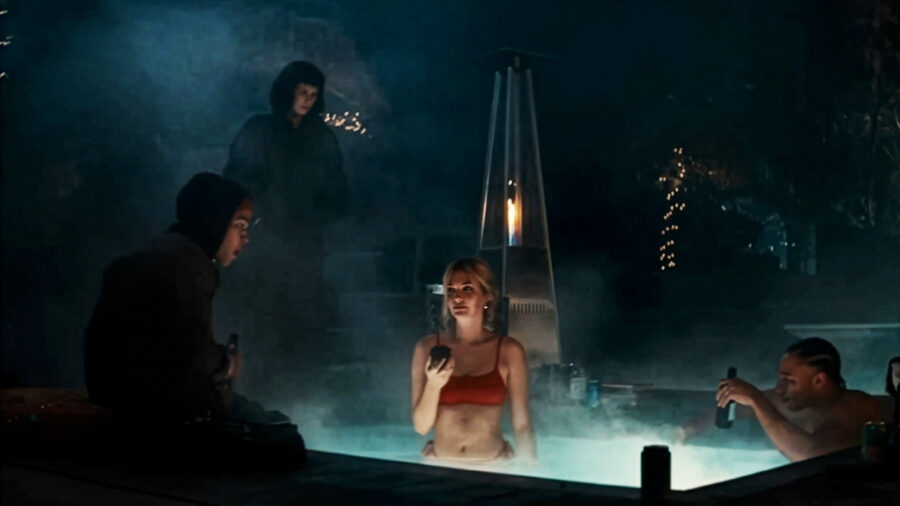
In a nutshell, Whistle is about a group of high school kids terrorized by an Aztec death whistle. Originally thought to “summon the dead,” once someone is inclined to blow on this obviously very deadly, skull-shaped, probably doesn’t feel great to rub all over your lips, contraption, this whistle actually summons your death.
Directed by Corin Hardy (The Hallow) and written by Owen Egerton, Whistle dictates that your specific death is chasing you the moment you are born and is trying to catch up with you your entire life. Sometimes we die of old age, and sometimes we die young and far too soon, but blowing the whistle makes your future death find you in a matter of days. Death looks exactly like you and suffers from whatever you would have on your deathbed.

Chrys (Dafne Keen) moves in with her cousin, Rel (Sky Wang), and starts at Pellington High, where she meets Grace (Ali Skovbye), her jock boyfriend, Dean (Jhaliel Swaby), and Grace’s friend, Ellie (Sophie Nelisse), whom Chrys likes. Hoping to blend in and forget her past, Chrys finds a whistle in her locker. After a shared detention, someone blows the whistle, and those who hear its piercing screech soon face death. Now, the survivors must uncover if they can escape the whistle’s deadly power.
There’s a strange art to Whistle; it shouldn’t be as good as it is. The film is a cliché high school drama, infused with the year’s bloodiest deaths so far. Chrys, being a lesbian, feels like a natural, non-stereotypical progression in the story. She’s gay and facing a world of trouble. That’s the main draw, aside from the Native American kazoo of death, massacring people for fun. The youth pastor-drug dealer-switchblade wielder isn’t essential, but horror films always find a use for such characters.
Chrys’s situation was already difficult before her introduction: she recently recovered from an overdose and her father’s death. Keen’s performance is withdrawn and hesitant, yet eager for normalcy. Chrys and Ellie are the film’s most grounded characters, likely explaining their attraction.

Whistle is not unlike any other horror film revolving around a cursed artifact; in fact, it’s incredibly similar. This is The Monkey with a different toy or Final Destination with a skull-faced instrument calling the shots. Whistle is Jumanji with fatalities and a little bit of The Frighteners just for good measure.
The film opens at a Pellington High basketball game. A player named Mason (Stephen Kalyn) is haunted by a burnt figure (I nicknamed him Crispy Carl) lurking in the bleachers. Mason noticeably freaks out during the game, but makes the game-winning shot. Not before the burnt figure, still smoking with embers glowing all over his body, lunges at him. Back in the locker room, Mason screams about it not being his time yet and takes the whistle out of his locker before smashing it on the ground. Later, thinking he’s cheated death, the burnt figure finds him in the shower and puts his burning arm down his throat. Mason’s teammates find him flailing about as his engulfed body burns to a crisp.

The deaths in Whistle are super creative and among the most entertaining in a horror film in a long time. Some of them range from lung cancer to old age, but there are two deaths that are unbelievable. One involves drunk driving, and the other involves working at a sawmill, but what makes them special is that the causes are invisible.
You see the effect and know the cause, but since the death is instantaneous, it’s just this gruesome display that makes little sense to anyone not familiar with the whistle. The drunk driving death sees the victim get bent up and contorted while floating in the air, and it’s as nasty and memorable as it sounds. The saw mill death is more of a presentation as it sprays blood everywhere and leaves the victim in this crumpled, limbless ball.

Whistle‘s writing is standard and mediocre, typical of films about summoning death with percussion. However, horror fans will appreciate the creative deaths, solid acting, and an ending that leaves you wanting a sequel.

Whistle was released nationwide in theaters on February 6.

By Robert Scucci
| Published

Have you ever wanted to book a romantic weekend with your better half just to get away from it all and rediscover the magical feelings that brought you together in the first place? If you’re smart, you’ll get a nice hotel within walking distance of the beach and all your favorite restaurants. That’s the safest bet.
Otherwise, you could end up like Jessie (Carla Gugino) in Gerald’s Game (2017), handcuffed to a bed in a remote cabin where nobody can hear you scream. Your husband has died of a heart attack after taking too much viagra, he’s getting eaten by the stray dog you fed earlier that found its way inside, and you’re hallucinating a demon known as the Moonlight Man, who stands just outside your field of vision and taunts you. You’re about one cup of water away from dying of dehydration because you can’t reach the keys, and by the time anybody finds you, it will be far too late.

What I’m trying to say here is that Gerald’s Game is a beyond solid psychological thriller, but not the kind of scenario you’d want to live through when you’re just trying to reignite the spark in your marriage. For that, just hire a babysitter and go bowling.
Gerald’s Game starts out innocently enough, but since it’s a Stephen King adaptation, you should expect the usual dark turns. Jessie and Gerald’s (Bruce Greenwood) trip to remote Alabama was never supposed to turn into a tragedy, but fate wasn’t on their side that evening. In an ideal world, the couple would live out their wildest sexual fantasies, cook some steaks, drink some wine, and head home with their marriage successfully rejuvenated.

Instead, Gerald dies of a heart attack after taking viagra and pushing his fantasy a little too far, upsetting Jessie, who didn’t want to take part in the kind of role-playing he was into. Handcuffed to her bed and unable to reach her phone or the keys, Jessie is completely alone, and things are about to get dark, both literally and figuratively.
The stray dog Jessie fed a cut of Gerald’s expensive steak to earlier finds its way into the house because Gerald left the door open. Hungry and looking for more food, the dog realizes that Gerald’s fresh corpse will provide all the sustenance it needs for the next couple of days. Fearing she’ll suffer a similar fate if she dehydrates before freeing herself, Jessie panics, which sends her spiraling in the worst way.

Not only is the prospect of Jessie dying handcuffed to her bed very real, but the dog also comes and goes as it pleases and will probably turn on her once it finishes with Gerald. To make matters worse, Jessie becomes delirious from lack of food and water, causing her to hallucinate a living Gerald who taunts and belittles her. Even worse, she sees a boogeyman lurking in the darkest corners of the bedroom, calling himself the Moonlight Man, who is either a figment of her imagination or an actual intruder.
Since we’re seeing everything from Jessie’s perspective in Gerald’s Game, the waters are muddied by her anxiety, her trauma, and her lack of sustenance. In so many words, Jessie is an unreliable protagonist, but there’s something else going on here that elevates this above your typical psychological thriller. Jessie is a strong-willed woman stuck in an unthinkably horrific situation. She’s not your typical damsel in distress, which makes her breakdown all the more effective.

Jessie’s predicament stirs up a whirlwind of emotions tied to her past, having been mistreated by her father as a little girl in ways that mirror Gerald’s fantasies before he died. What’s more, Jessie may not be as unreliable as you think when you consider the shots that play out from a more objective, almost omniscient perspective. She’s dealing with serious trauma, that goes without saying, but something else is happening just beneath the surface that will make your skin crawl when you realize what may actually be at play.
She’s rightfully in a heightened state due to her life-or-death conditions, and it’s implied that she normally has her wits about her when she’s not trapped in this very specific set of circumstances. Her anxieties are valid here, and her regression into her past traumas is triggered by what’s specifically happening to her in the present. It all makes for a rich character study that only the best psychological thrillers understand how to lay out for the audience.

Gerald’s Game is not for the faint of heart, but if you have the stomach for it, it’s one of the best psychological thrillers streaming on Netflix today.
Sam Raimi’s Send Help was a well-received throwback to the Spider-Man director’s low-fi (or at least lower-fi) roots, much like 2009’s excellently mean-spirited Drag Me to Hell, and it smartly capitalized on a recent trend of survival thriller movies. It has a 93 percent on Rotten Tomatoes and made $94 million, because audiences are in the mood for movies about people overcoming terrible experiences these days. Now Netflix is going to hop on the trend in April with the upcoming survival thriller Apex.
Starring Charlize Theron and Taron Egerton, Apex was directed by Icelandic filmmaker Baltasar Kormákur — who also made the harrowing survival movie Everest. Unlike that movie’s grounded, real-life story, Apex is about a woman who goes on a wilderness adventure and is stalked by a killer. It’ll be available on Netflix on April 24.

Maybe it’s because the average movie-watcher spent a year or so inside their home in the not-so-distant past, but people seem drawn to stories about being trapped in dangerous situations and surviving impossible odds. It’s the thrill of being out in nature paired with the thrill of proving the depths of your inner strength, all in the name of the kind of “what would I do in this situation?” fantasy that everyone has considered once or twice while watching a movie. It could also be a reaction to superhero movies, since those are all about special people doing special things, whereas survival movies are generally about normal people doing special things.
Another strength of survival thrillers is how malleable the genre is. Apex positions the desperate survivor as the hero, but Send Help was about a woman realizing how much she thrived in a survival situation and using it to her advantage to torment someone who terrorized her in her normal life. And yet both movies fit into the same genre! Survival thrillers can be about the excitement of someone surviving (humanity is great), or they can be about the schadenfreude of watching someone fail at surviving (nature is great), or, in the case of Apex and Send Help, they can simply be about how Charlize Theron and Rachel McAdams are great.

Can You Hum These Iconic Film Scores? It’s the Collider Movie Quiz!
A good score elevates a film’s emotional impact. A great score affects you long after the movie’s over. Here are a few examples of that excellence.

The survival thriller genre has blown up in the last few years, and Netflix has a handful of notable ones beyond the upcoming Apex: J.A. Bayona’s Society of the Snow is based on a true story about the members of a rugby team whose plane crashed in the Andes Mountains in the ‘70s. The Swimmers is another one based on a true story, focusing on two Syrian refugees who helped guide a boat of other refugees across the Aegean Sea. Going a little further back, there was the smash-hit Bird Box, which was at least about surviving a tough situation even if it wasn’t so much about the wilderness.
Outside of Netflix, there’s Ridley Scott’s The Martian (based on a book by Project Hail Mary’s Andy Weir, of course) and Alien, because what is outer space if not the ultimate wilderness? Good survival thrillers also tend to be huge for the people who make them, like Cast Away, The Revenant, and 127 Hours. Perhaps every great director has a survival thriller in them? Saving Private Ryan is about surviving war, if that counts, and GoodFellas is about surviving the mob, so there are Spielberg and Scorsese.

April 24, 2026
Baltasar Kormákur
Jeremy Robbins

Spinning the block on an ex is one of those ‘proceed with caution’ actions. But in the RARE cases that things work out, that renewed love can be a sight to see! Take Nelly and Ashanti, for example! This week, fans gushed about the couple’s happiness after a new video showed an impromptu karaoke session that left them both smiling and laughing. Reactions have even teased that Nelly, specifically, hasn’t stopped cheesin’ since seeing Ashanti on that Verzuz stage four and a half years ago.
On Monday (March 30), The Shade Room reposted a video of Nelly and Ashanti vibing in what appeared to be their home. It’s unclear whether the couple was headed out the door or just getting back, since they were both dressed. Ashanti in her red fur, and Nelly in his crisp white tee. Also, they both had diamonds on their ears and necks. The clip itself is only a few seconds long. Shanti introduces Nelly as her “baby daddy,” and then they randomly start singing Johnny Gill’s ‘My My My’ before busting out laughing. Watch the wholesome moment below.
As mentioned, that moment with the Haynes set fans off…in a good way! Folks were especially here for the overall joyful energy in the video. A spin-the-block love story for the ages! Married, in love and at peace are some of the things the roommates, especially, pointed out in over 1,500 comments reacting to “The Haynes” clip.
@yanifnii wrote, “It still makes me happy this happened.”
“A successful spin the block story,” @itzbeautifulgurl said.
“It’s the fact that he spun the block and ain’t stop smiling since and neither has she ❤️❤️❤️❤️,” @_sittinprettywidit_ added.
@thevibeconnoisseur_ also said, “Still ain’t stopped smiling. I love it.”
“I never knew Nelly smiled so much it’s true that the right person brings the right happiness out of you,” @bknica_323_ commented.
“This is what I’m better with you than without you looks like ❤️,” @msnikki_iam wrote.
“They match each other’s energy 😍,” @suckafree_365 added.
@brownskin__asian commented, “They belonged together even we knew it 😍.”
“This man have not been this happy in a long time Ashanti came back and the grass was way greener on her side 😂😂❤️,” @caramel_d_light said.
“Can’t even hate on them, they are bestfriends and husband and wife. They are definitely meant to be together,” @tonidwrld added.
@_missprettywu commented, “For all the haters. Saying just cause they smiling don’t mean they happy. How u know that?? Relationships have ups and downs. And when u aren’t happy it’s hard to hide. So good for them RELATIONSHIP GOALS ♥️.”
Still, not all of the comments were glowing reviews. Some roommates, like @angmadson71, tagged Ashanti, showing her love while saying she can’t support Nelly. Others like @coolie_melanin and @daethewriter labeled him a Trump supporter and called out the rapper for not speaking against the president. Some like @thesweetestspice reminded Nelly that he’s still “cancelled.”
So where is the Trump affiliation coming from? Last year, Nelly performed at an inaugural ball dedicated to Trump. After video surfaced on social media, fans went IN, dissing the rapper for seemingly supporting the controversial president.
Nelly fueled the flames when he clarified in interviews that his performance wasn’t political. According to Rolling Stone, the artist claimed it was an “honor to perform for the president of the United States, regardless of who is in office.” Months later, in June, he was still defending himself. Stepping into The Shade Room, Nelly said that he and Snoop Dogg, who faced similar backlash over a Trump performance, “do more in the community” and have done so for over 20 years.
Swipe below to see his full response.
What Do You Think Roomies?

By Jonathan Klotz
| Published

The debate over the best of anything can often be hard to settle, from the best hot dog to the best pizza, but when it comes to superhero blockbusters, there’s a correct answer. Spider-Man 2 andAvengers: Endgame have their defenders, and a case can be made for the original Superman, but nothing can compare to Christopher Nolan’s superhero magnum opus, The Dark Knight.
Now widely available on streamers like Hulu, Disney+, and HBO Max, the Emmy-winning film is not only the best superhero film ever made, but it’s one of the best crime movies of all time, and there’s no debate that it features one of the greatest performances in movie history, thanks to Heath Ledger’s performance as The Joker.

I was a huge fan of Ledger going back to The Patriot and A Knight’s Tale, but I was one of many comic book fans who heard Nolan cast him as The Joker and were left shaking our heads, wondering how the Australian pretty boy could follow in Jack Nicholson’s footsteps. The opening scene of The Dark Knight made it clear that Ledger’s Clown Prince of Crime was going to be something very different that no one had ever seen on the big screen before. Joker was a force of nature, an instrument of pure chaos who, as Michael Caine’s Alfred famously tried to describe, “some men just want to watch the world burn.”
Superhero films, especially Marvel’s post-Endgame content, can be accused of being all set up, but The Dark Knight is a runaway train driven by Ledger with Christian Bale’s Batman barely hanging on, from the opening bank heist to the nighttime chase and finally, the prisoner’s dilemma onboard a pair of ferries. Christian Bale’s second time around as Batman could have easily found him playing second-fiddle in his own movie, but Bale rose to the occasion and matched Ledger beat for beat in all of their scenes together. If anything, the film moves too fast and doesn’t give the audience enough time to breathe, which is why, on your latest rewatch, you’ll appreciate Aaron Eckhart’s Harvey Dent scenes as a chance to relax a little bit.
Heath Ledger won the Oscar for Best Supporting Actor thanks to his performance in The Dark Knight, only to be topped years later by Joaquin Phoenix winning the Oscar for Best Actor in Joker, a film that would have never been made if not for Ledger’s iconic performance. Ledger did such an amazing job that the comic version of the Joker was forever changed to reflect the unhinged, chaotic performance, an impressive feat considering the character had been an icon for over 60 years.
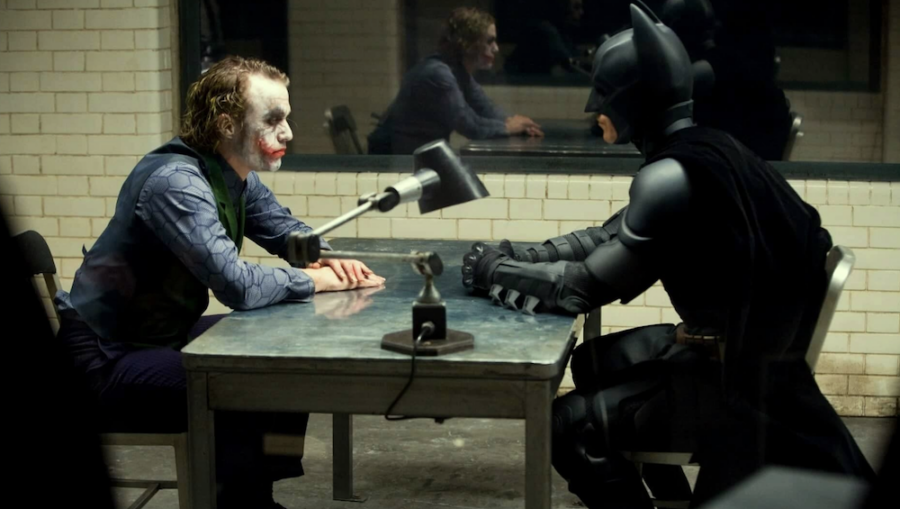
Removed from its comic book origins, The Dark Knight remains a spectacular experience, closer to Heat than to Batman (1989). The jailhouse discussion between Batman and Joker is the superhero equivalent of the famous diner scene, and it’s so good that almost every action thriller, comic book-based or not, has tried to recreate it. I roll my eyes whenever I see a movie try to explain that being caught was always part of the villain’s plan, because no one will ever do it as well as Nolan, Bale, and Ledger.
Spider-Man 2 is iconic, with Tobey Maguire and Alfred Molina, under the watchful eye of Sam Raimi, bringing layers of drama and pathos to what could have been a simple cash-in sequel. Yet it doesn’t transcend the entire genre the way that The Dark Knight does, a film that would have worked with generic characters, but by recontextualizing the Batman/Joker rivalry, it’s elevated to greatness. It also helps that it stands alone, with no teasers for a sequel and no cameos that lead nowhere.
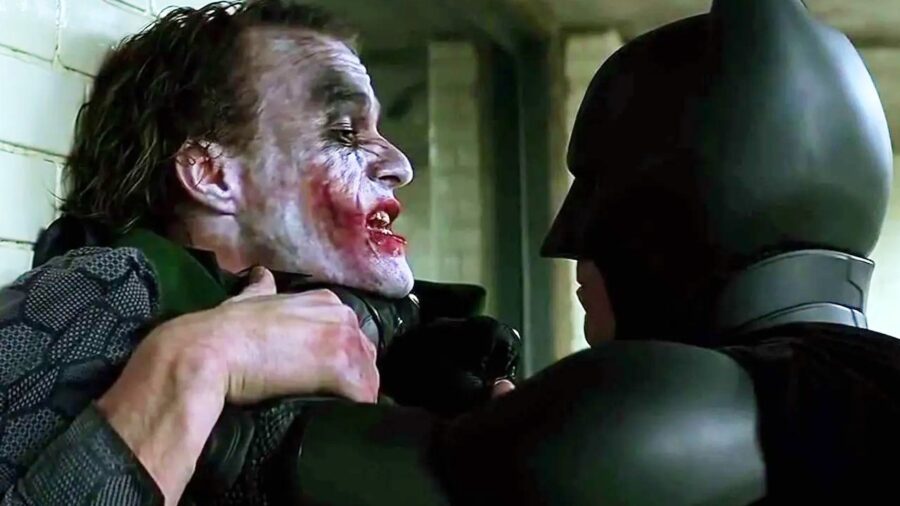
I have never been happier to be wrong than I was about Heath Ledger’s performance as The Joker. The Dark Knight was one of the greatest surprises in movie history, and today, when it’s widely praised as a nearly-perfect film and better than anything Marvel has ever done, it’s been forgotten that legions of fans expected it to be a flop. Imagine everyone’s surprise when it set box-office records on the way to earning over a billion dollars and garnering dozens of award nominations.
If you’ve never seen it, it’s been a few years, or you re-watch it every year, The Dark Knight is always worth your time. It’s timeless, it’s near-perfect, and there’s something in it that appeals to everyone.
:max_bytes(150000):strip_icc():format(jpeg)/The-Valley-Summer-House-033126-ab8b868a45f1474ca9fa4c6914dabeb1.jpg)
The controversial relationship reveal between the “Summer House” stars has taken the internet by storm.
Us Weekly has affiliate partnerships. We receive compensation when you click on a link and make a purchase. Learn more!
Jennifer Lopez is a masterclass on how to dress to impress, no matter how casual the occasion. While accompanying her child, Emme, as they got a haircut in Beverly Hills, the singer wore an all-black-everything ensemble and looked incredibly chic in a satin scoop-neck blouse and pencil skirt. Naturally, all of her accessories were designer, including the pair of black mesh flats that kept the look semi-low key for a trip to the salon (and that we are now obsessing over).
JLo’s shoes are the Christian Louboutin Galativi Mesh Flats. An exact pair is hard to come by, though even if you can snag your size on a site like Poshmark or TheRealReal, the flats will still set you back a couple of hundred dollars. Luckily, we found a similar point-toe mesh flat on Amazon that looks just as luxurious without the cringe-inducing couture price.
Get the Reitoye Flats for $41 (originally $46) at Amazon! Please note, prices are accurate as of the publishing date but are subject to change.
While you certainly don’t have to dress to the nines for a routine cut and color, swapping out your trusted pair of sneakers for mesh flats will definitely elevate a typical running errands outfit. The investment is twofold: If you’re stepping out in a t-shirt and jeans, mesh flats will effortlessly enhance your overall appearance. If your everyday aesthetic is semi-formal like Jenny from the Block’s satin tank and pencil skirt, the shoes can offer you a bit of comfort, whilst still maintaining a polished impression.

Relaxed, everyday loafers are already trendy, but with Jennifer Aniston on board? We’re even more inclined to get a pair. Aniston combined timeless heels with a chic loafer style, and we found a similar (and comfier!) option for just $38. Like Aniston’s, these shoes are certain to turn some heads. Elegant and sleek, these loafer-style […]
The Reitoye Flats have rubber soles and faux leather lining, with mesh encompassing the entire foot. The insole is cushioned, offering arch support, and made from cowhide, an optimal material for the spring and summer months when sweat is common. The pointed-toe flats also come in a range of sizes (including some halves), from a U.S. 6 to a U.S. 12, and cost only $46 – a fraction of the Louboutins.
According to reviewers, the shoes look even better in person. One commenter noted, “they’re very stylish,” and says the cutout design “adds a little something to an otherwise basic shoe.” Another added that, in addition to the look of the shoe, the flat is also (and, arguably, more importantly) comfortable: “I have wide feet, so I got an 8.5 instead of a regular 8 since these are pointy-toed. And they fit really well! No slipping off the heel and no squishing my toes.”
Lopez’s everyday style is unmatched. Though the actress tends to wear designers on the regular, don’t be fooled by the rocks that she’s got. We were able to find an Amazon version of her coveted mesh flats for only $41! A steal that, we think, Jenny from the Block would approve of.
Get the Reitoye Flats for $41 (originally $46) at Amazon! Please note, prices are accurate as of the publishing date but are subject to change.

A stroll through New York City requires comfortable footwear, and Jennifer Lawrence clearly knows the drill. The problem? Her simple pair of sock shoes cost $690, which is basically our shoe budget. . . for the next two years. The Puxowe Mesh Ballet Flat is a worthy alternative, giving off a similar vibe and nailing […]
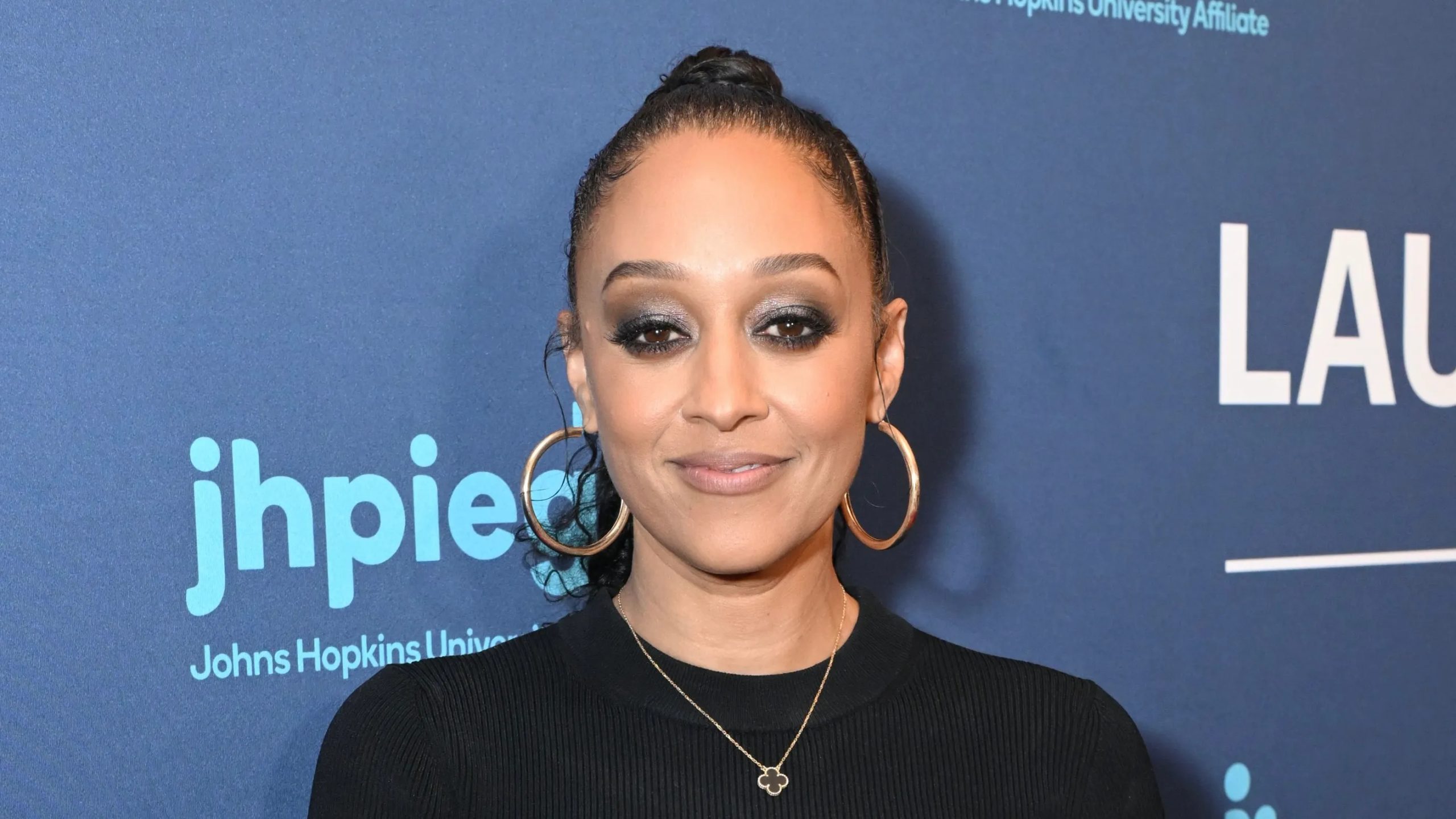
Tia Mowry is getting candid, opening up about how she “manifested” her new romance.
On Wednesday, March 25, PEOPLE published an exclusive interview with Mowry. Furthermore, the outlet reportedly spoke with her while she was attending the Jhpiego Laughter Is the Best Medicine Gala on Wednesday, March 18. While there, Mowry spoke on how she “manifested” her new romance.
“I will say that I’ve been in a place of solitude for a very long time. And there, I was really able to learn who I am, what it was that I wanted, and what it was that I needed. And I manifested this. I really did,” she said.
Per Mowry, she “became really positive” and spoke her new love “into existence.”
“I like speaking it into existence, just being really positive about the words that you are telling yourself. Visualization, I’m a huge believer of visualizing things and visualizing feelings. And I just started to stop just talking bad and poorly about dating because it was very easy to do that,” she said. “But I was like, ‘You know what? I believe in neuroscience and how the brain works, and if I continue to speak negative about it, that’s what my brain is going to seek out and find.’ But if I just start to speak positive things into existence, then it’ll eventually happen. And I really, in a way too, I was okay with being by myself.”
Per the outlet, Mowry declined to share any details about the new man in her life. However, she did note that she’s “very happy.”
“I want to protect [our privacy],” she reportedly explained.
Furthermore, she noted that intention and balance are important to her at this time in her life. And, despite finding love, she remains focused on “being the best mom.”
As The Shade Room previously reported, in February, Tia Mowry appeared to soft-launch her new romance by including a photo of a man’s feet planted behind hers on her beach.
In March, Mowry then confirmed her new love while appearing on the red carpet at Essence’s Black Women In Hollywood 2026 event.
More recently, Mowry gave fans another subtle look at her man while also showing off apparent roses he gifted her.
What Do You Think Roomies?
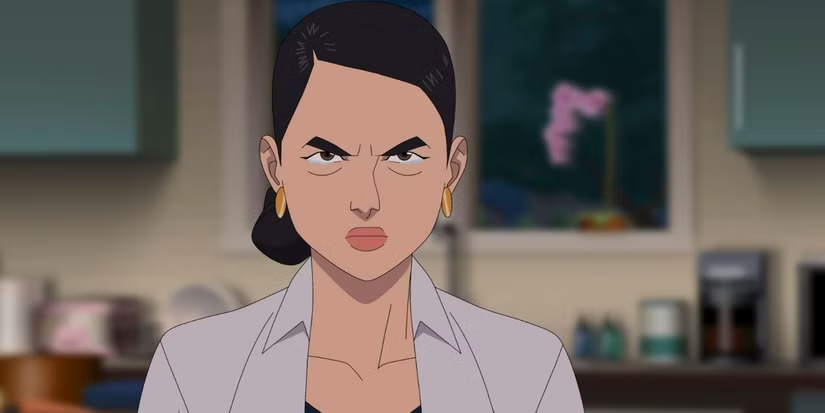
Editor’s note: The below recap contains spoilers for Invincible Season 4 Episode 5.
It’s not controversial to say that last week’s episode of Invincible wasn’t one of its best. We saw Mark Grayson (Steven Yeun) take an unwanted trip down to Hell to help Damien Darkblood (Clancy Brown) and his father, Satan (Bruce Campbell), defeat Volcanikka (Indira Varma). However, it did end with some pretty major cliffhangers. After getting his yellow-and-blue suit back, Mark receives a visit from Nolan (J.K. Simmons) and Allen (Seth Rogen), requesting his aid. While “Hurm” was one of the series’ weakest installments, “Give Us a Moment” is one of its most intense and emotional to date.

Episode 5 begins mere minutes after last week’s cliffhanger. As Eve (Gillian Jacobs) and Allen converse on the Graysons’ rooftop, Nolan and Mark have an awkward father-son reunion. Nolan is trying his best to show Mark that he’s truly changed, saying that while he’s full of regret about the Viltrum breeding plot, Mark was the one good thing to come out of it. Mark is still not having it, angry that Nolan has once again lied to him. Knowing that there’s not much time left, Nolan makes a last-ditch attempt to persuade Mark, telling him that the entire Coalition is aligned and that they’ll embark on their two-week trip to Talescria in the morning.
As Mark takes his time to make his final decision, Nolan finally attempts to apologize to Debbie (Sandra Oh). Mark warns Nolan that it will not go well, telling him, “Who is the apology for, her or yourself?” Nolan approaches the front door, but nearly walks away until Debbie opens it. She remains silent as Nolan tries to explain himself by saying, “I did the unspeakable… twice. I didn’t want Mark to get his powers. 20 years with you made me human. I’m sorry for it. I will spend the rest of my life trying to repair the damage I did.”
Debbie finally speaks, telling her ex-husband that his apology is “bullshit” and that, no matter how hard he tries, nothing he can do or say will repair the damage he caused. Nolan continues to try to explain himself, even going as far as to say that his romantic fling with Andressa (Rhea Seehorn) was a mistake. This only enrages Debbie more, and she punches Nolan in the chest, hurting her wrist. Hysterical, she demands that Nolan leave and never come back.

After being teased in Episode 2, Tech Jacket (Zoey Deutch) finally makes her debut. Yes, her. In the series, Tech Jacket is actually a teenage girl named Zoe Thompson, who works alongside her father, Ed (Bobby Moynihan), in defending the planet. Allen meets with Zoe and Ed, recruiting the former to join the Coalition of Planets. With her father’s approval, she agrees to join in the fight. Mark has also made his decision to join his father and Allen in the war, telling Debbie that this isn’t about Nolan; it’s about protecting the universe.
Angered that Nolan didn’t even visit him, Oliver (Christian Convery) tells Mark and Debbie that he is coming too. Shocked, Debbie and Mark immediately tell him no. Oliver explains that he wasn’t there for his real mom and that he needs to fight for Debbie, and nobody will stop him. Debbie finally agrees to let Oliver tag along, but requests that he, Mark, Eve, and Paul (Cliff Curtis) have one last family dinner with her. While his wife and sons share a melancholy meal, Nolan visits Art (Mark Hamill), and the two have some beers while catching up with one another. Nolan admits that he is happy for Debbie before apologizing to Art. He then asks Art to fix his suit, but Art rejects him, saying that he “only dresses heroes.” The two share an awkward goodbye, Nolan flies off, and Art lets out a big sigh of relief.

‘Invincible’ Season 4 Stars Officially Confirm Dark Turn for Mark and Eve
Steven Yeun and Gillian Jacobs tease the internal turmoil and conflict Mark and Eve will face in Season 4 of Invincible.
That night, Mark and Eve talk in bed, reminiscing on how they first met, as well as their belief that Robot (Ross Marquand/Zachary Quinto) and Monster Girl (Grey Griffin/Kevin Michael Richardson) will soon find their way home. Mark then asks Eve what it was she wanted to tell him before Nolan and Allen arrived, but she brushes the question off. In the morning, Mark bids farewell to Debbie, Eve, and Paul. Nolan is frustrated by Oliver’s insistence on joining the battle, but the young superhero stands firm on his decision. Alongside Tech Jacket, Mark, Oliver, Nolan, and Allen board the Venture and leave Earth. At the GPA headquarters, Cecil (Walton Goggins) and Donald (Chris Diamantopoulos) watch the liftoff, noting that for the first time in 20 years, the planet is Viltrumite-free. (Given how many times Mark has already left Earth in the past three seasons, that isn’t entirely true.)
On the ship, Oliver continues to give Nolan the cold shoulder, much to his dismay. Allen notices that Nolan is in a funk and expresses his concern to Mark, who tells him that Nolan expected Debbie to be happier and has realized that he has let Oliver down. Their conversation is interrupted when Conquest (Jeffrey Dean Morgan) and a Viltrumite gunship attack the Venture. Mark and Allen frantically search for Oliver and Nolan, finding the former barely conscious.
Conquest swoops in and begins crushing Oliver’s skull, and Nolan rescues him, ordering him to seek shelter on a nearby planet. Conquest begins taunting Mark about Eve, which only enrages him further. Nolan orders Tech Jacket, Allen, and the others to get to safety, and flies down to the nearby planet to save Mark and Oliver. Mark and Conquest continue to fight, which culminates in the bloodthirsty Viltrumite overpowering our hero. While on the ground, Mark begins choking Conquest, who then proceeds to punch a hole in Mark’s chest to rip out his organs. It’s one of the most graphic and upsetting scenes in the series. Mark is finally able to suffocate Conquest, but the damage to his body has already been done, and he collapses, near death. Nolan and Oliver are shocked when they discover a bloodied and withering Mark next to Conquest’s corpse.
Episode 5 ends with Telia (Tatiana Maslany) updating Thaedus (Peter Cullen) about the attack, informing him that she had no choice but to leave the team behind. Thaedus doesn’t seem too concerned, telling her that she made the correct decision in fleeing. In the post-credits scene, two Viltrumites stress that Thragg (Lee Pace) won’t be happy that Nolan and Mark have gotten away. It’s then revealed that Allen and Tech Jacket are hiding in an escape pod in the lower decks of the Viltrumite gunship.
“Give Us a Moment” is a lot, but after last week’s lackluster episode, that’s not a bad thing. In fact, it’s easy to forgive some of this season’s weaknesses, as this week’s episode is one of the best in the series. Not only does it feature several emotional character moments for all four members of the Grayson family, but it also convincingly confirms that the stakes have never been higher. Mark’s climactic fight with Conquest is brutal, but it’s also vital. We’ve seen Mark beaten badly before, but this is on a whole new level. It’s safe to say that Invincible Season 4 is now fully back on track.

March 26, 2021
Amazon Prime Video
Invincible

Bold and the Beautiful explodes as Sheila Carter (Kimberlin Brown) is getting suspicious and starting to put the pieces together this week. So, it’s not going to be long before she finds out Taylor Hayes (Rebecca Budig) was in bed with her husband, Deacon Sharpe (Sean Kanan).
And when Sheila is hurt and furious and ready to retaliate, we’re wondering if she will shock the fans and respond in a way that nobody saw coming. We’re going to dig into what would be the soapiest twist that would stun Taylor and Deacon and everybody.
So, by the end of this week, according to B&B spoilers, Sheila is going to revert to her old habits, but that doesn’t necessarily mean she’s going to get murdery. She has worked really hard to change her life after she got that release from prison that she wasn’t expecting, and she wanted to prove to Deacon that she’d changed. And Sheila may be pressed to see that she can’t behave like she used to.
So, this week we already saw Sheila nearly catch Deacon in bed with Taylor. Honestly, it’s insane that Sheila was creeping into Steffy Forrester‘s (Jacqueline MacInnes Wood) house while she was out of town, coming in the back door. That sort of stalking is one of Sheila’s old habits, and it’s insane. She came to bring Taylor flowers, then heard noises after creeping in the back door of a house that Sheila knows she’s not allowed to be in.
And then it got crazier. Why was Sheila’s first thought when she heard music and moaning that somebody’s hurting Taylor? Right? All these assumptions. To me, it’s not the best writing. But Sheila burst into Taylor’s room with that butcher knife, waving it around, ready to protect Taylor. Thankfully, Deacon jumped off the balcony and into the shrubbery before Sheila saw her husband.
And then Taylor panicked, thinking Sheila was going to kill her. You know, Taylor was scared that Sheila had somehow spotted Deacon. And then Sheila decided that Taylor was having some, you know, lady me time. And Sheila even admired how all out Taylor went with the candles and whatnot to do some self-pleasuring. It was just all so cringy.
Sheila then recommended some audio books to Taylor. It was all embarrassing. So, she threw on a robe and was shoving Sheila out of the house, just telling her, “Go, go, go.” Taylor reminded Sheila that she’s not supposed to be there. Taylor said, “If Steffy was home, her daughter would have called the cops on Sheila.” And then Taylor told Sheila, “Leave and don’t you ever come back to the house.”
But as Taylor was kicking her out, Sheila noticed the Il Giardino pizza box and that was what started her wheels turning. That was also insane because that is Finn (Tanner Novlan) and the kids’ favorite place to pick up pizza from. They do it all the time. And for all Sheila knows, it could have been from earlier in the day before Steffy and Finn left with the kids.
I don’t think a pizza box is a sign of cheating since there’s probably pizza boxes from Il Giardino in that house, you know, at least once a week. But that was what inspired Sheila to start thinking. And then when she got back to Il Giardino, she asked an employee if he’d seen Deacon, and he hadn’t. At that point, why didn’t Sheila pick up her phone and call Deacon instead? Sheila paced around downstairs till closing time.
Then she finally went upstairs and Deacon was on the sofa pretending to be asleep. And honestly, he’d been there for quite some time. So, on the next episode, we have Sheila telling Deacon that she went over to Steffy’s to bring Taylor flowers and she thought somebody was assaulting her. And Sheila says she thought Taylor was in danger, so she grabbed a butcher knife and went upstairs.
And then Sheila tells Deacon he’ll never guess what she walked in on. And of course, he’s playing dumb, but he’s also probably terrified that Sheila caught a glimpse of him. And it certainly was a really close call. But it seems like Sheila is in a way testing Deacon to see how he reacts, to see what he says.
Other spoilers for this week say that Sheila’s suspicions grow and that she’s putting everything together. And one thing that might trip them up ties to a phone call between Hope Logan (Annika Noelle) and Liam Spencer (Scott Clifton). There was no reason in another storyline for this phone call. And that’s why I think it’s a big hint. So, he called to ask Hope what she wanted for dinner. And then Liam said he’d grab something and bring it home.
And that phone call might have actually been important. So, Hope’s supposed to be out to dinner with Deacon. That’s the alibi he gave Sheila. But if Liam went over to pick out takeout from Il Giardino, that’s another sign, another red flag. So, Sheila might notice a receipt from Liam’s purchase or one of the servers may mention that Deacon’s son-in-law picked up dinner. That’s a big red flag.

So then there’s the spoiler about Sheila reverting back to her old ways or you know so it seems. But if she starts to go psycho, I think Deacon might tell Sheila, “You got to dial it back or you’re going to wind up in prison for the rest of your life and if you hurt Taylor, I will hate you.” I think Deacon could say something like that to her.
And from there, it’d be really wild if instead of trying to kill Taylor, we have Sheila doing something unexpected on Bold and the Beautiful. Remember that old Dolly Parton song, Jolene? If you don’t know the song, it’s Dolly singing about this beautiful woman who has been fooling around with another woman’s guy and then she’s begging Jolene, “Please don’t take my man. Please don’t take him just because you can.”
So, I’m wondering if we get a twist and Sheila shows up at first acting scary and confrontational and of course Taylor would be terrified she’s going to kill her for fooling around with Deacon. And then surprisingly, we could see Sheila break down. Literally get down on her knees and begs Taylor, “Please don’t take Deacon away from me. He’s all I have.” Which is true. Sheila’s got no family that’ll give her the time of day. She’s the town pariah.
And aside from Li Finnegan (Naomi Matsuda), everybody either hates Sheila, is scared of her, or both. And nobody wants her around. And I mean, it’s one thing for Taylor to steal Deacon from Sheila the Psycho, but another for Taylor to steal Deacon from this heartbroken woman who’s begging Taylor to please don’t take her man. Because that’s another thing entirely. It is cruel and she’s not a cruel person. Taylor isn’t.
So, Sheila may remind Taylor that Deacon was really struggling when he started therapy with her. And Sheila might try to make Taylor see how inappropriate it was for her to get involved with Deacon when he was in that vulnerable state because let’s be real, it was totally inappropriate and Sheila might literally beg Taylor, don’t take Deacon, please.
I think that would be such a huge twist because everybody expects Sheila to go homicidal on Taylor and maybe on Deacon, too. And Steffy’s so worried because of how dangerous and crazy Sheila is. So, I think it would be really interesting and actually refreshing if instead of proving Steffy right, we could see Sheila actually prove that she’s changed.
And maybe she doesn’t get murdery with Taylor, but begs her instead to not do this. I mean, how can she refuse Sheila, begging her for compassion? I think Taylor would be in a tough position of being selfish and stealing Sheila’s husband on top of Taylor violating her professional oath, or, you know, she could do the right thing and turn her back on Deacon. I think it would be a really cool twist and I’m really hoping to see it go this way instead of Sheila doing the same old things she always does.
And I think it would be interesting to see Taylor have this reality check that she is the villainess of this story. You know, this is not Romeo and Juliet. This is a bad person taking a woman’s husband. You know, Sheila is not the villain here. It is Taylor. And that would be, I think, game-changing and an amazing plot twist.
:max_bytes(150000):strip_icc():format(jpeg)/If-Ryan-Reynolds-The-Wiz-Lena-Horne-Roommates-Sadie-Sandler-033026-9003807cce614d6dbfb4f0daaad491a3.jpg)
You can also get a dose of nostalgia by revisiting “The Wiz” and “Smokey and the Bandit.”





Parliament publishes latest register of MPs’ financial interests

Intercom’s new post-trained Fin Apex 1.0 beats GPT-5.4 and Claude Sonnet 4.6 at customer service resolutions


The Story hosts event on Durham’s historic registers


Instagram, YouTube Found Responsible for Teen’s Mental Health Struggle in Historic Ruling

Tesco is selling new Cadbury Dairy Milk bar and people can’t wait to try it


Sweet Sixteen Game Thread: Tide vs Michigan
Fans slam 'heartbreaking' Barbie Dream Fest convention debacle with 'cardboard cutout' experience

Lana Del Rey Celebrates Her Husband’s 51st Birthday In New Post
Dems press CFTC, ethics board on prediction-market insider trades


Tallest college basketball player ever, standing at 7-foot-9, entering transfer portal

How to Style Spring Like WeWoreWhat: Easy Outfit Ideas for 2026


The Pixel 10a doesn’t have a camera bump, and it’s great


HBO’s Harry Potter Series Will Definitely Fail For One Big Reason, And It’s Not J.K. Rowling Or Snape


En Vogue in Brown Leather and Tailored Neutrals by Atelier Savoir, Styled by J Bolin


U.S. rule change may open trillions in 401(k) funds to crypto


What Are Your Favorite T-Shirts for the Weekend?


Weekly News Update, 3.27.26 – Corporette.com


Should Trump Be Scared Strait?


Women’s hockey camp eyes fitness boost, tactics ahead of WC 2026 campaign | Other Sports News


How to back up your iPhone & iPad to your Mac before something goes wrong


You must be logged in to post a comment Login