
Entertainment
The Greatest Movie of Every Genre in the ’60s

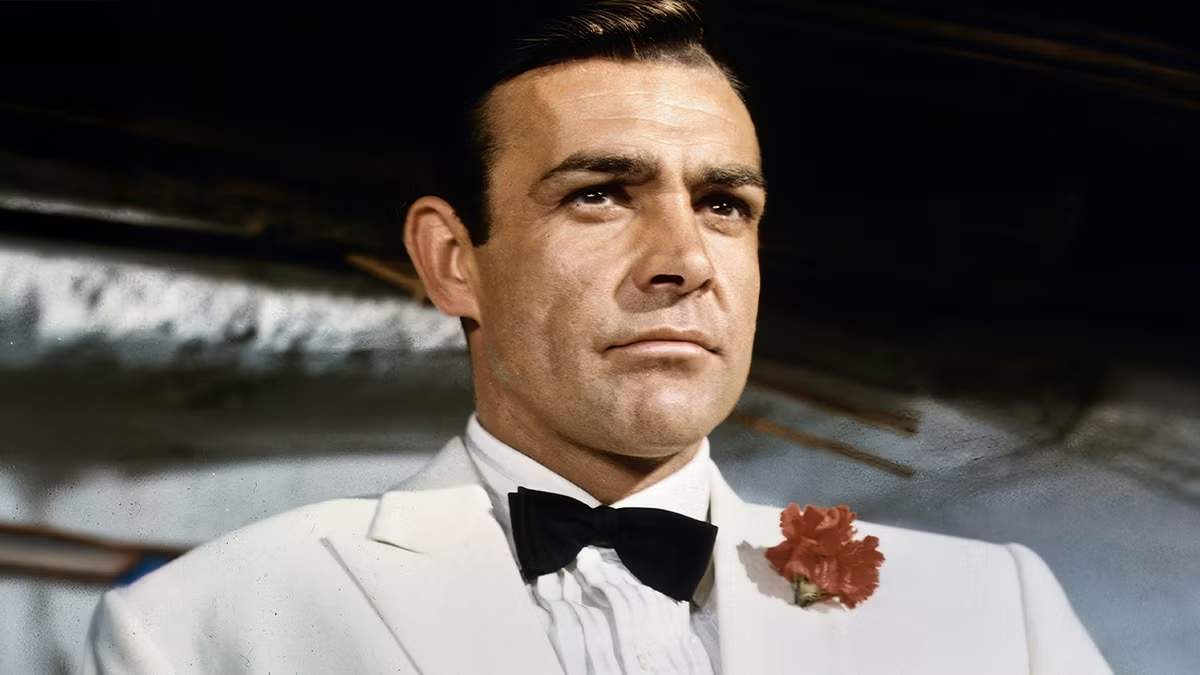
Marking the end of Hollywood’s golden age as well as being a fascinating era for international cinema, the 1960s is a decade in film defined by its greatest and most innovative triumphs. These groundbreaking hits have become iconic not only for their brilliance but for their lasting impact, too. In fact, such is the widespread excellence that practically every single genre has a defining legacy piece in the ’60s, monumental classics that have come to be heralded as some of the greatest movies ever made.
To examine the highlights of 10 major genres is to illustrate the variety and vastness of ’60s cinema, with action, animation, comedy, drama, epic cinema, fantasy, horror, sci-fi, thriller, and Western cinema being the focuses of this list. While we do leave out noteworthy romances like The Apartment and legal classics like To Kill a Mockingbird, it also presents an expansive and varied look at cinematic extravagance in the 1960s.
Action: ‘Goldfinger’ (1964)

In many respects, Dr. No is the pioneer of action blockbuster cinema as we know it today. It presents a formula of engrossing fun, thrilling stakes, stunning stunt work, and propulsive storytelling as it follows James Bond (Sir Sean Connery) on his mission. As the third, and arguably greatest, film in the franchise, 1964’s Goldfinger takes this formula and perfects it, leaning on its litany of unforgettable characters and its vibrant, vivacious set pieces to conjure a divine spectacle of sheer fun and excitement.
With its entrancing sense of style, suave sophistication, and even noteworthy elements like the Aston Martin DB5 and Auric Goldfinger’s (Gert Fröbe) eccentric villainy, Goldfinger stands as a platform for so many action masterpieces that have come out in the 60+ years since. Having said that, it is more than just an admirable relic, aging gracefully to be an enjoyable dose of high-minded spy thrills that, in the eyes of many, still stands as the greatest James Bond movie of all time.
Animation: ‘The Jungle Book’ (1967)

The 1960s were a fascinating though somewhat bleak time for animated cinema, with the form having to adjust to the advent of television (and, more pointedly, children’s cartoons), navigate complicated financial balances in the aftermath of some ’50s box office flops, and even evolve beyond Walt Disney’s vision following his death in 1966. That said, the genre did still produce a handful of beloved hits throughout the decade, with Disney’s adaptation of Rudyard Kipling’s The Jungle Book one of the best and most inviting pictures in the studio’s history.
Through the jungle musical adventure’s story of survival and friendship, it strikes a soaring tone of fun-loving simplicity fueled by the joyous nature of its songs and the brilliance of animal characters, which, even by Disney’s lofty standards, are outstanding. It charms, enraptures, and enchants with every second of its lean 78-minute runtime, making for one of the all-time great animated adventures and a defining beacon of family cinema in the 1960s.
Comedy: ‘Dr. Strangelove’ (1962)
Barbed wit, scorching satire, and sheer absurdity combine as magnificently as they do maniacally in Dr. Strangelove, a nerve-rattling, sidesplitting spoof of political ineptitude that hypothesizes the ignition spark of the Cold War. It sees a rogue American general sanction an irreversible nuclear attack on the Soviet Union. President Merkin Muffley (Peter Sellers) summons his war council in a desperate attempt to find a solution, but is met only with sensationalist conspiracies, warmongering ire, and a particularly devilish plan to outlast the looming nuclear holocaust.
Dr. Strangelove excels at using laughs and lunacy to illustrate the futility of war, emphasizing contemporary anxieties surrounding the Cold War. The result is a timeless triumph of comedy cinema that is both hysterically funny and bitterly pointed. It has come to be celebrated as one of Stanley Kubrick’s defining achievements, a masterpiece of satirical comedy that knows when to be ridiculous and when to be terrifying.
Drama: ‘Harakiri’ (1962)

While America was excelling in genre filmmaking throughout the ’60s, its forays into drama were left wanting compared to the movies on the global stage. Italy had Federico Fellini’s phenomenal films and the might of The Leopard, Soviet cinema presented the start of Andrei Tarkovsky’s esteemed career, and Sweden’s Ingmar Bergman was prolific, with 1966’s Persona standing as his best work of the decade. However, it is the commanding beauty and thematic resonance of Japanese cinema that wins out, with Masaki Kobayashi’s engrossing period drama Harakiri standing as one of the most essential movies of the decade of any genre.
The samurai classic utilizes breathtaking visuals, bold storytelling, and an arresting lead performance from Tatsuya Nakadai to tell the story of a veteran ronin whose request to commit seppuku in the house of a lord shelters a secret drive of vengeance and violence. Within its stylistic flourishes, Harakiri presents a thematic journey of the hypocrisy of honor and the corruption of power, anchored to one man’s love and loss. Challenging the often-romanticized samurai code, Harakiri is a sharp, culturally incisive drama that stands tall among the best movies of the 1960s.
Epic: ‘Lawrence of Arabia’ (1962)

Few movies define their decades quite like how Lawrence of Arabia defines the 1960s. Emblematic of Hollywood grandeur, the monumental biographical war epic coast on Peter O’Toole’s outstanding performance and its awe-inspiring visual majesty to explore the feats of T. E. Lawrence throughout the First World War. As an English serviceman, he is tasked with serving as a liaison between the British army and the allied Arab tribes, but his loyalties begin to waver as he galvanizes the Arabs and encourages them to use their stance against the Turks as a platform for independence.
Realized with astonishing shots of the desert that bring a palpable grandiosity to Lawrence’s tumultuous journey of wartime politics, inner turmoil, and frayed alliances, Lawrence of Arabia is a dazzling triumph of cinema that fills every second of its near-four-hour runtime with stirring beauty and profound narrative conviction. The 1960s house many great epics, from Spartacus to Doctor Zhivago to Once Upon a Time in the West, but it is undoubtedly Lawrence of Arabia that stands as the most distinguished and divine example of epic cinema of the decade, and possibly even of all time as well.
Fantasy: ‘Mary Poppins’ (1964)

Fantasy cinema of the 1960s is as intriguing as it is sporadic and varied, with sci-fi-leaning flicks like Barbarella meshing with historical adventures like Jason and the Argonauts, while family-oriented cinema tackled the genre as well. The latter approach produced many of the decade’s defining fantasy movies, with Disney’s hit sensation Mary Poppins enchanting millions of viewers of all ages with its magic and music as well as with its innovative marriage of animation and live-action.
The beloved family film unfolds as Mary Poppins (Julie Andrews) serves as the nanny of the two mischievous Banks children, instilling change in their lives while spreading kindness and joy wherever she goes. With Andrews’s angelic performance, a beaming eye for imaginative awe, and a perfect combination of family adventure and fantasy wonder, Mary Poppins has come to be regarded as one of the most iconic and culturally significant movies of its century.
Horror: ‘Psycho’ (1960)

A horror movie of rare influence, Psycho was instrumental in ushering cinematic chills beyond the era of monster campiness and sci-fi-infused scares and towards the visceral terror of real-world evils. It is a disturbing descent into exposed vulnerabilities and the complexity of depravity, one that torments viewers with its technical mastery, cutting-edge subversion of horror tropes, and psychologically complex screenplay, defined by a shocking midpoint twist.
Revolving around the Bates Motel, which is realized with a Gothic eeriness and foreboding isolation that pries on the viewer’s mind, Psycho is a triumph of cinematic tension, be it in the form of its famous shower scene, Arbogast’s (Martin Balsim) climb up the stairs to confront “Mother”, or Norman Bates’s (Anthony Perkins) initial interrogation. Even 65 years on from its release, Psycho still emits an intense and disconcerting dread, thriving as a harrowing submersion into unease powerfully accented by several sequences of raw, visceral, unforgettable terror.
Sci-Fi: 2001: ‘A Space Odyssey’ (1968)

There is an era in science-fiction cinema before 2001: A Space Odyssey, and an era after it. Such is the film’s genre-defining influence; the Stanley Kubrick spectacular completely recalibrated the possibilities of cinema, breaking new ground with its practical effects while steering the genre towards bold and unconventional storytelling laced with profound and complex themes of mankind’s existence, the nature of evolution, and the inherent dangers that lurk on the horizon of human progress.
Be it the stunning opening sequence depicting the very first steps of human evolution or the unbelievably intense stand-off between David Bowman (Kier Dullea) and his rogue A.I. computer HAL 9000, the film captivates and compels with its palpable urgency and its divine, exquisite beauty. Granted, it’s not an easy film to grasp, and people still debate its true meaning all these decades on from its initial release. Still, its confounding complexity—along with its picturesque grandeur and overawing thematic scope—make 2001: A Space Odyssey not only the best sci-fi film of the ’60s, but the defining triumph of the genre on the screen at large.
Thriller: ‘Blow-Up’ (1966)

Perhaps the most obscure movie on this list, Blow-Up was a small commercial success upon release, but it has grown to be regarded as a landmark phenomenon in thriller cinema in more recent decades. A co-production between Italy and the UK, it follows a hedonistic photographer who, while developing the film of photos he took in a park, discovers he may have accidentally captured footage of a murder. As he grows obsessed with solving the mystery, he must also deal with a woman he photographed who is demanding that he hand over the pictures of her.
Marrying intoxicating psychological angst with a striking visual flair and an underlying thematic exploration of art and reality amid 1960s London, Blow-Up excels as a cerebral and sinister masterpiece of atmospheric tension. While it hasn’t achieved the universal excellence of some of the other genre films of the ’60s, the Michelangelo Antonioni picture has enshrined itself as a bona fide cult classic defined by its technical prowess, innovative dare, enthralling ambiguity, and lasting cultural impact.
Western: ‘The Good, the Bad and the Ugly’ (1966)

The 1960s, like the ’50s and even parts of the ’40s before it, are a decade defined by one genre: the Western. In Hollywood throughout the ’50s in particular, the genre took a mythic form, wielding its stories of frontier justice and hard-edged morality to enshrine for America a national identity of gritty righteousness and gun-toting heroism. As audiences began to shift towards more violent and realistic tales in the 1960s, the griminess of the spaghetti Westerns became more prominent, and from this movement, the greatest ever Western movie was released.
A gripping tale of ambition, greed, violence, and immorality, The Good, the Bad and the Ugly soars as a masterpiece of tone and technical prowess. Its sheer entertainment value is defined by sweeping visuals, Ennio Morricone’s mesmerizing score, and Sergio Leone’s astute, involving direction. The film is incredibly timeless, with its appetite for style and eccentric, wicked fun aging magnificently as audience tastes have grown more ruthless, especially in the Western genre. Like so many other defining films of the ’60s, it has become a landmark achievement of its genre as well as a cinematic icon.



