
Entertainment
The Most Rewatchable Movie of Every Year of the 1990s

The 1990s were a great decade for movies. After the tame corporate blockbusters of the ’80s, the ’90s gave us runaway creativity, a fertile indie scene, and blockbusters with soul. This was the decade when spectacle met sincerity, when movie technology leaped forward, but storytelling stayed grounded in character and heart.
With this in mind, this list ranks the most rewatchable movies from every year of the ’90s. The titles below span a range of styles and genres, but all offer tons of depth and endless entertainment value, even on the umpteenth viewing.
1990 — ‘Home Alone’

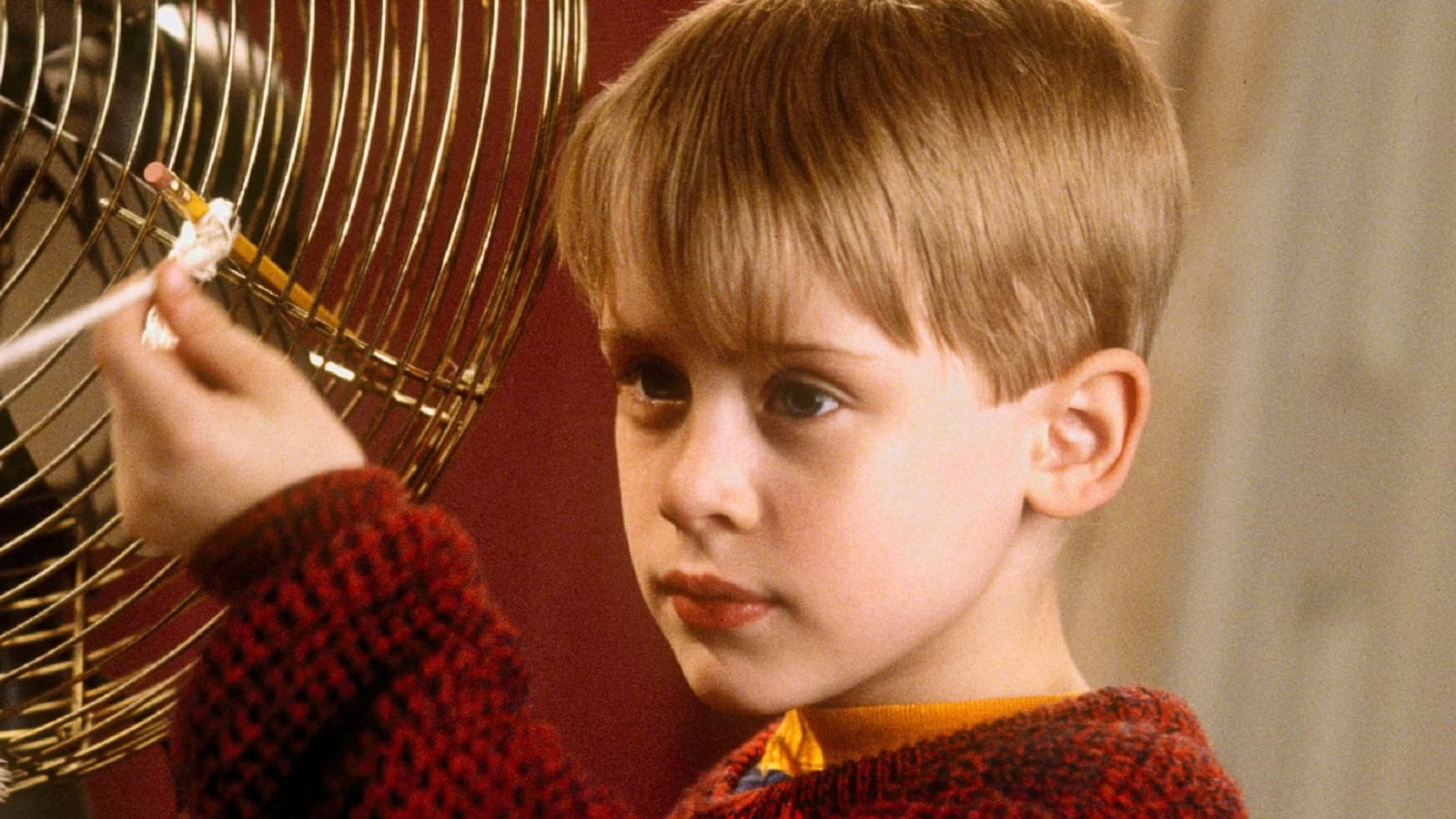
“Keep the change, ya filthy animal.” A Christmas classic. Home Alone took a simple premise and turned it into a world-conquering blockbuster (it grossed over $450m) that still holds up today. It’s not just the slapstick chaos or the ingenious traps, though watching the Wet Bandits get creatively annihilated never loses its thrill. Really, it’s the emotional undercurrent: a kid discovering independence, fear, triumph, and the quiet courage of being truly alone for the first time. Home Alone is a movie with a lot of heart.
John Williams’ score lifts all this into fairy-tale territory, and Macaulay Culkin radiates mischievous sincerity. No matter how old you get, Home Alone taps into the child who believed adventure and danger lived just beyond the front porch, the fantasy of defending your home from no-gooders. Returning to it is always a great nostalgia, and introducing it to younger generations rekindles the magic.
1991 — ‘Terminator 2: Judgment Day’

“Hasta la vista, baby.” Action cinema was never the same after T2. This sequel doubled down on everything that made its predecessor awesome, but added fresh dynamics all its once. Bringing the T-800 back as an ally was a genius move, building perfectly on the mythos of the first movie without stepping on its toes. Opposite Schwarzenegger, Linda Hamilton‘s Sarah Connor becomes even more hardened and unbreakable, transforming into one of the greatest heroines of the 1990s.
James Cameron‘s practical effects still feel tactile and brutal more than three decades later, and that molten-steel finale remains devastating no matter how many times you watch it. All this adds up to a propulsive action movie with unusual philosophical heft. It also gets surprisingly touching. When the T-800 says, “I know now why you cry”, you almost get a lump in your throat. What a classic.
1992 — ‘Unforgiven’

“It’s a hell of a thing, killin’ a man.” Clint Eastwood deliberately crafted Unforgiven as his final Western statement, and what a statement it was. It draws powerfully on the director-star’s own storied history with the genre, but dismantles it rather than glorifying it. This is a film about violence stripped of glamour, reputation stripped of romance, and age stripping away the lies men tell themselves. Eastwood’s William Munny is a former killer trying to outrun his sins, drawn reluctantly back into bloodshed that gives no one dignity.
Opposite him, Gene Hackman is frighteningly cruel, and Morgan Freeman provides weary grace. In telling these characters’ stories, the movie offers understanding rather than catharsis. There’s no feel-good spin. Here, heroism is an illusion and violence is corrosive, even when it’s carried out with good intentions. Rewatching Unforgiven now feels like returning to a graveyard of American legend. Haunting, regret-filled, brutally honest.
1993 — ‘Jurassic Park’

“Life finds a way.” With this movie, Spielberg somehow reached even greater blockbuster heights than he’d scaled before. Whether it’s your first watch or your twentieth, Jurassic Park still ignites childlike awe. That first brachiosaurus moment almost feels religious; the T-rex attack remains one of the most thrilling sequences ever filmed, and the raptors are pure nightmare fuel in the best way. All these years later, the dinosaurs look fantastic because they were mostly practical and animatronic rather than computer-generated.
Jurassic Park is built on such a simple, killer premise, and the execution is simply masterful from everyone involved. The visuals and music are brilliant, the script gives the cast a lot to work with, and the leads all turn in compelling, layered performances. Every character here feels like a real person rather than just a plot device. Although the sequels would try, none would quite capture Jurassic Park‘s lightning in a bottle.
1994 — ‘The Shawshank Redemption’

“Get busy livin’, or get busy dyin’.” For 1994, it’s a tough call between Pulp Fiction and The Shawshank Redemption for rewatchabiliy, but the latter just wins. Coming back to it always renews your faith in humanity just a little bit. It’s one of the most powerful movies about the triumph of the human spirit. Tim Robbins and Morgan Freeman give warm, lived-in performances, making one of the most touching male friendships in all of cinema.
Around them, prison walls, usually symbols of despair, become the backdrop for dignity, friendship, and patience blooming in impossible soil. All this builds up to that beautiful final scene, a moment that can’t help but make one emotional. Although Pulp Fiction and Forrest Gump got more attention on release, The Shawshank Redemption‘s reach arguably eclipsed both. It’s beloved by countless people, evident in it still being the all-time highest-rated movie on IMDb.
1995 — ‘Toy Story’

“To infinity… and beyond!” Toy Story was a landmark for animation and the start of Pixar’s 15-year dominance of the medium. It’s a modern fairytale that mixes slapstick joy and philosophical melancholy in a way that was unlike any other kids’ movie at the time. It serves up childhood imagination with adult emotion. Woody (Tom Hanks) and Buzz (Tim Allen) begin as rivals but evolve into something much richer: symbols of belonging, usefulness, and friendship forged through insecurity.
The storytelling is full of energy and care, and the writing is simply terrific, alternating seamlessly between funny and profound. Practically every line is quotable (indeed, Buzz Lightyear’s catchphrase is one of the most famous lines in movie history), and every second scene is now iconic. Toy Story‘s ambition and mega-success would greatly influence animation, opening a rich new vein for children’s entertainment.
1996 — ‘Scream’

“Do you like scary movies?” Wes Craven deserves major props for revolutionizing the slasher genre not once but twice. It seemed kind of dead by the mid-’90s, but the director resurrected it with Scream, making it fresh again by dissecting it in plain sight. This movie is self-aware, razor-sharp, scary, and hilarious. Meta without being smug, inventive without sacrificing dread. Neve Campbell’s Sidney Prescott becomes a new kind of final girl: vulnerable yet fierce, shaped by trauma but not defined by it. Opposite her, the killer Ghostface quickly joined the pantheon that includes Freddy Krueger and Michael Myers.
The movie is pure fun from beginning to end, gleefully subverting genre expectations at every turn. Having characters who watch slasher movies and understand their tropes was a narrative masterstroke, adding a new dynamic and making all the classic elements enjoyable once again. Not every sequel was a banger, but the original in a horror masterpiece.
1997 — ‘Titanic’

“I’m the king of the world!” James Cameron strikes again. Here, he fuses historical spectacle, doomed romance, and awe-struck disaster filmmaking into a truly colossal movie that somehow never loses its emotional grip. In a lesser director’s hands, all these narrative threats would’ve collapsed into a total mess, but Cameron makes it look easy. It helps that he had generational stars to ground the story. Leonardo DiCaprio and Kate Winslet radiate earnest, unpolished chemistry. Their sincerity keeps Titanic from ever feeling ironic or cynical.
The visuals were also ridiculously ambitious for their time, involving miniatures and elaborate underwater sets, as well as cutting-edge CGI. This blend of grand setpieces and compelling drama resonated with audiences, helping Titanic become the highest-grossing movie in history up til that point. (Cameron himself would later top it with Avatar.) The final sequence, between waking memory and dream reunion, remains one of cinema’s most glimmering farewells.
1998 — ‘The Truman Show’

“In case I don’t see ya: good afternoon, good evening, and good night!” The Truman Show tried to warn us. Years before reality television swallowed culture, this movie smartly explored its allure and dangers, all while serving up an entertaining story to beat. In it, Jim Carrey gives his first great dramatic performance as a man trapped in a manufactured paradise. Little does he know that his life is fodder for a TV show, his very existence engineered to keep eyeballs fixed to screens.
This premise hits so much harder today in a world of surveillance and social media, and politics as reality TV. Simply put, The Truman Show is one of the most prescient satires of all time. Yet it’s not all cynical or grim either. When he touches the set wall and steps toward freedom, you feel a genuine sense of grace and possibility.
1999 — ‘The Matrix’

“There is no spoon.” The sequels would ruin the mythology, but the first Matrix remains a high point for action cinema. With its cyber-philosophy, bullet-time, and sleek techno-noir aesthetic, it exploded culture and then refused to fade. Who knew martial arts and big-brain concepts could work together so well? Part of the movie’s success also comes courtesy of the cast.
Keanu Reeves’ Neo, Carrie-Anne Moss’ Trinity, and Hugo Weaving’s Agent Smith give performances that feel mythic yet cool, operatic yet grounded.
The setpieces are all bangers, with the Wachowskis and their stunt coordinators truly at the top of their game. The lobby shootout remains electric, the rooftop rescue still breath-catching, and Neo’s final monologue is still awesome. Twenty-plus years later, images like the red pill have burrowed deep into the public consciousness. No matter how many times you watch The Matrix, there’s always something new to ponder.




