
Entertainment
The Return of the King’

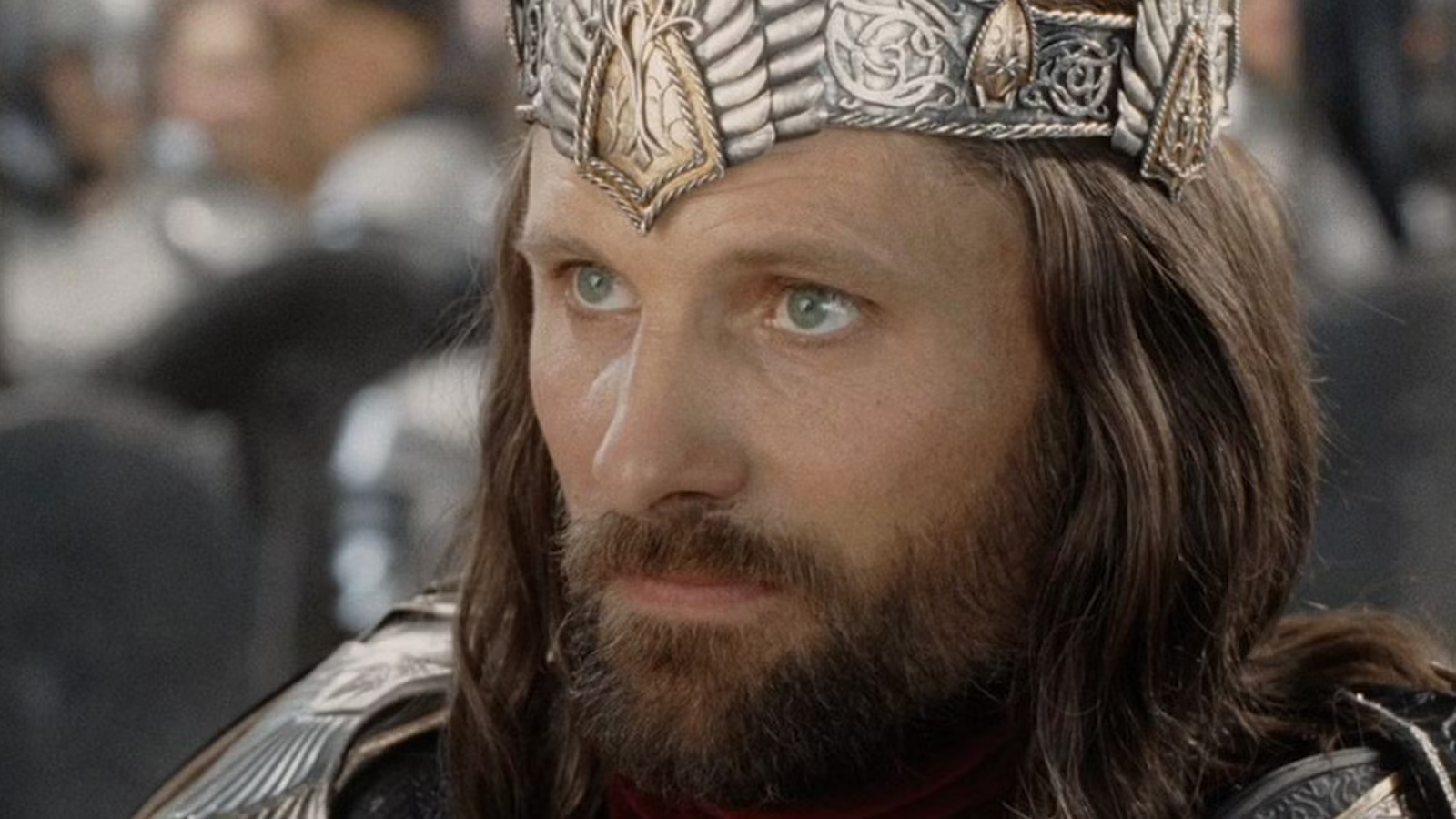
Every film has scenes that end up on the cutting room floor, but few have as many as Peter Jackson‘s The Lord of the Rings trilogy. There are so many of them, in fact, that each installment has a theatrical and an extended edition, with fans often lauding the latter as the best one. As it turns out, however, even a film as long as the extended edition of The Lord of the Rings: The Return of the King, clocking in at 263 minutes, doesn’t include everything that Jackson filmed for it, and leaves out an action sequence that could have outshined all others in the trilogy: a fight between Aragorn (Viggo Mortensen) and the Dark Lord himself, Sauron. Thankfully, however, Jackson ultimately decided to cut it from all versions of the movie, and, as epic as it may sound, he was right to do it.
Sauron Would Have Materialized To Fight Aragorn at the Battle of the Black Gate

The Battle of the Black Gate is the very last major battle in the trilogy, in which the Men of Gondor and Rohan challenge Sauron at his doorstep in Mordor. The Host of the West is led by Aragorn, who is tempted one last time by the Dark Lord before charging into the enemy army, but, in the scene that Peter Jackson cut from the final cut of The Return of the King, this temptation and Aragorn’s charge happen very differently. Instead of a voice in Aragorn’s head, Sauron materializes in front of him to lead the army of Mordor, something that doesn’t happen in any other scene in the trilogy, and the two are then locked in their own particular duel until the end of the battle.
What’s interesting is how this duel would have played out. The whole sequence has actually been filmed, complete with an actor playing Sauron in his full size and iconic armor. First, Sauron appears in front of his army in his fair form of Annatar, the Elven form he took back in the Second Age to trick the Elves into making the Rings of Power. Annatar appears bathed in blinding white light and is only visible to Aragorn, as shown in the footage available in the extra features of The Return of the King. This is Sauron’s last temptation to the heir of Isildur (Harry Sinclair), but, unlike his forebear, Aragorn resists it. Now fully visible and materialized, Sauron then attacks Aragorn, and the battle begins.
Unfortunately, however, Aragorn isn’t really a match for Sauron. As the footage shows, most of his blows are blocked by Sauron’s spiked armor, and the Dark Lord towers over him for most of the fight, being bigger than he ever was. Towards the end, Sauron knocks down Aragorn, who is only then able to stab him with his sword, the newly reforged Andúril. Sauron is unhurt, however, and, just as he is about to deliver a killing blow against Aragorn, the One Ring is destroyed in Mount Doom. What happens then is similar to the prologue scene in The Lord of the Rings: The Fellowship of the Ring, with Sauron literally blowing up as he loses the One Ring, only this time it’s for good.
Peter Jackson Cut This Scene From the Movie To Preserve Frodo and Sam’s Mission as the True Climax of the Film
This fight scene between Aragorn and Sauron never happens in the book, and would have been a completely original scene in Peter Jackson’s trilogy. Jackson initially believed that he “really had to do something more than just have Sauron stay in his tower as this flaming eye,” hence the idea of Sauron fighting in the Battle of the Black Gate. He also felt that Aragorn had come a long way in his journey from Ranger to King of Gondor, which would then warrant him a crack at the Dark Lord. They do have history, after all, with Aragorn being the last descendant of Isildur, so Jackson felt that, even though they never fight in the book, “it had to be in the movie.”
Fortunately, he eventually backtracked on this idea to preserve Frodo (Elijah Wood) and Sam’s (Sean Astin) scene at Mount Doom as the true climax of the story. The true purpose of the Battle of the Black Gate isn’t to actually defeat Sauron, after all, but to turn his attention away from Mount Doom and clear the way for Frodo and Sam to destroy the One Ring. It’s essentially a suicide mission because the Host of the West could very well be defeated before the Hobbits reach the mountain. They aren’t sure whether Frodo and Sam are even alive at all, and the decision to attack the Black Gate comes from estimating that, if Sauron doesn’t have the One Ring yet, then the Hobbits must be alive and close to accomplishing their mission.
With that in mind, Jackson decided to cut the duel from the movie, admitting that Aragorn’s true heroism doesn’t lie in having a one-on-one duel against Sauron, but instead on putting his and his troops’ lives at risk to try and help Frodo and Sam in any way they can. Sauron’s character was then replaced digitally with a troll, the one in the final cut that finds Aragorn in the middle of the battle. Most of Aragorn’s fight with the troll was actually filmed with Sauron as his opponent, with most of the duel’s beats playing out the same way, from the monster knocking Aragorn down to Legolas (Orlando Bloom) rushing to try and help. As for Sauron, he continued as the fiery eye in Barad-dûr.
‘The Return of the King’ Is Ultimately a Better Film Without Aragorn and Sauron’s Confrontation
In the end, Peter Jackson’s trilogy is better off without the duel between Aragorn and Sauron, and not only because it isn’t in the book, but also because it would ultimately make a plot hole. Sauron simply can’t materialize anywhere because he simply doesn’t have a physical form since he lost the One Ring. In the books, he isn’t even the fiery eye atop Barad-dûr, although he is ever-present. Instead, he is felt as a malevolent presence, a constant weight on the heroes’ shoulders throughout their journey, and the driving force behind everything that happens in Mordor. The whole purpose of his search for the One Ring is to fully regain his powers, including his ability to manifest physically.
Another important aspect is that a duel could twist the intentions behind the Battle of the Black Gate for the audience, giving the impression that it was a personal affair between Aragorn and Sauron, when, in fact, it isn’t. Earlier in the film (the extended edition, of course), Aragorn taunts the Dark Lord using the Palantír, showing him the reforged Andúril and making Sauron think he has the One Ring. So Sauron’s purpose in the battle isn’t to fight Aragorn at all, but to recover the One Ring, as that’s where he thinks it will be. There is history between Aragorn’s lineage and Sauron, but, in the movies, Aragorn’s arc is about realizing he isn’t his forebears, and a fight against Sauron would also betray that purpose.
In the end, it’s like Peter Jackson was himself tempted into using Sauron, but, like Aragorn, resisted it. It could have been an epic fight scene, for sure, but also an empty one, from a narrative standpoint. Even conceptually, it would be wrong to include it, as Sauron just can’t have a physical form precisely because he doesn’t have the One Ring. This scene does make for an interesting what-if and an awesome extra feature on the DVD, though, and we’re glad that’s where it ended up.
The Lord of the Rings: The Return of the King is available to stream on HBO Max.

- Release Date
-
December 17, 2003
- Runtime
-
201 minutes
- Writers
-
Fran Walsh, Philippa Boyens, Peter Jackson, J.R.R. Tolkien
- Producers
-
Barrie M. Osborne, Bob Weinstein, Harvey Weinstein, Mark Ordesky, Robert Shaye



